


P.S. Vinothraj’s Koozhangal (Pebbles, 2021) follows an abusive, alcoholic father, Ganapathy (Karuththadaiyaan), and his quiet, observant son, Velu (Chellapandi), as they journey—mostly on foot—to retrieve the boy’s mother. While she has fled her husband’s abuse and sought refuge in her parents’ house, Koozhangal is not a rescue narrative. It is a meditation on masculinity, endurance, and the slow, crushing weight of caste, class, and heat—all of which become indistinguishable in this desolate landscape.
Set in the arid terrain of interior Tamil Nadu, the film also refuses narrative acceleration, withholding catharsis. Scenes unfold in real time without compression—the walking, waiting, and enduring. It mirrors the stagnation of lives caught in poverty and patriarchy, where movement does not necessarily mean progress. Koozhangal thus shifts from a story about a family to an anatomy of inherited structures, revealing violence sustained through something standard rather than spectacular.
There is no background score and no cinematic embellishment. It is life stripped to its rawest, and perhaps for that very reason, it is among the most politically and psychologically piercing Indian films of our time. By not indulging in non-diegetic music and dramatic framing, Vinothraj denies the audience emotional cues that might soften or romanticize suffering.
That might also be why the film has been ignored by mainstream Indian cinema, despite winning the Tiger Award at the Rotterdam Film Festival and being India’s official Oscar entry. This fate is not uncommon for politically unsettling films made outside of the urban elite’s gaze.
How Violence is Inherited and Conditioned

At first glance, Ganapathy, the father, may appear a caricature of rural patriarchy: angry, loud, unshaven, barefoot, and drunk—almost stereotypically villainous. But Vinothraj does not pass moral judgment on him; he only exposes this character to us.
In a crucial early scene, Velu is pulled out of school by his father. No words are exchanged, just a cold, commanding stare. The child simply follows him, unquestioningly. This moment reveals the suffocating inheritance of obedience. As they walk, Ganapathy turns and, seething with anger, demands, “Do you love your mother or me more?”
The boy remains quiet: staring, absorbing, already understanding that any answer is a trap. This scene lays bare the emotional manipulation used to sustain control, and the impossible choices children in abusive households are forced to navigate. The family is also extremely poor; even within rural Tamil Nadu’s caste matrix, they occupy a lower rung.
Ganapathy’s control over his household thus becomes a compensatory performance of power and his only remaining form of privilege, and a tragic irony, where those at the society’s fringes replicate systems of violence within their own shrinking domestic spheres.
Kalaiyarasan and Vijayabaskar in The Dravidian Model (2021) describe Tamil Nadu’s developmental paradox: relatively advanced welfare indicators alongside deep informalisation and rural distress. According to the 2011 Census, over 30% of households in Tamil Nadu’s interior districts lack direct access to clean drinking water. Additionally, a 2021 National Family Health Survey (NFHS-5) reveals that nearly 1 in 3 women in rural India have experienced domestic violence.
Koozhangal becomes a cinematic embodiment of these statistics. When Ganapathy loses access to his wife, his grip on his only available form of agency slips. What ensues is a long walk not of reconciliation but reclamation of control and patriarchal entitlement. The Child:
Witnessing and Absorbing Violence

The emotional anchor of Koozhangal is Velu. He barely speaks. He only watches, and in that quiet, a storm brews—not of rage but of comprehension. His father walks, and so he follows. In many ways, this is not just the child’s physical journey but also his initiation into feral masculinity, into the rituals of subjugation and silence.
Ganapathy beats everyone: Velu, his wife’s family members, and even the passengers on the bus they are travelling on. Ganapathy, frustrated and intoxicated, lights up a cigarette, which annoys the man sitting behind him. The incident spirals into a physical altercation. It forces a woman carrying her child to get off at the next stop—her toddler starts crying uncontrollably amid the sudden outburst of shouting and scuffling amongst the men.
These strained bodies—packed, crammed, collapsing—mirror the claustrophobic tension of ambient and omnipresent patriarchy. It isn’t a tableau drama; it’s a public breakdown. The boy’s eyes widen with fear, the mother shielding her baby, all play out in tight quarters without music, melodrama, or mediation, exposing how patriarchy breeds public violence.
Velu is fearful and anxious, and yet tethered to his abusive parent. He does not cry. But he remembers, every kick of dust and every word of contempt.
In one evocative scene towards the end of Koozhangal, Velu discovers a small pebble, the film’s namesake. He gently cleans it and places it in his mouth, in a gesture that transforms the object into a vessel of comfort, memory, and emotional absorption. When he reaches home, he carefully places it among a cluster of other pebbles, each carrying a fragment of unspoken hurt.
The titular pebbles are a potent metaphor for his emotional state: hardened, shapeless, carried. Is this grief? Is it longing? Is it trauma being stored quietly and forever? Pebbles are shaped by pressure, erosion, and friction—by forces acting upon them over time. Velu, too, is being shaped. Koozhangal subtly suggests that masculinity, like stone, is formed through repeated abrasion.
However, unlike his father, who throws objects in anger, Velu gathers them tenderly and carefully. He does not weaponize the stone; he preserves it.
This distinction is important. The pebble may represent trauma, but how it is kept suggests the possibility of transformation. Ultimately, Vinothraj leaves it up to the viewers to decide what the pebbles signify: signs of protection, warning, or resilience—or how violence, when unaddressed, can crystallize across generations.
Landscapes of Resistance and Refusal

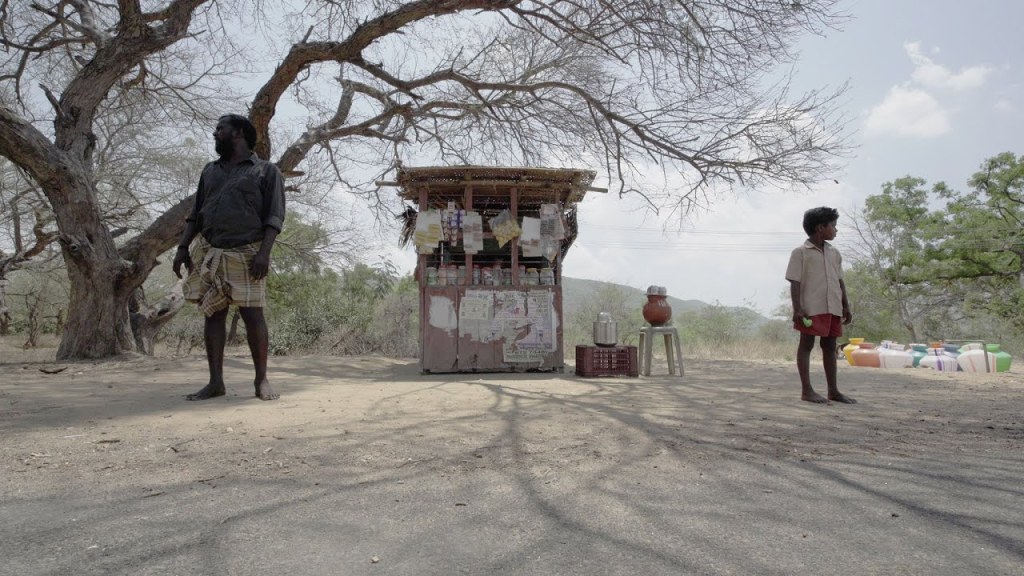
Koozhangal is as much about the land as it is about its people. Through its desolate landscape and mute suffering, the film unravels how caste and class structures are internalized, and how climate change weighs heaviest on those at the margins. The long walk back home is the clearest illustration of this. When Velu tears the bus fare, and they are forced to walk, mobility is revealed as class-bound.
Those with resources travel; those without endure. The father and son traverse miles under an unforgiving sun, as their bodies absorb what infrastructure fails to provide. Koozhangal does not state this explicitly, but the endless foot journey across land that they do not appear to own or control hints at their dispossession, as land ownership has historically been determined by caste.
The film’s geography is symptomatic of environmental injustice, where drought compounds political exclusion. The cracked land suggests agrarian decline; there are no thriving farms, no abundance, or signs of prosperity. The absence of cultivation mirrors the absence of opportunity. The ecological crisis amplifies patriarchal violence rather than mitigating it. Heat and exhaustion intensify Ganapathy’s volatility; irritation surfaces quickly, tenderness evaporates.
Situated within the specific socio-political landscape of interior Tamil Nadu, the land itself begins to speak a more structured history. The aridity we see is not simply climatic but historical. Southern Tamil Nadu has long been marked by agrarian distress, groundwater depletion, caste-segregated village geographies, and precarious wage labour. Scholars such as Anand Panidan have written about the entanglement of caste hierarchy, agrarian decline, and masculine anxiety in rural Tamil landscapes.
Climate change is not abstract; it presses onto skin, into breath, into temperament. The harsh terrain—dry riverbeds, thorny bushes, cracked earth—is both metaphor and mirror. It reflects the parched souls of its characters and bears witness to their pain. There is no water here, literal or emotional. Only aridity. In this way, the journey back home literalizes how environmental precarity, caste hierarchy, and masculine anxiety converge into personal violence.
What makes Koozhangal radical is its refusal to perform radicalism. Vinothraj, whose own mother walked miles to escape domestic violence, renders these moments not with melodrama but restraint. Trauma, in Koozhangal, is not cinematic; it is ordinary.
There is no savior. No retribution. No court, police, or resolution. Just the silent resistance of a woman who chooses not to return. The mother’s presence is spectral. Her defiance, her non-negotiation, is perhaps the film’s most radical act—an assertion of autonomy without theatrics. Velu also exhibits defiance. On their journey back, the boy tears up the crumpled money his father had been saving for the bus fare. He does it deliberately, finger by finger, so they are forced to walk on foot, back into the land, into the slow journey. It’s the boy’s own small revolt: refusing to return without their mother.
His act is a tantrum, strategy, and tenderness rolled into one. A rare moment of agency. By denying his father the means to return hastily to assert authority, the boy reshapes his reality. This is resistance not through voice but through refusal, just like his mother’s.
Endurance Without Redemption
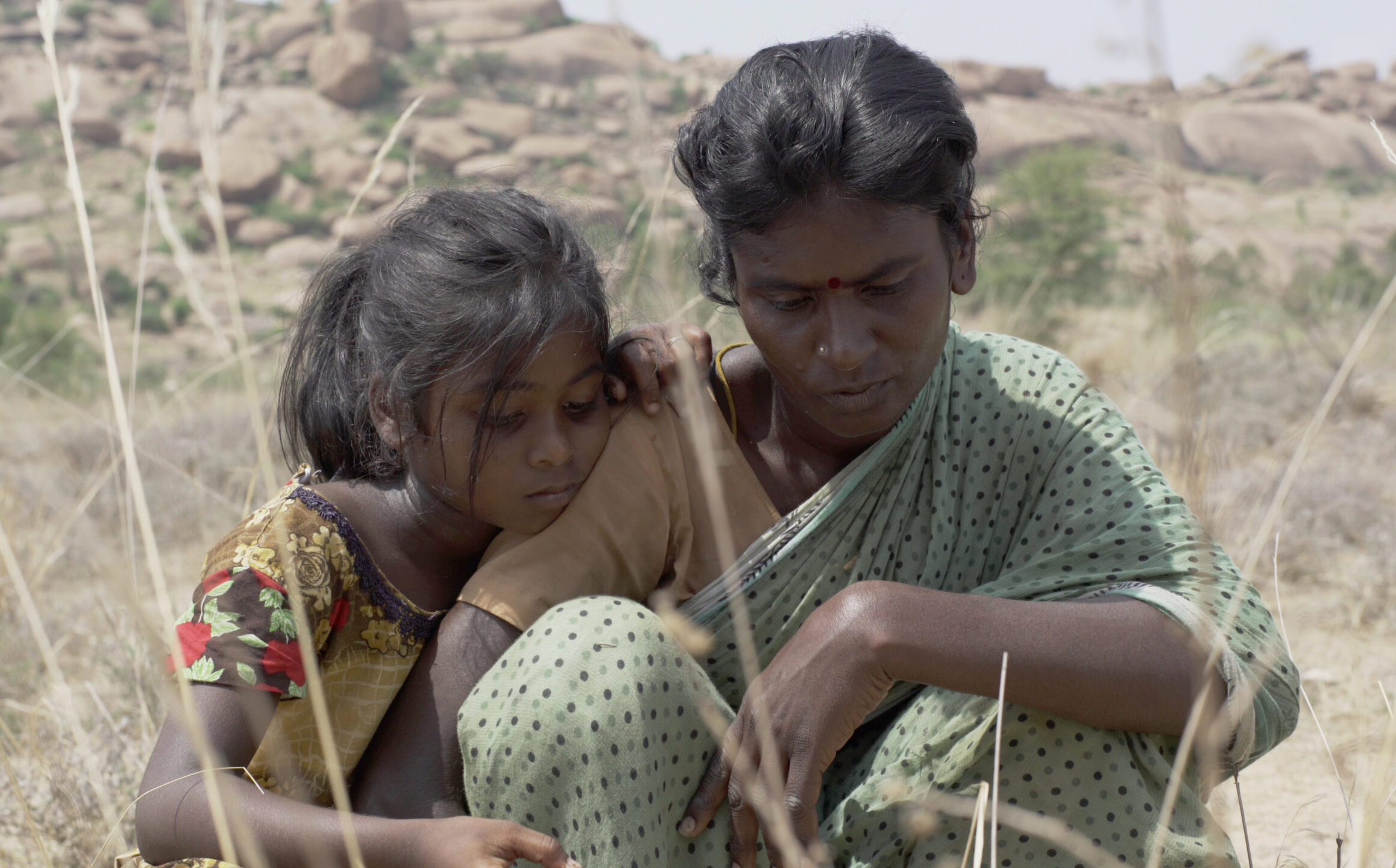
As the journey concludes, Ganapathy returns home to find his toddler daughter asleep and his wife still absent. He slumps beside the wall, exhausted, not enlightened.
Ganapathy turns to his mother, who is sitting on the porch, and asks, “Where is she?” She replies that the woman has gone to fetch water. Her lie hangs heavy, a shield against his anger, a temporary postponement of confrontation. Ganapathy, still fuming, instructs her to go and bring the wife back.
Meanwhile, Velu, quietly walking in, cradles a puppy in his arms—a rare, vulnerable gesture in a world that has denied him tenderness. The scene swells with the contradictions of their emotional landscape. Velu’s choice to bring the puppy home, after witnessing violence and abandonment, becomes an act of care in a household void of it.
In that final moment, there is no apology, no healing, only gestures—a command, a lie, and a puppy—each one weighted with survival, grief, and an unspoken yearning for love in a loveless terrain. There are no grand conclusions here, only the weight of what was witnessed.
Vinothraj’s lens is never exploitative. It does not aestheticize poverty. It honours the reality of rural life as a political condition. The lack of water, of school, of affection, of repair, these are the atmospheric details. They are critiques of a social order in which survival is privatized, and care is withdrawn, where the state recedes, leaving the family to absorb the shock of economic and ecological precarity. Koozhangal conveys how deprivation is redistributed downward: how drought becomes domestic tension, unemployment translates into fragile masculinity, and systematic neglect turns into intimate violence.
In its austerity, the film resonates with other worlds of Tamil realist cinema, such as Mari Selvaraj’s Pariyerum Perumal (2018) or Vetrimaaran’s Asuran (2019), yet it departs from them in crucial ways. Where those films explicitly and often articulate caste violence through confrontation, Vinothraj chooses opacity. Caste is felt but not named; hierarchy is ambient rather than declared. By rendering drought as an atmospheric rather than a policy failure, the state remains largely off-screen. Scarcity feels elemental, almost inevitable.
The absence of politics of irrigation, land reform, and governance critique intensifies universality, but it also risks blurring accountability because it’s implied rather than interrogated. When suffering is ambient, who is responsible for it?
Similarly, when Ganapthy is framed structurally rather than purely monstrous, his interior contradictions are only partially explored. Koozhangal powerfully captures the transmission of violence, yet it leaves open whether masculinity here is entirely trapped within repetition or capable of rupture.
While the film’s aesthetic opacity is part of its strength—it refuses didacticism—it also softens the historical specificity of rural Tamil Nadu’s stratified social order. Through minimalism over confrontation, Vinothraj crafts a film of immense moral weight. But minimalism is itself a political choice. What it leaves unsaid becomes as important as what it shows.
Ultimately, Koozhangal is a parable not of hope, but of endurance. It is about the pebbles we carry, some thrown in anger, some picked up in pain, and some simply never put down. Its quietness is its power. But its silence also lingers as a question: if violence is ordinary, how do we prevent it from becoming naturalized?

Koozhangal: A Meditation on Masculinity, Endurance, and Caste

Koozhangal is a parable not of hope, but of endurance. It is about the pebbles we carry, some thrown in anger, some picked up in pain, and some simply never put down.
P.S. Vinothraj’s Koozhangal (Pebbles, 2021) follows an abusive, alcoholic father, Ganapathy (Karuththadaiyaan), and his quiet, observant son, Velu (Chellapandi), as they journey—mostly on foot—to retrieve the boy’s mother. While she has fled her husband’s abuse and sought refuge in her parents’ house, Koozhangal is not a rescue narrative. It is a meditation on masculinity, endurance, and the slow, crushing weight of caste, class, and heat—all of which become indistinguishable in this desolate landscape.
Set in the arid terrain of interior Tamil Nadu, the film also refuses narrative acceleration, withholding catharsis. Scenes unfold in real time without compression—the walking, waiting, and enduring. It mirrors the stagnation of lives caught in poverty and patriarchy, where movement does not necessarily mean progress. Koozhangal thus shifts from a story about a family to an anatomy of inherited structures, revealing violence sustained through something standard rather than spectacular.
There is no background score and no cinematic embellishment. It is life stripped to its rawest, and perhaps for that very reason, it is among the most politically and psychologically piercing Indian films of our time. By not indulging in non-diegetic music and dramatic framing, Vinothraj denies the audience emotional cues that might soften or romanticize suffering.
That might also be why the film has been ignored by mainstream Indian cinema, despite winning the Tiger Award at the Rotterdam Film Festival and being India’s official Oscar entry. This fate is not uncommon for politically unsettling films made outside of the urban elite’s gaze.
How Violence is Inherited and Conditioned
At first glance, Ganapathy, the father, may appear a caricature of rural patriarchy: angry, loud, unshaven, barefoot, and drunk—almost stereotypically villainous. But Vinothraj does not pass moral judgment on him; he only exposes this character to us.
In a crucial early scene, Velu is pulled out of school by his father. No words are exchanged, just a cold, commanding stare. The child simply follows him, unquestioningly. This moment reveals the suffocating inheritance of obedience. As they walk, Ganapathy turns and, seething with anger, demands, “Do you love your mother or me more?”
The boy remains quiet: staring, absorbing, already understanding that any answer is a trap. This scene lays bare the emotional manipulation used to sustain control, and the impossible choices children in abusive households are forced to navigate. The family is also extremely poor; even within rural Tamil Nadu’s caste matrix, they occupy a lower rung.
Ganapathy’s control over his household thus becomes a compensatory performance of power and his only remaining form of privilege, and a tragic irony, where those at the society’s fringes replicate systems of violence within their own shrinking domestic spheres.
Kalaiyarasan and Vijayabaskar in The Dravidian Model (2021) describe Tamil Nadu’s developmental paradox: relatively advanced welfare indicators alongside deep informalisation and rural distress. According to the 2011 Census, over 30% of households in Tamil Nadu’s interior districts lack direct access to clean drinking water. Additionally, a 2021 National Family Health Survey (NFHS-5) reveals that nearly 1 in 3 women in rural India have experienced domestic violence.
Koozhangal becomes a cinematic embodiment of these statistics. When Ganapathy loses access to his wife, his grip on his only available form of agency slips. What ensues is a long walk not of reconciliation but reclamation of control and patriarchal entitlement. The Child:
Witnessing and Absorbing Violence
The emotional anchor of Koozhangal is Velu. He barely speaks. He only watches, and in that quiet, a storm brews—not of rage but of comprehension. His father walks, and so he follows. In many ways, this is not just the child’s physical journey but also his initiation into feral masculinity, into the rituals of subjugation and silence.
Ganapathy beats everyone: Velu, his wife’s family members, and even the passengers on the bus they are travelling on. Ganapathy, frustrated and intoxicated, lights up a cigarette, which annoys the man sitting behind him. The incident spirals into a physical altercation. It forces a woman carrying her child to get off at the next stop—her toddler starts crying uncontrollably amid the sudden outburst of shouting and scuffling amongst the men.
These strained bodies—packed, crammed, collapsing—mirror the claustrophobic tension of ambient and omnipresent patriarchy. It isn’t a tableau drama; it’s a public breakdown. The boy’s eyes widen with fear, the mother shielding her baby, all play out in tight quarters without music, melodrama, or mediation, exposing how patriarchy breeds public violence.
Velu is fearful and anxious, and yet tethered to his abusive parent. He does not cry. But he remembers, every kick of dust and every word of contempt.
In one evocative scene towards the end of Koozhangal, Velu discovers a small pebble, the film’s namesake. He gently cleans it and places it in his mouth, in a gesture that transforms the object into a vessel of comfort, memory, and emotional absorption. When he reaches home, he carefully places it among a cluster of other pebbles, each carrying a fragment of unspoken hurt.
The titular pebbles are a potent metaphor for his emotional state: hardened, shapeless, carried. Is this grief? Is it longing? Is it trauma being stored quietly and forever? Pebbles are shaped by pressure, erosion, and friction—by forces acting upon them over time. Velu, too, is being shaped. Koozhangal subtly suggests that masculinity, like stone, is formed through repeated abrasion.
However, unlike his father, who throws objects in anger, Velu gathers them tenderly and carefully. He does not weaponize the stone; he preserves it.
This distinction is important. The pebble may represent trauma, but how it is kept suggests the possibility of transformation. Ultimately, Vinothraj leaves it up to the viewers to decide what the pebbles signify: signs of protection, warning, or resilience—or how violence, when unaddressed, can crystallize across generations.
Landscapes of Resistance and Refusal
Koozhangal is as much about the land as it is about its people. Through its desolate landscape and mute suffering, the film unravels how caste and class structures are internalized, and how climate change weighs heaviest on those at the margins. The long walk back home is the clearest illustration of this. When Velu tears the bus fare, and they are forced to walk, mobility is revealed as class-bound.
Those with resources travel; those without endure. The father and son traverse miles under an unforgiving sun, as their bodies absorb what infrastructure fails to provide. Koozhangal does not state this explicitly, but the endless foot journey across land that they do not appear to own or control hints at their dispossession, as land ownership has historically been determined by caste.
The film’s geography is symptomatic of environmental injustice, where drought compounds political exclusion. The cracked land suggests agrarian decline; there are no thriving farms, no abundance, or signs of prosperity. The absence of cultivation mirrors the absence of opportunity. The ecological crisis amplifies patriarchal violence rather than mitigating it. Heat and exhaustion intensify Ganapathy’s volatility; irritation surfaces quickly, tenderness evaporates.
Situated within the specific socio-political landscape of interior Tamil Nadu, the land itself begins to speak a more structured history. The aridity we see is not simply climatic but historical. Southern Tamil Nadu has long been marked by agrarian distress, groundwater depletion, caste-segregated village geographies, and precarious wage labour. Scholars such as Anand Panidan have written about the entanglement of caste hierarchy, agrarian decline, and masculine anxiety in rural Tamil landscapes.
Climate change is not abstract; it presses onto skin, into breath, into temperament. The harsh terrain—dry riverbeds, thorny bushes, cracked earth—is both metaphor and mirror. It reflects the parched souls of its characters and bears witness to their pain. There is no water here, literal or emotional. Only aridity. In this way, the journey back home literalizes how environmental precarity, caste hierarchy, and masculine anxiety converge into personal violence.
What makes Koozhangal radical is its refusal to perform radicalism. Vinothraj, whose own mother walked miles to escape domestic violence, renders these moments not with melodrama but restraint. Trauma, in Koozhangal, is not cinematic; it is ordinary.
There is no savior. No retribution. No court, police, or resolution. Just the silent resistance of a woman who chooses not to return. The mother’s presence is spectral. Her defiance, her non-negotiation, is perhaps the film’s most radical act—an assertion of autonomy without theatrics. Velu also exhibits defiance. On their journey back, the boy tears up the crumpled money his father had been saving for the bus fare. He does it deliberately, finger by finger, so they are forced to walk on foot, back into the land, into the slow journey. It’s the boy’s own small revolt: refusing to return without their mother.
His act is a tantrum, strategy, and tenderness rolled into one. A rare moment of agency. By denying his father the means to return hastily to assert authority, the boy reshapes his reality. This is resistance not through voice but through refusal, just like his mother’s.
Endurance Without Redemption
As the journey concludes, Ganapathy returns home to find his toddler daughter asleep and his wife still absent. He slumps beside the wall, exhausted, not enlightened.
Ganapathy turns to his mother, who is sitting on the porch, and asks, “Where is she?” She replies that the woman has gone to fetch water. Her lie hangs heavy, a shield against his anger, a temporary postponement of confrontation. Ganapathy, still fuming, instructs her to go and bring the wife back.
Meanwhile, Velu, quietly walking in, cradles a puppy in his arms—a rare, vulnerable gesture in a world that has denied him tenderness. The scene swells with the contradictions of their emotional landscape. Velu’s choice to bring the puppy home, after witnessing violence and abandonment, becomes an act of care in a household void of it.
In that final moment, there is no apology, no healing, only gestures—a command, a lie, and a puppy—each one weighted with survival, grief, and an unspoken yearning for love in a loveless terrain. There are no grand conclusions here, only the weight of what was witnessed.
Vinothraj’s lens is never exploitative. It does not aestheticize poverty. It honours the reality of rural life as a political condition. The lack of water, of school, of affection, of repair, these are the atmospheric details. They are critiques of a social order in which survival is privatized, and care is withdrawn, where the state recedes, leaving the family to absorb the shock of economic and ecological precarity. Koozhangal conveys how deprivation is redistributed downward: how drought becomes domestic tension, unemployment translates into fragile masculinity, and systematic neglect turns into intimate violence.
In its austerity, the film resonates with other worlds of Tamil realist cinema, such as Mari Selvaraj’s Pariyerum Perumal (2018) or Vetrimaaran’s Asuran (2019), yet it departs from them in crucial ways. Where those films explicitly and often articulate caste violence through confrontation, Vinothraj chooses opacity. Caste is felt but not named; hierarchy is ambient rather than declared. By rendering drought as an atmospheric rather than a policy failure, the state remains largely off-screen. Scarcity feels elemental, almost inevitable.
The absence of politics of irrigation, land reform, and governance critique intensifies universality, but it also risks blurring accountability because it’s implied rather than interrogated. When suffering is ambient, who is responsible for it?
Similarly, when Ganapthy is framed structurally rather than purely monstrous, his interior contradictions are only partially explored. Koozhangal powerfully captures the transmission of violence, yet it leaves open whether masculinity here is entirely trapped within repetition or capable of rupture.
While the film’s aesthetic opacity is part of its strength—it refuses didacticism—it also softens the historical specificity of rural Tamil Nadu’s stratified social order. Through minimalism over confrontation, Vinothraj crafts a film of immense moral weight. But minimalism is itself a political choice. What it leaves unsaid becomes as important as what it shows.
Ultimately, Koozhangal is a parable not of hope, but of endurance. It is about the pebbles we carry, some thrown in anger, some picked up in pain, and some simply never put down. Its quietness is its power. But its silence also lingers as a question: if violence is ordinary, how do we prevent it from becoming naturalized?