



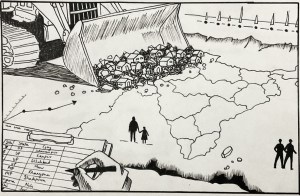

Editor’s Note: This piece is written by Afreen Fatima, the researcher and writer behind The Demolitions Project, whose own home in Allahabad, in the North Indian state of Uttar Pradesh, was razed in retaliation for dissent. This is the second of her three-part series of essays on how she shaped The Demolitions Project while navigating the personal and the political. Read the first essay here.
“Admin demolishes ‘illegal’ buildings in Khargone after Ram Navami procession clash” — The Indian Express
“House of murder accused’s father razed in Uttarakhand” — Times of India
These are the kinds of headlines that I came across as I began work on The Demolitions Project. Scrolling across television screens and news portals, I read reports announcing destruction with a cold finality. I remember standing amid broken walls and scattered belongings, an elderly man corrected me quietly when I asked, “Yahi aapka ghar tha? (Was this was your home)”. He gestured to the broken walls and said, “yahi mera ghar hai” (“this is my home”). The distance between the headlines and the utterance by the man who had lost his home contains the story of what this essay is trying to name.
In the process of this project, I became acutely aware that language itself can be a form of violence. What do you call the act of a home being destroyed as punishment? When such acts are carried out by state and urban authorities despite several court orders pointing out the sheer unjustness or illegality of them? The State and the mainstream media often deploy a sanitized, bureaucratic lexicon for these acts of destruction: “illegal construction,” “anti-encroachment drive,” “occupying government land”. These terms sound bloodless and technical, as if what was torn down was not a home but a mere structure, void of life and history, an inconvenience in the path of development or regularization. In my own case, when my home was marked for demolition in the aftermath of a protest, the official notice stated that our home was an “illegal construction” and had to be removed to restore law and order. It felt as if we had been reduced to an unnamed illegality and that the language of the state erases the human even before the bulldozer arrives.
As a writer-researcher navigating this minefield of terminology, I often struggled with how to name the violence without either sanitizing it or tipping into what might be seen as hyperbole. In the project, I settled on “extrajudicial, punitive demolitions” as a descriptor. It’s clinical, but each word is doing important work: extrajudicial (outside the law), punitive (intended as punishment), and demolitions (literal destruction of property). Still, in narrative sections and personal profiles, I found myself reaching for metaphors and more emotional language, because the cold terms didn’t capture the full truth. How do I describe a scene where a home is crushed along with everything a family had known as its own, and not make it sound like just another policy issue? How do I avoid turning it into a spectacle of suffering for consumption while also not reducing it to sterile facts and figures? It was a continuous tightrope walk. I have also realized that lucid analysis and personal grief must coexist in this storytelling. Pure analysis might miss the soul of the matter; pure grief might miss the structure behind it.
The Demolitions Project tried to strike that balance. I would write that this is about “illegal structures” on paper, but on the ground, it’s about punishment. I pointed out the semantic game: how “encroachment” became a catch-all justification, how “bulldozer justice” became a rallying cry. I contrasted it with the voices of those affected. Our very first newsletter quoted a displaced man asking: “Setting aside everything, how can you demolish someone’s home?” That question, posed in plain language, cuts through all the jargon.
Media Representation
To speak of demolitions only as events is to miss how thoroughly they are prepared in advance, through words, headlines, notices, and televised scripts that make destruction appear lawful, deserved, even necessary. Long before the bulldozer arrives, language has already done its work.
A close linguistic reading of mainstream headlines covering punitive demolitions reveals a pattern through which guilt is presupposed, and state violence is normalized. Here, mainstream headlines refer to those of legacy newspapers, mostly English national dailies that have some of the highest circulations in the country. Even online news readers access these sources widely, according to a study by the Reuters Institute for the Study of Journalism.
A Hindustan Times headline reads: “Prayagraj authority set to demolish Friday violence conspirator’s illegal house.” The noun phrase “violence conspirator” is particularly instructive. The absence of epistemic markers such as “alleged” or “accused” collapses an accusation into a fact, foreclosing the possibility of uncertainty or contestation. The label functions as a nominalized identity rather than a temporary legal status, fixing the individual within a frame of culpability even before any judicial process has taken place. The modifier “illegal”, attached to “house”, further naturalizes the legitimacy of demolition. It presents illegality as an established property of the home rather than a claim that is subject to legal scrutiny. The verb phrase “set to demolish” situates the action as procedural and anticipatory, framing this mode of state violence on its subjects as an administrative inevitability rather than a coercive act requiring justification.
A similar discursive economy operates in The Indian Express headline: “Admin demolishes ‘illegal’ buildings in Khargone after Ram Navami procession clash.” Here, the agent “Admin” functions as a bureaucratic abstraction, depersonalizing state power and muting accountability. While quotation marks around “illegal” might appear to signal journalistic distance, they ultimately perform a weak form of hedging that does not disrupt the headline’s causal logic. The temporal sequencing implied by “after Ram Navami procession clash” constructs demolition as a response to violence, even though no legal determination linking the demolished properties to the clash is provided. Linguistically, this “after X, then Y” structure does a powerful ideological work; it converts correlation into moral causation, making demolition appear not only reactive but necessary. The violence of destruction is thus narrativized as a consequence rather than a punishment.
The Times of India headline—“Bulldozers out again: Houses of violence accused razed in UP’s Saharanpur”—pushes this normalization further through metaphor and repetition. The phrase “bulldozers out again” frames demolition as routine, almost cyclical, invoking familiarity rather than exception. The agentive force is displaced onto the machine itself, bulldozers, while the state recedes entirely from view. The affected subjects are reduced to the relational noun phrase “violence accused,” a label that, while formally acknowledging accusation, still defines individuals primarily through alleged criminality. The verb “razed” carries connotations of complete destruction, yet in the absence of an explicit human agent, the act appears as an impersonal outcome rather than a deliberate policy choice. Together, these linguistic choices aestheticize demolition as both spectacle and solution.
The Dainik Jagran headline – “सहारनपुर में बवालियों पर कड़ी कार्रवाई, 64 को भेजा जेल, दो के घर पर चला बुलडोजर” – follows a comparable logic of presumption and normalization. The noun “बवालियों” (rioters/troublemakers) functions not as a provisional legal description but as a fixed identity. There are no epistemic markers such as “आरोपी” (accused) or “कथित” (alleged) that would signal uncertainty or an ongoing legal process. The individuals are constituted as rioters before any adjudication is referenced, collapsing accusation into fact. The phrase “कड़ी कार्रवाई” (strict action) frames the state’s response as firm, justified, and proportionate. “Action” appears as an administrative necessity rather than a coercive intervention requiring scrutiny. The subsequent clause, “दो के घर पर चला बुलडोजर” (a bulldozer ran on the houses of two), shifts agency onto the machine itself. The bulldozer “runs”; the state recedes. This grammatical construction obscures decision-making authority and renders demolition as procedural enforcement rather than discretionary punishment.
The Live Hindustan headline – “यूपी के इस जिले में मदरसे पर चला योगी सरकार का बुलडोजर, कई अवैध दुकानों को भी किया ध्वस्त” (“Yogi government’s bulldozer ran on a madrasa in this district of UP; many illegal shops were also demolished”) – illustrates how routine reporting frames state violence as administrative enforcement rather than coercive intervention. The agent is foregrounded as “योगी सरकार का बुलडोजर” (the Yogi government’s bulldozer), but the verb construction “चला” (ran) deflects agency onto the machine itself. It personalizes the action via the chief minister’s brand but deflects human agency to the machine, mirroring a common pattern where the machine becomes the protagonist, and decision-making authority recedes into the background. The targets – a मदरसा (madrasa) and अवैध दुकानों (illegal shops) – are presented with categorical labels of illegality without qualifiers. Neither ‘alleged’ nor any reference to specific legal adjudication appears; the structures are simply described as unlawful. By packaging the demolition of a religious education institution and commercial spaces within the same clause of administrative action, the headline syntactically collapses disparate phenomena into a single enforcement narrative.
Most mainstream editorial codes, including those of Reuters, the Press Council of India, and international ethical frameworks, require the use of qualifiers such as “alleged” or “accused” when guilt has not been established by a court, precisely to uphold the presumption of innocence. As illustrated above, this is often overlooked in Indian reporting of punitive demolitions.
Attribution standards are similarly compromised: assertions of illegality are rarely sourced to a specific legal order, statute, or judicial finding, but are instead presented as self-evident facts. Even when quotation marks are employed, as in “‘illegal’ buildings,” they function as weak stylistic gestures rather than substantive distancing, since no competing description or dispute is acknowledged. These deviations represent a patterned relaxation of journalistic safeguards at precisely the moment when heightened scrutiny is ethically required.
The mainstream media operates as both amplifier and co-producer of this violence, scripting demolitions within narratives of law enforcement, communal control, and state decisiveness. Rather than interrogating legality or human cost, media coverage often presents demolitions as justified acts of governance, while shifting scrutiny away from the state. The demolished are cast as suspects, rioters, or encroachers, their guilt assumed and their dispossession rendered acceptable in the public imagination.
This was sharply visible during the 2022 Jahangirpuri demolitions. In the immediate aftermath of a communal clash in North Delhi, bulldozers arrived to raze shops and homes, disproportionately affecting Muslim residents. Headlines such as “Bulldozer Action on Rioters” and “Illegal Constructions Razed After Riots” dominated coverage on channels like Zee News and Republic TV, even though no judicial process had sanctioned the demolitions. The Delhi Municipal Corporation’s claim of acting against “illegal structures” was echoed uncritically, with little inquiry into the selective targeting of properties or the suspicious timing that coincided with communal tensions. The televised spectacle of bulldozers at work, accompanied by triumphalist commentary, transformed state violence into a scene of public order being restored, erasing both its illegality and its human impact.
A similar media script unfolded in Khargone, Madhya Pradesh, following communal violence during Ram Navami in April 2022. Demolitions targeted Muslim-owned homes and businesses under the pretext of a crackdown on rioters; meanwhile, most of the victims of the said violence were also Muslims. Media narratives closely parroted the state government’s line, labeling it a “bulldozer crackdown on rioters”, despite the absence of investigations, charges, or court orders preceding the demolitions. Coverage focused on images of bulldozers and rubble, sidelining the testimonies of those rendered homeless. The media’s alignment with state narratives not only legitimized these acts of collective punishment but also presented them as necessary measures of governance.
Lexicon of Harm and Repair
In my conversations with those affected by demolitions, I also observed the evolution of language under duress. Initially, many victims would carefully use “they” for the authorities, speaking in a subdued tone. But as trust developed, some would shift to more charged words. “Yeh sarkar zulm kar rahi hai” – “This government is committing oppression,” one man finally blurted out after a long conversation, in which he had earlier only said “officials” and the “process”. It seemed he finally permitted himself to articulate what it was: zulm, oppression, injustice.
‘Zulm’, an Urdu word, carries weight in the Muslim culture and is often used in historical or religious contexts to denote great cruelty. I heard others use words like “na-insafi” (injustice), “atyachar” (atrocity), and “sazaa” (punishment).
On the flip side, officials I occasionally spoke to used chillingly detached language. One officer, an assistant to a district magistrate in Uttar Pradesh, said to me, “We only removed unauthorized structures. They were illegal occupants.” I countered, “They were families; where are they supposed to go?” He repeated, “Encroachment is encroachment. It doesn’t matter who it is.” That refusal to acknowledge the human face is emblematic of how language is wielded by those in power and those who shield power.
In writing these essays, I have had to confront my own vocabulary, too. These are autoethnographic in nature, so I allow myself to say “my home was demolished”, plainly. But when I slip into analysis, I cite numbers and talk about “disproportionate impact on marginalized populations”. It’s almost like I inhabit two linguistic worlds, one of cold and critical analysis and one of personal lament. I do not want to reduce our experiences to statistics or case studies alone, because that would be another erasure.
After a demolition, family members often refer to their house in the past tense, before much time has passed; this includes me. People would say: “Woh hamara ghar tha (That was our house)”. The use of “tha/thi” (referring to the past tense, was) guts me every time I catch myself or someone else using this unconsciously. A home goes from present to past in a matter of hours. The elderly man who assertively said, “Yahi mera ghar hai (This is my home)”, refused to speak of it in the past tense. He was still living on the site, amid broken walls, under a makeshift tin shed. For him, using language to claim the present ownership of his broken home was a form of resistance. It implied to me that the house may be broken, but it’s still our home; we haven’t given up on it. From that man, I learned something about naming as well, the power to name your reality on your own terms. The state named it “illegal”; he insisted on calling it “mera ghar(my house).”
I choose to highlight the resilience lest the narrative be only about victimhood. In sharing these stories, I strive to ensure that the victims are not remembered by the state’s false names for them but by the truth of who they are: families, citizens, human beings who did not deserve what happened to them. What follows, then, is an attempt to map a lexicon of harm and repair.
On one side of this lexicon sit the words that the state and media use to make violence legible and permissible: illegal, encroacher, rioter, mastermind, anti-social element, bulldozer justice, etc. These terms circulate with an air of administrative neutrality, stripping homes of history and people of personhood, until destruction appears procedural rather than punitive. The lexicon of harm is procedural, familiar, and repetitive.
Alongside, and often in opposition to this vocabulary, is another set of words, spoken quietly, sometimes insistently, by those who are made its targets: mera ghar, zulm, sazaa, na-insaafi, aam aadmi, etc. This is a language that does not seek legitimacy from law or spectacle but insists on moral clarity, on lived meaning. The lexicon of repair does not undo the violence but refuses its moral grammar. It names injustice where the state and media name procedure. Reading demolitions through these competing vocabularies allows us to see how violence is not only enacted through machines and notices but also through words themselves, through what the words erase, and what they attempt, however precariously, to repair.

In news reports and TV scrolls, I repeatedly saw phrases like “riot accused’s house bulldozed” or “home of mastermind demolished.” By framing it this way, the person is essentially defined by the state’s allegation alone – accused rioter, alleged illegal occupant, etc. Thus, the demolition is framed as a justified outcome of that label.
Meanwhile, the term “Bulldozer Justice” has even entered common usage, becoming intrinsic to India’s political vocabulary. Justice, a term that should connote fairness and due process, gets grotesquely paired with a machine of destruction. Meanwhile, the epithet “Bulldozer Baba” (Bulldozer Father) for the Uttar Pradesh Chief Minister and “Bulldozer Mama” (Bulldozer Uncle) for the former Madhya Pradesh Chief Minister circulate widely. In rally after rally, they chant these nicknames, celebrating the idea of summary punishment via demolition. The normalization of those words, bulldozer and justice together, signals how deeply the idea of state reprisal has seeped into popular consciousness, and the media is complicit. The normalization of phrases like “Bulldozer Justice” and their celebratory circulation through political nicknames coincides with a systematic erosion of basic reporting norms.

One of the most revealing asymmetries in demolition coverage lies in what English-language headlines are willing to name. “Bulldozer Justice” circulates freely across television tickers and front pages; its moral verdict is embedded in the noun itself. Justice appears unmarked, unquestioned, and available for immediate deployment. Yet the possibility that such demolitions might constitute “zulm” injustice is seldom entertained within the same linguistic register. The word does not travel upward into deadline grammar. It remains confined to the speech of those who have lost their homes, as if moral injury is admissible only as emotion, not as analysis.
Similarly, “sazaa” (punishment) is spoken by families who experience demolition as retribution. They describe the destruction of their homes as a sazaa imposed without conviction, but reportage hesitates to adopt even the neutral term “punitive” unless it is attributed to critics or victims. Instead, demolition is framed as “action”, “drive”, “crackdown”, or most strikingly, “justice”. The moral vocabulary of the state moves easily into journalistic narration; meanwhile, the moral vocabulary of those subjected to state power is treated as subjective excess. This linguistic filtering creates a subtle hierarchy in which “bulldozer justice” is considered objective, whereas “zulm” is viewed as emotional. The question, then, is not whether journalism should simply translate zulm into headlines. It is why the possibility of injustice is linguistically foreclosed while justice is so readily affirmed.
If any demolition occurs before adjudication, and if it follows accusation, then the category of punishment is analytically relevant. To name “justice” without interrogating its conditions is to perform judgment without scrutiny. The refusal to even consider the grammar of “zulm” reveals how deeply the state’s framing has sedimented into reporting style guides. In that asymmetry, in what can and cannot be said, lies the normalization of demolition and destruction.
Crime reporting demands adherence to the presumption of innocence; yet headlines routinely dispense with qualifiers such as “alleged” and present accusation as fact. Ethical attribution requires that claims of illegality be clearly sourced—to a court order, statute, or legal proceeding—rather than absorbed uncritically from state assertion. The separation between state narrative and verified fact is a foundational journalistic responsibility, one that collapses when demolitions are framed as acts of justice rather than as coercive state actions requiring scrutiny. To report a demolition as “justice” is to perform judgment without process; to label a home “illegal” without checking the legality is to naturalize punishment. These are not stylistic lapses but substantive failures. If journalism is to function as a democratic institution rather than an echo of state power, it must insist on precision in naming, restraint in moral framing, and accountability in attributing claims, especially when lives and homes are being destroyed.
On the other hand, when the affected families described themselves, there was almost a defensive politeness in their self-description, a need to assert their respectability and ordinariness in the face of monstrous accusations. One middle-aged woman, whose two-room house was flattened because her son was accused of a crime, kept telling me, “We are respectable people. Hamari koi galti nahi (We didn’t do anything wrong)”. She sent me images of government papers, identity cards, property tax receipts, and even a character certificate her son got from college. “We had papers,” she repeated more than once, as if assembling proof of their legitimacy as citizens and good folks. I heard this across many conversations: “We weren’t even there at the protest.” “We pay our taxes on time.” “We had all our documents, we’re not encroachers.” “We were just having lunch,” “We were getting back from the mosque,” “My children were doing homework.” It’s heartbreaking because families feel compelled to prove their innocence and worthiness of having a home, a basic human entitlement. We know that in the public discourse, someone likely called them “criminals” or “rioters.” So, they are compelled to counter that narrative with “we are decent, law-abiding people.”
There is violence in naming someone a criminal without a trial and then punishing them materially. In one case from Uttar Pradesh, rumors tied a man to a notorious gangster, and he became known as the gangster’s “right hand” in whisper networks. He told me angrily, “The media said that I was close to him, how do they come up with these things?” He had never been charged with a crime, but by repeatedly associating him with a gangster, the local news had effectively pre-condemned him. So, when his daughter-in-law’s house was demolished, many assumed it must be because he was indeed guilty of something. Media versions became the unofficial verdict, despite a senior police official later admitting they found no connection between him and the gangster. The bulldozer had already done its work by then.
Language creates identities of deservingness or undeservingness. When officials say “these people are encroachers or stone-pelters,” it strips the victims of the moral weight of sympathy; they become a faceless issue, not families. When the media says “rioters’ homes were demolished,” it carries an undertone that they brought it upon themselves. Note, they don’t say “alleged rioters” in headlines; presumption of innocence is a casualty in this phrasing. In contrast, the families always highlight their normalcy. These are attempts to remind the world that we are human beings, living ordinary lives, until this extraordinary injustice befell us. One man from Nuh, whose small shop was torn down, said to me, “Hum koi deshdrohi nahin, dukandaar hain” (“We’re not traitors to the nation, we are shopkeepers”). The fact that he even had to say he’s not a traitor reveals the heavy weight of suspicion placed on his community by default.
The violence of naming also extends to what these events are called in public discourse. Are they demolitions or evictions or collective punishment by bulldozer? Each term frames the incident differently. Early on, many newspapers simply called them “anti-encroachment drives,” borrowing the government’s terminology. This felt deeply misleading since the timing and targets clearly indicated punishment, not routine urban planning. The Jahangirpuri demolition in April 2022 was widely reported in precisely these terms, an “anti-encraochment drive” carried out by the municipal corporation, even as the bulldozers arrived immediately after communal violence and before any individualized judicial determination, demonstrating how readily media language mirrored the state’s framing.
The Demolitions Project consciously used the term “punitive demolitions” to force recognition of intent, for readers to realize this wasn’t neutral governance. Over time, I noticed some independent media adopting our phrasing, while government officials began bristling at it, preferring their sanitized lexicon. Language became a small but crucial battleground.
Impact of Media and Manufacturing of Public Consent
The demolition of my own home in June 2022, despite widespread legal criticism by rights activists and even by a former High Court Judge, much of the mainstream media accepted the government’s framing of the action as targeting an “accused rioter’s and mastermind’s illegal property.” Prime-time debates fixated on the alleged culpability of my family rather than questioning the legality or ethics of the demolition itself. The spectacle of a bulldozer in motion displaced the reality of a family’s home being erased. The human cost, the dispossession, trauma, loss, remained marginal in media coverage, subsumed by the narrative of state authority asserting control.
What emerges from these instances is a discursive environment where punitive demolitions are normalized, even celebrated. The media manufactures this consent through strategic framing, selective amplification, and emotive storytelling that privileges the spectacle over substance. This narrative production feeds a political culture in which visible state violence is valorized, constitutional norms are undermined, and democratic accountability is eroded. Acts that should provoke outrage become spectacles of approval, a shift that fundamentally alters public morality and entrenches a culture of impunity.
What I have tried to show is that the struggle over demolitions is also a struggle over grammar: over who gets to name, with what authority, and at what cost. When journalism abandons the presumption of innocence in language, when it collapses allegation into fact and state assertion into truth, it participates in the suspension of due process itself. Precision in naming, restraint in framing, and accountability in attribution are not stylistic choices. They are ethical obligations, because words determine whose suffering is seen as tragic and whose is rendered acceptable.
Against this grammar of erasure stands a quieter, more fragile insistence: yahi mera ghar hai. This is not a legal argument or a media claim; it is an assertion of presence, dignity, and continuity in the face of forced disappearance. To say “this is my home” amid rubble is to refuse the state’s attempt to push life into the past tense. It is a reminder that homes are not abstractions and that citizenship is not conditional on media approval or administrative convenience.
Rigorous reporting and presumption of innocence cannot undo a demolition, but it can refuse its legitimacy, it can insist that what is being destroyed is not an “illegal structure” but a life-world. And sometimes, that refusal is where accountability must begin.

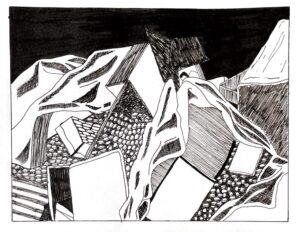
Indian Media’s Grammar of Demolition Creates Fertile Ground for Punitive Destruction
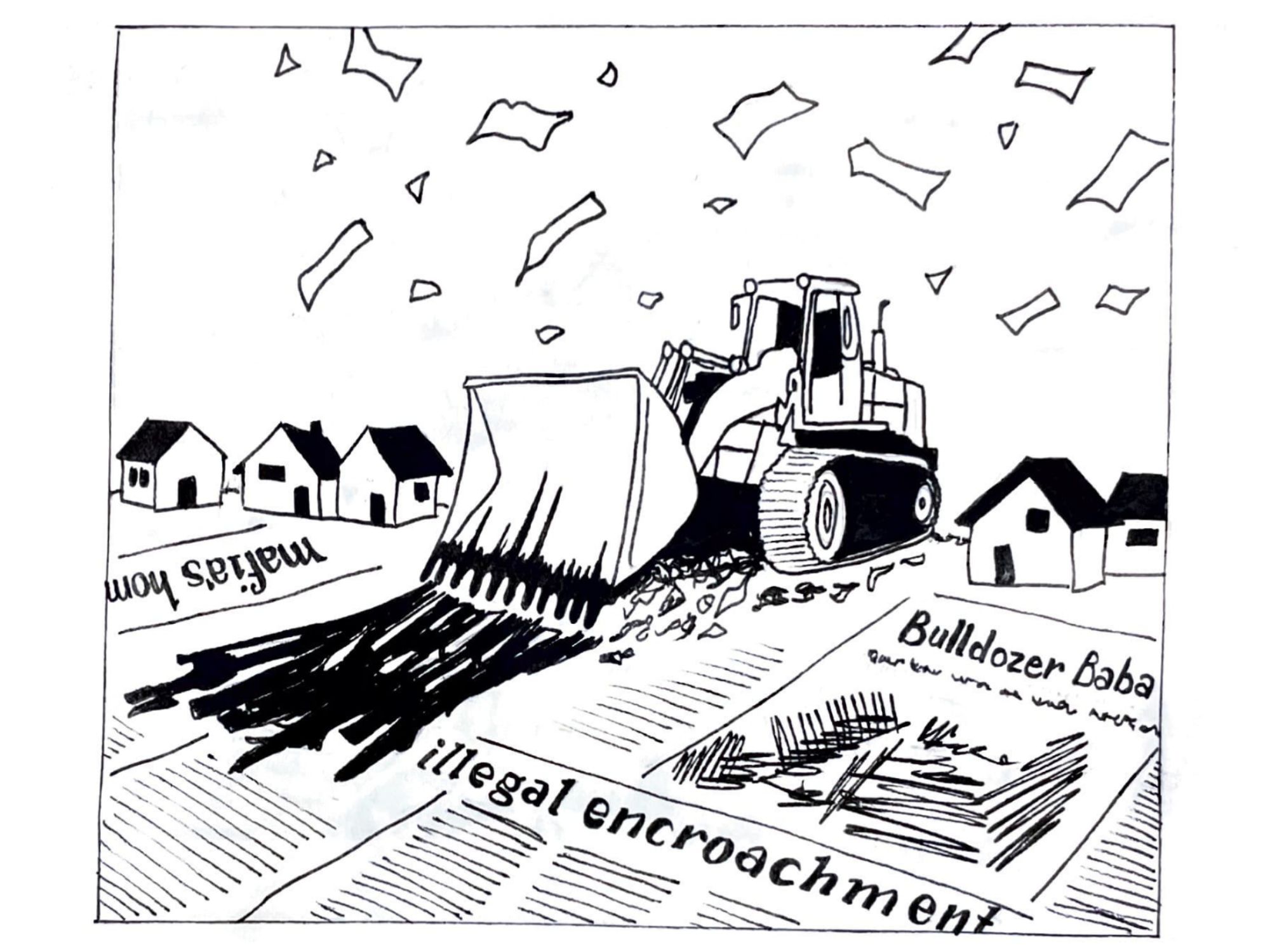
Illustration by Afreen Fatima for The Polis Project.
Editor’s Note: This piece is written by Afreen Fatima, the researcher and writer behind The Demolitions Project, whose own home in Allahabad, in the North Indian state of Uttar Pradesh, was razed in retaliation for dissent. This is the second of her three-part series of essays on how she shaped The Demolitions Project while navigating the personal and the political. Read the first essay here.
“Admin demolishes ‘illegal’ buildings in Khargone after Ram Navami procession clash” — The Indian Express
“House of murder accused’s father razed in Uttarakhand” — Times of India
These are the kinds of headlines that I came across as I began work on The Demolitions Project. Scrolling across television screens and news portals, I read reports announcing destruction with a cold finality. I remember standing amid broken walls and scattered belongings, an elderly man corrected me quietly when I asked, “Yahi aapka ghar tha? (Was this was your home)”. He gestured to the broken walls and said, “yahi mera ghar hai” (“this is my home”). The distance between the headlines and the utterance by the man who had lost his home contains the story of what this essay is trying to name.
In the process of this project, I became acutely aware that language itself can be a form of violence. What do you call the act of a home being destroyed as punishment? When such acts are carried out by state and urban authorities despite several court orders pointing out the sheer unjustness or illegality of them? The State and the mainstream media often deploy a sanitized, bureaucratic lexicon for these acts of destruction: “illegal construction,” “anti-encroachment drive,” “occupying government land”. These terms sound bloodless and technical, as if what was torn down was not a home but a mere structure, void of life and history, an inconvenience in the path of development or regularization. In my own case, when my home was marked for demolition in the aftermath of a protest, the official notice stated that our home was an “illegal construction” and had to be removed to restore law and order. It felt as if we had been reduced to an unnamed illegality and that the language of the state erases the human even before the bulldozer arrives.
As a writer-researcher navigating this minefield of terminology, I often struggled with how to name the violence without either sanitizing it or tipping into what might be seen as hyperbole. In the project, I settled on “extrajudicial, punitive demolitions” as a descriptor. It’s clinical, but each word is doing important work: extrajudicial (outside the law), punitive (intended as punishment), and demolitions (literal destruction of property). Still, in narrative sections and personal profiles, I found myself reaching for metaphors and more emotional language, because the cold terms didn’t capture the full truth. How do I describe a scene where a home is crushed along with everything a family had known as its own, and not make it sound like just another policy issue? How do I avoid turning it into a spectacle of suffering for consumption while also not reducing it to sterile facts and figures? It was a continuous tightrope walk. I have also realized that lucid analysis and personal grief must coexist in this storytelling. Pure analysis might miss the soul of the matter; pure grief might miss the structure behind it.
The Demolitions Project tried to strike that balance. I would write that this is about “illegal structures” on paper, but on the ground, it’s about punishment. I pointed out the semantic game: how “encroachment” became a catch-all justification, how “bulldozer justice” became a rallying cry. I contrasted it with the voices of those affected. Our very first newsletter quoted a displaced man asking: “Setting aside everything, how can you demolish someone’s home?” That question, posed in plain language, cuts through all the jargon.
Media Representation
To speak of demolitions only as events is to miss how thoroughly they are prepared in advance, through words, headlines, notices, and televised scripts that make destruction appear lawful, deserved, even necessary. Long before the bulldozer arrives, language has already done its work.
A close linguistic reading of mainstream headlines covering punitive demolitions reveals a pattern through which guilt is presupposed, and state violence is normalized. Here, mainstream headlines refer to those of legacy newspapers, mostly English national dailies that have some of the highest circulations in the country. Even online news readers access these sources widely, according to a study by the Reuters Institute for the Study of Journalism.
A Hindustan Times headline reads: “Prayagraj authority set to demolish Friday violence conspirator’s illegal house.” The noun phrase “violence conspirator” is particularly instructive. The absence of epistemic markers such as “alleged” or “accused” collapses an accusation into a fact, foreclosing the possibility of uncertainty or contestation. The label functions as a nominalized identity rather than a temporary legal status, fixing the individual within a frame of culpability even before any judicial process has taken place. The modifier “illegal”, attached to “house”, further naturalizes the legitimacy of demolition. It presents illegality as an established property of the home rather than a claim that is subject to legal scrutiny. The verb phrase “set to demolish” situates the action as procedural and anticipatory, framing this mode of state violence on its subjects as an administrative inevitability rather than a coercive act requiring justification.
A similar discursive economy operates in The Indian Express headline: “Admin demolishes ‘illegal’ buildings in Khargone after Ram Navami procession clash.” Here, the agent “Admin” functions as a bureaucratic abstraction, depersonalizing state power and muting accountability. While quotation marks around “illegal” might appear to signal journalistic distance, they ultimately perform a weak form of hedging that does not disrupt the headline’s causal logic. The temporal sequencing implied by “after Ram Navami procession clash” constructs demolition as a response to violence, even though no legal determination linking the demolished properties to the clash is provided. Linguistically, this “after X, then Y” structure does a powerful ideological work; it converts correlation into moral causation, making demolition appear not only reactive but necessary. The violence of destruction is thus narrativized as a consequence rather than a punishment.
The Times of India headline—“Bulldozers out again: Houses of violence accused razed in UP’s Saharanpur”—pushes this normalization further through metaphor and repetition. The phrase “bulldozers out again” frames demolition as routine, almost cyclical, invoking familiarity rather than exception. The agentive force is displaced onto the machine itself, bulldozers, while the state recedes entirely from view. The affected subjects are reduced to the relational noun phrase “violence accused,” a label that, while formally acknowledging accusation, still defines individuals primarily through alleged criminality. The verb “razed” carries connotations of complete destruction, yet in the absence of an explicit human agent, the act appears as an impersonal outcome rather than a deliberate policy choice. Together, these linguistic choices aestheticize demolition as both spectacle and solution.
The Dainik Jagran headline – “सहारनपुर में बवालियों पर कड़ी कार्रवाई, 64 को भेजा जेल, दो के घर पर चला बुलडोजर” – follows a comparable logic of presumption and normalization. The noun “बवालियों” (rioters/troublemakers) functions not as a provisional legal description but as a fixed identity. There are no epistemic markers such as “आरोपी” (accused) or “कथित” (alleged) that would signal uncertainty or an ongoing legal process. The individuals are constituted as rioters before any adjudication is referenced, collapsing accusation into fact. The phrase “कड़ी कार्रवाई” (strict action) frames the state’s response as firm, justified, and proportionate. “Action” appears as an administrative necessity rather than a coercive intervention requiring scrutiny. The subsequent clause, “दो के घर पर चला बुलडोजर” (a bulldozer ran on the houses of two), shifts agency onto the machine itself. The bulldozer “runs”; the state recedes. This grammatical construction obscures decision-making authority and renders demolition as procedural enforcement rather than discretionary punishment.
The Live Hindustan headline – “यूपी के इस जिले में मदरसे पर चला योगी सरकार का बुलडोजर, कई अवैध दुकानों को भी किया ध्वस्त” (“Yogi government’s bulldozer ran on a madrasa in this district of UP; many illegal shops were also demolished”) – illustrates how routine reporting frames state violence as administrative enforcement rather than coercive intervention. The agent is foregrounded as “योगी सरकार का बुलडोजर” (the Yogi government’s bulldozer), but the verb construction “चला” (ran) deflects agency onto the machine itself. It personalizes the action via the chief minister’s brand but deflects human agency to the machine, mirroring a common pattern where the machine becomes the protagonist, and decision-making authority recedes into the background. The targets – a मदरसा (madrasa) and अवैध दुकानों (illegal shops) – are presented with categorical labels of illegality without qualifiers. Neither ‘alleged’ nor any reference to specific legal adjudication appears; the structures are simply described as unlawful. By packaging the demolition of a religious education institution and commercial spaces within the same clause of administrative action, the headline syntactically collapses disparate phenomena into a single enforcement narrative.
Most mainstream editorial codes, including those of Reuters, the Press Council of India, and international ethical frameworks, require the use of qualifiers such as “alleged” or “accused” when guilt has not been established by a court, precisely to uphold the presumption of innocence. As illustrated above, this is often overlooked in Indian reporting of punitive demolitions.
Attribution standards are similarly compromised: assertions of illegality are rarely sourced to a specific legal order, statute, or judicial finding, but are instead presented as self-evident facts. Even when quotation marks are employed, as in “‘illegal’ buildings,” they function as weak stylistic gestures rather than substantive distancing, since no competing description or dispute is acknowledged. These deviations represent a patterned relaxation of journalistic safeguards at precisely the moment when heightened scrutiny is ethically required.
The mainstream media operates as both amplifier and co-producer of this violence, scripting demolitions within narratives of law enforcement, communal control, and state decisiveness. Rather than interrogating legality or human cost, media coverage often presents demolitions as justified acts of governance, while shifting scrutiny away from the state. The demolished are cast as suspects, rioters, or encroachers, their guilt assumed and their dispossession rendered acceptable in the public imagination.
This was sharply visible during the 2022 Jahangirpuri demolitions. In the immediate aftermath of a communal clash in North Delhi, bulldozers arrived to raze shops and homes, disproportionately affecting Muslim residents. Headlines such as “Bulldozer Action on Rioters” and “Illegal Constructions Razed After Riots” dominated coverage on channels like Zee News and Republic TV, even though no judicial process had sanctioned the demolitions. The Delhi Municipal Corporation’s claim of acting against “illegal structures” was echoed uncritically, with little inquiry into the selective targeting of properties or the suspicious timing that coincided with communal tensions. The televised spectacle of bulldozers at work, accompanied by triumphalist commentary, transformed state violence into a scene of public order being restored, erasing both its illegality and its human impact.
A similar media script unfolded in Khargone, Madhya Pradesh, following communal violence during Ram Navami in April 2022. Demolitions targeted Muslim-owned homes and businesses under the pretext of a crackdown on rioters; meanwhile, most of the victims of the said violence were also Muslims. Media narratives closely parroted the state government’s line, labeling it a “bulldozer crackdown on rioters”, despite the absence of investigations, charges, or court orders preceding the demolitions. Coverage focused on images of bulldozers and rubble, sidelining the testimonies of those rendered homeless. The media’s alignment with state narratives not only legitimized these acts of collective punishment but also presented them as necessary measures of governance.
Lexicon of Harm and Repair
In my conversations with those affected by demolitions, I also observed the evolution of language under duress. Initially, many victims would carefully use “they” for the authorities, speaking in a subdued tone. But as trust developed, some would shift to more charged words. “Yeh sarkar zulm kar rahi hai” – “This government is committing oppression,” one man finally blurted out after a long conversation, in which he had earlier only said “officials” and the “process”. It seemed he finally permitted himself to articulate what it was: zulm, oppression, injustice.
‘Zulm’, an Urdu word, carries weight in the Muslim culture and is often used in historical or religious contexts to denote great cruelty. I heard others use words like “na-insafi” (injustice), “atyachar” (atrocity), and “sazaa” (punishment).
On the flip side, officials I occasionally spoke to used chillingly detached language. One officer, an assistant to a district magistrate in Uttar Pradesh, said to me, “We only removed unauthorized structures. They were illegal occupants.” I countered, “They were families; where are they supposed to go?” He repeated, “Encroachment is encroachment. It doesn’t matter who it is.” That refusal to acknowledge the human face is emblematic of how language is wielded by those in power and those who shield power.
In writing these essays, I have had to confront my own vocabulary, too. These are autoethnographic in nature, so I allow myself to say “my home was demolished”, plainly. But when I slip into analysis, I cite numbers and talk about “disproportionate impact on marginalized populations”. It’s almost like I inhabit two linguistic worlds, one of cold and critical analysis and one of personal lament. I do not want to reduce our experiences to statistics or case studies alone, because that would be another erasure.
After a demolition, family members often refer to their house in the past tense, before much time has passed; this includes me. People would say: “Woh hamara ghar tha (That was our house)”. The use of “tha/thi” (referring to the past tense, was) guts me every time I catch myself or someone else using this unconsciously. A home goes from present to past in a matter of hours. The elderly man who assertively said, “Yahi mera ghar hai (This is my home)”, refused to speak of it in the past tense. He was still living on the site, amid broken walls, under a makeshift tin shed. For him, using language to claim the present ownership of his broken home was a form of resistance. It implied to me that the house may be broken, but it’s still our home; we haven’t given up on it. From that man, I learned something about naming as well, the power to name your reality on your own terms. The state named it “illegal”; he insisted on calling it “mera ghar(my house).”
I choose to highlight the resilience lest the narrative be only about victimhood. In sharing these stories, I strive to ensure that the victims are not remembered by the state’s false names for them but by the truth of who they are: families, citizens, human beings who did not deserve what happened to them. What follows, then, is an attempt to map a lexicon of harm and repair.
On one side of this lexicon sit the words that the state and media use to make violence legible and permissible: illegal, encroacher, rioter, mastermind, anti-social element, bulldozer justice, etc. These terms circulate with an air of administrative neutrality, stripping homes of history and people of personhood, until destruction appears procedural rather than punitive. The lexicon of harm is procedural, familiar, and repetitive.
Alongside, and often in opposition to this vocabulary, is another set of words, spoken quietly, sometimes insistently, by those who are made its targets: mera ghar, zulm, sazaa, na-insaafi, aam aadmi, etc. This is a language that does not seek legitimacy from law or spectacle but insists on moral clarity, on lived meaning. The lexicon of repair does not undo the violence but refuses its moral grammar. It names injustice where the state and media name procedure. Reading demolitions through these competing vocabularies allows us to see how violence is not only enacted through machines and notices but also through words themselves, through what the words erase, and what they attempt, however precariously, to repair.
In news reports and TV scrolls, I repeatedly saw phrases like “riot accused’s house bulldozed” or “home of mastermind demolished.” By framing it this way, the person is essentially defined by the state’s allegation alone – accused rioter, alleged illegal occupant, etc. Thus, the demolition is framed as a justified outcome of that label.
Meanwhile, the term “Bulldozer Justice” has even entered common usage, becoming intrinsic to India’s political vocabulary. Justice, a term that should connote fairness and due process, gets grotesquely paired with a machine of destruction. Meanwhile, the epithet “Bulldozer Baba” (Bulldozer Father) for the Uttar Pradesh Chief Minister and “Bulldozer Mama” (Bulldozer Uncle) for the former Madhya Pradesh Chief Minister circulate widely. In rally after rally, they chant these nicknames, celebrating the idea of summary punishment via demolition. The normalization of those words, bulldozer and justice together, signals how deeply the idea of state reprisal has seeped into popular consciousness, and the media is complicit. The normalization of phrases like “Bulldozer Justice” and their celebratory circulation through political nicknames coincides with a systematic erosion of basic reporting norms.
One of the most revealing asymmetries in demolition coverage lies in what English-language headlines are willing to name. “Bulldozer Justice” circulates freely across television tickers and front pages; its moral verdict is embedded in the noun itself. Justice appears unmarked, unquestioned, and available for immediate deployment. Yet the possibility that such demolitions might constitute “zulm” injustice is seldom entertained within the same linguistic register. The word does not travel upward into deadline grammar. It remains confined to the speech of those who have lost their homes, as if moral injury is admissible only as emotion, not as analysis.
Similarly, “sazaa” (punishment) is spoken by families who experience demolition as retribution. They describe the destruction of their homes as a sazaa imposed without conviction, but reportage hesitates to adopt even the neutral term “punitive” unless it is attributed to critics or victims. Instead, demolition is framed as “action”, “drive”, “crackdown”, or most strikingly, “justice”. The moral vocabulary of the state moves easily into journalistic narration; meanwhile, the moral vocabulary of those subjected to state power is treated as subjective excess. This linguistic filtering creates a subtle hierarchy in which “bulldozer justice” is considered objective, whereas “zulm” is viewed as emotional. The question, then, is not whether journalism should simply translate zulm into headlines. It is why the possibility of injustice is linguistically foreclosed while justice is so readily affirmed.
If any demolition occurs before adjudication, and if it follows accusation, then the category of punishment is analytically relevant. To name “justice” without interrogating its conditions is to perform judgment without scrutiny. The refusal to even consider the grammar of “zulm” reveals how deeply the state’s framing has sedimented into reporting style guides. In that asymmetry, in what can and cannot be said, lies the normalization of demolition and destruction.
Crime reporting demands adherence to the presumption of innocence; yet headlines routinely dispense with qualifiers such as “alleged” and present accusation as fact. Ethical attribution requires that claims of illegality be clearly sourced—to a court order, statute, or legal proceeding—rather than absorbed uncritically from state assertion. The separation between state narrative and verified fact is a foundational journalistic responsibility, one that collapses when demolitions are framed as acts of justice rather than as coercive state actions requiring scrutiny. To report a demolition as “justice” is to perform judgment without process; to label a home “illegal” without checking the legality is to naturalize punishment. These are not stylistic lapses but substantive failures. If journalism is to function as a democratic institution rather than an echo of state power, it must insist on precision in naming, restraint in moral framing, and accountability in attributing claims, especially when lives and homes are being destroyed.
On the other hand, when the affected families described themselves, there was almost a defensive politeness in their self-description, a need to assert their respectability and ordinariness in the face of monstrous accusations. One middle-aged woman, whose two-room house was flattened because her son was accused of a crime, kept telling me, “We are respectable people. Hamari koi galti nahi (We didn’t do anything wrong)”. She sent me images of government papers, identity cards, property tax receipts, and even a character certificate her son got from college. “We had papers,” she repeated more than once, as if assembling proof of their legitimacy as citizens and good folks. I heard this across many conversations: “We weren’t even there at the protest.” “We pay our taxes on time.” “We had all our documents, we’re not encroachers.” “We were just having lunch,” “We were getting back from the mosque,” “My children were doing homework.” It’s heartbreaking because families feel compelled to prove their innocence and worthiness of having a home, a basic human entitlement. We know that in the public discourse, someone likely called them “criminals” or “rioters.” So, they are compelled to counter that narrative with “we are decent, law-abiding people.”
There is violence in naming someone a criminal without a trial and then punishing them materially. In one case from Uttar Pradesh, rumors tied a man to a notorious gangster, and he became known as the gangster’s “right hand” in whisper networks. He told me angrily, “The media said that I was close to him, how do they come up with these things?” He had never been charged with a crime, but by repeatedly associating him with a gangster, the local news had effectively pre-condemned him. So, when his daughter-in-law’s house was demolished, many assumed it must be because he was indeed guilty of something. Media versions became the unofficial verdict, despite a senior police official later admitting they found no connection between him and the gangster. The bulldozer had already done its work by then.
Language creates identities of deservingness or undeservingness. When officials say “these people are encroachers or stone-pelters,” it strips the victims of the moral weight of sympathy; they become a faceless issue, not families. When the media says “rioters’ homes were demolished,” it carries an undertone that they brought it upon themselves. Note, they don’t say “alleged rioters” in headlines; presumption of innocence is a casualty in this phrasing. In contrast, the families always highlight their normalcy. These are attempts to remind the world that we are human beings, living ordinary lives, until this extraordinary injustice befell us. One man from Nuh, whose small shop was torn down, said to me, “Hum koi deshdrohi nahin, dukandaar hain” (“We’re not traitors to the nation, we are shopkeepers”). The fact that he even had to say he’s not a traitor reveals the heavy weight of suspicion placed on his community by default.
The violence of naming also extends to what these events are called in public discourse. Are they demolitions or evictions or collective punishment by bulldozer? Each term frames the incident differently. Early on, many newspapers simply called them “anti-encroachment drives,” borrowing the government’s terminology. This felt deeply misleading since the timing and targets clearly indicated punishment, not routine urban planning. The Jahangirpuri demolition in April 2022 was widely reported in precisely these terms, an “anti-encraochment drive” carried out by the municipal corporation, even as the bulldozers arrived immediately after communal violence and before any individualized judicial determination, demonstrating how readily media language mirrored the state’s framing.
The Demolitions Project consciously used the term “punitive demolitions” to force recognition of intent, for readers to realize this wasn’t neutral governance. Over time, I noticed some independent media adopting our phrasing, while government officials began bristling at it, preferring their sanitized lexicon. Language became a small but crucial battleground.
Impact of Media and Manufacturing of Public Consent
The demolition of my own home in June 2022, despite widespread legal criticism by rights activists and even by a former High Court Judge, much of the mainstream media accepted the government’s framing of the action as targeting an “accused rioter’s and mastermind’s illegal property.” Prime-time debates fixated on the alleged culpability of my family rather than questioning the legality or ethics of the demolition itself. The spectacle of a bulldozer in motion displaced the reality of a family’s home being erased. The human cost, the dispossession, trauma, loss, remained marginal in media coverage, subsumed by the narrative of state authority asserting control.
What emerges from these instances is a discursive environment where punitive demolitions are normalized, even celebrated. The media manufactures this consent through strategic framing, selective amplification, and emotive storytelling that privileges the spectacle over substance. This narrative production feeds a political culture in which visible state violence is valorized, constitutional norms are undermined, and democratic accountability is eroded. Acts that should provoke outrage become spectacles of approval, a shift that fundamentally alters public morality and entrenches a culture of impunity.
What I have tried to show is that the struggle over demolitions is also a struggle over grammar: over who gets to name, with what authority, and at what cost. When journalism abandons the presumption of innocence in language, when it collapses allegation into fact and state assertion into truth, it participates in the suspension of due process itself. Precision in naming, restraint in framing, and accountability in attribution are not stylistic choices. They are ethical obligations, because words determine whose suffering is seen as tragic and whose is rendered acceptable.
Against this grammar of erasure stands a quieter, more fragile insistence: yahi mera ghar hai. This is not a legal argument or a media claim; it is an assertion of presence, dignity, and continuity in the face of forced disappearance. To say “this is my home” amid rubble is to refuse the state’s attempt to push life into the past tense. It is a reminder that homes are not abstractions and that citizenship is not conditional on media approval or administrative convenience.
Rigorous reporting and presumption of innocence cannot undo a demolition, but it can refuse its legitimacy, it can insist that what is being destroyed is not an “illegal structure” but a life-world. And sometimes, that refusal is where accountability must begin.