



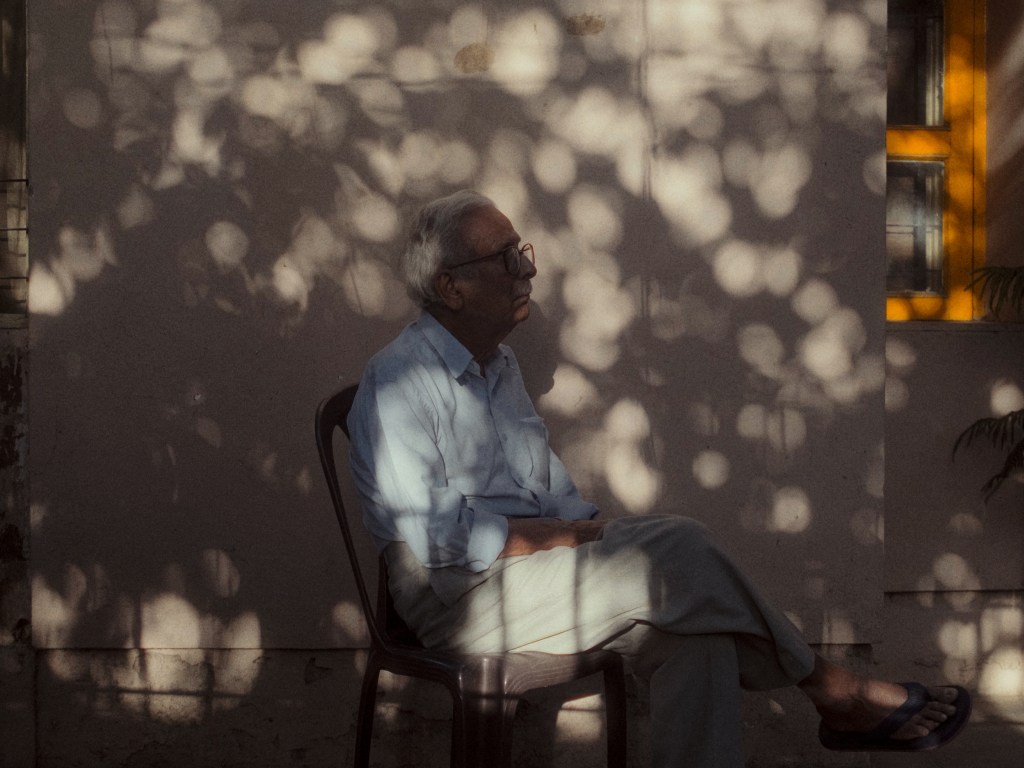
Poet and novelist Vinod Kumar Shukla, widely regarded as one of the greatest living writers in the Hindi language, recounts an amusing anecdote in the opening minutes of Achal Mishra’s Chaar Phool Hain Aur Duniya Hai (There are Four Flowers and There’s the World), a documentary about Shukla and his family, which released earlier this year. Bathed in iridescent afternoon sunlight, we see the 88-year-old pacing across his front garden in Raipur. Through a voiceover—as if the viewer is privy to his thoughts—Shukla mentions that there is someone from Bihar who keeps calling his landline.
When pressed for a reason behind the phone call, the voice on the other end says: “Sir, main kisse puchta, mujhe kaun batata ke aap zinda hai?” (“Sir, who could I have asked, who could have told me that you’re in fact alive?”). He admits the only way he could have gotten a reply to his question was if he called Shukla’s home, which he did. “Lekin, aapne hi jawab de diya!” (“But you answered it yourself!”)
Initially, Mishra had decided to begin the documentary with Shukla reciting a poem. But midway through the edit, he changed course. The contradictions that surrounded Shukla—despite the acclaim he had amassed over his literary career—were a better starting point.
That irony—a writer so visible to readers yet almost invisible to the literary establishment—has long defined Shukla’s place in Hindi literature. In a landscape still shaped by English-language privilege and metropolitan hierarchies, his refusal to relocate from Raipur, to write in English, or to self-mythologize within the circuits of Delhi and Mumbai has long become an act of dissent.
Shukla boasts a distinguished oeuvre—he has written numerous volumes of poetry, several short stories, and dabbled even in children’s literature. His words are known for evoking the quiet poetry of everyday rural life while experimenting boldly with form, genre, and magical realism. In fact, the writer’s ability to look inward, to turn the small, intimate worlds of the ordinary Indian middle class into stories that unfold with the logic and texture of a dream, has made him one of the most original voices in Hindi literature.
A Literary Giant with a Low Profile
From a small-town writer working in a regional tongue, Shukla has become an international literary presence—his work translated into Italian, Swedish, German, and French, adapted for the stage, and celebrated with prestigious awards. Over the past decade, English translations have been instrumental in the renewed interest in Shukla’s creative work, reintroducing his writing to a generation that might otherwise have never encountered it.
The impact of those translations became evident in 2019 when Blue is Like Blue, a collection of Shukla’s short stories translated into English by Arvind Krishna Mehrotra and Sara Rai, won the Atta Galatta-Bangalore Literature Festival Book Prize and the inaugural Mathrubhumi Book of the Year award. Then in 2023, Shukla became the first Indian recipient of the PEN/Nabokov Award for Achievement in International Literature. On the heels of that honor, Mehrotra, an eminent translator and poet, brought out Treasurer of Piggy Banks, the first English selection of Shukla’s poetry featuring 75 poems from his expansive body of work, last year.
If translation carried his voice across borders, the past year affirmed his stature at home with a long-overdue honor: Shukla won the 59th Jnanpith Award, India’s highest literary prize. Currently, a new edition of Deewar Mein Ek Khidki Rehti Thi, published by Hind Yugm, is at the top of the Amazon bestsellers list of Indian writing.
It is as if time barely had an imprint on the feeling of newness one encounters when reading Shukla. In fact, his international visibility, shaped less by institutions than by the sustained advocacy of Indian writers and translators, reflects the resilience of regional literary ecosystems and a counterpublic that continues to thrive beyond the hierarchies of global publishing.
Still, while Shukla’s stories have traveled farther than most Hindi writers—regularly published in international journals like Granta, n+1, The Baffler, and Metamorphoses—he remains largely unaware of his reach. It is this rootedness—this insistence on language as a home rather than a ladder—that makes his work radical. In refusing to translate himself into the idioms of prestige, he suggests that resistance can mean remaining exactly where one belongs.
Unlike other acclaimed writers, neither does Shukla have a social media presence, nor does he step out of Raipur, the capital city of Chhattisgarh in central India. It is perhaps why “when you Google Vinod Kumar Shukla,” Mishra noted, “one question often pops up: Is Vinod Kumar Shukla still alive?” That many readers kept posing this same query online surprised the filmmaker.
Indeed, Shukla’s matter-of-fact rendering of the answer to that question in the film’s opening allows the dual indications of the word “jawab” (answer) to acquire a gentleness that belies the absurdity of the moment. The answer is literal—of a person confronting his mortality; but also metaphorical—of a prolific writer communicating in the only device he can count on: his own words.
At a later point in the film, Shukla reiterates that thought, admitting that “the only way that a writer can be alive is if they are still writing.” To him, words are the only purpose and proof. It has been that way for over 50 years.

Cinema, Childhood, and the Making of a Visual Poet
One story that has often been repeated about the origins of Shukla’s literary influences is tied to the day he was born in 1937 in Rajnandgaon, a small town that is now part of Chhattisgarh. On that same day, Krishna Talkies, the town’s first cinema hall, opened its doors to the public, right opposite their house. Owned by family friends, Shukla grew up seeing the theatre as an extension of his own home. “It’s entirely possible that when, after five weeks, she [Amma] came out of the birthing room, someone who was going to see a film took me along,” he writes in his autobiographical essay, “Old Veranda.”
In that same piece, Shukla vividly recalls a childhood centered around the theatre, painting it as a place of refuge and escape. Children would “slip naked through the bars of the gate” and run into the hall to hide from an impending bath in the courtyard; other times, they would lie down on the stage of the cinema hall and watch films. As a child, Shukla would occasionally fall asleep midway and would have to be carried home. Being exposed to the larger-than-life world of moving images while straddling the smallness of daily living informed the writer that he eventually became: one who often admitted that he didn’t think in language but in images.
Shukla started writing at the age of fifteen. Although his poems began appearing in Hindi literary magazines as early as 1959, Lagbhag Jai Hind (Almost Jai Hind), his first poetry collection, was only published in 1971. Part of a series that poet Ashok Vajpeyi launched to showcase emerging writers, the slim volume of 20 poems announced the arrival of a distinctive poetic voice—one who could wield language with inventive yet understated precision. At the time, he was 34.
The poems in Lagbhag Jai Hind showcase Shukla’s talent for turning the simplest observations into profound meditations. They often begin with what feels like a plainspoken fact: “It takes time to tell the time,” But the more one lingers, the more these lines pulse with depth, turning observation into revelation. The lines then read: “It takes time to tell the time. / A dry leaf falls / as though it were a second.” In an instant, the scene has shifted. Time has become tactile: Now falling leaves mark the seconds of an invisible clock. What binds them together is Shukla’s refusal to flourish—he illuminates the world as it is, reminding us that even the most ordinary detail carries infinity within it.
His next poetry collection, Vah Aadmi Naya Garam Coat Pehen Kar Chala Gaya Vichar Ki Tarah (The Man Put on a New Winter Coat and Walked off Like a Thought), published in 1981, spanned 150 pages and contained 37 poems, which stood out for their startling oddity.
Despite the long title, the poems in the collection were marked by their economy, whittled down to spare verses that blurred passages between actuality and possibility. Ordinary objects become portals into other dimensions: “When I tossed a bunch of keys / in the air, / I saw / the sky open” he writes. This childlike curiosity, closer to the wonder of a folktale but expressed in Shukla’s spare, unadorned Hindi, transforms logic into play. Yet his poems also return, again and again, to the elusive idea of home—a place at once familiar and distant. In “A five-year-old girl,” the thought crystallizes in a single aching line: “Even at home I miss my home.”
Shukla’s insistence on treating words with meticulous care, and his refusal to say more than necessary, has earned him the label of an undescriptive poet. Yet, the simplicity is deceptive, for Shukla is also a strikingly visual poet, adept at turning words into an optical illusion. In the poem titled ‘A small green parrot,’ a bird melts into the tree it lands on—“After this, I couldn’t see the parrot. / Only the tree”—a transformation so delicate, it feels inevitable.
The unmistakable identity of Shukla’s lines also stemmed from his ease at rupturing Hindi syntax, allowing new cadences and meanings to emerge from familiar idioms and events. Nowhere is this clearer than in a line that begins in everyday but ends in astonishment: “जब मैंने हवा में चाभियों का गुच्छा उछाला, मैंने देखा, आसमान खुल गया।” (When I tossed a bunch of keys / in the air, / I saw / the sky open). Here, Shukla bends a routine phrase—चाभियाँ उछालना—so its rhythm briefly falters, and through that pause, meaning shifts. The sentence seems weightless, yet its off-balance syntax makes language itself feel newly alive, as if a small slip in grammar could open the sky.
Shukla’s work can thus be categorized within two literary movements of modernist Hindi poetry: Nayi Kavita (New Poetry) or Prayogvaad (Experimentalism), both driven by an acute attention to language and a desire to unshackle poetry from existing literary traditions.
The Gentle Power of Shukla’s Prose: Unraveling Hierarchies and Visibilizing Precarity
In his introduction to the 2019 collection of Shukla’s stories, Blue is Like Blue, Mehrotra notes something that bears repeating: “a line of Shukla is like a line of Shukla. It mirrors nothing but itself.”
Shukla’s prose is almost immediately recognizable by its attentiveness to fleeting observations, memories, and thoughts grounded in our mundane lives, which most of us take for granted. But despite his matter-of-fact prose, his narratives possess philosophical depth and a dreamlike quality, bordering on magical realism (a window in a house leads to rivers and ponds; people turn into birds or become invisible; a son inherits his father’s dentures).
Similarly, the protagonists who populate his novels are invisible citizens—working-class, disenfranchized—eking out a living away from centers of political, cultural, and social power, living out each day as it comes. There’s compassion in his words for the forgotten, but never melodrama or trite existential ruminations.
In a literary culture dominated by voices that mirror the privileged worlds of their authors, Shukla’s imagination insists on the moral intelligence of ordinariness. His words have always been tilted toward those who live on the edges of recognition—the clerk, the teacher, the farmer—and in doing so, he constructs a politics of equality, restoring value to what the world overlooks. In almost all of his work, when Shukla trains his gaze, almost compulsively, on the vivid interior lives of characters, he reveals, in Vajpeyi’s words, “a kind of sad humane wisdom about the human condition of our time.”
In 1979, he released his first novel, Naukar Ki Kameez (The Servant’s Shirt), a landmark work later adapted into a film of the same name by Mani Kaul in 1999. The story follows a young government clerk who puts on a runaway servant’s shirt only to find that his boss, his landlord, and his landlord’s wife start treating him as if he were that same servant.
Thus, Shukla turns a simple garment into a mirror of society’s prejudices. Once worn, it alters not the man himself but how the world sees him: his employer, his landlord, even strangers begin to treat him as though he had slipped into another skin. With gentle wit and unflinching clarity, Shukla reveals how the smallest shifts can unravel hierarchies and make visible the precariousness of dignity in a society that measures worth by social rank.
In Khilega To Dekhenge (Once It Flowers), Shukla’s second novel, published in 1996, an unnamed village schoolteacher moves into an abandoned police station after his school is blown away in a gale. Not one to stick to conventional plot structure, Shukla’s prose unfolds as a series of dreamlike vignettes that observe its protagonists familiarising themselves with the world they live in, capturing both the rhymes of existence and the wonders of quotidian rural life.
It was Shukla’s third novel, Deewar Mein Ek Khidki Rehti Thi (A Window Lived in the Wall), about a young married couple navigating their modest life with a deep sense of curiosity and wonder, that cemented his stature as a novelist. Published in 1997, the titular window—both literal and metaphorical—formed the crux of the narrative, representing the possibilities and small joys that nourish everyday realities.
Through the couple’s daily rituals—cooking, cleaning, tending to the house—Shukla builds a world where the window becomes a threshold between reality and imagination, at times revealing landscapes that shouldn’t exist, at other moments, reflecting their own dreams back to them. This delicate blending of the real and the unreal is quintessential Shukla, his own strain of magical realism rooted not in fantasy, but in the attentive noticing of life’s smallest wonders.
Two years later, the novel won the Sahitya Akademi Award, India’s second-highest literary honor, marking the first recognition that came Shukla’s way. As the PEN/Nabokov Award jury—which included writer Amit Chaudhuri, an avid champion of Shukla’s work—noted in their citation: “Shukla’s prose and poetry are marked by acute, often defamiliarizing, observation. The voice that emerges is that of a deeply intelligent onlooker, a daydreamer struck occasionally by wonder.
To read Shukla is to be reminded that the act of living is an act of bearing witness.
Shukla’s Legacy
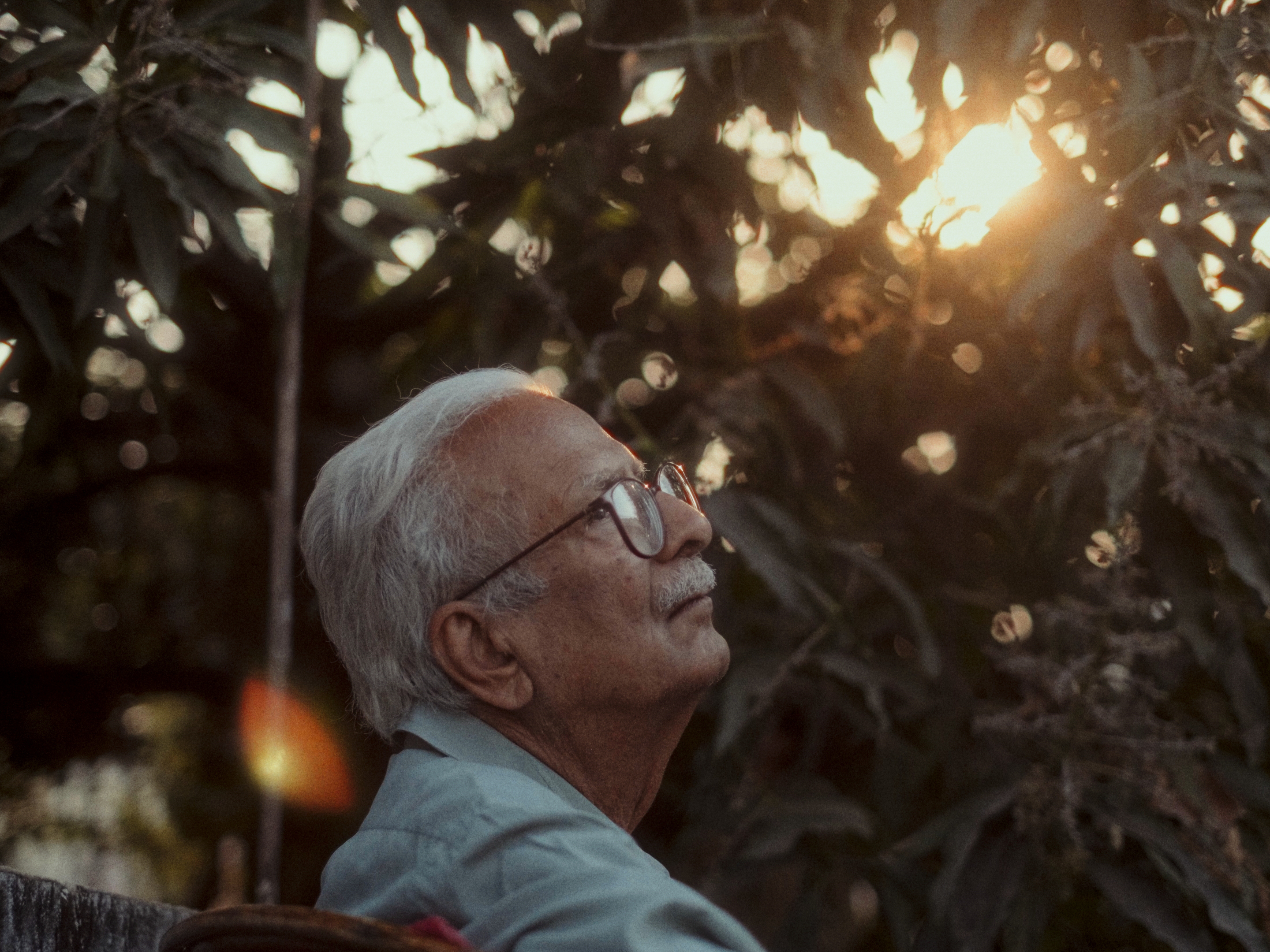
In a sense, Chaar Phool Hain Aur Duniya Hai similarly concerns itself with witnessing. In 2022, when Mishra, along with actor-writer Manav Kaul and their screenwriter friend Nihal Parashar, visited Shukla in his Raipur home, the trio was hoping to get a peek into his creative mind.
On his first visit, Mishra captured Kaul and Shukla in formal conversation, their exchanges spanning writing, memory, and a lifetime in literature. Yet the footage felt too staged, too bound by structure. Returning for a second visit, Mishra shifted roles: no longer a director arranging takes, but an unobtrusive observer; he loosened his grip on the camera, choosing instead to drift with the silences, the gestures, the unnoticed rhythms of Shukla’s days, hoping to render the in-between moments of the writer’s life more visible.
As a result, the film began to capture Shukla’s creativity not as a process but rather as a rigorous, daily practice, rooted in the idea that home and its surroundings remain a domain of continuous introspection.
For Mishra, the gateway to Vinod Kumar Shukla was not Hindi, but translation—an entry point shared by many in his generation. Yet even through this prism, Shukla’s voice struck him with uncommon clarity. Years before he ever held a camera to film the writer, Mishra was already carrying him as a secret compass, returning to the poems and stories that refused to age. The filmmaker spoke about Shukla’s delicate craft, admitting that Shukla is not the kind of poet who relies on the last line to deliver a message or a punch. Instead, little images are scattered throughout every line of a Vinod Kumar Shukla poem. “It’s almost like you could pick four lines from any poem and those lines could become a poem of their own,” he noted.
One thing Mishra noticed at Shukla’s home filming over two afternoons was that “there was rarely a disconnect between Shukla’s art and his way of being.” Shukla lives as simply as he writes. In Chaar Phool Hain Aur Duniya Hai, family emerges as both Shukla’s subject and collaborator. His pages echo with the rooms he inhabits, the relationships that sustain him.
The women in his writing, he confesses, are drawn from his wife’s rich inner life. His son, Shashwat Gopal, calls himself the “listener” of his father’s creative process. Even the importance that the soft-spoken writer places on expression and introspection has ultimately become a family inheritance. Shukla’s granddaughter spends hours taking pictures of the same mango tree in the garden every day, mesmerized by the changing beauty of familiarity. Shukla’s vision itself rests on a simple, radical belief—that within the smallest details of life lie infinite worlds.
Originality, for Shukla, then, is not an act of total invention. But rather, imagination that is sharpened by attention, by the willingness to look closely—at a room, a tree, a silence, oneself. Even in the film, Shukla doesn’t step outside his home, and yet the vivid, complex universes that he creates spill beyond their confines.
This very act of witnessing in Chaar Phool Hain Aur Duniya Hai circles back to the question of legacy. While the English language remains pedestalized in India, eroding the space for regional imagination, Shukla stands apart for giving Hindi literature a bold new imaginative range. His work insists that the heart of Indian literature beats elsewhere: in the porous, shifting boundaries between languages and lives.
There is a scene in the film that captures Shukla sitting by his window, looking at the world as if he were seeing it for the first time. That gaze—alert, tender, endlessly astonished—is what Hindi literature has inherited from him. Writers like Perumal Murugan, Vivek Shanbhag, and Banu Mushtaq have similarly shown how the regional imagination, once considered provincial, now defines the future of Indian writing. Today, translation is not just a mode of access: it is also an act of reclamation, returning to global literature the textures and rhythms that English alone cannot hold.
Perhaps that is Shukla’s greatest legacy: to show that even in translation, language can remain a home, not a departure.


Language as a Home, Not a Ladder: Vinod Kumar Shukla’s Resistance in Remaining Where He Belongs
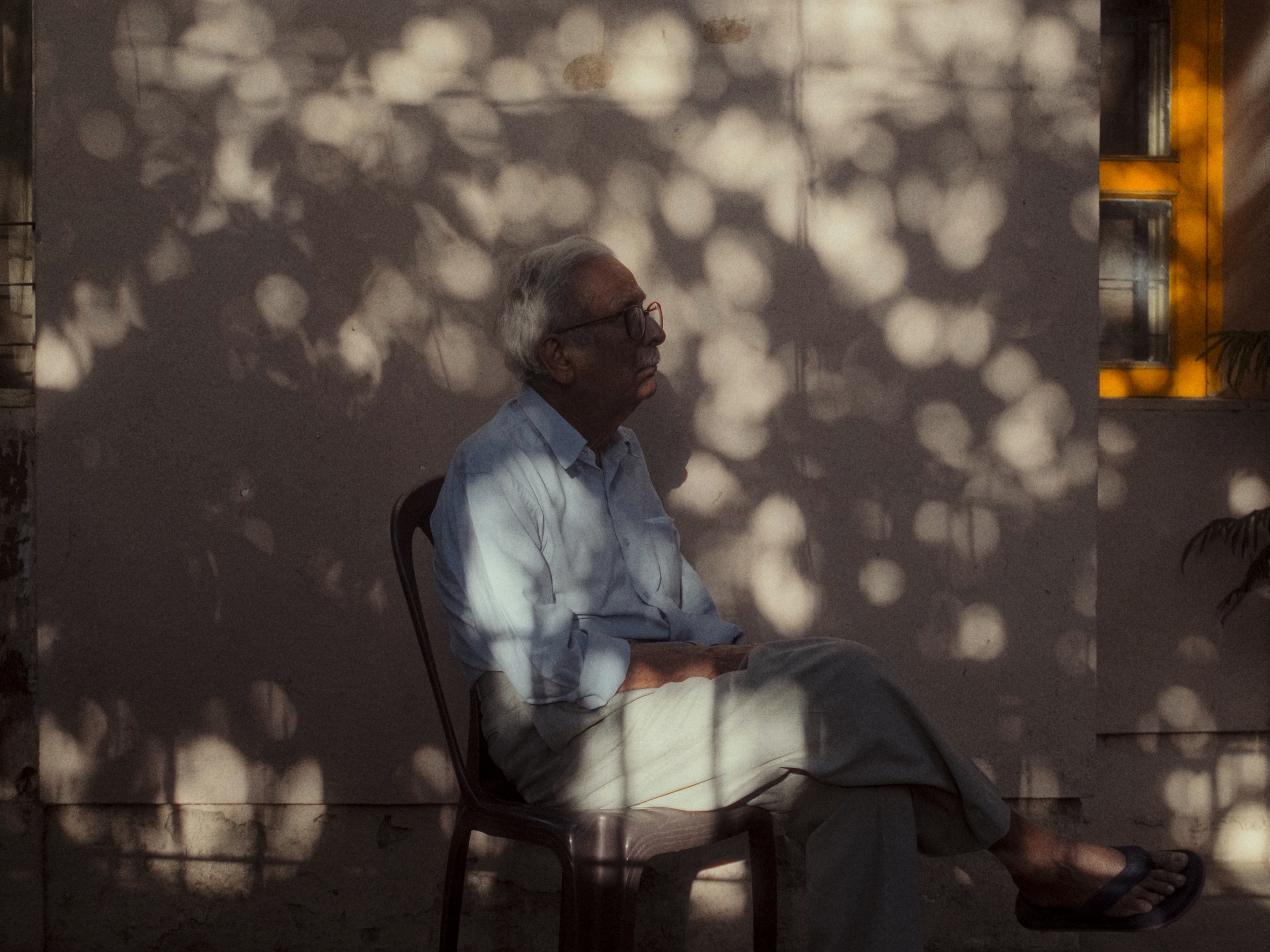
From a small-town writer working in a regional tongue, Vinod Kumar Shukla has become an international literary presence—his work translated into Italian, Swedish, German, and French, adapted for the stage, and celebrated with prestigious awards. A still from Achal Mishra's Chaar Phool Hain Aur Duniya Hai.
Poet and novelist Vinod Kumar Shukla, widely regarded as one of the greatest living writers in the Hindi language, recounts an amusing anecdote in the opening minutes of Achal Mishra’s Chaar Phool Hain Aur Duniya Hai (There are Four Flowers and There’s the World), a documentary about Shukla and his family, which released earlier this year. Bathed in iridescent afternoon sunlight, we see the 88-year-old pacing across his front garden in Raipur. Through a voiceover—as if the viewer is privy to his thoughts—Shukla mentions that there is someone from Bihar who keeps calling his landline.
When pressed for a reason behind the phone call, the voice on the other end says: “Sir, main kisse puchta, mujhe kaun batata ke aap zinda hai?” (“Sir, who could I have asked, who could have told me that you’re in fact alive?”). He admits the only way he could have gotten a reply to his question was if he called Shukla’s home, which he did. “Lekin, aapne hi jawab de diya!” (“But you answered it yourself!”)
Initially, Mishra had decided to begin the documentary with Shukla reciting a poem. But midway through the edit, he changed course. The contradictions that surrounded Shukla—despite the acclaim he had amassed over his literary career—were a better starting point.
That irony—a writer so visible to readers yet almost invisible to the literary establishment—has long defined Shukla’s place in Hindi literature. In a landscape still shaped by English-language privilege and metropolitan hierarchies, his refusal to relocate from Raipur, to write in English, or to self-mythologize within the circuits of Delhi and Mumbai has long become an act of dissent.
Shukla boasts a distinguished oeuvre—he has written numerous volumes of poetry, several short stories, and dabbled even in children’s literature. His words are known for evoking the quiet poetry of everyday rural life while experimenting boldly with form, genre, and magical realism. In fact, the writer’s ability to look inward, to turn the small, intimate worlds of the ordinary Indian middle class into stories that unfold with the logic and texture of a dream, has made him one of the most original voices in Hindi literature.
A Literary Giant with a Low Profile
From a small-town writer working in a regional tongue, Shukla has become an international literary presence—his work translated into Italian, Swedish, German, and French, adapted for the stage, and celebrated with prestigious awards. Over the past decade, English translations have been instrumental in the renewed interest in Shukla’s creative work, reintroducing his writing to a generation that might otherwise have never encountered it.
The impact of those translations became evident in 2019 when Blue is Like Blue, a collection of Shukla’s short stories translated into English by Arvind Krishna Mehrotra and Sara Rai, won the Atta Galatta-Bangalore Literature Festival Book Prize and the inaugural Mathrubhumi Book of the Year award. Then in 2023, Shukla became the first Indian recipient of the PEN/Nabokov Award for Achievement in International Literature. On the heels of that honor, Mehrotra, an eminent translator and poet, brought out Treasurer of Piggy Banks, the first English selection of Shukla’s poetry featuring 75 poems from his expansive body of work, last year.
If translation carried his voice across borders, the past year affirmed his stature at home with a long-overdue honor: Shukla won the 59th Jnanpith Award, India’s highest literary prize. Currently, a new edition of Deewar Mein Ek Khidki Rehti Thi, published by Hind Yugm, is at the top of the Amazon bestsellers list of Indian writing.
It is as if time barely had an imprint on the feeling of newness one encounters when reading Shukla. In fact, his international visibility, shaped less by institutions than by the sustained advocacy of Indian writers and translators, reflects the resilience of regional literary ecosystems and a counterpublic that continues to thrive beyond the hierarchies of global publishing.
Still, while Shukla’s stories have traveled farther than most Hindi writers—regularly published in international journals like Granta, n+1, The Baffler, and Metamorphoses—he remains largely unaware of his reach. It is this rootedness—this insistence on language as a home rather than a ladder—that makes his work radical. In refusing to translate himself into the idioms of prestige, he suggests that resistance can mean remaining exactly where one belongs.
Unlike other acclaimed writers, neither does Shukla have a social media presence, nor does he step out of Raipur, the capital city of Chhattisgarh in central India. It is perhaps why “when you Google Vinod Kumar Shukla,” Mishra noted, “one question often pops up: Is Vinod Kumar Shukla still alive?” That many readers kept posing this same query online surprised the filmmaker.
Indeed, Shukla’s matter-of-fact rendering of the answer to that question in the film’s opening allows the dual indications of the word “jawab” (answer) to acquire a gentleness that belies the absurdity of the moment. The answer is literal—of a person confronting his mortality; but also metaphorical—of a prolific writer communicating in the only device he can count on: his own words.
At a later point in the film, Shukla reiterates that thought, admitting that “the only way that a writer can be alive is if they are still writing.” To him, words are the only purpose and proof. It has been that way for over 50 years.
Cinema, Childhood, and the Making of a Visual Poet
One story that has often been repeated about the origins of Shukla’s literary influences is tied to the day he was born in 1937 in Rajnandgaon, a small town that is now part of Chhattisgarh. On that same day, Krishna Talkies, the town’s first cinema hall, opened its doors to the public, right opposite their house. Owned by family friends, Shukla grew up seeing the theatre as an extension of his own home. “It’s entirely possible that when, after five weeks, she [Amma] came out of the birthing room, someone who was going to see a film took me along,” he writes in his autobiographical essay, “Old Veranda.”
In that same piece, Shukla vividly recalls a childhood centered around the theatre, painting it as a place of refuge and escape. Children would “slip naked through the bars of the gate” and run into the hall to hide from an impending bath in the courtyard; other times, they would lie down on the stage of the cinema hall and watch films. As a child, Shukla would occasionally fall asleep midway and would have to be carried home. Being exposed to the larger-than-life world of moving images while straddling the smallness of daily living informed the writer that he eventually became: one who often admitted that he didn’t think in language but in images.
Shukla started writing at the age of fifteen. Although his poems began appearing in Hindi literary magazines as early as 1959, Lagbhag Jai Hind (Almost Jai Hind), his first poetry collection, was only published in 1971. Part of a series that poet Ashok Vajpeyi launched to showcase emerging writers, the slim volume of 20 poems announced the arrival of a distinctive poetic voice—one who could wield language with inventive yet understated precision. At the time, he was 34.
The poems in Lagbhag Jai Hind showcase Shukla’s talent for turning the simplest observations into profound meditations. They often begin with what feels like a plainspoken fact: “It takes time to tell the time,” But the more one lingers, the more these lines pulse with depth, turning observation into revelation. The lines then read: “It takes time to tell the time. / A dry leaf falls / as though it were a second.” In an instant, the scene has shifted. Time has become tactile: Now falling leaves mark the seconds of an invisible clock. What binds them together is Shukla’s refusal to flourish—he illuminates the world as it is, reminding us that even the most ordinary detail carries infinity within it.
His next poetry collection, Vah Aadmi Naya Garam Coat Pehen Kar Chala Gaya Vichar Ki Tarah (The Man Put on a New Winter Coat and Walked off Like a Thought), published in 1981, spanned 150 pages and contained 37 poems, which stood out for their startling oddity.
Despite the long title, the poems in the collection were marked by their economy, whittled down to spare verses that blurred passages between actuality and possibility. Ordinary objects become portals into other dimensions: “When I tossed a bunch of keys / in the air, / I saw / the sky open” he writes. This childlike curiosity, closer to the wonder of a folktale but expressed in Shukla’s spare, unadorned Hindi, transforms logic into play. Yet his poems also return, again and again, to the elusive idea of home—a place at once familiar and distant. In “A five-year-old girl,” the thought crystallizes in a single aching line: “Even at home I miss my home.”
Shukla’s insistence on treating words with meticulous care, and his refusal to say more than necessary, has earned him the label of an undescriptive poet. Yet, the simplicity is deceptive, for Shukla is also a strikingly visual poet, adept at turning words into an optical illusion. In the poem titled ‘A small green parrot,’ a bird melts into the tree it lands on—“After this, I couldn’t see the parrot. / Only the tree”—a transformation so delicate, it feels inevitable.
The unmistakable identity of Shukla’s lines also stemmed from his ease at rupturing Hindi syntax, allowing new cadences and meanings to emerge from familiar idioms and events. Nowhere is this clearer than in a line that begins in everyday but ends in astonishment: “जब मैंने हवा में चाभियों का गुच्छा उछाला, मैंने देखा, आसमान खुल गया।” (When I tossed a bunch of keys / in the air, / I saw / the sky open). Here, Shukla bends a routine phrase—चाभियाँ उछालना—so its rhythm briefly falters, and through that pause, meaning shifts. The sentence seems weightless, yet its off-balance syntax makes language itself feel newly alive, as if a small slip in grammar could open the sky.
Shukla’s work can thus be categorized within two literary movements of modernist Hindi poetry: Nayi Kavita (New Poetry) or Prayogvaad (Experimentalism), both driven by an acute attention to language and a desire to unshackle poetry from existing literary traditions.
The Gentle Power of Shukla’s Prose: Unraveling Hierarchies and Visibilizing Precarity
In his introduction to the 2019 collection of Shukla’s stories, Blue is Like Blue, Mehrotra notes something that bears repeating: “a line of Shukla is like a line of Shukla. It mirrors nothing but itself.”
Shukla’s prose is almost immediately recognizable by its attentiveness to fleeting observations, memories, and thoughts grounded in our mundane lives, which most of us take for granted. But despite his matter-of-fact prose, his narratives possess philosophical depth and a dreamlike quality, bordering on magical realism (a window in a house leads to rivers and ponds; people turn into birds or become invisible; a son inherits his father’s dentures).
Similarly, the protagonists who populate his novels are invisible citizens—working-class, disenfranchized—eking out a living away from centers of political, cultural, and social power, living out each day as it comes. There’s compassion in his words for the forgotten, but never melodrama or trite existential ruminations.
In a literary culture dominated by voices that mirror the privileged worlds of their authors, Shukla’s imagination insists on the moral intelligence of ordinariness. His words have always been tilted toward those who live on the edges of recognition—the clerk, the teacher, the farmer—and in doing so, he constructs a politics of equality, restoring value to what the world overlooks. In almost all of his work, when Shukla trains his gaze, almost compulsively, on the vivid interior lives of characters, he reveals, in Vajpeyi’s words, “a kind of sad humane wisdom about the human condition of our time.”
In 1979, he released his first novel, Naukar Ki Kameez (The Servant’s Shirt), a landmark work later adapted into a film of the same name by Mani Kaul in 1999. The story follows a young government clerk who puts on a runaway servant’s shirt only to find that his boss, his landlord, and his landlord’s wife start treating him as if he were that same servant.
Thus, Shukla turns a simple garment into a mirror of society’s prejudices. Once worn, it alters not the man himself but how the world sees him: his employer, his landlord, even strangers begin to treat him as though he had slipped into another skin. With gentle wit and unflinching clarity, Shukla reveals how the smallest shifts can unravel hierarchies and make visible the precariousness of dignity in a society that measures worth by social rank.
In Khilega To Dekhenge (Once It Flowers), Shukla’s second novel, published in 1996, an unnamed village schoolteacher moves into an abandoned police station after his school is blown away in a gale. Not one to stick to conventional plot structure, Shukla’s prose unfolds as a series of dreamlike vignettes that observe its protagonists familiarising themselves with the world they live in, capturing both the rhymes of existence and the wonders of quotidian rural life.
It was Shukla’s third novel, Deewar Mein Ek Khidki Rehti Thi (A Window Lived in the Wall), about a young married couple navigating their modest life with a deep sense of curiosity and wonder, that cemented his stature as a novelist. Published in 1997, the titular window—both literal and metaphorical—formed the crux of the narrative, representing the possibilities and small joys that nourish everyday realities.
Through the couple’s daily rituals—cooking, cleaning, tending to the house—Shukla builds a world where the window becomes a threshold between reality and imagination, at times revealing landscapes that shouldn’t exist, at other moments, reflecting their own dreams back to them. This delicate blending of the real and the unreal is quintessential Shukla, his own strain of magical realism rooted not in fantasy, but in the attentive noticing of life’s smallest wonders.
Two years later, the novel won the Sahitya Akademi Award, India’s second-highest literary honor, marking the first recognition that came Shukla’s way. As the PEN/Nabokov Award jury—which included writer Amit Chaudhuri, an avid champion of Shukla’s work—noted in their citation: “Shukla’s prose and poetry are marked by acute, often defamiliarizing, observation. The voice that emerges is that of a deeply intelligent onlooker, a daydreamer struck occasionally by wonder.
To read Shukla is to be reminded that the act of living is an act of bearing witness.
Shukla’s Legacy
In a sense, Chaar Phool Hain Aur Duniya Hai similarly concerns itself with witnessing. In 2022, when Mishra, along with actor-writer Manav Kaul and their screenwriter friend Nihal Parashar, visited Shukla in his Raipur home, the trio was hoping to get a peek into his creative mind.
On his first visit, Mishra captured Kaul and Shukla in formal conversation, their exchanges spanning writing, memory, and a lifetime in literature. Yet the footage felt too staged, too bound by structure. Returning for a second visit, Mishra shifted roles: no longer a director arranging takes, but an unobtrusive observer; he loosened his grip on the camera, choosing instead to drift with the silences, the gestures, the unnoticed rhythms of Shukla’s days, hoping to render the in-between moments of the writer’s life more visible.
As a result, the film began to capture Shukla’s creativity not as a process but rather as a rigorous, daily practice, rooted in the idea that home and its surroundings remain a domain of continuous introspection.
For Mishra, the gateway to Vinod Kumar Shukla was not Hindi, but translation—an entry point shared by many in his generation. Yet even through this prism, Shukla’s voice struck him with uncommon clarity. Years before he ever held a camera to film the writer, Mishra was already carrying him as a secret compass, returning to the poems and stories that refused to age. The filmmaker spoke about Shukla’s delicate craft, admitting that Shukla is not the kind of poet who relies on the last line to deliver a message or a punch. Instead, little images are scattered throughout every line of a Vinod Kumar Shukla poem. “It’s almost like you could pick four lines from any poem and those lines could become a poem of their own,” he noted.
One thing Mishra noticed at Shukla’s home filming over two afternoons was that “there was rarely a disconnect between Shukla’s art and his way of being.” Shukla lives as simply as he writes. In Chaar Phool Hain Aur Duniya Hai, family emerges as both Shukla’s subject and collaborator. His pages echo with the rooms he inhabits, the relationships that sustain him.
The women in his writing, he confesses, are drawn from his wife’s rich inner life. His son, Shashwat Gopal, calls himself the “listener” of his father’s creative process. Even the importance that the soft-spoken writer places on expression and introspection has ultimately become a family inheritance. Shukla’s granddaughter spends hours taking pictures of the same mango tree in the garden every day, mesmerized by the changing beauty of familiarity. Shukla’s vision itself rests on a simple, radical belief—that within the smallest details of life lie infinite worlds.
Originality, for Shukla, then, is not an act of total invention. But rather, imagination that is sharpened by attention, by the willingness to look closely—at a room, a tree, a silence, oneself. Even in the film, Shukla doesn’t step outside his home, and yet the vivid, complex universes that he creates spill beyond their confines.
This very act of witnessing in Chaar Phool Hain Aur Duniya Hai circles back to the question of legacy. While the English language remains pedestalized in India, eroding the space for regional imagination, Shukla stands apart for giving Hindi literature a bold new imaginative range. His work insists that the heart of Indian literature beats elsewhere: in the porous, shifting boundaries between languages and lives.
There is a scene in the film that captures Shukla sitting by his window, looking at the world as if he were seeing it for the first time. That gaze—alert, tender, endlessly astonished—is what Hindi literature has inherited from him. Writers like Perumal Murugan, Vivek Shanbhag, and Banu Mushtaq have similarly shown how the regional imagination, once considered provincial, now defines the future of Indian writing. Today, translation is not just a mode of access: it is also an act of reclamation, returning to global literature the textures and rhythms that English alone cannot hold.
Perhaps that is Shukla’s greatest legacy: to show that even in translation, language can remain a home, not a departure.