


The Eyes of Gaza: Plestia Alaqad’s Portrait of Endurance Amid the Horrors of Genocide

The Eyes of Gaza: A Diary of Resilience is a first-hand account of life during the genocide in Gaza, narrated through the raw diary entries of Plestia Alaqad, a journalist and author. Alaqad has been a crucial voice who has brought the daily realities of the genocide to a global stage on her social media platforms. Alaqad’s Instagram account has over 4 million followers. Her short-form videos and real-time reporting have been shared by major international outlets.
Alaqad’s unfiltered narration in her diary transforms distant headlines into an immediate, tangible human experience. Through her book, she captures not only the horrors of the genocide but also the unwavering strength of a people determined to survive, making The Eyes of Gaza both a haunting witness account and a testament to resilience amidst unimaginable loss.
What should have been mundane entries in the diary of a 23-year-old woman—entries that reflected curiosity, celebrated small joys, dreams, and everyday wonder—instead reflect despair, uncertainty, loss, and a deep sense of longing. On October 24th, 2023—18 days into the Israeli aggression—she writes, “Today is a heavy day. Every day feels like the worst day of my life, then Israel outdoes itself, and the next day is worse. My existence is an increasingly suffocating nightmare.”
Journaling has always been a tool for making sense of the world for Alaqad. In the preface, she writes about how she has nurtured the habit since the age of twelve, when she received her first diary—a dark purple notebook with lined pages gifted to her by her mother. She began writing about her school, friends, and her crushes on boys.
But she soon realized that her diary would not be filled with warm recollections alone, and that it would also hold “the memories of living under Israeli occupation, enduring bombardments, and being in a state of near-constant fear of dying or having my loved ones be killed.”
The Eyes of Gaza arrives at a time when our screens are flooded with images of burning land, and dead children—and yet, we scroll past them, numbed, desensitized. Yet, Alaqad refuses this depersonalized, one-dimensional narrative. As she chronicles pain, suffering, and death, she also captures both the personal and collective Gazan resilience—highlighting not just survival, but also living—cooking, laughing, fearing, hoping—under siege.
On October 26, for example, Alaqad writes of how a man named Nadeem had sourced some posters and paintings, and had invited children to draw and color their thoughts at Al-Shifa Hospital. On November 1, when Alaqad returns to the camp after reporting, she celebrates the birthday of Lolo, a five-year-old.
Through these stories, Alaqad offers a textured, deeply human portrait of endurance amidst the noise and falsehoods of Western mainstream media and their complicity in the genocide through the perpetuation of Zionist narratives that cast occupiers as victims, resistance as terror, and genocide as self-defense.
Writing as Therapy
For the better part of The Eyes of Gaza, we are taken through Alaqad’s diary entries from the first 45 days following October 7, 2023, until her exit from Gaza, brief stay in Egypt, and subsequent departure to Australia in March 2024.
There are entries from after this period as well—extending into January of this year—though they are not daily, and sparse. These later entries differ markedly in tone and content: they trace Alaqad’s move to Australia and her slow, uneven process of rebuilding a life away from Gaza. She writes of guilt for having left, for having survived. Gradually, her writing begins to show signs of recovery, of hope returning in fragments.
In the opening pages, Alaqad mentions how, from the time she received her first diary, she became inseparable from it. This reliance is evident in her journal entries during the genocide, when the diary becomes the receptacle for her emotional turmoil as she bears witness to a collapsing world around her.
Her entries reflect a turbulent emotional landscape: from a sense of growing dread (“I am shocked by how quickly the situation is escalating, and I begin to believe that we might be facing an especially bad Aggression”), helplessness and internal conflict with moral burden (“I feel I have to show the world the truth, but that’s difficult to do while I’m also trying to stay alive”), fragile hope and gratitude (“You have to treasure every moment, every laugh and every bit of hope you can”), to frustration at the world’s indifference (“If I scream it loud enough, will the world hear me?”).
Thus, the diary becomes her means of coping with chaos. Alaqad keeps writing: against all odds, against the overwhelming weight of despair. At one point, she’s completely cut off from her family and all her loved ones while reporting with a few fellow journalists from deep inside the conflict zone. Even then, she continues writing, undeterred. Ten days into the genocide, she leaves behind the comforts of home to take refuge in her grandparents’ house in Khan Younis, where she reports amid relentless bombings and sleepless nights.
Her entries from this time reflect longing—not just for safety, but for the ordinary. On November 11, thirty-six days into the genocide, she writes, “I miss my home too. I miss sleeping in my bed, I miss fighting with my sister about who will sleep on the couch, I miss making lunch in the kitchen, and I miss the sleepovers I used to have with my friends in my house. I miss everything.”
In a reality where everything is lost, Alaqad ensures control over at least one thing: her own narrative.
The Diary as a Form of Collective Memory
In its most intimate form, any diary is a private space.. Yet, in the context of Gaza’s devastation, this private document transforms into something far greater: a vessel of collective memory. Each line, each reflection, captures not only the author’s survival, but also the spirit of an entire people caught in the grip of a ruthless war machine: “I’m supposed to be the eyes of Gaza, to show the world what’s happening.”)
Alaqad blurs the line between the personal and the political, the particular and the universal. Her shattered routines, fears for her family, inconsistent meals, and sleepless nights—details so specific to her life—become emblematic of a broader Gazan reality under siege and bombardment. There is, too, an unbearable weight in this act of writing. She becomes a reluctant carrier of memory for those who cannot speak— the dead, the missing, the silenced.
Through her, their lives are marked, remembered, acknowledged. In writing her diary, she performs an ancient, sacred human duty: to witness, so that the living and the lost alike are not erased by the machinery of war and historical forgetting.
Alaqad’s writing is shaped by the broken rhythm of life in Gaza itself. Where every moment is shadowed by uncertainty and fear, the diary as a form— urgent, scattered, unpolished— is inevitable. Its mix of the ordinary and the horrific—entries about food or family suddenly interrupted by airstrikes and death; and captures the disjointed and disorienting experience of living under siege and constant bombing.
Thus, the form mirrors life: fragmented, unstable, and interrupted. In this function, this diary is not alone. It finds companionship in other private records—diaries smuggled from prisons, journals scribbled in bunkers, notebooks hidden from soldiers. Together, they weave an unofficial, people’s history: narratives that will never appear in government archives or military reports, but scattered, intimate texts that will, nonetheless, survive. Her diary joins this archive of resistance, refusing to let the world forget what history will surely omit: the human cost, the quiet endurance, the unrecorded grief of Gaza.
Testimony as a Form of Resilience
Above all, The Eyes of Gaza stands as a testament to resilience—not merely the personal fortitude of Alaqad, but also the unyielding spirit of the Palestinian people. Her writing is a quiet, persistent refusal to break under the weight of a relentless assault on her spirit. Through the book, lives the collective defiance of a people who, despite being besieged, displaced, and erased from official narratives, continue to insist on their right to exist, to be remembered. It is hard not to be moved by this profound resilience.
One cannot help but admire the tenacity with which Alaqad fulfills her dual roles: that of a journalist committed to telling the truth—unvarnished, unfiltered—to a world that has chosen not to see; and that of a young woman determined to preserve her own private world in the face of its disintegration. There is grace in her act of enduring, of continuing to record life amid death, of creating meaning and purpose where the war machine seeks to erase them. Alaqad’s diary offers this grace in abundance.
And yet, there is an unease that lingers: are we to simply consume this suffering as tragic inspiration, a tale of human endurance to marvel at from afar? Or must her words stir something deeper—an anger, an urgency, a demand for action to end the brutalities that make such records necessary in the first place?
This, perhaps, is the most unsettling feeling that The Eyes of Gaza evokes in the reader. For those lost in despair, it offers a fragile thread of hope in the darkest times. And for others, it offers something sharper—a call to conscience, to awareness, to the moral responsibility of those outside Gaza to not simply bear witness, but to act. To categorically refuse the quiet comfort of empathy without consequence.
In this way, Alaqad’s The Eyes of Gaza is more than a personal testament—it is a mirror held up to the world. What we choose to see in it, and what we choose to do with what we see, remain questions she leaves us to ponder.
Join us
Adithya Kamesh (he/him/his) is a Political Consultant specializing in Research and Communications. He is passionate about storytelling and enjoys delving into books and movies. His key areas of interest include Feminism, Geopolitics, and History.
Related Posts

The Eyes of Gaza: Plestia Alaqad’s Portrait of Endurance Amid the Horrors of Genocide
By Adithya Kamesh
November 10, 2025
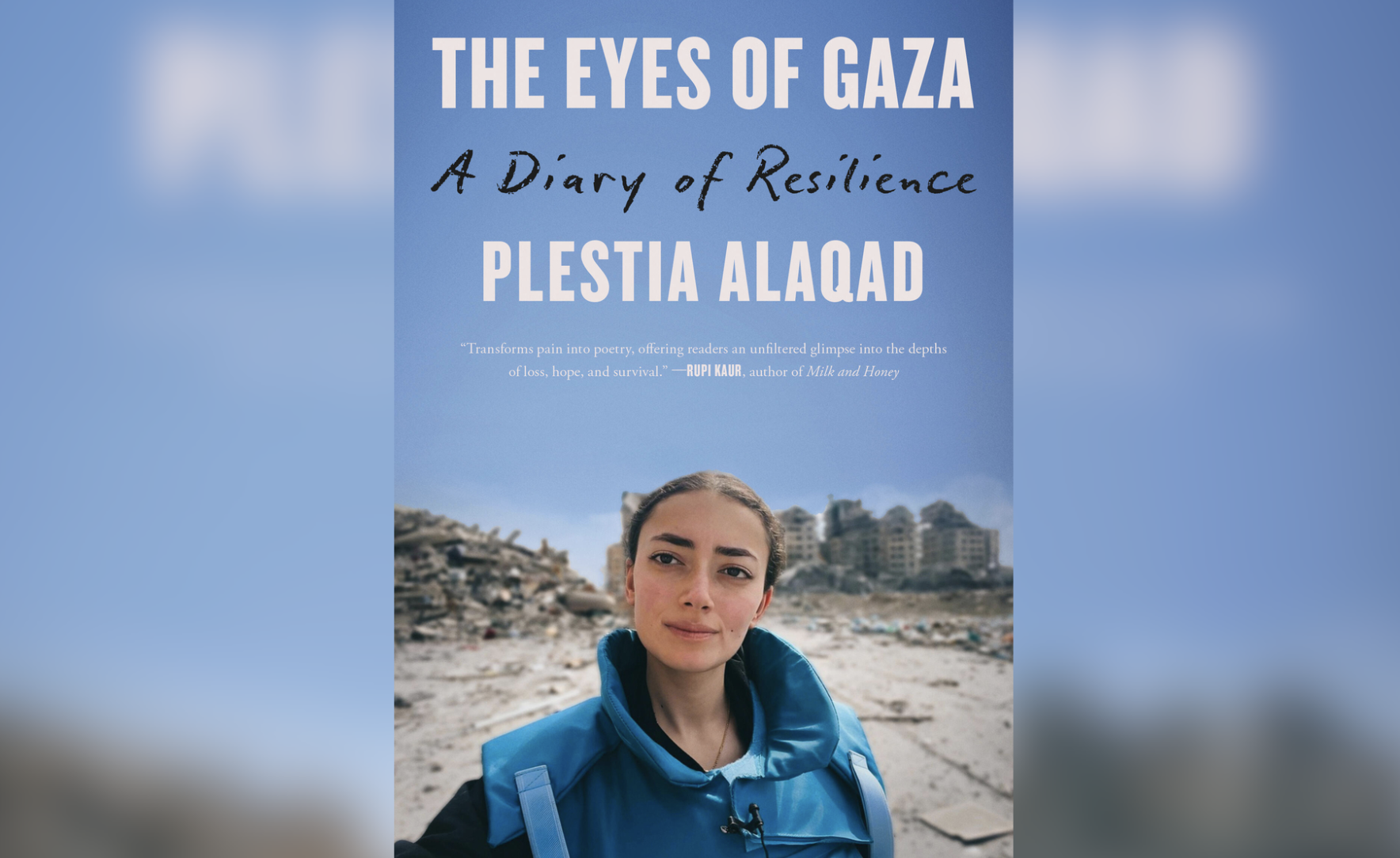
Through The Eyes of Gaza, Plestia Alaqad offers a textured, deeply human portrait of endurance amidst the noise and falsehoods of Western mainstream media and their complicity in the genocide through the perpetuation of Zionist narratives that cast occupiers as victims, resistance as terror, and genocide as self-defense.
The Eyes of Gaza: A Diary of Resilience is a first-hand account of life during the genocide in Gaza, narrated through the raw diary entries of Plestia Alaqad, a journalist and author. Alaqad has been a crucial voice who has brought the daily realities of the genocide to a global stage on her social media platforms. Alaqad’s Instagram account has over 4 million followers. Her short-form videos and real-time reporting have been shared by major international outlets.
Alaqad’s unfiltered narration in her diary transforms distant headlines into an immediate, tangible human experience. Through her book, she captures not only the horrors of the genocide but also the unwavering strength of a people determined to survive, making The Eyes of Gaza both a haunting witness account and a testament to resilience amidst unimaginable loss.
What should have been mundane entries in the diary of a 23-year-old woman—entries that reflected curiosity, celebrated small joys, dreams, and everyday wonder—instead reflect despair, uncertainty, loss, and a deep sense of longing. On October 24th, 2023—18 days into the Israeli aggression—she writes, “Today is a heavy day. Every day feels like the worst day of my life, then Israel outdoes itself, and the next day is worse. My existence is an increasingly suffocating nightmare.”
Journaling has always been a tool for making sense of the world for Alaqad. In the preface, she writes about how she has nurtured the habit since the age of twelve, when she received her first diary—a dark purple notebook with lined pages gifted to her by her mother. She began writing about her school, friends, and her crushes on boys.
But she soon realized that her diary would not be filled with warm recollections alone, and that it would also hold “the memories of living under Israeli occupation, enduring bombardments, and being in a state of near-constant fear of dying or having my loved ones be killed.”
The Eyes of Gaza arrives at a time when our screens are flooded with images of burning land, and dead children—and yet, we scroll past them, numbed, desensitized. Yet, Alaqad refuses this depersonalized, one-dimensional narrative. As she chronicles pain, suffering, and death, she also captures both the personal and collective Gazan resilience—highlighting not just survival, but also living—cooking, laughing, fearing, hoping—under siege.
On October 26, for example, Alaqad writes of how a man named Nadeem had sourced some posters and paintings, and had invited children to draw and color their thoughts at Al-Shifa Hospital. On November 1, when Alaqad returns to the camp after reporting, she celebrates the birthday of Lolo, a five-year-old.
Through these stories, Alaqad offers a textured, deeply human portrait of endurance amidst the noise and falsehoods of Western mainstream media and their complicity in the genocide through the perpetuation of Zionist narratives that cast occupiers as victims, resistance as terror, and genocide as self-defense.
Writing as Therapy
For the better part of The Eyes of Gaza, we are taken through Alaqad’s diary entries from the first 45 days following October 7, 2023, until her exit from Gaza, brief stay in Egypt, and subsequent departure to Australia in March 2024.
There are entries from after this period as well—extending into January of this year—though they are not daily, and sparse. These later entries differ markedly in tone and content: they trace Alaqad’s move to Australia and her slow, uneven process of rebuilding a life away from Gaza. She writes of guilt for having left, for having survived. Gradually, her writing begins to show signs of recovery, of hope returning in fragments.
In the opening pages, Alaqad mentions how, from the time she received her first diary, she became inseparable from it. This reliance is evident in her journal entries during the genocide, when the diary becomes the receptacle for her emotional turmoil as she bears witness to a collapsing world around her.
Her entries reflect a turbulent emotional landscape: from a sense of growing dread (“I am shocked by how quickly the situation is escalating, and I begin to believe that we might be facing an especially bad Aggression”), helplessness and internal conflict with moral burden (“I feel I have to show the world the truth, but that’s difficult to do while I’m also trying to stay alive”), fragile hope and gratitude (“You have to treasure every moment, every laugh and every bit of hope you can”), to frustration at the world’s indifference (“If I scream it loud enough, will the world hear me?”).
Thus, the diary becomes her means of coping with chaos. Alaqad keeps writing: against all odds, against the overwhelming weight of despair. At one point, she’s completely cut off from her family and all her loved ones while reporting with a few fellow journalists from deep inside the conflict zone. Even then, she continues writing, undeterred. Ten days into the genocide, she leaves behind the comforts of home to take refuge in her grandparents’ house in Khan Younis, where she reports amid relentless bombings and sleepless nights.
Her entries from this time reflect longing—not just for safety, but for the ordinary. On November 11, thirty-six days into the genocide, she writes, “I miss my home too. I miss sleeping in my bed, I miss fighting with my sister about who will sleep on the couch, I miss making lunch in the kitchen, and I miss the sleepovers I used to have with my friends in my house. I miss everything.”
In a reality where everything is lost, Alaqad ensures control over at least one thing: her own narrative.
The Diary as a Form of Collective Memory
In its most intimate form, any diary is a private space.. Yet, in the context of Gaza’s devastation, this private document transforms into something far greater: a vessel of collective memory. Each line, each reflection, captures not only the author’s survival, but also the spirit of an entire people caught in the grip of a ruthless war machine: “I’m supposed to be the eyes of Gaza, to show the world what’s happening.”)
Alaqad blurs the line between the personal and the political, the particular and the universal. Her shattered routines, fears for her family, inconsistent meals, and sleepless nights—details so specific to her life—become emblematic of a broader Gazan reality under siege and bombardment. There is, too, an unbearable weight in this act of writing. She becomes a reluctant carrier of memory for those who cannot speak— the dead, the missing, the silenced.
Through her, their lives are marked, remembered, acknowledged. In writing her diary, she performs an ancient, sacred human duty: to witness, so that the living and the lost alike are not erased by the machinery of war and historical forgetting.
Alaqad’s writing is shaped by the broken rhythm of life in Gaza itself. Where every moment is shadowed by uncertainty and fear, the diary as a form— urgent, scattered, unpolished— is inevitable. Its mix of the ordinary and the horrific—entries about food or family suddenly interrupted by airstrikes and death; and captures the disjointed and disorienting experience of living under siege and constant bombing.
Thus, the form mirrors life: fragmented, unstable, and interrupted. In this function, this diary is not alone. It finds companionship in other private records—diaries smuggled from prisons, journals scribbled in bunkers, notebooks hidden from soldiers. Together, they weave an unofficial, people’s history: narratives that will never appear in government archives or military reports, but scattered, intimate texts that will, nonetheless, survive. Her diary joins this archive of resistance, refusing to let the world forget what history will surely omit: the human cost, the quiet endurance, the unrecorded grief of Gaza.
Testimony as a Form of Resilience
Above all, The Eyes of Gaza stands as a testament to resilience—not merely the personal fortitude of Alaqad, but also the unyielding spirit of the Palestinian people. Her writing is a quiet, persistent refusal to break under the weight of a relentless assault on her spirit. Through the book, lives the collective defiance of a people who, despite being besieged, displaced, and erased from official narratives, continue to insist on their right to exist, to be remembered. It is hard not to be moved by this profound resilience.
One cannot help but admire the tenacity with which Alaqad fulfills her dual roles: that of a journalist committed to telling the truth—unvarnished, unfiltered—to a world that has chosen not to see; and that of a young woman determined to preserve her own private world in the face of its disintegration. There is grace in her act of enduring, of continuing to record life amid death, of creating meaning and purpose where the war machine seeks to erase them. Alaqad’s diary offers this grace in abundance.
And yet, there is an unease that lingers: are we to simply consume this suffering as tragic inspiration, a tale of human endurance to marvel at from afar? Or must her words stir something deeper—an anger, an urgency, a demand for action to end the brutalities that make such records necessary in the first place?
This, perhaps, is the most unsettling feeling that The Eyes of Gaza evokes in the reader. For those lost in despair, it offers a fragile thread of hope in the darkest times. And for others, it offers something sharper—a call to conscience, to awareness, to the moral responsibility of those outside Gaza to not simply bear witness, but to act. To categorically refuse the quiet comfort of empathy without consequence.
In this way, Alaqad’s The Eyes of Gaza is more than a personal testament—it is a mirror held up to the world. What we choose to see in it, and what we choose to do with what we see, remain questions she leaves us to ponder.
SUPPORT US
We like bringing the stories that don’t get told to you. For that, we need your support. However small, we would appreciate it.
Adithya Kamesh (he/him/his) is a Political Consultant specializing in Research and Communications. He is passionate about storytelling and enjoys delving into books and movies. His key areas of interest include Feminism, Geopolitics, and History.
Related Posts