



In Gaza, stories are a lifeline. A bridge stretched across ruins, an act of survival itself. The storyteller is not a bard in robes or a smiling grandmother with expansive gestures. Here, the storyteller emerges from the ruins, breathless from walking across broken buildings and scorched roads, bearing grief like a second skin, yet trying to shine a light of hope and resilience against war’s weight.
A storyteller in Gaza is located in the middle of the wreckage — someone who suffers the ravages of war, breathes its smoke, walks for miles under a scorching sun, navigating through sandy alleys between tents to reach children whose eyes hold images no child should ever have to see.
The traditional storytelling in Palestine is known as ‘Hikaye’; the tales are passed down generations, and have a unique narrative style that uses vocal inflections and rhythms to capture the listeners’ imaginations. In wartime, the storyteller’s art shifts from folkloric ritual into lifeline, preserving fragments of childhood slipping through fingers like sand.
“Meeting children in these conditions is hard, extraordinary, and unlike anything we have experienced before,” said Ashjan Abu Obeidallah, a 31-year-old storyteller working amid displacement, hunger, and loss in Gaza City. The children’s names are given to her by the shelter committees, compiled into lists, and scheduled for different sessions. Then they are brought to the site by her organization, Tamer Institute for Community Education, which educates local children.
The children arrive with a multitude of burdens. A boy exhausted from carrying gallons of water. Another child, sobbing, having just lost his father in the latest bombing. Their bodies are weak, weary, and underfed; torn between the memory of a destroyed home and the endless lines at communal kitchens. Hunger trails every child like a shadow.

Shrinking imagination or its stubborn renewal?
Each child who enters the storytellers’ circle carries the absence of thousands of others—more than 18,000 Palestinian children have been murdered since the war began. That is more than one child killed every hour by Israel since October 2023.
“Before the war,” said Abu Obeidallah, “we used to tell children stories about their dreams, their aspirations, about themselves. A child could sail within a story, just as he sails within himself. Now, everything has changed. We are compelled to speak of explosives. Landmines. Strange objects. These have become part of the child’s daily environment, and stories are now a means of warning them of death.”
She added, “Imagination has shrunk, drastically shrunk. The war has robbed the children of Gaza of their ability to imagine.” Speaking about the impact on young lives, she explained, “Their world is trapped in a cruel reality: carrying water, enduring hunger, lacking adequate clothing, and facing catastrophic misery that consumes their days. The spark of creativity falters when every breath is measured against survival.”
Another storyteller, Mohammad al-Amoudi, disagrees with Abu Obeidallah’s view. The 29-year-old storyteller believes that imagination cannot be easily extinguished: “A child’s identity is rooted in imagination, even under the harshest conditions. I see it still pulsating in them despite everything, maybe even against their will. Every child in Gaza carries internal dialogues, creates alternative worlds, and escapes into them when there is no other way out.”
Abu Obeidallah counters: “But when we ask the children about their dreams, the answers are devastating: How can we dream if the war hasn’t ended? How can we dream if we are hungry?”
This clash of views — al-Amoudi’s insistence on resilience, Abu Obeidallah’s warning of collapse — echoes an almost philosophical debate:
Is dreaming biology? Or luxury?
The stories are no longer only folktales. They bend toward survival, toward the rituals of washing with scarce water, the warnings of strange objects on the ground, the hurried maps of evacuation, the fragile art of learning how to live within canvas walls.
One of the stories often told these days is “Very Hungry” by Anas Abu Rahma. In it, a child’s imagination becomes his only defense against excruciating hunger. He waits for food as if for a long-delayed vacation, inventing the sound of a boiling pot, imagining inhaling a scent that does not exist, and tasting meals that do not arrive. Hunger becomes a mental game, a heavy weight that accompanies the family day and night. However, when there is no food for two years of war, the waiting becomes harder than the hunger itself.
Most of the children who attend the storytelling sessions have lost their clothes and belongings in the rubble. Many come every day in the same outfit, soiled by the lack of water and soap. “The shame of dirty clothes destroys a child’s spirit,” said Abu Obeidallah. “They drift away, feel alienated from the space.” Lice and skin infections have spread due to overcrowding in the tents, sometimes forcing her to separate children to limit contagion, al-Amoudi added.
The voices that preserve memory now fight to preserve themselves. The storyteller is at the very eye of the storm, where life collapses into dust in the Gaza Strip. Abu Obeidallah walks three kilometers from her home in Beach Camp to a shelter in Sheikh Radwan in Gaza City, under the hot sun, until her skin changes color. Sweat darkens her dress, dust clings to her hair, and the smell of smoke fills her lungs. Al-Amoudi makes his way on foot, through streets littered with rubble, past abandoned cars. Gaza has long since run out of fuel. Along the way, his mind races: Where will he find water? How will he get food? Prices soar, and the bank swallows half in commission.
“Daily life has become a mountain of worries,” Al-Amoudi said.

And yet, when the performance begins, they both embody joy. “I try to laugh, to joke, to be a source of support,” Abu Obeidallah said. Al-Amoudi describes the moments of storytelling as “boarding a fast train that erases the gloom, if only briefly. It personally gives me a ticket to imagination, just as it gives the children one. We try to counteract the terrible external noise — bombs, destruction, screams, loss — with another internal voice: the voice of the story.”
The storyteller sits among the children like an old shadow. He or she has nothing to give them except his or her voice. Their hands tremble, yet they create birds out of thin air. The children stare at the storyteller’s fingers as if they were secret keys. When he lowers his voice, they come closer. There is a moment when they forget the war, the way one forgets to carry a body. Then the children laugh. One laugh is enough to prove that destruction is not absolute.
Al-Amoudi tells a story about a girl who lost her entire family. The girl came to the session and drew the universe as three balls of fire. “She drew burning coal on the paper,” he said. “She recreated her pain in the colors of the flames, turning suffering into form.”
In al-Amoudi’s eyes, some children find in stories a bridge back to the lives they once knew. Abu Obeidallah observes that while listening to a story, a child is pulled away from the grim reality. Wonder returns. A spark in their eyes. As she narrates tales with hand gestures, shifting tones, and imitations, she sometimes feels that fragile ember flare again.
Healing together
In Gaza, storytelling is not just for children. When asked about the involvement of parents, Abu Obeidallah insisted that it went beyond heritage: “Parents need storytellers too — not just to remember stories from the past, but as a kind of therapy. Adults, too, have imaginations, dreams, and a longing for life. But the war has narrowed these spaces.”
Parents often linger at the edges of sessions, hesitant. Their eyes hold faint echoes of laughter. Abu Obeidallah imagines they want to sit with their children, laughing, shouting, maybe even dancing as the stories unfold.
But they hold back, for fear of appearing childish, or because the war has robbed them of the desire to dance with life.
For al-Amoudi, the parents’ presence signals a “place of hope” that still exists despite everything. In the moment of storytelling, families reclaim an old thread of memory, convincing their children — and perhaps themselves — that life is still possible. He calls it a “colored circle” that gathers everyone in the gray world left behind by the war: the ashes of homes, the ashes of souls, the ashes of everything around them.
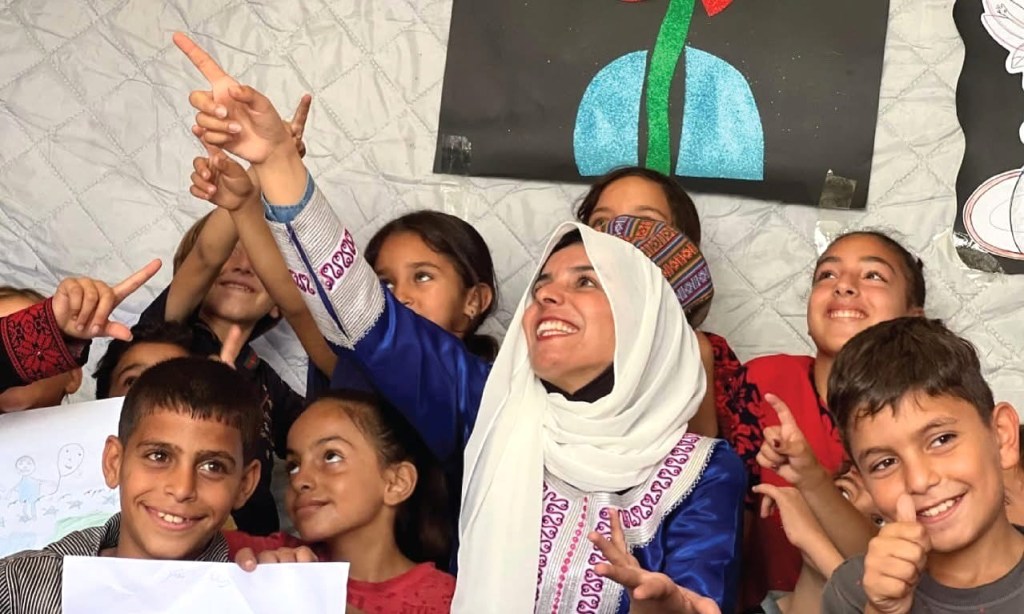
When asked about the messages they hope to convey, Abu Obeidallah says she tries to remind the children of who they were before the war: “I remind them of their laughter, their passion, that there is still room for dreams and life, however small. I try to erase the image of a graveyard from their minds and plant a garden instead.”
Al-Amoudi focuses on creating a safe space: “A space that war cannot penetrate, even if it’s narrow, it is alive, effective, and renewable.”
That space may remain with a child afterward as he stands in line at the community kitchen, a long-awaited bowl of hot food in hand. He might remember a character from the story, or replay a funny scene in his mind. “It’s a difficult equation,” al-Amoudi admitted, “but it is a form of resistance.”
The storyteller in Gaza is more than a narrator. The storyteller is a walker of ruins, a keeper of fragile sparks, trying to rebuild shattered inner landscapes. In the absence of schools and organized education, and after nearly two years of broken contact with knowledge, stories have become lessons in survival and an unspoken form of therapy.
Abu Obeidallah likens her work to repairing a torn canvas: “The war tore apart the inner scene of the child. I try to pick up the fragments and put them back together again.”
Al-Amoudi imagines it differently — as finding a melody in the cacophony of war, a tune audible only to the child and those who share the moment alongside.
Yet these stories are not without tension. Sometimes the storytellers feel as if they are clinging to a fraying thread. But even holding onto a thread can keep a child from falling into the abyss.
The craft of storytelling in Gaza is a living thing. “For me, storytelling is one of the ingredients of Palestinian Sumud--steadfastness,” wrote late author Refaat Alareer. It is a witness to a tragic present, a carrier of remembrance, and a daily confrontation with an existential question: Can stories stand up to war?
For Abu Obeidallah and al-Amoudi, the answer is not certain. But it is a necessary attempt, lest the voice of life in all of us be silenced.
A boy once drew himself without a stomach, saying hunger had eaten it. The page still trembles with that dark laughter. The story ends there, unfinished, like his body, like their lives—fragile, defiant, and still reaching for light.

What It Means to Tell Stories to Gaza’s Children Amid War and Hunger
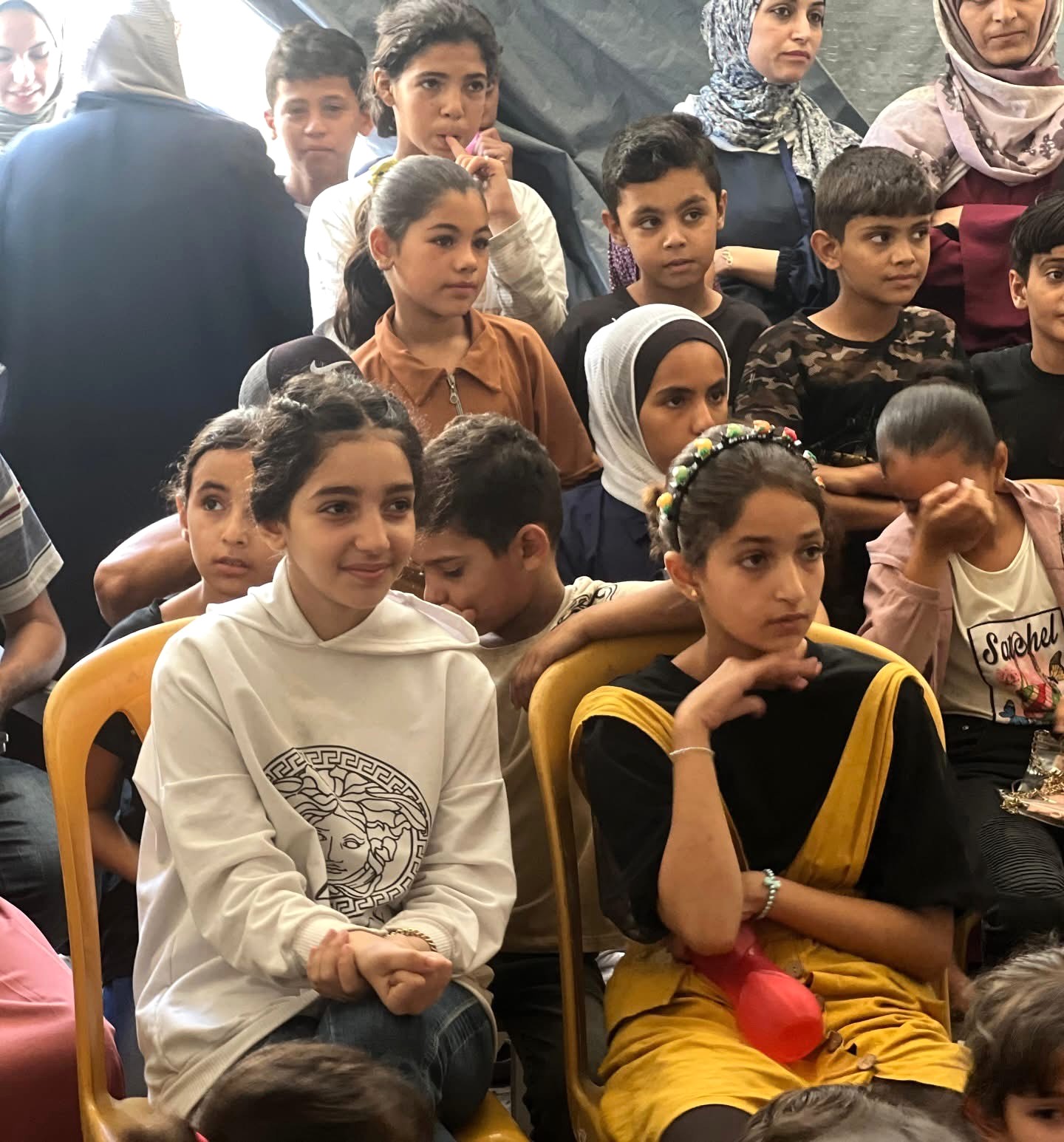
Photo by Husam Maarouf
In Gaza, stories are a lifeline. A bridge stretched across ruins, an act of survival itself. The storyteller is not a bard in robes or a smiling grandmother with expansive gestures. Here, the storyteller emerges from the ruins, breathless from walking across broken buildings and scorched roads, bearing grief like a second skin, yet trying to shine a light of hope and resilience against war’s weight.
A storyteller in Gaza is located in the middle of the wreckage — someone who suffers the ravages of war, breathes its smoke, walks for miles under a scorching sun, navigating through sandy alleys between tents to reach children whose eyes hold images no child should ever have to see.
The traditional storytelling in Palestine is known as ‘Hikaye’; the tales are passed down generations, and have a unique narrative style that uses vocal inflections and rhythms to capture the listeners’ imaginations. In wartime, the storyteller’s art shifts from folkloric ritual into lifeline, preserving fragments of childhood slipping through fingers like sand.
“Meeting children in these conditions is hard, extraordinary, and unlike anything we have experienced before,” said Ashjan Abu Obeidallah, a 31-year-old storyteller working amid displacement, hunger, and loss in Gaza City. The children’s names are given to her by the shelter committees, compiled into lists, and scheduled for different sessions. Then they are brought to the site by her organization, Tamer Institute for Community Education, which educates local children.
The children arrive with a multitude of burdens. A boy exhausted from carrying gallons of water. Another child, sobbing, having just lost his father in the latest bombing. Their bodies are weak, weary, and underfed; torn between the memory of a destroyed home and the endless lines at communal kitchens. Hunger trails every child like a shadow.
Shrinking imagination or its stubborn renewal?
Each child who enters the storytellers’ circle carries the absence of thousands of others—more than 18,000 Palestinian children have been murdered since the war began. That is more than one child killed every hour by Israel since October 2023.
“Before the war,” said Abu Obeidallah, “we used to tell children stories about their dreams, their aspirations, about themselves. A child could sail within a story, just as he sails within himself. Now, everything has changed. We are compelled to speak of explosives. Landmines. Strange objects. These have become part of the child’s daily environment, and stories are now a means of warning them of death.”
She added, “Imagination has shrunk, drastically shrunk. The war has robbed the children of Gaza of their ability to imagine.” Speaking about the impact on young lives, she explained, “Their world is trapped in a cruel reality: carrying water, enduring hunger, lacking adequate clothing, and facing catastrophic misery that consumes their days. The spark of creativity falters when every breath is measured against survival.”
Another storyteller, Mohammad al-Amoudi, disagrees with Abu Obeidallah’s view. The 29-year-old storyteller believes that imagination cannot be easily extinguished: “A child’s identity is rooted in imagination, even under the harshest conditions. I see it still pulsating in them despite everything, maybe even against their will. Every child in Gaza carries internal dialogues, creates alternative worlds, and escapes into them when there is no other way out.”
Abu Obeidallah counters: “But when we ask the children about their dreams, the answers are devastating: How can we dream if the war hasn’t ended? How can we dream if we are hungry?”
This clash of views — al-Amoudi’s insistence on resilience, Abu Obeidallah’s warning of collapse — echoes an almost philosophical debate:
Is dreaming biology? Or luxury?
The stories are no longer only folktales. They bend toward survival, toward the rituals of washing with scarce water, the warnings of strange objects on the ground, the hurried maps of evacuation, the fragile art of learning how to live within canvas walls.
One of the stories often told these days is “Very Hungry” by Anas Abu Rahma. In it, a child’s imagination becomes his only defense against excruciating hunger. He waits for food as if for a long-delayed vacation, inventing the sound of a boiling pot, imagining inhaling a scent that does not exist, and tasting meals that do not arrive. Hunger becomes a mental game, a heavy weight that accompanies the family day and night. However, when there is no food for two years of war, the waiting becomes harder than the hunger itself.
Most of the children who attend the storytelling sessions have lost their clothes and belongings in the rubble. Many come every day in the same outfit, soiled by the lack of water and soap. “The shame of dirty clothes destroys a child’s spirit,” said Abu Obeidallah. “They drift away, feel alienated from the space.” Lice and skin infections have spread due to overcrowding in the tents, sometimes forcing her to separate children to limit contagion, al-Amoudi added.
The voices that preserve memory now fight to preserve themselves. The storyteller is at the very eye of the storm, where life collapses into dust in the Gaza Strip. Abu Obeidallah walks three kilometers from her home in Beach Camp to a shelter in Sheikh Radwan in Gaza City, under the hot sun, until her skin changes color. Sweat darkens her dress, dust clings to her hair, and the smell of smoke fills her lungs. Al-Amoudi makes his way on foot, through streets littered with rubble, past abandoned cars. Gaza has long since run out of fuel. Along the way, his mind races: Where will he find water? How will he get food? Prices soar, and the bank swallows half in commission.
“Daily life has become a mountain of worries,” Al-Amoudi said.
And yet, when the performance begins, they both embody joy. “I try to laugh, to joke, to be a source of support,” Abu Obeidallah said. Al-Amoudi describes the moments of storytelling as “boarding a fast train that erases the gloom, if only briefly. It personally gives me a ticket to imagination, just as it gives the children one. We try to counteract the terrible external noise — bombs, destruction, screams, loss — with another internal voice: the voice of the story.”
The storyteller sits among the children like an old shadow. He or she has nothing to give them except his or her voice. Their hands tremble, yet they create birds out of thin air. The children stare at the storyteller’s fingers as if they were secret keys. When he lowers his voice, they come closer. There is a moment when they forget the war, the way one forgets to carry a body. Then the children laugh. One laugh is enough to prove that destruction is not absolute.
Al-Amoudi tells a story about a girl who lost her entire family. The girl came to the session and drew the universe as three balls of fire. “She drew burning coal on the paper,” he said. “She recreated her pain in the colors of the flames, turning suffering into form.”
In al-Amoudi’s eyes, some children find in stories a bridge back to the lives they once knew. Abu Obeidallah observes that while listening to a story, a child is pulled away from the grim reality. Wonder returns. A spark in their eyes. As she narrates tales with hand gestures, shifting tones, and imitations, she sometimes feels that fragile ember flare again.
Healing together
In Gaza, storytelling is not just for children. When asked about the involvement of parents, Abu Obeidallah insisted that it went beyond heritage: “Parents need storytellers too — not just to remember stories from the past, but as a kind of therapy. Adults, too, have imaginations, dreams, and a longing for life. But the war has narrowed these spaces.”
Parents often linger at the edges of sessions, hesitant. Their eyes hold faint echoes of laughter. Abu Obeidallah imagines they want to sit with their children, laughing, shouting, maybe even dancing as the stories unfold.
But they hold back, for fear of appearing childish, or because the war has robbed them of the desire to dance with life.
For al-Amoudi, the parents’ presence signals a “place of hope” that still exists despite everything. In the moment of storytelling, families reclaim an old thread of memory, convincing their children — and perhaps themselves — that life is still possible. He calls it a “colored circle” that gathers everyone in the gray world left behind by the war: the ashes of homes, the ashes of souls, the ashes of everything around them.
When asked about the messages they hope to convey, Abu Obeidallah says she tries to remind the children of who they were before the war: “I remind them of their laughter, their passion, that there is still room for dreams and life, however small. I try to erase the image of a graveyard from their minds and plant a garden instead.”
Al-Amoudi focuses on creating a safe space: “A space that war cannot penetrate, even if it’s narrow, it is alive, effective, and renewable.”
That space may remain with a child afterward as he stands in line at the community kitchen, a long-awaited bowl of hot food in hand. He might remember a character from the story, or replay a funny scene in his mind. “It’s a difficult equation,” al-Amoudi admitted, “but it is a form of resistance.”
The storyteller in Gaza is more than a narrator. The storyteller is a walker of ruins, a keeper of fragile sparks, trying to rebuild shattered inner landscapes. In the absence of schools and organized education, and after nearly two years of broken contact with knowledge, stories have become lessons in survival and an unspoken form of therapy.
Abu Obeidallah likens her work to repairing a torn canvas: “The war tore apart the inner scene of the child. I try to pick up the fragments and put them back together again.”
Al-Amoudi imagines it differently — as finding a melody in the cacophony of war, a tune audible only to the child and those who share the moment alongside.
Yet these stories are not without tension. Sometimes the storytellers feel as if they are clinging to a fraying thread. But even holding onto a thread can keep a child from falling into the abyss.
The craft of storytelling in Gaza is a living thing. “For me, storytelling is one of the ingredients of Palestinian Sumud--steadfastness,” wrote late author Refaat Alareer. It is a witness to a tragic present, a carrier of remembrance, and a daily confrontation with an existential question: Can stories stand up to war?
For Abu Obeidallah and al-Amoudi, the answer is not certain. But it is a necessary attempt, lest the voice of life in all of us be silenced.
A boy once drew himself without a stomach, saying hunger had eaten it. The page still trembles with that dark laughter. The story ends there, unfinished, like his body, like their lives—fragile, defiant, and still reaching for light.