




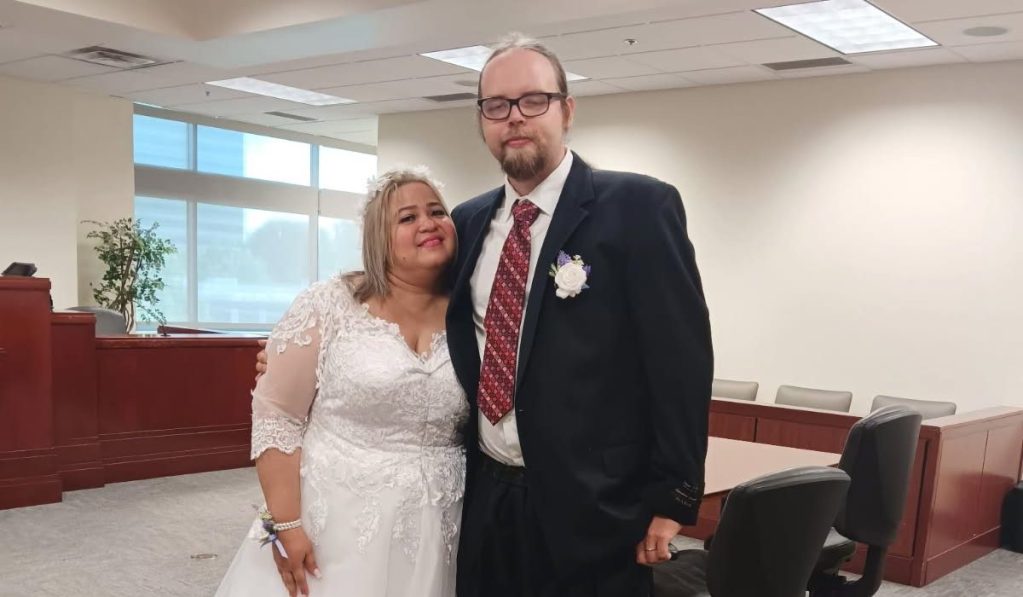
After arriving at her local Immigration and Customs Enforcement (ICE) office in Dallas for an interview regarding her green card application, agents detained Carol Mavo Rivero, 44, for three days. Since local centers were at full capacity, ICE sent her to CoreCivic’s Processing Center in Houston, over 200 miles from home.
Rivero’s husband, Johnny Gallup, said that she was arrested under false pretenses when he had accompanied her to the office for her interview on October 3, 2025.
“They sent her an email saying it was going to be an interview to review her paperwork,” Gallup said. “I stayed in the car to make sure nothing happened to her belongings or extra cash. I woke up from a slight nap needing to use the bathroom… She was already, like, somewhere else, being detained and secluded.”
Mavo Rivero is facing deportation, despite being on the path to citizenship after her wedding to Johnny Gallup last summer. Mavo Rivero had been the caregiver of her husband’s disabled father and grandmother. Gallup has had to sell their furniture to pay necessary legal fees and detention costs.
“She has been using her money for ramen and talking to me,” Gallup said. “And that’s pretty much it for her. I haven’t even been able to give her ramen money since I’ve been broke.”

CoreCivic is one of the largest for-profit prison, jail, and detention contractors in the country and is the subject of several civil rights investigations. CoreCivic has also been accused of exploitation, such as forced labor and inflated fees for basic services.
“It’s like 25 cents a text message, 21 cents a minute on video call at a limit of 30 minutes per call,” Gallup said. “She [Rivero] says that she is only using her money for ramen and talking to me. And that’s pretty much it for her. I haven’t even been able to give her ramen money since I’ve been broke. I literally have only been putting it on the family account for phone time.”
Mavo Rivero came to the United States in 2020 after several moves following the death of her stepmother, Yeisi Carolina Peña, in a police corruption scandal that rocked her hometown in Maracaibo, Venezuela, in September 2016.
Suspects tried in Peña’s murder were previously connected to smuggling operations in the State of Zulia in an investigation by Conectas. Her family and friends have alleged that her attempt to expose corruption within the Maracaibo police, likely in relation to a gasoline smuggling scheme, led to her murder. Peña was shot eight times at her home while her friends were held at gunpoint, including Mavo Rivero’s father, according to Venezuelan news platforms La Verdad and Que Pasa.
After Peña’s murder, Mavo Rivero briefly sought asylum elsewhere in South America before traveling to the U.S. out of fear for her safety. Her father, who also fled Venezuela, requested that his location remain undisclosed. She was granted temporary permission to enter the country through processing via the CBP One app, a phone application developed by Customs & Border Patrol to facilitate lawful entry into the U.S. that went online in 2020. Mavo Rivero was granted parole under the supervision of the Department of Homeland Security (DHS).
“Carol’s entry [into the U.S.], like thousands of others, was in accordance with the rules at the time,” Francisco Mavo, her father, said. “She applied for asylum. She has a driver’s license and a work permit, all in order. She’s married to an American citizen and yet is in [detention].”
Despite Mavo Rivero’s story serving the Trump administration’s narrative on Venezuela—which distinguishes the region almost solely by its drug smuggling operations and government corruption—Mavo Rivero was not granted asylum in the U.S. Even as the Trump administration claims Venezuela’s corruption presents a danger to its own people, Mavo Rivero must now find asylum elsewhere. She fears deportation would put her life in danger as a target for criminal groups in Venezuela because of her association with her stepmother.
“Since Carol and my father weren’t here [and couldn’t testify], four of the police officers were released last December,” said Indira Mavo, Rivero’s sister, who still lives in Venezuela. “She cannot return to Venezuela because they are free.” Family members of Peña have also received death threats from allies of her killers, as reported to the media in Venezuela.
Since the U.S. government does not maintain diplomatic relations with Venezuela, detainees from the country are not provided with a consul to advocate for their human rights. This complicates the legal process, as DHS cannot ensure safe arrivals due to a lack of contact with Venezuela. Moreover, it can even lead to a detainee being deported to another country, such as El Salvador.
The country’s lack of cooperation with Venezuela stems from hostilities arising after Hugo Chavez’s public criticism of U.S. imperialism in 1999, including but not limited to an alleged attempted coup orchestrated by the Bush administration in 2002.
Smuggling operations in Venezuela have been active for decades, but grew into prominence in the wake of Nicolàs Maduro’s election as president in April 2013 following Hugo Chávez’s death. Various criminal groups have utilized connections with officials in military and police bodies to facilitate the smuggling and trafficking of gasoline, drugs, and other contraband substances. Collaboration between government and criminal groups is nothing new in Venezuela, and reports of such activity have been prevalent since the 1990s during the presidency of Rafael Caldera.
Trafficking of illicit or regulated items in Venezuela became a topic of public discussion late last year as Secretary of State Marco Rubio accused Maduro of heading Cartel De Los Soles, a supposed group of government and military officials working in collaboration with cocaine traffickers within the region. This claim was put into question by experts and critics, including The Intercept’s Noah Hurowitz, who pointed out the region’s long history of trafficking, exacerbated by sanctions imposed by the U.S.
This January, Maduro and his wife, Cilia Flores, were kidnapped by the U.S. following an attack on Venezuela. The U.S. government has not presented any evidence that Maduro is collaborating with criminal organizations.
Mavo Rivero is now forced to choose between potential years in detention to fight her deportation in court and immediate deportation. She is seeking voluntary removal to an alternate country. However, Mavo Rivero’s parole status needs to be lifted before her removal due to her being categorized as an “arriving alien” or an applicant for admission. Per U.S. immigration law, one is confined to mandatory detention under this designation.
Allison O’Brien, Mavo Rivero’s lawyer, said that her fate is otherwise squarely in the hands of DHS/ICE.
“Her only other option would be to stay in detention the entire time her case was being approved by USCIS, and that would be if the judge allowed her to, and if DHS didn’t try to just have her deported. So it would still be a long shot, even if that’s what she wanted to do. But because she entered with parole, she can’t get a bond to get out.”
Maria Bravo-Escoto, an immigration lawyer serving Dallas-Fort Worth as part of the firm Escoto Law, said that status as an arriving alien complicates the legal process considerably. She also said that Rivero could be removed long before any victories could be made through litigation.
“[CBP One holders] are categorized as arriving aliens, so they’re not eligible for bond. So based on the statute and the regulations, they have to be detained while their proceedings are ongoing,” Bravo-Escoto said. “It’s definitely very tricky to have someone in that situation, right? They’re fighting against time because the removal proceedings will continue.”
Bravo-Escoto said that issues for users of the CBP One app have become increasingly common following significant changes made in January 2025 at the start of Trump’s second nonconsecutive term. Misleading announcements have even been reported to be mass emailed to parolees through the app.
“Around April, they started sending emails. I was one of the attorneys who received the email that was supposed to go to just CBP parolees, saying ‘you must leave the country now, you have seven days to depart,’” Bravo-Escoto said. “That definitely scared a lot of my clients who got those emails… because it was telling people they had to leave. But some of these people were already in removal proceedings, and if they just left, then it would have really hurt their case with the judge; they can’t just leave.”
Following a hearing on December 18, it became clear that Rivero is receiving “conflicting information” while attempting to withdraw her application for admission, O’Brien said. “The immigration judge told her at the hearing that the process commences when she and the deportation officers sign a paper and send it to the judge to grant [voluntary departure], while the deportation officers have told her multiple times that the immigration judge initiates the process.”
Even now, as a joint motion has been filed between DHS and her lawyer to grant Rivero voluntary departure, some of her personal items have reportedly been lost in storage. Communication with the outside has been minimal, and it is unknown if she has been approved for her selected country. Venezuelans have historically been deported to other nations, sometimes seemingly at random, due to the lack of contact with the country.


She Came to the US Fleeing Violence in Venezuela. Now She Faces Deportation.
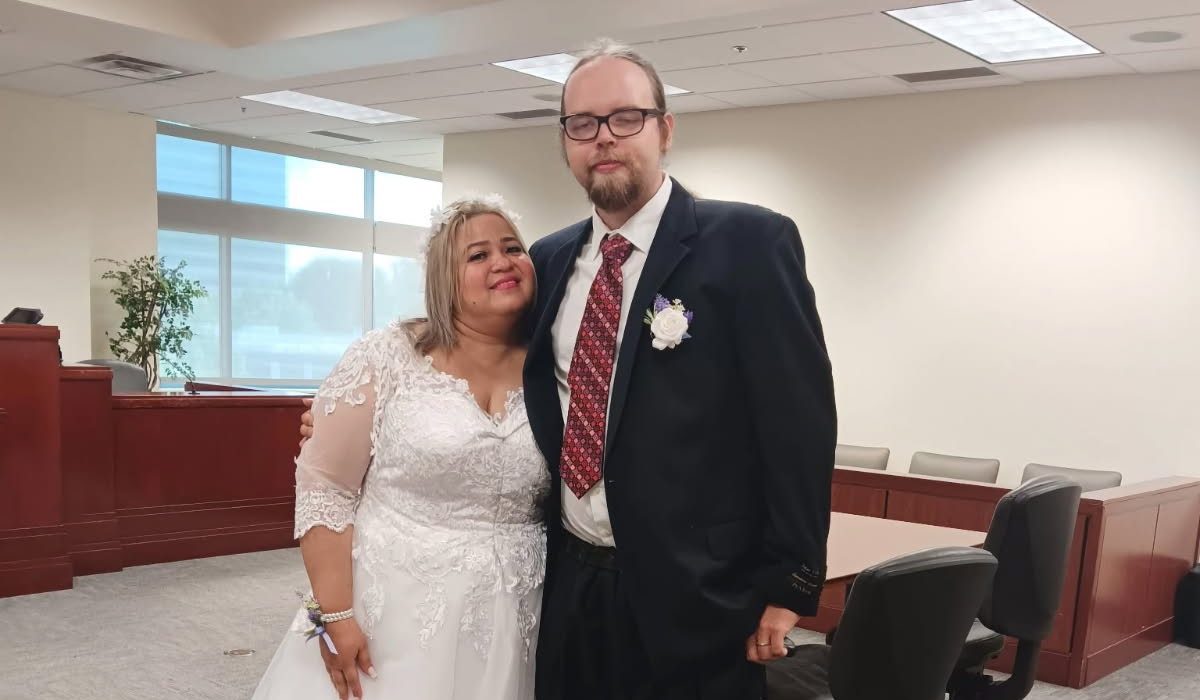
Carol Mavo Rivero married her husband, Johnny Gallup in a small ceremony last summer. She is now confined to immigration detention in Houston. PHOTO CREDIT: GALLUP FAMILY
After arriving at her local Immigration and Customs Enforcement (ICE) office in Dallas for an interview regarding her green card application, agents detained Carol Mavo Rivero, 44, for three days. Since local centers were at full capacity, ICE sent her to CoreCivic’s Processing Center in Houston, over 200 miles from home.
Rivero’s husband, Johnny Gallup, said that she was arrested under false pretenses when he had accompanied her to the office for her interview on October 3, 2025.
“They sent her an email saying it was going to be an interview to review her paperwork,” Gallup said. “I stayed in the car to make sure nothing happened to her belongings or extra cash. I woke up from a slight nap needing to use the bathroom… She was already, like, somewhere else, being detained and secluded.”
Mavo Rivero is facing deportation, despite being on the path to citizenship after her wedding to Johnny Gallup last summer. Mavo Rivero had been the caregiver of her husband’s disabled father and grandmother. Gallup has had to sell their furniture to pay necessary legal fees and detention costs.
“She has been using her money for ramen and talking to me,” Gallup said. “And that’s pretty much it for her. I haven’t even been able to give her ramen money since I’ve been broke.”
CoreCivic is one of the largest for-profit prison, jail, and detention contractors in the country and is the subject of several civil rights investigations. CoreCivic has also been accused of exploitation, such as forced labor and inflated fees for basic services.
“It’s like 25 cents a text message, 21 cents a minute on video call at a limit of 30 minutes per call,” Gallup said. “She [Rivero] says that she is only using her money for ramen and talking to me. And that’s pretty much it for her. I haven’t even been able to give her ramen money since I’ve been broke. I literally have only been putting it on the family account for phone time.”
Mavo Rivero came to the United States in 2020 after several moves following the death of her stepmother, Yeisi Carolina Peña, in a police corruption scandal that rocked her hometown in Maracaibo, Venezuela, in September 2016.
Suspects tried in Peña’s murder were previously connected to smuggling operations in the State of Zulia in an investigation by Conectas. Her family and friends have alleged that her attempt to expose corruption within the Maracaibo police, likely in relation to a gasoline smuggling scheme, led to her murder. Peña was shot eight times at her home while her friends were held at gunpoint, including Mavo Rivero’s father, according to Venezuelan news platforms La Verdad and Que Pasa.
After Peña’s murder, Mavo Rivero briefly sought asylum elsewhere in South America before traveling to the U.S. out of fear for her safety. Her father, who also fled Venezuela, requested that his location remain undisclosed. She was granted temporary permission to enter the country through processing via the CBP One app, a phone application developed by Customs & Border Patrol to facilitate lawful entry into the U.S. that went online in 2020. Mavo Rivero was granted parole under the supervision of the Department of Homeland Security (DHS).
“Carol’s entry [into the U.S.], like thousands of others, was in accordance with the rules at the time,” Francisco Mavo, her father, said. “She applied for asylum. She has a driver’s license and a work permit, all in order. She’s married to an American citizen and yet is in [detention].”
Despite Mavo Rivero’s story serving the Trump administration’s narrative on Venezuela—which distinguishes the region almost solely by its drug smuggling operations and government corruption—Mavo Rivero was not granted asylum in the U.S. Even as the Trump administration claims Venezuela’s corruption presents a danger to its own people, Mavo Rivero must now find asylum elsewhere. She fears deportation would put her life in danger as a target for criminal groups in Venezuela because of her association with her stepmother.
“Since Carol and my father weren’t here [and couldn’t testify], four of the police officers were released last December,” said Indira Mavo, Rivero’s sister, who still lives in Venezuela. “She cannot return to Venezuela because they are free.” Family members of Peña have also received death threats from allies of her killers, as reported to the media in Venezuela.
Since the U.S. government does not maintain diplomatic relations with Venezuela, detainees from the country are not provided with a consul to advocate for their human rights. This complicates the legal process, as DHS cannot ensure safe arrivals due to a lack of contact with Venezuela. Moreover, it can even lead to a detainee being deported to another country, such as El Salvador.
The country’s lack of cooperation with Venezuela stems from hostilities arising after Hugo Chavez’s public criticism of U.S. imperialism in 1999, including but not limited to an alleged attempted coup orchestrated by the Bush administration in 2002.
Smuggling operations in Venezuela have been active for decades, but grew into prominence in the wake of Nicolàs Maduro’s election as president in April 2013 following Hugo Chávez’s death. Various criminal groups have utilized connections with officials in military and police bodies to facilitate the smuggling and trafficking of gasoline, drugs, and other contraband substances. Collaboration between government and criminal groups is nothing new in Venezuela, and reports of such activity have been prevalent since the 1990s during the presidency of Rafael Caldera.
Trafficking of illicit or regulated items in Venezuela became a topic of public discussion late last year as Secretary of State Marco Rubio accused Maduro of heading Cartel De Los Soles, a supposed group of government and military officials working in collaboration with cocaine traffickers within the region. This claim was put into question by experts and critics, including The Intercept’s Noah Hurowitz, who pointed out the region’s long history of trafficking, exacerbated by sanctions imposed by the U.S.
This January, Maduro and his wife, Cilia Flores, were kidnapped by the U.S. following an attack on Venezuela. The U.S. government has not presented any evidence that Maduro is collaborating with criminal organizations.
Mavo Rivero is now forced to choose between potential years in detention to fight her deportation in court and immediate deportation. She is seeking voluntary removal to an alternate country. However, Mavo Rivero’s parole status needs to be lifted before her removal due to her being categorized as an “arriving alien” or an applicant for admission. Per U.S. immigration law, one is confined to mandatory detention under this designation.
Allison O’Brien, Mavo Rivero’s lawyer, said that her fate is otherwise squarely in the hands of DHS/ICE.
“Her only other option would be to stay in detention the entire time her case was being approved by USCIS, and that would be if the judge allowed her to, and if DHS didn’t try to just have her deported. So it would still be a long shot, even if that’s what she wanted to do. But because she entered with parole, she can’t get a bond to get out.”
Maria Bravo-Escoto, an immigration lawyer serving Dallas-Fort Worth as part of the firm Escoto Law, said that status as an arriving alien complicates the legal process considerably. She also said that Rivero could be removed long before any victories could be made through litigation.
“[CBP One holders] are categorized as arriving aliens, so they’re not eligible for bond. So based on the statute and the regulations, they have to be detained while their proceedings are ongoing,” Bravo-Escoto said. “It’s definitely very tricky to have someone in that situation, right? They’re fighting against time because the removal proceedings will continue.”
Bravo-Escoto said that issues for users of the CBP One app have become increasingly common following significant changes made in January 2025 at the start of Trump’s second nonconsecutive term. Misleading announcements have even been reported to be mass emailed to parolees through the app.
“Around April, they started sending emails. I was one of the attorneys who received the email that was supposed to go to just CBP parolees, saying ‘you must leave the country now, you have seven days to depart,’” Bravo-Escoto said. “That definitely scared a lot of my clients who got those emails… because it was telling people they had to leave. But some of these people were already in removal proceedings, and if they just left, then it would have really hurt their case with the judge; they can’t just leave.”
Following a hearing on December 18, it became clear that Rivero is receiving “conflicting information” while attempting to withdraw her application for admission, O’Brien said. “The immigration judge told her at the hearing that the process commences when she and the deportation officers sign a paper and send it to the judge to grant [voluntary departure], while the deportation officers have told her multiple times that the immigration judge initiates the process.”
Even now, as a joint motion has been filed between DHS and her lawyer to grant Rivero voluntary departure, some of her personal items have reportedly been lost in storage. Communication with the outside has been minimal, and it is unknown if she has been approved for her selected country. Venezuelans have historically been deported to other nations, sometimes seemingly at random, due to the lack of contact with the country.