


“This is how they’re treating a Palestinian at PEN,” announced Randa Jarrar while being dragged out of a PEN Out Loud event in February 2024, hosted by Mayim Bialik, a vocal Zionist, who was called out for a deeply insensitive joke about Israel’s war in Gaza. In protest, Jarrar and others read the names of 13 Palestinian writers killed by Israel in Gaza till that point. As of today, Israel has killed more than 270 journalists and media workers in Gaza since 7 October 2023.
Jarrar had volunteered with PEN America, a nonprofit organization working on freedom of expression and the literary arts, for nearly two decades. Her protest and subsequent silencing by PEN catalyzed a wave of withdrawals from PEN’s annual World Voices Festival, leading to its ultimate cancellation last year.
Jarrar is a Palestinian-Egyptian American novelist, essayist, performer, and translator. Her writing often uses whimsical, dark humor to explore profound themes surrounding diaspora and home, complex family dynamics, state violence, and queer desire.
Her award-winning debut novel, A Map of Home (2008), is a coming-of-age story of a young Palestinian-Egyptian woman who, like Jarrar, grows up in Kuwait and Egypt before moving to the US as a teenager. She has also published a short story collection titled Him, Me, Muhammad Ali (2016) and a memoir, Love Is an Ex-Country (2021), which explores her experiences as a queer, fat, Arab American.
Jarrar is also known for her pithy irreverence, from her 2014 essay, “Why I can’t stand white belly dancers”—which evoked a discourse on cultural appropriation and Orientalism—to her 2018 tweets about the former First Lady Barbara Bush, who died at the age of 92. “Barbara Bush was a generous and smart and amazing racist who, along with her husband, raised a war criminal,” Jarrar, then a creative writing professor at California State University, wrote. “Fuck outta here with your nice words.”
Jarrar carries that same unflinching moral clarity while dealing with Western cultural institutions and their double standards on Palestine. “Zionism is the exception to most liberal standards,” she said to me, something she has no tolerance for. This July, for instance, Jarrar withdrew from the Edinburgh International Book Festival over its platforming of Israeli writer Etgar Karat, who denied that Israel’s actions in Gaza constitute genocide.
“I will not waste my own time educating you, nor will I allow the fest to use my Palestinian queerness to wash its associations with genociders,” Jarrar wrote to the Book Festival team in an email she shared on her Instagram. “My people deserve better than this entire world offers them. I will not allow your festival access to me.” Soon after, the poet Fady Joudah and journalist Omar El Akkad followed suit.
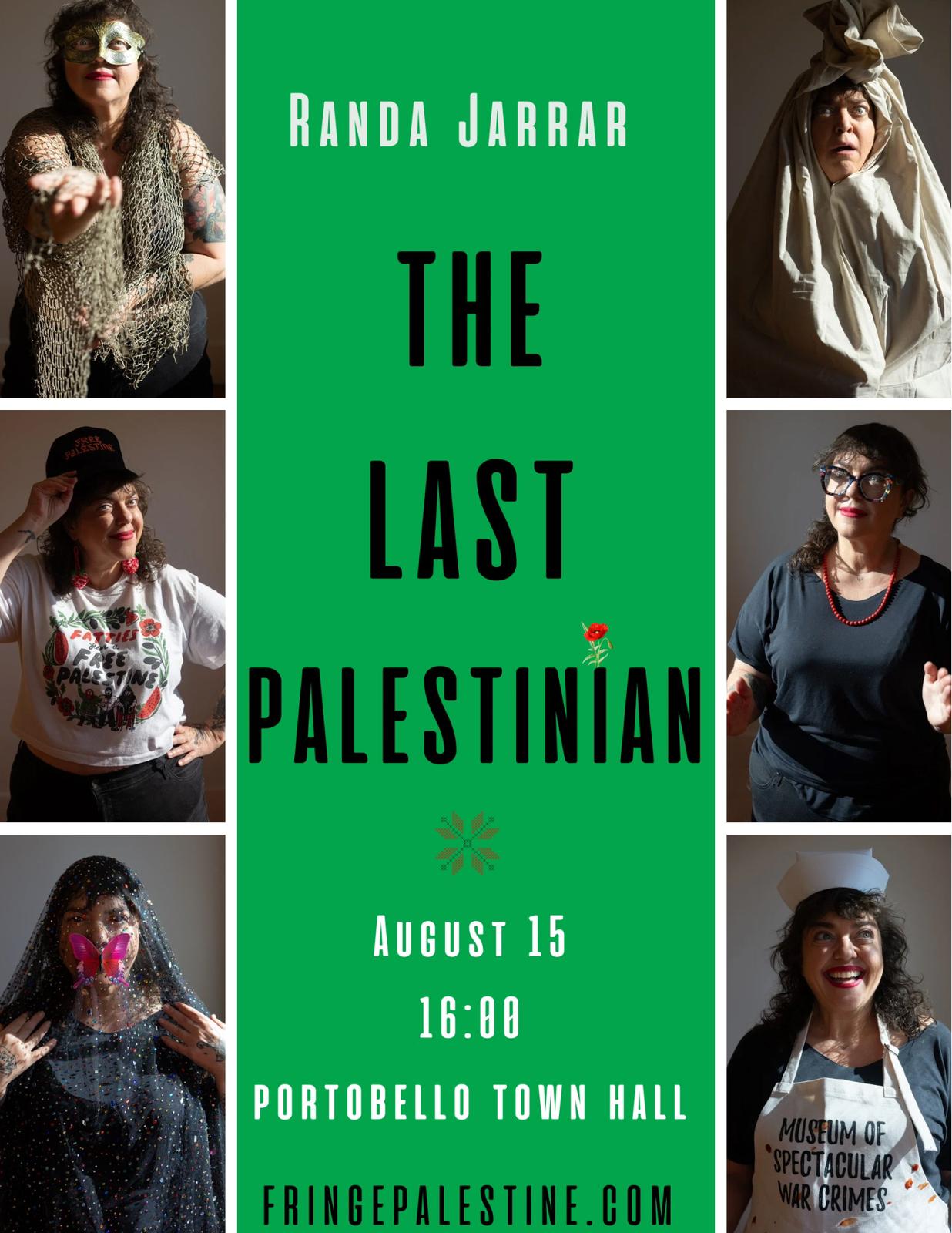
Jarrar has recently been dabbling in performance, voicing the role of Grandma in Ramy Youssef’s animated comedy series #1 Happy Family USA, which follows an Egyptian-American family’s life after 9/11. This year, she debuted a solo play, The Last Palestinian, which she wrote and performs herself. Set in 2055, it follows Asheerah—the last surviving Palestinian, who it turns out, is also the last surviving person on Earth—as she tries to figure out what happened with the help of an AI companion modeled on UN Special Rapporteur Francesca Albanese. In the process, we see renditions of different characters come to life, from the singer Björk to the goddess Anat.
The show is neither subtle nor sophisticated, but it channels Jarrar’s raw rage with absurdist humor and outlandish hypotheticals. I watched it last month at London’s Palestine House, sipping on Gaza Cola and nibbling on fresh, hot knafeh with a small, like-minded audience. Theater, it seemed, allowed this eclectic, passionate artist to step off the page and into her body. As Jarrar flitted between playing six different characters on stage, thoroughly milking their various accents and intonations, I felt a profound sense of joy, catharsis, and community. It was a space to not only hold collective grief, but also reimagine justice and even entertain revenge fantasies.
I sat with Jarrar a few weeks later to discuss how she navigates Western cultural spaces, writing and performing The Last Palestinian, working on Yussef’s TV show, and what genuine solidarity with Palestinians looks like. What follows is an edited excerpt of our conversation.
Kaashif Hajee: What were the most formative moments that shaped your voice as a writer, cultural producer, and outspoken activist?
Randa Jarrar: I was born in 1978, so I was lucky enough to experience visiting Palestine before the First Intifada [1987], and my family and I could drive to many different parts of Palestine—although I could never visit Jerusalem. Traveling to Palestine and going over the Allenby Bridge [the only crossing between Jordan and the occupied West Bank] and being strip-searched as a young girl was a very politically galvanizing experience: being sexually assaulted by people in uniform with giant guns who looked very white. So experiencing colonialism in my body—an erasure of and an attack on my own personal boundaries as a child—and not having the language to talk about it formed a crucial part of my life.
Then, hearing stories about my family and knowing historical facts about the Jarrars further put me on this journey: reading about how, when Napoleon tried to invade our part of Palestine in 1799, my father’s ancestor wrote an oral poem that galvanized and connected all the northern tribes in Palestine to fight against Napoleon. And they won. Then, I read later in Napoleon’s version of history that he supposedly “couldn’t continue with his conquest of Palestine because he didn’t have enough room for the prisoners.” This shows how history gets rewritten.
And then I read various texts over the years, primarily by Black and African women, including books like Nervous Conditions (1988) by Tsitsi Dangarembga and works by Frantz Fanon, which helped me understand how and why violence is not just something that the colonizer enacts, but also something that can be used against them.
KH: You’ve often chosen refusal—walking out, withdrawing, or saying no—as a form of resistance against various Western cultural institutions. What does that refusal allow for you as a writer?
RJ: It gives me a home. It gives me a sense of self-respect. It gives me boundaries that I can actually exercise and maintain. It gives me a community of people who also refuse. It reveals who has the guts and who doesn’t, not just those who performatively talk about resisting, but those who actually resist. It also shows the world how many institutions are just liars out to maintain their wealth and power. So, it gives me power.
KH: Has there been a personal cost to this refusal?
RJ: No. For me, these institutions, platforms, or places are disgusting. They nauseate me with their hypocrisy. They don’t align with who I am, what I want to do, and how I want the world to be. For me, the idea that losing a job is important in any way is just absolutely farcical at this point, with the possibility of 300,000 Palestinians being killed over the last almost two years of genocide, let alone how many others have been killed during the last 76 years, and the colonial project that makes it its business to annihilate my people and any kind of resistance in the Global South to its hegemonic projects and ideas.
And so for me, a career means nothing. A job is nothing. It’s losing opportunities with people and institutions. Power is a gift. I love watching a bridge burn behind me, because that means that the institution—those disgusting criminals—doesn’t have access to me any longer. I would love for other cultural producers to see it that way: that we actually have power as artists, and what we produce together is far more powerful. We’ve gone past a world where we need giant publications or platforms to give us a voice. We can give ourselves a voice. We have access to the means of production, so why not seize them?
KH: Tell me about your act of protest with PEN America last year. Did you expect the wave of withdrawals following the incident when you were forcibly removed?
RJ: I did not expect that kind of reaction because it wasn’t the first time I’ve been publicly flogged for doing what I believe in. In the past, I didn’t really see people rise to resist alongside me.
The fact that PEN was refusing to listen to so many people who were working with them [for free, and for decades] because they believed in what PEN America was doing, and then all of a sudden, through the portal of the genocide, they saw, “Oh wait, they’re not who they say they are.” And once that mask comes off, artists and writers realize, “Oh wait, I’m not contributing to something that actually matters, so I’m going to withdraw.” It was very powerful to see.
KH: You also recently withdrew from the Edinburgh International Book Festival. Did you ever worry that if you didn’t participate, then there wouldn’t be a Palestinian non-male voice there at all?
RJ: I really don’t agree with the whole “if I’m not there, then that’s a voice lost,” because that’s on them; it’s on the people doing the inviting to create a space that really honors me, and the work I’ve done. And they didn’t do that, so they lost. I went to Edinburgh with Welcome to the Fringe, Palestine, a collection of amazing volunteers and producers who have worked with Palestinians for years, and wanted to honor us. They invited us, and absolutely no Zionists.
By withdrawing, we send a powerful message by saying, “Hey, if, for example, the Edinburgh International Book Festival really wants to honor Palestinian voices, don’t invite people who deny that there’s a genocide, because then you’re basically saying that we’re not human. You’re agreeing that we’re not human.” So what’s the point of attending something that says that? And, yeah, so next time, don’t invite our murderers. There’s no conversation for that. There’s no excuse.
KH: What role do you think cultural institutions play in mediating discourse and manufacturing consent for what happens on the ground in politics?
RJ: Cultural institutions have the power to co-sign or reject genocide. It’s a responsibility that they might pretend not to have, but it just is the way it is. The New York Times, for instance, has consistently repeated the lies that the IOF [Israel Offensive/Occupation Forces] has stated, lies that dehumanize Palestinians and allow them to appear less human. The people working for The New York Times in Palestine are all settlers or have family members who are settlers, militants, or people in the IOF themselves. So this idea or excuse of neutrality is a myth, and it’s just used to cover egregious war crimes and more. It’s a responsibility, and we can’t overstate the influence of culture.
KH: How do you think about the body and humor together as strategies of survival, forms of resistance, or ways of holding grief without being consumed by it?
RJ: I just think living in a human body is hilarious. Maybe it’s because of the way I exist in the world at a very superficial level: the fact that I have light skin and light eyes means that I am allowed access to communities and places that think I’m a safe person for them to voice their disgusting, racist thoughts to. So in a way, I feel like a spy. At the same time, I’m told by my own people that I don’t look like them, or that I must not actually be Arab or Palestinian or Muslim because of my appearance.
Then, being fat, I’m told that, quite literally, I don’t belong. A chair will be too small, or people will move very far away from me when I’m getting on an airplane, as though my obesity were something they can catch. And as someone with an autoimmune disease, I’m constantly thinking about and grieving the fact that my body is not what I thought it was, which is, you know, just powerful.
Humor, to me, has always been a way to access and say forbidden things. It’s such an old thing that Palestinians do. And actually, all indigenous groups that have faced extinction or attempts at extinction have that gallows humor. Addressing the powerful through humor has always been a trick I have relied on, especially growing up as a girl in a household with a strict father. One way to access freedom was to make him laugh and to tell him stories.
Using humor and storytelling has given me the freedom I want, but has also created a weird liminal space for me as an outsider. But I like that, because then I can see the entire culture from that margin rather than being in the center and in a bubble about what’s actually happening.
KH: Tell me about The Last Palestinian. What was your inspiration behind the concept, and what were you trying to communicate? And why a performance?
RJ: In October of 2023, a lot of Palestinians could tell this was going to be a genocide, or a continuation of a 76-year project to exterminate us. And I had this idea: what if they exterminate all Palestinians and leave just one? Because that one Palestinian will be safe for them to control. And it has to be a woman, because Palestinian men are seen as dangerous. So, I just thought, “What would happen if there were only one last Palestinian?” I thought about that question over and over again. I tried writing it as a novel, and it didn’t work.
Then my friend Victor went on a medical strike. Victor is an amazing playwright, and they had worked with New York Theater Workshop for years as the playwright-in-residence. Victor had staged at least two shows with them. But when Victor kept asking them to call for a ceasefire, they wouldn’t do it. One day, Victor realized that people in Palestine can’t take their medications, including people with HIV. So Victor, who is HIV-positive, decided to stop taking their medication. Victor was using their body. Victor was digging their own grave and documenting it on social media, challenging this cultural institution.
I felt really moved by this act and became increasingly interested in theater and performance. Victor taught me that theater’s main original purpose is to revive the dead. Indigenous groups would use theater to bring on rain, bring on sunshine, and revive the dead. The power of that was so impressive and huge to me that I thought about reviving our martyrs, and I thought, “Well, there are all these amazing testimonies that our martyrs left behind. Should I dramatize those?”
KH: How did you arrive at the six characters in The Last Palestinian?
RJ: I wanted to focus on archetypal characters. So I chose six characters: Asheerah, the young woman who survives the genocide and is the only remaining survivor of the world. So getting to that part was really powerful. Understanding that actually the last Palestinian would be the last person alive, because when all Palestinians die, everyone is effectively dead.
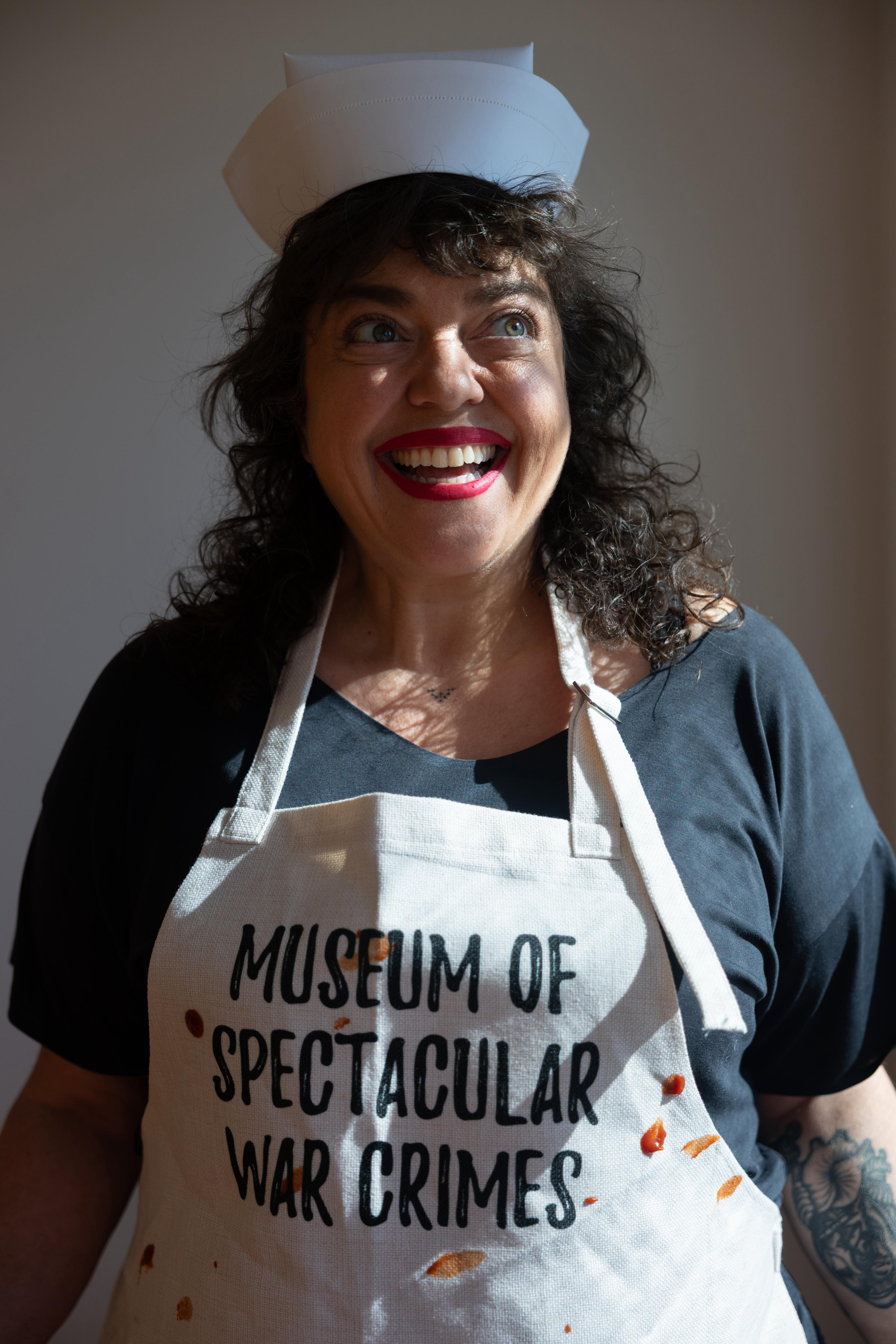
And then the second character, Francesca Albanese, because it’s interesting to see an Italian woman, someone who doesn’t share lineage, religion, or borders with Palestinians, fight so hard for them. She’s also hilarious, and I love doing an Italian accent. Björk, because Björk is amazing. The goddess Anat, because she’s older than the Pyramids [of Giza]; many people don’t know that Gaza is 5000-6000 years old. And Falastin, who’s an oral storyteller, and Dorit, who is an anti-Zionist Jew and an archivist at a war crimes museum.
Through these characters, I could basically create a fantasy of how I wanted the world to be before it ended. I wanted to create a show that was past, present, and future. I love the idea of time being cyclical and not linear, because I’m queer.
Ultimately, writing, creating, and learning how to perform on stage for this show has saved my life because I’ve just been so fucking depressed, as has everyone else, that I needed a vehicle. I needed something to hold my grief, but I also wanted that vehicle to have some power, and for that power to charge other people and hopefully ask them to take action, tell them, “Hey, are we all dead because we’re watching this? Or do we still have enough life in us to take action, to stop this?”
KH: The title, The Last Palestinian, is quite provocative and has a sense of nihilism as it seems to presuppose a dystopian end to the genocide. Were you not concerned about how that might come across?
RJ: I thought of the title as something that people will bring their own ideas and thoughts to. So they might see the title, and their mind might go there to nihilism, when in fact, the show is absolutely the opposite of that. The show imagines a world where the only people alive and on Earth will be Palestinians. My writing is provocative on purpose. The time to worry about what people might think has passed.
I hope that people will read the play or watch the show and understand what I’m trying to say, which is affirming life and our right to existence, us Palestinians, us indigenous people everywhere, and as a warning to the world: when will this stop? Will you only stop when there is only one of us left? And how can we all take action to ensure that does not happen?
KH: What has been your experience performing the show? What have been some of the responses you’ve gotten?
RJ: I’ve only performed it twice. It’s a very new show, so I performed it once before in Edinburgh, and it was a packed house, and everybody there was a supporter of Palestine. So it was a very similar crowd of supporters. Palestine House was completely different from that first experience because it was much more intimate, small, and had no tech whatsoever.
Performing the show is really fun. It’s also cathartic. I feel the goddess Anat, in a way, is visiting us. You know, her bust was discovered in 2022 in Gaza by a farmer and was placed in a museum, and then that museum was bombed. So I wonder if she and other ancestors, other Palestinian women—whether they were called Palestinian at the time or not—are with us in this moment. Performing makes me feel like a portal or bridge in time for all of us to connect and come up with ways to resist.
I hope to take the show to different spaces and places. But it’s a very new show, and I just wrote it this summer and had the absolute honor of working with theater directors, people like Dilo and Victor, who helped me figure out how to do this performance. It’s my first stage performance. I wanted to do it because I wanted to challenge myself. As an artist, it’s important to be uncomfortable and do things that we are fearful of doing, because the work of liberation can be very scary; so why not practice?
KH: You’ve also voiced the character of Grandma in Ramy Youssef’s show, #1 Happy Family USA (2025). What was that like?
RJ: Playing Grandma was really fun because I got to be so different. I could just show up as my voice. I got to work with Pam Brady, a brilliant creator herself who helped create South Park (1997-Present) and knows what she’s doing. I got to work with Mona Chalabi, an amazing artist and thinker, and of course, Ramy, who, in my mind, is one of the very few people in a position of power to consistently use really big platforms to consistently speak out for Palestine.
It was amazing to play this Egyptian, feminist Niqabi matriarch, someone who is absurd, too, in the way her body appears, and also someone full of comedy. She’s hilarious. I basically got to embody these old iconic Egyptian women I’d grown up with. And she’s also the only character who actually honors and loves the sole gay character in the family. She’s ahead of her time. I love her. Performing as her also gave me the kind of experience and practice to be a different character.
KH: What do you make of the conditional solidarity that Palestinians are offered?
RJ: Those people who offer conditional solidarity can go fuck themselves. If anything, it shows how performative and fake their allyship is. I’m actually grateful to be Palestinian because it creates this instant unmasking of people and really shows how far they’re willing to go.
We have to go far to properly ally and support, especially Palestinians who are undergoing genocide at this moment. We have to become uncomfortable. They’re losing their lives. And before they lose their lives, they lose their homes over and over again. They lose limbs, they lose their children, they lose different family members, they lose everything. So, pushing ourselves, all of us, to reevaluate what is actually important to us: do you really need what you think you need?
KH: What does genuine solidarity look like to you, especially in the diaspora?
RJ: Genuine solidarity could look like so many things. The simplest way is to look at BDS [Boycott, Divestment, Sanctions] and what the Palestinian civil society has asked us to do, which is to amp up our resistance and to boycott. And also, sadly, to fundraise to help families on the ground get the money and medical care they need. Diverting our spending and, more importantly, organizing through unions for a serious general strike is what we have needed for a long time.
But also imagining the world as you want it to be, rather than thinking that it’s an impossibility or a fantasy. The United States of America began as a fantasy, and so did “Isra-hell.” It began as a novel. So how can we imagine a different world? Let’s not shy away from the idea of cringe, and instead embrace daring, embrace the absurd, and never give in to despair, because that’s when we lose.
We have to think there is a chance—and there actually is a chance. Now, when people think of Israel, they don’t think, “Oh, the ending of Schindler’s List (1993) when everybody gets to go home.” They think of dead, powerless people, children, and babies.
This is a moment that we can’t afford to dip into despair about. We have to honor the dead. We have to fight. And there are so many different ways to do that, and different levels of comfort people have in terms of how much they want to fight. So find your comfort level, find your people, and take action every single day.
KH: If you could imagine a literary or artistic world shaped by Palestinians and their allies, what would that look like? What structures, values, and practices would have to be rebuilt from the ground up?
RJ: Everything, from the ways that babies are born and cared for, to the ways that the maternal is honored and recognized. Education systems that challenge and honor everyone. I dream of a time when we can exist outside of capitalism and rely on each other. You know, we’ve always been farmers. We’ve always belonged to the land. The land doesn’t belong to us. We belong to it. So, a return to the land and our old practices of farming, gathering, caring for each other, living in communities instead of this ridiculous individualistic society that is a nightmare and simply not sustainable.
And then, as artists, it would be so amazing for us to have our own theaters, our own workshops, our own clown schools, our own comedy places, our own everything. We don’t need the approval and the gaze of the Global North or the West to give our art credence, value, and credibility. And if we do need that, we need to figure out why. We need to decolonize ourselves from the inside out and embrace the audience of each other.
“Cultural Institutions Have the Power To Co-Sign or Reject Genocide”: Randa Jarrar on Refusal, Resistance, and ‘The Last Palestinian’
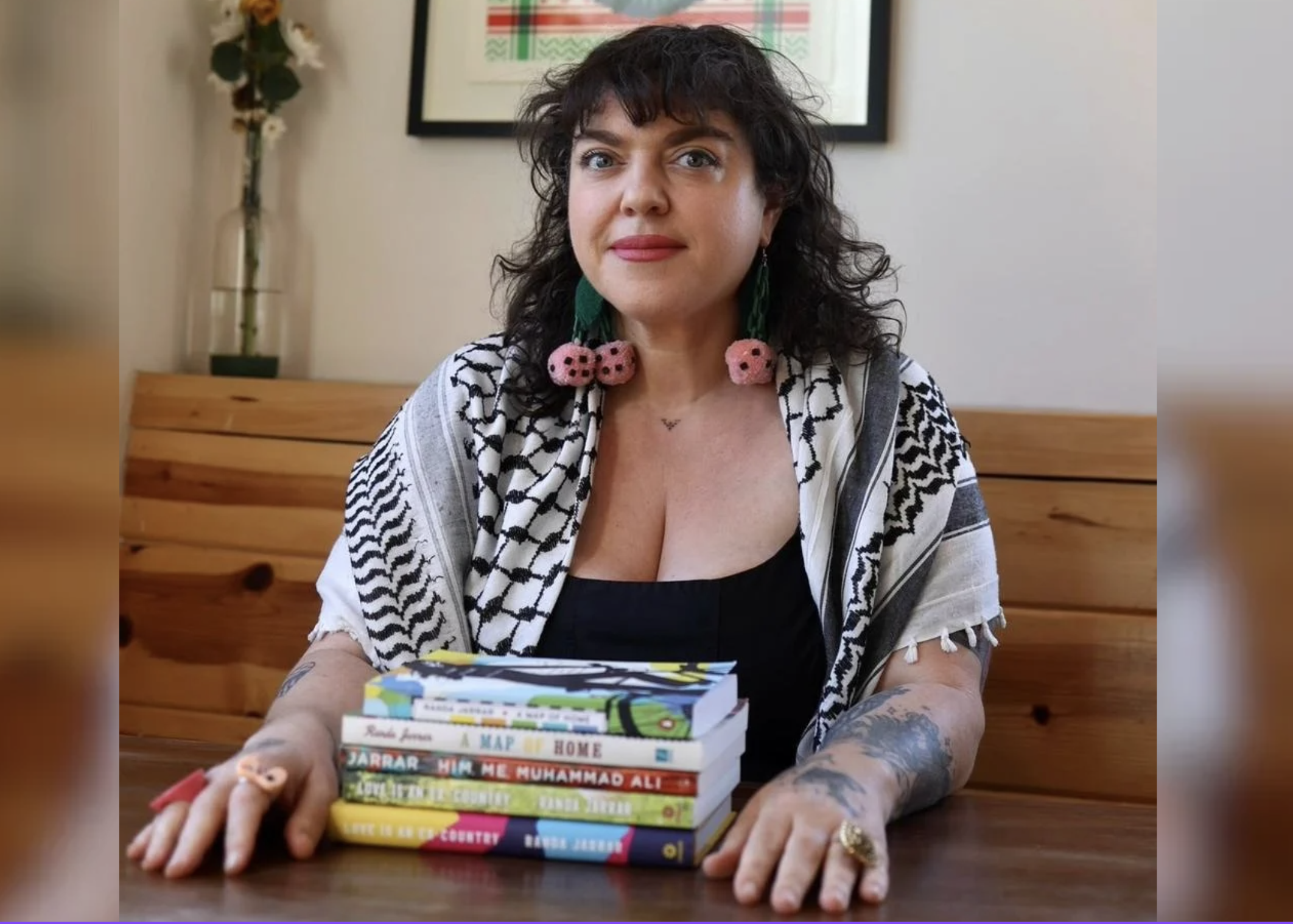
Randa Jarrar is a Palestinian-Egyptian American novelist, essayist, performer, and translator. Photo by Assad Shalhoub.
“This is how they’re treating a Palestinian at PEN,” announced Randa Jarrar while being dragged out of a PEN Out Loud event in February 2024, hosted by Mayim Bialik, a vocal Zionist, who was called out for a deeply insensitive joke about Israel’s war in Gaza. In protest, Jarrar and others read the names of 13 Palestinian writers killed by Israel in Gaza till that point. As of today, Israel has killed more than 270 journalists and media workers in Gaza since 7 October 2023.
Jarrar had volunteered with PEN America, a nonprofit organization working on freedom of expression and the literary arts, for nearly two decades. Her protest and subsequent silencing by PEN catalyzed a wave of withdrawals from PEN’s annual World Voices Festival, leading to its ultimate cancellation last year.
Jarrar is a Palestinian-Egyptian American novelist, essayist, performer, and translator. Her writing often uses whimsical, dark humor to explore profound themes surrounding diaspora and home, complex family dynamics, state violence, and queer desire.
Her award-winning debut novel, A Map of Home (2008), is a coming-of-age story of a young Palestinian-Egyptian woman who, like Jarrar, grows up in Kuwait and Egypt before moving to the US as a teenager. She has also published a short story collection titled Him, Me, Muhammad Ali (2016) and a memoir, Love Is an Ex-Country (2021), which explores her experiences as a queer, fat, Arab American.
Jarrar is also known for her pithy irreverence, from her 2014 essay, “Why I can’t stand white belly dancers”—which evoked a discourse on cultural appropriation and Orientalism—to her 2018 tweets about the former First Lady Barbara Bush, who died at the age of 92. “Barbara Bush was a generous and smart and amazing racist who, along with her husband, raised a war criminal,” Jarrar, then a creative writing professor at California State University, wrote. “Fuck outta here with your nice words.”
Jarrar carries that same unflinching moral clarity while dealing with Western cultural institutions and their double standards on Palestine. “Zionism is the exception to most liberal standards,” she said to me, something she has no tolerance for. This July, for instance, Jarrar withdrew from the Edinburgh International Book Festival over its platforming of Israeli writer Etgar Karat, who denied that Israel’s actions in Gaza constitute genocide.
“I will not waste my own time educating you, nor will I allow the fest to use my Palestinian queerness to wash its associations with genociders,” Jarrar wrote to the Book Festival team in an email she shared on her Instagram. “My people deserve better than this entire world offers them. I will not allow your festival access to me.” Soon after, the poet Fady Joudah and journalist Omar El Akkad followed suit.
Jarrar has recently been dabbling in performance, voicing the role of Grandma in Ramy Youssef’s animated comedy series #1 Happy Family USA, which follows an Egyptian-American family’s life after 9/11. This year, she debuted a solo play, The Last Palestinian, which she wrote and performs herself. Set in 2055, it follows Asheerah—the last surviving Palestinian, who it turns out, is also the last surviving person on Earth—as she tries to figure out what happened with the help of an AI companion modeled on UN Special Rapporteur Francesca Albanese. In the process, we see renditions of different characters come to life, from the singer Björk to the goddess Anat.
The show is neither subtle nor sophisticated, but it channels Jarrar’s raw rage with absurdist humor and outlandish hypotheticals. I watched it last month at London’s Palestine House, sipping on Gaza Cola and nibbling on fresh, hot knafeh with a small, like-minded audience. Theater, it seemed, allowed this eclectic, passionate artist to step off the page and into her body. As Jarrar flitted between playing six different characters on stage, thoroughly milking their various accents and intonations, I felt a profound sense of joy, catharsis, and community. It was a space to not only hold collective grief, but also reimagine justice and even entertain revenge fantasies.
I sat with Jarrar a few weeks later to discuss how she navigates Western cultural spaces, writing and performing The Last Palestinian, working on Yussef’s TV show, and what genuine solidarity with Palestinians looks like. What follows is an edited excerpt of our conversation.
Kaashif Hajee: What were the most formative moments that shaped your voice as a writer, cultural producer, and outspoken activist?
Randa Jarrar: I was born in 1978, so I was lucky enough to experience visiting Palestine before the First Intifada [1987], and my family and I could drive to many different parts of Palestine—although I could never visit Jerusalem. Traveling to Palestine and going over the Allenby Bridge [the only crossing between Jordan and the occupied West Bank] and being strip-searched as a young girl was a very politically galvanizing experience: being sexually assaulted by people in uniform with giant guns who looked very white. So experiencing colonialism in my body—an erasure of and an attack on my own personal boundaries as a child—and not having the language to talk about it formed a crucial part of my life.
Then, hearing stories about my family and knowing historical facts about the Jarrars further put me on this journey: reading about how, when Napoleon tried to invade our part of Palestine in 1799, my father’s ancestor wrote an oral poem that galvanized and connected all the northern tribes in Palestine to fight against Napoleon. And they won. Then, I read later in Napoleon’s version of history that he supposedly “couldn’t continue with his conquest of Palestine because he didn’t have enough room for the prisoners.” This shows how history gets rewritten.
And then I read various texts over the years, primarily by Black and African women, including books like Nervous Conditions (1988) by Tsitsi Dangarembga and works by Frantz Fanon, which helped me understand how and why violence is not just something that the colonizer enacts, but also something that can be used against them.
KH: You’ve often chosen refusal—walking out, withdrawing, or saying no—as a form of resistance against various Western cultural institutions. What does that refusal allow for you as a writer?
RJ: It gives me a home. It gives me a sense of self-respect. It gives me boundaries that I can actually exercise and maintain. It gives me a community of people who also refuse. It reveals who has the guts and who doesn’t, not just those who performatively talk about resisting, but those who actually resist. It also shows the world how many institutions are just liars out to maintain their wealth and power. So, it gives me power.
KH: Has there been a personal cost to this refusal?
RJ: No. For me, these institutions, platforms, or places are disgusting. They nauseate me with their hypocrisy. They don’t align with who I am, what I want to do, and how I want the world to be. For me, the idea that losing a job is important in any way is just absolutely farcical at this point, with the possibility of 300,000 Palestinians being killed over the last almost two years of genocide, let alone how many others have been killed during the last 76 years, and the colonial project that makes it its business to annihilate my people and any kind of resistance in the Global South to its hegemonic projects and ideas.
And so for me, a career means nothing. A job is nothing. It’s losing opportunities with people and institutions. Power is a gift. I love watching a bridge burn behind me, because that means that the institution—those disgusting criminals—doesn’t have access to me any longer. I would love for other cultural producers to see it that way: that we actually have power as artists, and what we produce together is far more powerful. We’ve gone past a world where we need giant publications or platforms to give us a voice. We can give ourselves a voice. We have access to the means of production, so why not seize them?
KH: Tell me about your act of protest with PEN America last year. Did you expect the wave of withdrawals following the incident when you were forcibly removed?
RJ: I did not expect that kind of reaction because it wasn’t the first time I’ve been publicly flogged for doing what I believe in. In the past, I didn’t really see people rise to resist alongside me.
The fact that PEN was refusing to listen to so many people who were working with them [for free, and for decades] because they believed in what PEN America was doing, and then all of a sudden, through the portal of the genocide, they saw, “Oh wait, they’re not who they say they are.” And once that mask comes off, artists and writers realize, “Oh wait, I’m not contributing to something that actually matters, so I’m going to withdraw.” It was very powerful to see.
KH: You also recently withdrew from the Edinburgh International Book Festival. Did you ever worry that if you didn’t participate, then there wouldn’t be a Palestinian non-male voice there at all?
RJ: I really don’t agree with the whole “if I’m not there, then that’s a voice lost,” because that’s on them; it’s on the people doing the inviting to create a space that really honors me, and the work I’ve done. And they didn’t do that, so they lost. I went to Edinburgh with Welcome to the Fringe, Palestine, a collection of amazing volunteers and producers who have worked with Palestinians for years, and wanted to honor us. They invited us, and absolutely no Zionists.
By withdrawing, we send a powerful message by saying, “Hey, if, for example, the Edinburgh International Book Festival really wants to honor Palestinian voices, don’t invite people who deny that there’s a genocide, because then you’re basically saying that we’re not human. You’re agreeing that we’re not human.” So what’s the point of attending something that says that? And, yeah, so next time, don’t invite our murderers. There’s no conversation for that. There’s no excuse.
KH: What role do you think cultural institutions play in mediating discourse and manufacturing consent for what happens on the ground in politics?
RJ: Cultural institutions have the power to co-sign or reject genocide. It’s a responsibility that they might pretend not to have, but it just is the way it is. The New York Times, for instance, has consistently repeated the lies that the IOF [Israel Offensive/Occupation Forces] has stated, lies that dehumanize Palestinians and allow them to appear less human. The people working for The New York Times in Palestine are all settlers or have family members who are settlers, militants, or people in the IOF themselves. So this idea or excuse of neutrality is a myth, and it’s just used to cover egregious war crimes and more. It’s a responsibility, and we can’t overstate the influence of culture.
KH: How do you think about the body and humor together as strategies of survival, forms of resistance, or ways of holding grief without being consumed by it?
RJ: I just think living in a human body is hilarious. Maybe it’s because of the way I exist in the world at a very superficial level: the fact that I have light skin and light eyes means that I am allowed access to communities and places that think I’m a safe person for them to voice their disgusting, racist thoughts to. So in a way, I feel like a spy. At the same time, I’m told by my own people that I don’t look like them, or that I must not actually be Arab or Palestinian or Muslim because of my appearance.
Then, being fat, I’m told that, quite literally, I don’t belong. A chair will be too small, or people will move very far away from me when I’m getting on an airplane, as though my obesity were something they can catch. And as someone with an autoimmune disease, I’m constantly thinking about and grieving the fact that my body is not what I thought it was, which is, you know, just powerful.
Humor, to me, has always been a way to access and say forbidden things. It’s such an old thing that Palestinians do. And actually, all indigenous groups that have faced extinction or attempts at extinction have that gallows humor. Addressing the powerful through humor has always been a trick I have relied on, especially growing up as a girl in a household with a strict father. One way to access freedom was to make him laugh and to tell him stories.
Using humor and storytelling has given me the freedom I want, but has also created a weird liminal space for me as an outsider. But I like that, because then I can see the entire culture from that margin rather than being in the center and in a bubble about what’s actually happening.
KH: Tell me about The Last Palestinian. What was your inspiration behind the concept, and what were you trying to communicate? And why a performance?
RJ: In October of 2023, a lot of Palestinians could tell this was going to be a genocide, or a continuation of a 76-year project to exterminate us. And I had this idea: what if they exterminate all Palestinians and leave just one? Because that one Palestinian will be safe for them to control. And it has to be a woman, because Palestinian men are seen as dangerous. So, I just thought, “What would happen if there were only one last Palestinian?” I thought about that question over and over again. I tried writing it as a novel, and it didn’t work.
Then my friend Victor went on a medical strike. Victor is an amazing playwright, and they had worked with New York Theater Workshop for years as the playwright-in-residence. Victor had staged at least two shows with them. But when Victor kept asking them to call for a ceasefire, they wouldn’t do it. One day, Victor realized that people in Palestine can’t take their medications, including people with HIV. So Victor, who is HIV-positive, decided to stop taking their medication. Victor was using their body. Victor was digging their own grave and documenting it on social media, challenging this cultural institution.
I felt really moved by this act and became increasingly interested in theater and performance. Victor taught me that theater’s main original purpose is to revive the dead. Indigenous groups would use theater to bring on rain, bring on sunshine, and revive the dead. The power of that was so impressive and huge to me that I thought about reviving our martyrs, and I thought, “Well, there are all these amazing testimonies that our martyrs left behind. Should I dramatize those?”
KH: How did you arrive at the six characters in The Last Palestinian?
RJ: I wanted to focus on archetypal characters. So I chose six characters: Asheerah, the young woman who survives the genocide and is the only remaining survivor of the world. So getting to that part was really powerful. Understanding that actually the last Palestinian would be the last person alive, because when all Palestinians die, everyone is effectively dead.
And then the second character, Francesca Albanese, because it’s interesting to see an Italian woman, someone who doesn’t share lineage, religion, or borders with Palestinians, fight so hard for them. She’s also hilarious, and I love doing an Italian accent. Björk, because Björk is amazing. The goddess Anat, because she’s older than the Pyramids [of Giza]; many people don’t know that Gaza is 5000-6000 years old. And Falastin, who’s an oral storyteller, and Dorit, who is an anti-Zionist Jew and an archivist at a war crimes museum.
Through these characters, I could basically create a fantasy of how I wanted the world to be before it ended. I wanted to create a show that was past, present, and future. I love the idea of time being cyclical and not linear, because I’m queer.
Ultimately, writing, creating, and learning how to perform on stage for this show has saved my life because I’ve just been so fucking depressed, as has everyone else, that I needed a vehicle. I needed something to hold my grief, but I also wanted that vehicle to have some power, and for that power to charge other people and hopefully ask them to take action, tell them, “Hey, are we all dead because we’re watching this? Or do we still have enough life in us to take action, to stop this?”
KH: The title, The Last Palestinian, is quite provocative and has a sense of nihilism as it seems to presuppose a dystopian end to the genocide. Were you not concerned about how that might come across?
RJ: I thought of the title as something that people will bring their own ideas and thoughts to. So they might see the title, and their mind might go there to nihilism, when in fact, the show is absolutely the opposite of that. The show imagines a world where the only people alive and on Earth will be Palestinians. My writing is provocative on purpose. The time to worry about what people might think has passed.
I hope that people will read the play or watch the show and understand what I’m trying to say, which is affirming life and our right to existence, us Palestinians, us indigenous people everywhere, and as a warning to the world: when will this stop? Will you only stop when there is only one of us left? And how can we all take action to ensure that does not happen?
KH: What has been your experience performing the show? What have been some of the responses you’ve gotten?
RJ: I’ve only performed it twice. It’s a very new show, so I performed it once before in Edinburgh, and it was a packed house, and everybody there was a supporter of Palestine. So it was a very similar crowd of supporters. Palestine House was completely different from that first experience because it was much more intimate, small, and had no tech whatsoever.
Performing the show is really fun. It’s also cathartic. I feel the goddess Anat, in a way, is visiting us. You know, her bust was discovered in 2022 in Gaza by a farmer and was placed in a museum, and then that museum was bombed. So I wonder if she and other ancestors, other Palestinian women—whether they were called Palestinian at the time or not—are with us in this moment. Performing makes me feel like a portal or bridge in time for all of us to connect and come up with ways to resist.
I hope to take the show to different spaces and places. But it’s a very new show, and I just wrote it this summer and had the absolute honor of working with theater directors, people like Dilo and Victor, who helped me figure out how to do this performance. It’s my first stage performance. I wanted to do it because I wanted to challenge myself. As an artist, it’s important to be uncomfortable and do things that we are fearful of doing, because the work of liberation can be very scary; so why not practice?
KH: You’ve also voiced the character of Grandma in Ramy Youssef’s show, #1 Happy Family USA (2025). What was that like?
RJ: Playing Grandma was really fun because I got to be so different. I could just show up as my voice. I got to work with Pam Brady, a brilliant creator herself who helped create South Park (1997-Present) and knows what she’s doing. I got to work with Mona Chalabi, an amazing artist and thinker, and of course, Ramy, who, in my mind, is one of the very few people in a position of power to consistently use really big platforms to consistently speak out for Palestine.
It was amazing to play this Egyptian, feminist Niqabi matriarch, someone who is absurd, too, in the way her body appears, and also someone full of comedy. She’s hilarious. I basically got to embody these old iconic Egyptian women I’d grown up with. And she’s also the only character who actually honors and loves the sole gay character in the family. She’s ahead of her time. I love her. Performing as her also gave me the kind of experience and practice to be a different character.
KH: What do you make of the conditional solidarity that Palestinians are offered?
RJ: Those people who offer conditional solidarity can go fuck themselves. If anything, it shows how performative and fake their allyship is. I’m actually grateful to be Palestinian because it creates this instant unmasking of people and really shows how far they’re willing to go.
We have to go far to properly ally and support, especially Palestinians who are undergoing genocide at this moment. We have to become uncomfortable. They’re losing their lives. And before they lose their lives, they lose their homes over and over again. They lose limbs, they lose their children, they lose different family members, they lose everything. So, pushing ourselves, all of us, to reevaluate what is actually important to us: do you really need what you think you need?
KH: What does genuine solidarity look like to you, especially in the diaspora?
RJ: Genuine solidarity could look like so many things. The simplest way is to look at BDS [Boycott, Divestment, Sanctions] and what the Palestinian civil society has asked us to do, which is to amp up our resistance and to boycott. And also, sadly, to fundraise to help families on the ground get the money and medical care they need. Diverting our spending and, more importantly, organizing through unions for a serious general strike is what we have needed for a long time.
But also imagining the world as you want it to be, rather than thinking that it’s an impossibility or a fantasy. The United States of America began as a fantasy, and so did “Isra-hell.” It began as a novel. So how can we imagine a different world? Let’s not shy away from the idea of cringe, and instead embrace daring, embrace the absurd, and never give in to despair, because that’s when we lose.
We have to think there is a chance—and there actually is a chance. Now, when people think of Israel, they don’t think, “Oh, the ending of Schindler’s List (1993) when everybody gets to go home.” They think of dead, powerless people, children, and babies.
This is a moment that we can’t afford to dip into despair about. We have to honor the dead. We have to fight. And there are so many different ways to do that, and different levels of comfort people have in terms of how much they want to fight. So find your comfort level, find your people, and take action every single day.
KH: If you could imagine a literary or artistic world shaped by Palestinians and their allies, what would that look like? What structures, values, and practices would have to be rebuilt from the ground up?
RJ: Everything, from the ways that babies are born and cared for, to the ways that the maternal is honored and recognized. Education systems that challenge and honor everyone. I dream of a time when we can exist outside of capitalism and rely on each other. You know, we’ve always been farmers. We’ve always belonged to the land. The land doesn’t belong to us. We belong to it. So, a return to the land and our old practices of farming, gathering, caring for each other, living in communities instead of this ridiculous individualistic society that is a nightmare and simply not sustainable.
And then, as artists, it would be so amazing for us to have our own theaters, our own workshops, our own clown schools, our own comedy places, our own everything. We don’t need the approval and the gaze of the Global North or the West to give our art credence, value, and credibility. And if we do need that, we need to figure out why. We need to decolonize ourselves from the inside out and embrace the audience of each other.