



Just before midnight on December 31, 2025, Akshay ER, the last of the 23 arrested young people, stepped out of jail into Delhi’s winter smog. Six others–Gurkirat, Ravjot, Ilakiya, Ayesha, Abhinash, and Kranti–were among the last batch released that week, after over a month in prison. The seven were targeted for alleged sedition, most of them university students, and arrested during an anti-pollution protest at India Gate in late November.
Sixteen other protesters–Akash, Aahan, Vishnu, Prakash, Sameer, Preeti, Satyam, Mehul, Vagesha, Noy, Kareena, Aatreya, Shreshth, Simran, Tanya, and Kajal–were released on bail earlier in December, in two batches.
The protesters were initially sent to three-day judicial custody after the Delhi Police alleged that they were demonstrating at an “unauthorized” site, attacking police personnel with chilli spray, and raising slogans in support of slain Madvi Hidma, a senior CPI(Maoist) leader killed on November 18, 2025, his body recovered in Andhra Pradesh’s Maredumilli forest, alongside his wife and four others. The incident remains contested, with police claiming a firefight and Maoists alleging a staged killing.
The release of the last batch of seven, ordered by a sessions court after weeks of contested hearings, closed a chapter that began with minor public-order charges and metastasized into allegations of sedition and insurgent sympathy. For more than a month, Delhi Police cast the students as “anti-nationals” and a threat to the Indian Republic.
The protest that triggered the crackdown
On November 23, a small crowd of around fifty to sixty people gathered near India Gate to protest Delhi’s air quality, which had crossed into the “hazardous” range at most government monitoring stations – some registering above 400 AQI. Private claims, citing their own instruments, raised aspersions of a much larger figure, exceeding 1000.
Winter had arrived early, thick with smoke and particulate matter. The protest followed weeks of agitation. Earlier in November, citizen groups such as Warrior Moms had sought meetings with newly elected Chief Minister Rekha Gupta, demanding urgent measures to protect children’s health. When those requests were rebuffed, calls for street protests circulated on social media. On November 9, hundreds assembled at India Gate. Police responded by detaining younger demonstrators, especially women, loading them onto buses, and releasing them hours later on the city’s outskirts.
Student environmentalists regrouped. Collectives such as The Himkhand joined with left-leaning campus groups to form the Delhi Coordination for Clean Air. Though it was Ravjot Kaur of the Bhagat Singh Chhatra Ekta Manch (bsCEM) who addressed the November 14 press conference at the Press Club of India, Gurkirat—whom The Polis Project spoke with earlier this month, a fortnight after her release along with Ravjot and four others—later described that moment as a turning point. The coalition, she explained, sought to shift the conversation on environmental degradation away from elite enclaves and into the city’s most punished geographies, mobilizing workers and peasants who lived and labored on the capital’s polluted peripheries. Their intent was both political and ecological: to confront what they saw as an extractive development model driving Delhi’s ecological collapse.
November 23: Barricades and Arrests
On the evening of November 23, police erected layers of barricades around India Gate. A few protesters climbed over them, holding placards and chanting slogans that linked Delhi’s smog to environmental destruction in adivasi regions. Some chants referenced Madvi Hidma, a Maoist commander reported killed by state forces days earlier in Andhra Pradesh. Others invoked a longer lineage of indigenous resistance, drawing a direct line between urban toxicity and the dispossession of jal, jungle, zameen (waters, forests, lands).

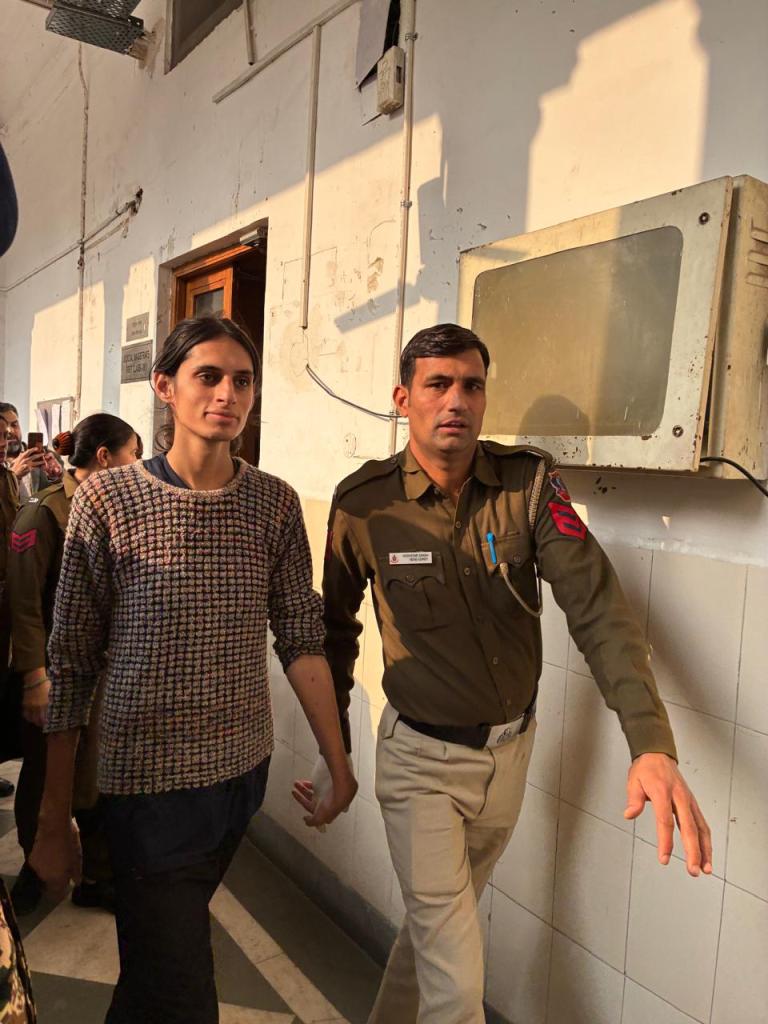
Police moved quickly to quell the protest. Six male students—including Delhi University law student Akshay ER, advocate Sameer, and a journalist—were detained near India Gate and taken to Kartavya Path police station on minor charges related to unlawful assembly. When their friends and supporters went to Parliament Street police station, believing the detainees were held there, another 17 protesters were picked up, including ten women and one transwoman, following what the police described as a scuffle with officers.
The following day, police produced the detainees in separate lower courts, bypassing lawyers. Sedition charge was added under Section 197 of the Bharatiya Nyaya Sanhita (BNS), a provision introduced during the 2023-2024 overhaul of India’s criminal laws. The charge transformed bailable offences into non-bailable offences and served as the legal basis for extended custody in this case.
Inside Custody
Photos and videos from the night of the arrests circulated quickly. One showed Akshay ER, a Delhi University law student, lying on his back as a policeman pushed his face hard to the left, his cheek almost touching the ground. He is a student from Kerala and belongs to a Scheduled Tribe community. Akshay ER became the first named accused in the case and, weeks later, the last to be released. “Only to silence our slogans,” a 24-year-old journalist arrested that night told The Polis Project, speaking on condition of anonymity.

As the detentions expanded from India Gate to Parliament Street Police Station, the allegations turned intimate and brutal.
Gurkirat Kaur, one of the 23 arrested, alleged that one woman protester was partially stripped during apprehension. “The tearing of our female comrade’s shirt happened while she was being apprehended,” Kaur said. “She was left with only her bra on, until the women lawyers came into the police station the first night.”
The lawyers rushed to Parliament Street police station after receiving a distress call from inside, Kaur described. Officers refused to disclose basic information, including the grounds of detention, the lawyers later told this reporter. One of them remained at the Parliament Street police station through the night with paralegal volunteers, waiting for access.
The journalist described physical assault: “I was ruthlessly beaten up, boxed, kicked, and thrown around by multiple policemen before being taken for formal arrest,” he said. “I was falsely charged with carrying pepper spray to be used against police officers. As many as three such sprays, which young women often carry for self-protection, were shown recovered from the six of us.” He was one of three specifically charged with carrying and using pepper spray, alongside Akshay ER and Sameer.
In court the next day, November 24, defence lawyers recorded visible injuries sustained by the arrested protesters. One of the lawyers for the students, Vertika Mani, informed the remand magistrate about the experience of the detainees, claiming custodial torture. She later told the media: “We have seen these ourselves. They have bruises on their bodies. The girls also had their clothes torn. All of them are ordinary college students, and they were in a really bad state. Some broke down in tears.”
That day, the magistrate declined to place the detainees in police custody and sent them to jail for a few days, under judicial custody. However, a subsequent request for police custody resulted in prolonged arguments till the first week of December at the Patiala House Court. The lawyers cited the bail order given in favour of the batch of 17, on December 2, in the Parliament Street case, which was suggestive of the custody being unwarranted. Around this time, the police came up with the RSU angle in the Kartyavya Path case, and mentioned the possibility of UAPA being applicable, and finally, the custody was granted.
During a hearing in the Kartyavya Path case, Ravjot Kaur testified in open court during the remand hearing after the first round of police custody interrogation had been completed. The court was hearing a police application for the extension of Ravjot Kaur’s police custody for a week, along with Gurkirat, Kranti, and a couple of others. Ravjot testified about the ordeal faced by her: “One policeman remarked to another, within my hearing, ‘How cute she is. Let me just get the chance to take her to a room by myself.’” After her testimony, the magistrate still extended custody of the students, but shortened the days from seven to two or three days, and ordered women officers to interrogate them under CCTV surveillance.
In the Parliament Street case, eight out of 17 protesters arrested in connection with an alleged scuffle with police outside the Parliament Street Police Station were granted bail on December 2. Nine accused had earlier secured bail on November 28. During the hearings, a defense counsel argued that custody wasn’t required to explore digital records, while another lawyer said raising an anti-establishment slogan was not a crime, countering the prosecution’s arguments. “People can’t be sent to 20 days in prison for a scuffle with the police,” a defence counsel was quoted as arguing by The Indian Express.
The accused in the two cases were represented by advocates Nizam Pasha, Sowjhanya Shankaran, Ahmad Ibrahim, Deeksha Dwivedi, Supantha Sinha, Vertika Mani, and Siddharth T Ganeshan, among others.
How a Case for Sedition was Made
The lawyers for the protesters argued that none of the original offences justified arrest. Under standard procedure, the students could have been released the same night with notices to appear later. Arrest, they said, had become a punishment.
In court, prosecutors relied mostly on slogans and placards from India Gate, describing them as explicit support for Madvi Hidma. The state’s account of Hidma as a senior Maoist commander was treated as a settled fact, sufficient to import a distant counterinsurgency operation into a Delhi protest about air pollution.
To bolster the charge, police introduced a YouTube video from a conference held in Hyderabad months earlier. It was a two-day conference organized in February 2025 by former Radical Students Union (RSU) members at the Sundaraiya Vidnyanam Bhawan auditorium in Hyderabad, owned by the CPI (Marxist), a parliamentary political party.
Prosecutors said that some of the accused appeared in the video and alleged they had links to the RSU, described as a “frontal organisation” of the proscribed CPI (Maoist) in parts of southern India. The insinuation hung over proceedings, alongside hints of possible prosecution under the stringent Unlawful Activities (Prevention) Act.
Defence counsel described the move as a fishing expedition. Outside the courtroom, a media trial unfolded, amplifying the police narrative while leaving unresolved basic jurisdictional questions, including whether RSU had any presence in Delhi.TV channels like Republic and Times Now looped viral clips of Hidma posters and “Long live Comrade Hidma” chants alongside allegations of protesters pepper-spraying police, framing the rally as a “hijacking” by “urban Naxals”, a term often used against activists or anti-establishment protesters. BJP leader Shahnawaz Hussain seized the moment to decry “professional protesters” masking Maoist sympathies under environmental cover. All of this offered little scrutiny of the underlying air quality grievances or RSU’s actual Delhi footprint.
Many on social media debated whether Hidma has a place in conversations about environmental issues like pollution. In a video report by the Times of India, a woman interviewee described that the fight of Adivasi communities, in places like Bastar, to protect their “Jal, Jangal, Jameen” (waters, forests, lands) was connected to the struggle for environmental justice in urban areas.
The Courts Finally Grant Relief
The first bails were granted on December 2 in the Parliament Street case, which did not include sedition charges. Fifteen of the 17 accused in the Parliament Street case were rearrested in the Kartavya Path case, according to news agency PTI.
Bail hearings thereafter turned on the same elements: slogans, alleged ideological sympathy to Maoism, and speculative links to the RSU. Defence lawyers cited precedent, including the Supreme Court’s 1995 ruling in Balwant Singh, arguing that slogans without demonstrable incitement or impact do not constitute sedition.
As hearings progressed, the prosecution’s case fell apart. In the sessions court, the state conceded that none of the accused was a member of the banned RSU, and that neither the Himkhand nor BSCEM was a prohibited organisation. The State admitted that no material evidence linked any detainee to CPI (Maoist) or its frontal groups.
Ten of the protesters were finally released on December 9. Following this, on December 26, Additional Sessions Judge Amit Bansal granted bail to six detainees: Gukirat Kaur, Ravjot Kaur, K. Sri Ilakiya, Ayisha Wafiya Midath, Kranti, and Abinash Satyapathy. The court’s order made no adverse observation on the slogans praising Hidma that had animated the police case for weeks.
On December 31, Akshay ER was also released, bringing the case’s custodial phase to a close.
After Release
What remains is not a legal question but a political one: what weeks of incarceration, custodial violence, and the slow grind of criminal process do to young people who took to the streets demanding breathable air.
Lawyers and supporters of the arrested protesters told The Polis Project that the students have not retreated from their commitments. Their organizing work continues to link Delhi’s pollution to a broader architecture of dispossession and environmental collapse.
In the state’s imagination, assembly became disorder, and speech became an act of insurgency. A protest about air became a test of obedience.
In the last week of 2025, seven young people walked free, the last of them on the very last night. And they breathed the same heavy air that had brought them to the streets in the first place.


From Smog to Sedition in Delhi: Youth Protesters Freed After Maoist “Phantom” Charges

Graphic by The Polis Project
Just before midnight on December 31, 2025, Akshay ER, the last of the 23 arrested young people, stepped out of jail into Delhi’s winter smog. Six others–Gurkirat, Ravjot, Ilakiya, Ayesha, Abhinash, and Kranti–were among the last batch released that week, after over a month in prison. The seven were targeted for alleged sedition, most of them university students, and arrested during an anti-pollution protest at India Gate in late November.
Sixteen other protesters–Akash, Aahan, Vishnu, Prakash, Sameer, Preeti, Satyam, Mehul, Vagesha, Noy, Kareena, Aatreya, Shreshth, Simran, Tanya, and Kajal–were released on bail earlier in December, in two batches.
The protesters were initially sent to three-day judicial custody after the Delhi Police alleged that they were demonstrating at an “unauthorized” site, attacking police personnel with chilli spray, and raising slogans in support of slain Madvi Hidma, a senior CPI(Maoist) leader killed on November 18, 2025, his body recovered in Andhra Pradesh’s Maredumilli forest, alongside his wife and four others. The incident remains contested, with police claiming a firefight and Maoists alleging a staged killing.
The release of the last batch of seven, ordered by a sessions court after weeks of contested hearings, closed a chapter that began with minor public-order charges and metastasized into allegations of sedition and insurgent sympathy. For more than a month, Delhi Police cast the students as “anti-nationals” and a threat to the Indian Republic.
The protest that triggered the crackdown
On November 23, a small crowd of around fifty to sixty people gathered near India Gate to protest Delhi’s air quality, which had crossed into the “hazardous” range at most government monitoring stations – some registering above 400 AQI. Private claims, citing their own instruments, raised aspersions of a much larger figure, exceeding 1000.
Winter had arrived early, thick with smoke and particulate matter. The protest followed weeks of agitation. Earlier in November, citizen groups such as Warrior Moms had sought meetings with newly elected Chief Minister Rekha Gupta, demanding urgent measures to protect children’s health. When those requests were rebuffed, calls for street protests circulated on social media. On November 9, hundreds assembled at India Gate. Police responded by detaining younger demonstrators, especially women, loading them onto buses, and releasing them hours later on the city’s outskirts.
Student environmentalists regrouped. Collectives such as The Himkhand joined with left-leaning campus groups to form the Delhi Coordination for Clean Air. Though it was Ravjot Kaur of the Bhagat Singh Chhatra Ekta Manch (bsCEM) who addressed the November 14 press conference at the Press Club of India, Gurkirat—whom The Polis Project spoke with earlier this month, a fortnight after her release along with Ravjot and four others—later described that moment as a turning point. The coalition, she explained, sought to shift the conversation on environmental degradation away from elite enclaves and into the city’s most punished geographies, mobilizing workers and peasants who lived and labored on the capital’s polluted peripheries. Their intent was both political and ecological: to confront what they saw as an extractive development model driving Delhi’s ecological collapse.
November 23: Barricades and Arrests
On the evening of November 23, police erected layers of barricades around India Gate. A few protesters climbed over them, holding placards and chanting slogans that linked Delhi’s smog to environmental destruction in adivasi regions. Some chants referenced Madvi Hidma, a Maoist commander reported killed by state forces days earlier in Andhra Pradesh. Others invoked a longer lineage of indigenous resistance, drawing a direct line between urban toxicity and the dispossession of jal, jungle, zameen (waters, forests, lands).
Police moved quickly to quell the protest. Six male students—including Delhi University law student Akshay ER, advocate Sameer, and a journalist—were detained near India Gate and taken to Kartavya Path police station on minor charges related to unlawful assembly. When their friends and supporters went to Parliament Street police station, believing the detainees were held there, another 17 protesters were picked up, including ten women and one transwoman, following what the police described as a scuffle with officers.
The following day, police produced the detainees in separate lower courts, bypassing lawyers. Sedition charge was added under Section 197 of the Bharatiya Nyaya Sanhita (BNS), a provision introduced during the 2023-2024 overhaul of India’s criminal laws. The charge transformed bailable offences into non-bailable offences and served as the legal basis for extended custody in this case.
Inside Custody
Photos and videos from the night of the arrests circulated quickly. One showed Akshay ER, a Delhi University law student, lying on his back as a policeman pushed his face hard to the left, his cheek almost touching the ground. He is a student from Kerala and belongs to a Scheduled Tribe community. Akshay ER became the first named accused in the case and, weeks later, the last to be released. “Only to silence our slogans,” a 24-year-old journalist arrested that night told The Polis Project, speaking on condition of anonymity.
As the detentions expanded from India Gate to Parliament Street Police Station, the allegations turned intimate and brutal.
Gurkirat Kaur, one of the 23 arrested, alleged that one woman protester was partially stripped during apprehension. “The tearing of our female comrade’s shirt happened while she was being apprehended,” Kaur said. “She was left with only her bra on, until the women lawyers came into the police station the first night.”
The lawyers rushed to Parliament Street police station after receiving a distress call from inside, Kaur described. Officers refused to disclose basic information, including the grounds of detention, the lawyers later told this reporter. One of them remained at the Parliament Street police station through the night with paralegal volunteers, waiting for access.
The journalist described physical assault: “I was ruthlessly beaten up, boxed, kicked, and thrown around by multiple policemen before being taken for formal arrest,” he said. “I was falsely charged with carrying pepper spray to be used against police officers. As many as three such sprays, which young women often carry for self-protection, were shown recovered from the six of us.” He was one of three specifically charged with carrying and using pepper spray, alongside Akshay ER and Sameer.
In court the next day, November 24, defence lawyers recorded visible injuries sustained by the arrested protesters. One of the lawyers for the students, Vertika Mani, informed the remand magistrate about the experience of the detainees, claiming custodial torture. She later told the media: “We have seen these ourselves. They have bruises on their bodies. The girls also had their clothes torn. All of them are ordinary college students, and they were in a really bad state. Some broke down in tears.”
That day, the magistrate declined to place the detainees in police custody and sent them to jail for a few days, under judicial custody. However, a subsequent request for police custody resulted in prolonged arguments till the first week of December at the Patiala House Court. The lawyers cited the bail order given in favour of the batch of 17, on December 2, in the Parliament Street case, which was suggestive of the custody being unwarranted. Around this time, the police came up with the RSU angle in the Kartyavya Path case, and mentioned the possibility of UAPA being applicable, and finally, the custody was granted.
During a hearing in the Kartyavya Path case, Ravjot Kaur testified in open court during the remand hearing after the first round of police custody interrogation had been completed. The court was hearing a police application for the extension of Ravjot Kaur’s police custody for a week, along with Gurkirat, Kranti, and a couple of others. Ravjot testified about the ordeal faced by her: “One policeman remarked to another, within my hearing, ‘How cute she is. Let me just get the chance to take her to a room by myself.’” After her testimony, the magistrate still extended custody of the students, but shortened the days from seven to two or three days, and ordered women officers to interrogate them under CCTV surveillance.
In the Parliament Street case, eight out of 17 protesters arrested in connection with an alleged scuffle with police outside the Parliament Street Police Station were granted bail on December 2. Nine accused had earlier secured bail on November 28. During the hearings, a defense counsel argued that custody wasn’t required to explore digital records, while another lawyer said raising an anti-establishment slogan was not a crime, countering the prosecution’s arguments. “People can’t be sent to 20 days in prison for a scuffle with the police,” a defence counsel was quoted as arguing by The Indian Express.
The accused in the two cases were represented by advocates Nizam Pasha, Sowjhanya Shankaran, Ahmad Ibrahim, Deeksha Dwivedi, Supantha Sinha, Vertika Mani, and Siddharth T Ganeshan, among others.
How a Case for Sedition was Made
The lawyers for the protesters argued that none of the original offences justified arrest. Under standard procedure, the students could have been released the same night with notices to appear later. Arrest, they said, had become a punishment.
In court, prosecutors relied mostly on slogans and placards from India Gate, describing them as explicit support for Madvi Hidma. The state’s account of Hidma as a senior Maoist commander was treated as a settled fact, sufficient to import a distant counterinsurgency operation into a Delhi protest about air pollution.
To bolster the charge, police introduced a YouTube video from a conference held in Hyderabad months earlier. It was a two-day conference organized in February 2025 by former Radical Students Union (RSU) members at the Sundaraiya Vidnyanam Bhawan auditorium in Hyderabad, owned by the CPI (Marxist), a parliamentary political party.
Prosecutors said that some of the accused appeared in the video and alleged they had links to the RSU, described as a “frontal organisation” of the proscribed CPI (Maoist) in parts of southern India. The insinuation hung over proceedings, alongside hints of possible prosecution under the stringent Unlawful Activities (Prevention) Act.
Defence counsel described the move as a fishing expedition. Outside the courtroom, a media trial unfolded, amplifying the police narrative while leaving unresolved basic jurisdictional questions, including whether RSU had any presence in Delhi.TV channels like Republic and Times Now looped viral clips of Hidma posters and “Long live Comrade Hidma” chants alongside allegations of protesters pepper-spraying police, framing the rally as a “hijacking” by “urban Naxals”, a term often used against activists or anti-establishment protesters. BJP leader Shahnawaz Hussain seized the moment to decry “professional protesters” masking Maoist sympathies under environmental cover. All of this offered little scrutiny of the underlying air quality grievances or RSU’s actual Delhi footprint.
Many on social media debated whether Hidma has a place in conversations about environmental issues like pollution. In a video report by the Times of India, a woman interviewee described that the fight of Adivasi communities, in places like Bastar, to protect their “Jal, Jangal, Jameen” (waters, forests, lands) was connected to the struggle for environmental justice in urban areas.
The Courts Finally Grant Relief
The first bails were granted on December 2 in the Parliament Street case, which did not include sedition charges. Fifteen of the 17 accused in the Parliament Street case were rearrested in the Kartavya Path case, according to news agency PTI.
Bail hearings thereafter turned on the same elements: slogans, alleged ideological sympathy to Maoism, and speculative links to the RSU. Defence lawyers cited precedent, including the Supreme Court’s 1995 ruling in Balwant Singh, arguing that slogans without demonstrable incitement or impact do not constitute sedition.
As hearings progressed, the prosecution’s case fell apart. In the sessions court, the state conceded that none of the accused was a member of the banned RSU, and that neither the Himkhand nor BSCEM was a prohibited organisation. The State admitted that no material evidence linked any detainee to CPI (Maoist) or its frontal groups.
Ten of the protesters were finally released on December 9. Following this, on December 26, Additional Sessions Judge Amit Bansal granted bail to six detainees: Gukirat Kaur, Ravjot Kaur, K. Sri Ilakiya, Ayisha Wafiya Midath, Kranti, and Abinash Satyapathy. The court’s order made no adverse observation on the slogans praising Hidma that had animated the police case for weeks.
On December 31, Akshay ER was also released, bringing the case’s custodial phase to a close.
After Release
What remains is not a legal question but a political one: what weeks of incarceration, custodial violence, and the slow grind of criminal process do to young people who took to the streets demanding breathable air.
Lawyers and supporters of the arrested protesters told The Polis Project that the students have not retreated from their commitments. Their organizing work continues to link Delhi’s pollution to a broader architecture of dispossession and environmental collapse.
In the state’s imagination, assembly became disorder, and speech became an act of insurgency. A protest about air became a test of obedience.
In the last week of 2025, seven young people walked free, the last of them on the very last night. And they breathed the same heavy air that had brought them to the streets in the first place.