


In February 2025, Trump horrified much of the world when he suggested that Gaza could become “the Riviera of the Middle East.”
But he was merely riffing on a comment made by his son-in-law, Jared Kushner, at a Harvard University event in 2024, in which he referred to Gaza as “a very valuable waterfront property.”
This is the same logic already at work in Dakhla, occupied by Morocco; in post-war Arugam Bay, Sri Lanka; and in Xinjiang, China. Occupied territories and persecuted communities become colorful backdrops to profitable, bankable destinations.
Tourism rebranding and Riviera-speak are reducing populations and locations to mere background scenery, while occupation and repression are washed away through the language of leisure, investment, and lifestyle. This strategy has now been extended to Gaza, in the midst of the genocide.
The Playbook: Israel and the Normalization of Occupation Through Tourism
Israel itself is already well-versed in the art of using tourism as an image-laundering and financial expansion vehicle. The state has been providing financial incentives to businesses operating in settlements, including those in the tourism industry, for decades to gloss over the occupation and annexation of Palestine.
Millions have been invested in visitor infrastructure at historic sites across the Occupied Palestinian Territories (OPT), notably the West Bank, and by capitalizing on its status as a Biblical or cultural destination, they have effectively legitimized the link between the State of Israel and Jewish history. Many settlements are intentionally constructed close to historic archeological sites.
Visitor maps issued by Israel’s Ministry of Tourism do not show the West Bank’s borders. Instead, the area is marked as “Judea” and “Samaria”, a term popularized by the government and not by Palestinians.
What’s more, Israel, having largely captured the Holy Land pilgrimage market, runs Israeli-centric tours. In practical terms, this means Christian pilgrims stay in Israel and visit holy sites in the OPT—the most notable being Bethlehem—but their visits are tightly choreographed, often unnamed as “occupied” and cultivate the impression that the entire Holy Land is simply “Israel”.
In addition, foreign online businesses fail to disclose accommodation listings as being in the OPT, labelling them as Israel instead.
The use of map manipulation, location distortion, and sanitizing the OPT through the tourism lens has been a steady and studied approach. Invisible borders and religious theatre are keeping occupation, repression, and state violence deliberately opaque.

Morocco’s Cultural Moment
From hosting and finishing runners-up at the 2025 Africa Cup of Nations, to future co-hosts of the FIFA World Cup in 2030, Morocco became Africa’s most visited country, outranking Egypt with almost 20 million foreign visitors, including Madonna, who rang in the new year with a lavish and heavily publicized trip to Marrakech and Fez.
The similarities between Morocco and Israel are crystal clear. Where Israel promotes religious tourism, Morocco has been exceptionally savvy at cultivating an industry based on exotic luxury. It knows how to court orientalism by trading on its cultural capital. Hammams are marketed as wellness spas, desert tours are spiritual retreats, and the humble souk is endless interior design inspo.
This, despite the 2025 youth-led protests, referred to as the Gen Z 212 Movement, which took place across major cities, including Rabat, Casablanca, and Tangier. The state was able to contain major unrest with the use of heavy police presence, arrests, and rapid dispersal.
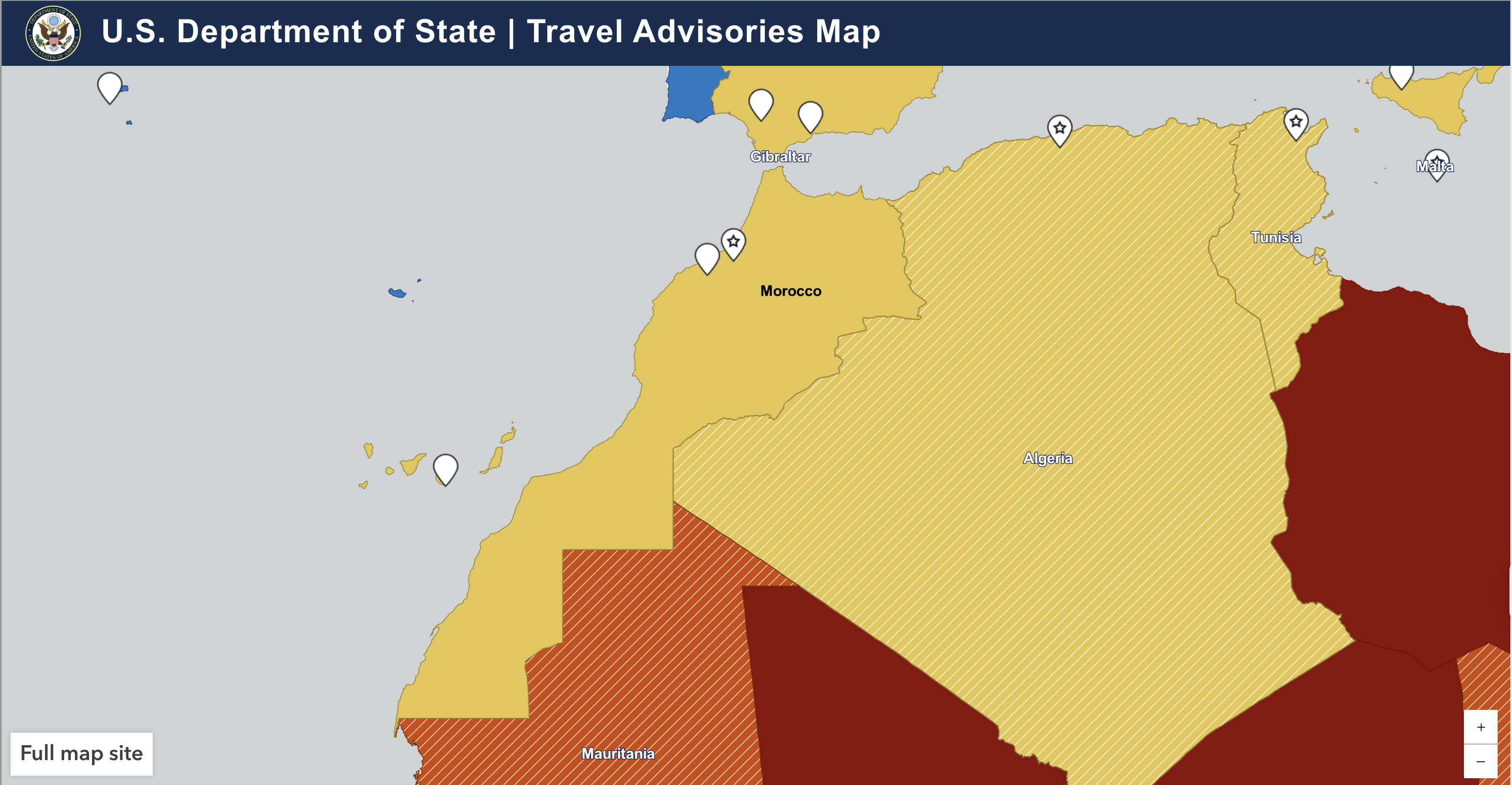
For travellers wanting to avoid the Casbah clichés, the space off the beaten track just got a bit bigger. Consult a US State Department map of Morocco, or any map whilst physically in Morocco, and the dashed border line you may have once noticed has quietly disappeared, effectively extending the country’s border all the way down to Mauritania. Not the case with Google Maps (outside of Morocco), where, below a very real and still present dashed line, you will read the words “Western Sahara” (WS).
This discrepancy reshapes how the territory is perceived. For those viewing the map from the US or Morocco, the delicate political situation and history become invisible. For everyone else, the border line proves the issue is ongoing and unresolved.
Morocco’s History of Occupation
The WS was a Spanish colony from 1884 to 1975. When Spain withdrew, Morocco and Mauritania both staked their historical claim, with Morocco eventually consolidating control, triggering a war with the Polisario Front, the Sahrawi liberation movement.
A portmanteau of the Popular Front for the Liberation of Saguia el-Hamra and Río de Oro, the Polsario was formed in 1973. They seek full independence for Western Sahara and represent the Sahrawi Arab Democratic Republic, which has been a member of the African Union since 1982. While a UN-brokered ceasefire was intended to lead to a referendum on self-determination, an “autonomy plan” that keeps the territory under Moroccan sovereignty was advanced instead—a plan backed during the first Trump administration.
It wasn’t long before Spain followed suit in 2023, followed by the UK, along with a host of EU countries. The final blow to the Sahrawi cause was the UN Security Council’s description of the Autonomy Plan as “the most feasible” path to a political solution last October, essentially legitimizing Morocco’s claim to Western Sahara as its ancestral homeland.
Meanwhile, there has been no discussion surrounding the removal of the Berm. At 2,700km, it is often described as the longest militarized wall in the world, dividing Moroccan-controlled (and resource-rich) WS from the areas held by the Sahrawi separatists. The UK Foreign Office explicitly warns against off-roading in this part of the Sahara, which is reported to have some of the densest landmine contamination on earth.
More worrying still is a report from a UN Human Rights Meeting in 2025, which emphasizes that “Western Sahara remains the only non-self-governing territory in the world without a UN mechanism dedicated to human rights monitoring.” The report also details accusations of weaponizing Sahrawi culture by targeting and sexually abusing women activists.
Moreover, an estimated 173,000 displaced Sahrawis continue to live in refugee camps outside Moroccan-administered territory, where they are hosted and subsidized by the Algerian state and governed by the Polisario Front. Conditions in the camps have become increasingly precarious, with limited access to fresh food, steadily dwindling humanitarian aid, and harsh desert conditions worsened by climate change.
Pro-government outlets like Morocco World News, however, affirm that “the Sahrawi people are Moroccan citizens with deep historical, cultural, and spiritual ties to the Moroccan nation.” UN backing or not, it remains unclear how and when the autonomy plan will be implemented, who would be eligible to vote, and, crucially, what will happen to the 173,000 refugees still stranded in the desert.

Morocco’s Tourism Rebrand: Dakhla and the Blueprint for Gaza
Nowhere is Morocco’s investment in Western Saharan infrastructure more visible than in the former sleepy fishing village of Dakhla. Formerly known as Villa Cisneros during the Spanish colonial era, Dakhla is going through a major rebrand as a kitesurfing paradise.
Increasingly marketed as an eco-tourism hub, with ‘eco-friendly’ lagoon camps, desert eco-lodges, and guided eco-tours promising ‘untouched’ Saharan nature, there is often little or no reference to the territory’s unresolved and disputed status. The fishing industry there remains hugely profitable, and protests by Sahrawi fishermen about unequal job opportunities and, indeed, inspections from the EU have all been promptly shut down by Moroccan authorities
In January 2025, Irish low-cost airline giant Ryanair began operating two direct flights to Dakhla from Spain, despite reports that its Lanzarote–Dakhla service had been flying with load factors as low as 9 percent.
Ryanair isn’t alone: there are now also direct flights with Air France-KLM group’s Transavia and Canary Islands airline Binter, as well as domestic carrier Royal Air Maroc, providing routes into the region.
US backing of Moroccan sovereignty over the territory and the scheduled opening of a US consulate in Dakhla have signalled safety for potential American tourists and, more importantly, translated into investment from US banks.
Highlighting major investments in the region’s infrastructure, renewable energy, agriculture, and social development, a Moroccan representative speaking at the UN Special Committee on Decolonization, described Western Sahara as one of “Morocco’s most dynamic growth poles and a future economic gateway to Africa.”
China and the Post-conflict Tourism Playbook
In recent years, Beijing has used tourism to sanitize accusations of the genocide of Uyghurs and other ethnic minorities in Xinjiang Province. Notorious for the persecution of Muslim minorities, the region has seen a dramatic rise in tourism in recent years: over 300 million domestic and international visitors were recorded in 2024, with similarly high figures reported in the first nine months of 2025.
Human Rights Watch even criticized the president’s promotion of Xinjiang in 2023 as “a place of beauty and harmony.” Human rights organizations accuse foreign tourism businesses of further sanitizing the region, as plans to build new hotels and attract further investment move ahead. Expanded infrastructure and heightened securitization reinforce the impression that Xinjiang is safe and open for business, while Uyghurs themselves are increasingly marketed as part of China’s “diversity”.
Foreign travel vloggers documenting “carefree” trips through Xinjiang are amplified by Beijing as proof that international media coverage is biased or hostile. Foreign (often Western) content creators thus unwittingly contribute to a façade of normalcy even as human rights groups continue to raise the alarm over mass detention and abuses, and broadcasting one-dimensional portrayals of multi-faceted and deeply complex regions ends up undermining these travelers’ naive attempts to show “authenticity”.
China, technologically more advanced, can more carefully control the narrative. For the Uyghurs, resistance is risky, and tourism puts them in a double bind. It makes them visible to the outside world, but their voices are silenced, and foreign tourism makes visitors complicit in their enforced silence.
Sri Lanka: Exposing the Precarity of the Facade
Often referred to as “war tourism,” Sri Lankan tourism has also helped normalize a permanent military presence in former conflict zones, and by capitalizing on the fear of a potential Tamil Tiger resurgence, the Sri Lankan state has been able to justify ongoing securitization in a country it has billed as safe and business-friendly. The end of Sri Lanka’s 30-year civil war in 2009 marked a turning point, enabling the government to soft-launch a newly ‘peaceful’ island through tourism-driven recovery.
Arugam Bay, once a quiet fishing community in the southeast of the island, was rebranded as a low-cost surf paradise, gradually displacing fishing as the area’s central livelihood. The town became especially popular with Israeli reservists seeking an affordable escape, and for years the arrangement appeared mutually beneficial.
Yet the fragility of this national rebranding and the inefficacy of its securitization have been repeatedly exposed. The 2019 Easter Bombings, which targeted churches and hotels, caused an immediate collapse in tourist arrivals, threatening the idealised public image that tourism had thus far helped to project.
Instability struck again in 2024 with the genocide in Gaza. Israeli reservists arriving in Arugam Bay were no longer anonymous backpackers on a tropical gap year, but active participants in a genocide, and tensions with other tourists and local residents began to surge. Israel and the US authorities eventually issued travel warnings after threats were made against Israeli visitors.
Yet, where locals have voiced their concerns about the dominance of Israeli tourists, Sri Lanka performs a happy island paradise with slick new roads and tourist resorts at the expense of civil liberties in a heavily securitised state. Resistance is scattered and volatile, but promptly contained and hushed up. It doesn’t disappear; it just becomes too expensive.
Whitewashing War Crimes: How Tourism Makes Repression Seem Contradictory
In places like Xinjiang and Western Sahara, airlines and luxury hotel brands function as normalization mechanisms, enabling foreign investment while smoothing over cultural erasure.
For Morocco, increasing flights into Dakhla helps build on a decades-old unity narrative. Successful tourism PR machines (as well as AI-generated history rewrites) prop up political doublespeak in which “Sahrawis are Moroccans” and “Uyghur diversity is welcomed.” They help erase frictions and state opaqueness over who controls the area and what is and isn’t permitted.
US recognition of Moroccan sovereignty over WS was part of the price for Rabat normalizing relations with Israel in the signing of the Abraham Accords in 2020. In so doing, Washington gained an Israel-friendly partner in North Africa, Morocco acquired military leverage, and Israel secured a foothold in a tension-filled part of North Africa by securing defence exports. The UK’s decision to back Morocco’s autonomy plan in June 2025 also pointed to future investments in the disputed territory.
The decision to award Morocco hosting of the Africa Cup of Nations 25/26, as well as co-hosting rights for the 2030 FIFA World Cup, shows how far Morocco’s global standing has come. When Ivanka Trump and Kushner (a central figure in the Abraham Accords) vacationed in Dakhla in 2022, and reportedly again in 2024, the former posted an idyllic shot of herself on Instagram, on a deserted, windswept beach. The caption read simply, “Morocco!”
Tourism, when used as a successful disguise, doesn’t erase repression; it makes it seem contradictory. Which is why Trump’s New Gaza plan, revealed at Davos on January 22nd, 2026, struck an entirely different, but no less uncomfortable chord. There are no smokescreens here—no sense of occupying territories inch by inch. There was nothing subtle about what was suggested, nor was there any hiding behind religious history or divine sovereignty. It was a grotesque media circus masquerading as policy, with Trump treating Gaza like an Atlantic City reboot.
Kushner and Trump have simply exposed the endgame, devoid of diplomacy or deniability. The outrage wasn’t that Trump thought it; it was that he said it out loud.

Rebranding Occupation From Morocco to Gaza: Tourism, Power, and the Business of Forgetting

"Free Sahara" murals in Gijon, Spain (Left), and at a Western Sahara refugee camp in Tindouf, Algeria (Right). Photo courtesy of the author.
In February 2025, Trump horrified much of the world when he suggested that Gaza could become “the Riviera of the Middle East.”
But he was merely riffing on a comment made by his son-in-law, Jared Kushner, at a Harvard University event in 2024, in which he referred to Gaza as “a very valuable waterfront property.”
This is the same logic already at work in Dakhla, occupied by Morocco; in post-war Arugam Bay, Sri Lanka; and in Xinjiang, China. Occupied territories and persecuted communities become colorful backdrops to profitable, bankable destinations.
Tourism rebranding and Riviera-speak are reducing populations and locations to mere background scenery, while occupation and repression are washed away through the language of leisure, investment, and lifestyle. This strategy has now been extended to Gaza, in the midst of the genocide.
The Playbook: Israel and the Normalization of Occupation Through Tourism
Israel itself is already well-versed in the art of using tourism as an image-laundering and financial expansion vehicle. The state has been providing financial incentives to businesses operating in settlements, including those in the tourism industry, for decades to gloss over the occupation and annexation of Palestine.
Millions have been invested in visitor infrastructure at historic sites across the Occupied Palestinian Territories (OPT), notably the West Bank, and by capitalizing on its status as a Biblical or cultural destination, they have effectively legitimized the link between the State of Israel and Jewish history. Many settlements are intentionally constructed close to historic archeological sites.
Visitor maps issued by Israel’s Ministry of Tourism do not show the West Bank’s borders. Instead, the area is marked as “Judea” and “Samaria”, a term popularized by the government and not by Palestinians.
What’s more, Israel, having largely captured the Holy Land pilgrimage market, runs Israeli-centric tours. In practical terms, this means Christian pilgrims stay in Israel and visit holy sites in the OPT—the most notable being Bethlehem—but their visits are tightly choreographed, often unnamed as “occupied” and cultivate the impression that the entire Holy Land is simply “Israel”.
In addition, foreign online businesses fail to disclose accommodation listings as being in the OPT, labelling them as Israel instead.
The use of map manipulation, location distortion, and sanitizing the OPT through the tourism lens has been a steady and studied approach. Invisible borders and religious theatre are keeping occupation, repression, and state violence deliberately opaque.
Morocco’s Cultural Moment
From hosting and finishing runners-up at the 2025 Africa Cup of Nations, to future co-hosts of the FIFA World Cup in 2030, Morocco became Africa’s most visited country, outranking Egypt with almost 20 million foreign visitors, including Madonna, who rang in the new year with a lavish and heavily publicized trip to Marrakech and Fez.
The similarities between Morocco and Israel are crystal clear. Where Israel promotes religious tourism, Morocco has been exceptionally savvy at cultivating an industry based on exotic luxury. It knows how to court orientalism by trading on its cultural capital. Hammams are marketed as wellness spas, desert tours are spiritual retreats, and the humble souk is endless interior design inspo.
This, despite the 2025 youth-led protests, referred to as the Gen Z 212 Movement, which took place across major cities, including Rabat, Casablanca, and Tangier. The state was able to contain major unrest with the use of heavy police presence, arrests, and rapid dispersal.
For travellers wanting to avoid the Casbah clichés, the space off the beaten track just got a bit bigger. Consult a US State Department map of Morocco, or any map whilst physically in Morocco, and the dashed border line you may have once noticed has quietly disappeared, effectively extending the country’s border all the way down to Mauritania. Not the case with Google Maps (outside of Morocco), where, below a very real and still present dashed line, you will read the words “Western Sahara” (WS).
This discrepancy reshapes how the territory is perceived. For those viewing the map from the US or Morocco, the delicate political situation and history become invisible. For everyone else, the border line proves the issue is ongoing and unresolved.
Morocco’s History of Occupation
The WS was a Spanish colony from 1884 to 1975. When Spain withdrew, Morocco and Mauritania both staked their historical claim, with Morocco eventually consolidating control, triggering a war with the Polisario Front, the Sahrawi liberation movement.
A portmanteau of the Popular Front for the Liberation of Saguia el-Hamra and Río de Oro, the Polsario was formed in 1973. They seek full independence for Western Sahara and represent the Sahrawi Arab Democratic Republic, which has been a member of the African Union since 1982. While a UN-brokered ceasefire was intended to lead to a referendum on self-determination, an “autonomy plan” that keeps the territory under Moroccan sovereignty was advanced instead—a plan backed during the first Trump administration.
It wasn’t long before Spain followed suit in 2023, followed by the UK, along with a host of EU countries. The final blow to the Sahrawi cause was the UN Security Council’s description of the Autonomy Plan as “the most feasible” path to a political solution last October, essentially legitimizing Morocco’s claim to Western Sahara as its ancestral homeland.
Meanwhile, there has been no discussion surrounding the removal of the Berm. At 2,700km, it is often described as the longest militarized wall in the world, dividing Moroccan-controlled (and resource-rich) WS from the areas held by the Sahrawi separatists. The UK Foreign Office explicitly warns against off-roading in this part of the Sahara, which is reported to have some of the densest landmine contamination on earth.
More worrying still is a report from a UN Human Rights Meeting in 2025, which emphasizes that “Western Sahara remains the only non-self-governing territory in the world without a UN mechanism dedicated to human rights monitoring.” The report also details accusations of weaponizing Sahrawi culture by targeting and sexually abusing women activists.
Moreover, an estimated 173,000 displaced Sahrawis continue to live in refugee camps outside Moroccan-administered territory, where they are hosted and subsidized by the Algerian state and governed by the Polisario Front. Conditions in the camps have become increasingly precarious, with limited access to fresh food, steadily dwindling humanitarian aid, and harsh desert conditions worsened by climate change.
Pro-government outlets like Morocco World News, however, affirm that “the Sahrawi people are Moroccan citizens with deep historical, cultural, and spiritual ties to the Moroccan nation.” UN backing or not, it remains unclear how and when the autonomy plan will be implemented, who would be eligible to vote, and, crucially, what will happen to the 173,000 refugees still stranded in the desert.
Morocco’s Tourism Rebrand: Dakhla and the Blueprint for Gaza
Nowhere is Morocco’s investment in Western Saharan infrastructure more visible than in the former sleepy fishing village of Dakhla. Formerly known as Villa Cisneros during the Spanish colonial era, Dakhla is going through a major rebrand as a kitesurfing paradise.
Increasingly marketed as an eco-tourism hub, with ‘eco-friendly’ lagoon camps, desert eco-lodges, and guided eco-tours promising ‘untouched’ Saharan nature, there is often little or no reference to the territory’s unresolved and disputed status. The fishing industry there remains hugely profitable, and protests by Sahrawi fishermen about unequal job opportunities and, indeed, inspections from the EU have all been promptly shut down by Moroccan authorities
In January 2025, Irish low-cost airline giant Ryanair began operating two direct flights to Dakhla from Spain, despite reports that its Lanzarote–Dakhla service had been flying with load factors as low as 9 percent.
Ryanair isn’t alone: there are now also direct flights with Air France-KLM group’s Transavia and Canary Islands airline Binter, as well as domestic carrier Royal Air Maroc, providing routes into the region.
US backing of Moroccan sovereignty over the territory and the scheduled opening of a US consulate in Dakhla have signalled safety for potential American tourists and, more importantly, translated into investment from US banks.
Highlighting major investments in the region’s infrastructure, renewable energy, agriculture, and social development, a Moroccan representative speaking at the UN Special Committee on Decolonization, described Western Sahara as one of “Morocco’s most dynamic growth poles and a future economic gateway to Africa.”
China and the Post-conflict Tourism Playbook
In recent years, Beijing has used tourism to sanitize accusations of the genocide of Uyghurs and other ethnic minorities in Xinjiang Province. Notorious for the persecution of Muslim minorities, the region has seen a dramatic rise in tourism in recent years: over 300 million domestic and international visitors were recorded in 2024, with similarly high figures reported in the first nine months of 2025.
Human Rights Watch even criticized the president’s promotion of Xinjiang in 2023 as “a place of beauty and harmony.” Human rights organizations accuse foreign tourism businesses of further sanitizing the region, as plans to build new hotels and attract further investment move ahead. Expanded infrastructure and heightened securitization reinforce the impression that Xinjiang is safe and open for business, while Uyghurs themselves are increasingly marketed as part of China’s “diversity”.
Foreign travel vloggers documenting “carefree” trips through Xinjiang are amplified by Beijing as proof that international media coverage is biased or hostile. Foreign (often Western) content creators thus unwittingly contribute to a façade of normalcy even as human rights groups continue to raise the alarm over mass detention and abuses, and broadcasting one-dimensional portrayals of multi-faceted and deeply complex regions ends up undermining these travelers’ naive attempts to show “authenticity”.
China, technologically more advanced, can more carefully control the narrative. For the Uyghurs, resistance is risky, and tourism puts them in a double bind. It makes them visible to the outside world, but their voices are silenced, and foreign tourism makes visitors complicit in their enforced silence.
Sri Lanka: Exposing the Precarity of the Facade
Often referred to as “war tourism,” Sri Lankan tourism has also helped normalize a permanent military presence in former conflict zones, and by capitalizing on the fear of a potential Tamil Tiger resurgence, the Sri Lankan state has been able to justify ongoing securitization in a country it has billed as safe and business-friendly. The end of Sri Lanka’s 30-year civil war in 2009 marked a turning point, enabling the government to soft-launch a newly ‘peaceful’ island through tourism-driven recovery.
Arugam Bay, once a quiet fishing community in the southeast of the island, was rebranded as a low-cost surf paradise, gradually displacing fishing as the area’s central livelihood. The town became especially popular with Israeli reservists seeking an affordable escape, and for years the arrangement appeared mutually beneficial.
Yet the fragility of this national rebranding and the inefficacy of its securitization have been repeatedly exposed. The 2019 Easter Bombings, which targeted churches and hotels, caused an immediate collapse in tourist arrivals, threatening the idealised public image that tourism had thus far helped to project.
Instability struck again in 2024 with the genocide in Gaza. Israeli reservists arriving in Arugam Bay were no longer anonymous backpackers on a tropical gap year, but active participants in a genocide, and tensions with other tourists and local residents began to surge. Israel and the US authorities eventually issued travel warnings after threats were made against Israeli visitors.
Yet, where locals have voiced their concerns about the dominance of Israeli tourists, Sri Lanka performs a happy island paradise with slick new roads and tourist resorts at the expense of civil liberties in a heavily securitised state. Resistance is scattered and volatile, but promptly contained and hushed up. It doesn’t disappear; it just becomes too expensive.
Whitewashing War Crimes: How Tourism Makes Repression Seem Contradictory
In places like Xinjiang and Western Sahara, airlines and luxury hotel brands function as normalization mechanisms, enabling foreign investment while smoothing over cultural erasure.
For Morocco, increasing flights into Dakhla helps build on a decades-old unity narrative. Successful tourism PR machines (as well as AI-generated history rewrites) prop up political doublespeak in which “Sahrawis are Moroccans” and “Uyghur diversity is welcomed.” They help erase frictions and state opaqueness over who controls the area and what is and isn’t permitted.
US recognition of Moroccan sovereignty over WS was part of the price for Rabat normalizing relations with Israel in the signing of the Abraham Accords in 2020. In so doing, Washington gained an Israel-friendly partner in North Africa, Morocco acquired military leverage, and Israel secured a foothold in a tension-filled part of North Africa by securing defence exports. The UK’s decision to back Morocco’s autonomy plan in June 2025 also pointed to future investments in the disputed territory.
The decision to award Morocco hosting of the Africa Cup of Nations 25/26, as well as co-hosting rights for the 2030 FIFA World Cup, shows how far Morocco’s global standing has come. When Ivanka Trump and Kushner (a central figure in the Abraham Accords) vacationed in Dakhla in 2022, and reportedly again in 2024, the former posted an idyllic shot of herself on Instagram, on a deserted, windswept beach. The caption read simply, “Morocco!”
Tourism, when used as a successful disguise, doesn’t erase repression; it makes it seem contradictory. Which is why Trump’s New Gaza plan, revealed at Davos on January 22nd, 2026, struck an entirely different, but no less uncomfortable chord. There are no smokescreens here—no sense of occupying territories inch by inch. There was nothing subtle about what was suggested, nor was there any hiding behind religious history or divine sovereignty. It was a grotesque media circus masquerading as policy, with Trump treating Gaza like an Atlantic City reboot.
Kushner and Trump have simply exposed the endgame, devoid of diplomacy or deniability. The outrage wasn’t that Trump thought it; it was that he said it out loud.