

Note: The US attacked Iran on 28 February, 2026, at Israel’s behest, murdering the country’s Supreme Leader, Ayatollah Khameini. In the weeks that have ensued, the US and Israel have engaged in indiscriminate bombing and war crimes. However, this time, we find ourselves shrouded by a thick haze of censorship perpetrated by the genocidal media in the US and Israel. While the moment might feel terrifying and unprecedented, it is anything but. Each week, our editorial team will unpack and analyze seminal texts that help us make sense of this moment.
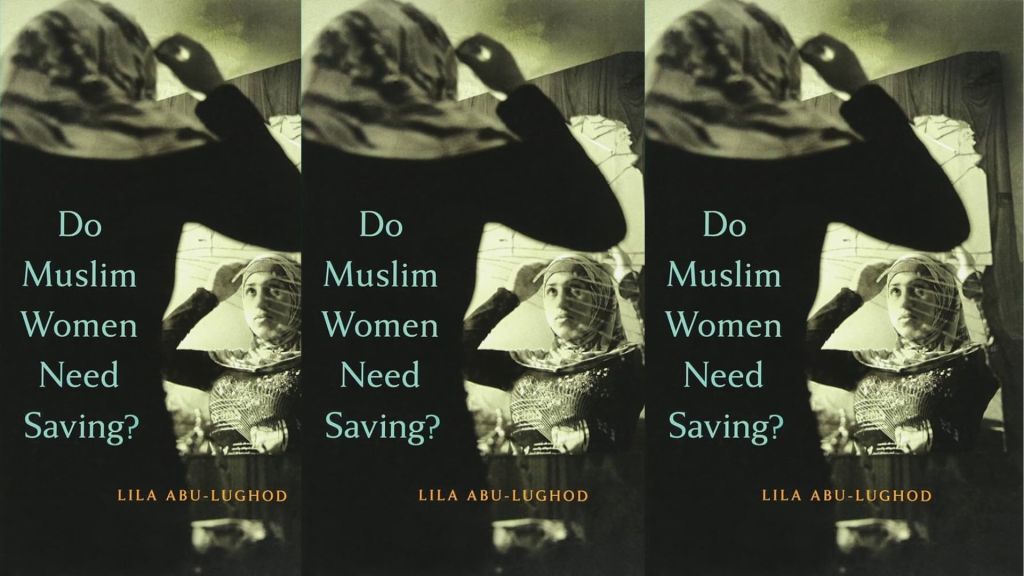
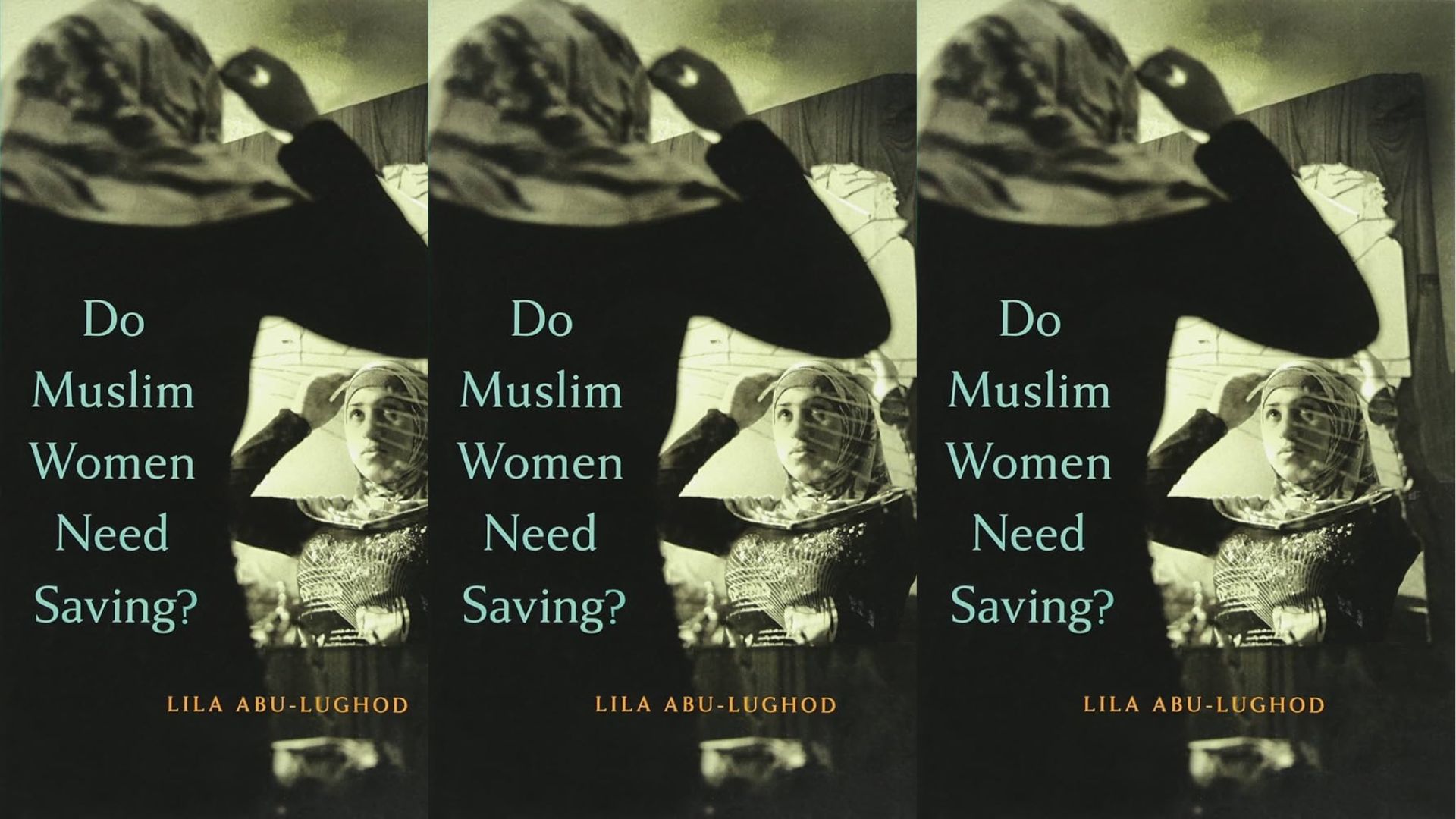
In Do Muslim Women Need Saving? (2013), Palestinian-American anthropologist Lila Abu-Lughod offers a powerful critique of the widespread assumption in Western politics, media, and feminism that Muslim women are oppressed victims needing rescue.
She argues that this assumption says more about Western political narratives and global power relations than it does about the actual lives of women in Muslim societies.
Her book emerged from the aftermath of the September 11 attacks and the beginning of the War in Afghanistan, when Western leaders repeatedly framed military invasion as a mission to liberate Afghan women from the Taliban. It builds on her 2002 journal article for American Anthropologist, “Do Muslim Women Really Need Saving? Anthropological Reflections on Cultural Relativism and Its Others.”
There, Abu-Lughod leverages 20 years of fieldwork experience in Egypt to criticize the colonial overtones of the USA’s War on Terror and its claims of saving Afghan women as justification.
Her critique is not that gender inequality does not exist in Muslim societies but that the simplified narratives used to describe it obscure the political, economic, and historical forces that shape women’s lives, while simultaneously legitimizing Western intervention.
“When you save someone,” Abu-Lughod writes, “you imply saving her to something.” That “something,” she suggests, is usually assumed to be Western liberal modernity itself—a particular vision of freedom, autonomy, and secularism presented as universal.
For her, this is a “constraining framework” for understanding people’s lives, and it shapes the kinds of solutions that we can imagine to solve complex political problems.
Breaking Down Abu-Lughod’s Arguments
Abu-Lughod’s insights in Do Muslim Women Need Saving? can be distilled into the following key ideas:
1. “Writing against culture”
Abu-Lughod theorizes a fictionalized space conceived in such discourse called “IslamLand,” where Afghanistan, Egypt, Saudi Arabia, Iran, and Indonesia become interchangeable sites of the same backward, static “Islamic culture” that uniformly oppresses Muslim women.
This idea stems from her 1991 essay “Writing Against Culture”, where Abu-Lughod argued that anthropology’s traditional use of “culture” often essentializes and homogenizes societies.
She thus rejects “cultural explanations” for gender inequality. She points out that violence against women—domestic abuse, sexual assault, femicide—occurs across the world. However, when it occurs in the West, it is reported as an individual crime, social pathology, or systemic inequality, whereas in Muslim societies, it is framed as cultural essence.
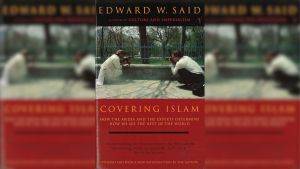
This double standard, Abu-Lughod argues, transforms complex political realities into civilizational narratives that Said has framed as Orientalism.
2. The Western savior
Abu-Lughod critiques several bestselling memoirs and personal narratives that follow a “rescue narrative” structure, portraying a suffering woman who escapes to the West and finds liberation from an oppressive Muslim culture, from Reading Lolita in Tehran by Azar Nafisi to Princess: A True Story of Life Behind the Veil in Saudi Arabia by Jean Sasson.
While individual stories might be genuine, she argues that the hard ubiquity and marketing of these narratives reinforce binaries of Western societies as empowering, modern, and progressive, and Muslim societies as uniquely oppressive, traditional, and regressive.
These binaries position Western governments, NGOs, and feminists as heroes and saviors, in turn legitimizing external intervention and ignoring Muslim women’s own resistance.

3. The oppressed Muslim woman and the veil
Central to the rhetoric of saving Muslim women is the burqa as a key symbol of the oppressed Muslim woman. Abu-Lughod describes a German human rights poster showing a woman wearing a blue Afghan burqa among several black garbage bags lined up against a wall, such that she visually resembles one of the bags.
The caption reads: “Oppressed women are easily overlooked.”
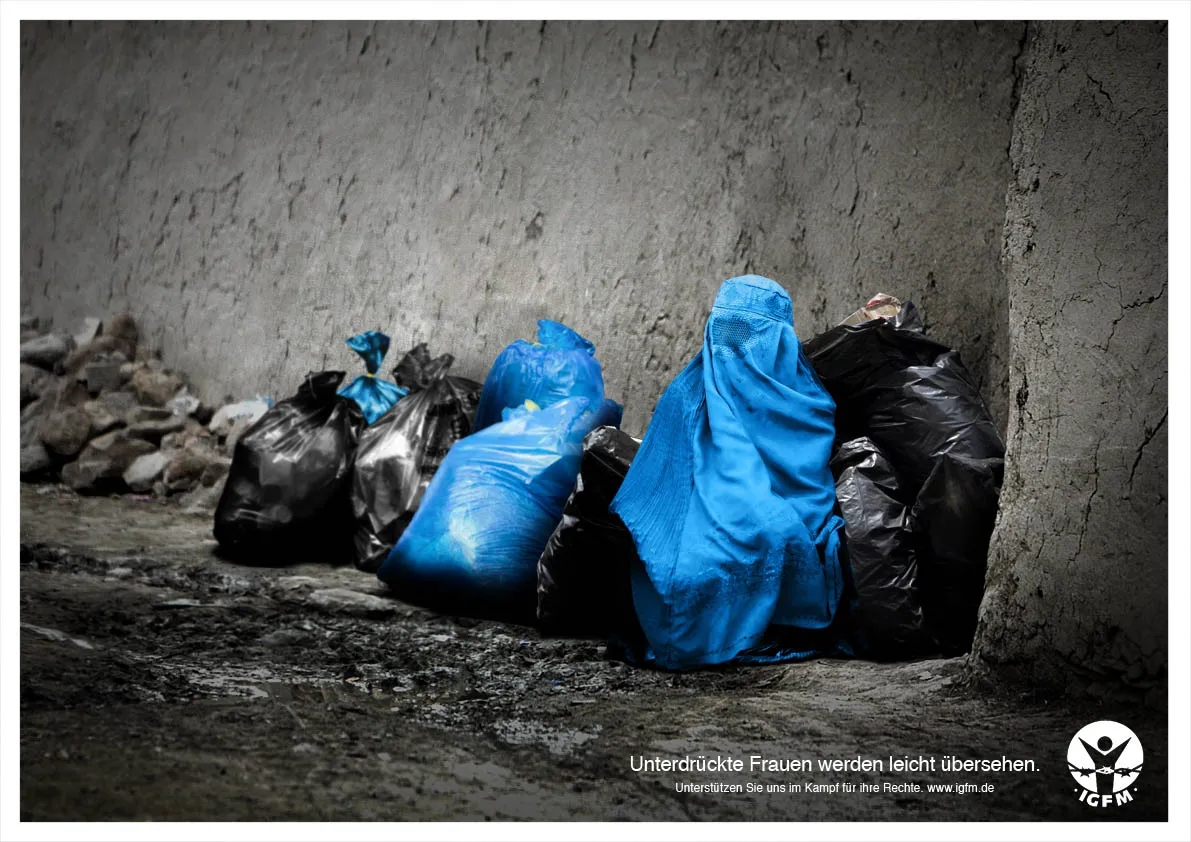
This example illustrates how Western humanitarian advocacy reproduces dehumanizing representations of Muslim women as faceless symbols of suffering—voiceless, passive, trapped by culture, and desperately awaiting rescue—rather than “agentic individuals” who can speak for themselves. This image of the Muslim woman is cast as a “singular stereotype”, erasing other cultural, political, and historical differences within this figure.
Abu-Lughod further critiques the Western obsession with the veil as a reductive view that imposes a single interpretive framework on a highly diverse set of practices across Muslim societies, each carrying different social meanings, including religious devotion, modesty, social respectability, community belonging, and political identity.
4. Solidarity and structural analysis
Abu-Lughod alternatively suggests engaging in a rigorous sociopolitical, structural analysis of the political and historical conditions that create and maintain inequality—war and occupation, authoritarian governance, economic inequality, and colonial histories.
More importantly, she points to the West’s own complicity in propping up oppressive regimes, creating conditions that harm women, while evading culpability and using civilizational frameworks to justify further military intervention.
To illustrate, Abu-Lughod asks the reader to imagine using the “patronizing” rhetoric of saving women in the United States about marginalized groups like Black or working-class women. “We now understand them as suffering from structural violence,” she notes. “We have become politicized about race and class, but not culture.”
She suggests the need to meaningfully engage with Muslim women on their own terms: listening to their voices, studying their lived experience, and understanding local contexts.
How this Applies Now
More than a decade later, the Western savior discourse Abu-Lughod identified remains a defining logic, from justifying illegal wars to pinkwashing genocide to policing Muslim women’s attire in the West.
1. The current war in Iran
Nowhere is this framing more clearly at play than in the current US-Israeli assault on Iran. Israeli Prime Minister Benjamin Netanyahu has constantly feigned support for the Women, Life, Freedom movement in Iran and emphasized the state’s oppressive treatment of women.
“We are waging a historic war for liberty,” he tweeted last evening, of the “once in a lifetime opportunity for you to remove the Ayatollah regime and gain your freedom.”

This language of saving Iranian women—echoed by Trump and Western media—is weaponized to justify this attack on Iran, in which over 1,200 civilians have been killed, including around 300 children.
Abu-Lughod’s critique can be seen in the perverse irony that on the first day of the attacks, US missiles struck a girl’s school in Minab, killing roughly 180 people, mostly schoolgirls aged 7–12.
2. The “Epstein class”
As Foad Izadi, a professor of North American Studies at the University of Tehran, said, Iranians “understand they are fighting the Epstein class that either rape little girls or bomb little girls.”
In terms of Abu-Lughod’s critique, the same Western political establishment that uses Muslim women’s liberation to justify bombing campaigns has demonstrated, through Epstein, a profound institutional tolerance for the abuse of women and girls at home.
3. Israeli pinkwashing
While Abu-Lughod’s book focuses primarily on gender and the figure of the oppressed Muslim woman, nowhere is the underlying logic she critiques—the use of progressive humanitarian language to legitimize occupation and war—more visible than in Israel’s long-running instrumentalization of LGBTQ rights to legitimize its occupation of Palestine.
Scholars such as Jasbir Puar situate this pinkwashing within the framework of “homonationalism”—the selective deployment of LGBTQ rights to seem progressive and legitimize colonial violence in the form of military occupation, movement restrictions, and surveillance.
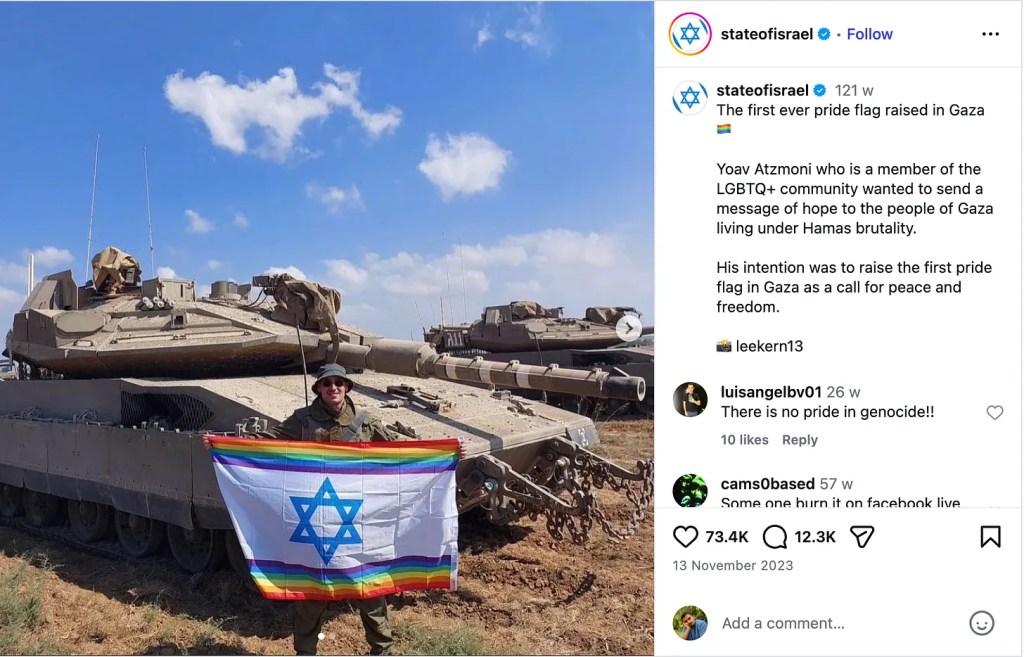
Never has this dynamic been more glaring than during Israel’s ongoing genocide and desecration of Gaza, where images have circulated online showing Israeli soldiers raising rainbow Pride flags next to destroyed buildings and presumably corpses of thousands, no doubt including queer people.
Perhaps the most enduring insight of Do Muslim Women Need Saving? is that the “saving” narrative is not simply a matter of prejudice or ignorance. It is a politically useful story rooted in colonialism and civilizational logic that justifies framing military interventions as humanitarian.
Bombing campaigns become liberation projects. Occupations become rescue missions. Abu-Lughod suggests that the question itself—Do Muslim women need saving?—was never really about Muslim women at all, but about the stories the Western Empire tells itself to reinforce its supremacy.
Instead, she suggests asking different questions, like: What political and economic structures shape women’s lives? What role have global powers played in creating those conditions?
In Abu-Lughod’s words, “Can we use a more egalitarian language of alliances, coalitions, and solidarity, instead of salvation?”
Lila Abu-Lughod Shows Why Those Who Claim to Save Muslim Women Don’t Care About Them
More than a decade later, the Western savior discourse Lila Abu-Lughod identified remains a defining logic, from justifying illegal wars to pinkwashing genocide to policing Muslim women’s attire in the West.
Note: The US attacked Iran on 28 February, 2026, at Israel’s behest, murdering the country’s Supreme Leader, Ayatollah Khameini. In the weeks that have ensued, the US and Israel have engaged in indiscriminate bombing and war crimes. However, this time, we find ourselves shrouded by a thick haze of censorship perpetrated by the genocidal media in the US and Israel. While the moment might feel terrifying and unprecedented, it is anything but. Each week, our editorial team will unpack and analyze seminal texts that help us make sense of this moment.
In Do Muslim Women Need Saving? (2013), Palestinian-American anthropologist Lila Abu-Lughod offers a powerful critique of the widespread assumption in Western politics, media, and feminism that Muslim women are oppressed victims needing rescue.
She argues that this assumption says more about Western political narratives and global power relations than it does about the actual lives of women in Muslim societies.
Her book emerged from the aftermath of the September 11 attacks and the beginning of the War in Afghanistan, when Western leaders repeatedly framed military invasion as a mission to liberate Afghan women from the Taliban. It builds on her 2002 journal article for American Anthropologist, “Do Muslim Women Really Need Saving? Anthropological Reflections on Cultural Relativism and Its Others.”
There, Abu-Lughod leverages 20 years of fieldwork experience in Egypt to criticize the colonial overtones of the USA’s War on Terror and its claims of saving Afghan women as justification.
Her critique is not that gender inequality does not exist in Muslim societies but that the simplified narratives used to describe it obscure the political, economic, and historical forces that shape women’s lives, while simultaneously legitimizing Western intervention.
“When you save someone,” Abu-Lughod writes, “you imply saving her to something.” That “something,” she suggests, is usually assumed to be Western liberal modernity itself—a particular vision of freedom, autonomy, and secularism presented as universal.
For her, this is a “constraining framework” for understanding people’s lives, and it shapes the kinds of solutions that we can imagine to solve complex political problems.
Breaking Down Abu-Lughod’s Arguments
Abu-Lughod’s insights in Do Muslim Women Need Saving? can be distilled into the following key ideas:
1. “Writing against culture”
Abu-Lughod theorizes a fictionalized space conceived in such discourse called “IslamLand,” where Afghanistan, Egypt, Saudi Arabia, Iran, and Indonesia become interchangeable sites of the same backward, static “Islamic culture” that uniformly oppresses Muslim women.
This idea stems from her 1991 essay “Writing Against Culture”, where Abu-Lughod argued that anthropology’s traditional use of “culture” often essentializes and homogenizes societies.
She thus rejects “cultural explanations” for gender inequality. She points out that violence against women—domestic abuse, sexual assault, femicide—occurs across the world. However, when it occurs in the West, it is reported as an individual crime, social pathology, or systemic inequality, whereas in Muslim societies, it is framed as cultural essence.
This double standard, Abu-Lughod argues, transforms complex political realities into civilizational narratives that Said has framed as Orientalism.
2. The Western savior
Abu-Lughod critiques several bestselling memoirs and personal narratives that follow a “rescue narrative” structure, portraying a suffering woman who escapes to the West and finds liberation from an oppressive Muslim culture, from Reading Lolita in Tehran by Azar Nafisi to Princess: A True Story of Life Behind the Veil in Saudi Arabia by Jean Sasson.
While individual stories might be genuine, she argues that the hard ubiquity and marketing of these narratives reinforce binaries of Western societies as empowering, modern, and progressive, and Muslim societies as uniquely oppressive, traditional, and regressive.
These binaries position Western governments, NGOs, and feminists as heroes and saviors, in turn legitimizing external intervention and ignoring Muslim women’s own resistance.
3. The oppressed Muslim woman and the veil
Central to the rhetoric of saving Muslim women is the burqa as a key symbol of the oppressed Muslim woman. Abu-Lughod describes a German human rights poster showing a woman wearing a blue Afghan burqa among several black garbage bags lined up against a wall, such that she visually resembles one of the bags.
The caption reads: “Oppressed women are easily overlooked.”
This example illustrates how Western humanitarian advocacy reproduces dehumanizing representations of Muslim women as faceless symbols of suffering—voiceless, passive, trapped by culture, and desperately awaiting rescue—rather than “agentic individuals” who can speak for themselves. This image of the Muslim woman is cast as a “singular stereotype”, erasing other cultural, political, and historical differences within this figure.
Abu-Lughod further critiques the Western obsession with the veil as a reductive view that imposes a single interpretive framework on a highly diverse set of practices across Muslim societies, each carrying different social meanings, including religious devotion, modesty, social respectability, community belonging, and political identity.
4. Solidarity and structural analysis
Abu-Lughod alternatively suggests engaging in a rigorous sociopolitical, structural analysis of the political and historical conditions that create and maintain inequality—war and occupation, authoritarian governance, economic inequality, and colonial histories.
More importantly, she points to the West’s own complicity in propping up oppressive regimes, creating conditions that harm women, while evading culpability and using civilizational frameworks to justify further military intervention.
To illustrate, Abu-Lughod asks the reader to imagine using the “patronizing” rhetoric of saving women in the United States about marginalized groups like Black or working-class women. “We now understand them as suffering from structural violence,” she notes. “We have become politicized about race and class, but not culture.”
She suggests the need to meaningfully engage with Muslim women on their own terms: listening to their voices, studying their lived experience, and understanding local contexts.
How this Applies Now
More than a decade later, the Western savior discourse Abu-Lughod identified remains a defining logic, from justifying illegal wars to pinkwashing genocide to policing Muslim women’s attire in the West.
1. The current war in Iran
Nowhere is this framing more clearly at play than in the current US-Israeli assault on Iran. Israeli Prime Minister Benjamin Netanyahu has constantly feigned support for the Women, Life, Freedom movement in Iran and emphasized the state’s oppressive treatment of women.
“We are waging a historic war for liberty,” he tweeted last evening, of the “once in a lifetime opportunity for you to remove the Ayatollah regime and gain your freedom.”
This language of saving Iranian women—echoed by Trump and Western media—is weaponized to justify this attack on Iran, in which over 1,200 civilians have been killed, including around 300 children.
Abu-Lughod’s critique can be seen in the perverse irony that on the first day of the attacks, US missiles struck a girl’s school in Minab, killing roughly 180 people, mostly schoolgirls aged 7–12.
2. The “Epstein class”
As Foad Izadi, a professor of North American Studies at the University of Tehran, said, Iranians “understand they are fighting the Epstein class that either rape little girls or bomb little girls.”
In terms of Abu-Lughod’s critique, the same Western political establishment that uses Muslim women’s liberation to justify bombing campaigns has demonstrated, through Epstein, a profound institutional tolerance for the abuse of women and girls at home.
3. Israeli pinkwashing
While Abu-Lughod’s book focuses primarily on gender and the figure of the oppressed Muslim woman, nowhere is the underlying logic she critiques—the use of progressive humanitarian language to legitimize occupation and war—more visible than in Israel’s long-running instrumentalization of LGBTQ rights to legitimize its occupation of Palestine.
Scholars such as Jasbir Puar situate this pinkwashing within the framework of “homonationalism”—the selective deployment of LGBTQ rights to seem progressive and legitimize colonial violence in the form of military occupation, movement restrictions, and surveillance.
Never has this dynamic been more glaring than during Israel’s ongoing genocide and desecration of Gaza, where images have circulated online showing Israeli soldiers raising rainbow Pride flags next to destroyed buildings and presumably corpses of thousands, no doubt including queer people.
Perhaps the most enduring insight of Do Muslim Women Need Saving? is that the “saving” narrative is not simply a matter of prejudice or ignorance. It is a politically useful story rooted in colonialism and civilizational logic that justifies framing military interventions as humanitarian.
Bombing campaigns become liberation projects. Occupations become rescue missions. Abu-Lughod suggests that the question itself—Do Muslim women need saving?—was never really about Muslim women at all, but about the stories the Western Empire tells itself to reinforce its supremacy.
Instead, she suggests asking different questions, like: What political and economic structures shape women’s lives? What role have global powers played in creating those conditions?
In Abu-Lughod’s words, “Can we use a more egalitarian language of alliances, coalitions, and solidarity, instead of salvation?”