


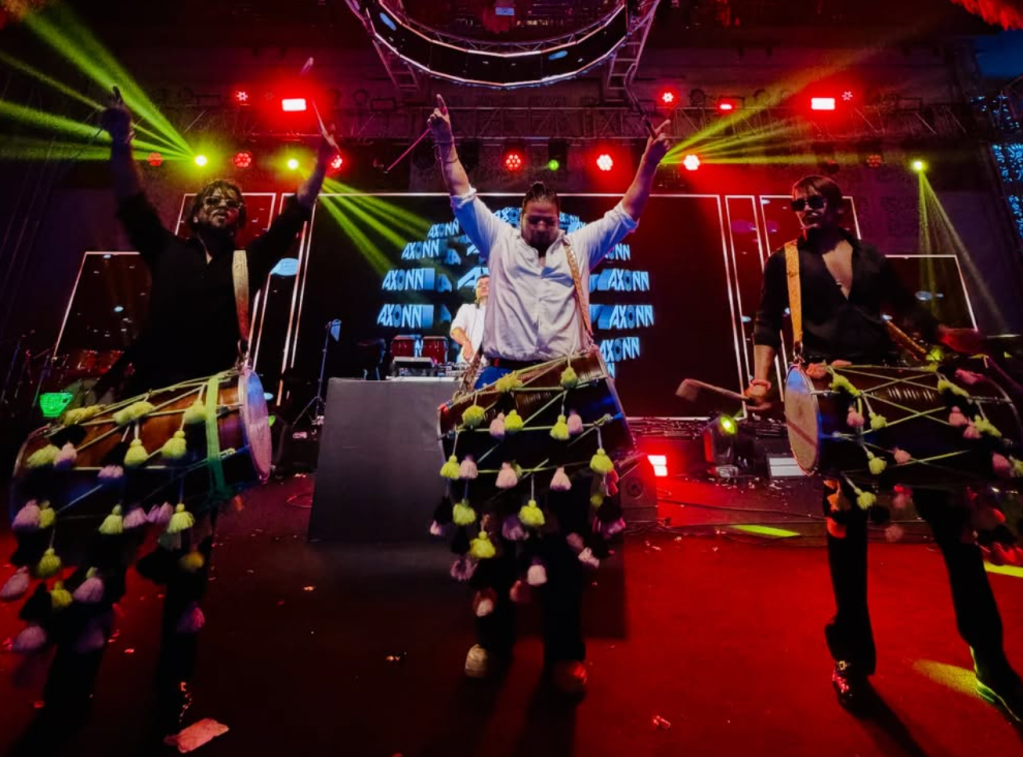
When I first met 30-year-old Vicky Bhatt in West Delhi’s Anand Parbat during the smog-choked winter, he was in a rush—packing his bags for a week-long trip to Sri Lanka, where he was set to perform at a wedding with his dhol (a large double-headed drum).
“It’s my eleventh time going abroad for a show,” he said, casually counting on his fingers. “Germany, Poland, Canada—three times—London…” He trailed off, losing track of the countries he’d been to.
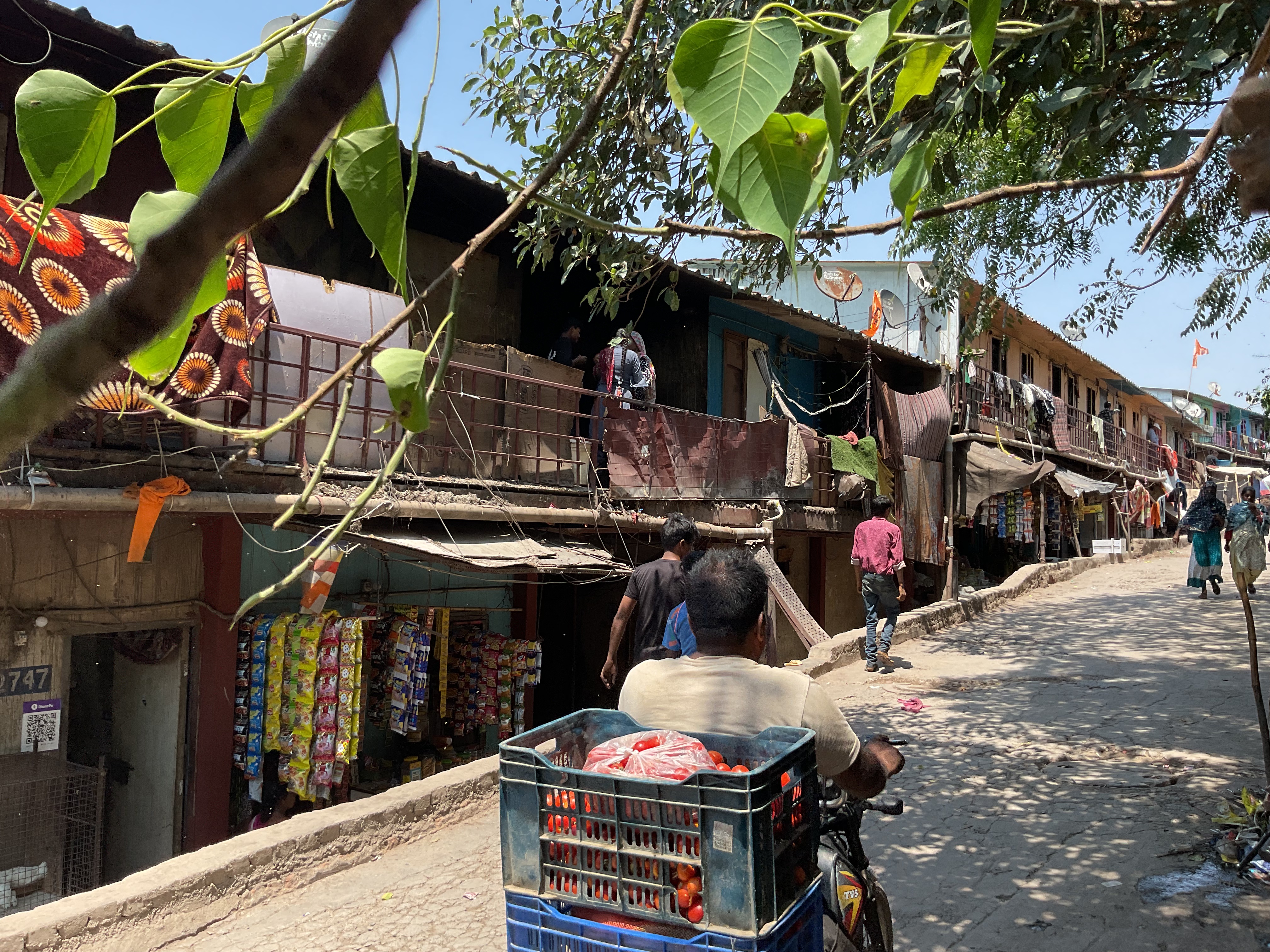
In the maze-like passages of Anand Parbat, where many performers now live in temporary housing units allotted by the Delhi Development Authority, the rhythm of the dhol echoes from every direction. Dhol players come and go, ducking into their single-room housing units; some practice right on the streets.
On makeshift desks in its lanes, residents sell sticks, goat or fiber skin, and other drum essentials. Some stalls even display colorful parandis (tassels), which Vicky claims he swaps to match his outfits, “to get the full look.”
“Everyone, young and old, does this work,” added Vicky. “Dhol is central to Delhi’s life. Everyone is obsessed with it as if any celebration is incomplete without it, and there’s a huge demand for it.”
The dhol remains one of the most iconic instruments in South Asian music. Known for its booming, resonant beat, it has long signaled celebration, anchoring weddings, festivals, and folk performances.
Although the dhol’s origins lie in folk traditions, its sonic presence has expanded far beyond them. Today, it shapes a wide spectrum of contemporary music, from Punjabi pop and Bollywood dance tracks to global hip-hop and EDM collaborations. This spread hasn’t happened organically; social media algorithms have played a major role in amplifying high-energy, percussive sounds that perform well on visual platforms like Instagram reels and TikTok.
Research on digital-platform music circulation shows that social media algorithms play an increasingly important role in determining which sounds travel globally. On platforms like TikTok and Instagram, high-energy, rhythm-driven, and easily loopable audio often performs better because it aligns with the way these feeds prioritize short, visually engaging content. This convergence, traditional percussion meeting digital loopability, has carried the dhol into new musical contexts.
As the dhol becomes a staple at every celebration, the demand for dhol players from Anand Parbat has also surged. “We’ve got clients from across India and even abroad. Anyone who wants the best dholis comes to our lanes,” Vicky shared. Much of this visibility, he added, comes from social media.
Viral videos of performances and Facebook reels have turned the dholis of Anand Parbat into a recognizable brand, drawing invitations to weddings and events not just from Delhi, but from countries as far as Canada and the UK. However, according to Vicky, playing the dhol wasn’t always this profitable, nor were so many people from his community drawn to it.
Vicky belongs to the Rajasthani Bhat community, a denotified tribe traditionally known for kathputli (puppet) performances. Once stigmatized under colonial laws as a “criminal tribe,” the Bhatts today remain among the most economically and socially marginalized communities, often relying on street performances and daily-wage labour for survival.
For generations, his family members have been kalakars (performers). “Most of our people were puppeteers,” he said, “but there were also magicians, snake charmers, acrobats, dancers, musicians, even traditional healers, and somewhere in the background were also players of dhol.”
Before moving to Anand Parbat, all the artisans lived in Kathputli Colony, Delhi’s famous settlement of performers. But in 2015, under the pretext of redevelopment, the Delhi government pushed the community off their land and resettled them in the transit camps of Anand Parbat. The dhol, Vicky explained, was never central to their art; it was kathputli that defined them.
“The dhol was just background noise for the kathputli naach (dancing puppets) in the colony,” he said. “Our community was more skilled than that. We were pushed into [dhol] when Kathputli—the colony and the art—both lost their relevance.”
With the erasure of Kathputli Colony from Delhi came the erasure of many traditional art forms. Thanks to its digital relevance and virality, the dhol has emerged from this state-induced displacement as a new expression that still allows the artists to call themselves artists, at least in some form.
However, the fading of kathputli isn’t merely about shifting tastes among the bourgeois and elite, or about a new craft finding relevance through the internet. It’s about how state neglect and displacement dismantled older art forms, leaving technology to merely accelerate what inequality had already begun, while continuing to leave artists and performers at the whims of a fickle and unforgiving market.
The Art Lost in Displacement
Kathputli Colony began in the 1950s as a patchwork of tents on an open field near Delhi’s Shadipur Depot—first settled by Rajasthani puppeteers, and later joined by folk artists from Bihar, Uttar Pradesh, Gujarat, Maharashtra, and elsewhere, each practicing different traditional art forms. Performers lived, trained, rehearsed, and showcased their talents on-site.
But more importantly, the dense sociality of the place fostered collaborations. It was a world steeped in color and chaos—a heady mix of joy and hardship, where poverty ran deep, but art gave life meaning and pride.
Vicky’s aunt, 46-year-old Guddi Bhatt, was among the early settlers. She remembers how almost every household in the colony was involved in performance work. Married to a puppeteer she fondly calls Guddu, she recalled the hectic, vibrant pace of those years.
“There was so much work. Everyone knew—if you wanted to add raunaq (sparkle) to a Delhi event, you needed people from our colony,” she said. “I used to do four to five shows a day. That was the demand. All of us were always busy.”
The years when Guddi recalls doing multiple shows a day were the same years Kathputli Colony still existed on the map of Delhi. But the sounds of redevelopment had already begun to echo.
In 2007, the Delhi Development Authority (DDA) selected the colony for the city’s first in-situ slum rehabilitation project—an idea that would later morph into the political slogan Jahan jhuggi, wahan makaan (“where there is a slum, there will be a house”). The slogan promised dignity and permanence to Delhi’s informal settlers, suggesting that residents would not be displaced but rehoused on the same land.
In practice, however, it became a tool of the state’s redevelopment logic—where “rehabilitation” meant relocating people to smaller, vertical units while a major portion of the land was handed over to private developers under public-private partnerships, aligning the project more with real estate interests than with the rights of the poor.
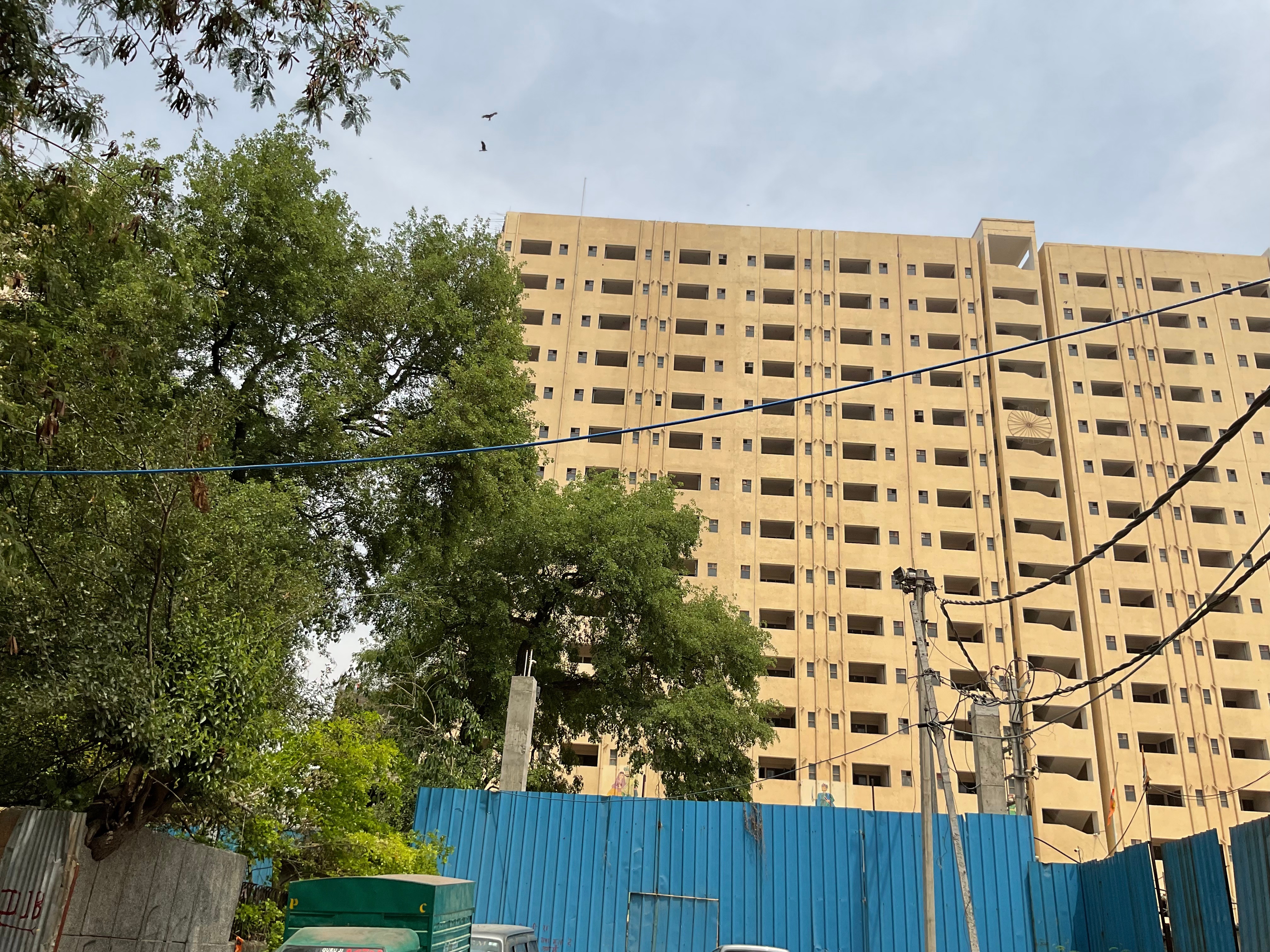
Two years later, in 2009, the Delhi Development Authority entered into a public-private partnership with Raheja Developers, granting the company a portion of the land for commercial development in exchange for constructing rehabilitation housing for nearly 2,800 displaced families. Raheja’s plan included 15-storey towers to rehouse the former residents, but the rest of the project was envisioned on a far grander scale.
Alongside the proposed rehabilitation, the company unveiled plans for Raheja Phoenix—marketed as “Delhi’s first true skyscraper.” The 54-storey luxury tower, with a projected height of 190 metres, would feature high-end flats, a sky club, and a helipad. The project was promoted as a symbol of the city’s “global” transformation, promising to modernize the urban landscape with luxury living, world-class amenities, and a skyline rivaling those of international capitals.
Predictably, the state’s “win-win” model tilted in favour of the developer. Between 2014 and 2017, the framed “participatory redevelopment” unfolded as a series of coercive evictions. A 2017 study by the Centre for Policy Research, for example, noted widespread use of misinformation and intimidation, with basic services cut off to compel compliance. Despite protests, by late 2017, the Katputhli colony was razed to the ground.
Of these, around 2,800 families deemed “eligible” were relocated to a transit camp in Anand Parbat, with the promise of receiving 30-square-metre flats in newly built towers on their original land within two years. Others were shifted to the city’s peripheries—some nearly 50 km away in Narela. Yet, these relocated families were the fortunate ones.
At least 771 families—nearly 20% of those displaced—received no housing at all. Such outcomes are far from isolated—even today, as state-led bulldozer actions become increasingly routine. Delhi’s urban renewal projects continue to reproduce the same pattern: selective “eligibility,” distant resettlement, and the quiet erasure of working-class communities under the rhetoric of world-class development.
Nearly a decade later, neither Guddi nor Vicky has been allotted the promised homes. Those moved to Narela continue to struggle on the city’s margins, cut off from their old lives and livelihoods.
The temporary shelters at the Anand Parbat transit camp—single-room units of just 12 square metres with shared toilets—have also begun to crumble. The work, too, has changed forms. “The artists are here, but the art has disappeared,” said Puran Bhatt, a community leader and internationally acclaimed puppeteer.
“Once, people associated Kathputli Colony with performance. If you went there, you’d find artists,” Bhatt recalled. But over time, that identity has faded. When the colony was demolished and residents scattered, work dried up almost overnight. The networks that sustained their art were torn apart.
In Anand Parbat, most couldn’t find space to store their instruments or puppets in the houses, which were made of PVC sheets, and supposedly had to carry everything as performing in the narrow, congested lanes was impossible. Those in Narela faced longer commutes to the city’s cultural hubs, with travel alone eating into their meagre earnings.
Additionally, relocation led to a severe “erosion of livelihoods,” as dispersed families could no longer collaborate or negotiate collectively with event organisers. “We had to start from scratch in the transit camps but were never able to rebuild what we had lost,” Bhatt said. “And worse, there’s no demand anymore. In the digital age, phones have replaced everything. No one has the patience for the slow rhythm of kathputli.”
The fallout of this collapse shows up in everyday lives. Families that once performed together now struggle to find a single show—and the rise of digital entertainment has only deepened their decline, pushing traditional art further to the margins.
For Guddi, work has dried up. Of her three daughters, two are married, and the family continues to pin its hopes on puppetry. A show can fetch ₹1,000-2,000, but most of it is spent on commuting.
“Entertainment today is instant, available at the touch of a screen,” she said. “Forget four shows a day—getting that much work in a month itself feels like a miracle.” The lack of work has begun to show in her life. Guddi often recalls the days at Kathputli Colony with a kind of wistful disbelief.
“Look at me now,” she said, pointing to a fading photo on the wall—her younger self beside her husband Guddu, cheeks full, dressed in bright clothes. “I was plump then. We wore new clothes, ate four meals a day. Now, look at me—I’m all dried up. Those weren’t rich days, but they were full. Now we’re just getting by.”
Picking up Drums, Leaving Kathputli
People stopped practising puppetry altogether. The magicians of the colony faced the same fate. “It’s difficult to pinpoint whether it was the digital boom or the displacement that truly caused Kathputli to disappear,” Bhatt said. “After all, residential neighbourhoods have also started treating performers’ voices as intrusions into their ‘world-class’ city.”
With fewer clients and no shows, many shifted to whatever jobs they could find: construction work, domestic labour, anything that helped them get by.
Yet amid the dwindling popularity of traditional arts, the dhol remained culturally relevant. “There were days when the only demand was for dhol players,” Bhatt added, “because they could still exist outside the world of traditional spectacle—playing at weddings and events.”
Raja Bhatt, 32, also moved to the transit camps after the demolition. With few work opportunities, he remembered only a handful of assignments—mostly playing the dhol at weddings. “I was even doing construction work,” he recalled. “We used to get limited gigs, mostly through the old networks we had—some from contractors or wedding planners.”
Slowly, though, things began to change with social media. “We started uploading random videos of ourselves performing and practising. Some of these clips began to pick up traction—first on TikTok (before it was banned), and then on Facebook,” he said. That was when Raja started practising the drum more seriously, realising that digital visibility could open doors that traditional networks no longer could.
The increased visibility gave his work new life. First came a wave of followers on TikTok, then on Facebook, and later, those numbers translated to Instagram. Further, it allowed him to reach clients across the city, the country, and even abroad.
“We’ve got clients from across India—and even abroad. Anyone who wants the best dholis comes to our lanes,” Raja shared with pride. His most talked-about assignment? Playing at the wedding of the son of Asia’s richest man, Mukesh Ambani, an event that made global headlines for its gaudy, no-holds-barred wealth display.
Raja, along with several dholis from the colony, was hired by a Delhi-based event management company contracted to provide performers for the $600 million wedding. “I remember Ranveer Singh doing boliyan (rhyming couplets) on our beats. Isha Ambani was dancing bhangra (Punjabi folk dance) with us,” he recalled.
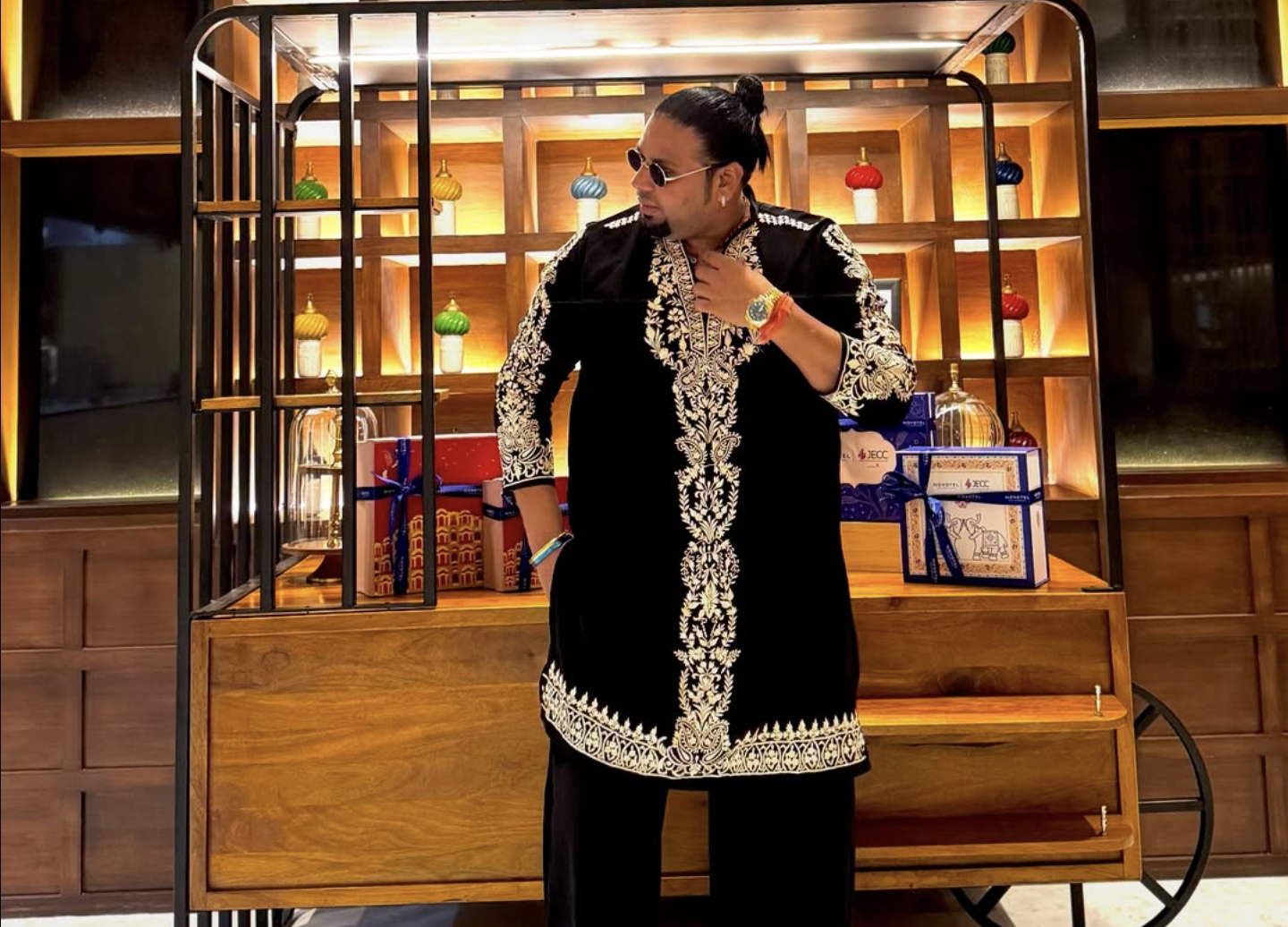
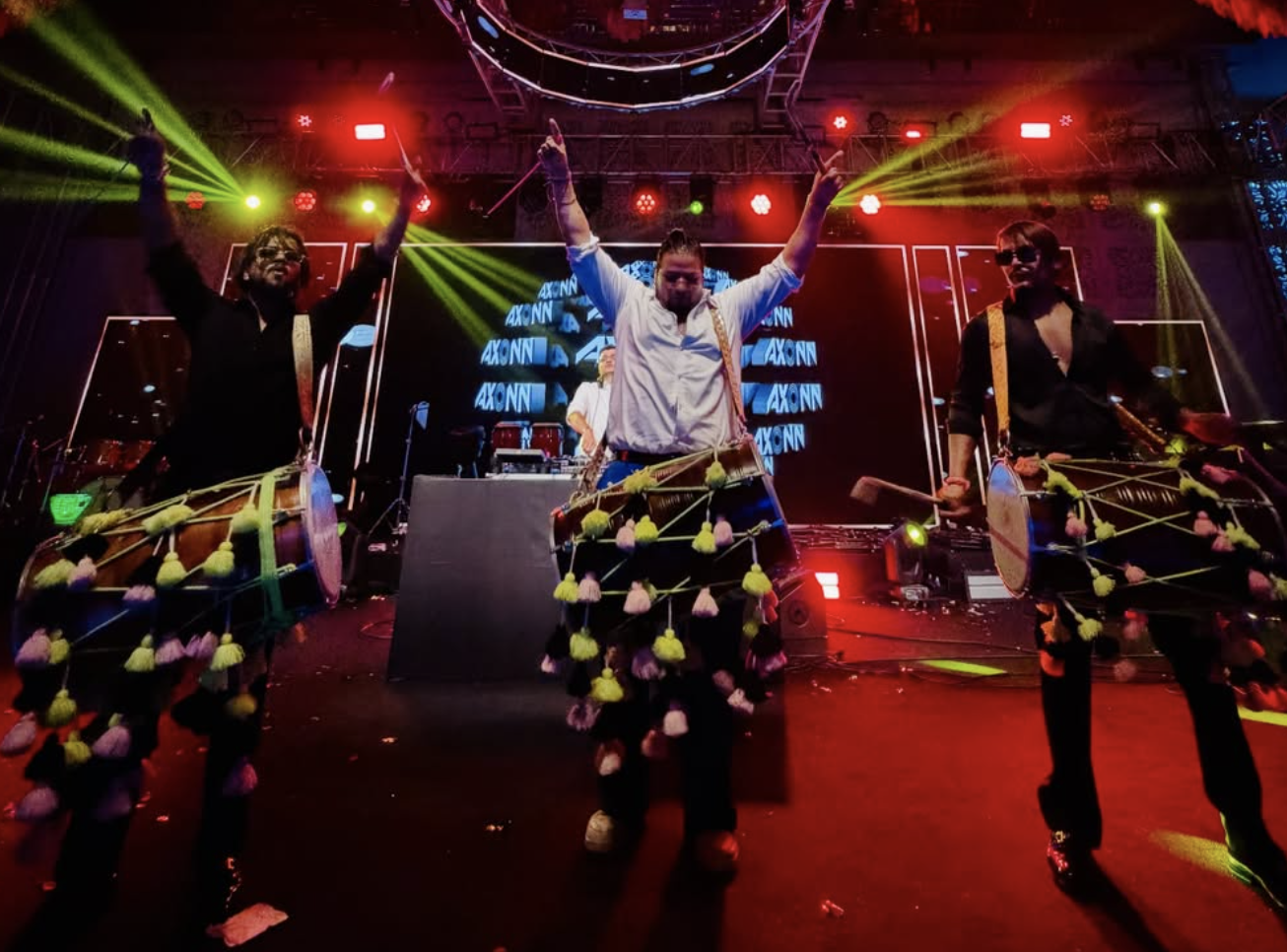
Today, Raja has lost count of the events he’s performed at—his clientele keeps expanding. His Instagram page shows 139K followers and is filled with photos of his travels across the globe: a Lohri celebration in Egypt, corporate gigs in Pattaya, weddings in Abu Dhabi, destination events in Turkey and Sri Lanka, concerts in Doha. His videos carry a simple pitch: wherever he plays, the space turns electric.
From Bollywood celebrities dancing to their beats to extravagant gigs, Raja’s six-member team has become a celebrity drum crew in Anand Parbat.
Seeing this trend, according to Raja, nearly everyone began promoting themselves on social media. “Many like us have been able to establish ourselves online. Some with a few followers, others with many—but either way, it’s brought work.”
Most work now comes through direct client inquiries on Instagram, though these are usually smaller gigs. Larger or international projects, however, are typically secured through agencies. “These agencies have more things sorted for us. They manage our travel, sometimes put us up in five-star hotels, arrange food, and pay us as per our performance. Of course, international gigs pay more than the local ones.”
The dhol, earlier played by the Dholi tribe in the colony alongside other art forms, has now become the most popular, in-demand, and perhaps the only relevant act. “That’s why the younger ones have all shifted to it,” said Vicky.
But like Vicky, Raja also confirmed that the bigger share of the earnings stays with the agencies. “As artists, we still receive a very limited portion—only 25 to 30 per cent comes into our hands,” he said. Still, he’s grateful they’re able to perform and make a living through their art.
The contrast between the rising profile of the drummers and their living conditions remains stark. The temporary rooms in the shanties of Anand Parbat are unchanged. The promised houses from the developers are still pending, with no clear timeline. Repairs are constant—one day a door falls off, the next the ceiling begins to crack. The units, made of PVC and asbestos, continue to deteriorate.
But money has started to show up—in the things people wear. Branded shopping bags from Zudio and H&M, youngsters shooting videos not on old Androids but on iPhones. Some have managed to buy bikes, scooters. Showing off his new iPhone, Vicky said, “If you want to work with certain people, you need to look like them, speak like them, sit and stand like them. Otherwise, you’re dismissed as not respectable enough. After all, art is not just about art.”
But the Boom—Was It for Everyone?

When asked if he too was on Instagram, 32-year-old Bittu Bhatt grew visibly frustrated. “Instagram didn’t do a damn thing. The ones who went viral got the attention. What about the rest of us?”
People, he said, only seek out famous artists, leaving equally talented artists struggling for visibility. “It’s not that we don’t get work, but we aren’t growing at the same pace.”
Bittu even tried promoting his account through paid models offered by the app. “I spent about ₹150 a day for nearly two weeks,” he said. “But I didn’t gain a single follower. I don’t think I’m less talented—it’s not about me. It’s this whole Instagram farce.”
Despite pushing his content through Instagram’s paid promotion tools, Bittu has barely crossed 1,000 followers. He still remembers the days when life and work both felt easier in the Shadipur settlement, the older Kathputli settlement before demolition.
Social media, while often celebrated for giving artists a wider audience, is far from egalitarian. Scholars describe this as the “Matthew effect” or the principle of cumulative advantage: performers who already gain attention are amplified, while those starting from zero—like Bittu—remain largely invisible.
Additionally, while these platforms can extend an artist’s reach beyond local or physical networks, they also create new hierarchies, privileging those with already striking visuals, catchy clips, or strategic self-branding. As a result, traditional skills alone no longer guarantee a livelihood
“There’s competition between us now,” Raja admitted. “But everyone just says—you eat what’s written in your fate.”
Many like Bittu are growing increasingly disillusioned with the promise of Instagram fame. The platform’s algorithms, he believes, have left him behind.
Fariduddin, 46, a street magician now working in construction, isn’t even aware of what Facebook or Instagram could do for him. “I never tried those apps on my phone,” he said. “I don’t think anyone wants to see magicians perform anymore. At least with labour work, you know you’ll get paid at the end of the day.”
The digital boom—and the rising popularity of the drum—has also largely excluded women.
Guddi remembers how central women were to puppetry. “We used to stitch clothes for the dolls, sometimes even help write the scripts. The roles were clearly divided. Women sat in front of the curtain with their dholaks and narrated the story, while the men worked the puppets behind it.” In those days, she said, women were equal protagonists in the performance. “Our share mattered.”
But in Anand Parbat today, where the drum has become the mainstay, not a single woman drummer has emerged. The dhol, dominated by men, has become its own digital commodity.
“The drums are heavy—made from mango wood. How will girls manage that?” Bittu asked. “They still get some work through us, like applying henna at weddings. But even there, the demand is now more for young men.”
Moreover, it is not just physical barriers like weight and tradition that restrict women—it is also the persistent digital gender divide. In India, women are 15 per cent less likely to own a mobile phone and 33 per cent less likely to use mobile internet services than men. This skew means digital platforms, which offer visibility and bookings for performers, favour men.
Not only do they have better access to devices, but men also face fewer social and structural barriers to content creation and promotion.
Guddi added, “Besides puppetry, what else do we have? We only have daughters. There’s no boy to play the dhol and bring in money. She can’t play the dhol—and even if she learns, will it look good, out there on Facebook, making videos and performing?”
The Beat Survived Displacement. But for How Long?
Yet even with its newfound digital visibility, the dhol is still a trend—and trends, by definition, turn. The very algorithm that lifted the dholis of Anand Parbat into global wedding circuits can just as quickly pivot to another sound, another aesthetic. For a community already displaced once, the possibility that their current livelihood rests on an inherently unstable digital rhythm feels both empowering and terrifying.
The dhol may have helped them rebuild an identity, but it has also tethered their survival to the volatility of online virality—an economy where attention is scarce, competition is constant, and the rules are always shifting. This uncertainty becomes sharper when placed against the unresolved question of housing.
Nearly ten years after demolition, the promised apartments remain undelivered. And when they do come—if they come—the shift from the porous, collaborative lanes of Anand Parbat to tightly stacked high-rise flats may again disrupt the very conditions that made the dhol possible: collective practice, shared rehearsal spaces, cross-household networks. Will they be able to recreate those rhythms in narrow balconies and enclosed corridors? Will a tower ever allow the same kind of sonic commons that a basti did?
The irony is hard to miss: even as the community adapts to each new wave of forced reinvention, their livelihoods remain dictated by forces beyond their control: state policies, real-estate ambitions, and now, the caprices of digital culture. The dhol may be beating loudly today, but its future—like the future of the community itself—rests on foundations far more fragile than its booming sound suggests.

Kathputli’s Lost Artisans: Displacement and the Making of a Digital Music Scene
Displacement and digital media has forced Delhi’s renowned puppeteering community to give up their art form in favor of a trendier one: the dhol. Photo of Raja Bhat from his Instagram.
When I first met 30-year-old Vicky Bhatt in West Delhi’s Anand Parbat during the smog-choked winter, he was in a rush—packing his bags for a week-long trip to Sri Lanka, where he was set to perform at a wedding with his dhol (a large double-headed drum).
“It’s my eleventh time going abroad for a show,” he said, casually counting on his fingers. “Germany, Poland, Canada—three times—London…” He trailed off, losing track of the countries he’d been to.
In the maze-like passages of Anand Parbat, where many performers now live in temporary housing units allotted by the Delhi Development Authority, the rhythm of the dhol echoes from every direction. Dhol players come and go, ducking into their single-room housing units; some practice right on the streets.
On makeshift desks in its lanes, residents sell sticks, goat or fiber skin, and other drum essentials. Some stalls even display colorful parandis (tassels), which Vicky claims he swaps to match his outfits, “to get the full look.”
“Everyone, young and old, does this work,” added Vicky. “Dhol is central to Delhi’s life. Everyone is obsessed with it as if any celebration is incomplete without it, and there’s a huge demand for it.”
The dhol remains one of the most iconic instruments in South Asian music. Known for its booming, resonant beat, it has long signaled celebration, anchoring weddings, festivals, and folk performances.
Although the dhol’s origins lie in folk traditions, its sonic presence has expanded far beyond them. Today, it shapes a wide spectrum of contemporary music, from Punjabi pop and Bollywood dance tracks to global hip-hop and EDM collaborations. This spread hasn’t happened organically; social media algorithms have played a major role in amplifying high-energy, percussive sounds that perform well on visual platforms like Instagram reels and TikTok.
Research on digital-platform music circulation shows that social media algorithms play an increasingly important role in determining which sounds travel globally. On platforms like TikTok and Instagram, high-energy, rhythm-driven, and easily loopable audio often performs better because it aligns with the way these feeds prioritize short, visually engaging content. This convergence, traditional percussion meeting digital loopability, has carried the dhol into new musical contexts.
As the dhol becomes a staple at every celebration, the demand for dhol players from Anand Parbat has also surged. “We’ve got clients from across India and even abroad. Anyone who wants the best dholis comes to our lanes,” Vicky shared. Much of this visibility, he added, comes from social media.
Viral videos of performances and Facebook reels have turned the dholis of Anand Parbat into a recognizable brand, drawing invitations to weddings and events not just from Delhi, but from countries as far as Canada and the UK. However, according to Vicky, playing the dhol wasn’t always this profitable, nor were so many people from his community drawn to it.
Vicky belongs to the Rajasthani Bhat community, a denotified tribe traditionally known for kathputli (puppet) performances. Once stigmatized under colonial laws as a “criminal tribe,” the Bhatts today remain among the most economically and socially marginalized communities, often relying on street performances and daily-wage labour for survival.
For generations, his family members have been kalakars (performers). “Most of our people were puppeteers,” he said, “but there were also magicians, snake charmers, acrobats, dancers, musicians, even traditional healers, and somewhere in the background were also players of dhol.”
Before moving to Anand Parbat, all the artisans lived in Kathputli Colony, Delhi’s famous settlement of performers. But in 2015, under the pretext of redevelopment, the Delhi government pushed the community off their land and resettled them in the transit camps of Anand Parbat. The dhol, Vicky explained, was never central to their art; it was kathputli that defined them.
“The dhol was just background noise for the kathputli naach (dancing puppets) in the colony,” he said. “Our community was more skilled than that. We were pushed into [dhol] when Kathputli—the colony and the art—both lost their relevance.”
With the erasure of Kathputli Colony from Delhi came the erasure of many traditional art forms. Thanks to its digital relevance and virality, the dhol has emerged from this state-induced displacement as a new expression that still allows the artists to call themselves artists, at least in some form.
However, the fading of kathputli isn’t merely about shifting tastes among the bourgeois and elite, or about a new craft finding relevance through the internet. It’s about how state neglect and displacement dismantled older art forms, leaving technology to merely accelerate what inequality had already begun, while continuing to leave artists and performers at the whims of a fickle and unforgiving market.
The Art Lost in Displacement
Kathputli Colony began in the 1950s as a patchwork of tents on an open field near Delhi’s Shadipur Depot—first settled by Rajasthani puppeteers, and later joined by folk artists from Bihar, Uttar Pradesh, Gujarat, Maharashtra, and elsewhere, each practicing different traditional art forms. Performers lived, trained, rehearsed, and showcased their talents on-site.
But more importantly, the dense sociality of the place fostered collaborations. It was a world steeped in color and chaos—a heady mix of joy and hardship, where poverty ran deep, but art gave life meaning and pride.
Vicky’s aunt, 46-year-old Guddi Bhatt, was among the early settlers. She remembers how almost every household in the colony was involved in performance work. Married to a puppeteer she fondly calls Guddu, she recalled the hectic, vibrant pace of those years.
“There was so much work. Everyone knew—if you wanted to add raunaq (sparkle) to a Delhi event, you needed people from our colony,” she said. “I used to do four to five shows a day. That was the demand. All of us were always busy.”
The years when Guddi recalls doing multiple shows a day were the same years Kathputli Colony still existed on the map of Delhi. But the sounds of redevelopment had already begun to echo.
In 2007, the Delhi Development Authority (DDA) selected the colony for the city’s first in-situ slum rehabilitation project—an idea that would later morph into the political slogan Jahan jhuggi, wahan makaan (“where there is a slum, there will be a house”). The slogan promised dignity and permanence to Delhi’s informal settlers, suggesting that residents would not be displaced but rehoused on the same land.
In practice, however, it became a tool of the state’s redevelopment logic—where “rehabilitation” meant relocating people to smaller, vertical units while a major portion of the land was handed over to private developers under public-private partnerships, aligning the project more with real estate interests than with the rights of the poor.
Two years later, in 2009, the Delhi Development Authority entered into a public-private partnership with Raheja Developers, granting the company a portion of the land for commercial development in exchange for constructing rehabilitation housing for nearly 2,800 displaced families. Raheja’s plan included 15-storey towers to rehouse the former residents, but the rest of the project was envisioned on a far grander scale.
Alongside the proposed rehabilitation, the company unveiled plans for Raheja Phoenix—marketed as “Delhi’s first true skyscraper.” The 54-storey luxury tower, with a projected height of 190 metres, would feature high-end flats, a sky club, and a helipad. The project was promoted as a symbol of the city’s “global” transformation, promising to modernize the urban landscape with luxury living, world-class amenities, and a skyline rivaling those of international capitals.
Predictably, the state’s “win-win” model tilted in favour of the developer. Between 2014 and 2017, the framed “participatory redevelopment” unfolded as a series of coercive evictions. A 2017 study by the Centre for Policy Research, for example, noted widespread use of misinformation and intimidation, with basic services cut off to compel compliance. Despite protests, by late 2017, the Katputhli colony was razed to the ground.
Of these, around 2,800 families deemed “eligible” were relocated to a transit camp in Anand Parbat, with the promise of receiving 30-square-metre flats in newly built towers on their original land within two years. Others were shifted to the city’s peripheries—some nearly 50 km away in Narela. Yet, these relocated families were the fortunate ones.
At least 771 families—nearly 20% of those displaced—received no housing at all. Such outcomes are far from isolated—even today, as state-led bulldozer actions become increasingly routine. Delhi’s urban renewal projects continue to reproduce the same pattern: selective “eligibility,” distant resettlement, and the quiet erasure of working-class communities under the rhetoric of world-class development.
Nearly a decade later, neither Guddi nor Vicky has been allotted the promised homes. Those moved to Narela continue to struggle on the city’s margins, cut off from their old lives and livelihoods.
The temporary shelters at the Anand Parbat transit camp—single-room units of just 12 square metres with shared toilets—have also begun to crumble. The work, too, has changed forms. “The artists are here, but the art has disappeared,” said Puran Bhatt, a community leader and internationally acclaimed puppeteer.
“Once, people associated Kathputli Colony with performance. If you went there, you’d find artists,” Bhatt recalled. But over time, that identity has faded. When the colony was demolished and residents scattered, work dried up almost overnight. The networks that sustained their art were torn apart.
In Anand Parbat, most couldn’t find space to store their instruments or puppets in the houses, which were made of PVC sheets, and supposedly had to carry everything as performing in the narrow, congested lanes was impossible. Those in Narela faced longer commutes to the city’s cultural hubs, with travel alone eating into their meagre earnings.
Additionally, relocation led to a severe “erosion of livelihoods,” as dispersed families could no longer collaborate or negotiate collectively with event organisers. “We had to start from scratch in the transit camps but were never able to rebuild what we had lost,” Bhatt said. “And worse, there’s no demand anymore. In the digital age, phones have replaced everything. No one has the patience for the slow rhythm of kathputli.”
The fallout of this collapse shows up in everyday lives. Families that once performed together now struggle to find a single show—and the rise of digital entertainment has only deepened their decline, pushing traditional art further to the margins.
For Guddi, work has dried up. Of her three daughters, two are married, and the family continues to pin its hopes on puppetry. A show can fetch ₹1,000-2,000, but most of it is spent on commuting.
“Entertainment today is instant, available at the touch of a screen,” she said. “Forget four shows a day—getting that much work in a month itself feels like a miracle.” The lack of work has begun to show in her life. Guddi often recalls the days at Kathputli Colony with a kind of wistful disbelief.
“Look at me now,” she said, pointing to a fading photo on the wall—her younger self beside her husband Guddu, cheeks full, dressed in bright clothes. “I was plump then. We wore new clothes, ate four meals a day. Now, look at me—I’m all dried up. Those weren’t rich days, but they were full. Now we’re just getting by.”
Picking up Drums, Leaving Kathputli
People stopped practising puppetry altogether. The magicians of the colony faced the same fate. “It’s difficult to pinpoint whether it was the digital boom or the displacement that truly caused Kathputli to disappear,” Bhatt said. “After all, residential neighbourhoods have also started treating performers’ voices as intrusions into their ‘world-class’ city.”
With fewer clients and no shows, many shifted to whatever jobs they could find: construction work, domestic labour, anything that helped them get by.
Yet amid the dwindling popularity of traditional arts, the dhol remained culturally relevant. “There were days when the only demand was for dhol players,” Bhatt added, “because they could still exist outside the world of traditional spectacle—playing at weddings and events.”
Raja Bhatt, 32, also moved to the transit camps after the demolition. With few work opportunities, he remembered only a handful of assignments—mostly playing the dhol at weddings. “I was even doing construction work,” he recalled. “We used to get limited gigs, mostly through the old networks we had—some from contractors or wedding planners.”
Slowly, though, things began to change with social media. “We started uploading random videos of ourselves performing and practising. Some of these clips began to pick up traction—first on TikTok (before it was banned), and then on Facebook,” he said. That was when Raja started practising the drum more seriously, realising that digital visibility could open doors that traditional networks no longer could.
The increased visibility gave his work new life. First came a wave of followers on TikTok, then on Facebook, and later, those numbers translated to Instagram. Further, it allowed him to reach clients across the city, the country, and even abroad.
“We’ve got clients from across India—and even abroad. Anyone who wants the best dholis comes to our lanes,” Raja shared with pride. His most talked-about assignment? Playing at the wedding of the son of Asia’s richest man, Mukesh Ambani, an event that made global headlines for its gaudy, no-holds-barred wealth display.
Raja, along with several dholis from the colony, was hired by a Delhi-based event management company contracted to provide performers for the $600 million wedding. “I remember Ranveer Singh doing boliyan (rhyming couplets) on our beats. Isha Ambani was dancing bhangra (Punjabi folk dance) with us,” he recalled.
Today, Raja has lost count of the events he’s performed at—his clientele keeps expanding. His Instagram page shows 139K followers and is filled with photos of his travels across the globe: a Lohri celebration in Egypt, corporate gigs in Pattaya, weddings in Abu Dhabi, destination events in Turkey and Sri Lanka, concerts in Doha. His videos carry a simple pitch: wherever he plays, the space turns electric.
From Bollywood celebrities dancing to their beats to extravagant gigs, Raja’s six-member team has become a celebrity drum crew in Anand Parbat.
Seeing this trend, according to Raja, nearly everyone began promoting themselves on social media. “Many like us have been able to establish ourselves online. Some with a few followers, others with many—but either way, it’s brought work.”
Most work now comes through direct client inquiries on Instagram, though these are usually smaller gigs. Larger or international projects, however, are typically secured through agencies. “These agencies have more things sorted for us. They manage our travel, sometimes put us up in five-star hotels, arrange food, and pay us as per our performance. Of course, international gigs pay more than the local ones.”
The dhol, earlier played by the Dholi tribe in the colony alongside other art forms, has now become the most popular, in-demand, and perhaps the only relevant act. “That’s why the younger ones have all shifted to it,” said Vicky.
But like Vicky, Raja also confirmed that the bigger share of the earnings stays with the agencies. “As artists, we still receive a very limited portion—only 25 to 30 per cent comes into our hands,” he said. Still, he’s grateful they’re able to perform and make a living through their art.
The contrast between the rising profile of the drummers and their living conditions remains stark. The temporary rooms in the shanties of Anand Parbat are unchanged. The promised houses from the developers are still pending, with no clear timeline. Repairs are constant—one day a door falls off, the next the ceiling begins to crack. The units, made of PVC and asbestos, continue to deteriorate.
But money has started to show up—in the things people wear. Branded shopping bags from Zudio and H&M, youngsters shooting videos not on old Androids but on iPhones. Some have managed to buy bikes, scooters. Showing off his new iPhone, Vicky said, “If you want to work with certain people, you need to look like them, speak like them, sit and stand like them. Otherwise, you’re dismissed as not respectable enough. After all, art is not just about art.”
But the Boom—Was It for Everyone?
When asked if he too was on Instagram, 32-year-old Bittu Bhatt grew visibly frustrated. “Instagram didn’t do a damn thing. The ones who went viral got the attention. What about the rest of us?”
People, he said, only seek out famous artists, leaving equally talented artists struggling for visibility. “It’s not that we don’t get work, but we aren’t growing at the same pace.”
Bittu even tried promoting his account through paid models offered by the app. “I spent about ₹150 a day for nearly two weeks,” he said. “But I didn’t gain a single follower. I don’t think I’m less talented—it’s not about me. It’s this whole Instagram farce.”
Despite pushing his content through Instagram’s paid promotion tools, Bittu has barely crossed 1,000 followers. He still remembers the days when life and work both felt easier in the Shadipur settlement, the older Kathputli settlement before demolition.
Social media, while often celebrated for giving artists a wider audience, is far from egalitarian. Scholars describe this as the “Matthew effect” or the principle of cumulative advantage: performers who already gain attention are amplified, while those starting from zero—like Bittu—remain largely invisible.
Additionally, while these platforms can extend an artist’s reach beyond local or physical networks, they also create new hierarchies, privileging those with already striking visuals, catchy clips, or strategic self-branding. As a result, traditional skills alone no longer guarantee a livelihood
“There’s competition between us now,” Raja admitted. “But everyone just says—you eat what’s written in your fate.”
Many like Bittu are growing increasingly disillusioned with the promise of Instagram fame. The platform’s algorithms, he believes, have left him behind.
Fariduddin, 46, a street magician now working in construction, isn’t even aware of what Facebook or Instagram could do for him. “I never tried those apps on my phone,” he said. “I don’t think anyone wants to see magicians perform anymore. At least with labour work, you know you’ll get paid at the end of the day.”
The digital boom—and the rising popularity of the drum—has also largely excluded women.
Guddi remembers how central women were to puppetry. “We used to stitch clothes for the dolls, sometimes even help write the scripts. The roles were clearly divided. Women sat in front of the curtain with their dholaks and narrated the story, while the men worked the puppets behind it.” In those days, she said, women were equal protagonists in the performance. “Our share mattered.”
But in Anand Parbat today, where the drum has become the mainstay, not a single woman drummer has emerged. The dhol, dominated by men, has become its own digital commodity.
“The drums are heavy—made from mango wood. How will girls manage that?” Bittu asked. “They still get some work through us, like applying henna at weddings. But even there, the demand is now more for young men.”
Moreover, it is not just physical barriers like weight and tradition that restrict women—it is also the persistent digital gender divide. In India, women are 15 per cent less likely to own a mobile phone and 33 per cent less likely to use mobile internet services than men. This skew means digital platforms, which offer visibility and bookings for performers, favour men.
Not only do they have better access to devices, but men also face fewer social and structural barriers to content creation and promotion.
Guddi added, “Besides puppetry, what else do we have? We only have daughters. There’s no boy to play the dhol and bring in money. She can’t play the dhol—and even if she learns, will it look good, out there on Facebook, making videos and performing?”
The Beat Survived Displacement. But for How Long?
Yet even with its newfound digital visibility, the dhol is still a trend—and trends, by definition, turn. The very algorithm that lifted the dholis of Anand Parbat into global wedding circuits can just as quickly pivot to another sound, another aesthetic. For a community already displaced once, the possibility that their current livelihood rests on an inherently unstable digital rhythm feels both empowering and terrifying.
The dhol may have helped them rebuild an identity, but it has also tethered their survival to the volatility of online virality—an economy where attention is scarce, competition is constant, and the rules are always shifting. This uncertainty becomes sharper when placed against the unresolved question of housing.
Nearly ten years after demolition, the promised apartments remain undelivered. And when they do come—if they come—the shift from the porous, collaborative lanes of Anand Parbat to tightly stacked high-rise flats may again disrupt the very conditions that made the dhol possible: collective practice, shared rehearsal spaces, cross-household networks. Will they be able to recreate those rhythms in narrow balconies and enclosed corridors? Will a tower ever allow the same kind of sonic commons that a basti did?
The irony is hard to miss: even as the community adapts to each new wave of forced reinvention, their livelihoods remain dictated by forces beyond their control: state policies, real-estate ambitions, and now, the caprices of digital culture. The dhol may be beating loudly today, but its future—like the future of the community itself—rests on foundations far more fragile than its booming sound suggests.