



On February 12, 2024, a 50-year-old auto driver from Kolkata received an unexpected call from the Okhla police station. The caller informed him that his son, SK Sajahan Ali, a master’s student of sociology at Jamia Millia Islamia, was getting himself into trouble by participating in a protest against the university administration.
The police warned that if Sajahan didn’t leave the protest site, his admission could be revoked, and he might face legal action.
This was the first time Sajahan’s father had ever been contacted by the police, especially about his son, who was nearly 1,000 miles away. Alarmed, he immediately called Sajahan, urging him to leave the protest.
“My father was shocked and told me to step away immediately. He had never received such a call before,” Sajahan told me. “Even I was taken aback—how did the police reach out to my father about a campus protest? What role did they have in this? How did they get my number?”
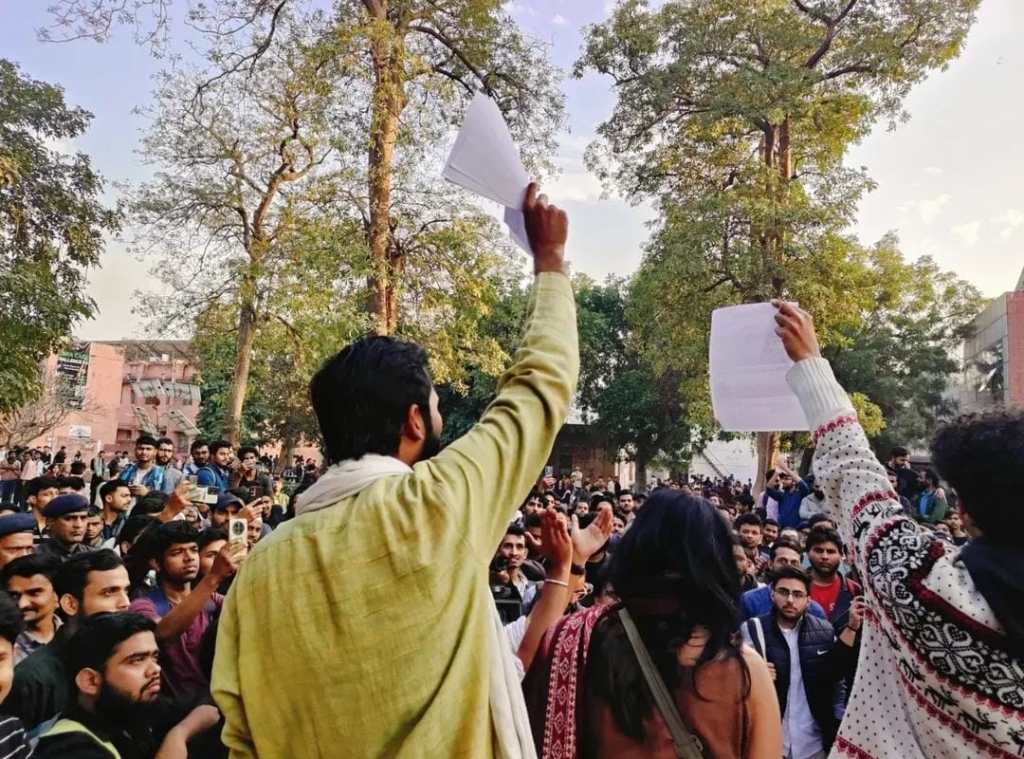
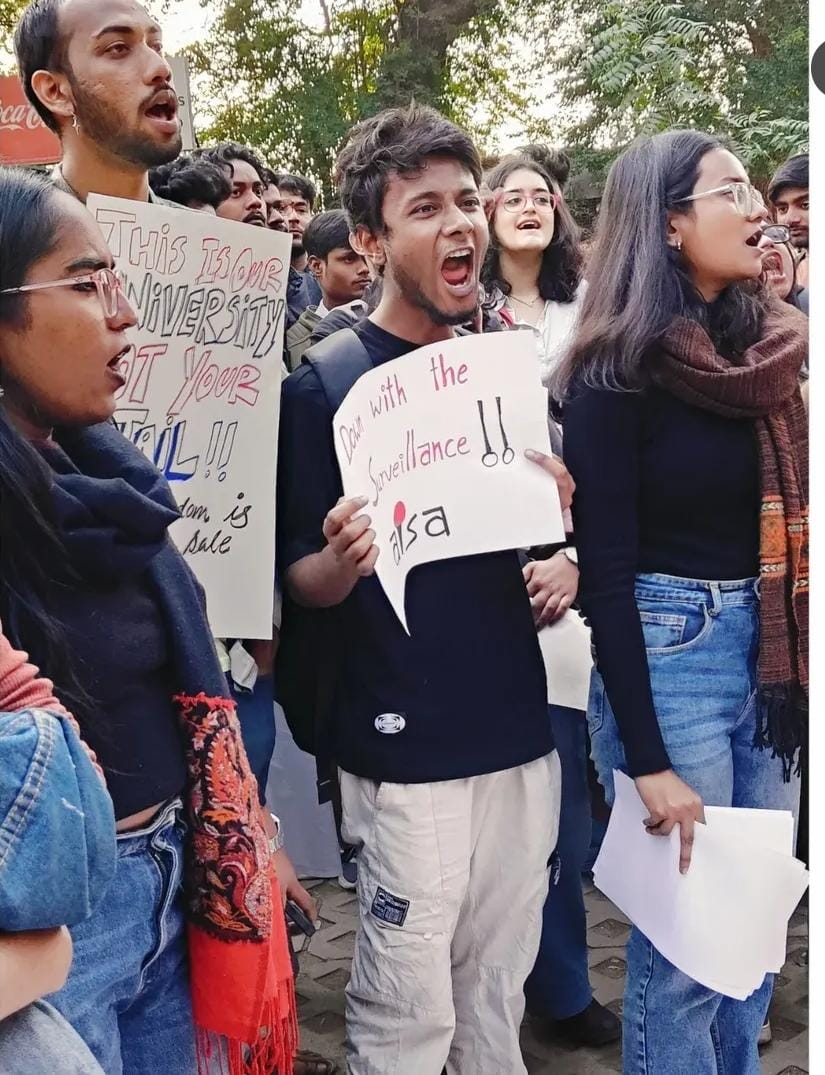
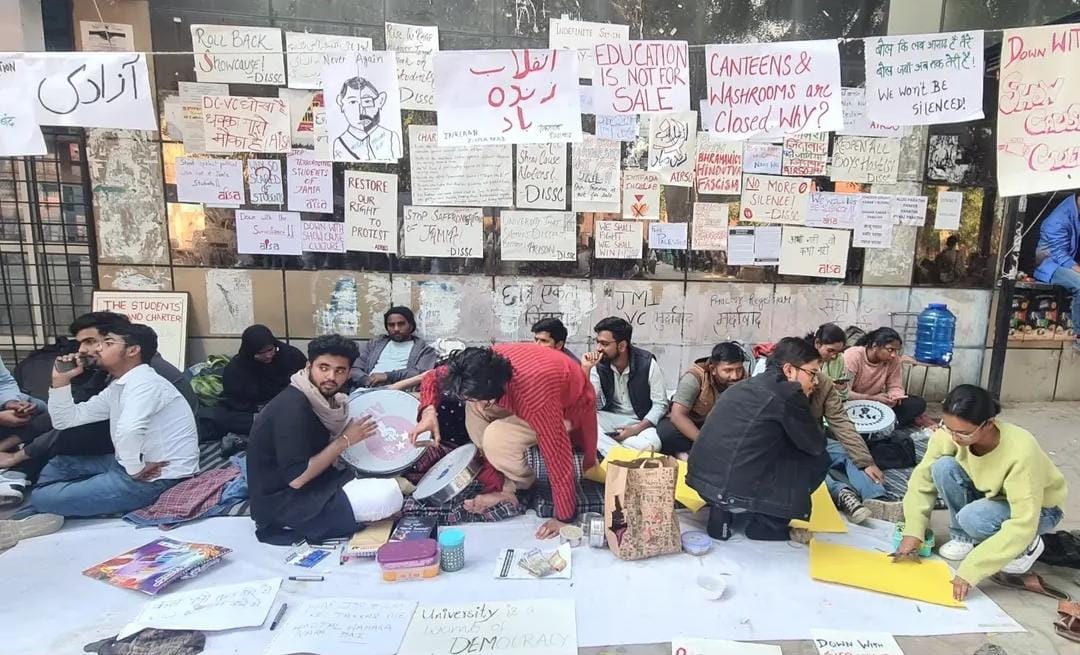
Sajahan and others were holding sit-in protests in response to the banning of protests by the Jamia Millia Islamia administration and show-cause notices issued to their fellow students, who had been warned of possible disciplinary action for staging protests on campus and commemorating the December 15, 2019 anniversary—in remembrance of the violent police crackdown when police forces stormed the campus, vandalized university property, and brutally assaulted students.
Scores of students were injured, with one law student losing an eye after being beaten in a washroom.
Students allege that since the December 15th, 2019 incident, Jamia Millia Islamia has steadily increased surveillance on campus, issuing frequent notices to students, and effectively banning protests against the administration and individuals in constitutional positions—something that has left many students dismayed. While the first official notice came in August 2022, warning against using the university campus for political activities, students claim they were under watch even before that.
During the admission process in May 2025, the university issued an unprecedented directive asking parents and local guardians of newly admitted students to take responsibility for their wards’ conduct and character.
“This is total nonsense,” said Sajahan. “They know they can’t stop us from exercising our rights, so now they’re trying to scare our parents and local guardians. The administration has only intensified surveillance over the years—now they’re involving our families.”
Not an Isolated Situation
While Jamia faces heightened scrutiny, activists say it is not an isolated case. Politically vibrant universities across India, including Jawaharlal Nehru University (JNU), Aligarh Muslim University (AMU), Dr. B. R. Ambedkar University Delhi (AUD), Banaras Hindu University (BHU), and others, are also seeing increased surveillance and police presence, protest bans, and administrative crackdowns.
Sucheta De, a prominent student activist and former president of both All India Students Association (AISA) and the JNU Students Union, confirmed that surveillance and scrutiny on campuses have risen to unprecedented levels. “Back in our time, before 2014, in campuses like JNU, Jamia Millia Islamia, and others, we could protest freely, exercise our rights, and face no disciplinary action from the administration,” she recalled.
In December 2023, JNU barred wall posters and protests within 100 meters of academic buildings, imposing fines up to ₹20,000 or expulsion, and ₹10,000 for acts deemed “anti-national.” Between 2019 and 2024, the university collected around ₹1.82 million in fines under such rules.
In March 2025, Ambedkar University Delhi’s dean directed faculty to identify protesting students, detailing names, timings, locations, and the nature of disruptions for disciplinary review. A month later, five AUD students were suspended by university administration, after being accused of “indiscipline” and “disrupting university functioning.” However, the students denied the allegation and said they were protesting peacefully.
The move attracted widespread condemnation by student bodies throughout campuses.
At Banaras Hindu University, following the 2023 protests over the alleged gang-rape of an IIT-BHU student, 13-14 students from multiple organizations were suspended for “indiscipline” and disturbing the “academic ambiance.” Student leaders argue such measures are silencing dissent and fostering a climate of fear across campuses.
De added that over the past decade, the current regime has been cracking down heavily on politically active campuses, particularly after the anti-CAA protests, a trend she finds especially alarming in minority institutions like Jamia Millia Islamia, which used to be the heart of these protests.
December 15th, 2019: The Police’s Violent Invasion of Jamia
In late 2019, nationwide protests erupted against the discriminatory and anti-Muslim Citizenship Amendment Act (CAA) and National Registry of Citizens (NRC).
In the late hours of December 15th, the Delhi Police forcefully entered Jamia, including the library and other buildings. They began to unleash violence on student protestors, including tear gas and baton charges. The Delhi Police caused extensive damage to Jamia’s buildings, assaulted students, and forcibly took them from the library, and paraded before the media with their hands raised—an image activists call one of the darkest moments for student dissent in India. Many were detained overnight.
De said these images of students were deeply disturbing. “It reminded all of us of fascist Nazi Germany,” she noted. De recalled how shocking it was that the police stormed the campus, entering libraries, classrooms, and even washrooms.
“That was the extreme level of violence one could unleash on students,” she said. Yet, she added that though the students were terrified, they refused to be silenced. De also mentioned how the students tried reaching the Jamia campus, but found the roads barricaded and the metro station shut.
The police action on Jamia Millia Islamia’s campus that night catalyzed nationwide protests against the government, including the Shaheen Bagh sit-in led by Muslim women, and demonstrations in Seelampur and Mumbai, where students from various universities marched in solidarity. These protests galvanized the populace, drawing hundreds of thousands of people, including activists, Bollywood celebrities, politicians, and student leaders from diverse groups.
Meanwhile, students from global universities like Oxford, Cambridge, Stanford, and MIT also organized protests condemning the police crackdown in Jamia. Student activist and former M.Phil scholar at Jamia Millia Islamia, Safoora Zargar—who was jailed for over three months in April 2020 while pregnant—described the 2019 protests as a critical turning point against the ruling Bharatiya Janata Party’s communal Hindutva policies.
“The protests at Jamia were instrumental in breaking the silence around the ruling party’s agenda,” she said. “The police brutality that followed garnered massive public sympathy and support across the country. I believe these were the biggest protests the BJP had faced, especially from educational institutions. These protests challenged the BJP’s status quo in a way they did not anticipate.”
The Impact of the Student and Anti-CAA Protests
Thus, once the pandemic began and demonstrators returned to their homes, the government began a systematic crackdown. Several students who had played prominent roles were subjected to raids and detentions. Among those arrested were PhD scholars of Jamia Millia Islamia, Zargar and Meeran Haider, undergraduate student Asif Iqbal Tanha, and the president of the alumni association, Shifa-ur-Rehman.
The students were implicated under the draconian Unlawful Activities (Prevention) Act (UAPA) in connection with the Seelampur violence in Delhi, which erupted following speeches by BJP leaders such as Kapil Mishra, Anurag Thakur, and Parvesh Sahib Singh inciting violence by targeting anti-CAA protesters. Despite widespread outrage, none of these BJP leaders has been charged. The pogrom claimed the lives of over 51 people, the majority of them Muslims.
Jamia Millia Islamia, like others, was shut starting in March 2020 and remained closed for two years. Physical classes resumed in March 2022, and returning students were shocked by what they returned to: a heavily guarded campus, with a strong police presence, as well as of Rapid Action Force (RAF)—a specialized unit of the Central Police Reserve Force, directly under the control of the Ministry of Home Affairs.
Zargar said she was stunned, like other students. “It didn’t feel like a university anymore—it looked like a war zone,” she said. “There were forces stationed outside, wearing helmets and carrying rods. It felt hostile, intimidating. We had never experienced anything like this before.”
She recalled how even simple movements on campus felt scrutinized. “I could sense that I was being watched closely,” she said. “It wasn’t just me—anyone who had raised their voice or questioned the government’s policies seemed to be under surveillance.” According to her, the change didn’t feel accidental: “It was as if the administration and the government had sat down and planned how to capture the campus and silence us.”
On August 29, 2022, Jamia Millia Islamia’s administration issued a notice warning against using the university campus for political activities.
“They [political activities] spoil the peaceful academic environment of the campus and disturb routine activities of the majority of discipline students throughout the academic session,” the circular stated. “No meeting or gathering of students shall be allowed in any part of the campus without prior permission of the Proctor, failing which disciplinary action shall be taken against the erring students.”
Niranjan, a law student at Jamia Millia Islamia, said the August 2022 circular left the student body in disbelief. “It felt like the administration was trying to erase the soul of the campus,” he remarked. “Jamia has always been known for its legacy of resistance—from the freedom struggle to the anti-CAA protests. This move was nothing less than a crackdown on student expression.”
He added that what followed was a steady rise in surveillance and intimidation, noting that students who spoke against government policies or questioned the administration were being watched closely. Show-cause notices, in particular, he shared, became a common tool of harassment.
“This wasn’t just a policy change—it was a message,” Niranjan asserted. “A message that dissent would no longer be tolerated.”
A New Vice Chancellor
In October last year, Professor Mazhar Asif was appointed the 16th Vice Chancellor of Jamia Millia Islamia (JMI), a strategic move many students describe as part of the wider university crackdown on dissent.
Asif was previously chairperson of the Centre of Persian and Central Asian Studies at Jawaharlal Nehru University (JNU). There, he was accused by members of the JNU Students’ Union (JNUSU) of provoking violence during the tense campus atmosphere in early 2020, particularly in the lead-up to the infamous JNU attack on January 5, when masked assailants stormed the campus and attacked students.
“He threatened protesting students with a lathi in November 2019 and again incited violence on January 4, 2020,” alleged Saket Moon, then JNUSU vice-president. Just a day later, on January 5, the brutal attack took place, injuring several students. Many linked Asif’s actions to the build-up of the violence.
JNUSU general secretary, Satish Yadav, also claimed that Asif, along with members of the JNU Teachers’ Federation (JNUTF), was present when he was assaulted near the School of Biotechnology on January 4. Yadav intended to file a police complaint naming Asif and others in connection with the January 5 violence.
Saurabh, the president of All India Students’ Association (AISA), a left-wing students organization at Jamia Millia Islamia, expressed concern over the appointment of Mazhar Asif as Vice Chancellor, saying it was part of a broader attempt to saffronize university spaces across the country. He pointed out that Asif’s known links with the Rashtriya Swayamsevak Sangh (RSS) and its student wing Akhil Bharatiya Vidyarthi Parishad (ABVP) made the move even more alarming.
“This isn’t just an individual appointment,” Saurabh said. “It signals a deliberate effort to turn campuses into ideological battlegrounds.”
On November 29, 2024, soon after Mazhar Asif’s appointment as Vice Chancellor, Jamia Millia Islamia issued an office memorandum banning protests, dharnas, or slogan-raising on campus without prior approval—especially those targeting constitutional dignitaries.
The memo read, “It has been brought to the notice of the Competent Authority… that some students are involved in raising slogans… against the Hon’ble Prime Minister of India and other law enforcement agencies… on issues not related to academia or the University.”
Sourabh said the directive was not just an attack on students but “an attack on the very essence of the university.”
Commemorating Dec 15th, Five Years On
Days before December 15, 2024, Jamia students led by All India Students Association (AISA), Dayar-e-Shauq Student Cadre (DISC), Student Federation of India (SFI) and All India Revolutionary Students Organization (AIRSO) submitted an intimation letter to the proctor followed by a call on December 14, seeking permission to hold a remembrance protest for the 2019 police violence.
Despite being an annual tradition, the request was denied on both December 12 and 14. Frustrated, students announced on December 14 that they would proceed with the protest anyway. Soon after, Jamia issued a notice closing all libraries and canteens, citing “maintenance.”
On December 15 (a Sunday), students initially faced resistance at the gates but eventually entered, finding no maintenance work. Meanwhile, outside, police arrived with lathis and water cannons to disperse protesters who didn’t manage to enter the campus. The demonstration ended by 2 PM.
To avoid further suppression, students held a silent protest the next day without prior notice. On December 17, four students were served show-cause notices for “indiscipline.” Sourabh said he replied, but his response was deemed unsatisfactory.
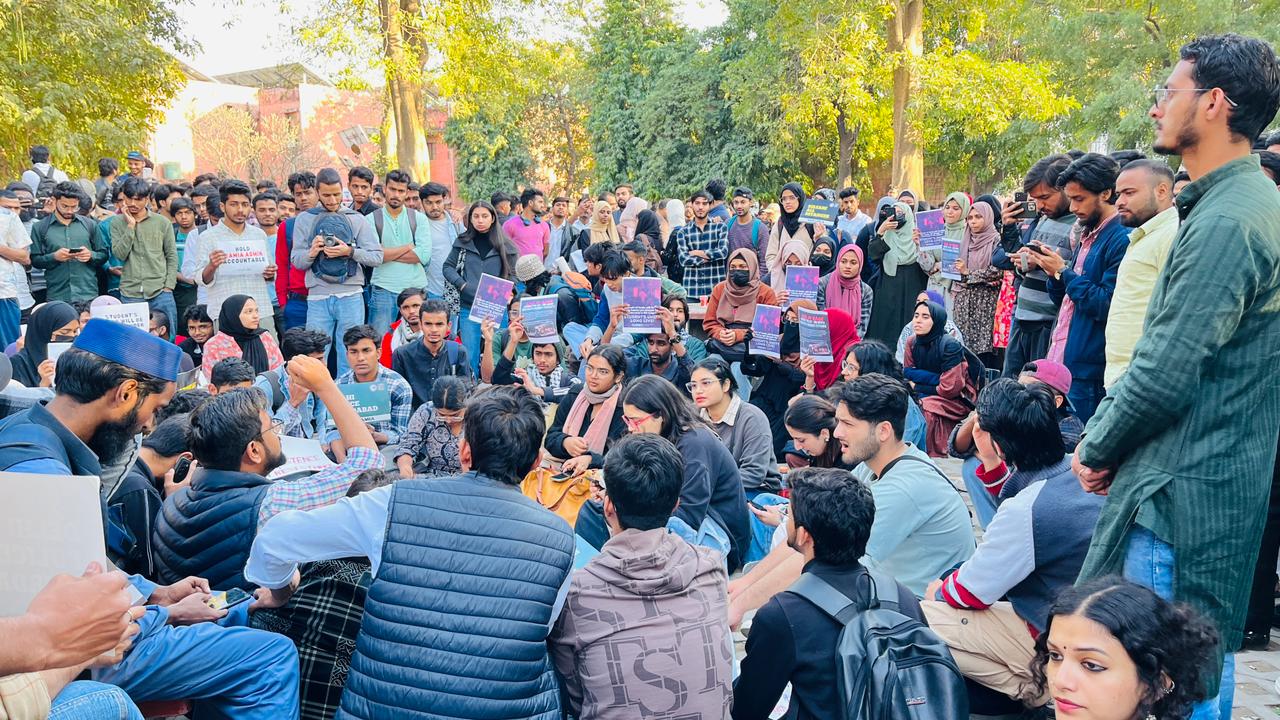
As the administration remained firm, students launched a sit-in on February 10 this year, demanding the revocation of the November memorandum that banned protests and gatherings without prior approval.
“The 2019 attack on the students of Jamia Millia Islamia was an example of authoritarianism in university spaces,” said Raja Ram Singh, current parliamentarian from Bihar’s Karakat constituency. “The recent crackdown on students for peacefully protesting against Jamia’s ban on protests and allowing police action on campus is a clear violation of their Fundamental Rights mentioned under Articles 19(a) and 19(b) of the Indian Constitution, which the BJP government is keen on diluting.”
Soon after the protests began, the university administration threatened students to vacate the protest site. When they refused, the police allegedly got involved and began contacting the students’ parents, issuing warnings.
Sonakshi, a master’s student in Media Governance, recalled that the administration first reached out to professors, who then tried to persuade students to leave by saying it could impact their future and that strict action might follow. “When we didn’t listen, they gave our personal details, including our parents’ phone numbers, to the police,” she said.
According to Sonakshi, the police then called their parents, pressuring them to make their children leave. “My father called me, and I could hear the fear in his voice. He was shivering,” she added, questioning how the administration could share such sensitive data and involve the police in an internal university matter concerning students.
Four days later, in the early hours of February 14, around 4:00 AM, Delhi Police, with the assistance of Jamia Millia Islamia’s security personnel, detained 17 students in what many called an illegal operation. Among those detained were Shajehan, Saurabh, and Sonakshi.
Sonakshi recounted that the authorities manhandled women students and behaved aggressively with everyone. She said Jamia security dragged them out of the campus by force, where the police were waiting with buses to take them into custody. “This was a completely unlawful detention. As per law, women can’t be detained before sunrise,” Sonakshi recalled.
Following their release, all 17 students who had participated in the sit-in protest were suspended from the university. Later, on March 4, the suspension was revoked by the Delhi High Court.
The Jamia Millia Islamia administration escalated matters by putting up posters of the protesting students on the university gates, displaying personal details that anyone could see. These posters revealed sensitive information like phone numbers, parents’ names, and residential addresses.
Sonakshi expressed her distress, saying she still receives threatening calls from unknown people ever since the administration put up their phone numbers. Highlighting the serious risks such actions pose to students, she questioned, “How could the administration be so careless about our safety?”
Students at Jamia are preparing to hold a protest and commemoration this year as well, but many say they feel intensely monitored and scrutinized by the university administration. Recently, several students were reportedly barred from sitting for their end-of-term exams due to “low attendance,” a move students insist is unprecedented on campus and has created an environment of fear among students.
Sajahan said they will “try our best to hold a protest on 15 December,” but acknowledged that fear of repercussions is widespread. He added that many students were prevented from taking exams on the grounds of attendance shortages, something he says “has never happened in Jamia before.”
Still, he stressed that they have not lost hope and will continue trying to register their dissent against what they view as an increasingly authoritarian administration and remembrance of 15th December 2019.

Stifling Student Protest is a Global Priority, From the US to India
Student leaders, activists, and scholars say the state’s crackdown on universities is not unprecedented. Historically, student movements in India have played a critical role in challenging authoritarian power in India and the world, making them natural targets for regimes looking to silence dissent. The police and institutional violence on American university campuses this year confirms that stifling student dissent is still a global governmental priority.
Sucheta De said student movements have always unsettled governments because they represent organized, ideological resistance. She added, “Every time power turns authoritarian in India, universities are the first to face the crackdown,” she said. “Even during Indira Gandhi’s Emergency, JNU students were monitored, threatened, and punished because student movements have historically challenged undemocratic power.”
In December 1973, almost a year before Indira Gandhi had declared the Emergency, one of the most powerful student uprisings in independent India erupted in Gujarat—the Nav Nirman Movement. What began as a protest against rising hostel mess fees and corruption in educational institutions quickly expanded into a statewide agitation against inflation, unemployment, and the misgovernance of the Chimanbhai Patel-led Congress government.
Students, joined by middle-class citizens and civil society groups, paralyzed the state through strikes and mass demonstrations, forcing the Gujarat government to resign in March 1974.
Sucheta De noted that student spaces like JNU, Jamia Millia Islamia, and Aligarh Muslim University have historically remained strongholds of dissent, where students have freely spoken against the BJP’s Hindutva policies. “Students at Jamia were the first to come out against the CAA when the rest of the country was still silent,” she said. What began as a campus protest in Jamia rapidly spread across India, inspiring nationwide demonstrations within weeks.
Such spaces, she added, are seen as threatening by any regime because they nurture political consciousness and collective resistance. “Universities can challenge power, and that is precisely why student leaders and campuses are so often targeted.”
In the United States, too, this trend has been sharply visible over the past two years. At Columbia University in 2024, police dismantled pro-Palestinian encampments and arrested dozens of students, while at the University of California, Los Angeles (UCLA), violent attacks on protestors were followed by police action.
Public universities like The City University, New York (CUNY) have faced deep budget cuts and hiring freezes, a move many faculty and activists argue is part of a political effort to weaken dissenting academic institutions.
Meanwhile, universities in states like Florida have faced restrictions on student-run diversity, equity, and inclusion (DEI) programs aimed to create a fair and welcoming environment for all students and staff by addressing historical underrepresentation and systemic disparities.
U.S. Immigration and Customs Enforcement (ICE) also targeted immigrant student activists in the US, including scholars like Indian post-doctoral researcher Badar Khan Suri and Korean American student Yunseo Chung, using immigration law to detain, threaten deportation, or revoke visas over their pro-Palestine activism. The crackdown reflected a broader pattern of ICE focusing on people of color to suppress political dissent on campuses.
An Indian Scholar currently pursuing a PhD from a U.S university said, “Authoritarian power doesn’t always arrive with a coup; sometimes it arrives through budget cuts, police on campuses, and politically loyal administrators who treat young voices as enemies rather than participants in democracy.” From New Delhi to New York, student activism has historically challenged state authority, and campuses have consistently been early spaces to resist ideological and political overreach, he added.
US universities, under the Trump administration’s aggressive crackdown on pro-Palestinian activism, have intensified suspensions, surveillance, and disciplinary actions disproportionately targeting Muslim, Arab, and low-income students. The resulting climate of fear and repression has severely chilled student protests nationwide, even as many continue resisting despite the risks.
A similar trend has emerged in Indian universities, where administrations have suspended students or barred them from campus in an effort to depoliticise student spaces. This has created an atmosphere of fear and repression, leading to fewer protests and shrinking activism.
Saurabh said, “University authorities in India have intensified their crackdown on student protesters, banning activists like me from campuses. This has effectively depoliticised these spaces and resulted in fewer demonstrations and growing authoritarianism.”
He himself is under ban for entering campus since 20 November, accused of “endangering the safety and security of students, staff, and property.” Saurabh maintains that he and others had only gathered peacefully to commemorate the widely criticized Batla House encounter.
The BJP’s Larger Strategy to Suppress Dissent and Weaken Institutions
Students, activists, and experts believe that the crackdown on Jamia students is part of a broader strategy by the BJP to stifle dissent and weaken institutions that challenge its policies, especially those representing minority communities.
“What’s happening at Jamia fits into a larger pattern we’ve seen unfold over the past decade,” said Raja Ram Singh. “Ever since JNU was targeted in 2015 for standing up to the government, attacks on academic spaces that foster dissent have only grown more frequent and more violent.”
Ram Singh also highlighted that Muslim students and institutions are being systematically marginalized. “This isn’t just about protests, it’s about reshaping academia along ideological lines,” he stated. “The government is cutting funding to minority institutions, placing Sangh-aligned individuals in decision-making roles, and punishing students from marginalized backgrounds with arbitrary suspensions, notices, and police intimidation.”
“These are not random administrative decisions,” Ram Singh stressed, “they’re part of a calculated attempt to change the very foundation of the Indian Constitution to suit a communal agenda.”
Back in 2022, there was a noticeable decline in funding for Jamia Millia Islamia, from ₹479.83 crore in 2020-21 to ₹411.10 crore in 2021-22. Aligarh Muslim University faced a similar cut, from ₹1,520.10 crore in 2020-21 to ₹1,214.63 crore in 2021-22.
For Zargar, the suspension of students, heavy policing of minority campuses like Jamia, and consistent funding cuts are deliberate tactics to silence minority voices. “The government knows that educational institutions are the strongest sites of dissent,” she said. “They think that by handicapping and policing these spaces, they can crush resistance—but they’re mistaken. The more they try to suppress campuses like Jamia, the louder our voices will become.”


The Systematic Witch-Hunt of Jamia Students: How Authorities Are Crushing Dissent

Sourabh Tripathi along with others burn the Disciplinary Committee notice served to them for protesting inside the campus.
On February 12, 2024, a 50-year-old auto driver from Kolkata received an unexpected call from the Okhla police station. The caller informed him that his son, SK Sajahan Ali, a master’s student of sociology at Jamia Millia Islamia, was getting himself into trouble by participating in a protest against the university administration.
The police warned that if Sajahan didn’t leave the protest site, his admission could be revoked, and he might face legal action.
This was the first time Sajahan’s father had ever been contacted by the police, especially about his son, who was nearly 1,000 miles away. Alarmed, he immediately called Sajahan, urging him to leave the protest.
“My father was shocked and told me to step away immediately. He had never received such a call before,” Sajahan told me. “Even I was taken aback—how did the police reach out to my father about a campus protest? What role did they have in this? How did they get my number?”
Sajahan and others were holding sit-in protests in response to the banning of protests by the Jamia Millia Islamia administration and show-cause notices issued to their fellow students, who had been warned of possible disciplinary action for staging protests on campus and commemorating the December 15, 2019 anniversary—in remembrance of the violent police crackdown when police forces stormed the campus, vandalized university property, and brutally assaulted students.
Scores of students were injured, with one law student losing an eye after being beaten in a washroom.
Students allege that since the December 15th, 2019 incident, Jamia Millia Islamia has steadily increased surveillance on campus, issuing frequent notices to students, and effectively banning protests against the administration and individuals in constitutional positions—something that has left many students dismayed. While the first official notice came in August 2022, warning against using the university campus for political activities, students claim they were under watch even before that.
During the admission process in May 2025, the university issued an unprecedented directive asking parents and local guardians of newly admitted students to take responsibility for their wards’ conduct and character.
“This is total nonsense,” said Sajahan. “They know they can’t stop us from exercising our rights, so now they’re trying to scare our parents and local guardians. The administration has only intensified surveillance over the years—now they’re involving our families.”
Not an Isolated Situation
While Jamia faces heightened scrutiny, activists say it is not an isolated case. Politically vibrant universities across India, including Jawaharlal Nehru University (JNU), Aligarh Muslim University (AMU), Dr. B. R. Ambedkar University Delhi (AUD), Banaras Hindu University (BHU), and others, are also seeing increased surveillance and police presence, protest bans, and administrative crackdowns.
Sucheta De, a prominent student activist and former president of both All India Students Association (AISA) and the JNU Students Union, confirmed that surveillance and scrutiny on campuses have risen to unprecedented levels. “Back in our time, before 2014, in campuses like JNU, Jamia Millia Islamia, and others, we could protest freely, exercise our rights, and face no disciplinary action from the administration,” she recalled.
In December 2023, JNU barred wall posters and protests within 100 meters of academic buildings, imposing fines up to ₹20,000 or expulsion, and ₹10,000 for acts deemed “anti-national.” Between 2019 and 2024, the university collected around ₹1.82 million in fines under such rules.
In March 2025, Ambedkar University Delhi’s dean directed faculty to identify protesting students, detailing names, timings, locations, and the nature of disruptions for disciplinary review. A month later, five AUD students were suspended by university administration, after being accused of “indiscipline” and “disrupting university functioning.” However, the students denied the allegation and said they were protesting peacefully.
The move attracted widespread condemnation by student bodies throughout campuses.
At Banaras Hindu University, following the 2023 protests over the alleged gang-rape of an IIT-BHU student, 13-14 students from multiple organizations were suspended for “indiscipline” and disturbing the “academic ambiance.” Student leaders argue such measures are silencing dissent and fostering a climate of fear across campuses.
De added that over the past decade, the current regime has been cracking down heavily on politically active campuses, particularly after the anti-CAA protests, a trend she finds especially alarming in minority institutions like Jamia Millia Islamia, which used to be the heart of these protests.
December 15th, 2019: The Police’s Violent Invasion of Jamia
In late 2019, nationwide protests erupted against the discriminatory and anti-Muslim Citizenship Amendment Act (CAA) and National Registry of Citizens (NRC).
In the late hours of December 15th, the Delhi Police forcefully entered Jamia, including the library and other buildings. They began to unleash violence on student protestors, including tear gas and baton charges. The Delhi Police caused extensive damage to Jamia’s buildings, assaulted students, and forcibly took them from the library, and paraded before the media with their hands raised—an image activists call one of the darkest moments for student dissent in India. Many were detained overnight.
De said these images of students were deeply disturbing. “It reminded all of us of fascist Nazi Germany,” she noted. De recalled how shocking it was that the police stormed the campus, entering libraries, classrooms, and even washrooms.
“That was the extreme level of violence one could unleash on students,” she said. Yet, she added that though the students were terrified, they refused to be silenced. De also mentioned how the students tried reaching the Jamia campus, but found the roads barricaded and the metro station shut.
The police action on Jamia Millia Islamia’s campus that night catalyzed nationwide protests against the government, including the Shaheen Bagh sit-in led by Muslim women, and demonstrations in Seelampur and Mumbai, where students from various universities marched in solidarity. These protests galvanized the populace, drawing hundreds of thousands of people, including activists, Bollywood celebrities, politicians, and student leaders from diverse groups.
Meanwhile, students from global universities like Oxford, Cambridge, Stanford, and MIT also organized protests condemning the police crackdown in Jamia. Student activist and former M.Phil scholar at Jamia Millia Islamia, Safoora Zargar—who was jailed for over three months in April 2020 while pregnant—described the 2019 protests as a critical turning point against the ruling Bharatiya Janata Party’s communal Hindutva policies.
“The protests at Jamia were instrumental in breaking the silence around the ruling party’s agenda,” she said. “The police brutality that followed garnered massive public sympathy and support across the country. I believe these were the biggest protests the BJP had faced, especially from educational institutions. These protests challenged the BJP’s status quo in a way they did not anticipate.”
The Impact of the Student and Anti-CAA Protests
Thus, once the pandemic began and demonstrators returned to their homes, the government began a systematic crackdown. Several students who had played prominent roles were subjected to raids and detentions. Among those arrested were PhD scholars of Jamia Millia Islamia, Zargar and Meeran Haider, undergraduate student Asif Iqbal Tanha, and the president of the alumni association, Shifa-ur-Rehman.
The students were implicated under the draconian Unlawful Activities (Prevention) Act (UAPA) in connection with the Seelampur violence in Delhi, which erupted following speeches by BJP leaders such as Kapil Mishra, Anurag Thakur, and Parvesh Sahib Singh inciting violence by targeting anti-CAA protesters. Despite widespread outrage, none of these BJP leaders has been charged. The pogrom claimed the lives of over 51 people, the majority of them Muslims.
Jamia Millia Islamia, like others, was shut starting in March 2020 and remained closed for two years. Physical classes resumed in March 2022, and returning students were shocked by what they returned to: a heavily guarded campus, with a strong police presence, as well as of Rapid Action Force (RAF)—a specialized unit of the Central Police Reserve Force, directly under the control of the Ministry of Home Affairs.
Zargar said she was stunned, like other students. “It didn’t feel like a university anymore—it looked like a war zone,” she said. “There were forces stationed outside, wearing helmets and carrying rods. It felt hostile, intimidating. We had never experienced anything like this before.”
She recalled how even simple movements on campus felt scrutinized. “I could sense that I was being watched closely,” she said. “It wasn’t just me—anyone who had raised their voice or questioned the government’s policies seemed to be under surveillance.” According to her, the change didn’t feel accidental: “It was as if the administration and the government had sat down and planned how to capture the campus and silence us.”
On August 29, 2022, Jamia Millia Islamia’s administration issued a notice warning against using the university campus for political activities.
“They [political activities] spoil the peaceful academic environment of the campus and disturb routine activities of the majority of discipline students throughout the academic session,” the circular stated. “No meeting or gathering of students shall be allowed in any part of the campus without prior permission of the Proctor, failing which disciplinary action shall be taken against the erring students.”
Niranjan, a law student at Jamia Millia Islamia, said the August 2022 circular left the student body in disbelief. “It felt like the administration was trying to erase the soul of the campus,” he remarked. “Jamia has always been known for its legacy of resistance—from the freedom struggle to the anti-CAA protests. This move was nothing less than a crackdown on student expression.”
He added that what followed was a steady rise in surveillance and intimidation, noting that students who spoke against government policies or questioned the administration were being watched closely. Show-cause notices, in particular, he shared, became a common tool of harassment.
“This wasn’t just a policy change—it was a message,” Niranjan asserted. “A message that dissent would no longer be tolerated.”
A New Vice Chancellor
In October last year, Professor Mazhar Asif was appointed the 16th Vice Chancellor of Jamia Millia Islamia (JMI), a strategic move many students describe as part of the wider university crackdown on dissent.
Asif was previously chairperson of the Centre of Persian and Central Asian Studies at Jawaharlal Nehru University (JNU). There, he was accused by members of the JNU Students’ Union (JNUSU) of provoking violence during the tense campus atmosphere in early 2020, particularly in the lead-up to the infamous JNU attack on January 5, when masked assailants stormed the campus and attacked students.
“He threatened protesting students with a lathi in November 2019 and again incited violence on January 4, 2020,” alleged Saket Moon, then JNUSU vice-president. Just a day later, on January 5, the brutal attack took place, injuring several students. Many linked Asif’s actions to the build-up of the violence.
JNUSU general secretary, Satish Yadav, also claimed that Asif, along with members of the JNU Teachers’ Federation (JNUTF), was present when he was assaulted near the School of Biotechnology on January 4. Yadav intended to file a police complaint naming Asif and others in connection with the January 5 violence.
Saurabh, the president of All India Students’ Association (AISA), a left-wing students organization at Jamia Millia Islamia, expressed concern over the appointment of Mazhar Asif as Vice Chancellor, saying it was part of a broader attempt to saffronize university spaces across the country. He pointed out that Asif’s known links with the Rashtriya Swayamsevak Sangh (RSS) and its student wing Akhil Bharatiya Vidyarthi Parishad (ABVP) made the move even more alarming.
“This isn’t just an individual appointment,” Saurabh said. “It signals a deliberate effort to turn campuses into ideological battlegrounds.”
On November 29, 2024, soon after Mazhar Asif’s appointment as Vice Chancellor, Jamia Millia Islamia issued an office memorandum banning protests, dharnas, or slogan-raising on campus without prior approval—especially those targeting constitutional dignitaries.
The memo read, “It has been brought to the notice of the Competent Authority… that some students are involved in raising slogans… against the Hon’ble Prime Minister of India and other law enforcement agencies… on issues not related to academia or the University.”
Sourabh said the directive was not just an attack on students but “an attack on the very essence of the university.”
Commemorating Dec 15th, Five Years On
Days before December 15, 2024, Jamia students led by All India Students Association (AISA), Dayar-e-Shauq Student Cadre (DISC), Student Federation of India (SFI) and All India Revolutionary Students Organization (AIRSO) submitted an intimation letter to the proctor followed by a call on December 14, seeking permission to hold a remembrance protest for the 2019 police violence.
Despite being an annual tradition, the request was denied on both December 12 and 14. Frustrated, students announced on December 14 that they would proceed with the protest anyway. Soon after, Jamia issued a notice closing all libraries and canteens, citing “maintenance.”
On December 15 (a Sunday), students initially faced resistance at the gates but eventually entered, finding no maintenance work. Meanwhile, outside, police arrived with lathis and water cannons to disperse protesters who didn’t manage to enter the campus. The demonstration ended by 2 PM.
To avoid further suppression, students held a silent protest the next day without prior notice. On December 17, four students were served show-cause notices for “indiscipline.” Sourabh said he replied, but his response was deemed unsatisfactory.
As the administration remained firm, students launched a sit-in on February 10 this year, demanding the revocation of the November memorandum that banned protests and gatherings without prior approval.
“The 2019 attack on the students of Jamia Millia Islamia was an example of authoritarianism in university spaces,” said Raja Ram Singh, current parliamentarian from Bihar’s Karakat constituency. “The recent crackdown on students for peacefully protesting against Jamia’s ban on protests and allowing police action on campus is a clear violation of their Fundamental Rights mentioned under Articles 19(a) and 19(b) of the Indian Constitution, which the BJP government is keen on diluting.”
Soon after the protests began, the university administration threatened students to vacate the protest site. When they refused, the police allegedly got involved and began contacting the students’ parents, issuing warnings.
Sonakshi, a master’s student in Media Governance, recalled that the administration first reached out to professors, who then tried to persuade students to leave by saying it could impact their future and that strict action might follow. “When we didn’t listen, they gave our personal details, including our parents’ phone numbers, to the police,” she said.
According to Sonakshi, the police then called their parents, pressuring them to make their children leave. “My father called me, and I could hear the fear in his voice. He was shivering,” she added, questioning how the administration could share such sensitive data and involve the police in an internal university matter concerning students.
Four days later, in the early hours of February 14, around 4:00 AM, Delhi Police, with the assistance of Jamia Millia Islamia’s security personnel, detained 17 students in what many called an illegal operation. Among those detained were Shajehan, Saurabh, and Sonakshi.
Sonakshi recounted that the authorities manhandled women students and behaved aggressively with everyone. She said Jamia security dragged them out of the campus by force, where the police were waiting with buses to take them into custody. “This was a completely unlawful detention. As per law, women can’t be detained before sunrise,” Sonakshi recalled.
Following their release, all 17 students who had participated in the sit-in protest were suspended from the university. Later, on March 4, the suspension was revoked by the Delhi High Court.
The Jamia Millia Islamia administration escalated matters by putting up posters of the protesting students on the university gates, displaying personal details that anyone could see. These posters revealed sensitive information like phone numbers, parents’ names, and residential addresses.
Sonakshi expressed her distress, saying she still receives threatening calls from unknown people ever since the administration put up their phone numbers. Highlighting the serious risks such actions pose to students, she questioned, “How could the administration be so careless about our safety?”
Students at Jamia are preparing to hold a protest and commemoration this year as well, but many say they feel intensely monitored and scrutinized by the university administration. Recently, several students were reportedly barred from sitting for their end-of-term exams due to “low attendance,” a move students insist is unprecedented on campus and has created an environment of fear among students.
Sajahan said they will “try our best to hold a protest on 15 December,” but acknowledged that fear of repercussions is widespread. He added that many students were prevented from taking exams on the grounds of attendance shortages, something he says “has never happened in Jamia before.”
Still, he stressed that they have not lost hope and will continue trying to register their dissent against what they view as an increasingly authoritarian administration and remembrance of 15th December 2019.
Stifling Student Protest is a Global Priority, From the US to India
Student leaders, activists, and scholars say the state’s crackdown on universities is not unprecedented. Historically, student movements in India have played a critical role in challenging authoritarian power in India and the world, making them natural targets for regimes looking to silence dissent. The police and institutional violence on American university campuses this year confirms that stifling student dissent is still a global governmental priority.
Sucheta De said student movements have always unsettled governments because they represent organized, ideological resistance. She added, “Every time power turns authoritarian in India, universities are the first to face the crackdown,” she said. “Even during Indira Gandhi’s Emergency, JNU students were monitored, threatened, and punished because student movements have historically challenged undemocratic power.”
In December 1973, almost a year before Indira Gandhi had declared the Emergency, one of the most powerful student uprisings in independent India erupted in Gujarat—the Nav Nirman Movement. What began as a protest against rising hostel mess fees and corruption in educational institutions quickly expanded into a statewide agitation against inflation, unemployment, and the misgovernance of the Chimanbhai Patel-led Congress government.
Students, joined by middle-class citizens and civil society groups, paralyzed the state through strikes and mass demonstrations, forcing the Gujarat government to resign in March 1974.
Sucheta De noted that student spaces like JNU, Jamia Millia Islamia, and Aligarh Muslim University have historically remained strongholds of dissent, where students have freely spoken against the BJP’s Hindutva policies. “Students at Jamia were the first to come out against the CAA when the rest of the country was still silent,” she said. What began as a campus protest in Jamia rapidly spread across India, inspiring nationwide demonstrations within weeks.
Such spaces, she added, are seen as threatening by any regime because they nurture political consciousness and collective resistance. “Universities can challenge power, and that is precisely why student leaders and campuses are so often targeted.”
In the United States, too, this trend has been sharply visible over the past two years. At Columbia University in 2024, police dismantled pro-Palestinian encampments and arrested dozens of students, while at the University of California, Los Angeles (UCLA), violent attacks on protestors were followed by police action.
Public universities like The City University, New York (CUNY) have faced deep budget cuts and hiring freezes, a move many faculty and activists argue is part of a political effort to weaken dissenting academic institutions.
Meanwhile, universities in states like Florida have faced restrictions on student-run diversity, equity, and inclusion (DEI) programs aimed to create a fair and welcoming environment for all students and staff by addressing historical underrepresentation and systemic disparities.
U.S. Immigration and Customs Enforcement (ICE) also targeted immigrant student activists in the US, including scholars like Indian post-doctoral researcher Badar Khan Suri and Korean American student Yunseo Chung, using immigration law to detain, threaten deportation, or revoke visas over their pro-Palestine activism. The crackdown reflected a broader pattern of ICE focusing on people of color to suppress political dissent on campuses.
An Indian Scholar currently pursuing a PhD from a U.S university said, “Authoritarian power doesn’t always arrive with a coup; sometimes it arrives through budget cuts, police on campuses, and politically loyal administrators who treat young voices as enemies rather than participants in democracy.” From New Delhi to New York, student activism has historically challenged state authority, and campuses have consistently been early spaces to resist ideological and political overreach, he added.
US universities, under the Trump administration’s aggressive crackdown on pro-Palestinian activism, have intensified suspensions, surveillance, and disciplinary actions disproportionately targeting Muslim, Arab, and low-income students. The resulting climate of fear and repression has severely chilled student protests nationwide, even as many continue resisting despite the risks.
A similar trend has emerged in Indian universities, where administrations have suspended students or barred them from campus in an effort to depoliticise student spaces. This has created an atmosphere of fear and repression, leading to fewer protests and shrinking activism.
Saurabh said, “University authorities in India have intensified their crackdown on student protesters, banning activists like me from campuses. This has effectively depoliticised these spaces and resulted in fewer demonstrations and growing authoritarianism.”
He himself is under ban for entering campus since 20 November, accused of “endangering the safety and security of students, staff, and property.” Saurabh maintains that he and others had only gathered peacefully to commemorate the widely criticized Batla House encounter.
The BJP’s Larger Strategy to Suppress Dissent and Weaken Institutions
Students, activists, and experts believe that the crackdown on Jamia students is part of a broader strategy by the BJP to stifle dissent and weaken institutions that challenge its policies, especially those representing minority communities.
“What’s happening at Jamia fits into a larger pattern we’ve seen unfold over the past decade,” said Raja Ram Singh. “Ever since JNU was targeted in 2015 for standing up to the government, attacks on academic spaces that foster dissent have only grown more frequent and more violent.”
Ram Singh also highlighted that Muslim students and institutions are being systematically marginalized. “This isn’t just about protests, it’s about reshaping academia along ideological lines,” he stated. “The government is cutting funding to minority institutions, placing Sangh-aligned individuals in decision-making roles, and punishing students from marginalized backgrounds with arbitrary suspensions, notices, and police intimidation.”
“These are not random administrative decisions,” Ram Singh stressed, “they’re part of a calculated attempt to change the very foundation of the Indian Constitution to suit a communal agenda.”
Back in 2022, there was a noticeable decline in funding for Jamia Millia Islamia, from ₹479.83 crore in 2020-21 to ₹411.10 crore in 2021-22. Aligarh Muslim University faced a similar cut, from ₹1,520.10 crore in 2020-21 to ₹1,214.63 crore in 2021-22.
For Zargar, the suspension of students, heavy policing of minority campuses like Jamia, and consistent funding cuts are deliberate tactics to silence minority voices. “The government knows that educational institutions are the strongest sites of dissent,” she said. “They think that by handicapping and policing these spaces, they can crush resistance—but they’re mistaken. The more they try to suppress campuses like Jamia, the louder our voices will become.”