




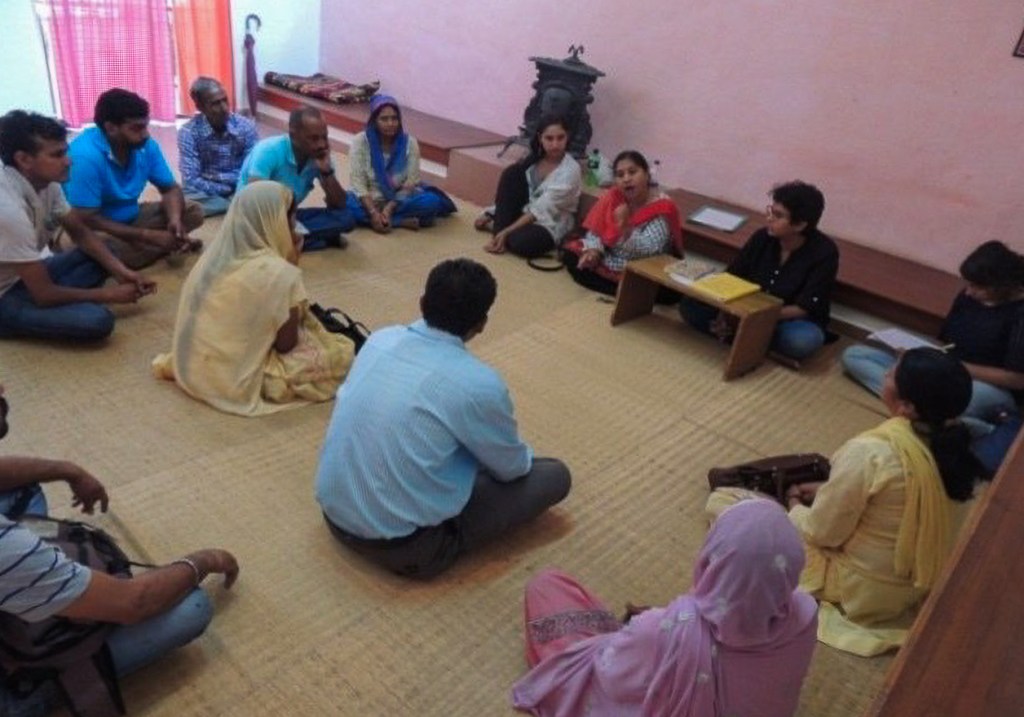
Himachal Pradesh — The cases that arrive at the Nari Adalat (Women-Led People’s Court) rarely follow a simple arc.
Preeti (pseudonym), a 49-year-old woman from Kangra, had spent 18 years in a marriage that slowly dismantled everything around her. Her husband’s drinking had worsened over the years, until it consumed the household entirely. He’d even sold furniture and utensils to fund his habit. The roof of their home had begun to cave in. On the worst nights, he would throw her out of the house while their three children watched.
When Preeti finally left, she went to her mother’s home in Punjab. She stayed for three months: safe, but hollowed by guilt about the children she had left behind. It was her mother-in-law who eventually reached out to the Nari Adalat. The Nyay Sakhis (Justice Comrades) travelled from Himachal Pradesh to Punjab to meet Preeti. She was clear about her terms: she would return only if her husband genuinely changed.
What followed were months of careful mediation: separate sessions with Preeti, her husband, and her mother-in-law, then joint ones. The Nyay Sakhis accompanied Preeti to the local police station, where a formal complaint was filed, making plain to the husband that the consequences of continued violence would be legal, not merely domestic. He stopped drinking. Preeti returned. She found work as a janitor at a nearby school.
Together, the family began repairing the house that had been on the verge of collapse. The Nyay Sakhis continued to follow up each month for six months, and then quarterly: the case never formally closed, because in domestic violence work, closure is not a single moment.
“Awaken, Woman”

As lightning lit up the evening sky, Tripta, a Nyay Sakhi, opened a long notebook and penned down the details of a legal case. Sitting at a wooden desk inside the library of the Jagori Rural Charitable Trust, she’s been keeping a record in this way of every case she has handled for the last 20 years.
“In 2004, I, along with four sakhis (friends/comrades), joined Jagori. We were full of excitement and commitment,” recalled Tripta, sporting a purple suit and a red bindi. Jagori is a feminist organization rooted in the belief that a just and equal society is not an aspiration, but a thing to be built.
Based in Rakkar, a village near Dharamshala in Himachal Pradesh, Jagori works across roughly 350 villages in Kangra and Chamba districts, with a team of 70 to 80 people—most of whom are local, from the same hills and villages as the communities they serve.
The organization’s name reflects its intent. “Jagori” means “awaken, woman”—a call not to protest, but to consciousness instead; to the slow, and difficult work of helping women recognise that the injustices they endure are not inevitable.
Across all its programmes, Jagori’s approach is consistent: it does not arrive in a village with answers. It arrives with questions, and stays long enough to build the conditions in which the community can answer them itself. It works with women and men, adolescents and elders, farmers and frontline government workers.
One of its key programs is the Aware Women’s Action for Justice (AWAJ), which organizes women’s collectives and runs the Nari Adalats to address violence, health, and women’s leadership in local governance.
It covers techniques that are typically less formal, faster, and more economical than going to court, like mediation, arbitration, bargaining, and conciliation. This method of dispute resolution is particularly suited to situations in which confidentiality, cultural sensitivity, and community involvement are essential.
For hundreds of women in Himachal and other border states, gaps in access to justice have been addressed by the Nari Adalats.
The Origin of Nari Adalats

After completing her diploma in social work in Germany in 1970, Abha Bhaiya returned to India and started working in Hyderabad for landless labor. “The realities are so different from what we really read and learn in our master’s courses,” reflected Bhaiya, founder and director of Jagori, now in her 70s.
Jagori dates back to 1984, when Bhaiya, along with six like-minded people, established the Jagori Documentation Resource and Training Centre in Delhi.
The thought of establishing a feminist organization came from the fact that “the women’s movement was constantly saying, ‘we do not want this; we do not agree to the development policy of the government.’ But we never said, ‘What do we want? Is there a model? Is there any policy?’” Bhaiya explained.
She knew it was time to create an alternative model, one that would say: this is the way we would like society to be built with new principles, new ideas, and new thoughts.
In 2002, Jagori was set up in Rakkar, in Himachal.
Tripta—who grew up in a village in nearby Kangra —joined Jagori in 2004, as one of five Nyay Sakhis. Its office was still on rent, and the organization was finding its feet. She had two young children at home, both in primary school, and no formal degree, no legal training, no prior experience in social work.
Jagori initiated the Nari Adalat in 2008, as an unofficial, community-based platform to help women and educate people about different types of violence: physical, emotional, economic, and psychological.
As a feminist organization, their strategy focused on hearing women out, confirming their lived experiences, and promoting group efforts to pursue justice and dignity outside of formal legal institutions that frequently seemed frightening or unapproachable.
“The resolution process is accomplished through dialogue and negotiations, with the voices of women as central to decision-making,” said Tripta. Men and women alike are allowed to ask for assistance in a transparent and open setting.
“When we come to know about any victim—or if someone comes to us—the first step that we take is to counsel the victim,” said Tripta, referring to their nariwaadi (feminist) approach. “After listening to them, to maintain neutrality, we speak to the other party (husband or in-laws).”
Anatomy of Cases

One woman in her early thirties, Shweta (pseudonym), referred through a neighbour, had endured years of physical and verbal abuse compounded by economic deprivation. Her husband controlled her finances, was suspicious of her movements, and regularly assaulted her—often in front of their children. She had not approached the police. The formal legal system felt, in her words, “too big and too far.”
Shweta came to the Nari Adalat not because she wanted to end the marriage, but because she wanted the violence to stop. The Nyay Sakhis documented her account across multiple sittings, then met separately with her husband. They explained, plainly, that physical and emotional abuse are criminal acts under Indian law—not a private matter, and certainly not excused by alcohol.
Written assurances were drawn up, read aloud, signed in front of witnesses, and entered into the Nari Adalat register. The husband was told that any breach would move the case to the police. Shweta claimed that the violence had reduced. She described feeling, for the first time, that someone had taken her account seriously.
Then there are the cases that resist easy resolution. A woman in her late forties came to the Nari Adalat after years of economic abuse; her husband had consistently withheld money for food and her children’s school fees, while spending freely on alcohol. The Nyay Sakhis worked not only with the husband, but also with the mother-in-law, who had quietly absorbed the household’s financial burden.
Through separate sessions, the Sakhis reframed the conversation: the husband’s obligation to financially support his family was legal, not optional. A repayment plan was negotiated and documented. The woman was connected with a local self-help group to begin building financial independence of her own. The case remains under monitoring.
Most cases in Nari Adalats end in mutual agreement between both parties. If one party disagrees, the case goes to court, where Jagori’s counseling and mediation are first recorded in a file and presented as primary information.
Laying the Groundwork: Rights Awareness Meets Mediation
Aasha Sharma’s early years at Jagori were spent in the villages, doing the slow, unglamorous work that precedes any visible change. She mobilized communities, built trust, ran awareness sessions on health rights, violence, women’s rights, and helped that belief that gender-based violence was not a private matter but a public failure.
She started resolving the small issues: a water dispute here, a land complaint there. But the small issues, she quickly learned, were rarely that small. They were where violence was hiding.
By 2005, Aasha had moved into domestic violence work. The passage of the Protection of Women from Domestic Violence Act in that same year 2005 marked a turning point that is not just in law, but in the work Jagori was already doing on the ground.
Aasha was part of the team that helped translate the Act’s protections from legislation into reality for women in Kangra’s villages.
They ran awareness campaigns explaining that physical, emotional, economic, and sexual violence were now legally recognized as forms of violence, that women had the right to protection orders, residence rights, and monetary relief, and that they did not have to leave their homes to be protected by the law.
Aasha helped launch radio programmes and nukkad nataks—street plays that carried Jagori’s message into villages that had never heard of women’s courts or legal rights. Many women had never heard of a Domestic Incident Report. Many did not know they could file a complaint without going to the police first. Jagori’s sakhis went village to village, explaining the process, sitting beside women as they filed complaints, accompanying them to Protection Officers and even to court when needed.
They pushed for the idea that awareness could not stop at the women themselves—the systems around them needed reorienting as well.
Over time, the Nari Adalat became the space where legal awareness met counseling and mediation and where a woman was able to understand her rights, weigh her options, and decide how far into the formal system she wanted to go—on her own terms.
After two decades of fieldwork, Tripta and Aasha feel that today, more women are fighting for their rights. According to them, these adalats are successful because, firstly, they offer women a safe space to be heard, and secondly, it is financially viable. “They don’t need to spend—neither their time nor money—fighting for their rights,” they said.
Jagori was finally designated a registered service provider under the Protection of Women from Domestic Violence Act, giving it the authority to assist women in filing Domestic Incident Reports, liaise with Protection Officers, and formally support cases before the Magistrate. The community women’s court had become, in the eyes of the state, a legitimate part of the justice system.
Back in the library, the storm had passed, and Tripta reopened her notebook. She flipped to a fresh page and wrote down details of a new case: a woman from a village two panchayats away, referred by a neighbour who had heard of the Nari Adalat through word of mouth.
Even today, Tripta doesn’t think of herself as a lawyer or an activist. “We are sakhis,” she said simply. “Friends.”
Outside, the mountains are quiet again. And somewhere in the villages below, another woman is deciding whether to speak.


Justice Beyond the Courtroom: Inside Himachal’s Women-Led People’s Courts
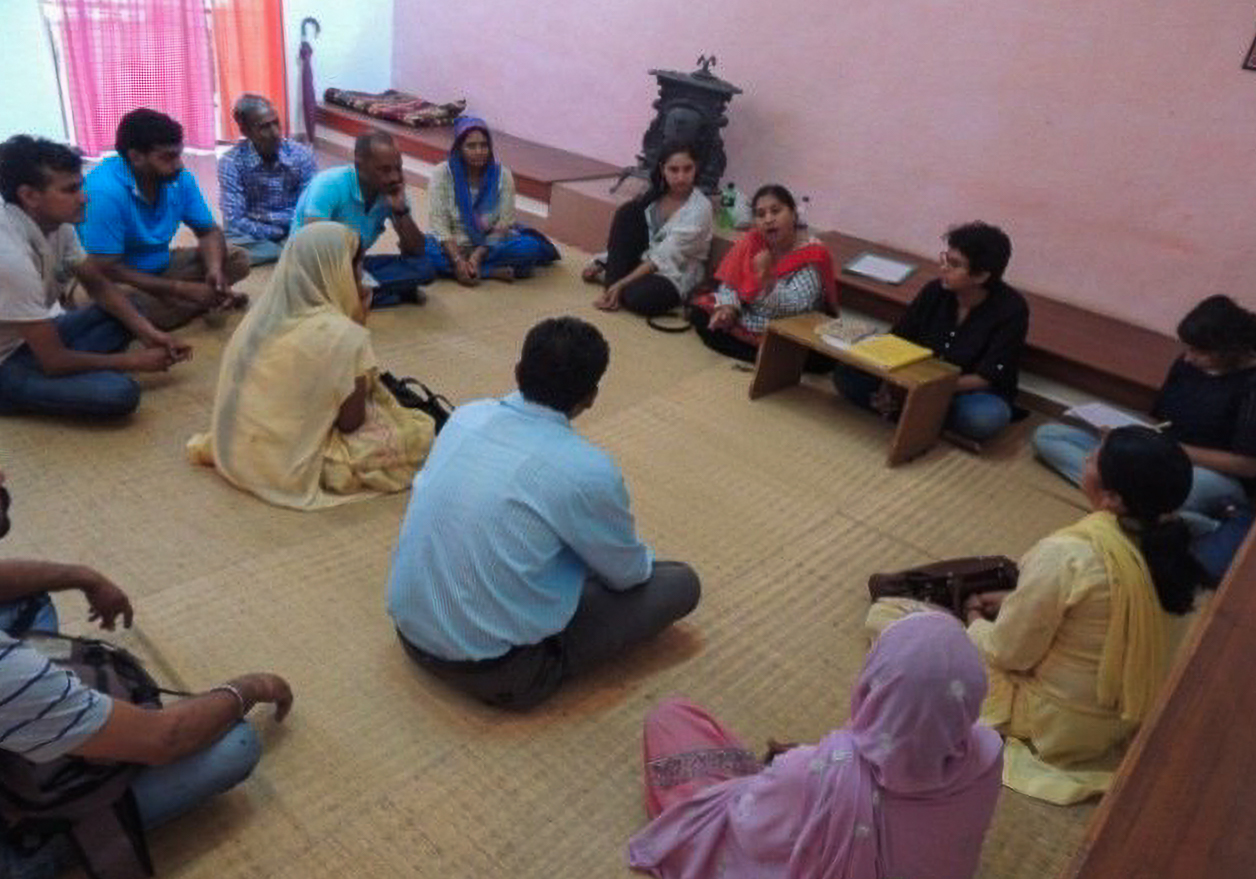
For hundreds of women in Himachal and other border states, gaps in access to justice have been addressed by the Nari Adalats (Women-Led Courts).
Himachal Pradesh — The cases that arrive at the Nari Adalat (Women-Led People’s Court) rarely follow a simple arc.
Preeti (pseudonym), a 49-year-old woman from Kangra, had spent 18 years in a marriage that slowly dismantled everything around her. Her husband’s drinking had worsened over the years, until it consumed the household entirely. He’d even sold furniture and utensils to fund his habit. The roof of their home had begun to cave in. On the worst nights, he would throw her out of the house while their three children watched.
When Preeti finally left, she went to her mother’s home in Punjab. She stayed for three months: safe, but hollowed by guilt about the children she had left behind. It was her mother-in-law who eventually reached out to the Nari Adalat. The Nyay Sakhis (Justice Comrades) travelled from Himachal Pradesh to Punjab to meet Preeti. She was clear about her terms: she would return only if her husband genuinely changed.
What followed were months of careful mediation: separate sessions with Preeti, her husband, and her mother-in-law, then joint ones. The Nyay Sakhis accompanied Preeti to the local police station, where a formal complaint was filed, making plain to the husband that the consequences of continued violence would be legal, not merely domestic. He stopped drinking. Preeti returned. She found work as a janitor at a nearby school.
Together, the family began repairing the house that had been on the verge of collapse. The Nyay Sakhis continued to follow up each month for six months, and then quarterly: the case never formally closed, because in domestic violence work, closure is not a single moment.
“Awaken, Woman”
As lightning lit up the evening sky, Tripta, a Nyay Sakhi, opened a long notebook and penned down the details of a legal case. Sitting at a wooden desk inside the library of the Jagori Rural Charitable Trust, she’s been keeping a record in this way of every case she has handled for the last 20 years.
“In 2004, I, along with four sakhis (friends/comrades), joined Jagori. We were full of excitement and commitment,” recalled Tripta, sporting a purple suit and a red bindi. Jagori is a feminist organization rooted in the belief that a just and equal society is not an aspiration, but a thing to be built.
Based in Rakkar, a village near Dharamshala in Himachal Pradesh, Jagori works across roughly 350 villages in Kangra and Chamba districts, with a team of 70 to 80 people—most of whom are local, from the same hills and villages as the communities they serve.
The organization’s name reflects its intent. “Jagori” means “awaken, woman”—a call not to protest, but to consciousness instead; to the slow, and difficult work of helping women recognise that the injustices they endure are not inevitable.
Across all its programmes, Jagori’s approach is consistent: it does not arrive in a village with answers. It arrives with questions, and stays long enough to build the conditions in which the community can answer them itself. It works with women and men, adolescents and elders, farmers and frontline government workers.
One of its key programs is the Aware Women’s Action for Justice (AWAJ), which organizes women’s collectives and runs the Nari Adalats to address violence, health, and women’s leadership in local governance.
It covers techniques that are typically less formal, faster, and more economical than going to court, like mediation, arbitration, bargaining, and conciliation. This method of dispute resolution is particularly suited to situations in which confidentiality, cultural sensitivity, and community involvement are essential.
For hundreds of women in Himachal and other border states, gaps in access to justice have been addressed by the Nari Adalats.
The Origin of Nari Adalats
After completing her diploma in social work in Germany in 1970, Abha Bhaiya returned to India and started working in Hyderabad for landless labor. “The realities are so different from what we really read and learn in our master’s courses,” reflected Bhaiya, founder and director of Jagori, now in her 70s.
Jagori dates back to 1984, when Bhaiya, along with six like-minded people, established the Jagori Documentation Resource and Training Centre in Delhi.
The thought of establishing a feminist organization came from the fact that “the women’s movement was constantly saying, ‘we do not want this; we do not agree to the development policy of the government.’ But we never said, ‘What do we want? Is there a model? Is there any policy?’” Bhaiya explained.
She knew it was time to create an alternative model, one that would say: this is the way we would like society to be built with new principles, new ideas, and new thoughts.
In 2002, Jagori was set up in Rakkar, in Himachal.
Tripta—who grew up in a village in nearby Kangra —joined Jagori in 2004, as one of five Nyay Sakhis. Its office was still on rent, and the organization was finding its feet. She had two young children at home, both in primary school, and no formal degree, no legal training, no prior experience in social work.
Jagori initiated the Nari Adalat in 2008, as an unofficial, community-based platform to help women and educate people about different types of violence: physical, emotional, economic, and psychological.
As a feminist organization, their strategy focused on hearing women out, confirming their lived experiences, and promoting group efforts to pursue justice and dignity outside of formal legal institutions that frequently seemed frightening or unapproachable.
“The resolution process is accomplished through dialogue and negotiations, with the voices of women as central to decision-making,” said Tripta. Men and women alike are allowed to ask for assistance in a transparent and open setting.
“When we come to know about any victim—or if someone comes to us—the first step that we take is to counsel the victim,” said Tripta, referring to their nariwaadi (feminist) approach. “After listening to them, to maintain neutrality, we speak to the other party (husband or in-laws).”
Anatomy of Cases
One woman in her early thirties, Shweta (pseudonym), referred through a neighbour, had endured years of physical and verbal abuse compounded by economic deprivation. Her husband controlled her finances, was suspicious of her movements, and regularly assaulted her—often in front of their children. She had not approached the police. The formal legal system felt, in her words, “too big and too far.”
Shweta came to the Nari Adalat not because she wanted to end the marriage, but because she wanted the violence to stop. The Nyay Sakhis documented her account across multiple sittings, then met separately with her husband. They explained, plainly, that physical and emotional abuse are criminal acts under Indian law—not a private matter, and certainly not excused by alcohol.
Written assurances were drawn up, read aloud, signed in front of witnesses, and entered into the Nari Adalat register. The husband was told that any breach would move the case to the police. Shweta claimed that the violence had reduced. She described feeling, for the first time, that someone had taken her account seriously.
Then there are the cases that resist easy resolution. A woman in her late forties came to the Nari Adalat after years of economic abuse; her husband had consistently withheld money for food and her children’s school fees, while spending freely on alcohol. The Nyay Sakhis worked not only with the husband, but also with the mother-in-law, who had quietly absorbed the household’s financial burden.
Through separate sessions, the Sakhis reframed the conversation: the husband’s obligation to financially support his family was legal, not optional. A repayment plan was negotiated and documented. The woman was connected with a local self-help group to begin building financial independence of her own. The case remains under monitoring.
Most cases in Nari Adalats end in mutual agreement between both parties. If one party disagrees, the case goes to court, where Jagori’s counseling and mediation are first recorded in a file and presented as primary information.
Laying the Groundwork: Rights Awareness Meets Mediation
Aasha Sharma’s early years at Jagori were spent in the villages, doing the slow, unglamorous work that precedes any visible change. She mobilized communities, built trust, ran awareness sessions on health rights, violence, women’s rights, and helped that belief that gender-based violence was not a private matter but a public failure.
She started resolving the small issues: a water dispute here, a land complaint there. But the small issues, she quickly learned, were rarely that small. They were where violence was hiding.
By 2005, Aasha had moved into domestic violence work. The passage of the Protection of Women from Domestic Violence Act in that same year 2005 marked a turning point that is not just in law, but in the work Jagori was already doing on the ground.
Aasha was part of the team that helped translate the Act’s protections from legislation into reality for women in Kangra’s villages.
They ran awareness campaigns explaining that physical, emotional, economic, and sexual violence were now legally recognized as forms of violence, that women had the right to protection orders, residence rights, and monetary relief, and that they did not have to leave their homes to be protected by the law.
Aasha helped launch radio programmes and nukkad nataks—street plays that carried Jagori’s message into villages that had never heard of women’s courts or legal rights. Many women had never heard of a Domestic Incident Report. Many did not know they could file a complaint without going to the police first. Jagori’s sakhis went village to village, explaining the process, sitting beside women as they filed complaints, accompanying them to Protection Officers and even to court when needed.
They pushed for the idea that awareness could not stop at the women themselves—the systems around them needed reorienting as well.
Over time, the Nari Adalat became the space where legal awareness met counseling and mediation and where a woman was able to understand her rights, weigh her options, and decide how far into the formal system she wanted to go—on her own terms.
After two decades of fieldwork, Tripta and Aasha feel that today, more women are fighting for their rights. According to them, these adalats are successful because, firstly, they offer women a safe space to be heard, and secondly, it is financially viable. “They don’t need to spend—neither their time nor money—fighting for their rights,” they said.
Jagori was finally designated a registered service provider under the Protection of Women from Domestic Violence Act, giving it the authority to assist women in filing Domestic Incident Reports, liaise with Protection Officers, and formally support cases before the Magistrate. The community women’s court had become, in the eyes of the state, a legitimate part of the justice system.
Back in the library, the storm had passed, and Tripta reopened her notebook. She flipped to a fresh page and wrote down details of a new case: a woman from a village two panchayats away, referred by a neighbour who had heard of the Nari Adalat through word of mouth.
Even today, Tripta doesn’t think of herself as a lawyer or an activist. “We are sakhis,” she said simply. “Friends.”
Outside, the mountains are quiet again. And somewhere in the villages below, another woman is deciding whether to speak.