


In 2023, I had a tough time locating online links to some key citations for an essay for Global Voices. The piece was about the renowned Kashmiri human rights defender Khurram Parvez and his 2nd year of incarceration in an Indian jail. These were longstanding references to critical articles, links to Kashmiri and regional newspapers and portals, including the websites of human rights organizations such as the Jammu and Kashmir Coalition of Civil Society (JKCCS) and the Association of Parents of Disappeared Persons (APDP).
Links to most articles were broken, and the websites did not work. The regional newspaper archives, investigative reports, and analyses, when available, were far down in the results shown by search engines. The search rankings had many newly written articles at the top. These were mostly written in the last decade or less, and aligned with the Indian state’s narrative on Kashmir, or were mildly dissenting at best.
It seemed that most of the archival data I was looking for had either been erased or replaced (some still lingered on the Wayback Machine, a digital cached archive of websites).
This disappearance was not accidental; it reflected the pattern of the Indian state’s deliberate reshaping of Kashmir’s memory landscape. This type of loss, archival erasure, and enforced disappearance of critical writing, alongside other forms of settler colonial violence fueling native dispossession, have been underway at a frightening speed in the last decade.
It is here that I propose the term Kashmircore—not as redundant theorization, but to trace something urgent. Kashmircore comprises a glut of state-driven production of political, cultural, and academic works that aim not just to erase but also replace Kashmiri counter-memory of resistance histories.
French thinker Michel Foucault described ‘counter-memory’ as a means of recalling the past by those subjugated. Counter-memory challenges and unsettles dominant power structures. As in other settler and security regimes, from the erasing and rewriting of Palestinian archives to the sanitization of indigenous histories in North America, Kashmircore adapts global strategies of erasure but in an Indian ethnonationalist idiom. Counter-memory, thus, is not just an intellectual or archival effort, but an urgent witness and weapon that reclaims people’s historical resistance.
Kashmircore comprises a glut of state-driven production of political, cultural, and academic works that aim not just to erase but also replace Kashmiri counter-memory of resistance histories.
For Kashmiri families, communities, activists, writers, and journalists, counter-memory, in addition to insurrection, has taken many forms: ranging from a mother calling her forcibly disappeared son’s name at a protest, to a folk song mourning those killed, or a poem that invokes freedom and liberty, or writing whole histories and ethnographies of state violence.
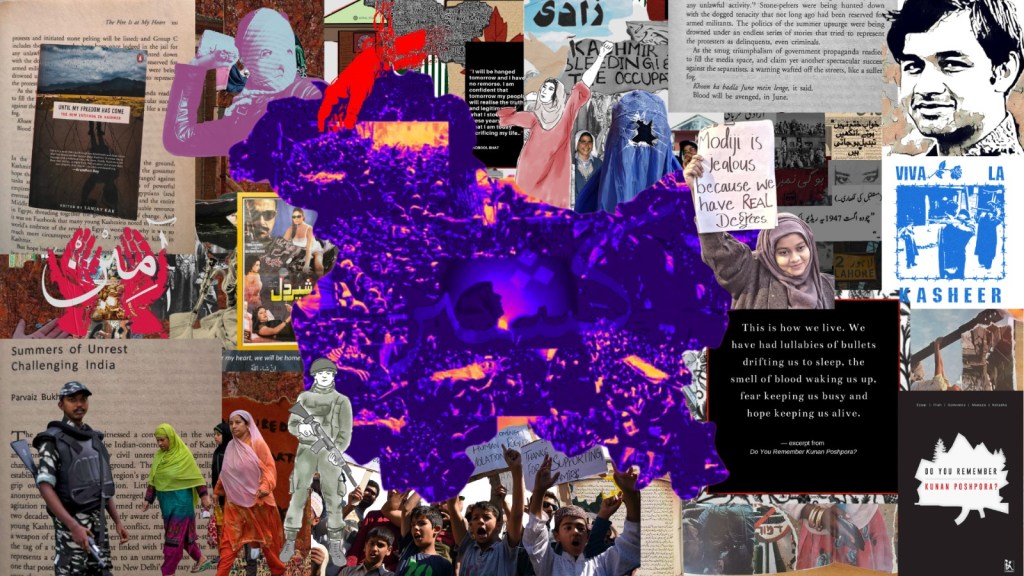
As I have discussed elsewhere in the past few decades, Kashmiris have vigorously stripped their stories of the hegemonic narratives of the Indian state since 1947. This went on to shape the Kashmiri intifada: From 2008 onwards, following mass civilian uprisings against Indian rule, there was a period of phenomenal surge in intellectual production. It resulted in a painstaking retelling of the story of Kashmiri resistance through histories, ethnographies, memoirs, films, media reports, research, graffiti, slogans, and literature of all genres in multiple languages.
Since 2014, the Indian state has been making concerted attempts to dismantle Kashmir’s counter-memory, which has contributed to the widespread Kashmircore content. This has gained further momentum since 2019, when India unilaterally and militarily removed the semi-autonomy of Jammu and Kashmir.
Kashmircore works through many mechanisms. Foremost among these are lawfare and bureaucracy, the overarching weapons that sustain the suppression of critical voices as well as the general population. Since 1990, the imposition of Armed Forces Special Powers Act (AFSPA) on the region has given the Indian military the authority to act with impunity. Additionally, the Unlawful Activities Prevention Act (UAPA) and Public Safety Act (PSA) are frequently used to exert control and demand compliance. Direct Indian rule issues diktats enrobed in administrative rulings that exacerbate extrajudicial killings of combatants and non-combatants; imprisoning activists and human rights defenders, blacklisting, raids on human rights organizations, and their FCRA cancellations. New domicile and residency laws are now engineering demographic changes, land expropriation, displacement, dispossession, and ecocide.
Kashmircore also operates through entrenching and normalizing censorship. Curriculum and library control is enforced through the banning of writers, books, and rewriting the educational curriculum. Diaspora, foreign researchers, and academics are often formally and informally barred from entering the region.
In 2020, a new media policy effectively downgraded journalism in the region to fawning reporting. It significantly expanded state control over the press by giving the Department of Information and Public Relations sweeping powers to define what constitutes “fake” news, “anti-national” or “unethical” journalism; to conduct background checks on publishers, editors, and reporters; and to de-empanel outlets or withhold government advertising when these definitions are violated. Censorship is a historical reality in Kashmir, but this policy started a new era of institutionalization of humiliation, imprisonment, demonetizing media, wiping archives, and the refusal of accreditation of journalists for any news seen as critical.
Most newspapers and media platforms are deeply affected. Those who did not fall in line were evicted from their offices and shut down, like the Kashmir Times, which has been forced to publish online. And the Kashmir Walla has been fully dismantled and even removed from the internet and social media. This process exemplifies how “normalcy”, as defined by state-narratives, is being enforced by silencing dissenting political, cultural, and journalistic voices. It ensures that state-sponsored “approved” content has less competition. In addition, international journalists and global human rights organizations are not permitted into the region.
Thus, Kashmircore manifests in platformized memory, where Kashmiri counter-narratives are erased and reshaped through the architecture of digital platforms. Platformized memory privileges state-backed or compliant content while burying critical archives. It comes with the manipulation of search and discoverability of content by flooding results, rendering broken links, editing Wikipedia, or down-ranking critical archives. The online existence of Kashmiris is full of takedowns, shadow bans, and legal bans on social media and websites.
The online existence of Kashmiris is full of takedowns, shadow bans, and legal bans on social media and websites.
Kashmircore has a new technological girth and momentum different from old-school propaganda. The potential for dissemination and creating newer layers of obfuscation in multimodal ways is immense. And AI, too, is a prominent tool deployed to produce Kashmircore on the fly, which circulates without scrutiny in a post-truth world. This entire process has engineered a complete vacuum in Kashmir, which is ready and waiting for intellectual and political opportunists who swoop in to lead glossy, state-sponsored cultural and creative ventures masquerading as innocent and benevolent enterprises.
Today, Kashmircore unfolds through technologically enhanced narratives that replace the language of resistance with promises of development and new cultural revival. A strictly curated and sanitized view of Kashmir is propagated through news and social media content. Front page laurels are apportioned to nominated administrators, sleek tourism vignettes are flush with magnificent drone shots, catchy soundtracks, and inviting soundbites. Direct rule propped by military occupation and a mix of limited forms of local administration has been turned into an accepted governance.
The everyday erasure of native life is packaged as an intellectual and cultural renaissance. Different forms of sponsored programs, like the recent state-sponsored book festival, which was afoot while 25 books were being banned, are organized, saturating the Kashmiri imagination with Indian nationalism. An aesthetic normalcy sanctioned by the state is propagated to camouflage political contestation; it not just minimizes but completely disregards the complexities of the region’s political landscape. Any hint of the word “dispute” written next to Kashmir is considered contraband and criminal.
Kashmircore is not created arbitrarily, but it emerges from incremental cultural and political laundering through institutional and cultural infrastructures and digital platforms. Literary festivals, cultural councils, think tanks, museum circuits, art exhibitions, mainstream and academic journals, conferences, film screenings, activist collectives, and even women’s groups reproduce the Indian nationalist framework under the garb of neutral expertise on social, economic, gender, and political justice. Fellowships, graduate study opportunities, and exchange programs sponsored in the name of reconciliation and peacebuilding also act as carriers of erasure. State-backed media and social media content amplified by algorithms package Kashmir as a consumable aesthetic and a place of ‘heavenly’ leisure and pilgrimage tourism. While there are no explicit funding disclosures, the sustained and growing reach of Kashmircore in times of extreme censorship makes the political economy visible.
Kashmircore is growing in the ecosystem of what Anjali Sajjandhar (2021) has described as the politics of expertise, which is patronized by the ruling right-wing Hindu supremacist Bharatiya Janata Party (BJP). Quoting Dasgupta, Sajjandhar argues that instead of “co-opting public intellectuals into the power structure, as was the practice during Congress rule”, the current dispensation is creating their “own institutional networks of anointed intellectuals and experts” deployed as “alternative authority to challenge the ‘hegemony of the progressives’ and the ‘erstwhile custodians of discourse.’”
In this context, Kashmircore stands out in two key aspects from old-style propaganda.
First, it is very tactful in not outrightly denying Kashmiri suffering and human rights violations. Instead, it dilutes and distorts it, framing it in a way that any blame is squarely placed on the Kashmiris themselves and their resistance.
Secondly, the curated content is not always overtly statist but subtly tries to narrow down state accountability in human rights abuses, and the focus is on casting Kashmiri resistance singularly as terrorism or Pakistan’s proxy war. The Indian government has implemented policies that influence media terminology. The dispute is framed within a counterterrorism narrative in which the violence perpetrated by the Indian state is either absolved or deemed lawful.
Kashmircore is a highly curated, stylized performance of Kashmir. In this version, history, resistance, suffering, and everyday life are stripped of the historical complexity that predates the Eurocentric neocolonial nation-state system that shapes South Asia. It carefully constructs narratives to fit the Indian ethno-nationalist perception of how one should think about Kashmir and Kashmiris, their history, and desires. It is the subtlest, most nuanced form of contemporary propaganda masquerading, sadly, as unbiased knowledge production. The blurring is all too real.
Kashmircore carefully constructs narratives to fit the Indian ethno-nationalist perception of how one should think about Kashmir and Kashmiris, their history, and desires.
In the decades-long crackdown on Kashmiri resistance, the calendar in Kashmir has become an aggregation of massacres and killings. Many tragic incidents that laid bare Indian colonial violence in Kashmir have been globally documented, like in Kunan Poshpora, the twin villages where the Indian army stands accused of mass rape in 1991; or the 2007-08 discovery of Namaloom Qabre (unmarked/unidentified graves), and mass burial sites in remote regions.
In 2009, the JKCCS and APDP, along with the International People’s Tribunal on Human Rights and Justice in Kashmir (IPTK), published the Buried Evidence report, documenting the unmarked graves (over 2700 with potentially several thousand more unaccounted for). It highlighted possible extrajudicial killings and enforced disappearances. In 2014, a group of 50 women came together as Justice for KunanPoshpora. Later, five activists went on to write an acclaimed survivor account titled ‘Do You Remember Kunan Poshpora?’.
Such documentary evidence has been recognized and amplified by international human rights watchdogs, such as the United Nations Human Rights Commission (OHCHR), Amnesty International, Human Rights Watch, among others. These have become a testament to the Kashmiri counter-memory that makes a strong case for attaining a just peace for the region as per the people’s wishes.
Yet in recent years, several Indian state-backed publications, including selectively positioned reports and books, have emerged that even directly contest survivor accounts. They doubt previous research, sometimes overtly or covertly, and try to reframe the past in line with the logic of Kashmircore. These competing narratives are often uncreatively named and not just mimic earlier works but also have the potential to muddle searchability. And while presenting their data as factual, they attempt to delegitimize earlier research and documentation.
Recently, a book named Why KunanPoshpora? was published to give a fresh viewpoint on the mass rape. It is written by 19-year-old “army-backed” authors who allege that the perpetrators were not Indian Army personnel, but militants disguised as soldiers. This narrative is presented even though Kunan-Poshpora stands backed by live testimonies and evidence collected by human rights workers and researchers, both local and international. Even the state’s own bureaucrats, one of whom spoke after 23 years, confessed that the state had threatened him to change his initial report on the incident. And while the state-sanctioned narrative was pushed into headlines, the earlier book was banned, illustrating the process of concerted erasure underway.
Another report presented as a multiyear study revisits the mass and unidentified graves in Kashmir, positioning itself as impartial and evidence-based, and steeped in the jargon of human rights and the Geneva Conventions. While critiquing earlier research on the same subject, it glosses over its own methodological gaps. It ultimately ends up relying on partial police records, testimonies, and local verification rather than DNA testing or systematic forensic investigation. A telling conclusion includes that only nine graves belong to civilians, and all others are classified as militants. While violations are not denied, the reframing of the earlier narrative around the mass/unidentified graves focuses on narrowing the scope of state accountability. It undermines globally recognized prior documentation, which has been widely corroborated by human rights organizations, including Human Rights Watch, Amnesty, and OHCHR. All of them have called for independent investigations and DNA profiling to determine the identities of the deceased and the circumstances of their deaths.
This shows that Kashmircore narratives deploy vocabulary from regular academic research; it hijacks rights scholarship to generate replacement narratives that pose as counter to counter-memory. As a form of supplanting history, Kashmircore aims to rewire people’s attention so that shifting blame away from the state becomes a natural and accepted way of thinking. The camouflaging of statist narratives within the language of truth, justice, reconciliation, and international law is diabolically astute. Terms like lived histories, ethnography, anthropology, everyday life, justice, truth, human rights, communities, gender justice, culture, and heritage are weaponized into tools for erasure and control.
The thrust on discrediting the counter-memory and planting Kashmircore is a move to normalize Kashmiris’ lives under Indian military occupation and settler colonialism. As a system of appropriation, Kashmircore rebrands the language of resistance and counter-memory to delegitimize the Kashmiri indigenous resistance movement, which is counted among similar anti-colonial struggles across the world. It is state propaganda that is discreetly packaged as neutral knowledge production while appropriating Kashmiri suffering and collective memory.
As a system of appropriation, Kashmircore rebrands the language of resistance and counter-memory to delegitimize the Kashmiri indigenous resistance movement
This is not to say that critical research, analysis, and writing about Kashmir’s political resistance, spanning over 77 years, is going to vanish into thin air. But it is increasingly clear that its erasure is not the only threat. It is that the Indian state is actively engaging compliant intellectuals, native Kashmiris, and others to replace counter-memory and superimpose Kashmircore onto it.
It is a telling question to ask: when everyone and anyone remotely critical of the Indian state is shut down, when whole archives are erased, and even measly social media posts are not spared from surveillance and penalization, how are some voices not just allowed but also amplified? Who decides what stories will survive, and will receive a world audience, and to what end?
The work of counter-memory is fragile, risky, and constantly under siege. But it is one of the few remaining tools that Kashmiris must protect to keep their history from being overwritten by Kashmircore. If not as a grand archive, counter-memory will always survive as scattered fragments, carried from reader to reader, hand to hand, heart to heart.
A Counter-memory Toolkit
Be proactive, not reactive.
For those committed to protecting counter-memory, the tools are closer to the essence of samizdat [self-publications in Russian, which originated in the Soviet Union, referring to the discreet production and circulation of state-banned work] in creating a chain of preservation and circulation than shouting to huge audiences from glossy LitFest platforms. You have to return to both analog and digital roots. Collect books. Save, copy, republish, and rehost articles, PDFs, and testimonies on multiple platforms (e.g. Wayback, Archive.today, Google Drive, online repositories).
Initiate and support digital archiving projects, oral histories, and community-led memory practices. Build small, authentic libraries of Critical Kashmir Studies scholarship, circulate USBs. Email files and PDFs to yourself when nothing else is available, screenshot, download, and share. Copy and paste across archives; create private, free WordPress sites to rehost for archiving. Download full materials instead of using links. Print and circulate offline when possible.
In your teaching and writing, maintain a citational hygiene. Share critical, credible, and established reports by Human Rights organizations and people’s collectives in and outside Kashmir, by reposting, quoting, and citing in your own work. Citation is memory in action; it is politics. Reference testimonies and survivor texts that Kashmircore tries to bury. Always use credible Kashmiri sources, journalists, and scholars, human rights documentation, survivor accounts, so that their work is not overwritten by statist Kashmircore “replacements”.
Given penalizing laws that criminalize counter-memory, be discreet, be safe. Stay alert, practice vigilance.
Be attentive to mimicry, dilution, and so-called “neutral” knowledge that reproduces Kashmircore logics; learn to recognize Kashmircore and call it out when you can.
Join us
Ather Zia is a political anthropologist, poet, short fiction writer, and columnist. She is a Professor of Anthropology and Gender Studies at the University of Northern Colorado. She is the author of 'Resisting Disappearances: Military Occupation and Women’s Activism in Kashmir', and the founder-editor of Kashmir Lit. Her latest poetry collection, 'In Kashmir: Writing Under Occupation', was published by Agitate Collective.
Related Posts

Kashmircore: India’s Tool to Erase Kashmiri Counter-Memory
By Ather Zia
October 14, 2025
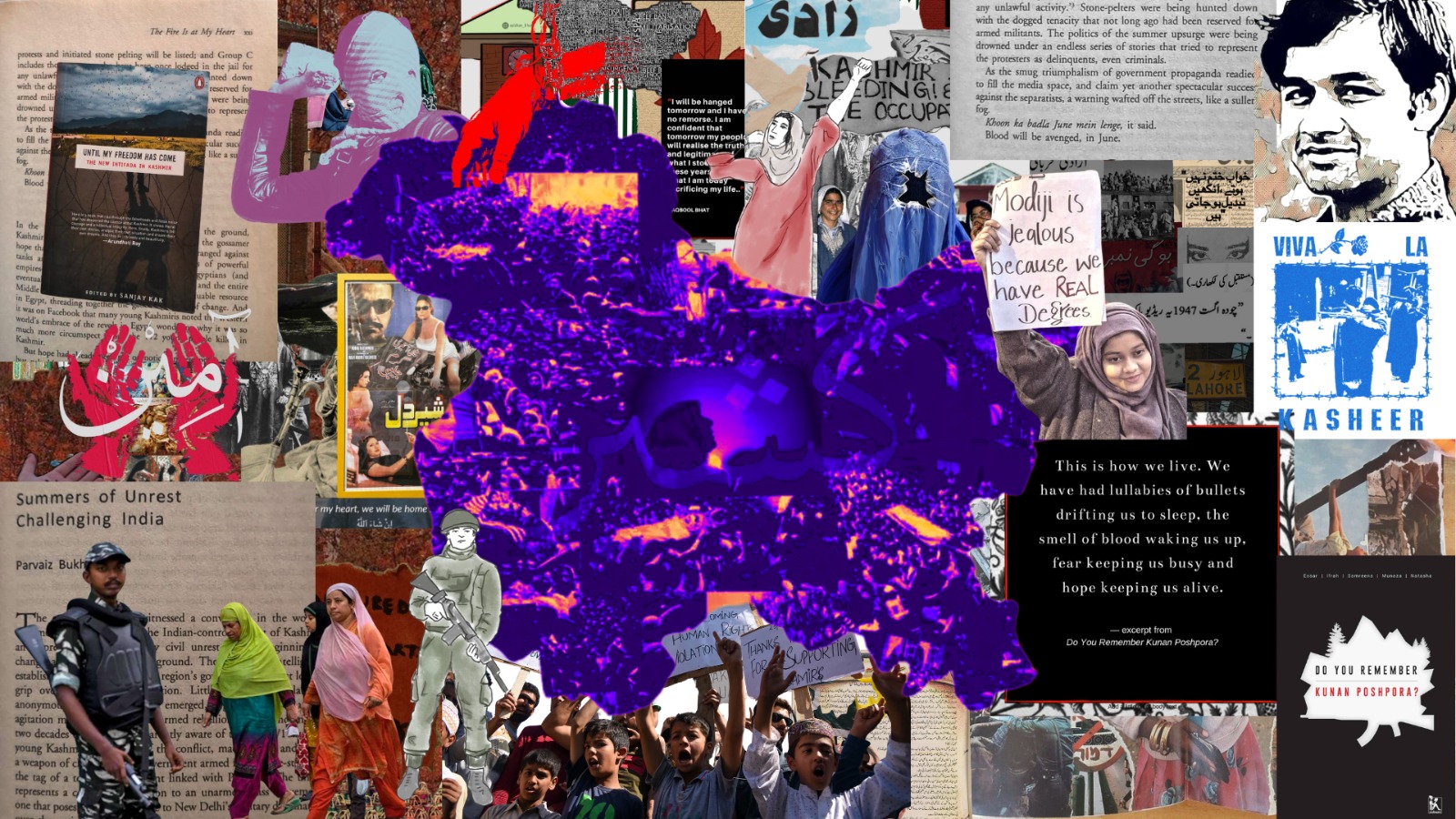
From 2008 onwards, following mass civilian uprisings against Indian rule, there was a period of phenomenal surge in intellectual production, known as the Kashmiri Intifada.
In 2023, I had a tough time locating online links to some key citations for an essay for Global Voices. The piece was about the renowned Kashmiri human rights defender Khurram Parvez and his 2nd year of incarceration in an Indian jail. These were longstanding references to critical articles, links to Kashmiri and regional newspapers and portals, including the websites of human rights organizations such as the Jammu and Kashmir Coalition of Civil Society (JKCCS) and the Association of Parents of Disappeared Persons (APDP).
Links to most articles were broken, and the websites did not work. The regional newspaper archives, investigative reports, and analyses, when available, were far down in the results shown by search engines. The search rankings had many newly written articles at the top. These were mostly written in the last decade or less, and aligned with the Indian state’s narrative on Kashmir, or were mildly dissenting at best.
It seemed that most of the archival data I was looking for had either been erased or replaced (some still lingered on the Wayback Machine, a digital cached archive of websites).
This disappearance was not accidental; it reflected the pattern of the Indian state’s deliberate reshaping of Kashmir’s memory landscape. This type of loss, archival erasure, and enforced disappearance of critical writing, alongside other forms of settler colonial violence fueling native dispossession, have been underway at a frightening speed in the last decade.
It is here that I propose the term Kashmircore—not as redundant theorization, but to trace something urgent. Kashmircore comprises a glut of state-driven production of political, cultural, and academic works that aim not just to erase but also replace Kashmiri counter-memory of resistance histories.
French thinker Michel Foucault described ‘counter-memory’ as a means of recalling the past by those subjugated. Counter-memory challenges and unsettles dominant power structures. As in other settler and security regimes, from the erasing and rewriting of Palestinian archives to the sanitization of indigenous histories in North America, Kashmircore adapts global strategies of erasure but in an Indian ethnonationalist idiom. Counter-memory, thus, is not just an intellectual or archival effort, but an urgent witness and weapon that reclaims people’s historical resistance.
Kashmircore comprises a glut of state-driven production of political, cultural, and academic works that aim not just to erase but also replace Kashmiri counter-memory of resistance histories.
For Kashmiri families, communities, activists, writers, and journalists, counter-memory, in addition to insurrection, has taken many forms: ranging from a mother calling her forcibly disappeared son’s name at a protest, to a folk song mourning those killed, or a poem that invokes freedom and liberty, or writing whole histories and ethnographies of state violence.
As I have discussed elsewhere in the past few decades, Kashmiris have vigorously stripped their stories of the hegemonic narratives of the Indian state since 1947. This went on to shape the Kashmiri intifada: From 2008 onwards, following mass civilian uprisings against Indian rule, there was a period of phenomenal surge in intellectual production. It resulted in a painstaking retelling of the story of Kashmiri resistance through histories, ethnographies, memoirs, films, media reports, research, graffiti, slogans, and literature of all genres in multiple languages.
Since 2014, the Indian state has been making concerted attempts to dismantle Kashmir’s counter-memory, which has contributed to the widespread Kashmircore content. This has gained further momentum since 2019, when India unilaterally and militarily removed the semi-autonomy of Jammu and Kashmir.
Kashmircore works through many mechanisms. Foremost among these are lawfare and bureaucracy, the overarching weapons that sustain the suppression of critical voices as well as the general population. Since 1990, the imposition of Armed Forces Special Powers Act (AFSPA) on the region has given the Indian military the authority to act with impunity. Additionally, the Unlawful Activities Prevention Act (UAPA) and Public Safety Act (PSA) are frequently used to exert control and demand compliance. Direct Indian rule issues diktats enrobed in administrative rulings that exacerbate extrajudicial killings of combatants and non-combatants; imprisoning activists and human rights defenders, blacklisting, raids on human rights organizations, and their FCRA cancellations. New domicile and residency laws are now engineering demographic changes, land expropriation, displacement, dispossession, and ecocide.
Kashmircore also operates through entrenching and normalizing censorship. Curriculum and library control is enforced through the banning of writers, books, and rewriting the educational curriculum. Diaspora, foreign researchers, and academics are often formally and informally barred from entering the region.
In 2020, a new media policy effectively downgraded journalism in the region to fawning reporting. It significantly expanded state control over the press by giving the Department of Information and Public Relations sweeping powers to define what constitutes “fake” news, “anti-national” or “unethical” journalism; to conduct background checks on publishers, editors, and reporters; and to de-empanel outlets or withhold government advertising when these definitions are violated. Censorship is a historical reality in Kashmir, but this policy started a new era of institutionalization of humiliation, imprisonment, demonetizing media, wiping archives, and the refusal of accreditation of journalists for any news seen as critical.
Most newspapers and media platforms are deeply affected. Those who did not fall in line were evicted from their offices and shut down, like the Kashmir Times, which has been forced to publish online. And the Kashmir Walla has been fully dismantled and even removed from the internet and social media. This process exemplifies how “normalcy”, as defined by state-narratives, is being enforced by silencing dissenting political, cultural, and journalistic voices. It ensures that state-sponsored “approved” content has less competition. In addition, international journalists and global human rights organizations are not permitted into the region.
Thus, Kashmircore manifests in platformized memory, where Kashmiri counter-narratives are erased and reshaped through the architecture of digital platforms. Platformized memory privileges state-backed or compliant content while burying critical archives. It comes with the manipulation of search and discoverability of content by flooding results, rendering broken links, editing Wikipedia, or down-ranking critical archives. The online existence of Kashmiris is full of takedowns, shadow bans, and legal bans on social media and websites.
The online existence of Kashmiris is full of takedowns, shadow bans, and legal bans on social media and websites.
Kashmircore has a new technological girth and momentum different from old-school propaganda. The potential for dissemination and creating newer layers of obfuscation in multimodal ways is immense. And AI, too, is a prominent tool deployed to produce Kashmircore on the fly, which circulates without scrutiny in a post-truth world. This entire process has engineered a complete vacuum in Kashmir, which is ready and waiting for intellectual and political opportunists who swoop in to lead glossy, state-sponsored cultural and creative ventures masquerading as innocent and benevolent enterprises.
Today, Kashmircore unfolds through technologically enhanced narratives that replace the language of resistance with promises of development and new cultural revival. A strictly curated and sanitized view of Kashmir is propagated through news and social media content. Front page laurels are apportioned to nominated administrators, sleek tourism vignettes are flush with magnificent drone shots, catchy soundtracks, and inviting soundbites. Direct rule propped by military occupation and a mix of limited forms of local administration has been turned into an accepted governance.
The everyday erasure of native life is packaged as an intellectual and cultural renaissance. Different forms of sponsored programs, like the recent state-sponsored book festival, which was afoot while 25 books were being banned, are organized, saturating the Kashmiri imagination with Indian nationalism. An aesthetic normalcy sanctioned by the state is propagated to camouflage political contestation; it not just minimizes but completely disregards the complexities of the region’s political landscape. Any hint of the word “dispute” written next to Kashmir is considered contraband and criminal.
Kashmircore is not created arbitrarily, but it emerges from incremental cultural and political laundering through institutional and cultural infrastructures and digital platforms. Literary festivals, cultural councils, think tanks, museum circuits, art exhibitions, mainstream and academic journals, conferences, film screenings, activist collectives, and even women’s groups reproduce the Indian nationalist framework under the garb of neutral expertise on social, economic, gender, and political justice. Fellowships, graduate study opportunities, and exchange programs sponsored in the name of reconciliation and peacebuilding also act as carriers of erasure. State-backed media and social media content amplified by algorithms package Kashmir as a consumable aesthetic and a place of ‘heavenly’ leisure and pilgrimage tourism. While there are no explicit funding disclosures, the sustained and growing reach of Kashmircore in times of extreme censorship makes the political economy visible.
Kashmircore is growing in the ecosystem of what Anjali Sajjandhar (2021) has described as the politics of expertise, which is patronized by the ruling right-wing Hindu supremacist Bharatiya Janata Party (BJP). Quoting Dasgupta, Sajjandhar argues that instead of “co-opting public intellectuals into the power structure, as was the practice during Congress rule”, the current dispensation is creating their “own institutional networks of anointed intellectuals and experts” deployed as “alternative authority to challenge the ‘hegemony of the progressives’ and the ‘erstwhile custodians of discourse.’”
In this context, Kashmircore stands out in two key aspects from old-style propaganda.
First, it is very tactful in not outrightly denying Kashmiri suffering and human rights violations. Instead, it dilutes and distorts it, framing it in a way that any blame is squarely placed on the Kashmiris themselves and their resistance.
Secondly, the curated content is not always overtly statist but subtly tries to narrow down state accountability in human rights abuses, and the focus is on casting Kashmiri resistance singularly as terrorism or Pakistan’s proxy war. The Indian government has implemented policies that influence media terminology. The dispute is framed within a counterterrorism narrative in which the violence perpetrated by the Indian state is either absolved or deemed lawful.
Kashmircore is a highly curated, stylized performance of Kashmir. In this version, history, resistance, suffering, and everyday life are stripped of the historical complexity that predates the Eurocentric neocolonial nation-state system that shapes South Asia. It carefully constructs narratives to fit the Indian ethno-nationalist perception of how one should think about Kashmir and Kashmiris, their history, and desires. It is the subtlest, most nuanced form of contemporary propaganda masquerading, sadly, as unbiased knowledge production. The blurring is all too real.
Kashmircore carefully constructs narratives to fit the Indian ethno-nationalist perception of how one should think about Kashmir and Kashmiris, their history, and desires.
In the decades-long crackdown on Kashmiri resistance, the calendar in Kashmir has become an aggregation of massacres and killings. Many tragic incidents that laid bare Indian colonial violence in Kashmir have been globally documented, like in Kunan Poshpora, the twin villages where the Indian army stands accused of mass rape in 1991; or the 2007-08 discovery of Namaloom Qabre (unmarked/unidentified graves), and mass burial sites in remote regions.
In 2009, the JKCCS and APDP, along with the International People’s Tribunal on Human Rights and Justice in Kashmir (IPTK), published the Buried Evidence report, documenting the unmarked graves (over 2700 with potentially several thousand more unaccounted for). It highlighted possible extrajudicial killings and enforced disappearances. In 2014, a group of 50 women came together as Justice for KunanPoshpora. Later, five activists went on to write an acclaimed survivor account titled ‘Do You Remember Kunan Poshpora?’.
Such documentary evidence has been recognized and amplified by international human rights watchdogs, such as the United Nations Human Rights Commission (OHCHR), Amnesty International, Human Rights Watch, among others. These have become a testament to the Kashmiri counter-memory that makes a strong case for attaining a just peace for the region as per the people’s wishes.
Yet in recent years, several Indian state-backed publications, including selectively positioned reports and books, have emerged that even directly contest survivor accounts. They doubt previous research, sometimes overtly or covertly, and try to reframe the past in line with the logic of Kashmircore. These competing narratives are often uncreatively named and not just mimic earlier works but also have the potential to muddle searchability. And while presenting their data as factual, they attempt to delegitimize earlier research and documentation.
Recently, a book named Why KunanPoshpora? was published to give a fresh viewpoint on the mass rape. It is written by 19-year-old “army-backed” authors who allege that the perpetrators were not Indian Army personnel, but militants disguised as soldiers. This narrative is presented even though Kunan-Poshpora stands backed by live testimonies and evidence collected by human rights workers and researchers, both local and international. Even the state’s own bureaucrats, one of whom spoke after 23 years, confessed that the state had threatened him to change his initial report on the incident. And while the state-sanctioned narrative was pushed into headlines, the earlier book was banned, illustrating the process of concerted erasure underway.
Another report presented as a multiyear study revisits the mass and unidentified graves in Kashmir, positioning itself as impartial and evidence-based, and steeped in the jargon of human rights and the Geneva Conventions. While critiquing earlier research on the same subject, it glosses over its own methodological gaps. It ultimately ends up relying on partial police records, testimonies, and local verification rather than DNA testing or systematic forensic investigation. A telling conclusion includes that only nine graves belong to civilians, and all others are classified as militants. While violations are not denied, the reframing of the earlier narrative around the mass/unidentified graves focuses on narrowing the scope of state accountability. It undermines globally recognized prior documentation, which has been widely corroborated by human rights organizations, including Human Rights Watch, Amnesty, and OHCHR. All of them have called for independent investigations and DNA profiling to determine the identities of the deceased and the circumstances of their deaths.
This shows that Kashmircore narratives deploy vocabulary from regular academic research; it hijacks rights scholarship to generate replacement narratives that pose as counter to counter-memory. As a form of supplanting history, Kashmircore aims to rewire people’s attention so that shifting blame away from the state becomes a natural and accepted way of thinking. The camouflaging of statist narratives within the language of truth, justice, reconciliation, and international law is diabolically astute. Terms like lived histories, ethnography, anthropology, everyday life, justice, truth, human rights, communities, gender justice, culture, and heritage are weaponized into tools for erasure and control.
The thrust on discrediting the counter-memory and planting Kashmircore is a move to normalize Kashmiris’ lives under Indian military occupation and settler colonialism. As a system of appropriation, Kashmircore rebrands the language of resistance and counter-memory to delegitimize the Kashmiri indigenous resistance movement, which is counted among similar anti-colonial struggles across the world. It is state propaganda that is discreetly packaged as neutral knowledge production while appropriating Kashmiri suffering and collective memory.
As a system of appropriation, Kashmircore rebrands the language of resistance and counter-memory to delegitimize the Kashmiri indigenous resistance movement
This is not to say that critical research, analysis, and writing about Kashmir’s political resistance, spanning over 77 years, is going to vanish into thin air. But it is increasingly clear that its erasure is not the only threat. It is that the Indian state is actively engaging compliant intellectuals, native Kashmiris, and others to replace counter-memory and superimpose Kashmircore onto it.
It is a telling question to ask: when everyone and anyone remotely critical of the Indian state is shut down, when whole archives are erased, and even measly social media posts are not spared from surveillance and penalization, how are some voices not just allowed but also amplified? Who decides what stories will survive, and will receive a world audience, and to what end?
The work of counter-memory is fragile, risky, and constantly under siege. But it is one of the few remaining tools that Kashmiris must protect to keep their history from being overwritten by Kashmircore. If not as a grand archive, counter-memory will always survive as scattered fragments, carried from reader to reader, hand to hand, heart to heart.
A Counter-memory Toolkit
Be proactive, not reactive.
For those committed to protecting counter-memory, the tools are closer to the essence of samizdat [self-publications in Russian, which originated in the Soviet Union, referring to the discreet production and circulation of state-banned work] in creating a chain of preservation and circulation than shouting to huge audiences from glossy LitFest platforms. You have to return to both analog and digital roots. Collect books. Save, copy, republish, and rehost articles, PDFs, and testimonies on multiple platforms (e.g. Wayback, Archive.today, Google Drive, online repositories).
Initiate and support digital archiving projects, oral histories, and community-led memory practices. Build small, authentic libraries of Critical Kashmir Studies scholarship, circulate USBs. Email files and PDFs to yourself when nothing else is available, screenshot, download, and share. Copy and paste across archives; create private, free WordPress sites to rehost for archiving. Download full materials instead of using links. Print and circulate offline when possible.
In your teaching and writing, maintain a citational hygiene. Share critical, credible, and established reports by Human Rights organizations and people’s collectives in and outside Kashmir, by reposting, quoting, and citing in your own work. Citation is memory in action; it is politics. Reference testimonies and survivor texts that Kashmircore tries to bury. Always use credible Kashmiri sources, journalists, and scholars, human rights documentation, survivor accounts, so that their work is not overwritten by statist Kashmircore “replacements”.
Given penalizing laws that criminalize counter-memory, be discreet, be safe. Stay alert, practice vigilance.
Be attentive to mimicry, dilution, and so-called “neutral” knowledge that reproduces Kashmircore logics; learn to recognize Kashmircore and call it out when you can.
SUPPORT US
We like bringing the stories that don’t get told to you. For that, we need your support. However small, we would appreciate it.
Ather Zia is a political anthropologist, poet, short fiction writer, and columnist. She is a Professor of Anthropology and Gender Studies at the University of Northern Colorado. She is the author of 'Resisting Disappearances: Military Occupation and Women’s Activism in Kashmir', and the founder-editor of Kashmir Lit. Her latest poetry collection, 'In Kashmir: Writing Under Occupation', was published by Agitate Collective.
Related Posts