



In the forests of southern Chhattisgarh, the tribal heartland in central India, villagers have been fleeing *millitary grade artillery* [https://scroll.in/article/1081780/as-maoists-ask-for-ceasefire-security-forces-shell-hills-sheltering-top-insurgent-leaders] that has no place outside a battleground. As Indian security forces deployed 81mm mortar shells and *drone-dropped* [https://www.thequint.com/news/india/chhattisgarh-tribals-claim-drone-attack-in-bastar-forces-deny] grenades, *civilian fatalities*[https://thepolisproject.com/read/how-the-indian-state-is-killing-bastars-children/] have been *reported multiple times*[https://scroll.in/article/1048413/bastar-villagers-allege-aerial-bombing-by-security-forces-what-is-the-truth] – an unprecedented escalation turning poor tribal communities, including *children*[https://scroll.in/article/1077656/a-dead-body-in-the-forest-injured-children-and-other-unanswered-questions-about-bastar-encounter], into collateral damage. The roots of this lethal transformation run deeper than the Bharatiya Janata Party-led National Democratic Alliance (NDA) government’s undertaking to *eradicate Maoism by March 2026*[https://www.thehindu.com/news/national/no-indian-citizen-will-lose-life-after-end-of-naxalism-by-march-31-2026-amit-shah/article69199051.ece].
India’s steel and mining push in these areas, where counterinsurgency operations are underway, is one factor. Another is the increasing militarization of India’s paramilitary forces, which, as this report will show, is aided by the NDA’s weapons manufacturing push. After IT, BPO, and Pharma, the NDA has projected weapons manufacturing as *India’s latest economic engine*[https://www.orfonline.org/research/india-s-defence-industry-achievements-and-challenges]. It aims to develop an indigenous arms manufacturing sector to boost self-reliance in weaponry and grab a part of *the over-$600 billion global arms and military services trade*[https://www.sipri.org/media/press-release/2024/worlds-top-arms-producers-see-revenues-rise-back-wars-and-regional-tensions].
Accordingly, the government is using India’s financial muscle, as the country with the *fourth-highest defence budget*[https://indianexpress.com/article/trending/top-10-listing/top-10-countries-highest-defence-budget-2025-9840269/] globally, to lure international weapon-makers (OEMs - Original Equipment Manufacturers) into technology transfers and local manufacturing, aggressively reshaping India’s weapons manufacturing sector. To this end, in 2020, it introduced new localization requirements, barring foreign manufacturers from selling directly to India’s armed forces. They now need to tie up with Indian firms and make their products in India. Simultaneously, the NDA invited India’s private sector into weapons manufacturing, saying the country needs to *reduce its dependence*[https://thewire.in/security/indias-assault-rifle-induction-woes-continue-with-delays-in-indigenous-ak-203-production/] on Public Sector Undertakings (PSUs) in defence.
Despite much of this transformation carrying far-reaching consequences — like the rise of a private sector-led military-industrial complex — most discussions on this shift have been limited to defence and national security circles. Wider conversations have been sporadic. Once, when it emerged that Indian firms like *Adani*[https://www.shephardmedia.com/news/uv-online/india-sends-newly-assembled-male-uavs-to-israel/], *Kalyani Strategic Systems*[https://www.haaretz.com/israel-news/2025-04-19/ty-article-magazine/.highlight/why-the-future-of-israeli-defense-lies-in-india/00000196-4c0a-dd47-ad9f-cedba2eb0000], and *Munitions India*[https://thewire.in/government/govt-owned-munitions-india-ltd-exported-ordnance-to-israel-as-gaza-was-reduced-to-rubble] had made the drones, shells, and firearms Israel is using on Gaza. And again, when the India-Pakistan clash last year resulted in *a spate of reports about India’s weapons manufacturing*[https://timesofindia.indiatimes.com/india/the-inside-story-of-a-seamless-operation-sindoor/articleshow/121241911.cms] progress.
Along the way, however, two larger questions have been missed.
First, it needs to be assessed whether the NDA’s assumption that transfer of technology through joint ventures can help India’s private sector muscle into the global weapons manufacturing trade is working. As books like *Apple in China*[https://www.simonandschuster.com/books/Apple-in-China/Patrick-McGee/9781668053379] show, transfer of technology agreements can help erstwhile suppliers emerge as new competitors – creating an outcome where, as this report will show, manufacturers are now unwilling to share core technologies.
Second, as reporter Andrew Feinstein writes in *The Shadow World: Inside The Global Arms Trade*[https://us.macmillan.com/books/9781250013958/theshadowworld/], bribery and the use of political connections have been integral to the global weapons trade. Riding on these, countries have been pushed into a “permanent war economy” where resources are diverted from “crucial social and developmental needs”. Today, as the private sector enters the weapons manufacturing sector, India too is seeing the rise of a domestic, profit-seeking military-industrial complex.
Apart from needing jobs, India is also prone to elite capture and a weakened rule of law. And so, will this domestic military-industrial complex create jobs and forex earnings, or will it drag India into the same quagmire that Feinstein described?
The defense sector is a secretive landscape. Despite many declining to speak, The Polis Project interviewed more than 40 people across national security, senior officers in paramilitary forces and state police, private weapons manufacturers, their public sector counterparts, weapons middlemen, an industry association, retired officials from the Ministry of Defence (MoD) and armed forces, and tier-one suppliers. The reporter travelled to the defense cluster near Kanpur, besides visiting Chennai, Hyderabad, Bangalore, Chandigarh, Delhi and Raipur.
Here is what The Polis Project found: While India’s weapons manufacturing push focuses on acquiring advanced technologies and encouraging local production, it faces challenges as foreign OEMs are unwilling to share core technologies. This reluctance makes them partner with smaller Indian firms (rather than established ones), which are content to limit themselves to weapons assembly.
The consequences run deep. Assemblers, as this report will show, will struggle to export. Hence, they will have to recover their investments through sales within India. However, with a rise in manufacturing capacity far exceeding what India’s military can absorb, several of these firms have begun selling to paramilitary forces and state police. It has intensified second-order effects like the use of *military-grade technologies on domestic insurgencies*[https://scroll.in/article/1081780/as-maoists-ask-for-ceasefire-security-forces-shell-hills-sheltering-top-insurgent-leaders] and the *hypermilitarization of state police*[https://timesofindia.indiatimes.com/city/guwahati/manipur-police-seeks-army-help-for-mmg-training/articleshow/113076366.cms%23:~:text=Manipur's%252520police%252520force%252520currently%252520rely,longer%252520barrel%252520for%252520more%252520accuracy.].
The first part of this story will present the above findings. The second part will discuss the larger costs that follow – be it intensified militarization in Bastar; civilian casualties; pervasive fear within local indigenous and tribal communities; unchecked police procurement of military-grade weapons, escalating violence, and long-term destabilization of the region; and long-term militarization of society itself.
1. The Ambition of Self-reliance
$India’s weapons manufacturing push focuses on acquiring advanced technologies and encouraging local production — mostly by the private sector. The country has been moving in that direction since the Kargil War in 1999, but the pace has picked up since 2014.
1.1 The View from Sarh
In 2018, the Uttar Pradesh Defence Industrial Corridor chose farmlands abutting Sarh for one of its manufacturing hubs. With that, the village became one of the ground zeros of India’s weapons manufacturing drive. A part of Uttar Pradesh Expressways Industrial Development Authority (UPEIDA)’s ‘Defence Industrial Corridor’, it is the node closest to Kanpur. Five more nodes are coming up near Jhansi, Chitrakoot, Lucknow, Aligarh, and Agra.
In April 2025, when The Polis Project visited Sarh, we found a relatively unchanged part of India. Once off the highway between Kanpur and Prayagraj, farmlands replaced peri-urban sprawl. The only hints of looming change in this 13-kilometer stretch between Sarh and the highway were a new bridge and two UPEIDA hoardings bearing images of PM Narendra Modi and UP Chief Minister Yogi Adityanath, welcoming visitors to the “Kanpur Node” of the defense corridor.
At Sarh itself, the manufacturing cluster was still taking shape. At eight in the morning, construction workers were walking along an orange boundary wall, beyond which stood the metal pillars of a large shed under construction.
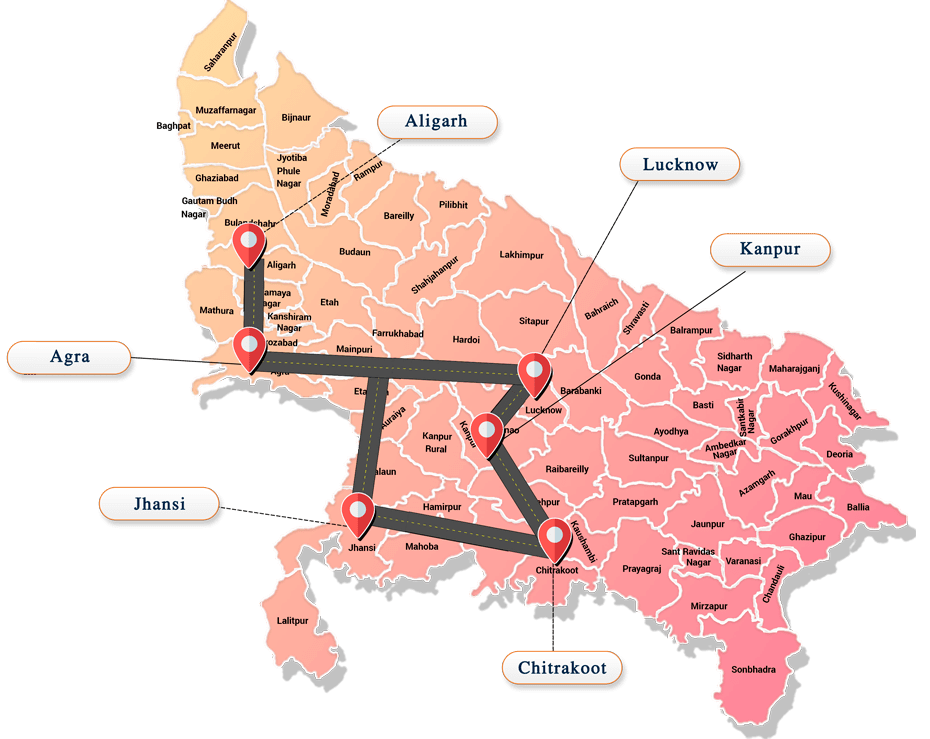
Further ahead, on the left, was the Adani Group’s small-caliber ammunition manufacturing unit. Already commissioned, this can *produce*[https://www.adani.com/newsroom/media-releases/advancing-aatmanirbharta] 150 million rounds, enough to meet 25% of India’s annual requirement. Across the road, work had begun on a sister unit for large-caliber ammunition. Another kilometer or so down the road stood another shed, reading “Adani Ammunition Complex”.
Two other factories, belonging to *Aadhunik Materials and Science*[https://www.zaubacorp.com/AADHUNIK-MATERIAL-AND-SCIENCES-PRIVATE-LIMITED-U17299UP2021PTC144508] and *AR Polymers*[https://arp.org.in], were also coming up there. Both will produce protective gear like helmets and bulletproof jackets.
A second defense corridor is *coming up*[https://www.adani.com/newsroom/media-releases/advancing-aatmanirbharta] in the southern state of Tamil Nadu, in and around the cities of Chennai, Hosur, Coimbatore, Madurai, and Tiruchirapalli. Defense manufacturers have also planted themselves elsewhere in India: Pune and Nashik in the west; Hyderabad, Bangalore, and Chennai in the south; Midnapore, Raipur, and Barrackpore in the east; one could go on.
Most of these nodes, as Sarh shows, will house private sector firms, a distinct break from Indian weapons manufacturing in the past. How did we get here?
1.2 The Indigenization Drive
For the longest time, India’s weapons manufacturing sector was the preserve of Public Sector Units. Bodies such as the Defence Research and Development Organisation (DRDO) developed new weapons; sister firms such as Hindustan Aeronautics and Central Electronics took those concepts into production. For instance, India’s 40-odd ordnance factories, all reporting to the Ordnance Factory Board, produced munitions, sights, parachutes, military apparel, and firearms.
In the case of technologies sourced from overseas, India followed a ‘buy and make’ model where the MoD bought a limited number of weapons, off the shelf, from overseas OEMs, followed by local production by a nominated local firm–usually a defense PSU.
Over the last decade, however, much of this architecture has changed. In 2021, for instance, ordnance factories were *consolidated into eight state-owned enterprises*[https://www.ddpmod.gov.in/sites/default/files/58aba4890363976299ae63c03904b4eb1bb789fd78b92502240ec0ea6f7f9585/5fb52470a7f5a95b134223f8b3586041928f08c8a54706242ff0bc579a722419.pdf]. “Now each (of the eight PSUs) has its own management,” said Vivek Rae, a former Director General (Acquisition) at the Ministry of Defence. “This was a long overdue and welcome development. A corporate decision-making structure will increase transparency about cost structures, enhance accountability, improve financial management, strengthen performance review, and facilitate modernization through technology collaboration and joint ventures,” he said.
There were other changes. The MoD launched iDEX, a fund that backs startups developing promising new defense technologies. Defense corridors also came up. Perhaps the most crucial shift was that the State began favoring private firms over defense PSUs in weapons development.
1999, India’s private sector had a limited role in defense production — mainly supplying components and supporting localization through/led by PSUs. “Even in the 90s, (defense PSUs) were pushing localization,” said a senior manager at VEM Technologies, a Hyderabad-based firm that makes missiles, on the condition of anonymity. Explaining the process, he said, “They would identify a component that needed to be localized and then, after getting approvals from the government, they would announce the specifications and invite private firms to participate.” In other words, private firms mainly worked as suppliers to state-owned defense firms, which also determined components that could be localized.
The private sector’s role began to swell after the Kargil war of 1999. India faced ammunition shortages during the war, leading to rushed imports. In 2001, the Vajpayee government opened defense production to private players and, for the first time, allowed foreign direct investment up to 26%. “Firms could make finished goods, or be tier-1 or 2 suppliers [of parts] to PSUs,” said Amit Cowshish, who worked as a financial advisor at the defense ministry (2005-12).
But investment remained limited largely because private companies did not receive substantial orders to sustain themselves. “Defense is not like other businesses,” Cowshish said. “You cannot create demand here by influencing consumer preferences. It is a monopsony (a market where a single buyer dominates many sellers). You get large capital investment only if investors are sure that there will be at least break-even demand for the products they manufacture. Private firms only entered a few sectors (in defense) like vehicles.”
A second push for private sector participation came in 2005. To boost technology infusion, the government introduced offsets, making it mandatory for global weapon OEMs selling to India to invest a defined percentage of the deal back into the country’s defense industry —whether PSUs or *private firms*[https://idsa.in/system/files/jds/jds_9_4_2015_DefenceOffsetPolicy.pdf] - by buying eligible defense products manufactured by them, investing in them in cash or kind, or transferring technology to them or to the DRDO. These are called offsets. The Rafale fighter jet deal, involving Anil Ambani’s Reliance Group, *illustrates*[https://www.businessworld.in/article/reliance-has-10-per-cent-of-offset-in-rafael-deal-dassault-ceo-162100] how offsets are supposed to work, even though the deal was mired in corruption allegations.
In 2017, 3 years after taking office, the NDA sought to give the private sector another boost by introducing the strategic partnership model for local production across four segments: helicopters, aircraft, submarines, and armoured vehicles such as main battle tanks. The model required the government to select, as Cowshish recently *wrote*[https://www.theindiacable.com/p/bnp-sweeps-bangladesh-polls-rafale], “Indian firms with engineering capability, manufacturing depth and financial solvency which would collaborate with overseas OEMs, selected by the MoD via a parallel process, for technology transfer and local production.” Though the model was intended for the private sector, an early exception was made for the *P-75 submarine*[https://infra.economictimes.indiatimes.com/news/ports-shipping/mazagon-dock-shipbuilders-negotiates-p75i-submarine-project-with-indian-navy/123819722] project, allowing MDL, a public-sector shipyard, to participate. It is another matter that no contract has so far been concluded under this model.
Then came the updated Defence Acquisition Procedure (DAP) of 2020, which, *with a list of over 500 items that could not be imported*[https://www.idsa.in/publisher/issuebrief/decoding-defence-acquisition-procedure-2020/], sought to promote self-reliance through the local production of arms, ammunition, and weapon systems. The DAP pegged the minimum requirement for indigenous content across various procurement categories generally at 50%, except in the case of outright purchase of equipment from abroad. The draft DAP 2026, released by the MoD in February, seeks to increase the indigenous content requirement to 60%. This insistence on local production is a problem for global OEMs who want to sell to India, but it’s not an insurmountable one. “Even this high percentage of requirement doesn’t rule out the possibility of collaboration between Indian and foreign companies,” said Cowshish.
As countries like China, Iran, Israel, Turkey, and Brazil muscle into the global arms trade, competition is rising. In this landscape, India’s Rs 185,000 crore military capital acquisition budget is too big to ignore.
As countries like China, Iran, Israel, Turkey, and Brazil muscle into the global arms trade, competition is rising. In this landscape, India’s Rs 185,000 crore military capital acquisition budget is too big to ignore.
“The numbers lure them,” said veteran defense analyst Rahul Bedi. “Which other country places an order for 126 Rafales or 300,000 carbines or 200,000 assault rifles?”
The outcome, which has been playing out over the last six years, is a double movement. In the past, the MoD had directed global OEMs seeking local partners towards defence PSUs and ordnance factories, but now they need private-sector partners. In tandem, a clutch of Indian private firms began seeking global OEMs for partnership. As the next part of this report will show, most joint ventures post the reforms flowed to the private sector.
1.3 How Defense Partnerships Now Work
At its campus in Ghaziabad, state-owned Central Electronics (CEL) sources defense technologies from DRDO, and converts them into products like missile tips (radomes). On being asked how DAP is working on the ground, a CEL official, speaking to The Polis Project on the condition of anonymity, mentioned the network analyzers (instruments used to test electrical systems) that CEL uses. “Just three or four foreign companies make these,” he said. “Earlier, we used to buy from HP, which has now spun this unit into a company called *Keysight Technologies*[https://valuetronics.com/blogs/news/understand-the-difference-between-hp-agilent-and-keysight?srsltid=AfmBOor_SmOpFow8eqpgiA1sTnKVYdXmC_WvvvRop_fX7gkOflOnleeZ].” Given import restrictions due to DAP, Keysight has tied up with a Delhi-based company called *Agmatel India*[https://www.zaubacorp.com/AGMATEL-INDIA-PRIVATE-LIMITED-U02109DL1997PTC084482], which now supplies network analyzers to CEL.
$Over the last five years, such deals have played out repeatedly across India. By March 2023, as then junior defense minister Ajay Bhatt told the parliament, the Indian government had *approved*[https://sansad.in/getFile/loksabhaquestions/annex/1711/AU3911.pdf] 45 joint ventures between global manufacturers and private companies. Some of these joint ventures — like the one between Elbit and Adani — were for platforms, i.e. finished weapons or weapons systems. Others — like the one between Keysight and Agmatel — were for components. $Since then, India has seen an increase in joint ventures between local firms and global OEMs. Take firearms manufacturing, which was dominated by government factories till recently; it now has at least 12 private companies.| Indian Company | Ownership Type | Partner(s) for JV | Partner Type |
|---|---|---|---|
| Adani’s PLR Systems | Private | Israel Weapon Industries | Foreign Private |
| SSS Defence | Private | Self-designed indigenous rifles | Domestic |
| Kalyani Strategic Systems | Private | Gunmakers like India's ARDE(Armament Research and Development Establishment, Pune) + Bulgaria's Arsenal | Govt R&D + Foreign State-Owned |
| Sajjan Jindal's Jindal Taurus |
Private JV | Brazil’s Taurus Armas | Foreign Private |
| Lokesh Machines | Private | Submachine gun design is based on an ARDE design | Govt R&D |
| IComm Tele, a part of Megha Engineering and Infrastructure | Private | Caracal International LLC, UAE | Foreign Private |
| Vinveli | Private | Česká Zbrojovka, Czech Republic | Foreign Private |
| Counter Measures Technologies | Private | Glock Ges.m.b.H, Austria | Foreign Private |
| Indo-Russian Rifles | Public JV | Russian Govt / Rosoboronexport + Small Arms Factory, Kanpur + Rifle Factory, Ishapore |
Foreign State + Domestic State |
| Sial Enterprises | Private | Webley & Scott, UK | Foreign Private |
| Paavak | Private | SRM Firearms | Foreign Private |
| Jayaswal Neco | Private | Desert Tech LLC, USA | Foreign Private |
| Anil Ambani’s Jai Armaments | Private | As of 2024, media reports said it was looking for JV partners. | - |
2. Changing Warfare, Tight-fisted OEMs, Newbie Assemblers, and Elusive Exports
$ As warfare evolves beyond traditional battlefields to include multiple domains like cyberspace, outer space, and electromagnetic spectrum, and weapon technologies shift from manned to AI-driven unmanned systems, India’s defense manufacturing push faces complexity. What we found: Foreign OEMs are often reluctant to share core technologies. This reluctance leads them to partner with newcomers rather than established Indian firms, resulting in questions about the scale of localization. Additionally, while India aims to be a global weapons exporter, intellectual property restrictions raise costs and limit export potential.2.1 How Warfare is Changing
$For the longest time, wars were purely physical, on the battlefield, albeit with ever more sophisticated weapons. Some of this had ruptured by the time of the First Gulf War (1990-91) and the Kosovo War (1998-99). Asymmetric wars with bodybags on one side and technology on the other had entered. $Since then, the nature of warfare has changed further. “The three physical domains of land, air, and sea are being replaced with seven domains — air, land, sea (undersea), outer space, cyber, electromagnetic spectrum, and near space or hypersonic,” said defense analyst Pravin Sawhney, and author of *The Last War: How AI will Shape India’s Final Showdown with China*[https://www.alephbookcompany.com/book/the-last-war-how-ai-will-shape-indias-final-showdown-with-china/]. $In wartime, countries will increasingly face electronic attacks on national infrastructure, such as financial systems and power grids, he said. Ukraine’s *December 2015 cyber-induced grid outage*[https://cyberlaw.ccdcoe.org/wiki/Power_grid_cyberattack_in_Ukraine_(2015)], which cut power to hundreds of thousands of people, was the first such instance. $Even on the battlefield, things are changing. Weapons are evolving from manned to unmanned systems with the rising *use*[https://economictimes.indiatimes.com/news/defence/drones-not-diplomats-chinas-new-warfare-strategy-is-loud-fast-autonomous-and-already-war-ready/articleshow/120209778.cms] of drones (as done by Ukraine and Iran), *drone swarms*[https://www.twz.com/land/shipping-container-launcher-packing-126-kamikaze-drones-hits-the-market] (coordinated groups of drones) and loitering munitions (unmanned drones that fly to an area and hover, searching for a target to attack). Further, machine learning and AI are getting integrated in them. $“[The global weapons industry] has moved from platforms to capabilities, from hardware to software,” Sawhney told The Polis Project. “This is not [merely] about building a tank, but about trying to expand its capabilities.” $Take drones. “If an unmanned aerial vehicle has 100 components and 10 technologies, the technologies are where the most important differentiators (amongst rival weapons in the market) will lie,” said the senior manager at VEM Technologies. The technologies can include seeking software, guidance software or unmanned control. Technology has also entered areas of the weapons trade that were earlier considered relatively low-tech. *Israel’s Arbel system*[https://www.middleeasteye.net/news/israel-india-ai-weapon-arbel-gaza-war], for instance, incorporates AI into its firearms to convert each shot to a precise kill shot, eliminating any human error. $This shift — where competitive advantage in weapons is shifting from hardware to software — is crucial for understanding how India’s ambition to become a weapons exporter is faring. Transfer of technology has long been pitched as the means to not just make India self-reliant in weaponry, but also to flip the country from a weapons buyer to a seller. $The catch is: technology is not being transferred.2.2 The Five Costs of OEMs Not Sharing Core Technologies
$To recap, the NDA wants global OEMs to transfer weapons technology at a time battlefield competitiveness increasingly lies in code, chips, and access to “refined” information derived from battlefields — be it Israel testing its weapons on Palestinians, or the world *studying*[https://www.rusi.org/explore-our-research/publications/commentary/key-questions-about-india-pakistan-aerial-clashes] the recent war between India and Pakistan to *gauge relative performance of Rafale and the Chinese J-10*[https://www.reuters.com/business/aerospace-defense/how-pakistan-shot-down-indias-cutting-edge-fighter-using-chinese-gear-2025-08-02/#:~:text=The%20J-10s%20shot%20down,hardware%20against%20untested%20Chinese%20alternatives.]. What gives today’s weapons technology their competitive edge is the accumulated, refined intelligence beneath it – what theorists call “data bodies”: the aggregated informational learning from real wars and targets.A data body is the digital shadow that surveillance systems build around a person. It is assembled from biometrics, location tracking, communications intercepts, and behavioral patterns. States and corporations can act upon this profile independent of the physical person to monitor, predict, target, or eliminate.
In modern warfare, data bodies are not a byproduct of weapons systems, they are at the core of the product being sold. Israel's military-industrial complex has spent decades refining this architecture by testing surveillance and targeting technologies on Palestinians, as documented by writers like Antony Loewenstein, Jeff Halper, and Naomi Klein. It produces export products whose competitive advantage lies in algorithmic refinement from live deployment on a captive population.
"When all the key components are being imported by licensed manufacturers of firearms and simply screwdrivered in India, it delivers no substance to the idea of Make in India for defense. As on date, a majority of weapons are being produced this way. The percentage of Indigenous Content (IC) compliance is therefore rarely met and may only exist on paper. It will most likely fail the litmus test of even a rudimentary technical inspection.” - Vivek Krishnan, Founder, SSS Defence$Two. As new entrants get into joint ventures with global OEMs, localization gets harder. If India floats a tender for a weapon which has to be, say, at least 60% indigenous in terms of final market value, bidders can either pitch locally developed weapons or present their tie-up with a foreign OEM and promise 60% localization. $There is a catch here. Since the details of local content are largely self-declared, it is hard for the government to verify claims of indigenization. On being asked if newcomers can deliver 60% localization, a senior official at Bangalore-based Axiscades Technologies, a defense firm owned by BJP leader Rajeev Chandrasekhar, said: “Firms are under-pricing imported items, and boosting margins on locally produced components, [thus] passing the product off as made-in-India.” $This point was seconded by Vivek Krishnan, the founder of Bangalore-based SSS Defence, an Indian OEM whose locally made sniper rifle *defeated*[https://theprint.in/defence/india-made-sniper-rifle-trumps-american-in-police-commando-competition/2504645/] imported rifles in the 2025 All India Police Commando Competition. “Indigenization is not just about the assembly line,” he told The Polis Project. “It includes design, building the supply chain, enshrining quality control for components, and then assembly, testing and certification. When all the key components are being imported by licensed manufacturers of firearms and simply screwdrivered in India, it delivers no substance to the idea of Make in India for defense. As on date, a majority of weapons are being produced this way. The percentage of Indigenous Content (IC) compliance is therefore rarely met and may only exist on paper. It will most likely fail the litmus test of even a rudimentary technical inspection.” $Citing drones as an instance, where indigenization is lagging, Dinesh Shivanna, the CTO of SSS Defence, added: “There is an airframe, software, autopilot, a data-link, a comms [communications] link, a camera, and an assembly. Of this, [Indian firms] only do assembly. Even the airframe’s parts are made elsewhere. But, if the mandate is for 50% localization, you will attach 50% of the value of the drone to assembly.” $Three. As global OEMs tie up with assemblers, India’s weapons manufacturing in the private sector is splitting into local OEMs and assemblers. While a few large groups like *L&T, Bharat Forge and Tata Advanced Systems*[https://www.fortuneindia.com/long-reads/indias-defence-sector-is-transforming-as-the-private-sector-storms-in-driving-modernisation/120602%23google_vignette] have been well-documented, it is still unclear what proportion of the private sector’s defense manufacturing push consists of assemblers. As the chart about firearms manufacturers shows, it is likely to be high. $“Why would the private sector invest in R&D without there being a reasonable certainty that it will be able to recover the cost and make some profit by selling the newly designed and developed product?” asked Cowshish. Assembly, in contrast, is more viable, as it is generally linked to the execution of specific contracts. $Four. Global OEMs’ unwillingness to share know-how hurts India’s defense preparedness. HAL’s Light Combat Aircraft has been *delayed*[https://thewire.in/security/engine-warfare-imported-trade-geopolitics] because General Electric’s engine deliveries were running late. $There are yet other concerns. “Look at what Israel did with the pagers,” said a senior executive in a defense PSU, on the condition of anonymity. He was referring to Israel remotely detonating explosives hidden inside pagers and walkie-talkies supplied to Hezbollah operatives across Lebanon, *killing dozens*[https://www.aljazeera.com/features/2025/9/17/lebanons-terrible-year-from-exploding-pagers-to-israeli-occupation] including civilians in 2024.“How do we know that anything we buy – radar, military equipment – cannot be used against us? If these are connected to the outside world, the supplier can disable at their discretion. In that case, your electronics will not work, your flights will not fly,” he said. $Apart from these, *as India’s experience with the Meteor missile shows*[https://english.mathrubhumi.com/features/specials/india-rafale-meteor-missile-delay-gevli3c0], systems from diverse countries may not be compatible. “In any meaningful defense manufacturing, we need to own the Intellectual Property Rights (IPR),” added Sudhir Mishra, former CEO and MD of BrahMos Aerospace. “We can take some help for design, development and production but we need the IPR. That is what [the] Defence Research and Development Organisation (DRDO) does. It produces the IPR and then goes to the Public Sector Undertakings – be it for missiles, armaments or armour. What we are getting is licensed production.” $And finally, five. Global OEMs’ decision to tie up with assemblers comes with one more caveat: Assemblers struggle to export.
2.3 Why Exports Stay Elusive
$In 2025, the Aero Show in Bangalore drew large crowds. As in previous years, civilians walked around gawking at the fighter planes, transport carriers, and attack helicopters on display. Defense-sector insiders, however, noted more substantive differences between this defense exhibition and its predecessors. $With over 900 companies setting up stalls, it was the *biggest*[https://www.thehindu.com/news/national/karnataka/biggest-ever-aero-india-to-kick-off-in-bengaluru/article69199785.ece] one to date. But the key change was that, over the preceding ten years, the ratio between foreign OEMs and local firms had flipped. In 2015, the Aero Show *had pulled in 623 companies*[https://www.vayuaerospace.in/news-details/Id/9/title/quarter-century-of-aero-india-shows]. Over half of these – 328 – were international manufacturers. By 2025, just 150 hailed from foreign countries. The rest were local firms.
This, however, is where questions about *cost-competitiveness*[https://www.channelnewsasia.com/asia/india-global-biggest-defence-manufacturing-hub-weapons-producers-arms-startups-ecosystem-modi-3476356] come in. “Indian-made 155 mm artillery shells cost $300–$400 each, compared to over $3,000 in Europe,” wrote *Times Now*[https://www.timesnownews.com/business-economy/industry/india-aims-to-become-global-arms-export-hub-with-new-financing-push-and-diplomatic-drive-hands-out-soft-deals-article-151433692]. “Local firms have sold howitzers (artillery guns that fire shells) for around $3 million—roughly half the European rate.”
3. In the Absence of Exports, the Search for Domestic Markets
$India’s push to build a weapons-exporting industry has sparked a boom in manufacturing. But, in the absence of exports, the Indian military will be the main buyer for most firms. Given the finite number of orders the military can place, this flood of producers is experiencing a glut, with more companies and production capacity than there is demand.3.1 As Newcomers Rush in, Overcapacity Looms
$For long, India’s weapons manufacturing sector was an enclave of engineers. It had research bodies like the DRDO; manufacturers like the ordnance factories; and their tier-1 and tier-2 suppliers, most of whom hailed from the private sector. Besides, private-sector OEMs were also growing as firms like L&T, Kalyani, Chennai-based DataPatterns, and Bangalore-based AlphaDesign Technologies established themselves. $Some of these private firms sourced *root technologies from the DRDO and operationalized them*[https://defenceupdate.in/drdo-atags-indias-very-own-indigenous-advanced-artillery-gun/]. Others, riding on their promoters’ previous work while employed by the armed forces, bootstrapped themselves. Over time, these firms too honed their capabilities. Outfits like AlphaDesign began supplying technologies, such as *missile-launch detection systems*[https://www.businesstoday.in/industry/aviation/story/alpha-signs-30-million-deal-with-elbit-for-iafs-mi17-helicopter-upgrade-71791-2017-02-16], to firms like Elbit. $Then came the transfer-of-technology approach.However, as OEMs tie up with assemblers – choosing not to share core technologies — India appears to be gaining neither self-reliance nor export-competitiveness. $Given the *promise of supernormal returns*[https://economictimes.indiatimes.com/news/defence/indias-defence-sector-outlook-remains-strong-with-rising-indigenisation-and-record-orders-report/articleshow/120372227.cms?from=mdr], India’s weapons manufacturing sector is seeing a flood of neophytes. At Sarh, both Adani Defence and Aadhunik Material and Sciences are newcomers. While Adani is best known as an infrastructure concessionaire, Aadhunik’s parent company is a *road-builder*[https://arthermosets.com/]. Aadhunik forayed into *protective gear like helmets and bulletproof jackets*[https://www.ynos.in/startup/aadhunik-material-and-sciences-private-limited-421310] only *four years ago*[https://www.zaubacorp.com/AADHUNIK-MATERIAL-AND-SCIENCES-PRIVATE-LIMITED-U17299UP2021PTC144508%23google_vignette]. $“We had the mining boom, the thermal power plant boom, the PLI boom and now, we have the defense boom,” said Vishal Singh, the promoter of Navbharat Defence Systems, a Raipur-based firm planning to manufacture kamikaze drones. “A lot of companies are rushing in,” he noted. $The scale of manufacturing capacity coming up is hard to gauge. While the government announces MoUs as a measure of its success, information about actual investments is near absent. It’s hard to tell what percentage of MoUs are being converted into actual investments, according to Bharat Jain, director of New Delhi-based Society of Indian Defence Manufacturers (SIDM). Industry executives and sector observers, however, suggest the said boom is degenerating into a glut. At present, India has 15 gun-makers; *500-odd drone startups*[https://tracxn.com/d/explore/drones-startups-in-india/__gSDfPZkFoOxgCGVX0gqCXECXtkJ1KA1Nsoz8bS1U0Rs], with an unknown percentage targeting military markets; another 100 or so firms making missile components and at least five firms making missiles. $In the absence of exports, the biggest buyer is the Indian army. Can it absorb all this production? “This is the question all of us have,” said the owner of a military boots-manufacturing firm in Kanpur. “When you have a factory, you have to sell. But, if so many people set up capacities, where will they sell [their weapons]?”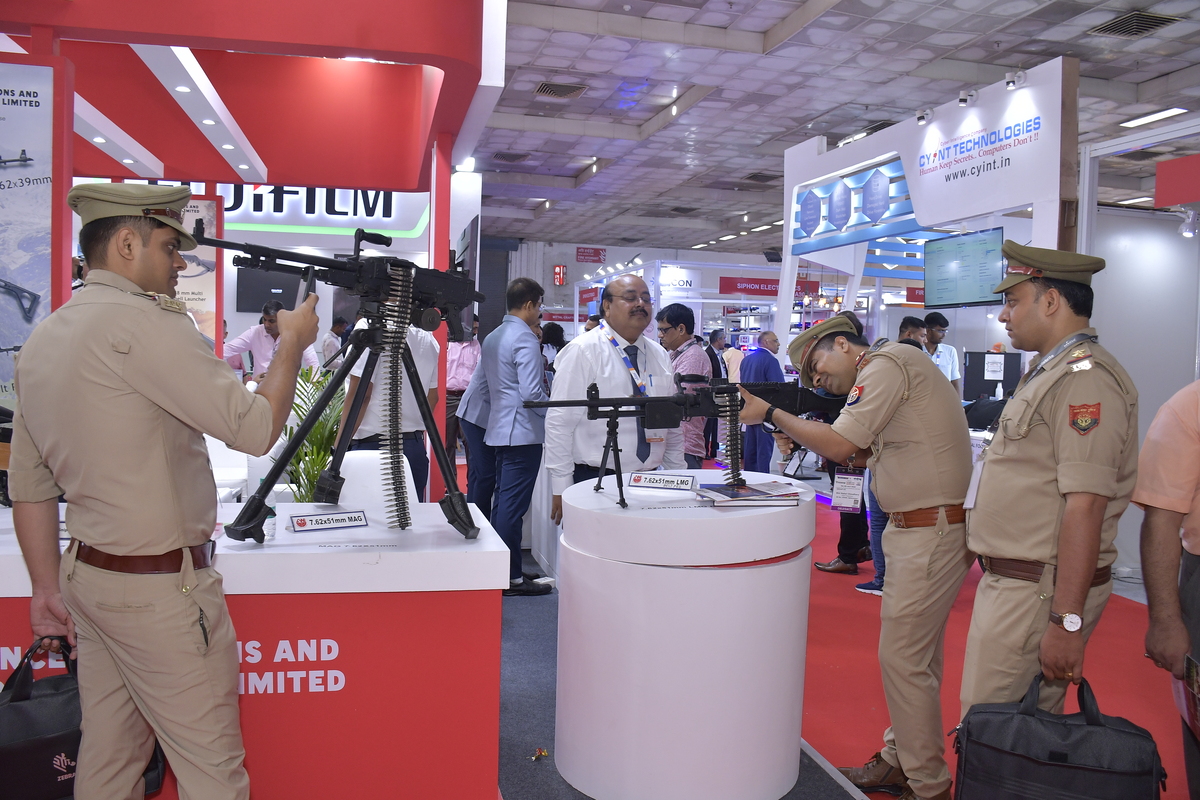
3.2 Role of Political Connections
$“Till DAP, we had middlemen bringing weapons into the country and trying to get orders,” said the firearms sector observer. “What has happened now is: the dalals have become pseudo-manufacturers.” $Take Sushen Mohan Gupta, one of India’s biggest defense middlemen. He *signed defense deals*[https://caravanmagazine.in/reportage/gupta-papers-rafale-deal-agusta-westland-sushen-gupta] worth Rs 83,300 crore during the Congress-led UPA years and another Rs 98,400 crore under the BJP-led NDA. His 2023 profile in Caravan magazine contains a telling detail: he wanted offsets from Dassault Aviation. $Several firms also have political and bureaucratic links. Some of these connections — like those between promoters like Rajeev Chandrasekhar and the Bharatiya Janata Party — are well-known. $ The Polis Project found that some smaller firms, too, have political links. $In one case, a firm making defense electronics appears to share directors and ownership links with a company accused of serious customs violations, while maintaining connections to the ruling political party. Chennai-based *Jeanuvs*[https://www.zaubacorp.com/FLDEC-DEFENCE-SPACE-AND-SECURITY-PRIVATE-LIMITED-U29309TN2021PTC141482] (now known as FLDEC Systems), incorporated in 2021, provides electronic and mechanical engineering systems to the defense sector. It owned a controlling stake in Vidvedaa PRG Airport Retail TRZ, a firm *accused by Indian Customs*[https://www.newindianexpress.com/cities/chennai/2024/Jul/02/aai-top-official-in-chennai-under-lens-in-267-kg-gold-smuggling-case] of being a front for a Sri Lankan gold smuggling syndicate. Jeanuvs’ founder, Vanchinathan Thangavel, was a *director on Vidvedaa PRG Airport Retail*[https://www.casemine.com/judgement/in/67b49b9cbde90d186f23ad15] along with *Gavarapet Ashok Prithvi*[https://www.zaubacorp.com/GAVARAPET-ASHOK-PRITHVI-07026840], a former state executive member of the Tamil Nadu BJP Youth Wing. Prithvi, as the News Minute reported, was also Vidvedaa PRG Airport Retail’s managing director. The Polis Project wrote to Thangavel asking him about this political link. This article will be updated when he responds."Not having such measures means there remains room for vested interests to push military hardware into the central and state armed forces. “As we now know, technological capacity has little to do with the final agreement. That is a lot more about other considerations like who you know in the system and what your affiliations are" — Rahul Bedi, defense analyst$The upshot? Even as India’s weapons manufacturing sector bloats into overcapacity, the entry of influential actors is further queering the field. With their entry, every player — local OEMs, large business groups, PSUs, politically-connected newcomers, and defense startups — are fashioning their own response to overcapacity. The foremost among them is Adani.
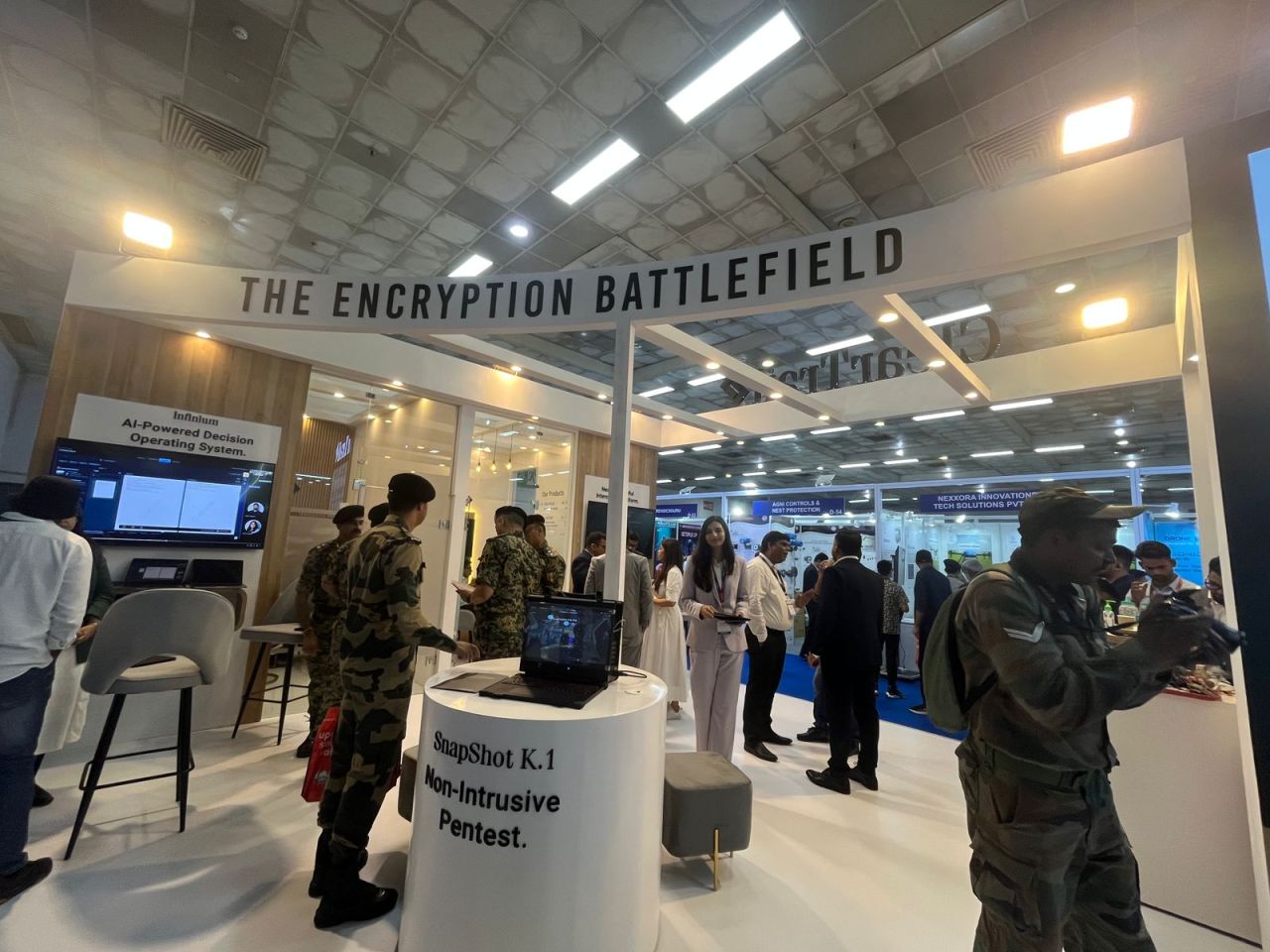
3.3 What Adani is Doing: Defense Manufacturing and International Military Networks
$The Adani Group’s defense business has rapidly expanded through numerous joint ventures with international firms from countries like Israel, the UAE, France, the USA, Italy, and Bulgaria, alongside strategic acquisitions to grow its capabilities. This expansion positions Adani as a key player in India’s defense industry, intensifying competition with state-owned enterprises while focusing on both domestic and export markets. Central to this growth is Adani’s close collaboration with Israel’s military-industrial complex, alongside India’s growing diplomatic relations with the country, and manufacturing base to advance shared defense technologies and strategic interests, with Adani replicating Israel’s own arms-export model. As these Indian companies deeply embed themselves in the global weapons supply chain, some critics have *raised*[https://www.deccanherald.com/opinion/india-is-firing-the-engine-of-war-in-gaza-while-preaching-peace-3084659] questions about the political and ethical implications of such companies’ expanding roles, particularly regarding controversial regimes, and the broader impact on regional security dynamics. $For all its size, the ammunition complex outside Sarh is a fraction of the Adani Group’s weapons-making ambition. Founded just ten years ago, it now offers a wide range of defense products: *UAVs*[https://www.adanidefence.com/unmanned-systems] (Unmanned Aerial Vehicle), *counter-drone systems*[https://www.adanidefence.com/counter-drone-systems], small arms, missiles, aircraft maintenance, *guns*[https://economictimes.indiatimes.com/news/defence/adani-unveils-south-asias-largest-defence-complex-in-kanpur-to-add-4000-jobs/articleshow/108012504.cms?from=mdr], and shipbuilding . It was on track to making fighter planes along with Saab, before the *Swedish firm peeled away*[https://www.hindustantimes.com/business/mutual-decision-defence-firm-saab-on-parting-ways-with-adani-group-101675962430080.html]. $As of writing, Adani has partnerships with at least seven defense companies from Israel, and one apiece from the UAE, Italy, France, the USA, Bulgaria, and India.3.4 Smaller Firms Looking for New Markets within India
$If firms like Adani Defence with Israeli tie-ups are eyeing domestic sales and exports, where do the rest sell? The PSUs are struggling, as the union leader said. Smaller private companies are struggling too. “I see many firms winding down,” said the Kanpur-based businessman. “How many is the million-dollar question.” $Firms are also reaching out to India’s paramilitary forces and, in the footsteps of the surveillance industry, state police. “Our market is state police departments, the Ministry of Home Affairs (NSG, CISF, ITBP, CRPF) and the MoD (army, navy, airforce),” an executive at the Vinveli office in Chennai told The Polis Project.“Defense is a business which needs investment and assurance. Any investment you make, you need to know that assembly here will be viable. Firms have to be either sure they can sell to the Indian defense forces; be a part of global supply chains; or have some other way of knowing they can offload stocks.” — A senior manager at VEM Technologies$Vinveli is not the only one vying for a bigger market. Chetan Seth, the Chairman of Chemon Group, which manufactures 40mm multi grenade launchers with Rippel Effect of South Africa, said, “Once the army chooses a weapon, it tends to place subsequent orders with the same company.” He added, “If I miss that order, we have the modernization of the paramilitaries. The state police forces are a huge and growing market too.” $Uttar Pradesh police, for instance, *ordered 1,228 units of the CZ Scorpion Evo 3 A1 submachine gun*[https://defence.in/threads/up-ats-chooses-vinvelis-cz-scorpion-evo-over-indigenous-asmi-for-1-228-smg-tender.10754/] from Vinveli. A serious question lies here. Unlike the army, police forces engage with India’s civilian population. Why would they need a gun capable of spraying *1,150 rounds per minute*[https://publish.obsidian.md/cynixia/Scorpion+EVO+3]? $On being posed that question, Rajnish Sharma, an *army colonel who now heads Chhattisgarh’s anti-Maoist Special Task Force*[https://timesofindia.indiatimes.com/india/now-stf-headed-by-col-to-combat-terror/articleshow/2341623.cms] at his unit headquarters outside the town of Durg, bristled. “Which of these weapons would (the) police not need?” he asked. “Which parts of this country are free from terrorism? There is urban warfare. In the case of something like Batla House, you will need LMGs and sniper rifles for a siege. A sniper rifle for precision shooting. SMG or 9 mm calibre guns for room entry, and also hand grenades and stun grenades.” $Hardwired into his assertion is another large change playing out in India.
3.5 Hypermilitarization in India
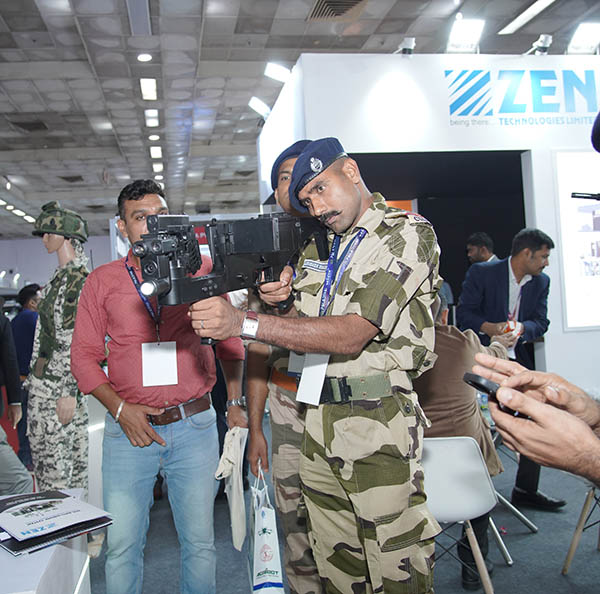
$Both Central Armed Police Forces (paramilitary forces like Assam Rifles, Border Security Force and Central Reserve Police Force) and state police are bulking up their armories. “Upgradation has been taking place for a while,” said a senior official who has worked in the National Security Advisor’s (NSA) office. “A lot of military grade weaponry is entering the paramilitaries and, from there, reaching the state police as well. This has always been the case. Weapons come into the military and then find their way into the state police.” $Both Sharma and the official who has worked in the NSA’s office described this build-up as unavoidable. “Terrorism is omnipresent,” claimed Sharma. “In Batla House, the terrorists had AK47s. To counter, you need something better. Across India, all goons are using AK47s. In Punjab, drug smugglers carry not just AK47s but also M16s. In the recent terror attack at Kathua, they had carried M4s.” $This is the logic of homeland security. Between the parliament attack and 26/11, the chorus for boosting domestic security has gotten louder. India, writes Manisha Sethi in *Kafkaland: Prejudice, Law and Counterterrorism in India*[https://www.threeessays.com/product/kafkaland-prejudice-law-and-counterterrorism-in-india/], has become a “techno-security state”, one that was being “advocated feverishly by an elastic group of corporates, ex-army generals, technocrats, arms traders, think tanks, security experts, commentators — and it was difficult mostly to tell one from another.” $One fallout of all this? Indian paramilitaries are baulking at hand-me-downs from the army and states are creating special police forces. Andhra Pradesh started with the Greyhounds. Chhattisgarh followed with squads like the Special Task Force and the District Reserve Guards. CRPF created COBRA. Each of these units has infantry weapons like automatic firearms. $“When you have a special problem, like terrorism in Punjab or Naxalism [Maoism] in central India, you need a specialized unit to tackle it,” said R.K. Vij, a former Director General of Police in Chhattisgarh. “We need such forces because regular police forces cannot handle such tasks.” Citing Maoism, he added, “Law and order comes under the state police. What happened in Chhattisgarh is we didn’t have enough troops. Therefore, central troops were needed. But then, you are dependent on them and you have to pay for them. It is also important we have these troops because if we ask the army to come, it will do so with its own weapons–AK47s or something higher.” $And yet, states unaffected by Maoism are bulking up on weapons too. The Uttar Pradesh Special Security Force was set up in 2020 to protect the courts, major religious places and establishments of the state. In 2024 the BJP-led state government said it would spend Rs 23 crore to procure *465 automatic pistols, 1113 submachine guns, and 330 assault rifles*[https://www.hindustantimes.com/cities/lucknow-news/upssf-to-be-equipped-with-state-of-the-art-weapons-101710788577013.html], among other weapons, for the force. Since then, it has placed more orders. “The state police force will soon be equipped with combat shotguns, 9 mm pistols, 5.56 mm rifle carbines, assault rifles, sub-machine guns, pump action guns, and advanced auxiliary gadgets such as thermal weapon sight for sniper rifles, magazines for Glock 33 pistols and huge cache of ammunitions for practice as well as for field operations,” reported *Hindustan Times*[https://www.hindustantimes.com/cities/lucknow-news/up-police-armoury-to-gain-rs-83-crore-firepower-101743533146367.html] last April. $Uttar Pradesh is not an outlier. Other states have set up special forces as well – like Delhi Police’s SWAT or Mumbai Police’s QRT and Force One – and heavily armed them. State police in Manipur have *medium machine guns*[https://m.thewire.in/article/security/manipur-police-gets-medium-machine-guns-seeks-army-training]. Their counterparts in other places like *Madhya Pradesh*[https://www.abplive.com/states/madhya-pradesh/mp-police-to-receive-upgraded-weapons-soon-as-government-looking-to-reform-ann-2118205] and *Jammu and Kashmir*[https://www.wionews.com/india-news/for-first-time-in-india-jk-police-to-get-american-assault-rifles-and-pistols-442976] have bulked up their arsenals too. $With this, said the NSA official, “The gap between the armed police and armed forces is narrowing.” And what India is getting, like the USA, is a *hypermilitarized police*[https://www.humanrightsinitiative.org/programs/aj/police/papers/gpj/militarisation_of_the_indian_police.pdf]. “If you go to a police station, you will find an armoury which will look like a small arms base,” he said. $As private sector weapon manufacturers try to cash in on this homeland security boom, another set of dire implications is taking shape.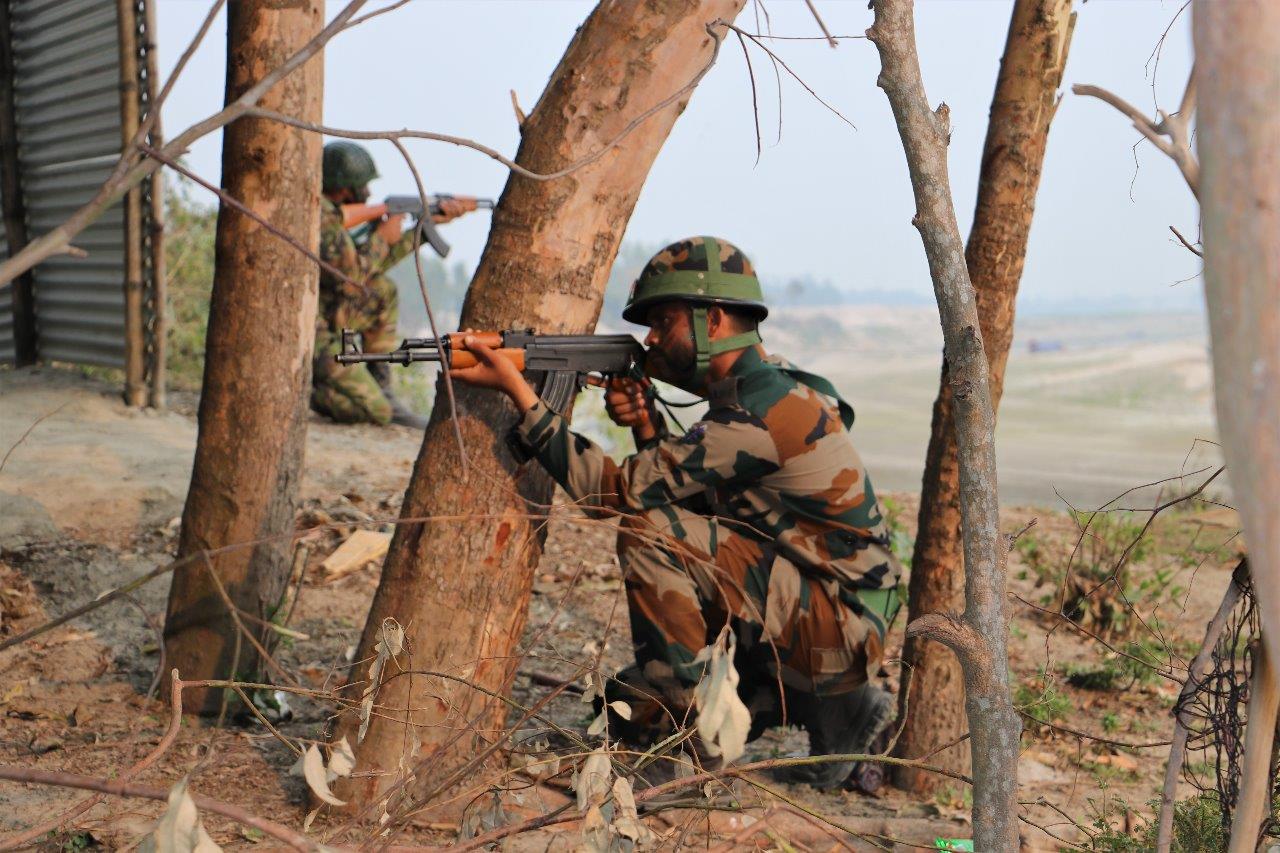
4. The Business and Cost of Hypermilitarization
$ India’s current anti-Maoist campaign in Bastar signals a deepening militarization of internal security, as state forces deploy military-grade weapons, drones, and heavy artillery with escalating civilian risks. This hardening is mirrored across India, where police and paramilitary units, equipped with increasingly advanced and excessive weaponry, blur the lines between civil policing and military operations. As procurement grows, often without clear oversight or justification, the dangers of indiscriminate force, misuse, and systemic corruption intensify, fostering a hypermilitarized security culture and raising questions about accountability, proportionality, and the long-term impact on democratic norms.4.1 The View from Bastar
$As this article was being written, India’s offensive against the Maoist insurgency entered what Indian media has been describing as a “*decisive phase*[https://www.indiatoday.in/india-today-insight/story/ground-zero-bastar-the-fight-to-finish-off-maoists-2648870-2024-12-12]”. $Last April, the CRPF and Chhattisgarh’s Special Task Force (STF) and District Reserve Guards attacked a Maoist stronghold — the Karregutta hills at the border between Chhattisgarh and Telangana — and, *at the end of three weeks*[https://www.pib.gov.in/PressReleasePage.aspx?PRID=2128736], took it over. The next month, state forces killed top Maoist leader Nambala Keshav Rao (65), a general secretary of the banned Communist Party of India (Maoist). $Later, on November 18, 2024, Maoist leader Madvi Hidma (50), his wife Madakam Raje (44) and four other Maoist rebels were *killed*[https://www.hindustantimes.com/india-news/top-maoist-hidma-killed-in-crippling-blow-to-lwe-101763491488535.html] by the Andhra Pradesh state police. Over the past year, *335 Maoists were killed*[https://scroll.in/latest/1089376/335-left-wing-extremists-killed-in-2025-over-2100-surrendered-centre] in this region and over 2,000 surrendered, according to official estimates. $his round of anti-Maoist operations differed from what India had conducted even five or ten years ago. There was, for one, far greater use of military weaponry, including, as journalist Malini Subramaniam reported, *helicopters, heavy artillery, and possibly even missiles*[https://scroll.in/article/1081780/as-maoists-ask-for-ceasefire-security-forces-shell-hills-sheltering-top-insurgent-leaders]. $“We Indians only do proportionate response which, in fact, prolongs conflict scenarios into protracted wars,” said Rajnish Sharma, who heads Chhattisgarh’s STF. “LWE [Left Wing Extremism] in India is one example. We could have eradicated it long back had we gone all out with all dimensions of combat protocols 25 years back. Chhattisgarh would have not endured so much loss of Security Forces’ lives.” $Speaking about the current counter-insurgency operations, Sharma said, “Since April 2025, we have been going all out — attack helicopters, 81 mm mortars, preponderance of ground forces, fleet of choppers for full logistic supplies — the end result was [that] the naxal cadre lost their will to fight and hence the mass surrenders [took place].” $With that, however, the risk of non-combatants being killed rose as well. For instance, in Bijapur, the People’s Union of Civil Liberties found, *mortar shells had killed two adivasi boys*[https://maktoobmedia.com/features/chhattisgarh-pucl-blames-govt-forces-mortar-shell-for-killing-two-adivasi-boys-in-may/]. $“Villages in Bastar say they are getting a lot of shelling,” Subramaniam told The Polis Project. “CRPF says it is using 51 mm shells. But the bomb fragments we see here are 81 mm shells.” $The difference is material. 51 mm mortar shells have a range of 850 meters, a kill radius of 3 meters, and a danger zone of 5 meters. But the 81 mm shell has "a range of 5 km, a kill radius of 5 meters, and a danger zone of 200 meters,” as an officer at the Chhattisgarh STF’s headquarter outside Bilaspur told The Polis Project. “That is how far the shrapnel can fly if the mortar lands on a hard surface like a rock.” $State forces were also using drones for surveillance and chasing villagers, Subramaniam added. “The people are chased such that they run into the forces which are stationed nearby,” she said. “There are 4-5 cases where drones have even been used to drop bombs.” $A Chhattisgarh Police source corroborated her claim. “No one will confirm this,” he said on the condition of anonymity. “But yes, it happened. The CRPF dropped grenades on Maoists. At that time, the state government had protested.” $On being asked why there was opposition, he said: “If you get it wrong, civilians will die. Army intelligence is not foolproof. And so, some of this can become indiscriminate. These [drones] are used in border areas as a military weapon. The mortar shells are the same story. ”4.2 The War Beyond Bastar
$Bastar, however, is just the start of a new era of hypermilitarized responses to local issues. In September 2025, firearms used by Ladakh police and CRPF to crack down on unarmed protestors were *powerful enough to kill four and leave others with exit wounds*[https://thewire.in/rights/ladakh-leh-protest-sonam-wangchuk-rights-security-forces-firing]. Here’s what happened to a teenage protestor: “A bullet chipped away a part of his fibula as it travelled though his limb before exiting,” reported The Wire. $“I can imagine a situation in which the police need a submachine gun or a pump action shotgun,” said Vij. “But you cannot have an assault rifle for policing.” $For crowd dispersal, police usually use shotguns, loaded with rounds of pellets, rubber, or slugs. Submachine guns may be needed for close-range shooting. Assault rifles, however, come with a range of 300-500 meters, which makes them suitable for infantry warfare, not policing. $While such acquisitions are deemed unavoidable by national security hawks, questions need to be asked. Does Uttar Pradesh need a special police force to guard its courts, temples, and administrative buildings? “The country’s VIPs now get the level of security once given to world leaders,” said the previously quoted NSA official. “The level of protection once given to a head of state is now being given to a halfpenny-tuppeny politician. This is now a status symbol.” $Going by media reports, Uttar Pradesh also wanted to *issue Glocks to home guards*[https://timesofindia.indiatimes.com/city/lucknow/up-home-guards-to-be-armed-with-glock-pistols/articleshow/91188593.cms]. Home guards, however, are meant to help police forces in emergencies with traffic management and so on. As V.N. Rai, a retired Director General of Police from Haryana, told The Polis Project: “They are called out in support roles and normally don't need firearms.” $Considering the volume and nature of the weapons being brought, one must assess whether the government-identified threat matches the procurement. For example, the Indian government cites internal security to justify its *crackdown*[https://thepolisproject.com/read/pushed-back-india-new-deportation-regime-bangladesh/] on suspected illegal Bangladeshi nationals and Rohingya refugees. “There is not a single FIR against the Rohingyas,” said Rai. “So what is the threat? But, in their name, weapons are being bought.” $Speaking on police modernization, Rai said, “In the Indian context, police modernization has come to mean militarization,” adding that the police don’t need such weapons, and definitely not in the numbers being bought. “A civil police force might need 1,000 lathis [batons]. It might need a few units of tear gas. But why do you need 1,000 rifles for 1,000 policemen? You are not going to fire at your civilians. Even in a situation, a whole battalion is not sent. We might send a platoon, a section, or a company. If a battalion has 20 rifles, that is more than enough to crush any situation.” $It should be asked, Rai noted, how many of the purchased weapons have been used. “From what I see, 95% have never been used. But if you don’t spend, how do you get your commission? That is what is happening here.” $“To modernize the police, we have to reduce militarization,” he added. “If I come in front of you with an assault rifle, will you feel safe or frightened? Big weapons result in neither security nor trust. The Indian police need trust-oriented training. The relationship between people and the police has to change.” $Between India’s uncritical embrace of the homeland security path and private weapon manufacturers looking for sales, the country is seeing the rise of a new gravy train. “In the past, we never procured from private companies,” Vij said. “Most of our weapons were bought from defense PSUs like the ordnance factory at Trichy. That is changing now.” $As India develops its own privately owned military-industrial complex, a political economy similar to the global weapons market is emerging for domestic sales. It, too, has built-in secrecy and high-value deals, which make bribes possible; technical complexity makes it easy to hide payments and corrupt motivations in selections. It makes room for cutthroat competition between suppliers, and a nexus between politicians and firms. $“All companies in this trade have some political or bureaucratic connection,” said Sharma, Chhattisgarh STF head. “Some vendors want to sell something we do not need. One firm tried to sell us *cornershots*[https://www.drdo.gov.in/drdo/corner-shot-weapon-system] (weapons used to shoot around corners). But that is something the NSG [National Security Guard] needs, not us.” $There is also concern around under-selling, where products with weaker capabilities (or poorer quality) might be foisted on troops. “Everything made for the army has to meet standards,” said the owner of the military boots-manufacturing firm in Kanpur. “The first pair you make should be the same as the hundredth and the thousandth pair. The importance of this cannot be overstressed.” $Stringent testing, said Sharma, prevents both over- and under-selling. Even if that is true for the Special Task Force in Chhattisgarh, it need not be for the rest of India. $In the case of Madhya Pradesh, the state government had bought *2,700 imported pump action shotguns*[https://timesofindia.indiatimes.com/city/bhopal/700-pump-action-rifles-of-mp-forest-dept-to-bolster-bsf-at-bdesh-border/articleshow/113333282.cms] for its forest department. These guns’ range is low compared to poachers’ high-powered rifles, but it would be overkill if the department is engaging with local protesters. These were later discontinued due to conflict with the police force. $While these purchases are shrouded in opacity, the aftereffects are not. “Once a police force has weapons, use-cases emerge,” said the NSA official. That is what happened in Thoothukudi, where *the police used self-loading rifles*[https://www.thenewsminute.com/tamil-nadu/thoothukudi-snipers-not-only-violated-rules-tampered-evidence-commission-report-169042] on villagers protesting against Sterlite. Thirteen people died. $India’s police forces have been repeatedly complicit in atrocities. In the northeastern state of Manipur, the state police have been *plagued by ethnic divides*[https://theprint.in/india/in-manipur-its-kuki-vs-meitei-cops-how-unrest-exposed-ethnic-faultlines-within-state-police/1650205/] in recent conflict, and they have also been implicated in extra-judicial killings in the past. Between January 1979 and May 2012, Manipur saw 1,528 fake encounters by security forces, according to a memorandum submitted by civil society groups in Manipur to Christof Heyns, the UN Special Rapporteur on extrajudicial, arbitrary or summary executions, states. Of these, Assam Rifles had *reportedly*[https://scroll.in/article/732113/why-children-in-manipur-are-writing-postcards-to-prime-minister-narendra-modi] killed 419 people; joint teams of state police and central paramilitary forces were responsible for another 481; and the state’s police and commandos had killed another 377 people. Manipur remains under the Armed Forces Special Powers Act that grants sweeping powers, but the impunity under it doesn't extend to forces mentioned above. $And yet, the police forces have medium machine guns. Their light machine guns were earlier *stolen*[https://timesofindia.indiatimes.com/city/guwahati/manipur-police-seeks-army-help-for-mmg-training/articleshow/113076366.cms] by rioters during the Manipur conflict. $Manipur is far from an exception. “Our police have been developed on the lines of an infantry battalion,” Rai said. “It has the same discipline, it is trained to respect superiors, not civilians.” $Author and academic Manisha Sethi concurred with Rai. “Indian police remains one of the most prejudiced police forces in the world,” she said. “A study conducted by Common Cause found nearly 50% of police personnel felt that Muslims were very much or somewhat naturally prone towards committing crimes.” $Compounding the matter, police forces across India are overworked yet poorly trained. By 2018, even as the state of Uttar Pradesh *began handing pistols*[https://www.bbc.com/news/world-asia-india-45719940] instead of the usual rifle to constables, the time spent on police training had decreased. As a result, poorly-trained cadets entered the police force but were handed weapons; the state saw a spike in extrajudicial “encounter” killings. $Even this, however, is not the full litany of the costs India will incur by liberalizing weapons manufacturing. Between promoters’ political links and firms’ imperative to sell, there is also the danger that surplus weapons will find their way into the civilian market. Counter Measure Technologies, for instance, *wants to sell*[https://www.hindustantimes.com/india-news/make-in-india-in-a-first-citizens-will-buy-glock-pistols-armed-forces-use/story-Hp0SI7DwIC14FsZXb4fIPI.html] Glocks to civilians. This development comes even as the country sees a steady rise in hate messaging and crime, politically aligned vigilante squads, and unemployment. $The spectre of weapons reaching civilians and non-state actors extends beyond firearms. In the Manipur conflict, *drones have been used to drop bombs*[https://www.thehindu.com/news/national/banned-insurgent-group-releases-video-claiming-drone-attack-on-assam-rifles-camp/article70393519.ece/amp/]. Or take undersea unmanned vehicles: “We saw a model which was offering 45-day endurance,” said the head of an Indian weapons OEM, on the condition of anonymity. “Can you imagine the possibilities for gold smugglers and others?”5. The Permanent War Economy
$India’s rapid expansion of defense manufacturing is creating a permanent war economy, with private firms flooding the space in pursuit of lucrative contracts and state support. This shift echoes earlier sectors’ oligarchic consolidation, risking overcapacity and weakening oversight. Instead of fostering indigenous innovation or the sustainable transfer of technology, the current trajectory cultivates a powerful, privately owned military-industrial complex, one that accelerates the militarization of both state forces and society, heightening vulnerabilities in an era marked by social division and economic precarity.5.1 Conclusion
$On the whole, a familiar arc is retracing itself. $In 2006, India liberalized power generation, opening what had been the preserve of state-owned firms to the private sector. Eyeing high returns, neophytes from unrelated sectors such as media, politics, textiles, and construction gambolled into power generation. The *aftermath*[https://thewire.in/political-economy/crony-capitalism-on-modis-watch-means-invisible-hands-ensure-you-never-go-bankrupt] was overcapacity, India’s non-performing assets crisis, the subsequent bargain-basement sale of stranded firms through bankruptcy courts, and the deepening of oligarchy as a few firms bought industry rivals at discounted rates. $India’s defense manufacturing ambitions are tracing a trajectory that is even grimmer. “Eisenhower [Late former US President] had warned against the ‘military-industrial complex’ in 1961, saying that the conjunction of a massive military establishment and a large arms industry posed a threat to democracy and could lead to ‘disastrous rise of misplaced power’,” said former MoD advisor, Cowshish. “We need to be cautious that we do not create the same situation that America created for itself.” India should, he said, have better differentiated responsibilities between the private and public sectors. “The important strategic projects could be with the public sector.” If the product is also intended for civilian use, it may be commercially more viable for the private sector to produce it, he said. $India, however, is sailing into a glut of weapons manufacturers, all drawn to the country’s large weapons procurement budget. $In time, there will be a shakeout. “At this time, the market is evenly poised between OEMs and assemblers,” said Vishal Singh. “In two years, we will see where this goes. Maybe we will be left with ten big companies.” It remains to be seen who prevails — the OEMs with know-how or the assemblers with political capital. It also remains to be seen how firms respond to low orders from the armed forces. $The early signs of the shakeout are already visible. The union leader from the PSU said orders are flowing away from public to private firms. Players with political clout are also squeezing homegrown OEMs out of the race, with some of them focusing more on export markets as a result. The question bears repeating. Is India’s weapons manufacturing push working? Or is it producing “licensed production” that benefits a few firms and countries like Israel, but saddles India with technological dependence (*on a country whose weapons array struggles before cheaper drones*[https://theconversation.com/is-israel-running-low-on-missile-interceptors-how-long-can-it-withstand-irans-retaliatory-attacks-278404])? And what of the privately-owned military-industrial complex that creates local markets for growth, leading to faster militarization of not just state forces but also society? $That morning near Sarh, a woman in a red saree sat by the roadside, slapping cow dung onto a wall for drying. It was a telltale reminder of where much of India’s population stands. The biggest threats to them lie in low social sector spending; abysmal state delivery of education, healthcare, and justice; increasingly compromised institutions; frayed ecological foundations; a kleptocratic polity and an oligarchic economy. $Despite such existential threats and despite the real problems with India’s weapons procurement lying in under-investments in R&D and opaque, discretionary exercises of power during purchases, the NDA appears to have embarked on a non-solution that will only create fresh risks for the country.The Polis Project is a New York-based global magazine of dissent, operating at the intersection of research and journalism. To stay updated about new stories and upcoming events, subscribe to our Substack.
Follow us on X and Instagram.