


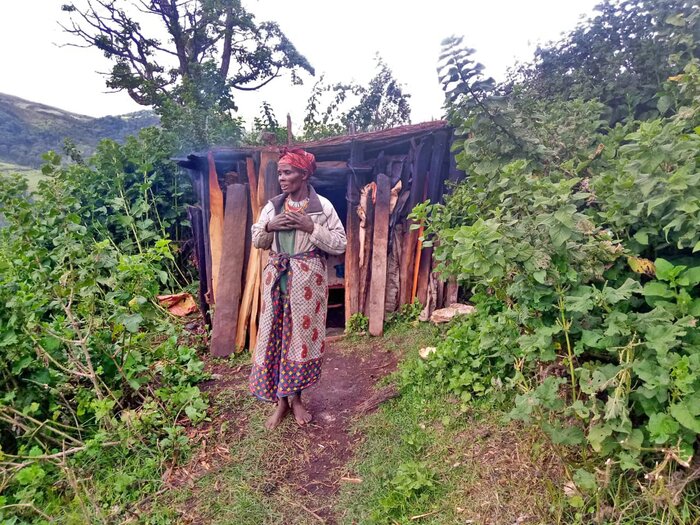
Armed rangers went to Kenya’s Embobut Forest to burn approximately 600 homes belonging to the indigenous Sengwer community in the early morning of May 14, 2024; ironically, this was done as part of European Union and World Bank-funded conservation efforts in Kenya. The action was also in violation of a court order that had implemented status quo on the forest and its existing dwellers. A day before, the Sengwar Council of Elders had said: “We are neither squatters nor encroachers nor internally displaced persons, but the aborigines, the indigenous peoples, the natives of Embobut forest and the entire Cherangany Hills. Our ancestors lived here since before Kenya became a British Colony in 1895.”
The field monitor person for the Kenya Forest Peoples Program (KFPP), an international NGO working with indigenous communities, said: “The rangers came to the community without issuing a warning to the families. When the rangers came, the families were running into the forest, the families had nothing, the children had no shoes, the families had no food, the families had no blankets.”
The forest, significant for biodiversity, is now contested. Located in the North Rift Valley, and covering about 22,000 hectares, it was registered as a protected public forest in 1954, and is part of the Cherangany Hills complex. For thousands of years, the elder leaders of the Sengwer people have lived in and called these Cherangany mountains home. However, since 2009, eviction drives against the Sengwer have subjected them to violence by the Kenya Forest Service (KFS). Today, as a result of being placed into transitional encampments on the edges of their ancestral land, they are now fighting to preserve their sacred groves.
What is occurring in Embobut it is a textbook example of “Green Carcerality” in the name of “conservation”.
Image credit:

Kenya: The EU Water Towers Programme and the Criminalization of the Sengwer
According to a 2024 field affidavit filed by the Oakland Institute, in the last two years, KFS rangers went to Embobut with gasoline and torches, without any eviction notices. An internal communication from the KFS, referenced in the affidavit, states that the rangers were instructed to “clear all structures” within a project area. As a result, over 600 homes were destroyed in just one week. There was no randomness involved in the actions of the KFS rangers; they were merely following orders.
Sengwer advocates describe this situation as a conflict between two different ways of understanding. In their 2021 presentation at the Global Diversity Foundation Forum, Kendi (a Sengwer community representative) and Milka Chepkorir (a Sengwer youth leader and advocate) argued that “fortress conservation” treats the Sengwer’s centuries-long presence on their land, and their traditional knowledge system, as an existential threat rather than as active stewardship.
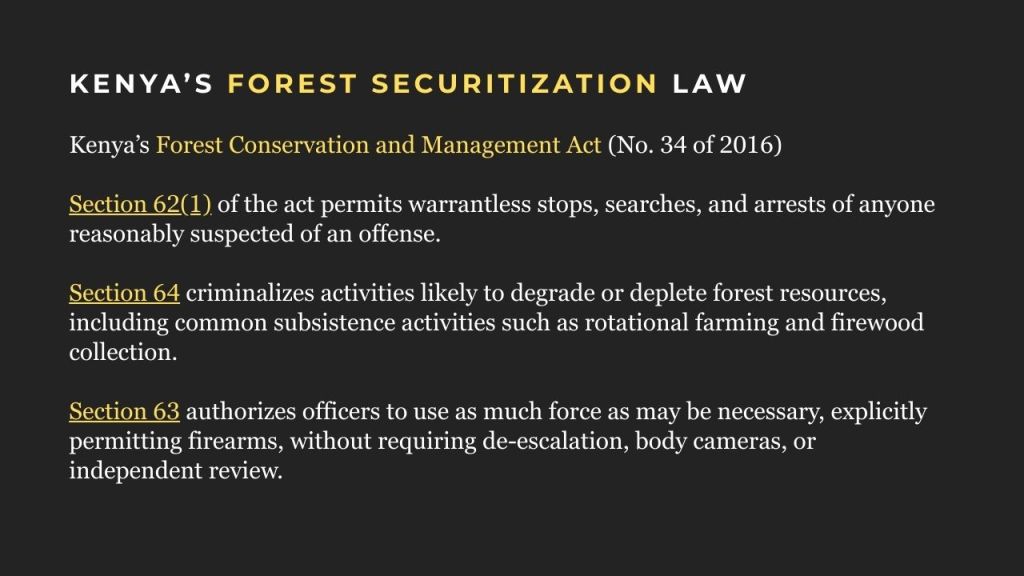
The forced removal of the Sengwer community from Embobut Forest is a consequence of the EU-funded Water Tower Protection and Climate Change Mitigation and Adaptation Program. It was launched in June 2016 with the intention of “protecting critical water catchment areas” by preserving forests. Although framed as climate protection efforts, this program has empowered KFS rangers to use violence under Section 63 of Kenya’s Forest Conservation and Management Act (2016), to forcefully evict communities and burn their homes.
The burning of at least 600 Sengwer homes in May 2024 demonstrates how the financing of climate mitigation measures via donors has provided the legal basis for a security regime that views the Sengwer as illegal settlers on their ancestral land.
The Sengwer reject evictions because their role as land stewards predates the forest borders colonial powers imposed. These boundaries emerged when the British gazetted Embobut Forest as a forest reserve in 1954. They transferred governance of the Sengwer ancestral territory, including Embobut, to the State without community consent.
In response to the 2018 death of a Sengwar man, Robert Kirotich, during an eviction process, the KFPP submitted a formal petition to the African Court on Human and Peoples’ Rights in which they alleged violation of the rights to property, culture, and life under Article 14 of the African Charter. Although this matter is still before the court, KFPP’s efforts have attracted increased international attention.
The EU finally halted funding in January 2018 following Kirotich’s death. However, local authorities were still taking eviction actions using enforcement powers granted to forest officers under Sections 62 and 63 of the Forest Conservation and Management Act. The law allows warrantless arrests, a broad prohibition of traditional land uses, and the lethal use of force with no oversight. In May 2024, when KFS rangers burned over 600 Sengwer homes, they were not acting outside the law; they were enforcing it.
It shows that donor policies are not the primary drivers of displacement; Kenyan laws themselves facilitate it. The EU program was designed as a grant-based climate adaptation program rather than aiming to produce tradable carbon credits available for purchase on an open market. Notably, it had no connection to REDD+, a UN-backed mechanism that links climate finance to verified forest conservation outcomes rather than to results-based payments.
KFS-led eviction efforts accelerated between 2013 and 2014 based on a combination of colonial-era forest regulations and the Forest Act of 2005, prior to 2016. By January 2014, there were hundreds of homes that had been burned down as a result of KFS-led evictions. Violence continued in subsequent years, and by late 2017, armed KFS guards were again conducting evictions, prompting international condemnation. The European Union’s €31-million Water Towers Protection Programme provided funding to the KFS for conservation activities in the Cherangany Hills since 2016. Following the killing of Robert Kirotich in January 2018 and urgent calls from UN experts, the EU suspended the programme on January 17, 2018, citing human rights violations.
Colombia: World Bank’s Amazon Vision and Weaponization of Anti-Terrorism Laws
In Colombia’s Amazonas region, the World Bank’s $76 million Amazon Vision Project, initiated in 2017 to reduce deforestation, has become a means by which the defense of indigenous lands is criminalized.
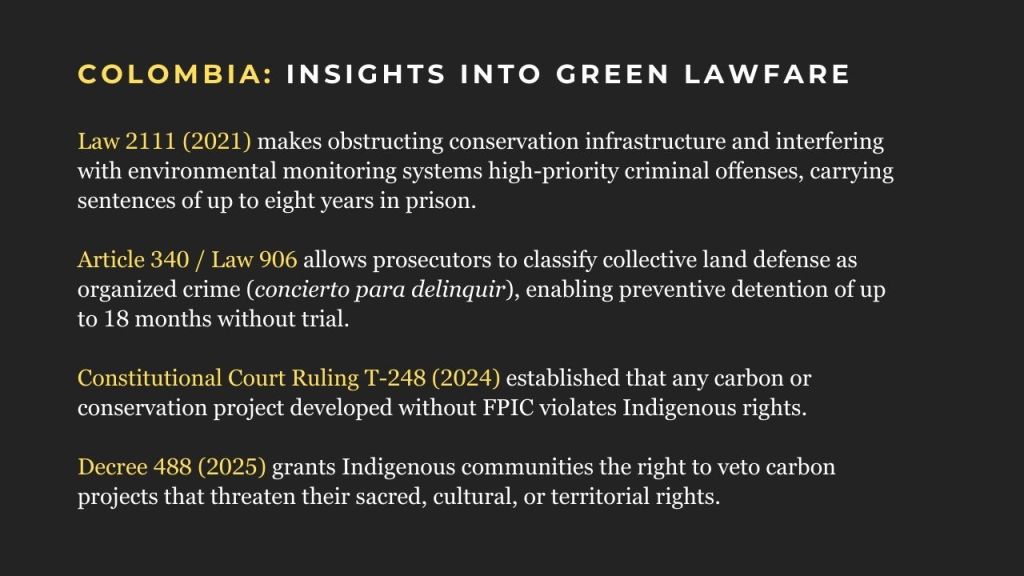
The Project provides financing to state-managed Conservation Zones on top of un-titled indigenous lands, that do not have formally recognized titles or Free, Prior and Informed Consent (FPIC) over them. If communities resist infrastructure associated with the State’s Conservation Zones, such as monitoring stations, road clearing for access to monitoring stations, or boundary markings, their actions can be charged as crimes under Law 2111 of 2021, for obstructing conservation infrastructure and interfering with the operation of an environmental monitoring system.
However, these charges may also include criminal conspiracy (concierto para delinquir) under Article 340 of the Penal Code, which allows prosecutors to view collective land defense actions as organized crime and request preventive detention of up to 18 months under Law 906 of 2004. Even though the Colombian Constitutional Court issued a ruling (T-248) in 2024 affirming that all Carbon and Conservation Projects require FPIC, legal uncertainty still exists since the Ministry of Environment has not published their mandatory protocols, and the cases are continuing to develop such that indigenous individuals can be charged with concierto para delinquir (criminal conspiracy) in regular courts.
The Amazon Vision Project itself did not fund private REDD+ projects, such as Baka Rokarire in Pira Paraná River. However, the World Bank’s institutional framework enabled private REDD+ schemes — including the Baka Rokarire project — to sell $3.8 million in carbon credits to Delta Airlines via Masbosques. It allowed the massive airline to offset emissions using credits drawn from projects allegedly operated without FPIC on indigenous land in the Pira Paraná River region.
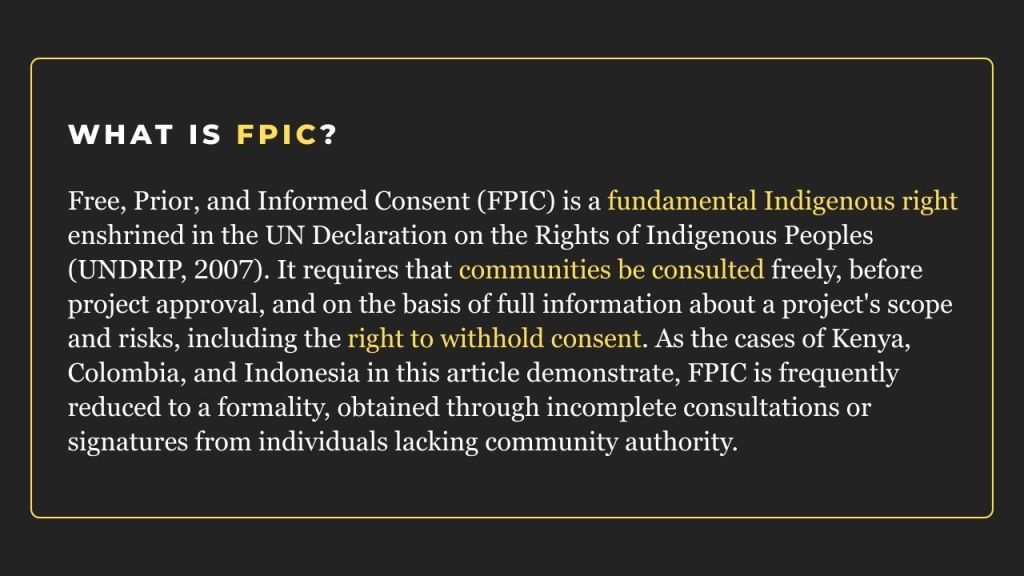
Community leaders such as Néstor Pacheco questioned the project’s legitimacy. They said that many of the signatures presented by the developers of the Baka Rokarire REDD+ carbon project were from people without authority. They also said that the FPIC, which is necessary for such projects, was never obtained by the project developers. In July 2022, the indigenous councils filed a legal action against Masbosques and the other companies involved in the project. Colombia’s Constitutional Court ruled in their favor in July 2024 (T-248), finding that the project lacked valid consent and ordering new protections for indigenous territories.
Although there is no formal “eco-terrorism” statute in Colombia, Colombian authorities are using Law 2111 of 2021 to classify deforestation-related actions as serious environmental crimes. They have established new offenses that include interference with environmental infrastructure or the prevention of environmental monitoring systems, both of which can carry a sentence of up to eight years in prison.
Under this law, Colombian authorities have reframed acts of community land defense as threats to national conservation efforts. While “anti-terrorism” has no formal legal basis in Colombia, prosecutors and police have nonetheless applied the label of “saboteur” to land defenders.
Dr. Luisa Cortés, legal advisor to indigenous communities in these cases, reports that prosecutors routinely stack Law 2111 environmental charges on top of organized crime or terrorism charges; this magnifies the seriousness of charges against acts of protest. For example, a roadblock carried out by a local community would be prosecuted simultaneously under “Obstructing Environmental Infrastructure” (Law 2111), “Deforestation” (allegedly because it could enable future deforestation), and “Concierto Para Delinquir” (Criminal Conspiracy). This turns a short-term imprisonment case into a long-term one.
The first thing Colombia’s Constitutional Court did after its historic 2024 ruling was to declare the Pira Paraná deal null and reaffirm indigenous peoples’ rights to govern themselves. Specifically, the Court determined that the Baka Rokarire REDD+ project, implemented in the Colombian Amazon by entities including Masbosques, was developed without obtaining proper FPIC. Consequently, it ordered the establishment of a set of legal protections, including a new protocol with an ethnic perspective, for indigenous peoples’ rights to self-determination in all future carbon development initiatives.
In response to this ruling, the federal government issued Decree No. 488 (May, 2025), which granted communities the right to object to projects on cultural grounds. Thus, if a carbon project poses a threat to sacred, cultural, or territorial rights, an indigenous community can veto it. However, prosecutors continue to apply the same tools in areas of project development where FPIC has not been acquired. So long as projects such as Amazon Vision continue to be developed under a model that supports state authority over Indigenous lands, the threat of criminalization will remain in place.
The Constitutional Court’s affirmation of indigenous rights to self-determination in the Pira Paraná case is in contradiction with the continued treatment of collective land defense as organized crime in other parts of Colombia. It makes the South American country an example of how a progressive legal framework can coexist with persistent “green lawfare”. This tension is not unique to Colombia; it reflects a broader pattern that scholar Laurel Mei-Singh identifies in her study of conservation conflict in Hawaii, where she coined the term “carceral conservationism”. She argues that while fortress conservation separates humans from their environment, carceral conservationism is used to “apprehend its criminalizing elements and the specific historical and geographical movements that contributed to fence construction.”
Indonesia: UN-REDD, MoEF, and the Erasure of Customary Rights
Indonesia’s development of a carbon market is directly related to its partnerships with the UN’s Reducing Emissions from Deforestation and Forest Degradation (UN-REDD) program and with its Ministry of Environment and Forestry (MoEF). Since 2009, the UN-REDD program has provided technical and financial support for integrating REDD+ into the country’s national policy; however, customary land rights have generally gone unrecognized.
In addition to over 23 million hectares of customary forest identified throughout Indonesia, less than 332,500 hectares of customary forest (roughly 1.4%) had been formally recognized under Indonesian law.
The lack of recognition of customary forests is not a barrier to the application of plantation and conservation laws, but rather an enabler. For example, under the terms of the Plantation Law No. 39/2014, large tracts of “non-productive” land can be leased out for agroforestry. Since untitled customary lands are typically considered state lands, they can also be classified as “non-productive” and thus leased out. As a result, when communities resist these developments, they are typically referred to as illegal occupiers of their ancestral lands.
The 2024 revisions to Indonesia’s Conservation Act intensified that movement towards exclusionary practices. These established “preservation areas” where traditional practices, such as gathering medicinal plants, rotational farming, and ceremonial access, are only allowed if they are directly linked to some form of state-designated “conservation work”. At the same time, corporations have been granted legal mechanisms for developing carbon trading and eco-tourism on those lands. According to Aliansi Masyarakat Adat Nusantara (AMAN) (Indonesia’s largest Indigenous rights alliance): “the law views our forests as nothing but carbon banks and not as our homes.”
Muhammad Arman, Advocacy and Legal Director of AMAN (Indigenous Peoples’ Alliance of the Archipelago), explains the real problem as the State’s failure to recognize indigenous peoples’ ownership rights over their customary forests, which cover more than 23 million hectares. As a result, when permits are issued for what appears to be empty land, they take precedence over all other uses of that land, including those of the indigenous peoples themselves. The laws that exist mention Indigenous peoples almost exclusively as “stakeholders”, not as “rights holders”, and provide for preservation areas, in which traditional practices such as rotational farming and ceremonial access to lands are severely limited. Arman has warned that this leaves communities vulnerable to removal. He called Article 9 of the Conservation Law a real threat that can at any time evict indigenous communities.
These preservation areas, combined with plantation concessions on lands held by Indigenous peoples under customary title, provide several opportunities for carbon projects precisely because Indigenous claims to lands are legally disregarded. AMAN has identified at least a dozen carbon project development locations on lands where Indigenous peoples are currently claiming rights; such projects include REDD+ initiatives on mangrove ecosystems in Papua and peatland conservation projects in Central Kalimantan.
Erasing Title, Creating Availability in Indonesia
The 2014 Plantation Law (No. 39) allows the leasing of non-productive land for agroforestry. The 2024 revisions to the Conservation Act will designate preservation areas where traditional practices, rotational farming, medicinal plant gathering, and ceremonial access are allowed, but only in relation to state-defined conservation work. Customary forests that are considered untitled are defined as state land, so they are always defined as non-productive and made available to lease.
In addition, of the 23 million hectares of customary forest identified by indigenous peoples and communities, only 332,500 hectares (approximately 1.5%) have been formally recognized (Mongabay, 2025). Thus, indigenous peoples’ claims to these lands are essentially invisible under the law. If a community resists development or leasing, it is then described as an illegal occupier of its own ancestral lands.
AMAN, supported by RRI, has urged Indonesia to immediately halt the classification of untitled customary forests as “non-productive” and pass its stalled bill on indigenous peoples’ rights, to ensure that conservation law is used to protect people and communities, not to exclude them.
In a 2023 report, the UN special rapporteur on Indigenous rights said very plainly that “conservation initiatives which exclude Indigenous peoples do not just fail, they actively harm.” However, without enforcement, these warnings rarely change policy on the ground.
Together, these laws reveal a transnational pattern: that environmental statutes are designed to be vague (capturing subsistence), expansive (criminalizing resistance), and punitive (authorizing the use of lethal force against people who resist the statute or authorize preventive detention), supported by strong enforcement and without accountability. The legal system is being used as an instrument of green carcerality to regulate climate.
The Legal Architecture of Green Carcerality
In her book Colonial Lives of Property, legal scholar Brenna Bhandar writes that contemporary property law is also a form of racial technology: it dictates who may have title to land, converts the presence of indigenous peoples on their lands into trespass, and classifies acts of indigenous peoples’ stewardship of the land into criminal activity. Similarly, in the Climate Era, carbon markets and conservation regulations expand upon this logic by converting ancestral occupation into environmental crimes such as deforestation, obstruction, illegal use, etc., and they criminalize indigenous peoples’ practices of caring for the land. A seemingly neutral environmental regulatory framework becomes a legal apparatus of dispossession.
This legal violence produces carcerality. Ruth Wilson Gilmore defines carcerality as the sum of all practices, conditions, and institutions that confine people, accept early death, and create differential vulnerability. In terms of climate governance, this becomes green carcerality operating through three mechanisms:
– Increased surveillance in forests: provided by forest guards, drones that monitor forests, and satellites tracking degradation.
– Expanded criminal categories: blocking environmental infrastructure, interfering with monitoring systems, and engaging in non-productive land use.
– Legal invisibility or criminalization: rendering Indigenous communities either nonexistent in law or criminally liable for existing on their ancestral territories.
However, what is happening in Kenya, Colombia, and Indonesia will demonstrate how this architectural structure functions through laws that are intentionally ambiguous, expansive, and punishing, having strong law enforcement structures and weak accountability structures.
The Funders’ Firewall: How Climate Finance Shields Itself from Accountability
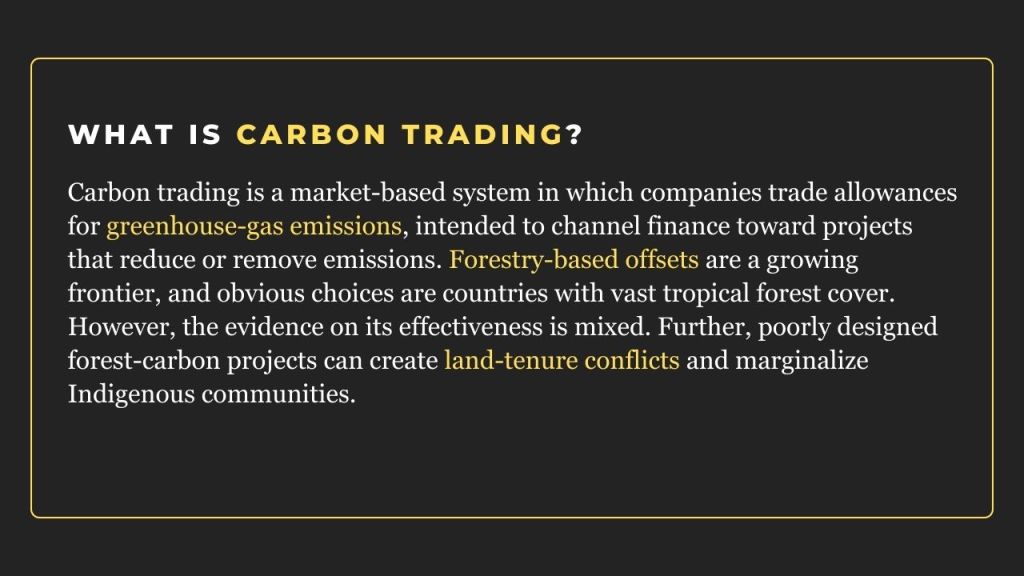
Systematic impunity within climate financing is not an example of a failure to properly supervise; it is an element of the system’s architecture. That represents the features of the system that provide the best means for the funder to be administratively efficient, while also offering a virtually unaccountable funding mechanism for the investor.
To illustrate one of the most basic data points supporting this assertion, consider the following finding reported by the Rights and Resources Initiative (RRI) audit 2025, which shows how an absence of accountability has become systemic: almost half of the 15 out of 33 nations hosting carbon projects lack laws requiring Indigenous peoples’ consent to host them. Almost all of those jurisdictions also lack established benefit-sharing and redress for impacted Indigenous communities, despite generating millions in revenue from carbon sales. These are not gaps in implementation; they are design choices that create a legally permissive environment for dispossession.
This violence is funded through two main shielding systems operating upstream and downstream, using an identical approach: first, verification of compliance is delegated to the very entities responsible for the eviction; second, their approval is used as evidence of compliance.
- The Upstream Shield: Multilateral Delegation
Nothing illustrates this better than the World Bank’s Environmental and Social Framework (ESF). The ESF was introduced by the World Bank in 2018 as a new safeguard mechanism to replace the previous safeguards. On paper, the ESF provides “Free, Prior and Informed Consent” (FPIC) for projects that will affect indigenous peoples. But in reality, the ESF strongly supports the Bank’s decision to collaborate with the host government, such as Kenya’s Forest Service, to conduct due diligence on the project.
Thus, a Bank loophole was exposed by the Bank’s own 2023 Inspection Panel Review of its Natural Resource Management Project (NRMP) on funding forest conservation efforts in Embobut. In the Bank’s internal review of the NRMP project, it was revealed that Bank Management failed to adequately identify and mitigate the risk of eviction, despite a large body of evidence gathered by Amnesty International and the Kenya Forest Peoples Programme showing that no valid FPIC process ever existed. The Panel also stated that Bank staff were aware of KFS evictions of the Sengwer since 2014, yet continued to disburse funding for this period until 2018, when the EU terminated their separate funding due to the death of Robert Kirotich.
The outcome is a perfect procedural defense, which the Bank can say Kenya has implemented national action, thus demonstrating compliance; Kenya can show the Bank’s funding supports Kenya’s conservation efforts, and meanwhile, the Sengwer have other options like human rights, because the Bank’s Grievance Mechanism only investigates procedural violations, not outcomes in terms of human rights.
- The Downstream Shield: The Private Carbon Market
The private carbon market is similarly opaque. Airlines such as Delta, and car companies including Volkswagen, purchase “carbon” from middlemen such as Masbosques and Ruby Canyon Environmental, which obtain their “carbon” from National Registries and third-party verifiers (such as Verra and Cercarbono) who then accept government-issued maps that prove “no conflict” with lands which Native peoples may claim.
In Tanzania, for instance, a soil carbon project by Volkswagen in Longido relies on village council signatures as proof of consent. In addition to these findings, the Maasai International Solidarity Alliance (MISA) found that many of the signatures gathered were from older men; as a result, many women and youth were excluded. Furthermore, MISA found that none of the elders who had signed the petition understood the legally binding 40-year commitment they were signing. And when communities later attempted to withdraw from the agreement, they found that there was no grievance process, because the project’s compliance had already been verified nationally.
- The Central Insight: Outsourcing Proof
Some Indigenous legal advocates argue that: “they don’t need to lie about what they did, they simply need to be able to outsource the proof”. Institutionalized mechanisms have developed ways of generating evidence (such as maps, signatures, government attestations) through the very same entities responsible for enforcing evictions and criminalizing people, so when the final product is presented to a boardroom in Washington or a European-based Corporate Sustainability Report, the violent nature of this process is removed, leaving behind nothing but compliant paper trails. In essence, the “firewall” isn’t a physical barrier; it is actually a circulatory system that allows data to flow only into the funding entity’s view that the funder is prepared to accept.
The Defiant Alternative: Forest Guardians as Counter-Forensics
Indigenous peoples are creating and implementing their own systems of forest management, not as recipients of authority, but as traditional authorities themselves.
In the Cherangany Hills of Kenya, the Sengwer people are practicing counter‑forensics: using GPS-enabled smartphones alongside their traditional ecological knowledge to build a parallel system of monitoring, mapping, and verification. The community-created documentation of illegal logging, armed ranger invasions, and encroachments onto sacred sites serves to challenge the state’s conservation narrative. Through the production of this community-created evidence record, the Sengwer are not only refuting government and carbon market claims of empty or degraded forests, but they are asserting their sovereignty through their own data. As a result, the counter-forensic archive created by the Sengwer has been used in national court proceedings and international human rights forums to demonstrate that the Sengwer are protectors and legal guardians of their ancestral lands.
While carbon markets often see the Dayak Iban community of Sungai Utik in West Kalimantan as an obstacle to ‘green carcerality,’ the community is a strong example of alternative models of rights-based climate governance. In 2019, the Indonesian government formally acknowledged the community’s customary forest of approximately 9,500 hectares, and that same year, the Sungai Utik was awarded the Equator Prize in recognition of its successful demonstration of how Indigenous-led stewardship can lead to measurable results for both climate and ecology.
The Sungai Utik model shows us that carbon can be sequestered, biodiversity protected, and cultural identity maintained; all of which are achieved by establishing and maintaining secure land rights and allowing communities to manage lands based on local knowledge rather than through exclusionary practices, surveillance, or the criminalization of Indigenous peoples. The Sungai Utik model of carbon storage, biodiversity protection, and the maintenance of cultural identity rejects extractive development and maintains long-term environmental integrity at no cost to the community in question, and never labels the people who live there as illegals or disposable.
The issue here is that while many interim court orders in Kenya stop some of the forced removals of the Sengwer people from their land in Embobut forest, there is no blanket court order in the public record that has stopped all evictions or ordered an evaluation of compliance with REDD+ projects. This is shown through the continued burning of areas within the forest by rangers and the displacement of communities, even after judges have ordered such practices to cease.
This weakness shows one major thing: interim court orders are insufficient. To ensure that climate financing is fair, consent from the local community (FPIC), as well as the community’s right to govern the revenue generated by carbon trading, must be a non-negotiable condition for receiving climate funding and not an optional safeguard that can be implemented at the whim of a government or the convenience of donors. As long as those conditions are absent, even when a court recognizes rights, those rights will be subject to elimination by enforcement officials acting under the guise of environmental protection.
Critics and indigenous communities suggest that the World Bank’s Environmental and Social Framework must cease to rely on host government affirmations of compliance as proof. Rather, as the Rights and Resources Initiative (RRI) recommended in its 2025 Carbon Rights Report, the World Bank should implement mandatory, independent, third-party verification of FPIC and allow affected Indigenous communities to have veto power over projects that affect their lands. The Forest Peoples Programme and the Indigenous Peoples’ Major Group have similarly called for binding consent mechanisms and grievance procedures with the authority to halt funding for conservation programs that do not include these enforceable safeguards beyond state control.


How Green Laws and Carbon Markets Being Used to Prosecute Indigenous Land Defenders in Global South
Sengwer woman stands outside her burnt hut in Kenya. Image Credit: forestpeoples.org
Armed rangers went to Kenya’s Embobut Forest to burn approximately 600 homes belonging to the indigenous Sengwer community in the early morning of May 14, 2024; ironically, this was done as part of European Union and World Bank-funded conservation efforts in Kenya. The action was also in violation of a court order that had implemented status quo on the forest and its existing dwellers. A day before, the Sengwar Council of Elders had said: “We are neither squatters nor encroachers nor internally displaced persons, but the aborigines, the indigenous peoples, the natives of Embobut forest and the entire Cherangany Hills. Our ancestors lived here since before Kenya became a British Colony in 1895.”
The field monitor person for the Kenya Forest Peoples Program (KFPP), an international NGO working with indigenous communities, said: “The rangers came to the community without issuing a warning to the families. When the rangers came, the families were running into the forest, the families had nothing, the children had no shoes, the families had no food, the families had no blankets.”
The forest, significant for biodiversity, is now contested. Located in the North Rift Valley, and covering about 22,000 hectares, it was registered as a protected public forest in 1954, and is part of the Cherangany Hills complex. For thousands of years, the elder leaders of the Sengwer people have lived in and called these Cherangany mountains home. However, since 2009, eviction drives against the Sengwer have subjected them to violence by the Kenya Forest Service (KFS). Today, as a result of being placed into transitional encampments on the edges of their ancestral land, they are now fighting to preserve their sacred groves.
What is occurring in Embobut it is a textbook example of “Green Carcerality” in the name of “conservation”.
Image credit:
Kenya: The EU Water Towers Programme and the Criminalization of the Sengwer
According to a 2024 field affidavit filed by the Oakland Institute, in the last two years, KFS rangers went to Embobut with gasoline and torches, without any eviction notices. An internal communication from the KFS, referenced in the affidavit, states that the rangers were instructed to “clear all structures” within a project area. As a result, over 600 homes were destroyed in just one week. There was no randomness involved in the actions of the KFS rangers; they were merely following orders.
Sengwer advocates describe this situation as a conflict between two different ways of understanding. In their 2021 presentation at the Global Diversity Foundation Forum, Kendi (a Sengwer community representative) and Milka Chepkorir (a Sengwer youth leader and advocate) argued that “fortress conservation” treats the Sengwer’s centuries-long presence on their land, and their traditional knowledge system, as an existential threat rather than as active stewardship.
The forced removal of the Sengwer community from Embobut Forest is a consequence of the EU-funded Water Tower Protection and Climate Change Mitigation and Adaptation Program. It was launched in June 2016 with the intention of “protecting critical water catchment areas” by preserving forests. Although framed as climate protection efforts, this program has empowered KFS rangers to use violence under Section 63 of Kenya’s Forest Conservation and Management Act (2016), to forcefully evict communities and burn their homes.
The burning of at least 600 Sengwer homes in May 2024 demonstrates how the financing of climate mitigation measures via donors has provided the legal basis for a security regime that views the Sengwer as illegal settlers on their ancestral land.
The Sengwer reject evictions because their role as land stewards predates the forest borders colonial powers imposed. These boundaries emerged when the British gazetted Embobut Forest as a forest reserve in 1954. They transferred governance of the Sengwer ancestral territory, including Embobut, to the State without community consent.
In response to the 2018 death of a Sengwar man, Robert Kirotich, during an eviction process, the KFPP submitted a formal petition to the African Court on Human and Peoples’ Rights in which they alleged violation of the rights to property, culture, and life under Article 14 of the African Charter. Although this matter is still before the court, KFPP’s efforts have attracted increased international attention.
The EU finally halted funding in January 2018 following Kirotich’s death. However, local authorities were still taking eviction actions using enforcement powers granted to forest officers under Sections 62 and 63 of the Forest Conservation and Management Act. The law allows warrantless arrests, a broad prohibition of traditional land uses, and the lethal use of force with no oversight. In May 2024, when KFS rangers burned over 600 Sengwer homes, they were not acting outside the law; they were enforcing it.
It shows that donor policies are not the primary drivers of displacement; Kenyan laws themselves facilitate it. The EU program was designed as a grant-based climate adaptation program rather than aiming to produce tradable carbon credits available for purchase on an open market. Notably, it had no connection to REDD+, a UN-backed mechanism that links climate finance to verified forest conservation outcomes rather than to results-based payments.
KFS-led eviction efforts accelerated between 2013 and 2014 based on a combination of colonial-era forest regulations and the Forest Act of 2005, prior to 2016. By January 2014, there were hundreds of homes that had been burned down as a result of KFS-led evictions. Violence continued in subsequent years, and by late 2017, armed KFS guards were again conducting evictions, prompting international condemnation. The European Union’s €31-million Water Towers Protection Programme provided funding to the KFS for conservation activities in the Cherangany Hills since 2016. Following the killing of Robert Kirotich in January 2018 and urgent calls from UN experts, the EU suspended the programme on January 17, 2018, citing human rights violations.
Colombia: World Bank’s Amazon Vision and Weaponization of Anti-Terrorism Laws
In Colombia’s Amazonas region, the World Bank’s $76 million Amazon Vision Project, initiated in 2017 to reduce deforestation, has become a means by which the defense of indigenous lands is criminalized.
The Project provides financing to state-managed Conservation Zones on top of un-titled indigenous lands, that do not have formally recognized titles or Free, Prior and Informed Consent (FPIC) over them. If communities resist infrastructure associated with the State’s Conservation Zones, such as monitoring stations, road clearing for access to monitoring stations, or boundary markings, their actions can be charged as crimes under Law 2111 of 2021, for obstructing conservation infrastructure and interfering with the operation of an environmental monitoring system.
However, these charges may also include criminal conspiracy (concierto para delinquir) under Article 340 of the Penal Code, which allows prosecutors to view collective land defense actions as organized crime and request preventive detention of up to 18 months under Law 906 of 2004. Even though the Colombian Constitutional Court issued a ruling (T-248) in 2024 affirming that all Carbon and Conservation Projects require FPIC, legal uncertainty still exists since the Ministry of Environment has not published their mandatory protocols, and the cases are continuing to develop such that indigenous individuals can be charged with concierto para delinquir (criminal conspiracy) in regular courts.
The Amazon Vision Project itself did not fund private REDD+ projects, such as Baka Rokarire in Pira Paraná River. However, the World Bank’s institutional framework enabled private REDD+ schemes — including the Baka Rokarire project — to sell $3.8 million in carbon credits to Delta Airlines via Masbosques. It allowed the massive airline to offset emissions using credits drawn from projects allegedly operated without FPIC on indigenous land in the Pira Paraná River region.
Community leaders such as Néstor Pacheco questioned the project’s legitimacy. They said that many of the signatures presented by the developers of the Baka Rokarire REDD+ carbon project were from people without authority. They also said that the FPIC, which is necessary for such projects, was never obtained by the project developers. In July 2022, the indigenous councils filed a legal action against Masbosques and the other companies involved in the project. Colombia’s Constitutional Court ruled in their favor in July 2024 (T-248), finding that the project lacked valid consent and ordering new protections for indigenous territories.
Although there is no formal “eco-terrorism” statute in Colombia, Colombian authorities are using Law 2111 of 2021 to classify deforestation-related actions as serious environmental crimes. They have established new offenses that include interference with environmental infrastructure or the prevention of environmental monitoring systems, both of which can carry a sentence of up to eight years in prison.
Under this law, Colombian authorities have reframed acts of community land defense as threats to national conservation efforts. While “anti-terrorism” has no formal legal basis in Colombia, prosecutors and police have nonetheless applied the label of “saboteur” to land defenders.
Dr. Luisa Cortés, legal advisor to indigenous communities in these cases, reports that prosecutors routinely stack Law 2111 environmental charges on top of organized crime or terrorism charges; this magnifies the seriousness of charges against acts of protest. For example, a roadblock carried out by a local community would be prosecuted simultaneously under “Obstructing Environmental Infrastructure” (Law 2111), “Deforestation” (allegedly because it could enable future deforestation), and “Concierto Para Delinquir” (Criminal Conspiracy). This turns a short-term imprisonment case into a long-term one.
The first thing Colombia’s Constitutional Court did after its historic 2024 ruling was to declare the Pira Paraná deal null and reaffirm indigenous peoples’ rights to govern themselves. Specifically, the Court determined that the Baka Rokarire REDD+ project, implemented in the Colombian Amazon by entities including Masbosques, was developed without obtaining proper FPIC. Consequently, it ordered the establishment of a set of legal protections, including a new protocol with an ethnic perspective, for indigenous peoples’ rights to self-determination in all future carbon development initiatives.
In response to this ruling, the federal government issued Decree No. 488 (May, 2025), which granted communities the right to object to projects on cultural grounds. Thus, if a carbon project poses a threat to sacred, cultural, or territorial rights, an indigenous community can veto it. However, prosecutors continue to apply the same tools in areas of project development where FPIC has not been acquired. So long as projects such as Amazon Vision continue to be developed under a model that supports state authority over Indigenous lands, the threat of criminalization will remain in place.
The Constitutional Court’s affirmation of indigenous rights to self-determination in the Pira Paraná case is in contradiction with the continued treatment of collective land defense as organized crime in other parts of Colombia. It makes the South American country an example of how a progressive legal framework can coexist with persistent “green lawfare”. This tension is not unique to Colombia; it reflects a broader pattern that scholar Laurel Mei-Singh identifies in her study of conservation conflict in Hawaii, where she coined the term “carceral conservationism”. She argues that while fortress conservation separates humans from their environment, carceral conservationism is used to “apprehend its criminalizing elements and the specific historical and geographical movements that contributed to fence construction.”
Indonesia: UN-REDD, MoEF, and the Erasure of Customary Rights
Indonesia’s development of a carbon market is directly related to its partnerships with the UN’s Reducing Emissions from Deforestation and Forest Degradation (UN-REDD) program and with its Ministry of Environment and Forestry (MoEF). Since 2009, the UN-REDD program has provided technical and financial support for integrating REDD+ into the country’s national policy; however, customary land rights have generally gone unrecognized.
In addition to over 23 million hectares of customary forest identified throughout Indonesia, less than 332,500 hectares of customary forest (roughly 1.4%) had been formally recognized under Indonesian law.
The lack of recognition of customary forests is not a barrier to the application of plantation and conservation laws, but rather an enabler. For example, under the terms of the Plantation Law No. 39/2014, large tracts of “non-productive” land can be leased out for agroforestry. Since untitled customary lands are typically considered state lands, they can also be classified as “non-productive” and thus leased out. As a result, when communities resist these developments, they are typically referred to as illegal occupiers of their ancestral lands.
The 2024 revisions to Indonesia’s Conservation Act intensified that movement towards exclusionary practices. These established “preservation areas” where traditional practices, such as gathering medicinal plants, rotational farming, and ceremonial access, are only allowed if they are directly linked to some form of state-designated “conservation work”. At the same time, corporations have been granted legal mechanisms for developing carbon trading and eco-tourism on those lands. According to Aliansi Masyarakat Adat Nusantara (AMAN) (Indonesia’s largest Indigenous rights alliance): “the law views our forests as nothing but carbon banks and not as our homes.”
Muhammad Arman, Advocacy and Legal Director of AMAN (Indigenous Peoples’ Alliance of the Archipelago), explains the real problem as the State’s failure to recognize indigenous peoples’ ownership rights over their customary forests, which cover more than 23 million hectares. As a result, when permits are issued for what appears to be empty land, they take precedence over all other uses of that land, including those of the indigenous peoples themselves. The laws that exist mention Indigenous peoples almost exclusively as “stakeholders”, not as “rights holders”, and provide for preservation areas, in which traditional practices such as rotational farming and ceremonial access to lands are severely limited. Arman has warned that this leaves communities vulnerable to removal. He called Article 9 of the Conservation Law a real threat that can at any time evict indigenous communities.
These preservation areas, combined with plantation concessions on lands held by Indigenous peoples under customary title, provide several opportunities for carbon projects precisely because Indigenous claims to lands are legally disregarded. AMAN has identified at least a dozen carbon project development locations on lands where Indigenous peoples are currently claiming rights; such projects include REDD+ initiatives on mangrove ecosystems in Papua and peatland conservation projects in Central Kalimantan.
Erasing Title, Creating Availability in Indonesia
The 2014 Plantation Law (No. 39) allows the leasing of non-productive land for agroforestry. The 2024 revisions to the Conservation Act will designate preservation areas where traditional practices, rotational farming, medicinal plant gathering, and ceremonial access are allowed, but only in relation to state-defined conservation work. Customary forests that are considered untitled are defined as state land, so they are always defined as non-productive and made available to lease.
In addition, of the 23 million hectares of customary forest identified by indigenous peoples and communities, only 332,500 hectares (approximately 1.5%) have been formally recognized (Mongabay, 2025). Thus, indigenous peoples’ claims to these lands are essentially invisible under the law. If a community resists development or leasing, it is then described as an illegal occupier of its own ancestral lands.
AMAN, supported by RRI, has urged Indonesia to immediately halt the classification of untitled customary forests as “non-productive” and pass its stalled bill on indigenous peoples’ rights, to ensure that conservation law is used to protect people and communities, not to exclude them.
In a 2023 report, the UN special rapporteur on Indigenous rights said very plainly that “conservation initiatives which exclude Indigenous peoples do not just fail, they actively harm.” However, without enforcement, these warnings rarely change policy on the ground.
Together, these laws reveal a transnational pattern: that environmental statutes are designed to be vague (capturing subsistence), expansive (criminalizing resistance), and punitive (authorizing the use of lethal force against people who resist the statute or authorize preventive detention), supported by strong enforcement and without accountability. The legal system is being used as an instrument of green carcerality to regulate climate.
The Legal Architecture of Green Carcerality
In her book Colonial Lives of Property, legal scholar Brenna Bhandar writes that contemporary property law is also a form of racial technology: it dictates who may have title to land, converts the presence of indigenous peoples on their lands into trespass, and classifies acts of indigenous peoples’ stewardship of the land into criminal activity. Similarly, in the Climate Era, carbon markets and conservation regulations expand upon this logic by converting ancestral occupation into environmental crimes such as deforestation, obstruction, illegal use, etc., and they criminalize indigenous peoples’ practices of caring for the land. A seemingly neutral environmental regulatory framework becomes a legal apparatus of dispossession.
This legal violence produces carcerality. Ruth Wilson Gilmore defines carcerality as the sum of all practices, conditions, and institutions that confine people, accept early death, and create differential vulnerability. In terms of climate governance, this becomes green carcerality operating through three mechanisms:
– Increased surveillance in forests: provided by forest guards, drones that monitor forests, and satellites tracking degradation.
– Expanded criminal categories: blocking environmental infrastructure, interfering with monitoring systems, and engaging in non-productive land use.
– Legal invisibility or criminalization: rendering Indigenous communities either nonexistent in law or criminally liable for existing on their ancestral territories.
However, what is happening in Kenya, Colombia, and Indonesia will demonstrate how this architectural structure functions through laws that are intentionally ambiguous, expansive, and punishing, having strong law enforcement structures and weak accountability structures.
The Funders’ Firewall: How Climate Finance Shields Itself from Accountability
Systematic impunity within climate financing is not an example of a failure to properly supervise; it is an element of the system’s architecture. That represents the features of the system that provide the best means for the funder to be administratively efficient, while also offering a virtually unaccountable funding mechanism for the investor.
To illustrate one of the most basic data points supporting this assertion, consider the following finding reported by the Rights and Resources Initiative (RRI) audit 2025, which shows how an absence of accountability has become systemic: almost half of the 15 out of 33 nations hosting carbon projects lack laws requiring Indigenous peoples’ consent to host them. Almost all of those jurisdictions also lack established benefit-sharing and redress for impacted Indigenous communities, despite generating millions in revenue from carbon sales. These are not gaps in implementation; they are design choices that create a legally permissive environment for dispossession.
This violence is funded through two main shielding systems operating upstream and downstream, using an identical approach: first, verification of compliance is delegated to the very entities responsible for the eviction; second, their approval is used as evidence of compliance.
- The Upstream Shield: Multilateral Delegation
Nothing illustrates this better than the World Bank’s Environmental and Social Framework (ESF). The ESF was introduced by the World Bank in 2018 as a new safeguard mechanism to replace the previous safeguards. On paper, the ESF provides “Free, Prior and Informed Consent” (FPIC) for projects that will affect indigenous peoples. But in reality, the ESF strongly supports the Bank’s decision to collaborate with the host government, such as Kenya’s Forest Service, to conduct due diligence on the project.
Thus, a Bank loophole was exposed by the Bank’s own 2023 Inspection Panel Review of its Natural Resource Management Project (NRMP) on funding forest conservation efforts in Embobut. In the Bank’s internal review of the NRMP project, it was revealed that Bank Management failed to adequately identify and mitigate the risk of eviction, despite a large body of evidence gathered by Amnesty International and the Kenya Forest Peoples Programme showing that no valid FPIC process ever existed. The Panel also stated that Bank staff were aware of KFS evictions of the Sengwer since 2014, yet continued to disburse funding for this period until 2018, when the EU terminated their separate funding due to the death of Robert Kirotich.
The outcome is a perfect procedural defense, which the Bank can say Kenya has implemented national action, thus demonstrating compliance; Kenya can show the Bank’s funding supports Kenya’s conservation efforts, and meanwhile, the Sengwer have other options like human rights, because the Bank’s Grievance Mechanism only investigates procedural violations, not outcomes in terms of human rights.
- The Downstream Shield: The Private Carbon Market
The private carbon market is similarly opaque. Airlines such as Delta, and car companies including Volkswagen, purchase “carbon” from middlemen such as Masbosques and Ruby Canyon Environmental, which obtain their “carbon” from National Registries and third-party verifiers (such as Verra and Cercarbono) who then accept government-issued maps that prove “no conflict” with lands which Native peoples may claim.
In Tanzania, for instance, a soil carbon project by Volkswagen in Longido relies on village council signatures as proof of consent. In addition to these findings, the Maasai International Solidarity Alliance (MISA) found that many of the signatures gathered were from older men; as a result, many women and youth were excluded. Furthermore, MISA found that none of the elders who had signed the petition understood the legally binding 40-year commitment they were signing. And when communities later attempted to withdraw from the agreement, they found that there was no grievance process, because the project’s compliance had already been verified nationally.
- The Central Insight: Outsourcing Proof
Some Indigenous legal advocates argue that: “they don’t need to lie about what they did, they simply need to be able to outsource the proof”. Institutionalized mechanisms have developed ways of generating evidence (such as maps, signatures, government attestations) through the very same entities responsible for enforcing evictions and criminalizing people, so when the final product is presented to a boardroom in Washington or a European-based Corporate Sustainability Report, the violent nature of this process is removed, leaving behind nothing but compliant paper trails. In essence, the “firewall” isn’t a physical barrier; it is actually a circulatory system that allows data to flow only into the funding entity’s view that the funder is prepared to accept.
The Defiant Alternative: Forest Guardians as Counter-Forensics
Indigenous peoples are creating and implementing their own systems of forest management, not as recipients of authority, but as traditional authorities themselves.
In the Cherangany Hills of Kenya, the Sengwer people are practicing counter‑forensics: using GPS-enabled smartphones alongside their traditional ecological knowledge to build a parallel system of monitoring, mapping, and verification. The community-created documentation of illegal logging, armed ranger invasions, and encroachments onto sacred sites serves to challenge the state’s conservation narrative. Through the production of this community-created evidence record, the Sengwer are not only refuting government and carbon market claims of empty or degraded forests, but they are asserting their sovereignty through their own data. As a result, the counter-forensic archive created by the Sengwer has been used in national court proceedings and international human rights forums to demonstrate that the Sengwer are protectors and legal guardians of their ancestral lands.
While carbon markets often see the Dayak Iban community of Sungai Utik in West Kalimantan as an obstacle to ‘green carcerality,’ the community is a strong example of alternative models of rights-based climate governance. In 2019, the Indonesian government formally acknowledged the community’s customary forest of approximately 9,500 hectares, and that same year, the Sungai Utik was awarded the Equator Prize in recognition of its successful demonstration of how Indigenous-led stewardship can lead to measurable results for both climate and ecology.
The Sungai Utik model shows us that carbon can be sequestered, biodiversity protected, and cultural identity maintained; all of which are achieved by establishing and maintaining secure land rights and allowing communities to manage lands based on local knowledge rather than through exclusionary practices, surveillance, or the criminalization of Indigenous peoples. The Sungai Utik model of carbon storage, biodiversity protection, and the maintenance of cultural identity rejects extractive development and maintains long-term environmental integrity at no cost to the community in question, and never labels the people who live there as illegals or disposable.
The issue here is that while many interim court orders in Kenya stop some of the forced removals of the Sengwer people from their land in Embobut forest, there is no blanket court order in the public record that has stopped all evictions or ordered an evaluation of compliance with REDD+ projects. This is shown through the continued burning of areas within the forest by rangers and the displacement of communities, even after judges have ordered such practices to cease.
This weakness shows one major thing: interim court orders are insufficient. To ensure that climate financing is fair, consent from the local community (FPIC), as well as the community’s right to govern the revenue generated by carbon trading, must be a non-negotiable condition for receiving climate funding and not an optional safeguard that can be implemented at the whim of a government or the convenience of donors. As long as those conditions are absent, even when a court recognizes rights, those rights will be subject to elimination by enforcement officials acting under the guise of environmental protection.
Critics and indigenous communities suggest that the World Bank’s Environmental and Social Framework must cease to rely on host government affirmations of compliance as proof. Rather, as the Rights and Resources Initiative (RRI) recommended in its 2025 Carbon Rights Report, the World Bank should implement mandatory, independent, third-party verification of FPIC and allow affected Indigenous communities to have veto power over projects that affect their lands. The Forest Peoples Programme and the Indigenous Peoples’ Major Group have similarly called for binding consent mechanisms and grievance procedures with the authority to halt funding for conservation programs that do not include these enforceable safeguards beyond state control.