


This opinion piece is published as part of a collaboration between DiEM25 (@diem25.org), a pan-European political movement co-founded by Yanis Varoufakis, and The Polis Project, which documents global communities in resistance at the intersection of politics, art, and culture.
We are committed to addressing urgent political realities by building and strengthening our communities through shared knowledge and solidarity. This partnership seeks to amplify the work of both organizations through co-publishing, joint initiatives, and engaged dialogues—fostering deeper, more inclusive conversations on contemporary politics, justice, and resistance. From empire and colonialism to systemic inequality, we aim to provide fresh, cross-border perspectives on the most pressing issues of our time.
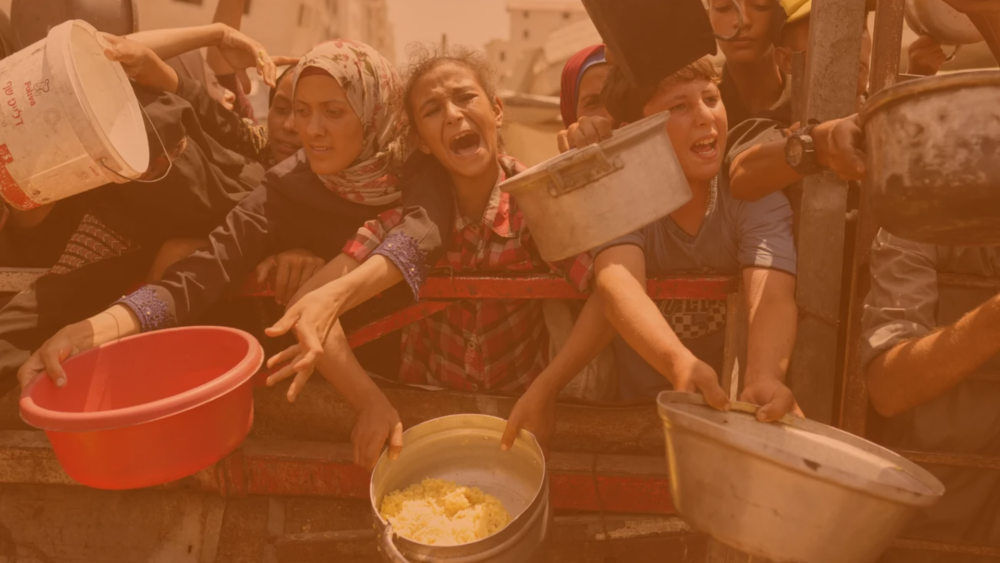
After more than a year of repeated warnings, the UN-backed Food Security Phase Classification (IPC) announced last week for the first time that famine is underway in parts of the Gaza Strip. According to the IPC, the lives of 132,000 children under five are at risk from malnutrition, and by the end of September more than half of all children in Gaza are expected to suffer from acute undernourishment.
In response, the UN Food and Agriculture Organization, the World Food Programme, the World Health Organization, and UNICEF issued a joint statement calling for an immediate ceasefire and unhindered humanitarian access to Gaza. UNICEF Executive Director Catherine Russell warned: “As we have repeatedly said, the signs were unmistakable: children with emaciated bodies, too weak to cry or eat; babies dying of hunger and preventable disease; parents arriving at clinics with nothing left to feed their children.”
UN Human Rights Commissioner Volker Türk described the famine as “a direct result of the Israeli government’s actions.” Benjamin Netanyahu, dismissed the IPC report as a “lie” claiming – contrary to the entire international humanitarian community – that Israel is pursuing a “policy of hunger prevention.”
The Israeli government’s desperation to mask the consequences of its starvation strategy in Gaza can be seen in the wave of sinister ads saturating platforms like YouTube. Some smear the UN as the cause of the crisis, while others push the opposite claim – that there is no shortage of food in Gaza at all. Videos of supposedly bustling fast-food restaurants flash across the screen with the caption: “There is food in Gaza. Any other claim is a lie.” These ads are sponsored by Israel’s Ministry of Foreign Affairs.
At the same time, while Israel’s war regime continues to promote the myth of “humane” and “proportionate” warfare – dismissing Gaza’s unprecedented civilian death toll as Hamas propaganda – investigations by 972 Magazine, Local News and The Guardian show that by May 2025, 83 percent of those killed in Gaza were civilians. Their research is based on an internal Israeli intelligence database.
Overall death toll estimates range from the UN’s conservative figure of 60,000 to over 80,000 according to an independent study that also counts the indirect effects of Israel’s campaign: hunger, disease, and the deliberate destruction of the health system. According to research by Yossi Bartal even these estimates are far too low and the death toll exceeds 100,000 – not taking into account the consequences of famine.
Against these harrowing figures of the unfolding genocide, the catastrophic consequences of Israel’s announced invasion are all too clear. The IPC identifies Gaza City as especially hard-hit by famine, and the Israeli Ministry of Defense, according to the Times of Israel, expects up to one million people to be displaced. The invasion has already begun, with bombardments and troop incursions leaving massive destruction, as Palestinian journalists and organisations like Doctors Without Borders on the ground report.
The full-scale offensive is yet to come, pending the mobilisation of 60,000 reservists. Netanyahu has already rejected a ceasefire proposal by Egypt, Qatar, and the United States. According to Haaretz, he is banking on Hamas rejecting his counter-offer in order to escalate the war further – despite mass protests in Israel calling for a ceasefire-deal.
Meanwhile, in the occupied West Bank, Israeli authorities continue to entrench the occupation and seizure of Palestinian territory. Right-extremist finance minister Bezalel Smotrich announced the long-contested “E1” settlement plan, openly mocking European governments’ recognition of a Palestinian state. While many Western observers see this as the final nail in the coffin of a contiguous Palestinian territory, others point out that the occupation regime already fragments the West Bank at will, cutting off enclaves—including areas where “E1” is to be built – whenever it chooses.
None of this is surprising. Netanyahu and his cabinet are candid: there will be no Palestinian state and “autonomy” only to the degree that they dictate. Despite protests against his government, polls indicate that this position reflects the mainstream of Israeli politics, not a fringe view.
Germany, meanwhile, continues to act as though it is sincerely working toward a two-state solution. Its lofty appeals for “humanitarian conduct of war,” access for aid, and an end to illegal settlement policies ring hollow against the reality on the ground—one in which Germany itself plays a decisive role.
As Israel’s largest trading partner in Europe, second-biggest arms supplier, and diplomatic shield from international accountability, Germany is deeply complicit in the genocide unfolding in Gaza and the annexing of the West Bank. Neither its airlift of aid to Gaza, nor the symbolic curbing of future offensive arms export licenses (backed by a majority in German society), alters this. Moreover, such steps were only taken after opposition from within the foreign office – former and current diplomats – become too loud to ignore.
(…)
This opinion piece was written by Wasil Schauseil for DiEM25. You can read the full article here.
Join us
After more than a year of repeated warnings, the UN-backed Food Security Phase Classification (IPC) announced last week for the first time that famine is underway in parts of the Gaza Strip. According to the IPC, the lives of 132,000 children under five are at risk from malnutrition, and by the end of September more than half of all children in Gaza are expected to suffer from acute undernourishment.
In response, the UN Food and Agriculture Organization, the World Food Programme, the World Health Organization, and UNICEF issued a joint statement calling for an immediate ceasefire and unhindered humanitarian access to Gaza. UNICEF Executive Director Catherine Russell warned: “As we have repeatedly said, the signs were unmistakable: children with emaciated bodies, too weak to cry or eat; babies dying of hunger and preventable disease; parents arriving at clinics with nothing left to feed their children.”
UN Human Rights Commissioner Volker Türk described the famine as “a direct result of the Israeli government’s actions.” Benjamin Netanyahu, dismissed the IPC report as a “lie” claiming – contrary to the entire international humanitarian community – that Israel is pursuing a “policy of hunger prevention.”
The Israeli government’s desperation to mask the consequences of its starvation strategy in Gaza can be seen in the wave of sinister ads saturating platforms like YouTube. Some smear the UN as the cause of the crisis, while others push the opposite claim – that there is no shortage of food in Gaza at all. Videos of supposedly bustling fast-food restaurants flash across the screen with the caption: “There is food in Gaza. Any other claim is a lie.” These ads are sponsored by Israel’s Ministry of Foreign Affairs.
At the same time, while Israel’s war regime continues to promote the myth of “humane” and “proportionate” warfare – dismissing Gaza’s unprecedented civilian death toll as Hamas propaganda – investigations by 972 Magazine, Local News and The Guardian show that by May 2025, 83 percent of those killed in Gaza were civilians. Their research is based on an internal Israeli intelligence database.
Overall death toll estimates range from the UN’s conservative figure of 60,000 to over 80,000 according to an independent study that also counts the indirect effects of Israel’s campaign: hunger, disease, and the deliberate destruction of the health system. According to research by Yossi Bartal even these estimates are far too low and the death toll exceeds 100,000 – not taking into account the consequences of famine.
Against these harrowing figures of the unfolding genocide, the catastrophic consequences of Israel’s announced invasion are all too clear. The IPC identifies Gaza City as especially hard-hit by famine, and the Israeli Ministry of Defense, according to the Times of Israel, expects up to one million people to be displaced. The invasion has already begun, with bombardments and troop incursions leaving massive destruction, as Palestinian journalists and organisations like Doctors Without Borders on the ground report.
The full-scale offensive is yet to come, pending the mobilisation of 60,000 reservists. Netanyahu has already rejected a ceasefire proposal by Egypt, Qatar, and the United States. According to Haaretz, he is banking on Hamas rejecting his counter-offer in order to escalate the war further – despite mass protests in Israel calling for a ceasefire-deal.
Meanwhile, in the occupied West Bank, Israeli authorities continue to entrench the occupation and seizure of Palestinian territory. Right-extremist finance minister Bezalel Smotrich announced the long-contested “E1” settlement plan, openly mocking European governments’ recognition of a Palestinian state. While many Western observers see this as the final nail in the coffin of a contiguous Palestinian territory, others point out that the occupation regime already fragments the West Bank at will, cutting off enclaves—including areas where “E1” is to be built – whenever it chooses.
None of this is surprising. Netanyahu and his cabinet are candid: there will be no Palestinian state and “autonomy” only to the degree that they dictate. Despite protests against his government, polls indicate that this position reflects the mainstream of Israeli politics, not a fringe view.
Germany, meanwhile, continues to act as though it is sincerely working toward a two-state solution. Its lofty appeals for “humanitarian conduct of war,” access for aid, and an end to illegal settlement policies ring hollow against the reality on the ground—one in which Germany itself plays a decisive role.
As Israel’s largest trading partner in Europe, second-biggest arms supplier, and diplomatic shield from international accountability, Germany is deeply complicit in the genocide unfolding in Gaza and the annexing of the West Bank. Neither its airlift of aid to Gaza, nor the symbolic curbing of future offensive arms export licenses (backed by a majority in German society), alters this. Moreover, such steps were only taken after opposition from within the foreign office – former and current diplomats – become too loud to ignore.
(…)
This opinion piece was written by Wasil Schauseil for DiEM25. You can read the full article here.
SUPPORT US
We like bringing the stories that don’t get told to you. For that, we need your support. However small, we would appreciate it.
Related Posts