




From Severance to Squid Game: How Your Favorite TV Dramas Gamify Oppression
Dystopia has become one of the dominant cultural languages of our time. From literature to streaming platforms, it offers a shorthand for expressing our collective sense of crisis, whether political, environmental, or social. As genre fiction, it thrives on familiar tropes of collapse and survival, making it immediately popular and marketable. However, at its best, dystopia also opens up imaginative space for questioning power, envisioning resistance, and reframing the present through the lens of catastrophe.
According to Parrot Analytics, the number of dystopian films released globally has nearly doubled between 2010 and 2024, driven by major franchises such as The Hunger Games, Mad Max, and The Matrix. Around 21% of dystopian films released before 2010 have skewed toward female audiences, with young adult-oriented stories such as The Hunger Games leading the shift.
Margaret Atwood once stated that everything in The Handmaid’s Tale is based on real historical events. She didn’t put anything in the book that hadn’t already happened. Since then, the world has only given rise to more dystopian dreams. And more of fiction has become a reflection of our present, magnified and pushed to its most terrifying extreme.
However, in most dystopian fiction, stories from the Global South are constantly co-opted by creators from the Global North. Alfonso Cuarón’s Children of Men borrows imagery of refugee camps and police violence from the Global South but re-centers it within a crumbling Britain. Denis Villeneuve’s Dune distills Middle Eastern and North African histories of colonial plunder into a palatable space opera led by a white messiah. Then they are sanitized, flattened, packaged in a video gamified format, and sold to an audience who would rather deal with these issues through the prism of individual action rather than collective rage. The people whose traumas are fictionalized do not get the centre stage in such fiction. Instead, we get simulations of suffering filtered through the lens of the privileged, white-skinned, Eurocentric, or American.
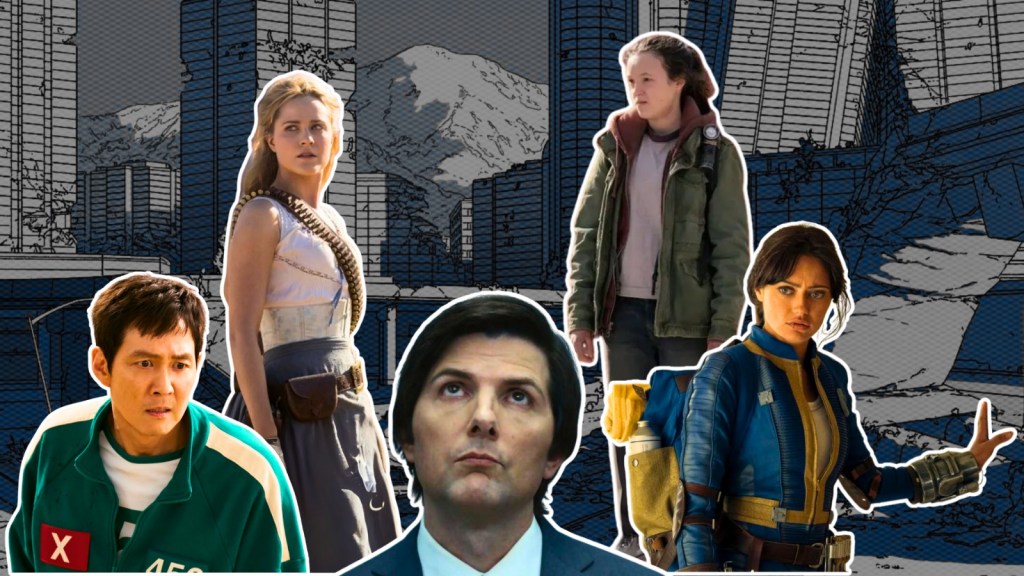
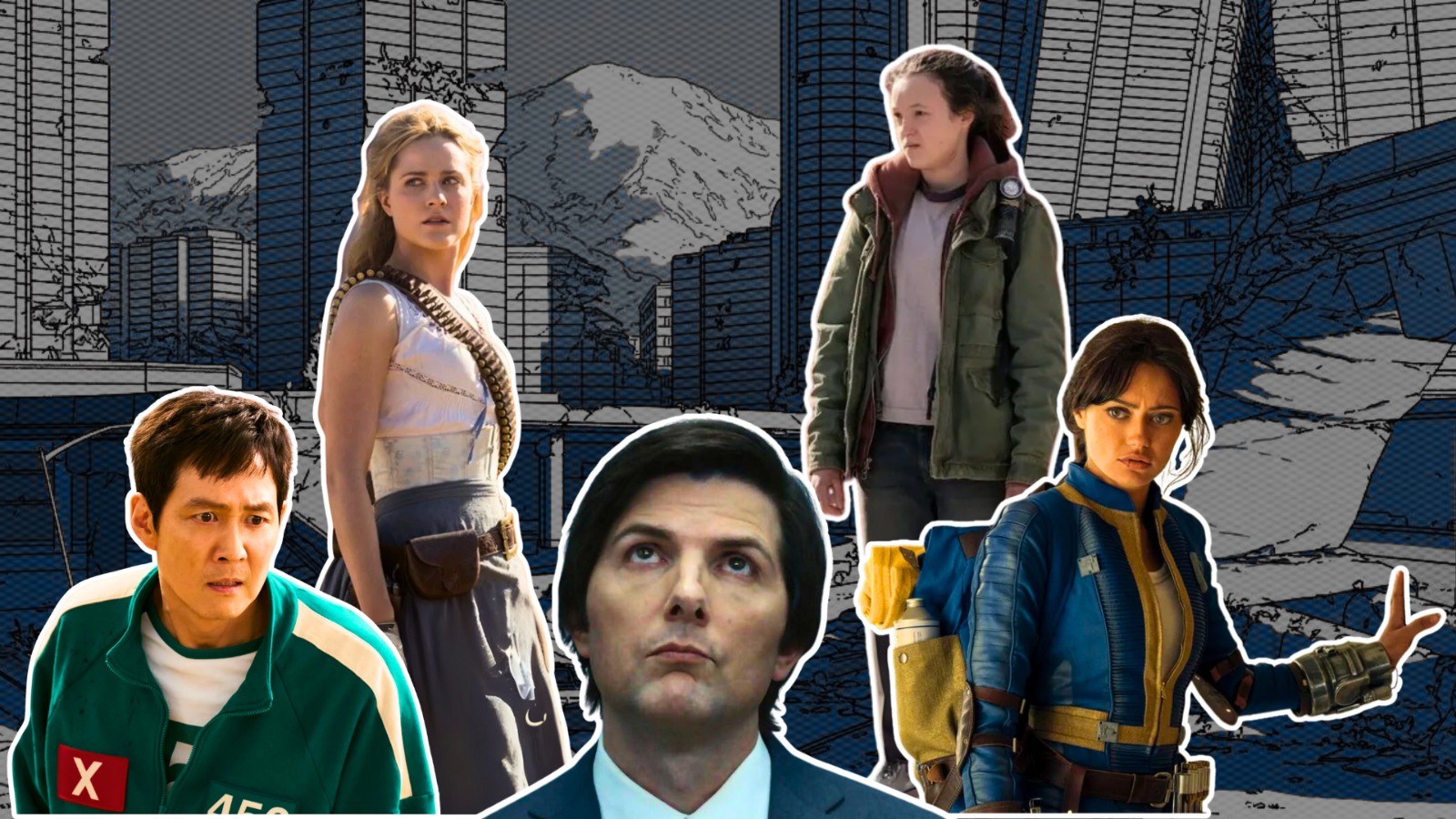
Contemporary dystopian fiction—like Severance, Squid Game, The Last of Us, Westworld, and Fallout—doesn’t just present grim futures, it renders them through the logic of video games, where the narrative unfolds like a mission-based campaign, worlds are structured like obstacle courses, and protagonists “level up” through suffering.
Prestige television shows, in particular, often trade systemic analyses for aestheticized individual struggle, gamifying oppression into quests for personal redemption or survival. In Severance, for instance, corporate dehumanization is distilled into a puzzle-box office floor, while the larger systemic rot and the conditions that enable corporate greed to flourish recede into the background
Squid Game literalizes this dynamic. Each round of children’s games becomes a deadly “level” for the protagonists to survive. In a show meant to critique the very machineries of exploitation, the audience is invited instead to root for the survival of the one individual, rather than cheering on ways to dismantle the system itself.
Beyond their aesthetic sheen, there’s a deeper dissonance: these stories are largely told by corporations and creators complicit in the very systems they claim to critique. When creators with murky or imperialist politics tell stories of dystopia, we must ask whether we’re being sold a critique or a simulation of one. Is the goal to unsettle us, or is it to keep us engaged, distracted, and emotionally gratified?
A Reflection Of Our Dystopian World
From Orwell to Atwood, from Blade Runner to Children of Men, dystopia has traditionally been a terrain of radical imagination and political critique—a mode of storytelling that held a mirror to authoritarianism, surveillance, and systemic collapse. These were cautionary tales rooted in collective anxieties and structural critiques.
Ridley Scott’s 1982 masterpiece, Blade Runner, is perhaps the originator of dystopian film as we know it. Set in a rain-soaked Los Angeles of 2019, ex-cop Rick Deckard (Harrison Ford) is pulled back into duty as a “blade runner,” tasked with hunting down rogue replicants—bioengineered humans nearly indistinguishable from real ones. As Deckard pursues them, he confronts questions of morality, memory, and what it means to be human. The film exposed the dehumanizing consequences of unchecked capitalism, surveillance, and corporate control, blurring the lines between man and machine to question the ethics of power and profit.
Alfonso Cuaron’s 2006 film, Children of Men, follows disillusioned bureaucrat Theo (Clive Owen), who lives in a near-future Britain where humanity faces extinction after two decades of global infertility. Society has collapsed into authoritarian control and violent xenophobia, with refugees caged and brutalized. When Theo is tasked with protecting Kee, a young refugee miraculously pregnant, he sets out on a journey to safeguard her and humanity’s fragile hope, exposing the cruelty of state power and the resilience of ordinary people. These dystopias were meant to be fully inhabited—visceral, suffocating, impossible to ignore. In Children of Men, where the camera lingers in long, chaotic takes that trap us inside a collapsing world of barbed wire, cages, and tear gas, the critique of authoritarianism and xenophobia is inescapable because it saturates every frame.
Today, the sharp increase in dystopian fiction mirrors rising global anxieties around artificial intelligence, digital surveillance, climate change, and political instability. We keep exploring our real-world fears through fictional apocalypses, as has arguably always been the role of fiction. But rendering these fears through video game logic perverts this goal, only helping us put a safe psychological, emotional, and geographical distance between the gory, gnarly, messy, uncomfortable truth of the dystopia and our lived realities. The collapse is happening there, not here, and so we are no longer complicit in it—or even involved at all.
We know that the surveillance state of 1984 exists in Kashmir. The theocratic horrors of The Handmaid’s Tale aren’t far off from the laws governing women in Afghanistan, Iran, and the US.
In Gaza, people are being gunned down while collecting food. This dystopia is Israel’s military strategy. And The Hunger Games borrowed a page from this violent militarism and scripted it years ago, when Katniss’s sister Prim is killed in a bombing at a supposed aid drop zone.
The climate apocalypse of The Last of Us is already decimating communities in the Pacific Islands and Sub-Saharan Africa. And Palestine, under siege, displacement, and digital erasure, eerily mirrors the refugee camps and militarized borders of Children of Men or the alien ghettos of District 9, where entire populations are dehumanized, starved, and left to rot in plain sight.
From Teen Fiction to Structural Template
YA dystopian fiction narratives started increasingly resembling the structure and logic of video games a while ago. Stories like The Hunger Games, Divergent, and Ender’s Game don’t just depict dystopian violence; they gamify it.
Katniss Everdeen enters a literal arena designed like a deadly obstacle course, where survival is tied to spectacle and strategy. In Ender’s Game (1985), Orson Scott Card tells the story of Andrew “Ender” Wiggin, a gifted child recruited into an elite military academy where children are trained through increasingly complex battle simulations. Ender excels at these games, believing he is preparing for a distant war against an alien species called the Formics. Only at the climax does he discover the truth: the simulations were real battles, and his final “game” has made him complicit in the genocide of an entire species.
This framing mirrored the mechanics of video games, where the goal is less about dismantling the rules than playing them better than everyone else.
There’s a direct lineage from these YA dystopias like The Hunger Games to the current wave of prestige dystopia. What was once dismissed as teen fiction has quietly become the structural template for popular entertainment.
What narrative structures are favored over others offers insights to understand how dystopia is heavily gamified these days. Now, they are often adapted from pre-existing video games (The Last of Us) or located in game-like arenas (Squid Game), and every game has its main players. Everyone else is just background. In dystopian TV, this logic carries over in alarming ways. In these stories, protagonists navigate obstacle-laden arenas (sometimes full of zombies, sometimes full of severed “innies”), complete missions, and engage with a mix of “players” and “NPC-like” characters, reinforcing a familiar game logic: the world is terrible, but it can be won (or lost) by the chosen ones.
The protagonist becomes the central node of all suffering, growth, and resistance. Everyone else—the so-called non-player characters (NPC)—exists to populate the world and sometimes push the plot along. In Squid Game, for example, Lee Jung-jae’s Seong Gi-hun is trapped in a series of deadly children’s games, where advancing to the next level depends on other contestants’ elimination. Hundreds of faceless players become collateral damage, their deaths reinforcing his arc of survival and reluctant heroism.
This new grammar of storytelling can be directly reflected in how the Pahalgam attack triggered a chillingly gamified response online. People were baying for blood as if cheering on a live-action war simulation. Soldiers, to their minds, became NPCs in this imagined nationalistic video game, their deaths treated less like human tragedy and more like a scoreboard reset. Part of this detachment can be traced to the influence of guns-and-glory propaganda films like Uri: The Surgical Strike (2019), which present military action as thrilling, heroic, and game-like. Most of these voices came from far-flung urban centres, revealing just how abstract and disconnected the violence really is for them.
In the world of video games, multiple narratives can be created every time the player loses a life and has to start over again, giving them a sense of control they do not have over reality. This line of thinking, when applied to reality, is obviously dangerous, but it is happening increasingly. Applied to real life, this logic becomes disturbingly corrosive. It treats very real human lives like those of NPCs, expendable rather than singular and irreplaceable. When events like the Pahalgam attack are consumed through this lens, the death of soldiers—or civilians—can be abstracted into points on a scoreboard, and the true gravity of loss is erased. The danger lies in cultivating a society that can “restart” after real-world violence without fully grappling with its human consequences.
Severance and Tech Dystopias
Severance perfectly encapsulates this structural dynamic of gamification. It centres on corporate employees whose consciousness is surgically split between their work and personal lives—a chilling metaphor for capitalist compartmentalization and our Sisyphean attempts to reclaim personal agency. But beyond its themes, the show’s very design mimics the mechanics of a puzzle-platformer or escape room.
Characters navigate mystery doors, track coded memos, receive performance scores, and attempt to unlock higher-clearance levels—all hallmarks of game progression. There are sometimes special levels where the characters get to go on sidequests, like we see the innies do in the “Woe’s Hollow” episode in the second season of Severance. In “Woe’s Hollow,” the Macrodata Refinement (MDR) team is jolted out of their office routine and dropped into a snowy wilderness for Lumon’s so-called “Outdoor Retreat and Team-Building Occurrence” (ORTBO). What begins as a corporate bonding exercise quickly turns into something stranger. They chase uncanny doubles of themselves through the woods, stumble upon a cave containing the elusive “Fourth Appendix,” and unearth disturbing revelations about the Eagan family, founders and owners of the mysterious monopoly, “Lumon.” Unlike the rote structure of the work floor, this detour feels exploratory and uncanny. Viewers are invited to play along, piecing clues together as if unlocking achievements.
To make the experience even more real, Apple has also launched a Macro Data Refining game. Thus, corporate existential dread gets stylised. It becomes digestible. It becomes fun. Alienation becomes interactive. The effect is seductive. What should feel claustrophobic instead becomes thrilling. The end product is aesthetically cool.
Severance is sharp, but there is plenty more that remains unaddressed. Yes, the corporation is the villain, rendered in sterile extremes—endless white corridors, windowless offices, rituals designed to drain individuality. But while the critique is there, the structure still funnels our investment into a classic “defeat the big bad corp” arc. The systemic forces that allow such corporations to thrive—the economics of late capitalism, the cult of productivity, the complicity of the state—need more scathing takedowns too. Severance succeeds at world-building a corporate hell, but doesn’t always linger on the larger machinery enabling it.
The Last of Us & The Single-Player Survival Quest
If Severance turns the office into a puzzle box, The Last of Us transforms the apocalypse into an emotionally immersive single-player campaign.
In The Last of Us, Joel (Pedro Pascal) and Ellie’s (Bella Ramsey) journey through a decaying, post-pandemic America is structured as a personal adventure. They regularly meet side characters who serve clear mechanical functions: to provide emotional backstory, introduce moral dilemmas, or be sacrificed for development. There’s very little dwelling on the systemic decay of this world; instead, we’re made to care because Joel and Ellie care. Hence, here dystopia becomes a backdrop, a mere set dressing for a hero’s journey.
In contrast, Bill and Frank’s story in the first season (episode three) is a beautifully rendered detour that explores a queer relationship in a world threatened by monsters. It is a self-contained chapter that enriches the world thematically but has minimal bearing on the larger plot beyond giving Joel a car. In episode five, Henry and Sam appear just long enough to introduce the cost of protecting loved ones, only to be sacrificed by the episode’s end for Joel and Ellie’s emotional growth.
There is little interrogation of systemic collapse beyond what directly affects Joel and Ellie. FEDRA and the Fireflies are mentioned but rarely examined in depth. The cordyceps fungus—a plausible climate-era pandemic—is largely reduced to atmospheric danger. The stakes are personal, not political.
This model, derived directly from video game storytelling, encourages viewers to invest in the “main player” characters while tuning out the suffering of the rest. In real-world dystopias—with military occupation, refugee crises, and apartheid regimes—there are no NPCs. Every person is living the horror. But in these shows, the world itself is a simulation of oppression, not a reckoning with it. Here, dystopia feels like scenery, not the subject.
This detachment is dangerous as it conditions us to see systemic violence not as collective trauma, but as a context for individual growth. Instead of solidarity, it ends up evoking a sense of spectatorship. The reason this does us a disservice is that dystopia must be disquieting, not feel playable.
The Last of Us showrunner Craig Mazin has also been criticised for his pro-Israel sentiments, while Neil Druckmann, co-creator of the game, has directly cited the “Israel-Palestine conflict” as inspiration. Israel’s genocidal impact on Palestine is not critiqued in the game or the show; rather, it is used as fodder for virtual violence.
As argued by Emanuel Maiberg in Vice, The Last of Us Part II game (which is the basis for the second and other forthcoming seasons) takes a troubling centrist view that puts two squabbling factions inspired by Israel and Palestine on equal footing. Maiberg writes, “Whereas Abby and Ellie find interpersonal resolution at the end, the game seems content to leave the question of community-scale cycles of violence as a regrettable fact of human existence.”
The Corporate Complicity of Dystopia
Severance comes from Apple, a company synonymous with exploitative labour practices and aggressive intellectual property hoarding. Apple profits from supply chains linked to conflict mineral extraction in Sudan and the Congo. These regions are destabilised, their people displaced and exploited, by the relentless demand for cobalt and coltan to power our devices.
And ironically enough, the show about a biotech company that surgically divides people’s work minds from their personal consciousness is celebrated for its anti-corporate vision. That contradiction is not lost on us, but it is rarely addressed with the urgency it deserves. Instead, we end up marvelling at the show’s clever design, its Kubrickian framing, and its deadpan performances.
Amazon Prime bankrolls post-apocalyptic, sci-fi dystopias like Fallout and The Expanse (a story about space colonization) while fueling tech surveillance and worker abuse in real life. Amazon thrives on the human rights violations eerily similar to the world it portrays.
Whether the horror is corporate or post-apocalyptic, it’s often polished by the very hands that profit off the same systemic violence. As dystopia becomes a prestige product, the question is no longer just “what is the story?” but “whose story is it, and who gets to tell it?”
Mega corporations caring for nothing but their capital is not a recent phenomenon. It is what has led us here.
Lionsgate Films, the distributor for The Hunger Games, Divergent, and Ender’s Game, had a tie-up with cosmetics brand CoverGirl to promote products that Capitol residents would use. Speaking of CoverGirl’s glossy Capitol Couture site promoting the product line, Andrew Slack wrote about the tone deaf move in the LA Times, “This is perhaps the most creative and brilliant marketing campaign I’ve ever seen. It is also one of the most disturbing.”
It took the very excesses Suzanne Collins skewered—the shallow spectacle and cosmetic distraction of the Capitol—and repackaged and sold it to audiences as aspirational beauty trends. They took the dystopia The Hunger Games and turned it into lifestyle branding.
When dystopia becomes entertainment, it stops being a warning. It becomes a product. And like any product, it serves its makers first.
As dystopian science fiction continues to saturate our screens, we must resist distraction. Instead, we need to question if the genre has lost its teeth. Created, funded, and distributed by the very entities they set out to critique, these shows offer audiences the illusion of resistance while subtly reinforcing the individualist, solutionist logic of neoliberal capitalism. Some of them even tend to favour the oppressor in subtle ways. They no longer reflect dystopia so much as repackage it. So, why are we still watching?
Join us
Debiparna Chakraborty is a film, TV, and culture critic dissecting media at the intersection of gender, politics, and power. Her words have also appeared in Outlook India, The Quint, FarOut Magazine, and other publications.


From Severance to Squid Game: How Your Favorite TV Dramas Gamify Oppression
By Debiparna Chakraborty
September 18, 2025
Contemporary dystopian TV shows don't just present grim futures; they render them through the logic of video games, where the narrative unfolds like a mission-based campaign, worlds are structured like obstacle courses, and protagonists “level up” through suffering.
Dystopia has become one of the dominant cultural languages of our time. From literature to streaming platforms, it offers a shorthand for expressing our collective sense of crisis, whether political, environmental, or social. As genre fiction, it thrives on familiar tropes of collapse and survival, making it immediately popular and marketable. However, at its best, dystopia also opens up imaginative space for questioning power, envisioning resistance, and reframing the present through the lens of catastrophe.
According to Parrot Analytics, the number of dystopian films released globally has nearly doubled between 2010 and 2024, driven by major franchises such as The Hunger Games, Mad Max, and The Matrix. Around 21% of dystopian films released before 2010 have skewed toward female audiences, with young adult-oriented stories such as The Hunger Games leading the shift.
Margaret Atwood once stated that everything in The Handmaid’s Tale is based on real historical events. She didn’t put anything in the book that hadn’t already happened. Since then, the world has only given rise to more dystopian dreams. And more of fiction has become a reflection of our present, magnified and pushed to its most terrifying extreme.
However, in most dystopian fiction, stories from the Global South are constantly co-opted by creators from the Global North. Alfonso Cuarón’s Children of Men borrows imagery of refugee camps and police violence from the Global South but re-centers it within a crumbling Britain. Denis Villeneuve’s Dune distills Middle Eastern and North African histories of colonial plunder into a palatable space opera led by a white messiah. Then they are sanitized, flattened, packaged in a video gamified format, and sold to an audience who would rather deal with these issues through the prism of individual action rather than collective rage. The people whose traumas are fictionalized do not get the centre stage in such fiction. Instead, we get simulations of suffering filtered through the lens of the privileged, white-skinned, Eurocentric, or American.
Contemporary dystopian fiction—like Severance, Squid Game, The Last of Us, Westworld, and Fallout—doesn’t just present grim futures, it renders them through the logic of video games, where the narrative unfolds like a mission-based campaign, worlds are structured like obstacle courses, and protagonists “level up” through suffering.
Prestige television shows, in particular, often trade systemic analyses for aestheticized individual struggle, gamifying oppression into quests for personal redemption or survival. In Severance, for instance, corporate dehumanization is distilled into a puzzle-box office floor, while the larger systemic rot and the conditions that enable corporate greed to flourish recede into the background
Squid Game literalizes this dynamic. Each round of children’s games becomes a deadly “level” for the protagonists to survive. In a show meant to critique the very machineries of exploitation, the audience is invited instead to root for the survival of the one individual, rather than cheering on ways to dismantle the system itself.
Beyond their aesthetic sheen, there’s a deeper dissonance: these stories are largely told by corporations and creators complicit in the very systems they claim to critique. When creators with murky or imperialist politics tell stories of dystopia, we must ask whether we’re being sold a critique or a simulation of one. Is the goal to unsettle us, or is it to keep us engaged, distracted, and emotionally gratified?
A Reflection Of Our Dystopian World
From Orwell to Atwood, from Blade Runner to Children of Men, dystopia has traditionally been a terrain of radical imagination and political critique—a mode of storytelling that held a mirror to authoritarianism, surveillance, and systemic collapse. These were cautionary tales rooted in collective anxieties and structural critiques.
Ridley Scott’s 1982 masterpiece, Blade Runner, is perhaps the originator of dystopian film as we know it. Set in a rain-soaked Los Angeles of 2019, ex-cop Rick Deckard (Harrison Ford) is pulled back into duty as a “blade runner,” tasked with hunting down rogue replicants—bioengineered humans nearly indistinguishable from real ones. As Deckard pursues them, he confronts questions of morality, memory, and what it means to be human. The film exposed the dehumanizing consequences of unchecked capitalism, surveillance, and corporate control, blurring the lines between man and machine to question the ethics of power and profit.
Alfonso Cuaron’s 2006 film, Children of Men, follows disillusioned bureaucrat Theo (Clive Owen), who lives in a near-future Britain where humanity faces extinction after two decades of global infertility. Society has collapsed into authoritarian control and violent xenophobia, with refugees caged and brutalized. When Theo is tasked with protecting Kee, a young refugee miraculously pregnant, he sets out on a journey to safeguard her and humanity’s fragile hope, exposing the cruelty of state power and the resilience of ordinary people. These dystopias were meant to be fully inhabited—visceral, suffocating, impossible to ignore. In Children of Men, where the camera lingers in long, chaotic takes that trap us inside a collapsing world of barbed wire, cages, and tear gas, the critique of authoritarianism and xenophobia is inescapable because it saturates every frame.
Today, the sharp increase in dystopian fiction mirrors rising global anxieties around artificial intelligence, digital surveillance, climate change, and political instability. We keep exploring our real-world fears through fictional apocalypses, as has arguably always been the role of fiction. But rendering these fears through video game logic perverts this goal, only helping us put a safe psychological, emotional, and geographical distance between the gory, gnarly, messy, uncomfortable truth of the dystopia and our lived realities. The collapse is happening there, not here, and so we are no longer complicit in it—or even involved at all.
We know that the surveillance state of 1984 exists in Kashmir. The theocratic horrors of The Handmaid’s Tale aren’t far off from the laws governing women in Afghanistan, Iran, and the US.
In Gaza, people are being gunned down while collecting food. This dystopia is Israel’s military strategy. And The Hunger Games borrowed a page from this violent militarism and scripted it years ago, when Katniss’s sister Prim is killed in a bombing at a supposed aid drop zone.
The climate apocalypse of The Last of Us is already decimating communities in the Pacific Islands and Sub-Saharan Africa. And Palestine, under siege, displacement, and digital erasure, eerily mirrors the refugee camps and militarized borders of Children of Men or the alien ghettos of District 9, where entire populations are dehumanized, starved, and left to rot in plain sight.
From Teen Fiction to Structural Template
YA dystopian fiction narratives started increasingly resembling the structure and logic of video games a while ago. Stories like The Hunger Games, Divergent, and Ender’s Game don’t just depict dystopian violence; they gamify it.
Katniss Everdeen enters a literal arena designed like a deadly obstacle course, where survival is tied to spectacle and strategy. In Ender’s Game (1985), Orson Scott Card tells the story of Andrew “Ender” Wiggin, a gifted child recruited into an elite military academy where children are trained through increasingly complex battle simulations. Ender excels at these games, believing he is preparing for a distant war against an alien species called the Formics. Only at the climax does he discover the truth: the simulations were real battles, and his final “game” has made him complicit in the genocide of an entire species.
This framing mirrored the mechanics of video games, where the goal is less about dismantling the rules than playing them better than everyone else.
There’s a direct lineage from these YA dystopias like The Hunger Games to the current wave of prestige dystopia. What was once dismissed as teen fiction has quietly become the structural template for popular entertainment.
What narrative structures are favored over others offers insights to understand how dystopia is heavily gamified these days. Now, they are often adapted from pre-existing video games (The Last of Us) or located in game-like arenas (Squid Game), and every game has its main players. Everyone else is just background. In dystopian TV, this logic carries over in alarming ways. In these stories, protagonists navigate obstacle-laden arenas (sometimes full of zombies, sometimes full of severed “innies”), complete missions, and engage with a mix of “players” and “NPC-like” characters, reinforcing a familiar game logic: the world is terrible, but it can be won (or lost) by the chosen ones.
The protagonist becomes the central node of all suffering, growth, and resistance. Everyone else—the so-called non-player characters (NPC)—exists to populate the world and sometimes push the plot along. In Squid Game, for example, Lee Jung-jae’s Seong Gi-hun is trapped in a series of deadly children’s games, where advancing to the next level depends on other contestants’ elimination. Hundreds of faceless players become collateral damage, their deaths reinforcing his arc of survival and reluctant heroism.
This new grammar of storytelling can be directly reflected in how the Pahalgam attack triggered a chillingly gamified response online. People were baying for blood as if cheering on a live-action war simulation. Soldiers, to their minds, became NPCs in this imagined nationalistic video game, their deaths treated less like human tragedy and more like a scoreboard reset. Part of this detachment can be traced to the influence of guns-and-glory propaganda films like Uri: The Surgical Strike (2019), which present military action as thrilling, heroic, and game-like. Most of these voices came from far-flung urban centres, revealing just how abstract and disconnected the violence really is for them.
In the world of video games, multiple narratives can be created every time the player loses a life and has to start over again, giving them a sense of control they do not have over reality. This line of thinking, when applied to reality, is obviously dangerous, but it is happening increasingly. Applied to real life, this logic becomes disturbingly corrosive. It treats very real human lives like those of NPCs, expendable rather than singular and irreplaceable. When events like the Pahalgam attack are consumed through this lens, the death of soldiers—or civilians—can be abstracted into points on a scoreboard, and the true gravity of loss is erased. The danger lies in cultivating a society that can “restart” after real-world violence without fully grappling with its human consequences.
Severance and Tech Dystopias
Severance perfectly encapsulates this structural dynamic of gamification. It centres on corporate employees whose consciousness is surgically split between their work and personal lives—a chilling metaphor for capitalist compartmentalization and our Sisyphean attempts to reclaim personal agency. But beyond its themes, the show’s very design mimics the mechanics of a puzzle-platformer or escape room.
Characters navigate mystery doors, track coded memos, receive performance scores, and attempt to unlock higher-clearance levels—all hallmarks of game progression. There are sometimes special levels where the characters get to go on sidequests, like we see the innies do in the “Woe’s Hollow” episode in the second season of Severance. In “Woe’s Hollow,” the Macrodata Refinement (MDR) team is jolted out of their office routine and dropped into a snowy wilderness for Lumon’s so-called “Outdoor Retreat and Team-Building Occurrence” (ORTBO). What begins as a corporate bonding exercise quickly turns into something stranger. They chase uncanny doubles of themselves through the woods, stumble upon a cave containing the elusive “Fourth Appendix,” and unearth disturbing revelations about the Eagan family, founders and owners of the mysterious monopoly, “Lumon.” Unlike the rote structure of the work floor, this detour feels exploratory and uncanny. Viewers are invited to play along, piecing clues together as if unlocking achievements.
To make the experience even more real, Apple has also launched a Macro Data Refining game. Thus, corporate existential dread gets stylised. It becomes digestible. It becomes fun. Alienation becomes interactive. The effect is seductive. What should feel claustrophobic instead becomes thrilling. The end product is aesthetically cool.
Severance is sharp, but there is plenty more that remains unaddressed. Yes, the corporation is the villain, rendered in sterile extremes—endless white corridors, windowless offices, rituals designed to drain individuality. But while the critique is there, the structure still funnels our investment into a classic “defeat the big bad corp” arc. The systemic forces that allow such corporations to thrive—the economics of late capitalism, the cult of productivity, the complicity of the state—need more scathing takedowns too. Severance succeeds at world-building a corporate hell, but doesn’t always linger on the larger machinery enabling it.
The Last of Us & The Single-Player Survival Quest
If Severance turns the office into a puzzle box, The Last of Us transforms the apocalypse into an emotionally immersive single-player campaign.
In The Last of Us, Joel (Pedro Pascal) and Ellie’s (Bella Ramsey) journey through a decaying, post-pandemic America is structured as a personal adventure. They regularly meet side characters who serve clear mechanical functions: to provide emotional backstory, introduce moral dilemmas, or be sacrificed for development. There’s very little dwelling on the systemic decay of this world; instead, we’re made to care because Joel and Ellie care. Hence, here dystopia becomes a backdrop, a mere set dressing for a hero’s journey.
In contrast, Bill and Frank’s story in the first season (episode three) is a beautifully rendered detour that explores a queer relationship in a world threatened by monsters. It is a self-contained chapter that enriches the world thematically but has minimal bearing on the larger plot beyond giving Joel a car. In episode five, Henry and Sam appear just long enough to introduce the cost of protecting loved ones, only to be sacrificed by the episode’s end for Joel and Ellie’s emotional growth.
There is little interrogation of systemic collapse beyond what directly affects Joel and Ellie. FEDRA and the Fireflies are mentioned but rarely examined in depth. The cordyceps fungus—a plausible climate-era pandemic—is largely reduced to atmospheric danger. The stakes are personal, not political.
This model, derived directly from video game storytelling, encourages viewers to invest in the “main player” characters while tuning out the suffering of the rest. In real-world dystopias—with military occupation, refugee crises, and apartheid regimes—there are no NPCs. Every person is living the horror. But in these shows, the world itself is a simulation of oppression, not a reckoning with it. Here, dystopia feels like scenery, not the subject.
This detachment is dangerous as it conditions us to see systemic violence not as collective trauma, but as a context for individual growth. Instead of solidarity, it ends up evoking a sense of spectatorship. The reason this does us a disservice is that dystopia must be disquieting, not feel playable.
The Last of Us showrunner Craig Mazin has also been criticised for his pro-Israel sentiments, while Neil Druckmann, co-creator of the game, has directly cited the “Israel-Palestine conflict” as inspiration. Israel’s genocidal impact on Palestine is not critiqued in the game or the show; rather, it is used as fodder for virtual violence.
As argued by Emanuel Maiberg in Vice, The Last of Us Part II game (which is the basis for the second and other forthcoming seasons) takes a troubling centrist view that puts two squabbling factions inspired by Israel and Palestine on equal footing. Maiberg writes, “Whereas Abby and Ellie find interpersonal resolution at the end, the game seems content to leave the question of community-scale cycles of violence as a regrettable fact of human existence.”
The Corporate Complicity of Dystopia
Severance comes from Apple, a company synonymous with exploitative labour practices and aggressive intellectual property hoarding. Apple profits from supply chains linked to conflict mineral extraction in Sudan and the Congo. These regions are destabilised, their people displaced and exploited, by the relentless demand for cobalt and coltan to power our devices.
And ironically enough, the show about a biotech company that surgically divides people’s work minds from their personal consciousness is celebrated for its anti-corporate vision. That contradiction is not lost on us, but it is rarely addressed with the urgency it deserves. Instead, we end up marvelling at the show’s clever design, its Kubrickian framing, and its deadpan performances.
Amazon Prime bankrolls post-apocalyptic, sci-fi dystopias like Fallout and The Expanse (a story about space colonization) while fueling tech surveillance and worker abuse in real life. Amazon thrives on the human rights violations eerily similar to the world it portrays.
Whether the horror is corporate or post-apocalyptic, it’s often polished by the very hands that profit off the same systemic violence. As dystopia becomes a prestige product, the question is no longer just “what is the story?” but “whose story is it, and who gets to tell it?”
Mega corporations caring for nothing but their capital is not a recent phenomenon. It is what has led us here.
Lionsgate Films, the distributor for The Hunger Games, Divergent, and Ender’s Game, had a tie-up with cosmetics brand CoverGirl to promote products that Capitol residents would use. Speaking of CoverGirl’s glossy Capitol Couture site promoting the product line, Andrew Slack wrote about the tone deaf move in the LA Times, “This is perhaps the most creative and brilliant marketing campaign I’ve ever seen. It is also one of the most disturbing.”
It took the very excesses Suzanne Collins skewered—the shallow spectacle and cosmetic distraction of the Capitol—and repackaged and sold it to audiences as aspirational beauty trends. They took the dystopia The Hunger Games and turned it into lifestyle branding.
When dystopia becomes entertainment, it stops being a warning. It becomes a product. And like any product, it serves its makers first.
As dystopian science fiction continues to saturate our screens, we must resist distraction. Instead, we need to question if the genre has lost its teeth. Created, funded, and distributed by the very entities they set out to critique, these shows offer audiences the illusion of resistance while subtly reinforcing the individualist, solutionist logic of neoliberal capitalism. Some of them even tend to favour the oppressor in subtle ways. They no longer reflect dystopia so much as repackage it. So, why are we still watching?
SUPPORT US
We like bringing the stories that don’t get told to you. For that, we need your support. However small, we would appreciate it.
Debiparna Chakraborty is a film, TV, and culture critic dissecting media at the intersection of gender, politics, and power. Her words have also appeared in Outlook India, The Quint, FarOut Magazine, and other publications.
Related Posts



Don’t Say Palestine: Politics of Western Media Style Guides and Entrenched Bias
Claudia Gohn, Shubhanjana Das