



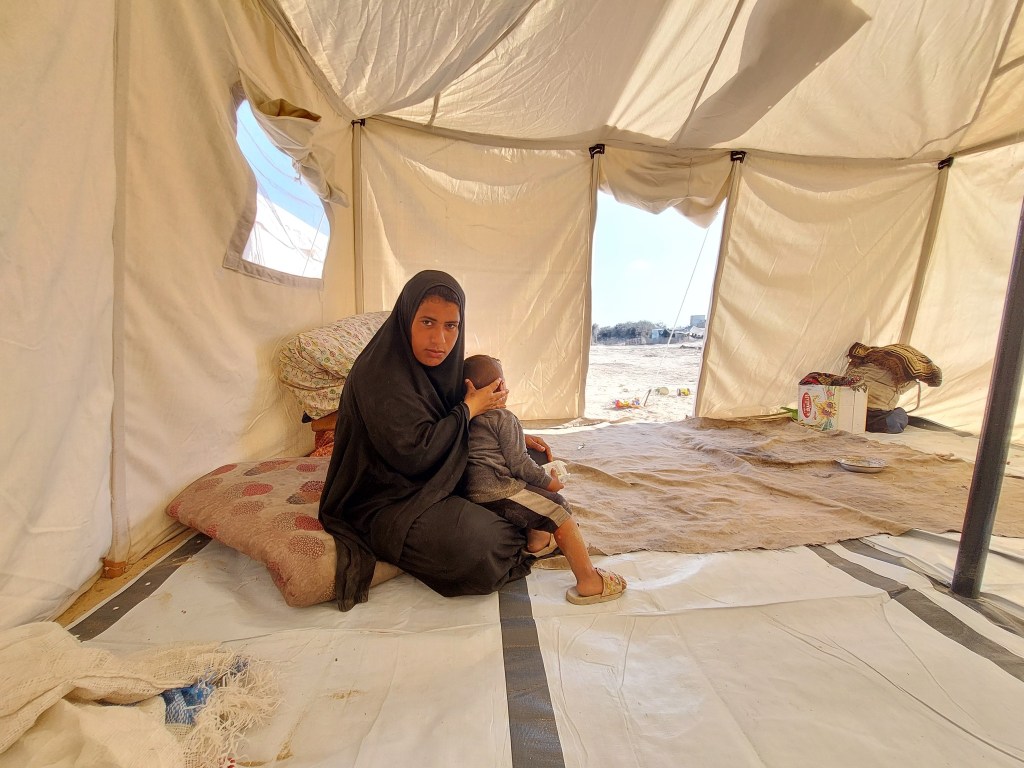
At the edges of the Nuseirat refugee camp in southern Gaza, Sadiqa Abu Hashish, 23, sits inside a tattered tent, holding her three-year-old daughter, trying to soothe her. She fled the Shuja’iyya neighborhood in northern Gaza in February 2024, joining the millions displaced by Israel’s war on the region.
Inside the suffocating tent, the heat clings to her face, yet she cannot afford to complain. She is pregnant, and her husband has been missing for a month with no news of his whereabouts. She said: “I used to live in a simple home, surrounded by neighbors, friends, and a daily routine. Today, for a year and a half, I have been a displaced woman in a tent that offers neither warmth nor shelter from the cold. Every day is a battle for survival: searching for water, food, medicine, and safety. I am both the mother and the father to my child.”

Sadiqa described her daily struggle under ongoing displacement: “I am six months pregnant and receive no medical care—no check-ups, no supplements, no medication. I suffer from constant lower abdominal pain, persistent infections, and exhaustion that consumes me. I fear losing my baby every day.”
She added that water is a rare commodity across the Gaza Strip under Israeli siege. Even someone like Sadiqa, a pregnant woman who is the primary caregiver to her daughter and a two-year-old son, must walk miles to fetch water. “I wash my children’s clothes and bodies with seawater. Its salt stings their skin. They suffer from rashes and infections because of the lack of clean water. There is not enough drinking water; sometimes we go days without a sufficient drink.”
Sadiqa lives under a compounded crisis: pregnant, displaced, and raising her children alone. At night, she holds them close, fearing what may come. “What if I fall ill? What if I lose my child? There is no hospital to go to, no ambulance can reach us,” she said.
The tragedies in Gaza extend beyond bombing and destruction; they penetrate the daily lives of the forcibly displaced women amid the collapse of basic life necessities, protection systems, and medical infrastructure.
Pregnancy Without Care
According to the United Nations Population Fund (UNFPA), “Many women, children, and other vulnerable people, including the elderly, are forced to rely on family members to try and bring back rations, putting them at increased risk of malnutrition and starvation. An estimated 55,000 pregnant and breastfeeding women in Gaza are expected to be at severe risk of death from malnutrition by mid-2026…”
Despite the latest ceasefire agreements, Israel is currently only allowing half of the agreed number of aid trucks—300 per day—in Gaza, citing a delay in receiving hostage bodies. The situation on the ground remains as dire as before, with inadequate access to food, water, medicine, and healthcare. Israel has bombed at least 36 hospitals and many more healthcare facilities across the Gaza Strip since the start of the war.

A few kilometers from the Nuseirat camp, Nancy Abu Mousa, 23, had embarked on an ordeal. She walked ten kilometers on foot, for more than half a day, from the Al-Nasr neighborhood in northern Gaza to the south. Pregnant with twins at six months, she carried her two-year-old daughter on her back and pushed her injured husband on a cart. Describing her harrowing journey through dangerous areas under Israeli bombardment, she said, “I was gasping amid the sounds of bombing and aircraft. Everything around me was collapsing.”
But that was not all. “At a sand hill known as Al-Nuweiri — the last point separating north from south Gaza — I went into labor. I only realized I had given birth when I saw a tiny body drop to the ground. I spread the only cloth I had, and there, on bare asphalt, I miscarried my twins, who were given nothing by this world but a swift death and a cruel displacement. Ambulances never arrived; hospitals were destroyed and overwhelmed with casualties,” she said.
She continued walking until she reached a hospital in Nuseirat, carrying her babies wrapped in cloth. Doctors informed her that they had died. “There was no room for me. Beds were filled with injured patients and complicated cesarean cases, so I left without receiving treatment.”
Grieving the loss of her twin infants, Nancy said, “My dream remains unfulfilled… displacement killed my babies, Fariha and Mahmoud, whom I longed to hold.”
She described her experience as “reproductive violence”, pointing to the deprivation of care after her loss. “I couldn’t even get sanitary pads. I used an old cloth given by a neighbor. I am homeless, awaiting an uncertain fate with my only surviving child, who suffers from cancer without treatment.”

Dr. Mohammad Abu Afesh, director of the Medical Relief Association in Gaza, commented on the situation, saying, “The war destroyed not only health infrastructure but women’s right to life and safe childbirth.” He added that pregnant women have no regular medical follow-up due to destroyed hospitals and suspended maternity units. Gaza records 130 births daily, with over a quarter via cesarean section.
The shortage of medicine and prenatal supplements has worsened anemia and malnutrition among women. Cesareans are often performed without anesthesia due to depleted supplies, exposing women to severe pain and complications. Postpartum care has all but vanished, leading to infections that threaten mothers and newborns. Experts in maternal health reported a whopping 300% increase in spontaneous abortions (early pregnancy loss) since the war began.
Dr. Abu Afesh warns that food scarcity and water contamination have caused weakened immunity, vitamin deficiencies, increased miscarriages, premature births, low birth weight, and congenital deformities. Toxic fumes and chemical residues from bombing have also been linked to fetal deformities and secondary infertility. Local reports indicate alarming rises in congenital anomalies (birth defects) over the past two years.
The psychological trauma of displacement — combined with the loss of shelter — disrupts menstrual cycles, increases rates of psychological infertility and spontaneous abortion, and deprives displaced women of privacy and medical care. “Family planning, routine checkups, and vaccination campaigns have all stopped,” Dr. Abu Afesh says. “Thousands of women are left without care or protection in one of Gaza’s worst health crises.”
In July this year, the UNFPA sounded an alarm over birth rate, maternal and child health in the Gaza Strip. Pregnant women and newborns in Gaza face “catastrophic” conditions.
“Every mother and child deserves the right to a safe birth and a healthy start to life. What we are witnessing is a systematic denial of these fundamental rights, pushing an entire generation to the brink,” said Laila Baker, regional director for the Arab States at UNFPA.

No Privacy, No Protection
Besides healthcare, women have also been robbed of privacy. “The tent offers no privacy,” Sadiqa adds. “There is nowhere to change or bathe. I wait until darkness to relieve myself in an empty agricultural field behind the camp, but the fear of harassment or assault is constant. I have heard of such incidents happening to girls here. As women, we lack protection — there is no law, no functioning police. That leaves us feeling unsafe on top of the fear of shelling and displacement.”
There is also no recourse to abuse by one’s family or husband. Before her husband disappeared, he verbally abused Sadiqa. “I had no choice. Even if I wanted a divorce, there is no court or law to protect me, and things might get worse.”
Like hundreds of other women, Sadiqa feels that merely surviving in Gaza comes at a psychological, physical, and material cost. She dreams of a normal day when she can drink clean water, bathe without fear, and sleep without worry. For now, she can only hold her children close and whisper to them: “Do not be afraid… Mama is with you.”
The Israeli military offensive has forcibly displaced more than 90% of Gaza’s population, around 1.9 million Palestinians, as per UN estimates. The displacement has made it nearly impossible for women to know where safe places are or to access the already limited services available. Around 90% of all residential buildings in Gaza have also been damaged or destroyed.
Displacement, loss of family, lack of security, and overcrowding in shelters and tents also render young women and girls vulnerable to abuse and exploitation. In an overcrowded school shelter in Deir al-Balah, 19-year-old Fatima (name changed) lives with trauma that she cannot speak about. She has been living in dilapidated classrooms turned into makeshift shelters, sharing space, water, and air with hundreds of others. There, she was sexually harassed by a man living in the same shelter.
“I was standing in line for food when I felt a strange hand reach toward me. I froze. I didn’t scream or move. I returned to the classroom, trembling,” she recalls.
Since then, Fatima has withdrawn, avoiding eye contact with others, and confiding in no one — neither her elderly mother nor her brothers, who also verbally abuse her. “If I told someone, they wouldn’t believe me. They would blame me. Here, no one defends us; no law protects us.”
Fatima now lives in a cycle of fear, shame, and silence. “Shelters should be safe spaces from bombing, but they are overcrowded. There is no privacy for girls. Violence in its many forms — physical, psychological, sexual — is repeated here. We survivors have nothing but silence to survive. Everyone speaks of bombing, massacres, and hunger, but no one defends our privacy amid these complex crises.”
These three stories from the heart of displacement converge on fragility, fear, and the absence of protection.
The UNFPA’s April–May 2025 report documents rising gender-based violence in Gaza after the collapse of the last ceasefire on March 8. Heightened risks are linked to displacement and resource deprivation, alongside documented cases of rape and sexual exploitation despite a 19.8% drop in official reporting.
Women’s rights activist Imtiaz Hasbani said that Israel’s war on Gaza “exposed the unprecedented fragility of protection mechanisms,” noting that legal and social safeguards for women have severely eroded. “Before the war, women had limited but existing protection through courts and rights institutions. Now there is no law, no functioning courts, leaving women open to violence and exploitation.”
Hasbani added that the legal vacuum has disproportionately harmed women, increasing physical, sexual, and economic violence amid displacement and overcrowding in shelters, with rising rates of harassment, assault, and honor crimes. Survivors have no safe spaces to report, no trust in legal systems, and face stigmatization that deepens their suffering.
Hasbani narrated a case: in one of Gaza’s devastated neighborhoods, a 27-year-old woman lives a double tragedy. After losing both her legs when an Israeli shell struck her home in the Al-Sabra area of northern Gaza on August 22, 2024, she found herself trapped in another form of violence — this time within her own household.
Since her injury, she has been confined to a wheelchair and relies entirely on humanitarian aid provided to the wounded and displaced. Yet her father controls these relief supplies and denies her access to them, claiming that, as a woman, she has no right to spend money on herself. This patriarchal control has deprived her of her most basic needs, despite her being a legally competent adult with the right to manage her own financial affairs.
According to Hasbani, a specialist in gender-based violence, this case is not an isolated one but rather part of a broader pattern of economic violence against women and girls with disabilities in Gaza. She explains that some families exploit the physical dependency of women with disabilities to assert financial control, often withholding humanitarian aid or compensation received through relief organizations.
“The legal vacuum and the suspension of courts since the onset of the war have only deepened the problem,” Hasbani pointed out. “Many women are left without any legal mechanism to protect their rights or manage their resources independently.”
For months, the young woman has been seeking legal help to obtain official recognition of her right to manage her aid without her father’s guardianship. But with Gaza’s courts paralyzed, her fate, like that of many women across the Strip, remains in limbo.
Hasbani stressed that saving women in Gaza requires urgent action: deploying mobile judicial units, establishing specialized medical and legal services for survivors of violence, and providing direct psychosocial and economic support to widows, divorced, and abused women.
However, the ongoing genocide has suspended all human rights, including those of women and girls, to survive with dignity.

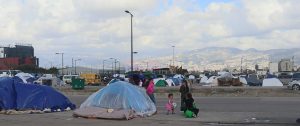
Displaced Women in Gaza: A Life Without Safety, Healthcare, Dignity
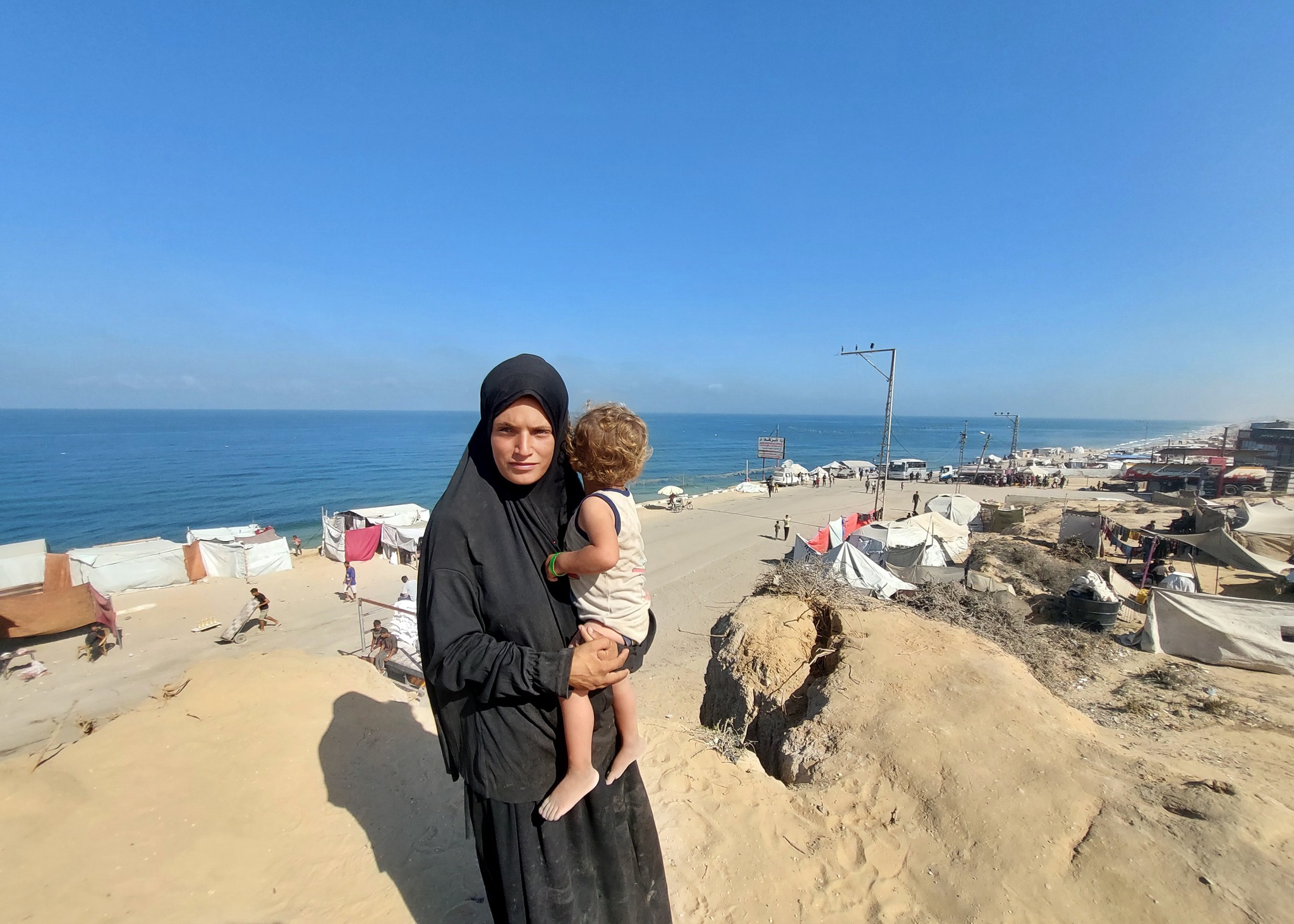
Nancy stands on a hill called "Al-Nuweiri," the barrier that separates northern Gaza from its south, near which she lost her twins. Photo by Doaa Shaheen
At the edges of the Nuseirat refugee camp in southern Gaza, Sadiqa Abu Hashish, 23, sits inside a tattered tent, holding her three-year-old daughter, trying to soothe her. She fled the Shuja’iyya neighborhood in northern Gaza in February 2024, joining the millions displaced by Israel’s war on the region.
Inside the suffocating tent, the heat clings to her face, yet she cannot afford to complain. She is pregnant, and her husband has been missing for a month with no news of his whereabouts. She said: “I used to live in a simple home, surrounded by neighbors, friends, and a daily routine. Today, for a year and a half, I have been a displaced woman in a tent that offers neither warmth nor shelter from the cold. Every day is a battle for survival: searching for water, food, medicine, and safety. I am both the mother and the father to my child.”
Sadiqa described her daily struggle under ongoing displacement: “I am six months pregnant and receive no medical care—no check-ups, no supplements, no medication. I suffer from constant lower abdominal pain, persistent infections, and exhaustion that consumes me. I fear losing my baby every day.”
She added that water is a rare commodity across the Gaza Strip under Israeli siege. Even someone like Sadiqa, a pregnant woman who is the primary caregiver to her daughter and a two-year-old son, must walk miles to fetch water. “I wash my children’s clothes and bodies with seawater. Its salt stings their skin. They suffer from rashes and infections because of the lack of clean water. There is not enough drinking water; sometimes we go days without a sufficient drink.”
Sadiqa lives under a compounded crisis: pregnant, displaced, and raising her children alone. At night, she holds them close, fearing what may come. “What if I fall ill? What if I lose my child? There is no hospital to go to, no ambulance can reach us,” she said.
The tragedies in Gaza extend beyond bombing and destruction; they penetrate the daily lives of the forcibly displaced women amid the collapse of basic life necessities, protection systems, and medical infrastructure.
Pregnancy Without Care
According to the United Nations Population Fund (UNFPA), “Many women, children, and other vulnerable people, including the elderly, are forced to rely on family members to try and bring back rations, putting them at increased risk of malnutrition and starvation. An estimated 55,000 pregnant and breastfeeding women in Gaza are expected to be at severe risk of death from malnutrition by mid-2026…”
Despite the latest ceasefire agreements, Israel is currently only allowing half of the agreed number of aid trucks—300 per day—in Gaza, citing a delay in receiving hostage bodies. The situation on the ground remains as dire as before, with inadequate access to food, water, medicine, and healthcare. Israel has bombed at least 36 hospitals and many more healthcare facilities across the Gaza Strip since the start of the war.
A few kilometers from the Nuseirat camp, Nancy Abu Mousa, 23, had embarked on an ordeal. She walked ten kilometers on foot, for more than half a day, from the Al-Nasr neighborhood in northern Gaza to the south. Pregnant with twins at six months, she carried her two-year-old daughter on her back and pushed her injured husband on a cart. Describing her harrowing journey through dangerous areas under Israeli bombardment, she said, “I was gasping amid the sounds of bombing and aircraft. Everything around me was collapsing.”
But that was not all. “At a sand hill known as Al-Nuweiri — the last point separating north from south Gaza — I went into labor. I only realized I had given birth when I saw a tiny body drop to the ground. I spread the only cloth I had, and there, on bare asphalt, I miscarried my twins, who were given nothing by this world but a swift death and a cruel displacement. Ambulances never arrived; hospitals were destroyed and overwhelmed with casualties,” she said.
She continued walking until she reached a hospital in Nuseirat, carrying her babies wrapped in cloth. Doctors informed her that they had died. “There was no room for me. Beds were filled with injured patients and complicated cesarean cases, so I left without receiving treatment.”
Grieving the loss of her twin infants, Nancy said, “My dream remains unfulfilled… displacement killed my babies, Fariha and Mahmoud, whom I longed to hold.”
She described her experience as “reproductive violence”, pointing to the deprivation of care after her loss. “I couldn’t even get sanitary pads. I used an old cloth given by a neighbor. I am homeless, awaiting an uncertain fate with my only surviving child, who suffers from cancer without treatment.”
Dr. Mohammad Abu Afesh, director of the Medical Relief Association in Gaza, commented on the situation, saying, “The war destroyed not only health infrastructure but women’s right to life and safe childbirth.” He added that pregnant women have no regular medical follow-up due to destroyed hospitals and suspended maternity units. Gaza records 130 births daily, with over a quarter via cesarean section.
The shortage of medicine and prenatal supplements has worsened anemia and malnutrition among women. Cesareans are often performed without anesthesia due to depleted supplies, exposing women to severe pain and complications. Postpartum care has all but vanished, leading to infections that threaten mothers and newborns. Experts in maternal health reported a whopping 300% increase in spontaneous abortions (early pregnancy loss) since the war began.
Dr. Abu Afesh warns that food scarcity and water contamination have caused weakened immunity, vitamin deficiencies, increased miscarriages, premature births, low birth weight, and congenital deformities. Toxic fumes and chemical residues from bombing have also been linked to fetal deformities and secondary infertility. Local reports indicate alarming rises in congenital anomalies (birth defects) over the past two years.
The psychological trauma of displacement — combined with the loss of shelter — disrupts menstrual cycles, increases rates of psychological infertility and spontaneous abortion, and deprives displaced women of privacy and medical care. “Family planning, routine checkups, and vaccination campaigns have all stopped,” Dr. Abu Afesh says. “Thousands of women are left without care or protection in one of Gaza’s worst health crises.”
In July this year, the UNFPA sounded an alarm over birth rate, maternal and child health in the Gaza Strip. Pregnant women and newborns in Gaza face “catastrophic” conditions.
“Every mother and child deserves the right to a safe birth and a healthy start to life. What we are witnessing is a systematic denial of these fundamental rights, pushing an entire generation to the brink,” said Laila Baker, regional director for the Arab States at UNFPA.
No Privacy, No Protection
Besides healthcare, women have also been robbed of privacy. “The tent offers no privacy,” Sadiqa adds. “There is nowhere to change or bathe. I wait until darkness to relieve myself in an empty agricultural field behind the camp, but the fear of harassment or assault is constant. I have heard of such incidents happening to girls here. As women, we lack protection — there is no law, no functioning police. That leaves us feeling unsafe on top of the fear of shelling and displacement.”
There is also no recourse to abuse by one’s family or husband. Before her husband disappeared, he verbally abused Sadiqa. “I had no choice. Even if I wanted a divorce, there is no court or law to protect me, and things might get worse.”
Like hundreds of other women, Sadiqa feels that merely surviving in Gaza comes at a psychological, physical, and material cost. She dreams of a normal day when she can drink clean water, bathe without fear, and sleep without worry. For now, she can only hold her children close and whisper to them: “Do not be afraid… Mama is with you.”
The Israeli military offensive has forcibly displaced more than 90% of Gaza’s population, around 1.9 million Palestinians, as per UN estimates. The displacement has made it nearly impossible for women to know where safe places are or to access the already limited services available. Around 90% of all residential buildings in Gaza have also been damaged or destroyed.
Displacement, loss of family, lack of security, and overcrowding in shelters and tents also render young women and girls vulnerable to abuse and exploitation. In an overcrowded school shelter in Deir al-Balah, 19-year-old Fatima (name changed) lives with trauma that she cannot speak about. She has been living in dilapidated classrooms turned into makeshift shelters, sharing space, water, and air with hundreds of others. There, she was sexually harassed by a man living in the same shelter.
“I was standing in line for food when I felt a strange hand reach toward me. I froze. I didn’t scream or move. I returned to the classroom, trembling,” she recalls.
Since then, Fatima has withdrawn, avoiding eye contact with others, and confiding in no one — neither her elderly mother nor her brothers, who also verbally abuse her. “If I told someone, they wouldn’t believe me. They would blame me. Here, no one defends us; no law protects us.”
Fatima now lives in a cycle of fear, shame, and silence. “Shelters should be safe spaces from bombing, but they are overcrowded. There is no privacy for girls. Violence in its many forms — physical, psychological, sexual — is repeated here. We survivors have nothing but silence to survive. Everyone speaks of bombing, massacres, and hunger, but no one defends our privacy amid these complex crises.”
These three stories from the heart of displacement converge on fragility, fear, and the absence of protection.
The UNFPA’s April–May 2025 report documents rising gender-based violence in Gaza after the collapse of the last ceasefire on March 8. Heightened risks are linked to displacement and resource deprivation, alongside documented cases of rape and sexual exploitation despite a 19.8% drop in official reporting.
Women’s rights activist Imtiaz Hasbani said that Israel’s war on Gaza “exposed the unprecedented fragility of protection mechanisms,” noting that legal and social safeguards for women have severely eroded. “Before the war, women had limited but existing protection through courts and rights institutions. Now there is no law, no functioning courts, leaving women open to violence and exploitation.”
Hasbani added that the legal vacuum has disproportionately harmed women, increasing physical, sexual, and economic violence amid displacement and overcrowding in shelters, with rising rates of harassment, assault, and honor crimes. Survivors have no safe spaces to report, no trust in legal systems, and face stigmatization that deepens their suffering.
Hasbani narrated a case: in one of Gaza’s devastated neighborhoods, a 27-year-old woman lives a double tragedy. After losing both her legs when an Israeli shell struck her home in the Al-Sabra area of northern Gaza on August 22, 2024, she found herself trapped in another form of violence — this time within her own household.
Since her injury, she has been confined to a wheelchair and relies entirely on humanitarian aid provided to the wounded and displaced. Yet her father controls these relief supplies and denies her access to them, claiming that, as a woman, she has no right to spend money on herself. This patriarchal control has deprived her of her most basic needs, despite her being a legally competent adult with the right to manage her own financial affairs.
According to Hasbani, a specialist in gender-based violence, this case is not an isolated one but rather part of a broader pattern of economic violence against women and girls with disabilities in Gaza. She explains that some families exploit the physical dependency of women with disabilities to assert financial control, often withholding humanitarian aid or compensation received through relief organizations.
“The legal vacuum and the suspension of courts since the onset of the war have only deepened the problem,” Hasbani pointed out. “Many women are left without any legal mechanism to protect their rights or manage their resources independently.”
For months, the young woman has been seeking legal help to obtain official recognition of her right to manage her aid without her father’s guardianship. But with Gaza’s courts paralyzed, her fate, like that of many women across the Strip, remains in limbo.
Hasbani stressed that saving women in Gaza requires urgent action: deploying mobile judicial units, establishing specialized medical and legal services for survivors of violence, and providing direct psychosocial and economic support to widows, divorced, and abused women.
However, the ongoing genocide has suspended all human rights, including those of women and girls, to survive with dignity.