




Who Can Afford Delhi’s Metro? How a Dream Project Became a Commuter’s Nightmare

On a cold November morning last year, two dozen Delhi University students stood outside Nirman Bhawan holding handmade placards. They were demanding a concessional monthly pass for the Delhi Metro from the Transport Ministry. By noon, police had detained more than thirty of them. The confrontation raised an important question: how did Delhi build a metro—hailed as “a dream for years”—that remains unaffordable for the students, migrants, and workers who keep the city running?
The issue was simple math: the cost of bus versus metro travel. Students pay just ₹75 for five months of unlimited bus travel in the city, yet a single metro ride costs over ₹40, a price few poor or migrant workers can afford. Tensions boiled over when the police detained over 30 protesters, preventing their delegation from even entering the Transport Ministry. “It’s clear how threatened the [city] authorities are by students, as they are even blocking our demand for something as basic as a metro pass,” said SFI Delhi president Sooraj Kumar, echoing a campaign backed by over 60,000 signatures.
If the Delhi Metro is, after all, meant for the people—as it has been marketed by the bureaucrats, politicians, and planners—then why was a demand as basic as affordable metro passes provoking the deployment of riot police?
In late 2002, Prime Minister Atal Bihari Vajpayee bought the first official ticket, declaring that “Delhi had seen a dream for years; today that dream is coming true. Metro was a big need in Delhi.” The Metro was indeed a marvel of modern engineering: fully air-conditioned coaches, state-of-the-art signaling, and sprawling elevated tracks. Politicians from Sheila Dikshit to Narendra Modi framed it as a symbol of 21st-century India, likening it to “the dams of modern India,” anointing the metro as something that conferred prestige on any city that had one.
However, the Metro was built on loans and tax breaks—a capital-intensive juggernaut largely inaccessible to the everyday commuter. About 60% of the Metro’s Phase I funding came from concessional loans (mostly from Japan’s JICA), which Delhi Metro Rail Commission (DMRC) officials later cited as a reason they “are already in debt” and could not afford fare concessions. Strict financial guidelines even prevented early DMRC employees from any discounted travel, as spokesman Anuj Dayal reminded students in 2006: “We have taken 60% of our budget cost as a loan from Japan… and are in no position to give a concession to anybody.”
From the outset, the Delhi Metro was clearly never intended to be a public transport system for all. It was engineered as a prestige project financed by foreign debt and justified through cost-recovery logic. The Delhi Metro is yet another large-scale project termed as “development,” but which seldom aids most of the population; rather, its benefits are experienced only by bureaucrats, corporations, politicians, and a handful of the upper-middle class. In most ways, however, the metro is a spectacle, which we look at in awe.
Prestige Play and A Luxury for the Privileged
On social media and in interviews, many commuters recount how the Metro largely caters to middle-class men in Delhi—office-goers heading to Connaught Place or Gurgaon, who can walk or park their cars at stations and then zip downtown. By contrast, an auto-rickshaw puller near Old Delhi or a domestic helper from Seelampur can never afford the ₹60-100 daily fare. Even many IIT students avoid the Metro for trips to the crowded North Campus, preferring the ₹10 bus, an IIT professor told me.
These voices underscore a brutal fact: the Metro’s famed efficiency is moot if you can’t even reach the station cheaply. Studies of Delhi’s public transport show that most people still depend on buses, cycle-rickshaws, or their bicycles for short hops. Yet these modes experience ever-crumbling support. Bus stops often lack shelters or benches; many DTC routes that once served peripheral colonies were scrapped or replaced by the under-financed Bus Cluster scheme; cycle lanes are a mere facade that do not provide much functionality, except along one court-mandated stretch by the Yamuna, and even those vanish into nothing, where pollution and potholes dominate.
In place of these systemic flaws, the Metro has become a prestige play. New lines are unveiled with fanfare (and often a personal ribbon-cutting by the Prime Minister), while long-standing problems remain. For example, despite promises, Delhi still lacks a comprehensive and safe bus rapid transit network. The old Bus Rapid Transit (BRT) corridor on Srinagar Highway was dismantled under political pressure in 2016.
Delhiites say that if officials cared about commuters, they would have built protected cycle tracks and accessible bus lanes decades ago—before launching a ₹100,000 crore rail grid. Urban mobility experts like Professor Geetam Tiwari of IIT-Delhi have long argued that Delhi has never prioritized buses, cycles, or walking. Consider how the Delhi Transport Corporation—which runs the buses—pays dozens of taxes, whereas the Metro enjoys broad exemptions.
According to Tiwari, other government policies reflect this bias: it is keen on “MRTS [Mass Rapid Transit Systems] projects, which will never carry the majority of trips in a city,” but “there is no commitment to improving bus systems or infrastructure for bicycles.”
How the Delhi Metro Excludes: Gender and Disability
In fast-growing Delhi, most neighborhoods, particularly in the outer reaches and resettlement colonies, have poor last-mile connections. Buses in those areas often run infrequently, and auto drivers may refuse to pick up women or charge double fares at night. As one woman in Bawana bluntly put it, “There are no buses or rickshaws in the evening… I must walk back from the factory with other female coworkers. It’s unsafe and exhausting.”
Thus, even as shiny Metro stations sprouted across Lutyens and Gurgaon, for Delhi’s poorest workers, the day began and ended with rocky footpaths, broken streets, and a bus stop that never came.
The social profile of typical Metro riders confirms this divide. Far more men than women ride the trains, reflecting both cultural norms and safety fears. Studies show that only about 20% of Delhi Metro trips are taken by women. When the travel writer Chandrahas Choudhury highlighted this disparity in 2019, he pointed out that “the metro is about twice as expensive as the next available public transport option (usually a bus or shared auto-rickshaw).”
In practice, that means tens of thousands of lower-middle-class working women—maids, helpers, nurses, cleaners—avoid the Metro entirely for purely economic reasons, even if they recognize it is safer and faster.
The only ones flooding the trains are those who can afford the higher fare, typically commuting from affluent neighborhoods on longer journeys to corporate jobs. A 2018 Centre for Science and Environment study found that after a fare hike, the average Delhi commuter spends 14% of household income on Metro rides, second globally only to Hanoi—among systems charging under 50 US cents per trip.
For nearly a third of Delhi riders, Metro travel eats up nearly 20% of household income, far beyond what most poor and even modest-income Delhiites can afford. While the fares for the public buses in Delhi fall well within the ceiling, the problem lies in the fact that the fleet is inadequate to match up with the demands, and the Metro fares, even before the recent hikes, exceed the ceiling.
Metro accessibility issues are compounded for persons with disabilities. Design critic Henri Fanthome observed that the Metro’s accessibility is often just cosmetic. He encountered a blind passenger being led into a train whose path from the street was obstructed by parked cars and broken pavement: “no clear signage, nothing for people with disabilities” on the way to the station. Elsewhere, a “tactile path” for vision-impaired commuters dead-ends into a tree, and many elevators simply don’t work, forcing someone with mobility issues to climb more than 60 stairs at stations like Qutub Minar.
Fanthome concludes that the Metro’s “illusion of design success” evaporates completely when viewed from the perspective of Delhi’s least able riders.
Ignoring the Urban Poor
In addition, Delhi’s transit geography and trip patterns work against the Metro. Many poor commuters work or live within a few kilometres of each other and rarely travel the long distances that justify train travel. This casts serious doubts on the government’s motivations behind hemorrhaging money on the Metro, instead of fortifying other modes of transport.
Tikender Pawar, former deputy mayor of Shimla and a transport expert, notes that “most Indians work in the unorganized sector and prefer to work in a 5-7 km range. And for that, they don’t use metros.” In other words, someone earning ₹200 a day for local construction work will find an early-morning crowded bus or shared auto far cheaper and more direct than a multi-transfer Metro ride.
Chemical-engineer-turned-social-scientist, Dunu Roy, notes that Delhi’s planners repeatedly ignored the reality that “increasing numbers of poor inhabitants continue to live in shantytowns without services…” Despite this majority, successive master plans shunted slum and resettlement colonies to the far edges, funnelling investment instead into highways, luxury real estate, and “tourism” projects.
In practice, decades of building roads and embankments made driving cars through the city easier than commuting by foot or public transport. Working-class Delhiites—laborers, domestic workers, vendors—saw their neighborhoods boxed by ring roads and then largely bypassed by the gleaming infrastructure projects that followed.
These are hardly isolated grievances. Across India, the Metro boom has often ignored local context. In smaller Tier-2 cities such as Jaipur, Lucknow, and Agra, underused metros have become financial albatrosses. A 2024 investigation by The Print found that Jaipur’s 12 km line (opened in 2015) drew only about 50,000 riders per day, in a city of roughly 4 million people. Planners once touted Jaipur’s train as a “jewel in the crown,” but after a decade, it was simply bleeding money, never expanded, and resorted to renting out moving trains for birthday parties to recoup costs.
Architect Madhav Raman warns that “small cities do not need this…it only works where population density is very high.” A 2018 Comptroller & Auditor General report had noted that Jaipur Metro “was not required… till 2025,” yet politicians raced to build it anyway. In Lucknow, too, analysts observed a yawning gap: the metro’s North-South corridor was projected to carry 200,000 riders daily to break even, but barely saw 85,000. Similar shortfalls have dogged Kochi, Mumbai, and other cities.
These cases mirror a global pattern: shiny new rail systems can confer political prestige—especially when lauded as such by the media—but their ridership often disappoints when reality bites. A recent IIT-Delhi study found India’s metros averaging well under half their projected ridership, even in Delhi, prompting government denials that the 2023 rider count had nonetheless overtaken targets. But the lesson remains clear: if commuter trips are short and dispersed, splurging on heavy rail often backfires.
Funding for “mega” transit cannibalizes what little is available for cheaper modes. Since 2005, Delhi has spent more on road-widening and flyovers than on holistic mobility, which would include developing various means of transportation, including a bus system, metro, and even last-mile connectivity methods that are integrated, making commuting cheaper and accessible. This is the case even as the Ministry of Urban Development issued detailed notes on financing metros by leveraging land values.
In one report she co-authored, Tiwari noted that if bus corporations received the same tax breaks as metros, they could turn a profit. Instead, the system traps commuters into always paying for inaccessible modes.
The Way Forward
The students are not seeking free rides, only a structure akin to the DTC’s cheap monthly passes. They point out that the Delhi Metro is frequently ranked among the world’s most expensive on an affordability index. They highlight that the Delhi government and DMRC have repeatedly rebuffed earlier calls for passes, citing financial strain. In late 2022, even the Delhi minister tasked with fares refused a direct request, saying DMRC’s debt load made subsidies impossible.
The Students’ Federation of India’s (SFI) recent protest grew out of a campaign dating to 2019, including meetings with officials and petitions. After massive student voter turnout helped install the current Delhi government, Arvind Kejriwal floated a 50% fare cut for students, even free rides for women—moves E. Sreedharan derided as election gimmicks. The tug-of-war is vivid: the Delhi government’s transport minister has hinted at partial metro subsidies (slated to appear in the latest budget), while central authorities (and the DMRC’s board) continue to insist on cost recovery.
A former DMRC official told The Print that the network could fill in ridership with expansion alone—“as [the] metro network expanded in the city, ridership also increased,” suggesting patience might solve the math—ironic when the Delhi Metro is presented as making commute fast, even as its benefits are two decades too slow to arrive. But student activists and mobility advocates see it differently: they want the resources that built an elite transit backbone to be reallocated toward inclusive solutions now.
On November 13, riot police moved in to evict student protesters. Their chorus rose in defiance: “If workers don’t carry suitcases to Delhi, why can’t they get cheap passes!” The slogan distilled the question of who Delhi’s transport system serves and who it abandons.
In the weeks that followed, activists demanded an independent fare-fixation committee, subsidized monthly passes, and a transit charter guaranteeing affordable access. Their critique went beyond fares. Delhi’s buses, which move far more people than the Metro, remain underfunded and shrinking. Restoring free bus travel for women or adding new routes through slums would cost a fraction of the cost of Metro expansion, yet it lacks political will.
Cycling and walking advocates joined in, calling for curb ramps, continuous sidewalks, and protected crossings—basic infrastructure that has been ignored. At the same time, planners sketch elevated corridors and superhighways for cyclists.
As one activist put it, policy remains captive to “metro man” blueprints that prize spectacle over function. Back at Nirman Bhawan, the SFI had crystallized these frustrations in simple slogans: “Will the CM not listen to citizens?” read one banner. Another displayed a Metro token with crossed-out price tags, followed by the stark reminder: “60k signatures, still unheard.”
The students’ chants proclaimed Delhi as their city too, insisting that education should enable rather than restrict mobility. Their message resonated with passersby who stopped to listen and question. A 50-year-old rickshaw driver, watching the demonstration, offered his own perspective on Delhi’s transport hierarchy. He had never ridden the Metro and saw no reason to start.
“What’s the point?” he asked with a shrug. “If my legs work, I’ll just take the bus.” His pragmatism contrasted sharply with the frustration of younger protesters, particularly the DUSU candidates from SFI who had watched Metro fares rise beyond their reach. “The Metro may have been a dream for some,” they declared, “but it’s becoming a nightmare for others.”
This tension reveals the deeper failure at the heart of Delhi’s transport planning. The Metro was never designed for the majority of Delhi’s residents. Built as a showcase of modern infrastructure, it serves middle-class commuters traveling between formal employment centers while bypassing the dense neighborhoods where most Delhiites live and work. Its stations are monuments to a development model that prioritizes prestige over accessibility, aesthetics over affordability.
The students outside Nirman Bhawan were not simply demanding cheaper rides. They were challenging a vision of the city that treats public transport as a luxury service rather than a basic necessity. Their protest points toward an alternative—a Delhi that prioritizes buses over metros, sidewalks over skyways, and universal access over architectural grandeur. Whether policymakers will listen remains an open question, but the voices from the pavement grow louder each day.
Join us
Ankush Pal is a sociologist trained at the London School of Economics and Political Science, researching inequalities, public space, South Asian culture, and urbanization. He is currently working on spatiality, infrastructural imperialism, and poly-coloniality in Bengal.
Related Posts

Who Can Afford Delhi’s Metro? How a Dream Project Became a Commuter’s Nightmare
By Ankush Pal
October 6, 2025
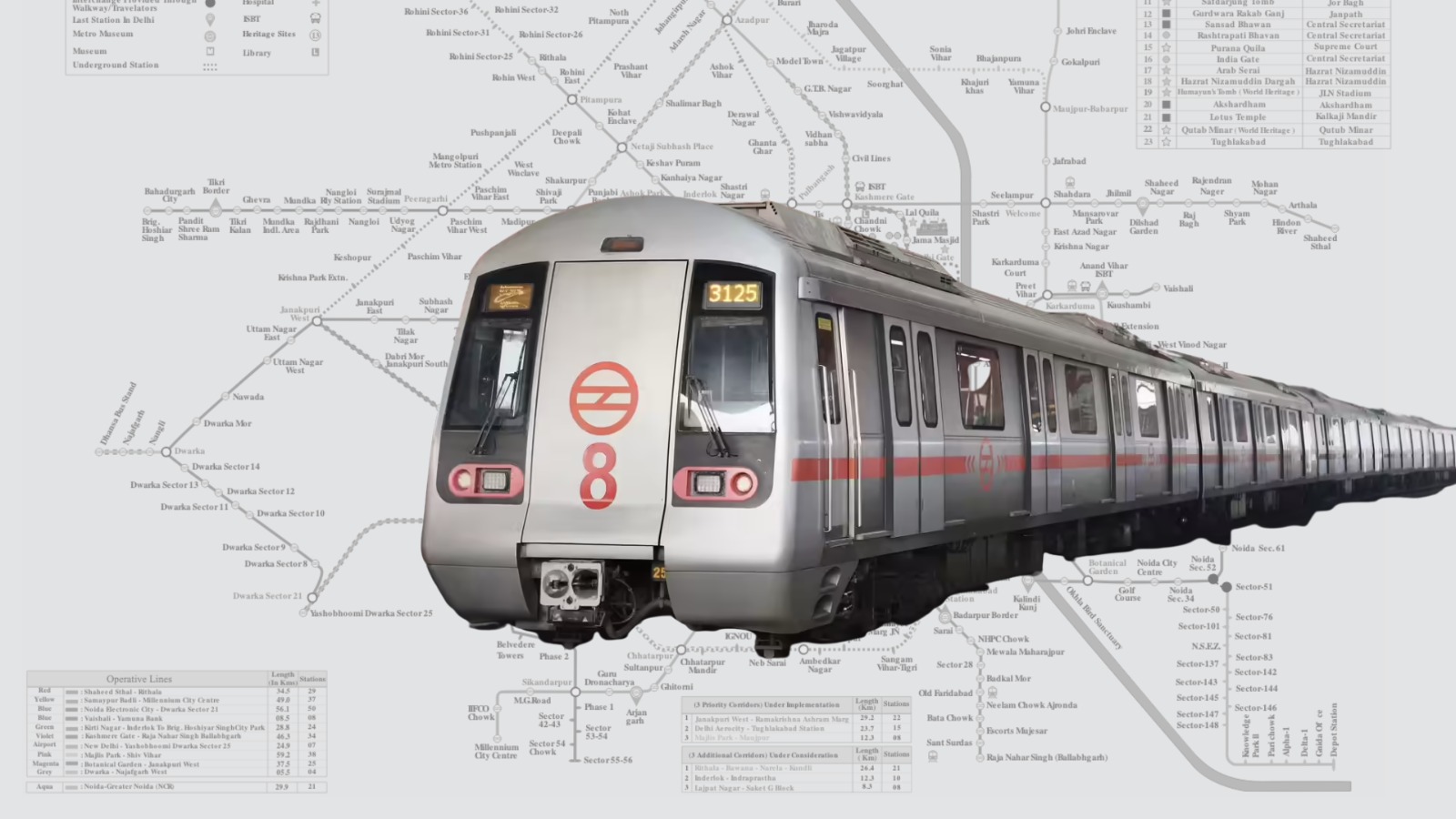
The Delhi Metro is yet another large-scale project termed as “development,” but which seldom aids most of the population.
On a cold November morning last year, two dozen Delhi University students stood outside Nirman Bhawan holding handmade placards. They were demanding a concessional monthly pass for the Delhi Metro from the Transport Ministry. By noon, police had detained more than thirty of them. The confrontation raised an important question: how did Delhi build a metro—hailed as “a dream for years”—that remains unaffordable for the students, migrants, and workers who keep the city running?
The issue was simple math: the cost of bus versus metro travel. Students pay just ₹75 for five months of unlimited bus travel in the city, yet a single metro ride costs over ₹40, a price few poor or migrant workers can afford. Tensions boiled over when the police detained over 30 protesters, preventing their delegation from even entering the Transport Ministry. “It’s clear how threatened the [city] authorities are by students, as they are even blocking our demand for something as basic as a metro pass,” said SFI Delhi president Sooraj Kumar, echoing a campaign backed by over 60,000 signatures.
If the Delhi Metro is, after all, meant for the people—as it has been marketed by the bureaucrats, politicians, and planners—then why was a demand as basic as affordable metro passes provoking the deployment of riot police?
In late 2002, Prime Minister Atal Bihari Vajpayee bought the first official ticket, declaring that “Delhi had seen a dream for years; today that dream is coming true. Metro was a big need in Delhi.” The Metro was indeed a marvel of modern engineering: fully air-conditioned coaches, state-of-the-art signaling, and sprawling elevated tracks. Politicians from Sheila Dikshit to Narendra Modi framed it as a symbol of 21st-century India, likening it to “the dams of modern India,” anointing the metro as something that conferred prestige on any city that had one.
However, the Metro was built on loans and tax breaks—a capital-intensive juggernaut largely inaccessible to the everyday commuter. About 60% of the Metro’s Phase I funding came from concessional loans (mostly from Japan’s JICA), which Delhi Metro Rail Commission (DMRC) officials later cited as a reason they “are already in debt” and could not afford fare concessions. Strict financial guidelines even prevented early DMRC employees from any discounted travel, as spokesman Anuj Dayal reminded students in 2006: “We have taken 60% of our budget cost as a loan from Japan… and are in no position to give a concession to anybody.”
From the outset, the Delhi Metro was clearly never intended to be a public transport system for all. It was engineered as a prestige project financed by foreign debt and justified through cost-recovery logic. The Delhi Metro is yet another large-scale project termed as “development,” but which seldom aids most of the population; rather, its benefits are experienced only by bureaucrats, corporations, politicians, and a handful of the upper-middle class. In most ways, however, the metro is a spectacle, which we look at in awe.
Prestige Play and A Luxury for the Privileged
On social media and in interviews, many commuters recount how the Metro largely caters to middle-class men in Delhi—office-goers heading to Connaught Place or Gurgaon, who can walk or park their cars at stations and then zip downtown. By contrast, an auto-rickshaw puller near Old Delhi or a domestic helper from Seelampur can never afford the ₹60-100 daily fare. Even many IIT students avoid the Metro for trips to the crowded North Campus, preferring the ₹10 bus, an IIT professor told me.
These voices underscore a brutal fact: the Metro’s famed efficiency is moot if you can’t even reach the station cheaply. Studies of Delhi’s public transport show that most people still depend on buses, cycle-rickshaws, or their bicycles for short hops. Yet these modes experience ever-crumbling support. Bus stops often lack shelters or benches; many DTC routes that once served peripheral colonies were scrapped or replaced by the under-financed Bus Cluster scheme; cycle lanes are a mere facade that do not provide much functionality, except along one court-mandated stretch by the Yamuna, and even those vanish into nothing, where pollution and potholes dominate.
In place of these systemic flaws, the Metro has become a prestige play. New lines are unveiled with fanfare (and often a personal ribbon-cutting by the Prime Minister), while long-standing problems remain. For example, despite promises, Delhi still lacks a comprehensive and safe bus rapid transit network. The old Bus Rapid Transit (BRT) corridor on Srinagar Highway was dismantled under political pressure in 2016.
Delhiites say that if officials cared about commuters, they would have built protected cycle tracks and accessible bus lanes decades ago—before launching a ₹100,000 crore rail grid. Urban mobility experts like Professor Geetam Tiwari of IIT-Delhi have long argued that Delhi has never prioritized buses, cycles, or walking. Consider how the Delhi Transport Corporation—which runs the buses—pays dozens of taxes, whereas the Metro enjoys broad exemptions.
According to Tiwari, other government policies reflect this bias: it is keen on “MRTS [Mass Rapid Transit Systems] projects, which will never carry the majority of trips in a city,” but “there is no commitment to improving bus systems or infrastructure for bicycles.”
How the Delhi Metro Excludes: Gender and Disability
In fast-growing Delhi, most neighborhoods, particularly in the outer reaches and resettlement colonies, have poor last-mile connections. Buses in those areas often run infrequently, and auto drivers may refuse to pick up women or charge double fares at night. As one woman in Bawana bluntly put it, “There are no buses or rickshaws in the evening… I must walk back from the factory with other female coworkers. It’s unsafe and exhausting.”
Thus, even as shiny Metro stations sprouted across Lutyens and Gurgaon, for Delhi’s poorest workers, the day began and ended with rocky footpaths, broken streets, and a bus stop that never came.
The social profile of typical Metro riders confirms this divide. Far more men than women ride the trains, reflecting both cultural norms and safety fears. Studies show that only about 20% of Delhi Metro trips are taken by women. When the travel writer Chandrahas Choudhury highlighted this disparity in 2019, he pointed out that “the metro is about twice as expensive as the next available public transport option (usually a bus or shared auto-rickshaw).”
In practice, that means tens of thousands of lower-middle-class working women—maids, helpers, nurses, cleaners—avoid the Metro entirely for purely economic reasons, even if they recognize it is safer and faster.
The only ones flooding the trains are those who can afford the higher fare, typically commuting from affluent neighborhoods on longer journeys to corporate jobs. A 2018 Centre for Science and Environment study found that after a fare hike, the average Delhi commuter spends 14% of household income on Metro rides, second globally only to Hanoi—among systems charging under 50 US cents per trip.
For nearly a third of Delhi riders, Metro travel eats up nearly 20% of household income, far beyond what most poor and even modest-income Delhiites can afford. While the fares for the public buses in Delhi fall well within the ceiling, the problem lies in the fact that the fleet is inadequate to match up with the demands, and the Metro fares, even before the recent hikes, exceed the ceiling.
Metro accessibility issues are compounded for persons with disabilities. Design critic Henri Fanthome observed that the Metro’s accessibility is often just cosmetic. He encountered a blind passenger being led into a train whose path from the street was obstructed by parked cars and broken pavement: “no clear signage, nothing for people with disabilities” on the way to the station. Elsewhere, a “tactile path” for vision-impaired commuters dead-ends into a tree, and many elevators simply don’t work, forcing someone with mobility issues to climb more than 60 stairs at stations like Qutub Minar.
Fanthome concludes that the Metro’s “illusion of design success” evaporates completely when viewed from the perspective of Delhi’s least able riders.
Ignoring the Urban Poor
In addition, Delhi’s transit geography and trip patterns work against the Metro. Many poor commuters work or live within a few kilometres of each other and rarely travel the long distances that justify train travel. This casts serious doubts on the government’s motivations behind hemorrhaging money on the Metro, instead of fortifying other modes of transport.
Tikender Pawar, former deputy mayor of Shimla and a transport expert, notes that “most Indians work in the unorganized sector and prefer to work in a 5-7 km range. And for that, they don’t use metros.” In other words, someone earning ₹200 a day for local construction work will find an early-morning crowded bus or shared auto far cheaper and more direct than a multi-transfer Metro ride.
Chemical-engineer-turned-social-scientist, Dunu Roy, notes that Delhi’s planners repeatedly ignored the reality that “increasing numbers of poor inhabitants continue to live in shantytowns without services…” Despite this majority, successive master plans shunted slum and resettlement colonies to the far edges, funnelling investment instead into highways, luxury real estate, and “tourism” projects.
In practice, decades of building roads and embankments made driving cars through the city easier than commuting by foot or public transport. Working-class Delhiites—laborers, domestic workers, vendors—saw their neighborhoods boxed by ring roads and then largely bypassed by the gleaming infrastructure projects that followed.
These are hardly isolated grievances. Across India, the Metro boom has often ignored local context. In smaller Tier-2 cities such as Jaipur, Lucknow, and Agra, underused metros have become financial albatrosses. A 2024 investigation by The Print found that Jaipur’s 12 km line (opened in 2015) drew only about 50,000 riders per day, in a city of roughly 4 million people. Planners once touted Jaipur’s train as a “jewel in the crown,” but after a decade, it was simply bleeding money, never expanded, and resorted to renting out moving trains for birthday parties to recoup costs.
Architect Madhav Raman warns that “small cities do not need this…it only works where population density is very high.” A 2018 Comptroller & Auditor General report had noted that Jaipur Metro “was not required… till 2025,” yet politicians raced to build it anyway. In Lucknow, too, analysts observed a yawning gap: the metro’s North-South corridor was projected to carry 200,000 riders daily to break even, but barely saw 85,000. Similar shortfalls have dogged Kochi, Mumbai, and other cities.
These cases mirror a global pattern: shiny new rail systems can confer political prestige—especially when lauded as such by the media—but their ridership often disappoints when reality bites. A recent IIT-Delhi study found India’s metros averaging well under half their projected ridership, even in Delhi, prompting government denials that the 2023 rider count had nonetheless overtaken targets. But the lesson remains clear: if commuter trips are short and dispersed, splurging on heavy rail often backfires.
Funding for “mega” transit cannibalizes what little is available for cheaper modes. Since 2005, Delhi has spent more on road-widening and flyovers than on holistic mobility, which would include developing various means of transportation, including a bus system, metro, and even last-mile connectivity methods that are integrated, making commuting cheaper and accessible. This is the case even as the Ministry of Urban Development issued detailed notes on financing metros by leveraging land values.
In one report she co-authored, Tiwari noted that if bus corporations received the same tax breaks as metros, they could turn a profit. Instead, the system traps commuters into always paying for inaccessible modes.
The Way Forward
The students are not seeking free rides, only a structure akin to the DTC’s cheap monthly passes. They point out that the Delhi Metro is frequently ranked among the world’s most expensive on an affordability index. They highlight that the Delhi government and DMRC have repeatedly rebuffed earlier calls for passes, citing financial strain. In late 2022, even the Delhi minister tasked with fares refused a direct request, saying DMRC’s debt load made subsidies impossible.
The Students’ Federation of India’s (SFI) recent protest grew out of a campaign dating to 2019, including meetings with officials and petitions. After massive student voter turnout helped install the current Delhi government, Arvind Kejriwal floated a 50% fare cut for students, even free rides for women—moves E. Sreedharan derided as election gimmicks. The tug-of-war is vivid: the Delhi government’s transport minister has hinted at partial metro subsidies (slated to appear in the latest budget), while central authorities (and the DMRC’s board) continue to insist on cost recovery.
A former DMRC official told The Print that the network could fill in ridership with expansion alone—“as [the] metro network expanded in the city, ridership also increased,” suggesting patience might solve the math—ironic when the Delhi Metro is presented as making commute fast, even as its benefits are two decades too slow to arrive. But student activists and mobility advocates see it differently: they want the resources that built an elite transit backbone to be reallocated toward inclusive solutions now.
On November 13, riot police moved in to evict student protesters. Their chorus rose in defiance: “If workers don’t carry suitcases to Delhi, why can’t they get cheap passes!” The slogan distilled the question of who Delhi’s transport system serves and who it abandons.
In the weeks that followed, activists demanded an independent fare-fixation committee, subsidized monthly passes, and a transit charter guaranteeing affordable access. Their critique went beyond fares. Delhi’s buses, which move far more people than the Metro, remain underfunded and shrinking. Restoring free bus travel for women or adding new routes through slums would cost a fraction of the cost of Metro expansion, yet it lacks political will.
Cycling and walking advocates joined in, calling for curb ramps, continuous sidewalks, and protected crossings—basic infrastructure that has been ignored. At the same time, planners sketch elevated corridors and superhighways for cyclists.
As one activist put it, policy remains captive to “metro man” blueprints that prize spectacle over function. Back at Nirman Bhawan, the SFI had crystallized these frustrations in simple slogans: “Will the CM not listen to citizens?” read one banner. Another displayed a Metro token with crossed-out price tags, followed by the stark reminder: “60k signatures, still unheard.”
The students’ chants proclaimed Delhi as their city too, insisting that education should enable rather than restrict mobility. Their message resonated with passersby who stopped to listen and question. A 50-year-old rickshaw driver, watching the demonstration, offered his own perspective on Delhi’s transport hierarchy. He had never ridden the Metro and saw no reason to start.
“What’s the point?” he asked with a shrug. “If my legs work, I’ll just take the bus.” His pragmatism contrasted sharply with the frustration of younger protesters, particularly the DUSU candidates from SFI who had watched Metro fares rise beyond their reach. “The Metro may have been a dream for some,” they declared, “but it’s becoming a nightmare for others.”
This tension reveals the deeper failure at the heart of Delhi’s transport planning. The Metro was never designed for the majority of Delhi’s residents. Built as a showcase of modern infrastructure, it serves middle-class commuters traveling between formal employment centers while bypassing the dense neighborhoods where most Delhiites live and work. Its stations are monuments to a development model that prioritizes prestige over accessibility, aesthetics over affordability.
The students outside Nirman Bhawan were not simply demanding cheaper rides. They were challenging a vision of the city that treats public transport as a luxury service rather than a basic necessity. Their protest points toward an alternative—a Delhi that prioritizes buses over metros, sidewalks over skyways, and universal access over architectural grandeur. Whether policymakers will listen remains an open question, but the voices from the pavement grow louder each day.
SUPPORT US
We like bringing the stories that don’t get told to you. For that, we need your support. However small, we would appreciate it.
Ankush Pal is a sociologist trained at the London School of Economics and Political Science, researching inequalities, public space, South Asian culture, and urbanization. He is currently working on spatiality, infrastructural imperialism, and poly-coloniality in Bengal.
Related Posts