





For millennials and the generations before them who grew up consuming popular Tamil cinema, it may be a cultural shock to witness all kinds of meat—including pork and beef—being slaughtered, cooked, and consumed onscreen.
Today, a section of Tamil cinema is undoing the culinary worldviews produced and distributed for mass consumption in the past. Films like Pa. Ranjith’s Blue Star (2024) and Era Saravanan’s Nandhan (2024) have especially stretched the seeable, speakable, and showable food on screen for a mainstream Tamil audience. Close-up visuals of pork and beef slaughtering are a big deal because in the Indian subcontinent, pork and beef eating are directly linked to caste.
According to a caste-based worldview, those who abstain from all forms of meat eating are considered morally superior, those who consume pork and beef are considered inferior to all, and everyone else takes positions in between. The most infamous of Vedic texts, Manusmriti—considered extremely oppressive towards women and oppressed caste people, especially Dalits—rationalized inequalities through its prescriptions of taste and etiquette mostly related to food.
Popular Tamil films also reflected the crux of this matter for a long time, showing villainous characters eating meat-heavy food and thereby situating meat in the context of antagonism. For instance, Kamal Haasan’s Thevar Magan (1992), a Madurai-style film, belongs to that lazy category where Kamal Haasan (Sakthivelu) and his father Sivaji Ganesan (Peria Thevar) are seen having “clean” eating habits where they eat from proper banana leaf in a Brahminic format of men-eat-first followed by women reinforcing the norms of eating practice in “respectable” families.
In an essay on Equatorial Guinea and African cuisines, scholar Igor Cusack writes, “the presence or absence of food in novels or poems is usually not noted by the casual reader.” True, one may or may not be watchful of the food in the movie one watches. It may be at the periphery of a frame. But food implicitly works with the audience’s minds.
A Culinary Arc through Blue Star
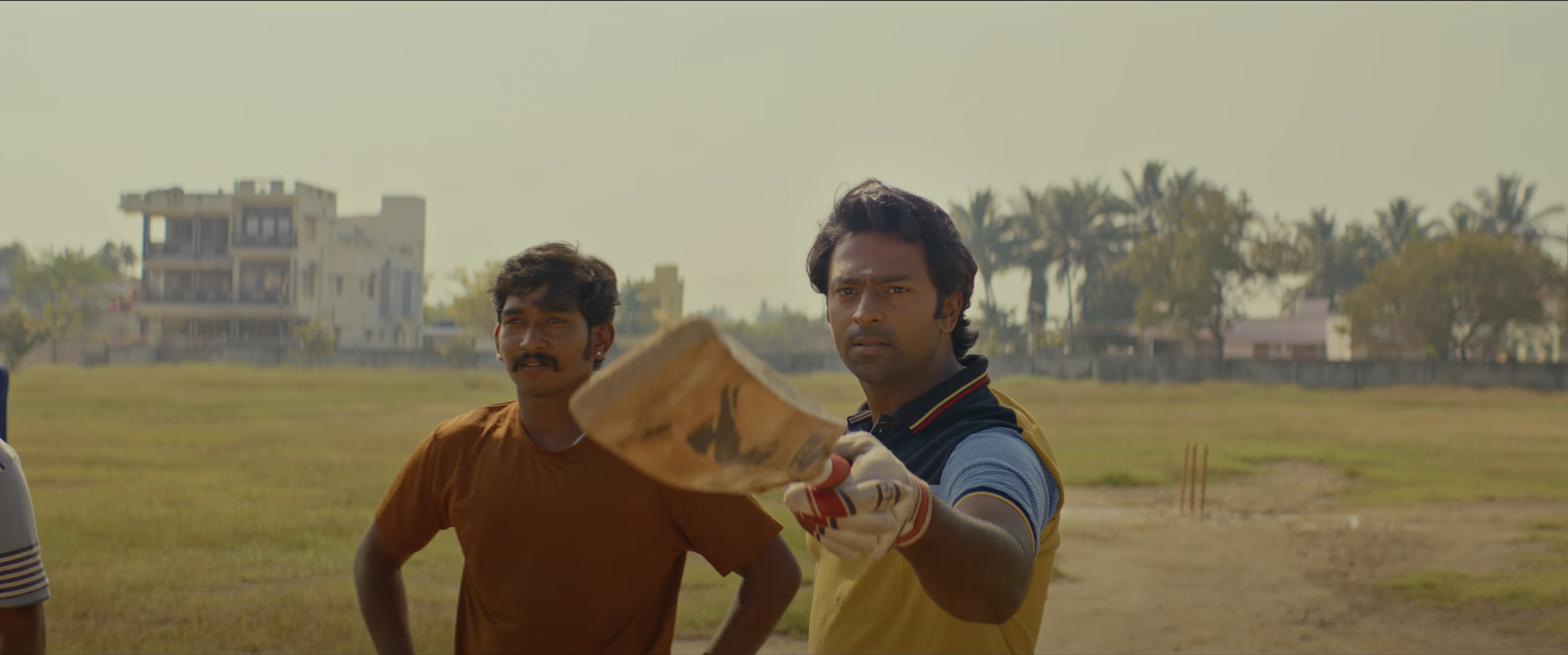
Creators like Pa. Ranjith have overturned the protein protocol of Tamil cinema—beef and pork slaughtering have become a cornerstone in movies like his, to represent Dalit living and everyday experience.
Produced by Pa. Ranjith’s Neelam Productions and directed by S. Jayakumar, Blue Star is set in the railway town of Arakkonam and is a cricket story, which is considered a genre in itself.
Blue Star revolves around the aspirations of a bunch of Dalit youth to play a match against their dominant caste counterparts in their village deity’s carnival.
The complete absence of the winning cricket-and-nationalism theme is particularly significant given the politics of such films. For instance, Lagaan (2001), Iqbal (2005), and various biopics of sports stars, including M.S. Dhoni: The Untold Story (2016), invoke a strong sense of nationalism, and playing for Team India is an extremely noble act.
But Blue Star shows us that we haven’t heard the cricket story from everyone—especially Dalits. In the film, food is used as a symbol to inform the virtual distance between the big aspirations of young players wanting to play for the country (those who can even dream of it, in the first place), and the ones whose fight is to play on the same pitch against their own townspeople hailing from a supposedly better caste position.
The movie opens with visuals of pork being slaughtered, and Dr. Ambedkar’s statue, which zooms out further to the town’s outskirts before zooming into a Dalit Christian settlement. Such a close-up shot of meat slaughtering, especially pork, is unprecedented in mainstream cinema. Pork meat shops in India are found on the outskirts in the buffer area between villages or towns. The film’s opening thus shifts the virtual proscenium to the periphery, an allegory for what is to come.
The protagonist, Ashok Selvan (Ranjith), is introduced in alternating frames with a bat which he taps on the ground, and the whetting of knives by butchers in his area. We see them play in the fallow lands and pray in a church of thatch. We also see that they do not just feed on leftovers, but on fresh meat that is considered so inappropriate to be seen on big screens.
In his 2024 book Dalit Kitchens of Marathwada, Shahu Patole writes, “the upper classes had neither time nor interest to find out what this (Dalit) category ate.” The author also points out that the food of the dominant caste of a region has always passed off as the food of the region itself.
For instance, the widely used metonymy for Tamils is filter coffee and vegetarian breakfast like idli, dosa, and medu vada by the popular cinema from Ek Duuje Ke Liye (1981) to Chennai Express (2013). It is a lie in the face of millions of Tamils who consume large amounts of meat and fish. According to a survey released by the Registrar General of India, 97.65 percent of the population in Tamil Nadu consumes meat.
Bollywood cannot be singled out for such misleading portrayals about Tamil tastes. Tamil films themselves have been using the tenets of vegetarianism to produce a visual culture of proper and improper food of the Tamils. For instance, Michael Madana Kama Rajan (1990) shows fish as an ingredient of disgust and unacceptable by setting it in a comical scene of Tamil Brahmin cooks who accidentally discover the ingredient in their kitchen.
In the scene, Kamal Haasan (Kameshwaran) plays a sidekick who works under his father, Delhi Ganesh (Palakkad Mani Iyer), a sought-after Brahmin cook who is renowned for his “pure” cooking legacy. In the Brahmin kitchen, a sliver of fish accidentally slips into a life-sized cauldron of boiling sambhar when no one notices, all busy bantering, and the scene itself produces an air of light-heartedness to the audience.
But hell breaks loose when a ladle of sambhar with fish lands in a vegetarian guest’s banana leaf. The entire scene’s fun is elevated to another level for the audience. But what is waiting for a quick mind probe is this: the ingredient of pollution in the scene could have been anything. It could have been anything inedible or inanimate, like a shoe.
Yet fish, an everyday staple for scores of Tamils who consider it perfectly edible—and also the target audience of the scene—as the choice of pollution marker goes to inform the culinary hegemony of a select few dominant caste in the Tamil film industry.
The scene is intended to be light-hearted, but the message it conveys is damaging. The damage is that even today, fish is relegated to a food that’s unacceptable to be eaten in public. Schools with brazen no-meat and fish for lunch policies, for example, are becoming increasingly common in Tamil Nadu.
In fact, ritual sacrifice of birds and animals like chicken, goat, and buffalo is a common practice across rural Tamil Nadu, and is an annual phenomenon in sync with the agrarian cycle. However, laws banning such sacrifices—brought about by reformist Hindu ideologies leaders and policy-makers—have been in effect since 1950. But it was never practically implemented because of the scale of this practice.
However, in 2003, then-Chief Minister Jayalalitha suddenly called for enforcing the law. Its immense repercussions in rural Tamil Nadu—from the disruption of temple festivals centred on goat or chicken sacrifice to subsequent mass protests—led to the entire Act being repealed a few months later.
These two worldviews of Hindu religiosity, according to Anthony Good’s “Animal Sacrifice and the Law in Tamil Nadu,” have never been about religiosity but an altering political scene.
The aesthetic of beef and pork as food of the good characters was absent because Dalits were absent as creators in Tamil cinema, until Pa. Ranjith, Mari Selvaraj, Vetrimaran brought stories of how they live, and what they eat. Shahu Patole, in the book, also writes about the cultural shock experienced by Marathi readers in the 1970s with the rise of Dalit literature, which increasingly portrayed their everyday lives and food descriptions.
Unsurprisingly, then, films like Blue Star have created ripples across Tamil popular cinema. The film was received well both critically and commercially. Though not a blockbuster hit, it performed well in its first seven days. In a review, Pa. Ranjith is called “the mastermind in transforming the zeitgeist towards a cinema movement that calls for equality, peace, and love for all.”
Nandhan Calls for New Codes of Commensality
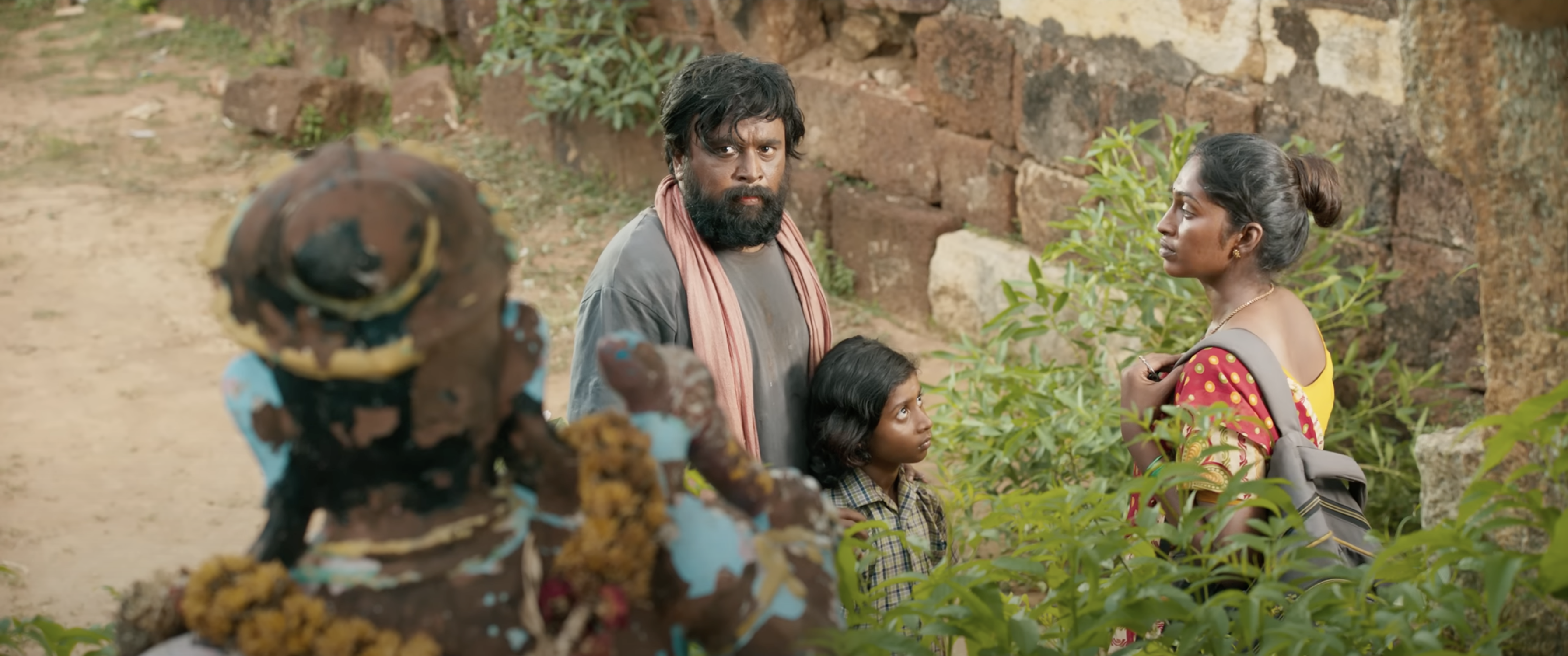
Nandhan revolves around a loyal Dalit sidekick, Koozhpaanai (Sasi Kumar), and his dominant caste employer, Koppulingam (Balaji Sakthivel), who also happens to be their village Panchayat president for many successive terms, with no one else to file a nomination to contest against him (something he is immensely proud of). The equilibrium and order of matters remain unmoved between them—the Dalit employee subservient perpetually, and his master presiding over the lives of others surrounding him.
But hell breaks loose when the village Panchayat is unexpectedly declared as reserved by the government. This means that the Panchayat chair can only be presided over by a Scheduled Caste candidate. It hurts the ego of the dominant-caste Koppulingam, who cannot fathom the idea of being ruled by a Dalit village head. He exploits the feudal order of matters in the village to hoodwink the state. He makes his subservient farmhand, Koozhpanai, win the election by making him the premier candidate of choice, stopping anyone else from even filing a nomination.
The most piercing communicative expression happens through food in Nandhan. Koppulingam’s smallness and outright violent nature are exhibited when he makes Koozhpaanai dine with his kin men, whom he wants to disgrace, because of a feud. It is not only about who eats that is rooted in caste, but also who eats with whom. A dominant caste, according to Manusmriti, cannot dine with an oppressed caste or outcast and can never eat food cooked by an oppressed-caste person. The scene thus uses this heinous cultural practice based on the codes of commensality—the act of breaking bread together—to demonstrate Koppulingam’s capacity for evil.
Unable to read this, the innocent Koozhpaanai rejoices at his cunning master’s crafty behaviour while Koppulingam’s relatives feel utterly disgraced. Koppulingam’s grotesqueness is aided by his wife, who employs facial twists and fluttering lips to express the wrongness of Koozhpanai dining with them. The other diners suddenly freeze upon realizing that Koozhpanai was sharing a table with them—the pièce de résistance of the film’s usage of commensal protocols to convey evil.
Today, food remains at the heart of violent caste-based discrimination all over India. More recently, the killing of a 23-year-old Jeetendra in Uttarakhand in April 2019 by dominant caste men also happened due to his dining with other dominant caste people in the front row of a wedding feast.
Nandhan is allegorically a fight between the state founded on the principles of equality and the average Indian village order, which isn’t far removed from feudal order. The film ends with multiple testimonies of real-life Dalit Panchayat leaders from reserved village Panchayats, on whose traumatic experiences the movie is loosely based.
Before Nandhan, scenes about commensal codes were tried in the past, in films like Mudhal Mariyadhai (1985), where another classic fish-eating scene in the film is etched in the hearts of Tamil cinema fans: where Malaichami (Sivaji Ganesan) and Kuyil (Radha) slurp freshly cooked fish clean off the bone. But underlining the scene is the fact that Kuyil is an oppressed caste spinster who persuades the dominant caste village head, Malaichami, to eat at her place.
The creators of the film clearly wanted to have the scene, but were also unsure of hurting the sensibilities of their dominant caste audience. And while the scene is widely regarded as an intimate moment between the two, given their caste positions, their intimacy had to be justified.
Therefore, to validate Malaichami’s otherwise “inappropriate” eating with a young woman from an outcast group, they instrumentalized the character of Ponnatha (Vadivukarasi). Ponnatha serves her husband stale food in her left hand while clearing her snot with her right hand. She is shown serving him fermented rice pap gruel, which is stale beyond consumption. Malaichami is thus unable to eat, and his only option is to dine with Kuyil.
Nandhan represents a major departure from this kind of storytelling for Tamil audiences. The increasing presence of all kinds of meat and speaking of Dalit discourses in the context of taste for mass audiences is like living the dream of all those who fought for dignity and equal opportunity. C.S. Lakshmi, in her translator’s preface of Black Coffee in a Coconut Shell, writes, “to do away with caste, we only had to deny its existence and assert our own casteless status.” She ends by writing, “it needs confrontation and overcoming.”


Food, Caste, and Popular Cinema: How Blue Star and Nandhan Subvert Brahminical Codes of Commensality
The posters of Nandhan and Blue Star.
For millennials and the generations before them who grew up consuming popular Tamil cinema, it may be a cultural shock to witness all kinds of meat—including pork and beef—being slaughtered, cooked, and consumed onscreen.
Today, a section of Tamil cinema is undoing the culinary worldviews produced and distributed for mass consumption in the past. Films like Pa. Ranjith’s Blue Star (2024) and Era Saravanan’s Nandhan (2024) have especially stretched the seeable, speakable, and showable food on screen for a mainstream Tamil audience. Close-up visuals of pork and beef slaughtering are a big deal because in the Indian subcontinent, pork and beef eating are directly linked to caste.
According to a caste-based worldview, those who abstain from all forms of meat eating are considered morally superior, those who consume pork and beef are considered inferior to all, and everyone else takes positions in between. The most infamous of Vedic texts, Manusmriti—considered extremely oppressive towards women and oppressed caste people, especially Dalits—rationalized inequalities through its prescriptions of taste and etiquette mostly related to food.
Popular Tamil films also reflected the crux of this matter for a long time, showing villainous characters eating meat-heavy food and thereby situating meat in the context of antagonism. For instance, Kamal Haasan’s Thevar Magan (1992), a Madurai-style film, belongs to that lazy category where Kamal Haasan (Sakthivelu) and his father Sivaji Ganesan (Peria Thevar) are seen having “clean” eating habits where they eat from proper banana leaf in a Brahminic format of men-eat-first followed by women reinforcing the norms of eating practice in “respectable” families.
In an essay on Equatorial Guinea and African cuisines, scholar Igor Cusack writes, “the presence or absence of food in novels or poems is usually not noted by the casual reader.” True, one may or may not be watchful of the food in the movie one watches. It may be at the periphery of a frame. But food implicitly works with the audience’s minds.
A Culinary Arc through Blue Star
Creators like Pa. Ranjith have overturned the protein protocol of Tamil cinema—beef and pork slaughtering have become a cornerstone in movies like his, to represent Dalit living and everyday experience.
Produced by Pa. Ranjith’s Neelam Productions and directed by S. Jayakumar, Blue Star is set in the railway town of Arakkonam and is a cricket story, which is considered a genre in itself.
Blue Star revolves around the aspirations of a bunch of Dalit youth to play a match against their dominant caste counterparts in their village deity’s carnival.
The complete absence of the winning cricket-and-nationalism theme is particularly significant given the politics of such films. For instance, Lagaan (2001), Iqbal (2005), and various biopics of sports stars, including M.S. Dhoni: The Untold Story (2016), invoke a strong sense of nationalism, and playing for Team India is an extremely noble act.
But Blue Star shows us that we haven’t heard the cricket story from everyone—especially Dalits. In the film, food is used as a symbol to inform the virtual distance between the big aspirations of young players wanting to play for the country (those who can even dream of it, in the first place), and the ones whose fight is to play on the same pitch against their own townspeople hailing from a supposedly better caste position.
The movie opens with visuals of pork being slaughtered, and Dr. Ambedkar’s statue, which zooms out further to the town’s outskirts before zooming into a Dalit Christian settlement. Such a close-up shot of meat slaughtering, especially pork, is unprecedented in mainstream cinema. Pork meat shops in India are found on the outskirts in the buffer area between villages or towns. The film’s opening thus shifts the virtual proscenium to the periphery, an allegory for what is to come.
The protagonist, Ashok Selvan (Ranjith), is introduced in alternating frames with a bat which he taps on the ground, and the whetting of knives by butchers in his area. We see them play in the fallow lands and pray in a church of thatch. We also see that they do not just feed on leftovers, but on fresh meat that is considered so inappropriate to be seen on big screens.
In his 2024 book Dalit Kitchens of Marathwada, Shahu Patole writes, “the upper classes had neither time nor interest to find out what this (Dalit) category ate.” The author also points out that the food of the dominant caste of a region has always passed off as the food of the region itself.
For instance, the widely used metonymy for Tamils is filter coffee and vegetarian breakfast like idli, dosa, and medu vada by the popular cinema from Ek Duuje Ke Liye (1981) to Chennai Express (2013). It is a lie in the face of millions of Tamils who consume large amounts of meat and fish. According to a survey released by the Registrar General of India, 97.65 percent of the population in Tamil Nadu consumes meat.
Bollywood cannot be singled out for such misleading portrayals about Tamil tastes. Tamil films themselves have been using the tenets of vegetarianism to produce a visual culture of proper and improper food of the Tamils. For instance, Michael Madana Kama Rajan (1990) shows fish as an ingredient of disgust and unacceptable by setting it in a comical scene of Tamil Brahmin cooks who accidentally discover the ingredient in their kitchen.
In the scene, Kamal Haasan (Kameshwaran) plays a sidekick who works under his father, Delhi Ganesh (Palakkad Mani Iyer), a sought-after Brahmin cook who is renowned for his “pure” cooking legacy. In the Brahmin kitchen, a sliver of fish accidentally slips into a life-sized cauldron of boiling sambhar when no one notices, all busy bantering, and the scene itself produces an air of light-heartedness to the audience.
But hell breaks loose when a ladle of sambhar with fish lands in a vegetarian guest’s banana leaf. The entire scene’s fun is elevated to another level for the audience. But what is waiting for a quick mind probe is this: the ingredient of pollution in the scene could have been anything. It could have been anything inedible or inanimate, like a shoe.
Yet fish, an everyday staple for scores of Tamils who consider it perfectly edible—and also the target audience of the scene—as the choice of pollution marker goes to inform the culinary hegemony of a select few dominant caste in the Tamil film industry.
The scene is intended to be light-hearted, but the message it conveys is damaging. The damage is that even today, fish is relegated to a food that’s unacceptable to be eaten in public. Schools with brazen no-meat and fish for lunch policies, for example, are becoming increasingly common in Tamil Nadu.
In fact, ritual sacrifice of birds and animals like chicken, goat, and buffalo is a common practice across rural Tamil Nadu, and is an annual phenomenon in sync with the agrarian cycle. However, laws banning such sacrifices—brought about by reformist Hindu ideologies leaders and policy-makers—have been in effect since 1950. But it was never practically implemented because of the scale of this practice.
However, in 2003, then-Chief Minister Jayalalitha suddenly called for enforcing the law. Its immense repercussions in rural Tamil Nadu—from the disruption of temple festivals centred on goat or chicken sacrifice to subsequent mass protests—led to the entire Act being repealed a few months later.
These two worldviews of Hindu religiosity, according to Anthony Good’s “Animal Sacrifice and the Law in Tamil Nadu,” have never been about religiosity but an altering political scene.
The aesthetic of beef and pork as food of the good characters was absent because Dalits were absent as creators in Tamil cinema, until Pa. Ranjith, Mari Selvaraj, Vetrimaran brought stories of how they live, and what they eat. Shahu Patole, in the book, also writes about the cultural shock experienced by Marathi readers in the 1970s with the rise of Dalit literature, which increasingly portrayed their everyday lives and food descriptions.
Unsurprisingly, then, films like Blue Star have created ripples across Tamil popular cinema. The film was received well both critically and commercially. Though not a blockbuster hit, it performed well in its first seven days. In a review, Pa. Ranjith is called “the mastermind in transforming the zeitgeist towards a cinema movement that calls for equality, peace, and love for all.”
Nandhan Calls for New Codes of Commensality
Nandhan revolves around a loyal Dalit sidekick, Koozhpaanai (Sasi Kumar), and his dominant caste employer, Koppulingam (Balaji Sakthivel), who also happens to be their village Panchayat president for many successive terms, with no one else to file a nomination to contest against him (something he is immensely proud of). The equilibrium and order of matters remain unmoved between them—the Dalit employee subservient perpetually, and his master presiding over the lives of others surrounding him.
But hell breaks loose when the village Panchayat is unexpectedly declared as reserved by the government. This means that the Panchayat chair can only be presided over by a Scheduled Caste candidate. It hurts the ego of the dominant-caste Koppulingam, who cannot fathom the idea of being ruled by a Dalit village head. He exploits the feudal order of matters in the village to hoodwink the state. He makes his subservient farmhand, Koozhpanai, win the election by making him the premier candidate of choice, stopping anyone else from even filing a nomination.
The most piercing communicative expression happens through food in Nandhan. Koppulingam’s smallness and outright violent nature are exhibited when he makes Koozhpaanai dine with his kin men, whom he wants to disgrace, because of a feud. It is not only about who eats that is rooted in caste, but also who eats with whom. A dominant caste, according to Manusmriti, cannot dine with an oppressed caste or outcast and can never eat food cooked by an oppressed-caste person. The scene thus uses this heinous cultural practice based on the codes of commensality—the act of breaking bread together—to demonstrate Koppulingam’s capacity for evil.
Unable to read this, the innocent Koozhpaanai rejoices at his cunning master’s crafty behaviour while Koppulingam’s relatives feel utterly disgraced. Koppulingam’s grotesqueness is aided by his wife, who employs facial twists and fluttering lips to express the wrongness of Koozhpanai dining with them. The other diners suddenly freeze upon realizing that Koozhpanai was sharing a table with them—the pièce de résistance of the film’s usage of commensal protocols to convey evil.
Today, food remains at the heart of violent caste-based discrimination all over India. More recently, the killing of a 23-year-old Jeetendra in Uttarakhand in April 2019 by dominant caste men also happened due to his dining with other dominant caste people in the front row of a wedding feast.
Nandhan is allegorically a fight between the state founded on the principles of equality and the average Indian village order, which isn’t far removed from feudal order. The film ends with multiple testimonies of real-life Dalit Panchayat leaders from reserved village Panchayats, on whose traumatic experiences the movie is loosely based.
Before Nandhan, scenes about commensal codes were tried in the past, in films like Mudhal Mariyadhai (1985), where another classic fish-eating scene in the film is etched in the hearts of Tamil cinema fans: where Malaichami (Sivaji Ganesan) and Kuyil (Radha) slurp freshly cooked fish clean off the bone. But underlining the scene is the fact that Kuyil is an oppressed caste spinster who persuades the dominant caste village head, Malaichami, to eat at her place.
The creators of the film clearly wanted to have the scene, but were also unsure of hurting the sensibilities of their dominant caste audience. And while the scene is widely regarded as an intimate moment between the two, given their caste positions, their intimacy had to be justified.
Therefore, to validate Malaichami’s otherwise “inappropriate” eating with a young woman from an outcast group, they instrumentalized the character of Ponnatha (Vadivukarasi). Ponnatha serves her husband stale food in her left hand while clearing her snot with her right hand. She is shown serving him fermented rice pap gruel, which is stale beyond consumption. Malaichami is thus unable to eat, and his only option is to dine with Kuyil.
Nandhan represents a major departure from this kind of storytelling for Tamil audiences. The increasing presence of all kinds of meat and speaking of Dalit discourses in the context of taste for mass audiences is like living the dream of all those who fought for dignity and equal opportunity. C.S. Lakshmi, in her translator’s preface of Black Coffee in a Coconut Shell, writes, “to do away with caste, we only had to deny its existence and assert our own casteless status.” She ends by writing, “it needs confrontation and overcoming.”