


Madras, one of India’s major metropolitan centres, has become a key site for the expansion of platform capitalism and the reconfiguration of urban informal labor. Digital ride-hailing and delivery platforms such as Ola, Uber, Rapido, Swiggy, and Zomato have proliferated over the past decade.
In a city reorganized by platform capitalism and shrinking informal incomes, women’s work is persistently framed either as empowerment or exception—celebrated as entrepreneurial freedom or marked as anomalous disruption. Auto Queens, a 30-minute Tamil documentary directed and edited by Sraiyanti Haricharan, refuses both these frames, instead situating women’s auto-driving as ordinary labor embedded within gendered regimes of precarity, urban space, and collective struggle.
The 2025 film follows the everyday lives of Leela Rani, Mohanasundari, and the union they built—Veera Pengal Munnetra Sangam (VPMS, translating to Courageous Women’s Union for Emancipation). The VPMS is India’s first women auto-rickshaw drivers’ cooperative in Madras, and Haricharan documents how women build systems of care inside a city that offers them neither space nor safety.
The refusal to document women’s work as an exception or empowerment extends to form. There is no explanatory narration, no sentimental framing of struggle, and no external voice translating politics for the viewer. Instead, Haricharan portrays labor itself—inside autos, at union meetings, on the road—as the site where politics is produced.
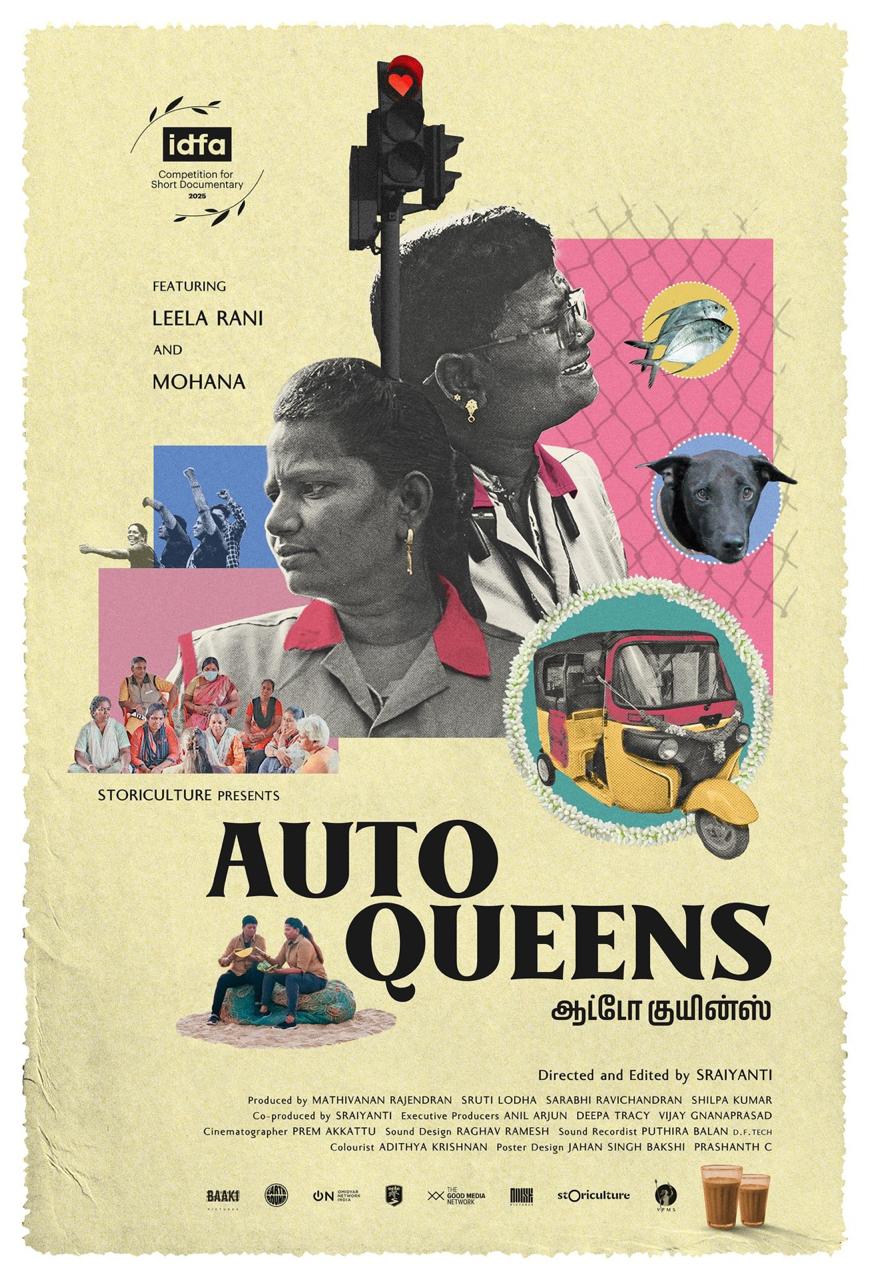
Today, there are nearly 500 women auto drivers in Madras, a fact largely invisible within dominant narratives of urban labor. From the beginning, Auto Queens was conceived not simply as representation but as an intervention into how working-class women’s organizing circulates, and where it is allowed to circulate.
Vijay Gnanaprasad (ECTE) first brought the union’s story to the filmmakers and played a key role in early organizing. Produced by Storiculture (Humans in the Loop, Taak)—whose work has sought to rethink how films are made, funded, and circulated—Auto Queens treats film distribution itself as a site of labor.
For example, the film process included a five-day media camp for 60 women from the union to give them narrative agency, including teaching them how to use technology like Instagram Reels to narrate their stories. Daily wages were paid, recognizing that time away from driving has a material cost.
Auto Queens does not arrive with conclusions already formed. Instead, it listens, walks, waits. Even though the film’s duration is short, the time feels stretched, as the narrative emerges from the rhythm of collective urban life rather than from a pre-scripted arc.
The Filmmakers and Their Gaze
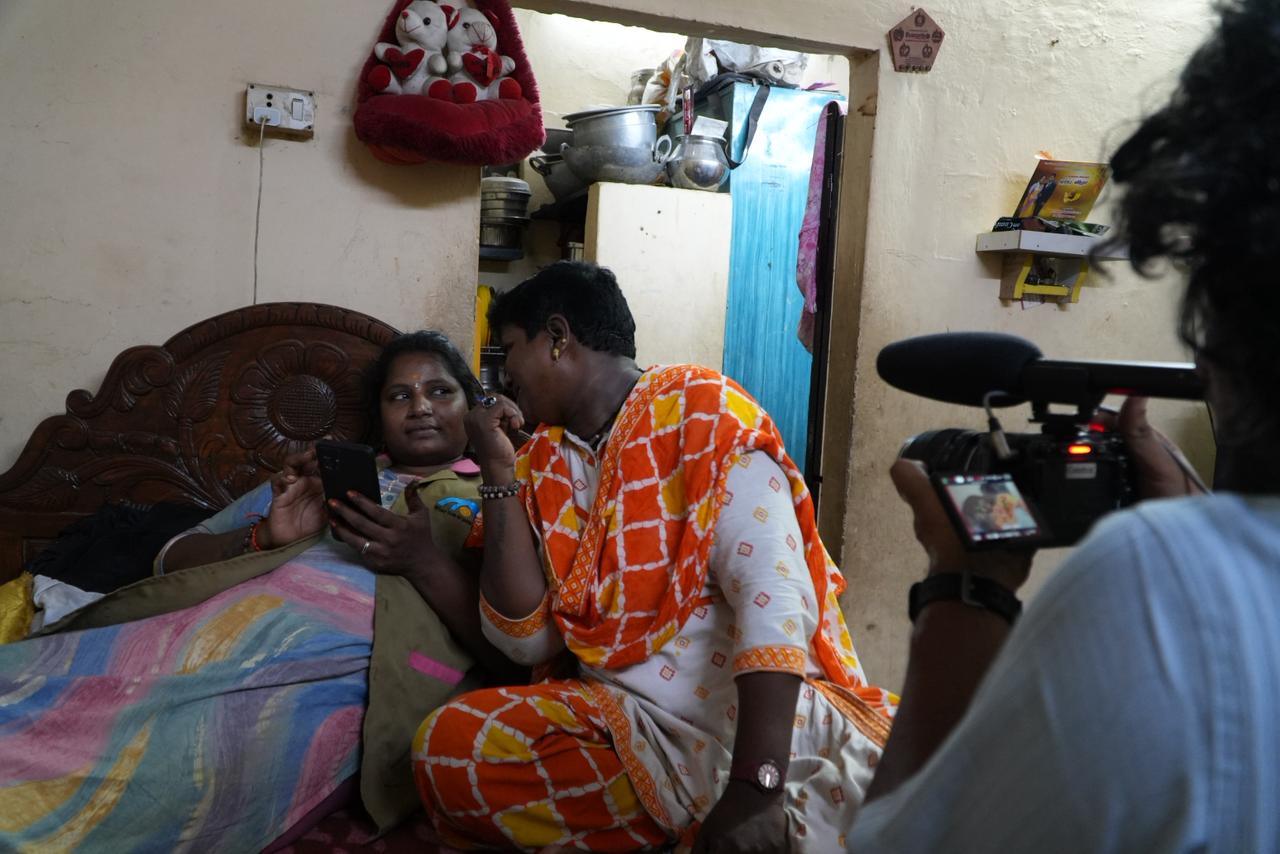
The film’s politics emerge in how it chooses to see. For cinematographer Prem Akkattu, Auto Queens’ ethics are inseparable from its makers’ own experiences as workers within extractive media economies. Akkattu’s intervention is about the stark difference he observed between the VPMS rickshaw union and cinema unions. In cinema, he noted, those who present themselves as “leaders” are often owners rather than workers, which renders labor politics structurally unintelligible to them.
Both Akkattu and Haricharan encountered suspicion when they spoke about collective organization within the film industry: What benefits will you give? What benefit do you want?—as if collectivization could only be understood in transactional terms. For those positioned above the class hierarchy, unions appeared coercive, something that forces people to join. However, for those below, union membership was a minimal condition for survival, a defence against elimination.
Akkattu recalls the relief of working on Auto Queens after experiences in commercial Malayalam and Tamil cinema, and even politically progressive documentary projects in Bombay. Underpayment, lack of credit, and being treated as replaceable labor left a stinging sensation. Those rejections and denials shaped the ethics of Auto Queens—clear ideas of how not to work.
He is also acutely aware of how much power a cinematographer wields in documentary filmmaking. “Characters become conscious of the camera,” he said. “The camera always carries a narrative even when you don’t mean it to.”
Haricharan’s approach was shaped by sustained engagement with the union and building relationships with the members, whereas it was conversations with the members that motivated Akkattu. “For the first few days, we weren’t really talking,” Akkattu admitted. “Then we started walking with them.” Interviews followed: long, unhurried conversations with union members. “The narrative came from there,” he said. While the project unfolded over roughly 1.5 years, the core production cycle took about six months.
One decision was made quickly: they would not isolate Leela or Mohana as heroic individuals. Instead, their friendship—its teasing, corrections, disagreements—became central not just to the film but also to the union they built. This dynamic is visible even in how they name power. While talking to me, Leela said at one point, unapologetically, “I have the arrogance of a man.” “No,” Mohana interrupted. “It’s the arrogance of women. That’s how it should be named.”
Later, Leela recounted an incident that clarified what she meant. “One night, a man asked for a drop at 9:30,” she said. “I told him it was late and asked him to take another auto. He said, ‘You are very arrogant.’” She paused. “How is it arrogance when all I said was that it is late, respectfully?”
Auto Queens thus centres Leela and Mohana not simply as subjects framed by the camera, but as figures through whom collective labor produces forms of organization, ethics, and politics. The union they built is not merely a contextual background but a narrative axis around which the film’s temporal and affective structure circulates. Friendship, rather than victimhood, becomes the film’s organizing affect.
Friendships and Space
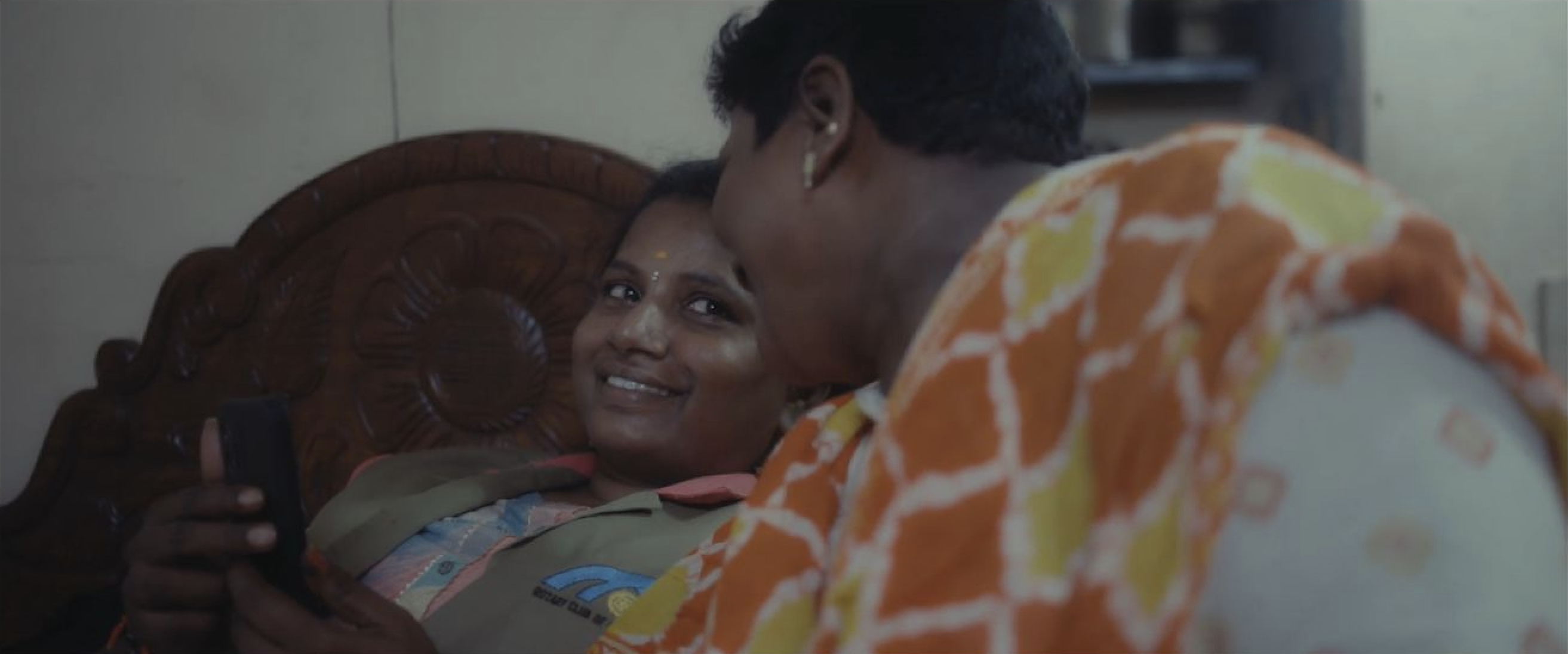
Leela, born and raised in Madras, has been driving an auto for over 25 years, having entered the profession to support herself and her child after leaving an abusive marriage.
In a late scene, as she and Mohana sit on a moored boat under the moon, talking of strategy and patience, Leela reflects that since 2008, “the world forced me to channel my masculinity.” Rage became armor; love and violence are not opposites but temporal strategies, each mobilized to force change in men.
She says this with cropped hair, studs and gold earrings, vermilion and sandalwood pressed onto skin, holding together a body that does not settle into the recognizable scripts of femininity. Once, she wore her hair long and braided jasmine into it, until a passenger touched her hair and body without consent. She cut it soon after and has kept it short since—a refusal carried on the surface of the body.
The film does not reduce Leela to injury; instead, it frames her through scenes of work, union activity, leisure, and everyday negotiation, allowing labor rather than trauma to anchor her cinematic presence. In conversation, she described work as moral and even spiritual, and insisted that union membership gave her a sense of freedom she had never previously known.
While Auto Queens presents Mohana primarily as an organizer and interlocutor, our conversations trace a long trajectory of education, migration, and serial labor that precedes and underwrites this representation. Mohana comes from Thirukazhukundram (Sengapettu), from a farming family that later migrated to Madras. She recalled her mother’s insistence that she attend school, even if only up to the eighth standard, and described the city as a space that “gives knowledge.” From a young age, she moved through multiple forms of precarious work—15-20 jobs, including screen printing and milk packet disposal units—before turning to driving.
Leela and Mohana have known each other for close to 8 years now, and they arrive at work together, arguing and laughing in the same breath, feeding each other fish, the day already a shared terrain. Between routes and reels, snakes and strategies, friendship is forged in the rhythms of surviving and organizing side by side. The film renders their friendship as its emotional and organizational spine, situating unionization as an affective relation before it becomes institutional.
Empirical studies of Madras’ gig economy document declining incentives, extended working hours, and persistent insecurity. These developments unfold within a broader labor regime in which informality remains the dominant condition of work—over 90 percent of India’s workforce continues to be employed in informal or informalized arrangements.
Auto Queens gestures toward the broader political economy of platform capitalism through brief montage sequences—images of Ola, Uber, Swiggy, and Zomato—signalling an environment that has hollowed out informal auto labor and situating the women’s union within a wider landscape of platformised urban mobility. Unionization is thus stitched together from what the city withholds, such as credit, safety, dignity; denials that press upon labor and the fragile, gendered work of holding life together—and not from any preset ideology.
Unions After Platforms
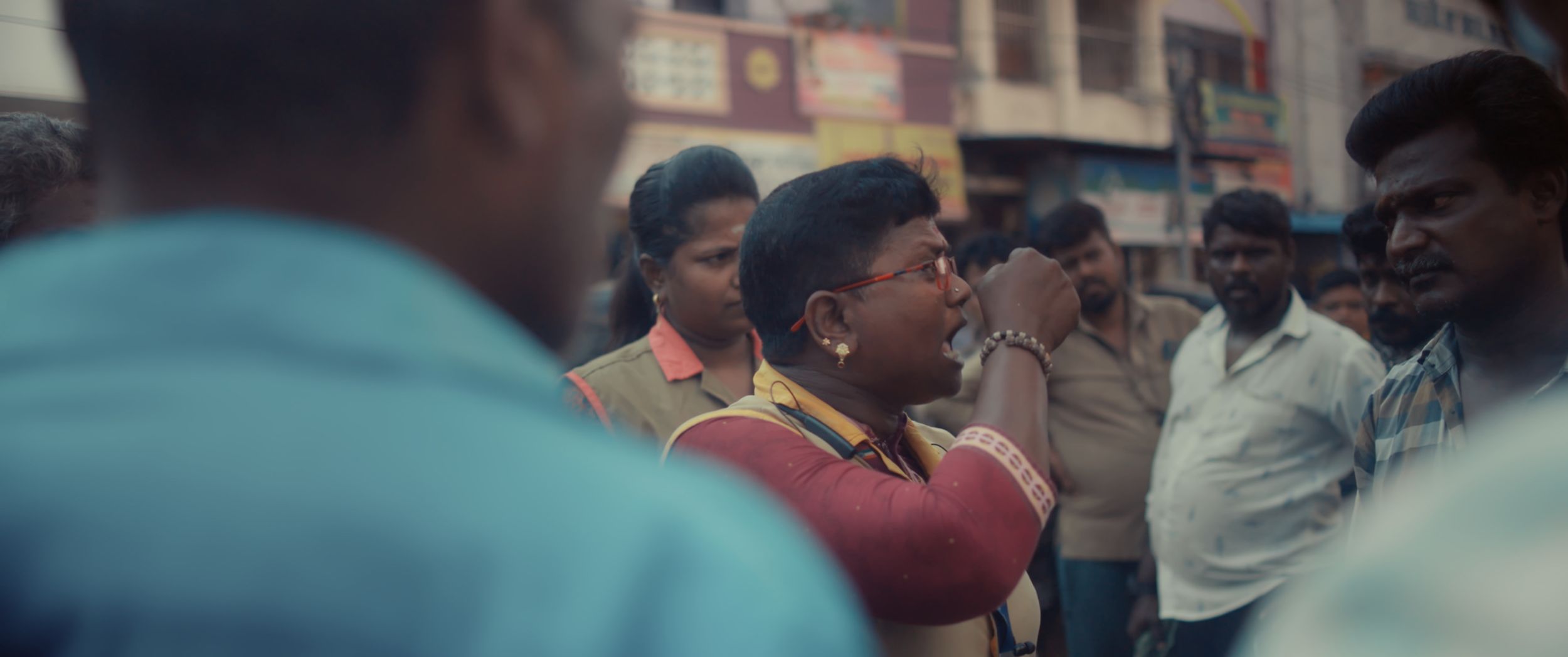
Driving, for Mohana, was always about challenging limits. As a child, she climbed walls and trees. As a teenager, she loved bikes. “If men can do it, why can’t we?” she asked, a question that later became organizational rather than rhetorical. After facing difficulties in her marriage, she decided to get a driving licence.
During the COVID-19 pandemic, as she drove extensively across Madras, she began observing unions, all run by men. “That’s when I realized women can unionize too,” she said. “And that there has to be a proper system of service.” It took six years to build the union, and eight years to consolidate it, which also includes a co-operative. Union membership cost ₹222 per person and covered basic benefits such as insurance, an ID card, and a uniform.
Through scenes of meetings, work, and collective deliberation, Auto Queens foregrounds how the cooperative infrastructure emerged as a practical response to the limits of union-based welfare.
Drawing from memories of milk cooperatives in their villages, Mohana and the union transitioned into a cooperative model within a year of formally registering the union. While the union structure enabled savings, members felt that recurring expenditures should be offset through profits generated by collective business activity. The cooperative thus exists not to replace the union, but to do what the union cannot: access loans and financial systems otherwise available only to private businesses.
Today, the co-operative has 35 members, 25 of whom are shareholders. Shares are priced at ₹100, and members can purchase multiple shares as a one-time capital contribution to finance cooperative business operations. While some members bought a single share at ₹100, around thirty members invested approximately ₹3,000 each in share capital. Through the cooperative, spare parts are sold to auto drivers at prices lower than the market rate.
In Tamil Nadu, surveys and policy reports describe the pandemic as a “once-in-a-century crisis” for informal workers, producing precarious living conditions, interrupted earnings, and weak state support mechanisms. Leela remembered earning ₹60,000 a month when she first started driving. “Now it has reduced,” she said. “Earlier, in three or four hours, we could earn ₹4,000–₹5,000.”
Post-pandemic recovery has been uneven, with many workers shifting into platform-mediated labor as one of the few accessible income sources, further entrenching informality within digital infrastructures. This post-COVID restructuring thus did not mark a transition from informality to formalization but a recomposition of informality through digital platforms.
In our conversations, Mohana articulated this restructuring through a pragmatic critique of corporate logic: “Corporates work on incentives,” Mohana explained. “Short pickups, long drops. No gaps. It’s completely exploitative.”
Women auto drivers have borne the brunt of this shift. During the pandemic, Leela recalled open hostility. “We were humiliated. Men said we were taking away their jobs.” What angers Mohana is the selectiveness of that resentment. “Nobody asks women in IT why they are working. Nobody asks women in housekeeping. This anger is only towards auto drivers.”
That anger finds form in the union. Mohana described its structure carefully, almost pedagogically. “Union money is usually only for the individual,” she explained. “We changed that. If a driver dies, the family is supported through insurance. We also give small loans of ₹10,000, repayable over ten months with only ₹100 interest.” Unlike traditional unions run by men, they say this one extends care beyond the individual worker to the family.
The union’s thinking has already travelled beyond Madras. Their proposal for a worker-owned ride-hailing application won the first prize at the Global Cooperative Summit held in Kozhikode in 2024. The idea was to develop an application, structured as a cooperative platform, in which investment, profits, and shares would remain with the workers themselves.
Unlike joining corporate gig platforms where drivers remain dependent on opaque Provident Fund-like welfare mechanisms, the proposed model sought to reconfigure platformization as collective worker property rather than extractive intermediary control. For Mohana, the recognition confirmed their thinking about corporate work.
Aesthetic and Narrative Choices
Madras is not merely a backdrop in Auto Queens but a structuring presence that shapes both form and politics. Haricharan and Akkattu describe the city as dense, chaotic, and claustrophobic—a space that must constantly be negotiated rather than inhabited. This sense of compression informs the film’s visual language.
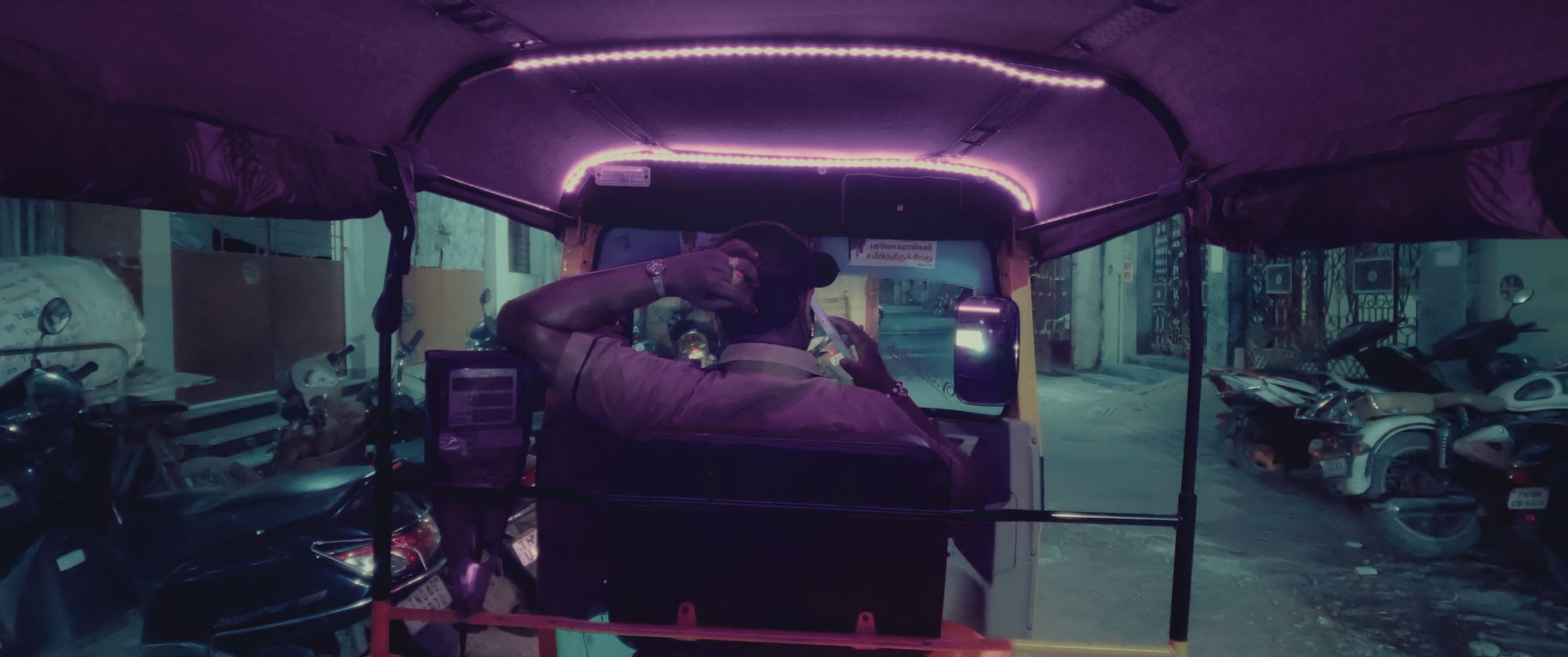
Tight close-ups, a camera frequently positioned inside the auto, and the relative absence of wide shots refuse the panoramic mastery typical of urban documentary imagery. Drone shots appear sparingly, deployed to register scale and spatial saturation. Camera angles shift with affect—low angles when Mohana moves with force, quieter frames when power recedes—producing a visual grammar attuned to relational dynamics.
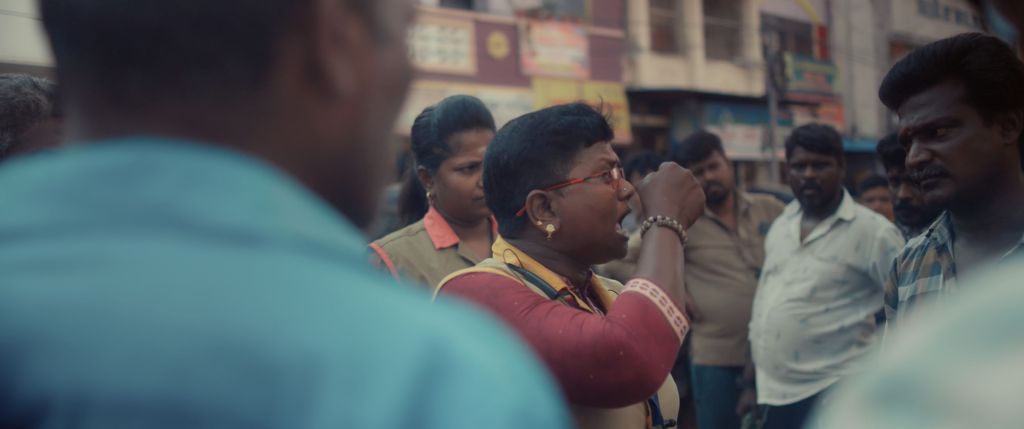
Technique itself becomes narratively legible: the single zoom shot during a fight scene marks conflict through form, while a GoPro placed inside the auto allows passengers to forget the camera, enabling moments of unselfconscious interaction. Akkattu contrasted this proximity with the extractive logic of observational distance, where zoom lenses enable filmmakers to remain physically and ethically detached—“like flies on the wall.” Here, intimacy is not a stylistic flourish but an ethical demand: the makers and viewers are compelled to sit inside labor rather than observe it from afar.
The choice of vintage, manual-focus prime lenses further signals a refusal of visual perfection. In our conversation, Akkattu described modern lenses as producing a hyperreal plasticity that tracks faces, pores, and micro-expressions with algorithmic precision—a logic now intensified by AI-driven imaging. The softness of older lenses, by contrast, resists this technological fetishization of clarity, aligning visual imperfection with a politics of relational realism, foregrounding the camera’s entanglement in power rather than masking it through claims of neutrality.
This reflexivity extends to editing. Despite being offered an external editor, Haricharan edited the film herself, resisting the fragmentation of documentary labor in which meaning is reconstructed away from the conditions of filming. For her, patterns recognized during shooting risk being lost when editing is separated from the embodied labor of the camera.
At the same time, the team sought to avoid over-identification. Charlotte Munch Bengsten, one of the editors of The Act of Killing, served as a consulting editor, providing what Akkattu called a “third eye”—a reflexive distance that allowed the filmmakers to remain fluid in their decisions as patterns emerged.
Music plays a central role in this ethic. Rather than functioning as aesthetic embellishment, music and dance appear integral to Leela and Mohana’s everyday lives. Pleasure becomes not a sentimental add-on but a political assertion against documentary traditions that aestheticize deprivation.
Language, too, becomes a site of political transmission. Haricharan reads Leela and Mohana’s speech patterns as echoes of the Self-Respect Movement, suggesting that political consciousness circulates through lived experience rather than formal texts. As Mohana said, knowledge expands by talking to people. Her vision for the union—to structure routes that facilitate interactions with elderly people, students, and NRIs—frames labor infrastructure as a space of learning and exchange, where political consciousness emerges through the possibility of relationality and pedagogy meeting.
The film also stages a critique of capitalist mediation of feminism and labor. Haricharan argued that capitalism systematically demonizes unions and collective formation, framing solidarity as inefficiency or threatening. Sound design contributes to this critique by inserting radio advertisements for feminine products on Women’s Day. These ads produce a jarring contrast, exposing the commodification of feminist discourse alongside the disposability of women’s labor. Feminism circulates as branding even as structural conditions of gendered work remain unchanged.
Consent, too, is a negotiated process: the characters had to agree with how they were depicted, rendering the film co-authored rather than extractive. This emphasis on consent extends the film’s labor politics into the domain of documentary practice, where subjects are often rendered as raw material for extraction rather than collaborators.
The film’s spatial logic renders space as a political resource unevenly allocated along axes of gender, caste, and class. Women’s occupation of urban space is rendered inherently political because space itself is unevenly distributed. Haricharan told me that cities increasingly lack space and that marginalization compounds spatial deprivation. This spatial politics extends to labor: within capitalist systems, there is little space for solidarity, even among workers, as competition and precarity fracture collective formation. The film’s claustrophobic framing thus becomes an aesthetic corollary to structural enclosure.
Sound design and montage produce fatigue as a structural condition rather than an individual pathology, situating tiredness within the rhythms of neoliberal urban life. The chronology itself mirrors this exhaustion: city, labor, and the search for rest are interwoven in the montage, producing a temporal experience of perpetual functioning. “Everyone is tired, but everyone continues to work; tiredness becomes the soundscape of labor”, said Haricharan.
Women’s labor is central to this critique. She notes that men retain moments of rest or leisure, while women’s labor subsidizes both capital and caste. The film’s moments of leisure—watching the moon, laughing on the beach, sharing jokes—are therefore not escapist interludes but scenes of structural deprivation made visible.
Across these formal and narrative strategies, Auto Queens stages a documentary ethics that refuses extractive representation, aesthetic mastery, and victimizing realism. By situating labor, space, and fatigue within a dense urban ecology, the film reframes women’s unionized work not as a marginal spectacle but as a site where political consciousness, relational ethics, and feminist world-making are enacted in everyday practice.
Circulation
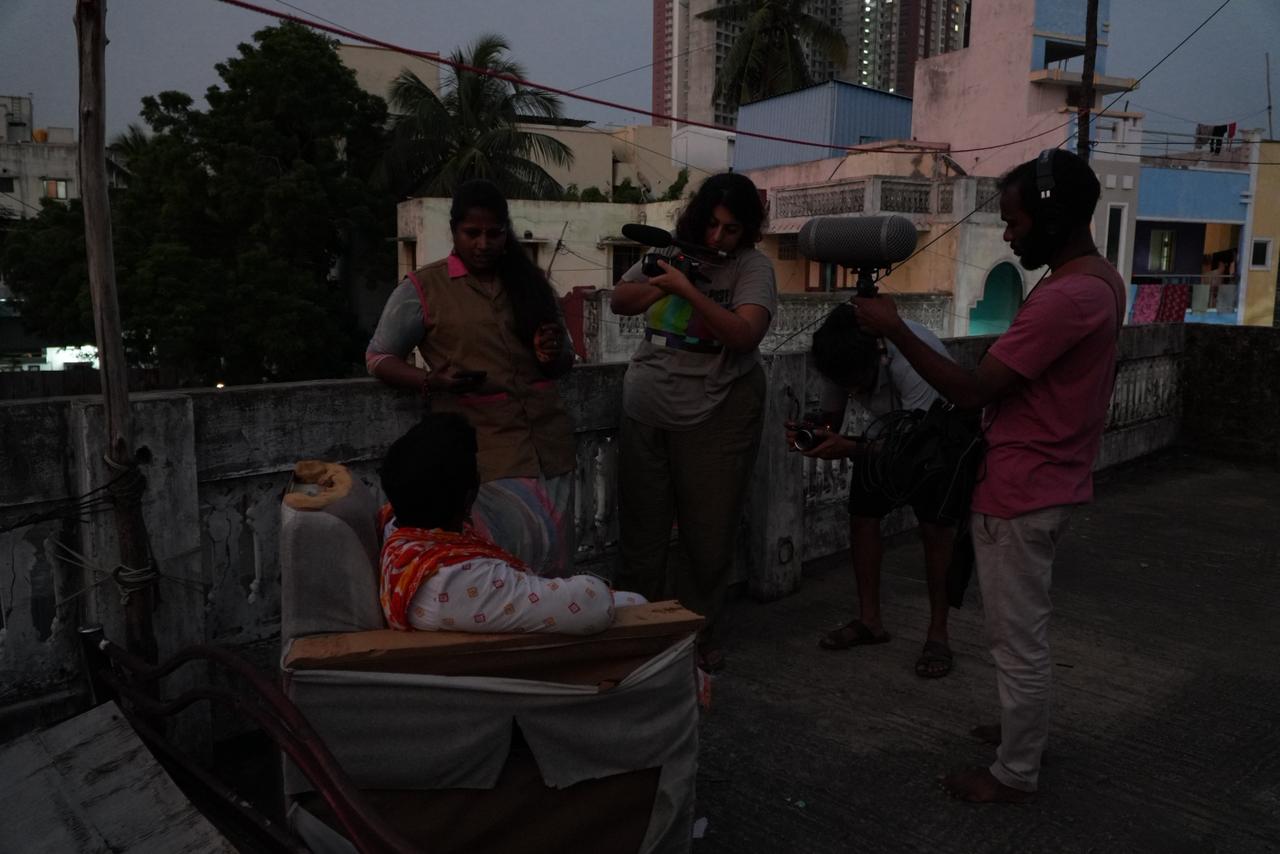
The film’s circulation strategy similarly treats distribution as a political terrain rather than a neutral endpoint.
Sruti Lodha from Storiculture notes that films backed by NGOs often remain confined to closed institutional circuits, rarely reaching wider public audiences. For her and fellow producer Mathivanan Rajendran, the decision to take Auto Queens into the mainstream was therefore a political choice, not an aspirational one. “Tamil Nadu already has an audience,” Mathivanan explains. “This story should not be a footnote—it belongs in the mainstream.”
They aim to screen the film across a hundred communities in Tamil Nadu, prioritizing union spaces and working-class audiences over festival prestige alone. The film was theatrically screened for the union in Madras on 14 December 2025.
Philanthropic funding from Omidyar made this circulation materially possible. It allowed the team to avoid debt cycles, pay everyone fairly, invest in distribution, and travel with the film—even as the organization later withdrew from India due to its political stance. “Once you’re paying debts,” Mathivanan argued, “impact reduces.” The funding does not insulate the film from political contradiction. However, according to Mathivanan, it enabled the filmmakers to hold distribution, labor ethics, and accountability together without collapsing under financial pressure.
The film’s selection at the International Documentary Film Festival Amsterdam (IDFA) and its multiple screenings in Amsterdam were not treated as endpoints, but as extensions of this circulation. “It spoke universally,” Haricharan reflects, not because it abstracted labor into metaphor, but because it remained anchored in the specificity of Leela and Mohana’s lives.
Auto Queens will have its US premiere at the True/False Film Festival in Columbia in March 2026.
When asked to name a moment of pride for the union, Mohana answers without hesitation. “We won the Kamla Bhasin Award for Gender Equality in 2025 in Kathmandu,” she said. “We are illiterate women, but we are changing lives. Today, people look at us and see role models.”

Auto Queens: Circles of Labor, Form, and Survival
A still from Auto Queens.
Madras, one of India’s major metropolitan centres, has become a key site for the expansion of platform capitalism and the reconfiguration of urban informal labor. Digital ride-hailing and delivery platforms such as Ola, Uber, Rapido, Swiggy, and Zomato have proliferated over the past decade.
In a city reorganized by platform capitalism and shrinking informal incomes, women’s work is persistently framed either as empowerment or exception—celebrated as entrepreneurial freedom or marked as anomalous disruption. Auto Queens, a 30-minute Tamil documentary directed and edited by Sraiyanti Haricharan, refuses both these frames, instead situating women’s auto-driving as ordinary labor embedded within gendered regimes of precarity, urban space, and collective struggle.
The 2025 film follows the everyday lives of Leela Rani, Mohanasundari, and the union they built—Veera Pengal Munnetra Sangam (VPMS, translating to Courageous Women’s Union for Emancipation). The VPMS is India’s first women auto-rickshaw drivers’ cooperative in Madras, and Haricharan documents how women build systems of care inside a city that offers them neither space nor safety.
The refusal to document women’s work as an exception or empowerment extends to form. There is no explanatory narration, no sentimental framing of struggle, and no external voice translating politics for the viewer. Instead, Haricharan portrays labor itself—inside autos, at union meetings, on the road—as the site where politics is produced.
Today, there are nearly 500 women auto drivers in Madras, a fact largely invisible within dominant narratives of urban labor. From the beginning, Auto Queens was conceived not simply as representation but as an intervention into how working-class women’s organizing circulates, and where it is allowed to circulate.
Vijay Gnanaprasad (ECTE) first brought the union’s story to the filmmakers and played a key role in early organizing. Produced by Storiculture (Humans in the Loop, Taak)—whose work has sought to rethink how films are made, funded, and circulated—Auto Queens treats film distribution itself as a site of labor.
For example, the film process included a five-day media camp for 60 women from the union to give them narrative agency, including teaching them how to use technology like Instagram Reels to narrate their stories. Daily wages were paid, recognizing that time away from driving has a material cost.
Auto Queens does not arrive with conclusions already formed. Instead, it listens, walks, waits. Even though the film’s duration is short, the time feels stretched, as the narrative emerges from the rhythm of collective urban life rather than from a pre-scripted arc.
The Filmmakers and Their Gaze
The film’s politics emerge in how it chooses to see. For cinematographer Prem Akkattu, Auto Queens’ ethics are inseparable from its makers’ own experiences as workers within extractive media economies. Akkattu’s intervention is about the stark difference he observed between the VPMS rickshaw union and cinema unions. In cinema, he noted, those who present themselves as “leaders” are often owners rather than workers, which renders labor politics structurally unintelligible to them.
Both Akkattu and Haricharan encountered suspicion when they spoke about collective organization within the film industry: What benefits will you give? What benefit do you want?—as if collectivization could only be understood in transactional terms. For those positioned above the class hierarchy, unions appeared coercive, something that forces people to join. However, for those below, union membership was a minimal condition for survival, a defence against elimination.
Akkattu recalls the relief of working on Auto Queens after experiences in commercial Malayalam and Tamil cinema, and even politically progressive documentary projects in Bombay. Underpayment, lack of credit, and being treated as replaceable labor left a stinging sensation. Those rejections and denials shaped the ethics of Auto Queens—clear ideas of how not to work.
He is also acutely aware of how much power a cinematographer wields in documentary filmmaking. “Characters become conscious of the camera,” he said. “The camera always carries a narrative even when you don’t mean it to.”
Haricharan’s approach was shaped by sustained engagement with the union and building relationships with the members, whereas it was conversations with the members that motivated Akkattu. “For the first few days, we weren’t really talking,” Akkattu admitted. “Then we started walking with them.” Interviews followed: long, unhurried conversations with union members. “The narrative came from there,” he said. While the project unfolded over roughly 1.5 years, the core production cycle took about six months.
One decision was made quickly: they would not isolate Leela or Mohana as heroic individuals. Instead, their friendship—its teasing, corrections, disagreements—became central not just to the film but also to the union they built. This dynamic is visible even in how they name power. While talking to me, Leela said at one point, unapologetically, “I have the arrogance of a man.” “No,” Mohana interrupted. “It’s the arrogance of women. That’s how it should be named.”
Later, Leela recounted an incident that clarified what she meant. “One night, a man asked for a drop at 9:30,” she said. “I told him it was late and asked him to take another auto. He said, ‘You are very arrogant.’” She paused. “How is it arrogance when all I said was that it is late, respectfully?”
Auto Queens thus centres Leela and Mohana not simply as subjects framed by the camera, but as figures through whom collective labor produces forms of organization, ethics, and politics. The union they built is not merely a contextual background but a narrative axis around which the film’s temporal and affective structure circulates. Friendship, rather than victimhood, becomes the film’s organizing affect.
Friendships and Space
Leela, born and raised in Madras, has been driving an auto for over 25 years, having entered the profession to support herself and her child after leaving an abusive marriage.
In a late scene, as she and Mohana sit on a moored boat under the moon, talking of strategy and patience, Leela reflects that since 2008, “the world forced me to channel my masculinity.” Rage became armor; love and violence are not opposites but temporal strategies, each mobilized to force change in men.
She says this with cropped hair, studs and gold earrings, vermilion and sandalwood pressed onto skin, holding together a body that does not settle into the recognizable scripts of femininity. Once, she wore her hair long and braided jasmine into it, until a passenger touched her hair and body without consent. She cut it soon after and has kept it short since—a refusal carried on the surface of the body.
The film does not reduce Leela to injury; instead, it frames her through scenes of work, union activity, leisure, and everyday negotiation, allowing labor rather than trauma to anchor her cinematic presence. In conversation, she described work as moral and even spiritual, and insisted that union membership gave her a sense of freedom she had never previously known.
While Auto Queens presents Mohana primarily as an organizer and interlocutor, our conversations trace a long trajectory of education, migration, and serial labor that precedes and underwrites this representation. Mohana comes from Thirukazhukundram (Sengapettu), from a farming family that later migrated to Madras. She recalled her mother’s insistence that she attend school, even if only up to the eighth standard, and described the city as a space that “gives knowledge.” From a young age, she moved through multiple forms of precarious work—15-20 jobs, including screen printing and milk packet disposal units—before turning to driving.
Leela and Mohana have known each other for close to 8 years now, and they arrive at work together, arguing and laughing in the same breath, feeding each other fish, the day already a shared terrain. Between routes and reels, snakes and strategies, friendship is forged in the rhythms of surviving and organizing side by side. The film renders their friendship as its emotional and organizational spine, situating unionization as an affective relation before it becomes institutional.
Empirical studies of Madras’ gig economy document declining incentives, extended working hours, and persistent insecurity. These developments unfold within a broader labor regime in which informality remains the dominant condition of work—over 90 percent of India’s workforce continues to be employed in informal or informalized arrangements.
Auto Queens gestures toward the broader political economy of platform capitalism through brief montage sequences—images of Ola, Uber, Swiggy, and Zomato—signalling an environment that has hollowed out informal auto labor and situating the women’s union within a wider landscape of platformised urban mobility. Unionization is thus stitched together from what the city withholds, such as credit, safety, dignity; denials that press upon labor and the fragile, gendered work of holding life together—and not from any preset ideology.
Unions After Platforms
Driving, for Mohana, was always about challenging limits. As a child, she climbed walls and trees. As a teenager, she loved bikes. “If men can do it, why can’t we?” she asked, a question that later became organizational rather than rhetorical. After facing difficulties in her marriage, she decided to get a driving licence.
During the COVID-19 pandemic, as she drove extensively across Madras, she began observing unions, all run by men. “That’s when I realized women can unionize too,” she said. “And that there has to be a proper system of service.” It took six years to build the union, and eight years to consolidate it, which also includes a co-operative. Union membership cost ₹222 per person and covered basic benefits such as insurance, an ID card, and a uniform.
Through scenes of meetings, work, and collective deliberation, Auto Queens foregrounds how the cooperative infrastructure emerged as a practical response to the limits of union-based welfare.
Drawing from memories of milk cooperatives in their villages, Mohana and the union transitioned into a cooperative model within a year of formally registering the union. While the union structure enabled savings, members felt that recurring expenditures should be offset through profits generated by collective business activity. The cooperative thus exists not to replace the union, but to do what the union cannot: access loans and financial systems otherwise available only to private businesses.
Today, the co-operative has 35 members, 25 of whom are shareholders. Shares are priced at ₹100, and members can purchase multiple shares as a one-time capital contribution to finance cooperative business operations. While some members bought a single share at ₹100, around thirty members invested approximately ₹3,000 each in share capital. Through the cooperative, spare parts are sold to auto drivers at prices lower than the market rate.
In Tamil Nadu, surveys and policy reports describe the pandemic as a “once-in-a-century crisis” for informal workers, producing precarious living conditions, interrupted earnings, and weak state support mechanisms. Leela remembered earning ₹60,000 a month when she first started driving. “Now it has reduced,” she said. “Earlier, in three or four hours, we could earn ₹4,000–₹5,000.”
Post-pandemic recovery has been uneven, with many workers shifting into platform-mediated labor as one of the few accessible income sources, further entrenching informality within digital infrastructures. This post-COVID restructuring thus did not mark a transition from informality to formalization but a recomposition of informality through digital platforms.
In our conversations, Mohana articulated this restructuring through a pragmatic critique of corporate logic: “Corporates work on incentives,” Mohana explained. “Short pickups, long drops. No gaps. It’s completely exploitative.”
Women auto drivers have borne the brunt of this shift. During the pandemic, Leela recalled open hostility. “We were humiliated. Men said we were taking away their jobs.” What angers Mohana is the selectiveness of that resentment. “Nobody asks women in IT why they are working. Nobody asks women in housekeeping. This anger is only towards auto drivers.”
That anger finds form in the union. Mohana described its structure carefully, almost pedagogically. “Union money is usually only for the individual,” she explained. “We changed that. If a driver dies, the family is supported through insurance. We also give small loans of ₹10,000, repayable over ten months with only ₹100 interest.” Unlike traditional unions run by men, they say this one extends care beyond the individual worker to the family.
The union’s thinking has already travelled beyond Madras. Their proposal for a worker-owned ride-hailing application won the first prize at the Global Cooperative Summit held in Kozhikode in 2024. The idea was to develop an application, structured as a cooperative platform, in which investment, profits, and shares would remain with the workers themselves.
Unlike joining corporate gig platforms where drivers remain dependent on opaque Provident Fund-like welfare mechanisms, the proposed model sought to reconfigure platformization as collective worker property rather than extractive intermediary control. For Mohana, the recognition confirmed their thinking about corporate work.
Aesthetic and Narrative Choices
Madras is not merely a backdrop in Auto Queens but a structuring presence that shapes both form and politics. Haricharan and Akkattu describe the city as dense, chaotic, and claustrophobic—a space that must constantly be negotiated rather than inhabited. This sense of compression informs the film’s visual language.
Tight close-ups, a camera frequently positioned inside the auto, and the relative absence of wide shots refuse the panoramic mastery typical of urban documentary imagery. Drone shots appear sparingly, deployed to register scale and spatial saturation. Camera angles shift with affect—low angles when Mohana moves with force, quieter frames when power recedes—producing a visual grammar attuned to relational dynamics.
Technique itself becomes narratively legible: the single zoom shot during a fight scene marks conflict through form, while a GoPro placed inside the auto allows passengers to forget the camera, enabling moments of unselfconscious interaction. Akkattu contrasted this proximity with the extractive logic of observational distance, where zoom lenses enable filmmakers to remain physically and ethically detached—“like flies on the wall.” Here, intimacy is not a stylistic flourish but an ethical demand: the makers and viewers are compelled to sit inside labor rather than observe it from afar.
The choice of vintage, manual-focus prime lenses further signals a refusal of visual perfection. In our conversation, Akkattu described modern lenses as producing a hyperreal plasticity that tracks faces, pores, and micro-expressions with algorithmic precision—a logic now intensified by AI-driven imaging. The softness of older lenses, by contrast, resists this technological fetishization of clarity, aligning visual imperfection with a politics of relational realism, foregrounding the camera’s entanglement in power rather than masking it through claims of neutrality.
This reflexivity extends to editing. Despite being offered an external editor, Haricharan edited the film herself, resisting the fragmentation of documentary labor in which meaning is reconstructed away from the conditions of filming. For her, patterns recognized during shooting risk being lost when editing is separated from the embodied labor of the camera.
At the same time, the team sought to avoid over-identification. Charlotte Munch Bengsten, one of the editors of The Act of Killing, served as a consulting editor, providing what Akkattu called a “third eye”—a reflexive distance that allowed the filmmakers to remain fluid in their decisions as patterns emerged.
Music plays a central role in this ethic. Rather than functioning as aesthetic embellishment, music and dance appear integral to Leela and Mohana’s everyday lives. Pleasure becomes not a sentimental add-on but a political assertion against documentary traditions that aestheticize deprivation.
Language, too, becomes a site of political transmission. Haricharan reads Leela and Mohana’s speech patterns as echoes of the Self-Respect Movement, suggesting that political consciousness circulates through lived experience rather than formal texts. As Mohana said, knowledge expands by talking to people. Her vision for the union—to structure routes that facilitate interactions with elderly people, students, and NRIs—frames labor infrastructure as a space of learning and exchange, where political consciousness emerges through the possibility of relationality and pedagogy meeting.
The film also stages a critique of capitalist mediation of feminism and labor. Haricharan argued that capitalism systematically demonizes unions and collective formation, framing solidarity as inefficiency or threatening. Sound design contributes to this critique by inserting radio advertisements for feminine products on Women’s Day. These ads produce a jarring contrast, exposing the commodification of feminist discourse alongside the disposability of women’s labor. Feminism circulates as branding even as structural conditions of gendered work remain unchanged.
Consent, too, is a negotiated process: the characters had to agree with how they were depicted, rendering the film co-authored rather than extractive. This emphasis on consent extends the film’s labor politics into the domain of documentary practice, where subjects are often rendered as raw material for extraction rather than collaborators.
The film’s spatial logic renders space as a political resource unevenly allocated along axes of gender, caste, and class. Women’s occupation of urban space is rendered inherently political because space itself is unevenly distributed. Haricharan told me that cities increasingly lack space and that marginalization compounds spatial deprivation. This spatial politics extends to labor: within capitalist systems, there is little space for solidarity, even among workers, as competition and precarity fracture collective formation. The film’s claustrophobic framing thus becomes an aesthetic corollary to structural enclosure.
Sound design and montage produce fatigue as a structural condition rather than an individual pathology, situating tiredness within the rhythms of neoliberal urban life. The chronology itself mirrors this exhaustion: city, labor, and the search for rest are interwoven in the montage, producing a temporal experience of perpetual functioning. “Everyone is tired, but everyone continues to work; tiredness becomes the soundscape of labor”, said Haricharan.
Women’s labor is central to this critique. She notes that men retain moments of rest or leisure, while women’s labor subsidizes both capital and caste. The film’s moments of leisure—watching the moon, laughing on the beach, sharing jokes—are therefore not escapist interludes but scenes of structural deprivation made visible.
Across these formal and narrative strategies, Auto Queens stages a documentary ethics that refuses extractive representation, aesthetic mastery, and victimizing realism. By situating labor, space, and fatigue within a dense urban ecology, the film reframes women’s unionized work not as a marginal spectacle but as a site where political consciousness, relational ethics, and feminist world-making are enacted in everyday practice.
Circulation
The film’s circulation strategy similarly treats distribution as a political terrain rather than a neutral endpoint.
Sruti Lodha from Storiculture notes that films backed by NGOs often remain confined to closed institutional circuits, rarely reaching wider public audiences. For her and fellow producer Mathivanan Rajendran, the decision to take Auto Queens into the mainstream was therefore a political choice, not an aspirational one. “Tamil Nadu already has an audience,” Mathivanan explains. “This story should not be a footnote—it belongs in the mainstream.”
They aim to screen the film across a hundred communities in Tamil Nadu, prioritizing union spaces and working-class audiences over festival prestige alone. The film was theatrically screened for the union in Madras on 14 December 2025.
Philanthropic funding from Omidyar made this circulation materially possible. It allowed the team to avoid debt cycles, pay everyone fairly, invest in distribution, and travel with the film—even as the organization later withdrew from India due to its political stance. “Once you’re paying debts,” Mathivanan argued, “impact reduces.” The funding does not insulate the film from political contradiction. However, according to Mathivanan, it enabled the filmmakers to hold distribution, labor ethics, and accountability together without collapsing under financial pressure.
The film’s selection at the International Documentary Film Festival Amsterdam (IDFA) and its multiple screenings in Amsterdam were not treated as endpoints, but as extensions of this circulation. “It spoke universally,” Haricharan reflects, not because it abstracted labor into metaphor, but because it remained anchored in the specificity of Leela and Mohana’s lives.
Auto Queens will have its US premiere at the True/False Film Festival in Columbia in March 2026.
When asked to name a moment of pride for the union, Mohana answers without hesitation. “We won the Kamla Bhasin Award for Gender Equality in 2025 in Kathmandu,” she said. “We are illiterate women, but we are changing lives. Today, people look at us and see role models.”