




Technologies of Genocide: How Big Tech Profits from Mass Annihilation
By Suchitra Vijayan
August 20, 2025
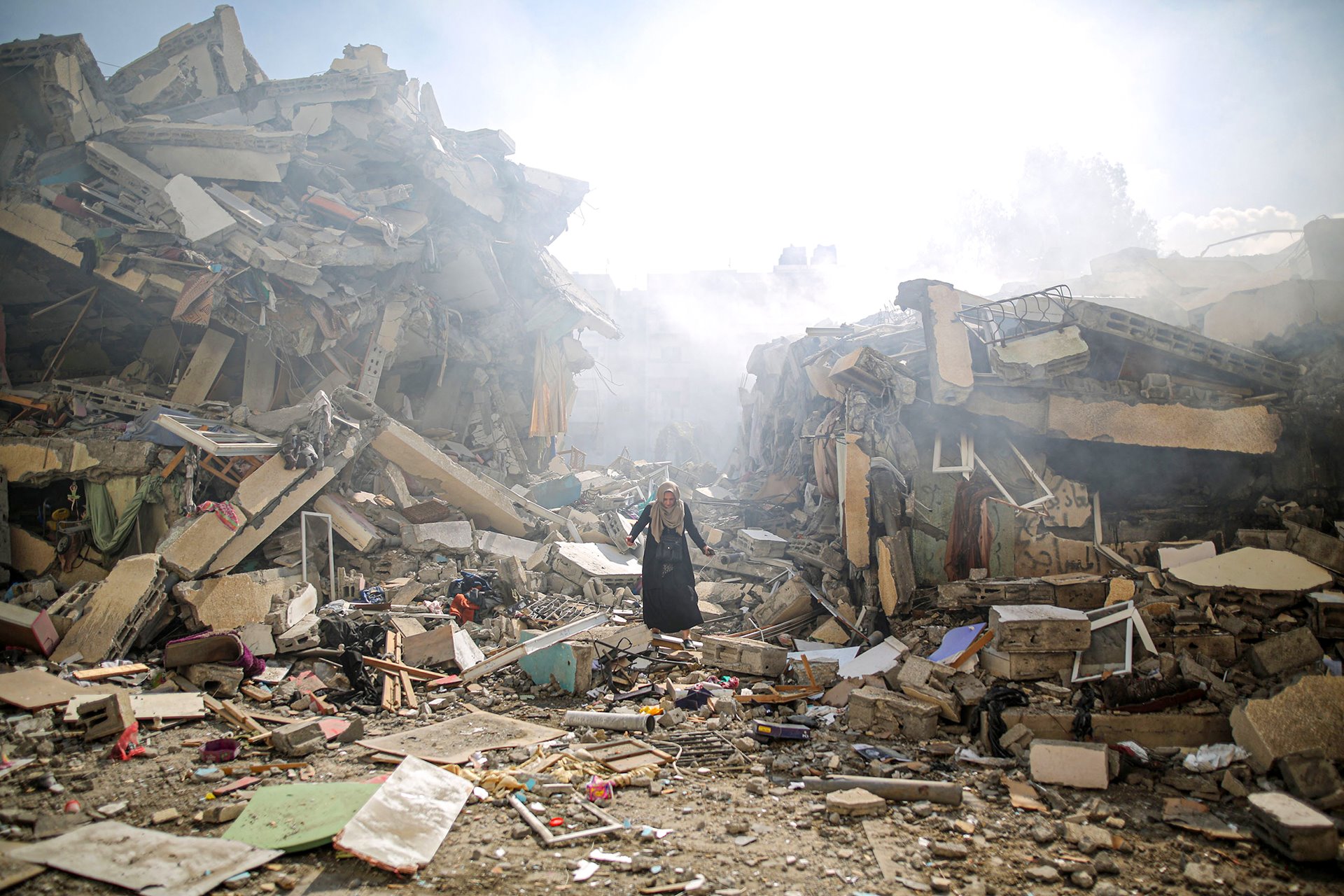
What does genocide look like in the digital age? Not just bodies under the rubble, open-air prisons, mass graves, or destroyed hospitals, but it’s fibre optics, cables, data centres, predictive algorithms, surveillance apps, and being shadow-banned for having an opinion. Genocide is now not only live-streamed but also monetised.
For close to two years, we have been complicit witnesses to the genocide of the Palestinian people in Gaza. The annihilation is live-streamed, surveilled, quantified, and sold. The platforms that host our conversations, the cloud that stores our lives as digital dust, and the companies that promise social connection are also the infrastructure of annihilation.
Palestinians have told us this for years: What is tested on Palestinians, never stays in Palestine; it is exported to Bastar, Kashmir, Xinjiang, Sudan, and beyond. This Genocide is monetised.
For decades, international law has refused to name and address this reality. This denial of genocide in its digital, economic, and algorithmic forms has allowed states to act unchallenged. States do not act alone; they are enabled by Silicon Valley, financed by Wall Street, armed by military contractors, and legitimised by the Western media. From predictive policing to algorithmic targeting, from biometric classification to digital erasure, we inhabit a world where the machinery of extermination is intricately linked to the machinery of profit.
The Technologies of Genocide series begins with the refusal of denial. Our first conversation is with Jalal Abukhater, a Palestinian rights advocate, and Eric Sype, an Organiser, both of whom work with Hamleh, the Arab Centre for the Advancement of Social Media. In this podcast, they trace how the infrastructures of annihilation and extraction are not abstract technologies, but lived architectures of fear: databases that decide if a Palestinian can cross a checkpoint, algorithms that erase their voices mid-sentence, blackout zones where the very possibility of testimony is extinguished.
You can listen to the Podcast on YouTube and Soundcloud
The Economy of Genocide
On July 3, 2025, Francesca Albanese, the UN Special Rapporteur on the situation of human rights in the Palestinian territories, released From Economy of Occupation to Economy of Genocide. The report shows in forensic detail how Israel’s war on Gaza is enabled and made profitable by corporate actors across every sector, including weapons manufacturers, AI labs, construction firms, tourist industries, surveillance companies, and above all, technology giants. According to Albanese, Israel’s campaign of annihilation has generated over $225 billion in market gains; in a single month, $67.8 billion was added to Tel Aviv’s stock market. In the case of Palestine, genocide is the profit model.
In our conversation, Eric argues: “We used to live in a world where corporate accountability strategies at least had some traction. That world is gone. Companies now openly lie about their contracts, and they don’t care at all. They are in your face, complicit in occupation, apartheid, and genocide.”
This is not an aberration, but the market logic of capital. Palantir, once seen as an outlier, has become the model to emulate, using tech for military intelligence and surveillance. “Big tech has always marketed itself as creating technologies for a better world,” Eric observed. “But they’re moving full steam ahead into military contracts and weapon manufacturing. They don’t want to be seen as that. But that’s exactly where they’re going.” Gone are the days when companies like Google ran on the false promise of slogans like “Don’t be evil.” That farce of being good, of “tech for good,” is over, though in truth it never existed. Silicon Valley was never a utopia betrayed. It was founded on surveillance capitalism, designed to profit from people as data bodies and, increasingly, as objects of mass annihilation. Genocide today feeds quarterly reports, just as cotton and sugar once fed colonial empires. Bigotry is not a moral aberration; it is big business.
Surveillance as Domination
Surveillance is not an auxiliary system; it constitutes the very architectures of domination and extermination. Jalal describes this lived reality: “The harvesting of Palestinian data became so normalised that there is no such thing as a right to privacy under occupation. Our speech is policed, our movements tracked, our faces scanned at checkpoints. The idea is to live in a place where you believe you’re always being monitored. Big Brother is watching anything you do or say. A Facebook post can bring soldiers to your home at four in the morning.”
“What we saw in Gaza,” Jalal notes, “is that these databases were turned into targeting systems. Israeli intelligence admits AI targeting systems increased the efficiency of killing.”
What Jalal describes is Data colonialism. It is how digital technology turns our everyday lives into resources to be extracted for profit. It creates a new social order in which human life is treated as something to be mined, tracked, and owned. Palestinian faces, voices, and movements are converted into data that trains predictive policing and autonomous targeting. The occupied are rendered not merely disposable, but computational raw material. And Palestine is just the beginning. As Jalal warned, “What starts in Palestine always finds its way elsewhere.” Drones perfected in Gaza appear in India’s Bastar region, tracking journalists. Spyware tested on Palestinians infects dissidents’ phones across continents. Pegasus, once developed as part of Israel’s arsenal to subjugate Palestinians, was later sold globally as “field-tested.”3 Surveillance here is not just the gathering of information, it is what Achille Mbembe names necropolitics: the coding of who may live and who must die.
Erasure Online, Erasure on the Ground
Alongside the physical extermination of Palestinians runs the digital campaign of disappearance. Hamleh has tracked how Meta platforms, especially Facebook and Instagram, systematically silence Palestinian voices. During the May 2021 uprising, as Palestinians across historic Palestine mobilised against the Israeli occupation, online platforms throttled their content. A report commissioned by Meta itself later confirmed that Palestinian digital rights were violated at “a massive scale.”
After October 2023, Meta reduced its moderation thresholds, resulting in mass deletions. “The most affected were journalists and people in Gaza,” Jalal explains, “the very people who had no other means to tell their story, to document war crimes, to say they were alive.” Erasure has become the policy, coded in every aspect of Meta’s platforms. “Genocide is physically erasing Palestinians while platforms like Meta are digitally erasing our voices,” Jalal concludes. “It is a virtual campaign of extermination.”
Corporate Complicity and Aiding & Abetting
Genocide today cannot be understood without the complicity of corporations.
International criminal law already recognises that individuals, including corporate officers, may be liable for aiding and abetting when their conduct substantially contributes to crimes with knowledge of their likely commission (Rome Statute, art. 25(3)(c), (d); Prosecutor v. Taylor, Appeals Judgment, SCSL-03-01-A, 26 Sept. 2013).
Albanese’s report names at least 48 corporations, including Google, Amazon, Microsoft, and Meta, that directly profit from the war in Gaza. Project Nimbus, a contract between Google and Amazon, provides cloud and AI services to the Israeli military, explicitly at the time of genocide.12
Export-control regimes, too, prohibit such transfers. The Arms Trade Treaty bars transfers where there is knowledge they would be used in genocide or war crimes. The Wassenaar Arrangement already controls spyware and surveillance software. The blacklisting of NSO Group by the US government confirms this: spyware is never neutral commerce, but a weapon.
The doctrine of “dual-use” cannot launder genocide. In international law and arms trade, “dual-use” refers to technologies or goods that can serve both civilian and military purposes. Big Tech leans on this argument to mask its role in atrocity, claiming that a tool designed for communication, logistics, or data analysis cannot be blamed if it is later deployed for surveillance, targeting, or killing. But intent and knowledge matter. When corporations know their products are being used to enable crimes, the cloak of “dual-use” disappears. Genocide cannot be excused as an unfortunate by-product of innovation.
Where the foreseeable, substantial effect of a contract is mass killing, it comes with liability. As the Rome Statute makes clear, aiding and abetting requires neither genocidal intent nor military uniform. It requires only knowledge and contribution. That threshold has long been crossed.
The Cycle of Capital and Annihilation
Toward the end of our conversation, Jalal places today’s technologies in a longer arc:
“This is history repeating itself. Slavery, colonialism, industrial capitalism — each stage enriched a few through mass exploitation. Technology is no different. Tech is not new. It is a tool. And in this cycle, it is used to entrench authoritarianism and genocide. The power lies with us, the workers and people creating these tools. But it requires more organizing, more connection, more refusal.”
Eric echoes:
“Capitalism starts with something useful. Then infinite growth turns it destructive: colonial conquest, fossil fuel extraction, and now militarised AI. It will never give us the society we want. It inevitably leads to destruction and violence.”
This is what scholars call ‘racial capitalism’: a system where profits depend on rendering some populations disposable, and converting their lives to market gains. Genocide may be encrypted behind the clean interfaces of profit. But liberation, too, can be encoded in refusals, in solidarities, in organized memory.
Palestine today is the site of genocide. But it is also the site of resistance—voices refusing disappearance, workers leaking contracts, communities archiving testimonies, movements linking digital rights to the right to live. The responsibility now lies with us: to hear, to act, to refuse complicity.
SUPPORT US
We like bringing the stories that don’t get told to you. For that, we need your support. However small, we would appreciate it.
Suchitra Vijayan is the founder and executive director of The Polis Project and the author of Midnight’s Borders: A People’s History of Modern India and How Long Can the Moon Be Caged? Voices of Indian Political Prisoners.
Related Posts


- It's Not You, It's The Media
Technologies of Genocide: How Big Tech Profits from Mass Annihilation

Suchitra Vijayan is the founder and executive director of The Polis Project and the author of Midnight’s Borders: A People’s History of Modern India and How Long Can the Moon Be Caged? Voices of Indian Political Prisoners.