


Technologies of Genocide: Episode Two | Bloodshed in Bangladesh
By Suchitra Vijayan
September 19, 2025
This episode continues our ‘Technologies of Genocide’ series, where we examine how power, repression, and resistance unfold in the digital sphere. If you haven’t yet, we invite you to listen to our first episode on Palestine, where we traced how technology shapes both erasure and survival. And stay with us for the next installment, where we turn to the Eelam genocide—exploring another chapter in the global struggle to document, resist, and remember.
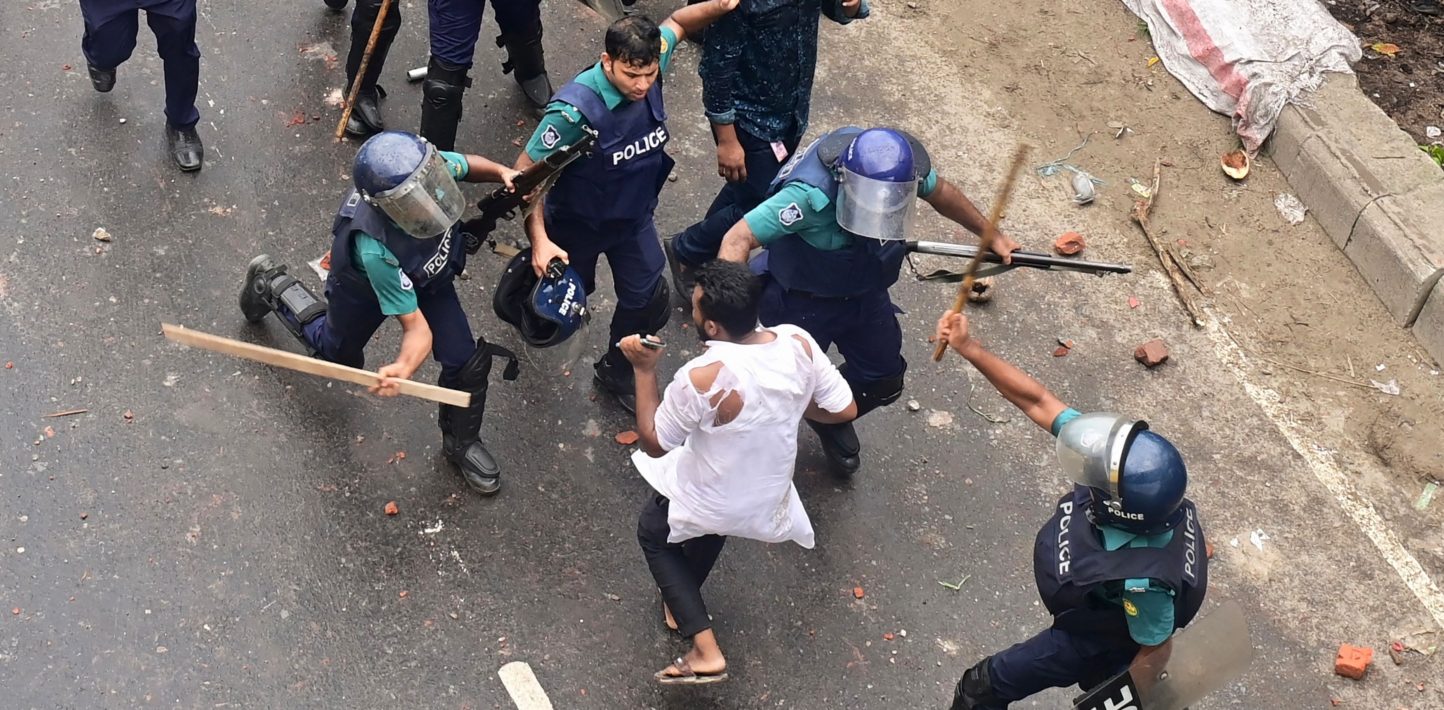
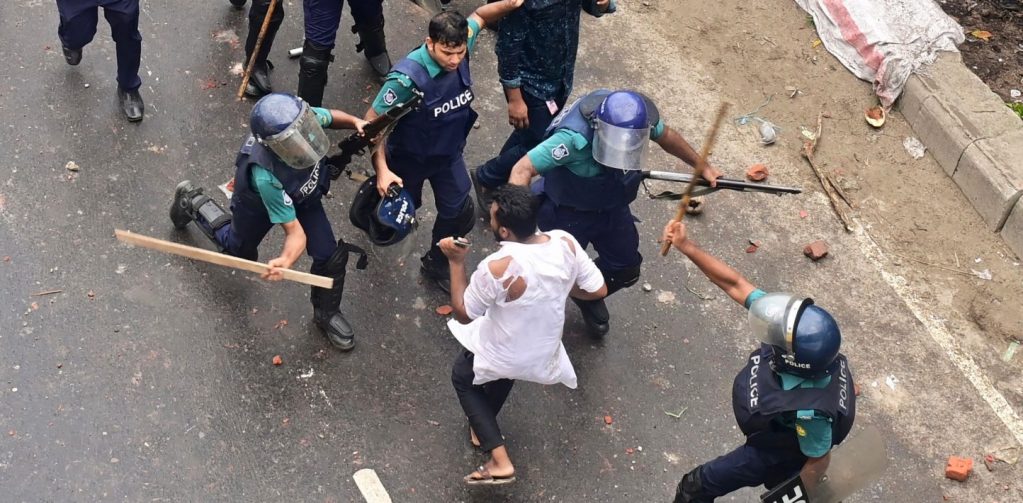
A year after the historic mass uprising in Bangladesh, which brought down the Awami League government, no definitive list exists of those killed by law enforcement during the protests between 16 July and 5 August 2024. Families are left without answers, justice remains elusive, and the machinery of impunity grinds on.
On January 15, 2025, the Tech Global Institute, in collaboration with the International Truth and Justice Project (ITJP) and Outsider Movie Company, released a landmark body of work: Bloodshed in Bangladesh, a forensic report. It documented 148 killings that occurred on a single day, July 19. Accompanying the report were two investigative films, Jatrabari and Gazipur, which reconstructed the final hours of protest, the deployment of state terror, and the targeted killing of 20-year-old Mohammad Riddoy.
These are not merely records; these are archives of grief, repression, resistance, and reckoning, memory preserved against erasure, testimony offered in defiance of silence. In its method, scope, and depth, this project is part of the global counter-forensic movements, most notably the work of Forensic Architecture and Amnesty’s Citizen Tech, among others. In these works, the spatial investigations of state violence have transformed how evidence of state violence is mapped, narrated, and rendered justiciable.
In this episode, I speak to four researchers from the Tech Global Institute whose work lies at the heart of Bloodshed in Bangladesh. Sabhanaz Rashid Diya, Executive Director and a computational social scientist, brings over 16 years of global experience in tech policy, ethics, and digital governance, including leading public policy at Meta for Bangladesh. Sams Wahid Shahat, a researcher specializing in media ecosystems in the Global South, leverages his background in fact-checking and strategic communications to examine how disinformation shapes public memory. Arafat, who trained in journalism at the University of Liberal Arts Bangladesh, specializes in digital verification and helped in evidence authentication and chain-of-custody protocols crucial to this investigation. Apon Das, a media scholar, writer, and fact-checking educator currently studying anthropology at the University of Delhi, investigated the architectures of digital propaganda and narrative warfare for the project.
Together, they have constructed an archive of evidence under siege, a forensic record of a massacre the Bangladeshi state tried to erase. Together, Diya, Sams, Arafat, and Apon offer a window into the painstaking labour of truth under blackout: how evidence was gathered, how narratives were contested, and how, in the face of state brutality, memory itself became a method. For the Tech Global Institute team, digital forensics was not just a tool; it was, as Sams puts it, “our lifeline for resistance.”
Even before the uprising erupted, Diya and her team had begun collecting digital traces — videos, photos, fragments of testimony — anticipating what the state would later attempt to bury. “We were worried this was all going to be lost,” she recalls. “So we started the documentation work immediately.”
Through metadata analysis, satellite imagery, video triangulation, and geolocation of alleyways and shopfronts, the team reconstructed the killings frame by frame. In Gazipur, they located the precise spot where Riddoy was executed outside Sharif Chandra Hospital. His body was never returned to his family.
“The credibility of our work lies in the chain of custody,” Arafat insists. “Otherwise, this evidence won’t be admissible in court.” The team followed internationally recognized protocols, collaborating with legal experts, firearms analysts, and prosecutors, not only to bear witness but also to lay the groundwork for future accountability.
At the height of the uprising, the Bangladesh government cut off internet access, and it unleashed a torrent of disinformation. “More than 80% of political ads during the blackout shared pro-government content,” Apon explains. Just as the street became a site of one form of war on civilians, Facebook also became a battlefield. Protesters were cast as Islamist radicals, violent vandals, and foreign pawns on the platform. The state’s aim was precise: to delegitimize the dead by smearing the living.
“We saw officials claim the first protester killed had ties to Islamist groups,” Sams recounts. “They downplayed the massacre. They shifted blame.”
Mainstream media amplified the deceit. “Most channels focused on vandalism of state property, not the killings,” Diya says. “And after August 5th, they reversed their position entirely.”
Even now, the fog of denial lingers. “People still ask: ‘Are you sure this wasn’t an Islamist uprising?’” Diya reflects. “That’s the long shadow of state-backed disinformation.”
In Bangladesh, to archive is to resist. “Archiving is inherently a political act because it challenges the state’s monopoly over history,” she asserts.
But it is not only political, it is profoundly human.
The team worked closely with victims’ families — not just to document, but to honour them. They sought consent, showed them the footage, and they sat with the families in their grief. “We knew this was the last recollection of memory they might ever have,” Sams says. “Some families said, ‘I don’t want to watch it until justice is served.’ Others asked, ‘Will my son’s name be remembered?’”
“This archive,” Sams says, “will help us remember what they want us to forget.” Because there is no justice without recognition. No accountability without memory. And no future without naming the dead. “They were not just collateral damage,” Diya says. “They made a deliberate choice to fight for Bangladesh’s freedom.”
The state’s use of digital technologies in Bangladesh reveals a double bind. On the one hand, shutdowns and network blackouts erase the possibility of documenting violence as it unfolds. On the other hand, the very same platforms, when permitted to function, are weaponized to flood the public sphere with disinformation and state-sanctioned narratives. This collusion between state power and big tech makes erasure systemic: silence and noise work together to obscure truth.
It is precisely in this terrain that digital counter-forensics becomes essential. Born from the need to resist simultaneous silencing and distortion, it refuses the erasures of both blackout and propaganda.
Digital counter-forensics is the act of witnessing, gathering, and excavating evidence that is often buried by the state. Where states erase, it restores. Where official narratives lie, it synchronises citizen memory and forensics to reconstruct the facts. It is a form of insurgent knowledge production, drawing on open-source imagery, metadata, geolocation, and video to recreate what repression tries to unmake. Unlike traditional forensic tech, it does not serve the state; it holds it to account. In the hands of those resisting genocide and authoritarian erasure, digital counter-forensics becomes a way of naming the dead, of tracing the arc of bullets, and accounting.
The forensic, here, is not detached; it is intimate, fragile, political. At the Tech Global Institute, each video, each blurred frame, and each timestamped movement is a stitch in a broader pattern — a mosaic of state violence that cannot be seen through any single lens alone. In sites like Jatrabari and Gazipur, pattern recognition restores the details: where protesters fled, where security forces encircled, where bodies fell, and where footage was last posted before the blackout descended. These isolated fragments are assembled like puzzle pieces to unearth intent and make impunity discernible.
But more importantly, it helps us prove that the violence against protesting civilians was a result of the state machinery functioning as designed, that social media was not peripheral, but central to both resistance and repression. The evidence tells a story that the regime wants buried: a story in which power is deliberate, violence is systematic, and truth is rendered into a contested terrain.
SUPPORT US
We like bringing the stories that don’t get told to you. For that, we need your support. However small, we would appreciate it.
Suchitra Vijayan is the founder and executive director of The Polis Project and the author of Midnight’s Borders: A People’s History of Modern India and How Long Can the Moon Be Caged? Voices of Indian Political Prisoners.
Related Posts

- Technologies of Genocide
Technologies of Genocide: Episode Two | Bloodshed in Bangladesh
Suchitra Vijayan is the founder and executive director of The Polis Project and the author of Midnight’s Borders: A People’s History of Modern India and How Long Can the Moon Be Caged? Voices of Indian Political Prisoners.