



Technologies of Genocide: Episode Three | What is happening in Congo will not stay in Congo

The Democratic Republic of Congo has witnessed multiple cycles of mass and genocidal violence unleashed for over a hundred years, from King Leopold’s colonial expeditions to the new extractive economies driven today by Silicon Valley and other state actors. These processes have made DRC not only a site of unending and ongoing violence but also a place where its minerals are extracted at the cost of human lives. In this conversation, we begin by discussing how exploration and extraction are intertwined. Here at the beginning of the conversation, Halakhe notes: “For a very long time, exploration and exploitation have gone hand in hand in Congo.”
We examine the complicity of nation-states such as Rwanda, Uganda, the UAE, and Israel in sustaining and profiting from this genocidal violence. We approach violence not merely as an outcome or aftermath of extractive, exploitative policies rooted in colonial histories, but as something foundational to the extraction itself.
From Hiroshima to iPhones
The link between global technological advancement and Congolese resource extraction is not merely historical; it is ongoing. The uranium that powered the Manhattan Project was drawn from the DRC. As Halakhe remarked, “The Manhattan Project is celebrated as a marvel…some of that uranium came from the DRC. People in the DRC are still paying the price.” Today, the demand for minerals such as coltan, cobalt, and gold across industrial, military, and defense sectors drives new forms of exploitation and displacement. Behind every device, electric car, or military system lies the willingly invisibilized labor and ecological destruction of places like DRC.
The narrative surrounding technological progress often overlooks those who mine the minerals, inhale the dust, and inhabit the landscapes left barren by extraction. In the profoundly immoral geography of our present, the promise of advancement rests always upon the disappearance of lives and lands of those rendered disposable. But who creates, enables, and sustains these pipelines?
Rwanda, the DRC Wars, and the “Guilt Bonus”
DRC’s latest cycle of mass violence is inexplicably linked to the Rwandan genocide and its aftermath.“Within 100 days, close to a million people were killed,” a grim statistic that underscores the magnitude of suffering also produced new political conditions. As Halakhe notes, “This is one of those moments where the victims become killers,” capturing the tragic transformation of power and violence.
The genocide also provided Rwanda a “guilt bonus,” a political shield to assert a “right to self-defense” that justifies military interventions and backing of proxies like the M23 rebel group in DRC. Halakhe highlights how Rwanda wields global guilt over the genocide to resist international criticism: “You never supported us during the genocide; we won’t be lectured now.” This narrative obscures ongoing abuses and legitimizes regional destabilization.
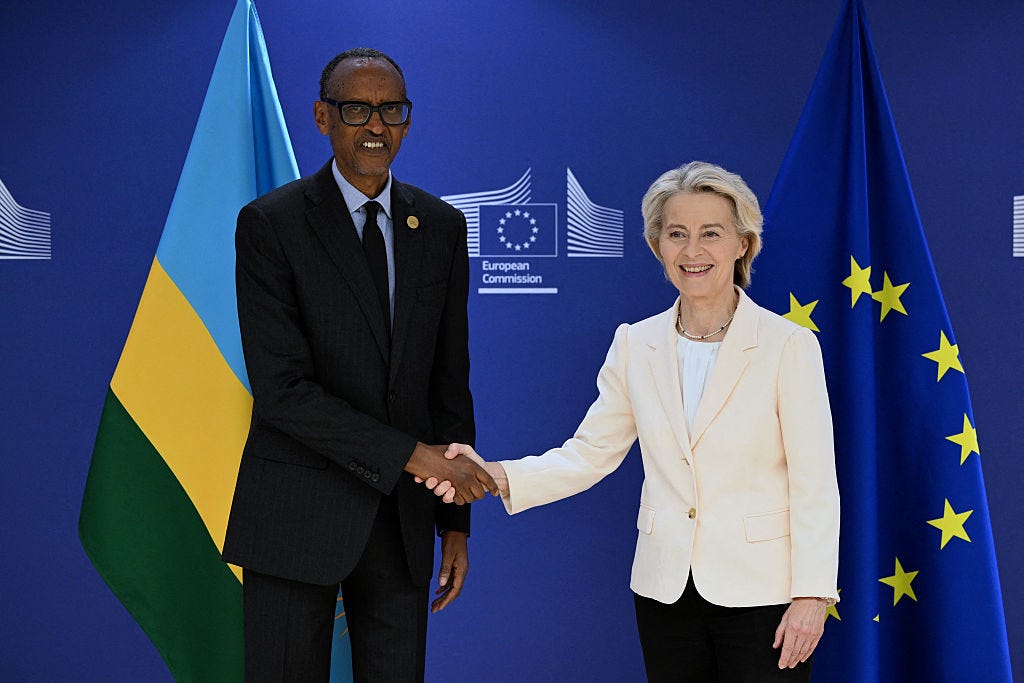
Today, Rwanda plays a pivotal role in the exploitation of minerals in eastern DRC. Supported by Rwandan forces, the M23 controls large territories rich in minerals such as coltan, gold, and cobalt. Rwanda has also been implicated in the illegal extraction and smuggling of these resources, integrating them into international supply chains and profiting economically while depriving DRC of crucial revenues. Today, Rwanda’s official exports of minerals far exceed what the country can produce domestically, pointing to systematic laundering of Congolese resources: “Exports are listed that geology cannot justify.”
Sub-Imperial Gatekeepers and the Resource Pipeline
Halake next discusses how the networks of regional brokers and state actors critically shape the resource extraction economy. Rwanda, a “sub-imperial power” and “gatekeeper for Gulf countries,” controls key transit routes for minerals and other valuable resources, such as timber. Uganda plays a parallel role in eastern Africa, both as a transit hub and active exploiter. Its military presence is officially focused on “counterterrorism” operations against groups such as the Allied Democratic Forces, and it also controls lucrative mineral and timber trade routes. Uganda smuggles billions annually in Congolese gold, timber, and other resources, often via nighttime motorcycle convoys trafficking prized, endangered African mahogany.
These resource flows rely on tacit or explicit elite agreements. During former DRC President Joseph Kabila’s rule: “Kabila could steal in silence only with Rwandan complicity: ‘You get your cut, we get ours.’” Exploitation is a web of local, regional, and international interests thriving on instability and weak governance, more complex than a simple North-South binary.
Rwanda and Uganda’s dual roles as mediators and power brokers, while maintaining influence over armed groups involved in resource extraction, allow them to safeguard economic interests and project regional influence. Together, their military incursions and economic networks sustain conflicts and resource plunder in eastern DRC. Control over mineral-rich territories and smuggling routes facilitates the flow of valuable resources into global markets, entwining local struggles with global consumption.
The role of other actors, such as the United Arab Emirates (UAE), further complicates the terrain. As Halakhe noted, “The biggest malign actor in the region is the UAE.” From “gold leaving Sudan” and “militias are recycled from one war to the next,” the Gulf states play an increasingly influential role in shaping extraction and violence. The “attention economy” and PR help maintain international legitimacy, but “lift the bonnet and you see a rotten system built on Sudanese blood.”
Securitization and the Return of Mercenaries
Similarly, Qatar brokered the recent peace agreement between Rwanda and the DRC, which includes a minerals-for-security deal that links economic access to resources with security cooperation. This deal consolidates securitization, both as a practice and ideology, by effectively trading the security and lives of people in the region for mineral concessions. It opens rich mineral supply chains to external investors, especially Western companies, amidst strategic competition with China and Russia.
The agreement has sparked concern about securitization that frames people as risks to be managed or traded. The re-emergence of private security providers and mercenary outfits, dubbed “cowboy capitalists,” are playing key roles in protecting Silicon Valley-backed mining interests. These private military and security enterprises represent a globalization of private violence, in which the needs of global conglomerates shape local security policies on the ground.
Silicon Valley’s involvement extends beyond software and encompasses defense technology companies that produce drones, surveillance, and electronic warfare technologies, often backed by prominent venture capital firms, further linking private capitalism, security, and extractive economies globally. This minerals-for-security framework between Rwanda and the DRC, alongside Silicon Valley’s private security ventures, shows how securitization, extractive capitalism, and private violence are shaping security arrangements on the ground in the DRC, commodifying human life and local resources within the context of global economic and geopolitical competition.
Public Relations, Charlatans, and Symbolism
We then discuss how the old logic of the empire has adapted to new geopolitical and media conditions, where narrative management plays a crucial role in sustaining extractive logics by shaping and controlling public perceptions and historical memory. Halake rightly links “from Stanley to today’s influencers,” suggesting that the legacy of colonial exploration narratives, epitomized by Henry Morton Stanley, continues today under new forms where narrative control functions as an extractive industry itself. This means that stories, images, and public relations are deployed strategically to legitimize ongoing extraction and exploitation, obscuring the violence and displacement involved in these processes.
For instance, the “Visit Rwanda” campaign was prominently displayed on Premier League football jerseys, such as Arsenal’s. Corporate sponsorship and sports branding serve as an “imperial ledger,” a form of soft power and marketing that masks harsher realities on the ground.
Pan Africanism, envisioned by leaders and revolutionaries like Patrice La Mumba, has been weaponised: “Pan-Africanism has become the last [resort] of tyrants who don’t want to be questioned.” Language and imagery traditionally associated with liberation and unity are co-opted by authoritarian leaders. Such leaders invoke Pan-Africanism rhetorically to shield themselves from accountability, deflect criticism, and maintain power, even as they perpetuate oppression and economic exploitation.
“What is happening in Congo will not stay in Congo.”
The techniques and technologies of extraction and control in places like DRC are not contained within national borders but rather travel globally, as they are tested in one conflict zone and then deployed elsewhere. This includes forms of digital surveillance, military hardware, and systemic violation of rights embedded in global supply chains, where extraction technologies become transnational, reproducing violence and economic control in multiple locations.
The same is true for knowledge. Our job is to be very attentive to history because, for history to exist, knowledge has to be produced, and we are in an age where AI is cannibalizing that very knowledge. AI-enabled digital erasure is an extension of historical book bans and censorship, where archives are not only controlled but also actively manipulated or erased through software and platform governance and censorship. In this sense, the refusal to forget suffering, the act of documenting and archiving, especially by those on the frontlines like writers, journalists, and human rights defenders, is also a form of resisting these infrastructures of repression.
Hope, Refusal, and the Ethics of Stamina
By the end, the conversation returned to where many conversations currently reside: history as a site of liberation. One of the most important things for me was Halakhe’s insistence that we must look to history to realize that the last days of an empire are often its darkest days, and to see history as a source of liberation and solidarity across time.
Despite a grim accounting of violence and exploitation, we refused fatalism. We ended the conversation with a note of hope when Halakhe said, “My job is not to give despair a chance.”
He called himself a “happy warrior,” an insistence on the possibility of transformation: “Revolutions are hard, but revolutions must happen.” As his closing comment frames it: “We need countries that build people, not just flags and passports… what happens in Congo should hurt us as much as Palestine, Sudan, Ethiopia.”
It was cathartic. In most Technologies of Genocide recordings, by the time we finish, we have spent at least three to four weeks preparing, reading material, contacting our guests, and sharing questions. We are often left with an immense amount of knowledge about what is happening to various communities and their resistance. We rarely end with radical hope—this time we did.
Listen to Technologies of Genocide, episode three, in conversation with Abdullahi B. Halakhe.