


May 15, 2026
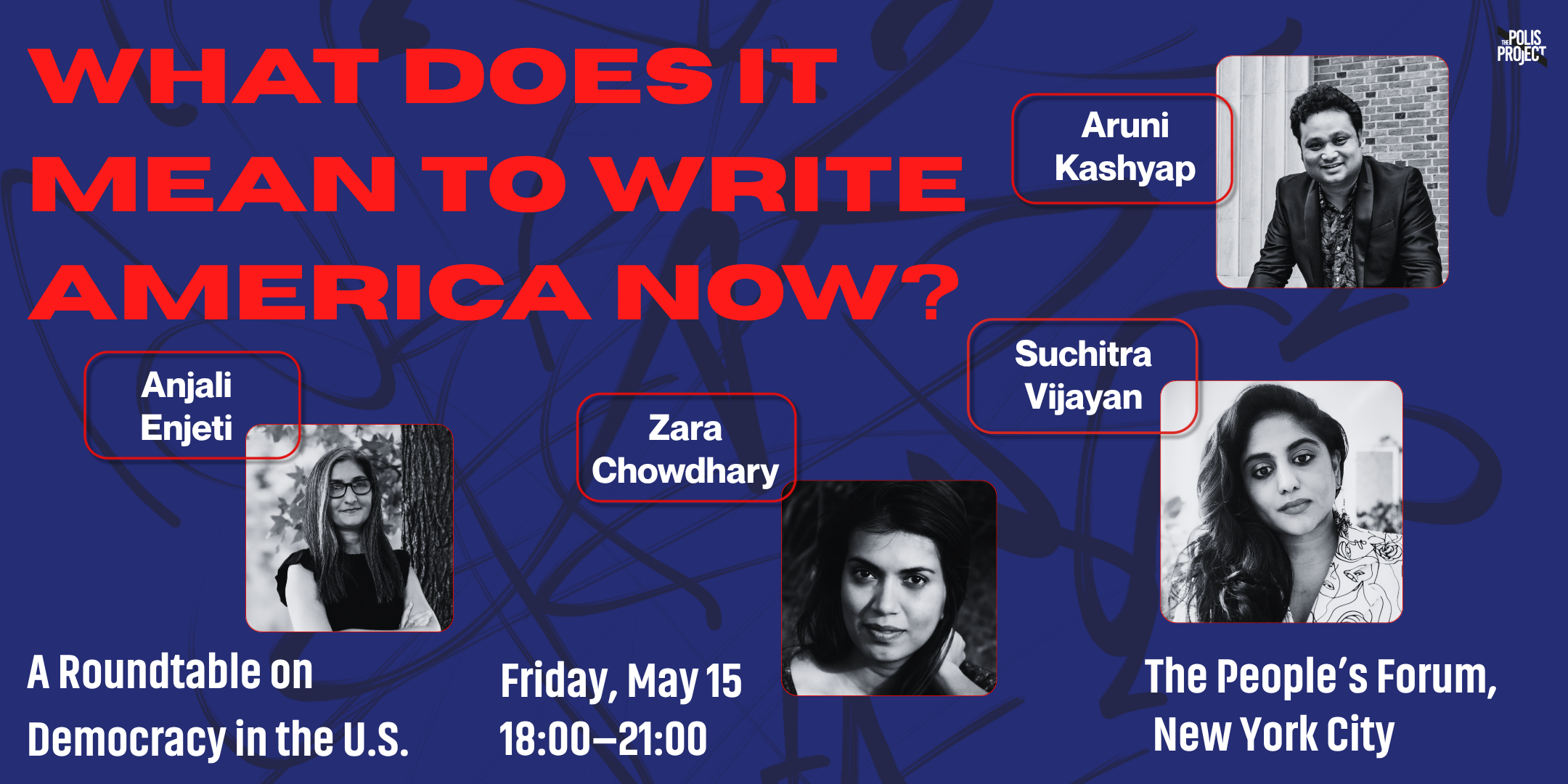
The People’s Forum, New York City
The Polis Project hosted an evening of conversation with Zara Chowdhary, Aruni Kashyap, Anjali Enjeti, and Suchitra Vijayan on writing, witnessing, and making sense of democracy in America during a time of deep political rupture. The four reflected on what it means to report on and live in a country shaped by growing authoritarianism. The speakers considered how writers of the diaspora move through America not as distant observers, but as people shaped by, implicated in, and resisting its systems of power.
Nearly two centuries after Alexis de Tocqueville wrote Democracy in America as an outsider attempting to understand the United States’ political experiment, this conversation returned to that question from a different lens. It asked how democracy is lived, enforced, broken, defended, and narrated today, and what it means to tell stories with rigour and care without collapsing into despair.
SPEAKERS
Anjali Enjeti is a journalist, activist, poll worker, former attorney, and the author of Southbound, The Parted Earth, and Ballot. Her work explores democracy, migration, race, and political participation in the United States.
Aruni Kashyap is a writer and translator, and the author of The Way You Want to Be Loved, The House With a Thousand Stories, and the forthcoming How to Date a Fanatic. His work moves across fiction, translation, memory, and political life in South Asia and the diaspora.
Zara Chowdhary is a writer, producer, and educator, and the author of The Lucky Ones. Her work examines memory, violence, survival, and the intimate afterlives of political rupture.
Suchitra Vijayan is the Executive Director of The Polis Project and the author of Midnight’s Borders and How Long Can the Moon Be Caged? Her work focuses on borders, state violence, citizenship, and the political possibilities of witness and resistance.
The transcript has been edited for length and clarity.
Opening remarks
Suchitra Vijayan:
Hello everyone, thank you for coming. I want to begin with a brief introduction to The Polis Project. We are a global magazine of dissent, and we document communities and resistance at the intersection of art, culture, and politics.
Next year, The Polis Project turns ten. I have no idea where a decade went, but here we are. Over the last few years, we have ventured into things we never thought possible. About two years ago, the brilliant Madhuri Shastri joined us to build our culture vertical. Since then, we have been doing incredible work. All aspiring writers, thinkers, and reviewers should find Madhuri, and you have my permission to harass her.
Public programming has always been at the heart of The Polis Project, because if we are going to document communities and resistance, we must also gather community. I have been manifesting and planning this event for over a year.
One of the reasons this conversation came together was that all my students suddenly started quoting Tocqueville’s Democracy in America. I have always felt underwhelmed by the book, and I have always wondered: who gets to travel through America and opine on it? Who gets to tell these stories? When I thought about who I wanted to hear from about America now, the three names that came to me are all here.
This conversation asks: who gets to write about America at a time when ICE is pulling people off the streets, voting rights are being gutted, and violence against Black and brown bodies continues to grow? It can feel as if helplessness is our only option. But this is precisely when we turn to writers whose work refuses hopelessness.
I first encountered Aruni Kashyap through his fiction thirteen years ago, when Bhakti Shringarpure asked me to review his work. Since then, I have watched him write across fiction, nonfiction, and translation. His American fiction debut, How to Date a Fanatic, is now out.
I have known Anjali Enjeti through her books and through years of conversations about what it means to be American, to organise communities, to face political heartbreak, and still keep going. Her new book, Ballot, is out now.
I first encountered Zara Chowdhary through The Lucky Ones, an extraordinary book about bearing witness to the Gujarat pogrom, living with its aftermath, and reflecting on it from the United States.
So please join me in welcoming Zara Chowdhary, Aruni Kashyap, and Anjali Enjeti.
What does it feel like to be a writer right now?
Suchitra Vijayan:
We are living through a moment that is difficult to name, let alone write about. What does it feel like to be a writer right now? What is making sense to you, and what is not?
Zara Chowdhary:
Thank you, Suchitra, and thank you to The Polis Project for gathering us in such isolated times.
What does it feel like to be a writer right now? It feels like walking on coals while juggling eggs, hoping that neither you nor the eggs fry. I wrote a book about genocide, and then I went on tour during a genocide, while living in the belly of the empire that creates and sustains so many of these systems. My brain has been in a whirlpool. I feel as if I have come out on the other side of some sort of matrix.
Aruni Kashyap:
I feel that we are in an absurd apocalypse. I do not know whether it began in 2014 in India, intensified in 2016 in the United States, or has simply been in a nosedive since then.
But whenever I think about survival, I return to my formative years in Assam, where the 1980s and 1990s were marked by insurgency and brutal counterinsurgency. People in my family were tortured and beaten. Armed groups would come to villages demanding food, and the army would later ask why people fed them. The answer is simple: you do not argue with people carrying guns.
In the middle of all this, I saw literary organisations and artists draw enormous crowds. Assam Sahitya Sabha, for all its problems, would attract hundreds of thousands of people to listen to poetry and fiction. Many were not formally literate, but they gathered to hear literature. I take inspiration from that. Despite the dumpster fire around us, we still have to go to work every day.
My father has written twenty-four books. He has never received an advance or a royalty cheque. He made his phone number public and was flooded with hatred, but he kept writing op-eds. He still writes at seventy-six. I take inspiration from writers and artists like him. However absurd the apocalypse feels, I have to keep at it, because I have so much more than many of the people I grew up around. So I have to keep fighting.
Anjali Enjeti:
I was born in the United States and spent much of my childhood in the Deep South, in Chattanooga, Tennessee. I have now lived in Georgia for nineteen years. When you live in the South for a long time, you grow up around Black resistance: the Civil Rights Movement, the Voting Rights Movement, and contemporary Black organisers and thinkers. I discovered Black radical writers such as Angela Davis, June Jordan, James Baldwin, and Audre Lorde before I ever found many South Asian writers.
My third book, Ballot, is about voting and voting rights in an anti-voting climate. I signed the contract in December 2023, which meant I was writing it through 2024. I was looking at 2020, when Trump lost and then turned his rage towards swing states like Georgia, where I live. I had already been involved in anti-voter-suppression work for years. But in 2024, as part of the pro-Palestinian movement in Georgia, I began to feel that the book no longer made sense.
We were trying to meet anyone connected to the Biden administration or the Harris campaign. We were meeting members of Congress, trying to open dialogue. And the people we had worked so hard to elect would not return emails or phone calls. Dialogue vanished. That broke me. I almost walked away from the book.
I kept going because I did not know how else to process what was happening. I remembered that there are still people fighting the system. Writing democracy, for me, means using creativity to find solutions and translating those solutions into some kind of concrete action.
Writing from the heart of empire
Suchitra Vijayan:
I want to stay with the idea of living in the heart of empire. We are bearing witness to a live-streamed genocide, protests, and a feeling that nothing is changing. How does writing exist in this moment? What do you do?
Aruni Kashyap:
I use my classroom as a space of hope. Somewhere along the way, I realised that part of my job is to create more fiction writers, especially writers in the tradition of those I admire. We read those writers, take the work apart, put it back together, and talk about how fiction, poetry, and nonfiction can change public discourse.
The classroom, like fiction, can be a sovereign space. It is where we can assert different rules and parameters. We have to work hard to keep such spaces sovereign, but they are fertile. They allow us to plant new seeds.
Zara Chowdhary:
When I was watching the way Israel’s violence was being justified, and hearing American politicians repeat that the Iron Dome had to be protected, I kept thinking about the structure of that phrase. Then I realised: America lives under an Iron Dome of information.
In this country, there is such limited access to stories from the rest of the world. There is also a designed cut-off point where empathy is meant to end, because beyond that point, empire becomes harder to sustain. Once I understood that, I understood why speaking to many Americans felt like speaking another language.
The problem is not only news media. It is everything around us: public school education, history books, film, culture, and the stories we are allowed to tell. Information itself has been designed to serve empire. My job becomes finding creative ways to infiltrate that dome.
Anjali Enjeti:
Sometimes I remind myself that we do not have to crack US empire all at once. We can crack the smaller units of empire. A classroom, a conversation, an article, an essay, or a small group where someone begins to doubt the propaganda they have inherited.
Sometimes we have to be the first person to plant that doubt. It is uncomfortable, but it matters. I have often ranted on social media and imagined that this is how we change people, but sometimes it is the smaller conversations that are more powerful. You tell someone: the United States is not the hero in this story. You have been taught to reverse good and evil. You are not served by empire; you are harmed by it.
Zara Chowdhary on The Lucky Ones
Suchitra Vijayan:
Zara, The Lucky Ones asks the reader to sit with the Gujarat pogrom. What is striking about the book is its intimacy. It feels as though you are sitting beside the reader and speaking directly to them. You have said that you kept asking why you were writing this more than twenty years later. Have you found an answer?
Zara Chowdhary:
So much of writing a first book is self-doubt. Do I have the tools? Am I ready? What do I have to offer when journalists and investigators have already written about this violence?
I began by writing about my father. I was writing a chapter called “Slow Violence”, after Rob Nixon’s work. At first, it was about a public servant who went to work every day, was mocked and humiliated for being Muslim by his Hindu Gujarati colleagues, came home, drank, and then the violence of the world outside entered the house. I was so focused on my father that I had not yet zoomed out to recognise that this was part of a system.
The pogrom was the spectacle, but the violence had been happening much longer. Once I understood that, I realised that the only thing I could offer was my family. There were people who lost so much more, including Ehsan Jafri, Bilkis Bano, Shabana, Suhana, and many others. What I had was the memory of these stories traumatising us. I could offer the experience of living in a home already on fire, inside a state that was also on fire.
I learned from writings of the Shoah, the Nakba, and other traditions of witnessing. I kept asking what it means to write from within. It broke me on the page. But touring the book, especially after Trump was elected again, made me realise that time does not move forward in the way we imagine. It feels like time moves through us, while we keep doing the same things.
Aruni Kashyap on vernacular aesthetics and writing against empire
Suchitra Vijayan:
Aruni, your first novel, The House with a Thousand Stories, was set against the armed insurgency in Assam, a conflict many Americans and many South Asians know little about. Your new novel, How to Date a Fanatic, moves between India and the United States. How has living here shaped the novel and your sense of writing against violence?
Aruni Kashyap:
How to Date a Fanatic is mostly set around Delhi, though there are scenes in the United States and Assam. It follows a character who moves back to India after doing his PhD, falls in love, and is not loved back, while exploring the queer dating circuit.
Many people do not know that until 2013, when my first novel came out, I wrote only in Assamese. I wrote stories, columns, and literary criticism in Assamese. I wrote four novels in Assamese and nobody published them. Then I wrote in English, and that got published.
Because of this, the aesthetics I borrow from are vernacular aesthetics: the Assamese novel, the Bengali novel, the Hindi novel. I have often found myself in opposition to the globetrotting Indian novel in English, which sheds “excess baggage” to move easily through the world. I wanted to be read widely, but on my own terms, without shedding what was valuable to me.
For me, resisting empire also meant resisting the novel that serves empire. Many Indian English novels centre the Western reader. They explain, soften, and avoid naming dehumanising systems because they do not want to make that reader uncomfortable. I wanted instead to return to the regional Indian novel, which is far more capacious, democratic, heterogeneous, and alive.
Zara Chowdhary:
That is exactly the Iron Dome again: the entitlement that knowledge must come to the reader, that the novel must come to them. I once got a review complaining that my novel had too many languages and character names, and that I should have provided a map and character list. My response was: Google Earth exists. Why are we expected to do all this labour?
Anjali Enjeti on Ballot and voting rights
Suchitra Vijayan:
Anjali, Ballot is deeply personal. You have organised, worked to elect people, and then faced their silence and refusal to engage. What did it cost to write this book at a time when voting rights are being dismantled in real time?
Anjali Enjeti:
Voting in a red state prepared me for this moment. When you live in a red state, your rights are always compromised, even when they exist on paper. Abortion, for instance, was only legal in name in many red states before Dobbs. If someone has to drive 100 miles, take days off work, return for multiple appointments, and navigate endless barriers, that is not meaningful access.
I am also a poll worker in Fulton County, one of the most targeted counties in the United States. Before the 2024 election, our state election board, run by Trump loyalists, tried to introduce new rules around hand-counting ballots after polls closed. Long before the Supreme Court further dismantled the Voting Rights Act, we were already in constant crisis.
In January, the FBI raided the Fulton County elections hub and seized ballots from the 2020 election, including mine. When you live inside this kind of suppression, you stop expecting your polling place to remain open, or your drop box to be where it was last year, or your district to stay intact.
In 2018, I was part of a group of residents that helped flip three districts blue: state senate, state representative, and congressional. A few years later, two of those districts were gerrymandered red. I live in a blue suburb of Atlanta, and my congressional district was redrawn so far north that it reaches near the Appalachian Trail.
This is the everyday reality of living in a red state. It gives you a certain clarity: crisis is not exceptional. It exists under every administration, in different forms. What matters is building broad coalitions and working within communities at the smallest, most local level.
Carol Anderson says that the problem with voting rights is that people think barriers like poll taxes and literacy tests disappeared. They did not disappear; they changed forms. A poll tax exists when your precinct closes and you must spend more money on transport to vote. A literacy test exists when ballots are not translated and voters cannot read them in the language provided. Rights are continuously infringed upon, whether or not they appear robust on paper.
Who are you writing for?
Suchitra Vijayan:
When you sit down to write, who are you writing for? Are you writing for people who already understand? Are you writing towards someone you do not know?
Aruni Kashyap:
I am a storyteller. Stories are how I make sense of the world, whether the world makes sense or not.
For writers in English from India, the question of audience has always been contentious. I decided that I did not want to be consumed by that debate, so I returned to the vernacular novel. Assamese, Bengali, and Hindi novelists are not primarily concerned with whether a reader in New York, London, or Switzerland will understand them. They write for readers who can enter the language and culture of the work.
If I assume that the whole world is my audience, I write water. In the quest for universalism, the work becomes flat. It loses historical and cultural grain. The artistic challenge is to stay with the specificity of where I come from, without overexplaining or orienting the work towards a Western reader.
Anjali Enjeti:
Usually, I take an interest in a problem and write in order to find a solution. Then I realise that I am part of the problem.
My first book was about Southern identity, white supremacy, and race from the perspective of a brown girl growing up in the 1980s South. I began almost from a victim position, then realised that I was implicated in racism in ways I had not understood. I was speaking against racism while still upholding white supremacy and US imperialism. That has happened in my other books too. I write to figure something out, then discover that I am the one who needs to change.
Zara Chowdhary:
For me, a key line came from Gerda Lerner, the Holocaust survivor and historian who helped build women’s history as a field in the United States. She said that patriarchy at the dinner table is fascism in the streets. That became a mantra for the book.
I wondered why I should write for a reader in New York or Chicago. Then a friend from Tennessee read the pages and told me, “This sounds like my family.” That helped me see that I was writing from one part of the world about a problem that existed elsewhere too. The intimate systems and the global systems were connected.
In my next work, I am thinking about extraction: settler colonial extraction, capitalist extraction, and the extraction that has long been done from Dalit, Muslim, and marginalised bodies in South Asia. I am interested in what that does to the body, especially the woman’s body, and how to tell a story about land and personhood at once.
Refusing the demand to perform trauma
Suchitra Vijayan:
For those of us writing about violence and dispossession, there is often a demand to perform trauma, as if violence is the only story Black and brown writers can tell. Have there been times when you refused that demand?
Zara Chowdhary:
When Mohsen Mahdawi walked out smiling after his arrest, I thought: that is my approach. We are alive, we are telling these stories, and we are filled with art, ability, talent, technique, craft, and power.
I do not think reality can be beautified, but in early drafts I sometimes tried to aestheticise pain. Eventually I realised that the raw thing had to remain. Then I had to ask what around it offered relief. For me, that was my mother’s painting, dancing with my sister in our room, closing the door, finding joy that was embodied and not performed.
Aruni Kashyap:
Even in conditions of horror, humour exists. During counterinsurgency in Assam, there were stories that became jokes or urban legends: soldiers misunderstanding local phrases, names being mistaken for commands. These stories existed alongside rape, torture, and extrajudicial killings.
When I wrote my first novel, my drafts were full of violence, partly because journalism had failed us. But I realised that the writers I admire are often funny, ironic, and beautiful. So I moved much of the violence backstage. The reader sees characters responding to it or living in its aftermath.
Revision taught me that I had to foreground the perennial resistance of common people, where there is joy, hope, and delight. I did not want to write only from disappointment.
Anjali Enjeti:
There is a tendency to write trauma with a redemption arc, a happy ending, or a saviour story. But many people walk around with unresolved trauma. Some never heal. Some die in despair. Some never live a peaceful life again.
Part of writing trauma is teaching readers that this too is a realistic and acceptable narrative. You can write beyond the traumatic event without sanitising it, and without pretending there is always a lesson. Sometimes there is no lesson. There is just trauma, and people going about their lives as best they can.
Audience questions
Audience member:
How do we balance explaining institutions with creating intimate, empathetic stories that move people to confront authoritarianism and organise?
Anjali Enjeti:
I have changed my thinking on this. In creative writing, we are often taught that the enemy is being too didactic. We are told to show, not tell, to be subtle, lyrical, and beautiful. But it is very hard to fight propaganda only through subtlety.
If the goal is education, sometimes we have to be direct. Sometimes we cannot meet the audience where they are. We have to state the truth clearly because we are on a timeline and we do not have endless time for the reader to gradually arrive.
Audience member:
Zara, could you have written The Lucky Ones if you still lived in India?
Zara Chowdhary:
I have many drafts in Google Docs from India, including angry drafts from 2014 when Modi was first elected. But they were not a book. There is no practical real-world scenario in which a large Indian publisher today would say, “Let me publish this.”
What helped me write the book was watching the anti-CAA and NRC protests, especially Shaheen Bagh. I saw people who were the age I had been in 2002, speaking with fury and clarity about belonging and democracy. They reminded me of who I used to be. They reminded me that I come from a place of strength, defiance, and dignity.
Audience member:
How do you deal with vernacular aesthetics when many regional canons are also shaped by caste and patriarchy?
Aruni Kashyap:
That is an important question. The Assamese literature I grew up reading was polyphonic in ways that were different from some other regional canons. But no literary tradition is innocent. When I speak of vernacular aesthetics, I am not saying the vernacular is pure. I am saying that it gives me tools to resist the flattening demands of Indian English writing and the Western reader.
Audience member:
For those of us shaped by immigrant parents, family histories of violence, and the South, how do we confront complex identities in this moment?
Anjali Enjeti:
We cannot assume that crisis is new just because some people are recognising it now. In the South, many of these structures have always been visible. The work is to build coalitions across histories, rather than imagine that one community’s suffering is exceptional. We have to learn from international movements and from the people around us who have been resisting for generations.
Zara Chowdhary:
Family histories often come to us late, in fragments. Sometimes our parents do not tell us what they survived until much later. But the silence itself shapes us. It comes out in the everyday. Writing can help us understand how intimate family systems carry the violence of larger political systems.
Publishing, power, and what to read now
Suchitra Vijayan:
Let us end with the future of storytelling and publishing. Where do you see hope, and what contemporary writers should people read?
Aruni Kashyap:
In the Anglophone publishing world, I see hope in independent presses and university presses. They often publish urgent work that corporate publishers will not risk. I also see value in the relationship between academia and creative writing, because tenure, however imperfect, can give writers room to do aesthetically adventurous work.
Many of my graduate students distrust corporate publishing and actively seek independent presses. Because corporate publishing dominates the conversation, it can be hard to see all the new plants growing elsewhere.
I recommend Kin by Tayari Jones, Anjali’s Ballot, Zara’s The Lucky Ones, and, of course, a very good book coming in July called How to Date a Fanatic.
Anjali Enjeti:
Almost every publishing path involves some compromise. I was paid very poorly for my books, but I was able to publish the books I wanted without the same level of compromise that might have come with a large corporate publisher. I do not want to romanticise being underpaid, because that also reflects privilege and the harm built into publishing.
Some of the best writing readers will find is in translation and from small presses. I recommend Kin by Tayari Jones, Let the Poets Govern by Aja Monet, Fear Less by Tracy K. Smith, and Choice by Neel Mukherjee.
Zara Chowdhary:
I have been reading older white women writers because I am interested in how they enter rooms and write whole worlds with such authority. I have also been thinking about how they write the intimacy of the violence of the American project.
In contemporary work, I was blown away by Isabella Hammad’s Enter Ghost, Danez Smith’s poetry, Lena Khalaf Tuffaha’s poetry, and T Kira Madden’s fiction. When literature works, it does not only explain a system. It renders it.
Closing remarks
Suchitra Vijayan:
We can compile a longer reading list and send it out to our readers.
Thank you all for being here. We want to keep doing these events because The Polis Project is sustained by a community of readers, writers, thinkers, and organisers. Please subscribe to our newsletter, support the work if you can, and keep coming to future gatherings.
I also want to acknowledge the incredible people in this room, including Jee from Singapore Unbound and Kavitha Rajagopalan from the Center for Community Media. This audience is full of people doing important work, and I hope you get to know one another.
Thank you so much for coming. I hope you keep coming back for more events.