









Four years after Myanmar’s military seized power, regional economic networks continue to sustain its campaign of violence. Despite sanctions by Western governments, companies and financial institutions across ASEAN have enabled the junta’s access to weapons, oil revenues, aviation fuel, and foreign currency. UN Special Rapporteur Tom Andrews has described this as a “billion-dollar death trade,” tracing at least US $1 billion in arms and raw materials to supply chains operating through Singapore, Thailand, China, and India.
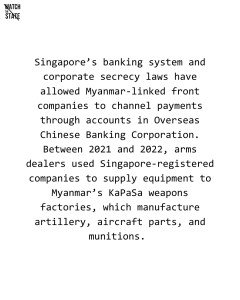
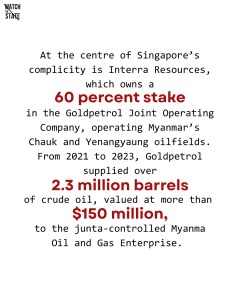
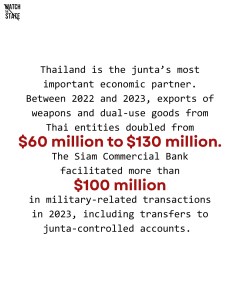
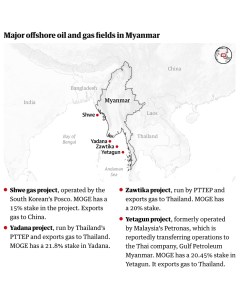
Singapore remains the junta’s primary financial hub. Between 2021 and 2022, entities registered there shipped US $254 million in arms-related goods to Myanmar, while Singapore-listed Interra Resources has supplied over two million barrels of crude oil to the regime’s state-owned Myanma Oil and Gas Enterprise. In Thailand, exports of military-linked materials doubled between 2022 and 2023, and state-owned PTT continues to pay over US $500 million annually to junta-controlled energy companies. Malaysian contractors and service providers have maintained operations at gas fields that generate critical foreign exchange for the military.
A 2025 investigation by Justice For Myanmar identified 54 ASEAN-based firms maintaining direct or indirect business links with the junta. These range from energy and telecommunications ventures to aviation-fuel suppliers and technology firms. No ASEAN member state has imposed sanctions on the Myanmar military or its affiliated banks and conglomerates. The result is a regional economy that continues to deliver capital, fuel, and legitimacy to a regime accused of systematic war crimes, long after the world’s attention has shifted elsewhere.