



Neighborliness became a living infrastructure of resistance as Operation Metro Surge swept across Minnesota
Minneapolis, St. Paul, and communities across Minnesota have spent months living through what residents describe as an unprecedented federal immigration enforcement operation. Known as Operation Metro Surge, the deployment has brought thousands of federal agents into the state and led to thousands of arrests since December 2025.
Proponents within the Department of Homeland Security (DHS) describe Metro Surge as the largest immigration enforcement effort in the agency’s history. Opponents — including Congresswoman Ilhan Omar — have called it a “militarized campaign of fear that treated immigrants as criminals and weaponized the federal government against our own residents,” in a Star Tribune commentary.
Many Minnesotans use another word: occupation.
That occupation was met with an ecosystem of resistance and community care. It was embedded in the efforts of neighbors and neighborhoods, local businesses, community organizations, unions, schools, and more.
In the Twin Cities and surrounding communities, whistles became commonplace — community members were prepared to draw attention to the actions of immigration agents detaining people on the streets. Businesses like Smitten Kitten — an adult store in Minneapolis — and Wrecktangle Pizza became hubs for mutual aid, gathering supplies and monetary donations to distribute across impacted neighbors. After the murder of a Minnesotan, Glam Doll Donuts became a makeshift warming place, and The Copper Hen Cakery & Kitchen became a field hospital for medics supporting community members on-site.
Operation Metro Surge
At its peak, the operation included roughly 4,000 federal immigration enforcement agents statewide, though Minneapolis received much focus both from immigration officers and in media coverage. The force was primarily composed of ICE Enforcement and Removal Operations (ERO) and Homeland Security Investigations (HSI), supplemented by more than 1,000 U.S. Customs and Border Protection (CBP) personnel, including Border Patrol and specialized tactical units.
Recent court filings indicate that 400 to 650 agents remain stationed in Minnesota, even after most Border Patrol units were demobilized by late February. Before the operation began in December 2025, roughly 150 federal agents covered a five-state region that included Minnesota.
Since the deployment, thousands of people have been arrested or detained across Minnesota. The White House and DHS estimate the number at roughly 4,000, though it remains unclear how many of them were U.S. citizens and were later released. A Star Tribune analysis has questioned the federal government’s numbers and underlying data.
In short, the Star Tribune article, published in late February, states that about half of the individuals that the Trump administration had labeled “worst of the worst” were already in prison, whether at the federal level or in Minnesota.
“Of the remainder, just over half were accused or convicted of a violent crime, the analysis found. The most common charges the rest faced were drug crimes, theft and illegal re-entry into the country, a felony. Only a few had outstanding warrants and were actively wanted by police.”
Why Minnesota?
The surge was launched in December 2025 as a multi-agency federal enforcement effort targeting alleged social services fraud and immigration violations. But state officials, community organizers, and civil rights advocates argue the operation quickly expanded beyond those stated goals.
Minnesota was singled out for Operation Metro Surge due to a combination of stated law enforcement goals and what local officials describe as political retaliation. The Trump administration justified the surge as a multi-agency investigation into large-scale social services fraud, sparked in part by a viral YouTube video released in December 2025.
A viral video by YouTuber Nick Shirley alleging widespread fraud at Somali-run daycare centers prompted a rapid federal response, including DHS raids and a freeze on state childcare funding. Subsequent state inspections found that nearly all the sites were operating normally; the “evidence” of empty buildings resulted from Shirley visiting before business hours or filming a center that had been closed for years.
Minnesota’s state and local leaders — including Governor Tim Walz and Attorney General Keith Ellison — argued in federal court that the operation is a campaign of political retribution. They say the administration has used the surge to pressure “sanctuary” jurisdictions like Minneapolis and St. Paul to abandon policies restricting local cooperation with ICE.
Renee Nicole Good and Alex Pretti
The occupation has resulted in the deaths of two Minnesotans — Renee Nicole Good (age 37) and Alex Pretti (age 37)— both killed by federal immigration agents.
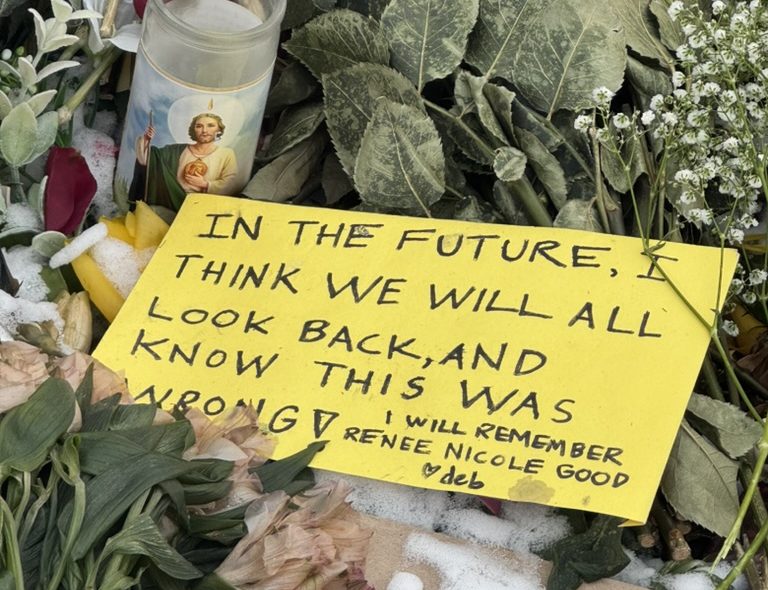
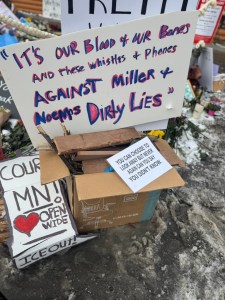
Pretti was killed in January by CBP officers. Good was shot in early January while sitting in her car by ICE agent Jonathan Ross in Minneapolis. Memorials for both have been erected in the city, with community protectors watching them around the clock. No one has been charged in either killing.
The Trump administration and DHS claimed both Good and Pretti were violent aggressors and that agents acted in self-defense.
But eyewitness footage shows Good angling her car away from the officer — not toward him — when she was shot. The officer, later identified as Jonathan Ross, did not appear to be in the vehicle’s path. Good was shot in the side of the head.
In the killing of Pretti, federal authorities claimed he approached Border Patrol agents with a handgun. Assistant Homeland Security Secretary Tricia McLaughlin said in a news release that Pretti “wanted to do maximum damage and massacre law enforcement,” forcing agents to fire what she described as “defensive shots.”
While DHS claimed Pretti was armed and threatening, video recorded by community members — along with frame-by-frame analyses by The New York Times and other outlets — shows he was holding a cell phone in his right hand. Although he was legally licensed to carry a firearm, it was holstered and had already been taken by agents before he was shot 10 times in five seconds.
In both cases, federal agents reportedly prevented bystanders — including a physician and a pediatrician — from performing CPR. In Pretti’s case, witnesses say agents counted his bullet wounds while he lay motionless.
Federal Obstruction and Retaliation
Federal authorities have obstructed state-level investigations by refusing to share evidence with the Minnesota Bureau of Criminal Apprehension (BCA) and blocking local investigators from accessing the scene of Pretti’s death. After a court lifted a restraining order protecting evidence from destruction, state legislators introduced bills requiring BCA oversight of fatal encounters involving federal agents.
In the killing of Good, Ross is the only agent publicly named. In late January 2026, Deputy Attorney General Todd Blanche announced that the Department of Justice (DOJ) would not open a criminal investigation, describing Ross’s actions as “defensive.” Good was explicitly labeled a “domestic terrorist” by DHS Secretary Kristi Noem.
However, media investigations have identified several of the shooters, including Agent Ross. His history — including a prior arrest incident and the use of a sexist slur during the killing of Good — has become a central point of contention.
Two shooters have been publicly identified in the killing of Pretti. Jesus Ochoa, a CBP agent, is seen in witness footage firing multiple shots while Pretti was already restrained on the ground. Raymundo Gutierrez, also a CBP agent, has been identified as the second shooter. Both agents have been placed on administrative leave. At least five other unnamed CBP agents were captured on video wrestling Pretti to the ground and pinning him moments before the fatal shots. One unidentified agent is seen clapping immediately after the shooting.
Investigations into the shootings of Pretti and Good are now at a standoff between state and federal authorities. While journalists and local officials have identified several agents, the federal government has largely shielded them from local prosecution.
The DOJ Civil Rights Division has also faced criticism for a lack of transparency, with spokespeople refusing to confirm whether key evidence — including body-camera footage — has been shared even with others within the federal government.
Statewide Investigations
Hennepin County Attorney Mary Moriarty — whose jurisdiction includes Minneapolis — and the Minnesota BCA are attempting a criminal investigation into the killings. Moriarty said federal authorities were obstructing the process by refusing to share evidence or allow interviews with the agents. She set a March 3 deadline for federal agencies to respond to requests for names and evidence.
After the March 3 deadline passed without a federal response, the standoff between state and federal authorities entered a new phase. Moriarty’s office launched the Transparency and Accountability Project (TAP), a public portal designed to collect community-sourced video and other evidence federal agencies have refused to provide.
At the same time, the scope of the investigation has broadened. The Hennepin County Attorney’s Office is now reviewing at least 17 incidents of potential misconduct by federal agents. While federal officials argue their agents are shielded by sovereign immunity, Moriarty has said she is prepared to go to federal court to compel the release of identities and evidence related to the killings of Pretti and Good. Minnesota Attorney General Keith Ellison has also filed suit against the DHS seeking to halt deployments like Operation Metro Surge.
The DOJ has not opened a criminal investigation into either killing. Instead, the focus has largely been on labeling Renee and her widow, Becca Good, specifically, as “domestic terrorists,” according to a The New York Times report.
As part of that investigation, mass resignations within the DOJ were sparked not just by the refusal to investigate Ross, but by the active demand from senior officials to turn the criminal investigation onto Becca Good. Prosecutors were pressured to open a criminal investigation into Becca for “assaulting, resisting, or impeding” a federal officer at the time of Renee’s killing.
After the killing of Pretti, Attorney General Pam Bondi sent a letter to Governor Walz, stating that if he wanted Operation Metro Surge to end, he needed to comply with several stated “solutions,” including Minnesota releasing the state’s unredacted voter roll in order to ensure “ Minnesota’s voter registration practices comply with federal law.”
Minnesota refused to comply, according to an article in Mother Jones and a press conference held by the governor following Pretti’s killing.
While the federal response to community resistance and caretaking efforts have been deeply militarized, the state has tried to position itself as a type of counter-balance.
Minnesota Attorney General Ellison and the cities of Minneapolis and St. Paul filed a joint lawsuit alleging the operation is unconstitutional and violates the Tenth Amendment. St. Paul passed an ordinance banning law enforcement from wearing identity-obscuring masks and prohibiting federal staging on city property. Minneapolis Mayor Jacob Frey issued a similar executive order.
Local police departments have also been instructed to follow “separation ordinances,” meaning they do not participate in federal immigration enforcement. However, state departments have incurred millions of dollars in overtime costs managing the resulting public unrest.
Resistance and Caretaking
As federal institutions and legal frameworks are weaponized against residents, many Minnesotans have stopped looking to the government for protection and instead turned to one another, relying on a deep-rooted infrastructure of community resistance and caretaking.
Organizers describe the response as a “city-supported community-safety ecosystem,” one that evolved directly from the 2020 George Floyd uprisings and the early days of the pandemic.
Community response to the federal occupation centers on two forms of action: resistance and caretaking, according to Ricardo Levins Morales — a movement artist, organizer, and elder based in Minneapolis — citing the work of movement elder Susan Raffo.
That infrastructure is both a response to current conditions and the product of a long history of organizing in Minnesota. It addresses the crisis of the moment while building long-term capacity for future struggles.
“The way to keep fascists from achieving their long-term goals is to keep them from achieving their short-term goals,” Levins Morales said. Resistance targets those long-term goals, while caretaking disrupts the short-term ones.
Across the Twin Cities and other regions of Minnesota, organizers and community leaders urge people to get to know their neighbors — both to prepare for what may come and because knowing your neighbors means knowing your community.
“When we talk about neighbors, we’re really talking about people we care about — people we don’t see as different from ourselves,” said Megan Olivia Hall, former Minnesota Teacher of the Year from St. Paul. Hall has taught in Saint Paul Public Schools since 2001. “Community and connection are real human needs. But we can skate past them when we’re always working, caring for our kids, spending money, or just skating on the surface of life.”
Neighborliness has been central to Minnesota’s resistance movement. Organizers know of roughly 80 to 100 mutual aid networks in the Twin Cities alone, though much of the resistance and caretaking work happens quietly or in underground spaces.
This neighborly response has also included the largest statewide general strike in nearly a century.
Day of Truth and Freedom
On January 23, Minnesotans launched a general strike, with roughly 700-1000 businesses, museums, and cultural institutions participating. Despite temperatures around -21°F (with wind chills as low as -40 to -50), the crowd filled the 20,000-seat Target Center and spilled into the surrounding streets. Local organizers estimated participation as high as 100,000 people, describing a “unified statewide pause” that included workers staying home, students walking out of school, and a “no shopping” blackout.
The strike, called the “Day of Truth and Freedom,” was organized by faith leaders and was endorsed by labor unions across the state, including the AFL-CIO. Because of the extreme cold, both Minneapolis and St. Paul Public Schools canceled in-person classes. Teachers, students, staff, and administrators from both districts participated in the rally.
Across Minnesota, much of the response has taken the form of community defense, with whistles becoming an everyday tool across the Twin Cities and other communities in the state.
Outside Bench Pressed, a business in Minneapolis’ Seward neighborhood, a bowl of whistles reading “FUCK ICE” sits available to all. Several videos circulating this year show whistles being used to disrupt and push away immigration enforcement officials.
“For a while we were out at the buses with our whistles every afternoon, ready in case ICE showed up,” Hall said.
Whistles are not just noise. They create a kind of human shield for children during one of the most vulnerable moments of their day — moving from home to the school bus.
Schools Fight Back
Because of fears created by the occupation, both Minneapolis and St. Paul Public Schools began offering online learning options for students who feel it is unsafe to attend in person. More families chose virtual school for fear of leaving home and because schools themselves have become targets for immigration enforcement.
Hall — the SPPS teacher — said her school has not been targeted as heavily as others, but the fear remains real. Some of her students now attend classes entirely online.
“As we learned during the pandemic, virtual learning is not the same as in-person learning. There is far less opportunity to understand how students are doing, how much they’re learning, and what they need. There’s a constant worry about the students who aren’t here in person,” Hall said.
Hall said approximately half the students at her 6th–12th grade school participated in a January 14 walkout after the killing of Good, and teachers spoke with them about staying safe in the streets.
“Especially during a time when you’re worried about kids being out on the streets — when you don’t know who else will be there or whether it will be safe.”
Fridley Public Schools and Duluth Public Schools, joined by the state teachers union Education Minnesota, filed a federal lawsuit on February 4 against the DHS seeking to halt immigration enforcement on or near school grounds. The legal challenge aims to restore a 30-year “protected areas” policy that the Trump administration rescinded in January 2025, which restricted enforcement at sensitive locations like schools and hospitals. School leaders say its removal has led to masked federal agents circling campuses and detaining families at bus stops, causing what they describe as a “devastating impact” on attendance and student mental health.
Legal Observation
Another form of resistance to the federal occupation has been legal observation, with trained community members documenting ICE and CBP misconduct and spreading word about the operation across Minnesota.
Annastacia Belladonna-Carrera, executive director of Common Cause MN, says legal observation in Minnesota has many roots.
Organizers training legal observers today often point to the work of Darnella Frazier, who at 17 recorded the murder of George Floyd by former Minneapolis police officer Derek Chauvin. Frazier was not a legal observer, but her decision to film Floyd’s murder helped transform Minnesota and push the state’s racial justice movement forward during the 2020 uprisings.
Belladonna-Carrera, a lawyer, describes the grassroots resistance in the Twin Cities and beyond as a “city-supported community-safety ecosystem.” Belladonna-Carrera and others note that much of the infrastructure supporting today’s resistance and caretaking grew out of the 2020 uprisings and the early days of the pandemic.
Witness statements say 15 people present observed and recorded Pretti’s killing. Stella Carlson was one of them and was interviewed by CNN in late January.
“I wasn’t going to leave Alex by himself, undocumented. That wasn’t an option,” Carlson said in the interview. “Obviously, somebody had just been executed in the street. I knew I was in danger. We all were. But I wasn’t going to leave until we were all cleared out.”
While visible acts of resistance — from strikes to whistle networks — have drawn public attention, the quieter effects of Operation Metro Surge have reshaped daily life across the Twin Cities and the ability of many Minnesotans to feel safe in their communities.
Economic Impact
In Minnesota, the presence of federal immigration enforcement agents has pushed hundreds of families to stay home. Small businesses — particularly along ethnic corridors like University Avenue in the Twin Cities and Lake Street in Minneapolis — have seen a sharp decline in business as fewer people venture out and more money is directed to mutual aid funds. Both corridors were already hard hit during the uprising following the murder of George Floyd.
The Senate Jobs and Economic Policy Committee discussed the impacts of Operation Metro Surge during a February 25 meeting. According to data presented there, Minneapolis alone experienced an estimated $203.1 million in economic impact. That total includes $47 million in lost wages from people afraid to leave home for work, $81 million in lost restaurant and small-business revenue, $4.7 million from hotel cancellations extending into summer, and $15.7 million in additional rent assistance tied to lost household income since December 2025.
In St. Paul, too, the impacts were significant.
“Our mercados, our Vietnamese bakeries, our taquerias, and East African restaurants have been intentionally targeted by federal immigration enforcement operations — from the East Side to the North End, from Rondo to the West Side, and across our entire community,” said St. Paul Mayor Kaohly Her.
The economic impact on businesses, families, and individuals has led to calls for an eviction moratorium, amid fears that many people would be unable to pay rent by March 1.
A February report from the University of Minnesota’s Center for Urban and Regional Affairs estimates that rent debt in Minnesota during the first two months of 2026 is between $27.4 million and $51.3 million — on top of the typical $44.6 million in expected rent debt.
Amid those fears and the growing challenges facing renters — particularly Black and Brown renters sheltering at home — a coalition of portfolio-level housing unions across Minneapolis and St. Paul launched Twin Cities Tenants on January 30, with support from the Tenant Union Federation.
On February 17, Twin Cities Tenants announced they were assessing “rent strike readiness.” A week later, the group demanded eviction protections from Minneapolis officials and called for a rent strike. However, despite extensive efforts with 272 volunteers knocking on more than 1,000 doors within two weeks, the strike did not move forward because of a lack of numbers.
“We have been risking so much in the Twin Cities. People are risking their safety — their bodily safety — and the safety of their families. There’s fear of abduction, fear even in leaving home to go to work,” said Nadia Langley, an organizer with Twin Cities Tenants and the South Minneapolis Tenants Union.
While the impacts of the occupation have had a long reach, community members have responded by utilizing a mutual aid ecosystem — one utilized after the murder of George Floyd and depended on again in 2026.
Mutual Aid and Community Care in Minnesota
In 2020, George Floyd Square became both the focus of a community uprising and a hub for mutual aid. Medics treated protesters injured by pepper spray and sick community members, and food flowed to those who needed it.
Belladonna-Carrera describes the community response in 2026 as a “co-architecture of safety and justice.”
“That’s what makes this moment different. It’s not just a continuation of 2020 — like rapid response teams — it’s now permanent infrastructure,” Belladonna-Carrera said. “These are living systems growing out of the trauma and transformation of 2020. The uprising built durable networks of care, protection, and political action that continue to evolve and respond.”
The mutual aid and caretaking models that evolved directly from networks established at George Floyd Square have spread from homes and schools to areas outside the Whipple Building.
At Whipple, a group called Haven Watch waits outside to support people released by immigration agents and help them contact their families, since most detainees do not have their phones when they are released. A visit to Whipple to support those protesting the occupation prompted Natalie Ehret, an Army veteran and mother of two, to found Haven Watch earlier this year. The Minneapolis-based effort is a volunteer-run humanitarian organization largely funded by donations.
Donations have funded much of the work in Minnesota — from community members doing laundry for neighbors unable to leave home to volunteers collecting SkyMiles to fly people home after being detained and released out of state. Food justice organizations have also expanded distribution networks.
According to Kyla Goux of TC Food Justice (TCFJ), need in the Twin Cities has quadrupled in recent months. TCFJ is a community-based food justice organization founded a decade ago by students at the University of Minnesota’s School of Public Health. The group primarily connects organizations with surplus food to hunger-relief groups that can distribute it.
“The model of TC Food Justice is that we’re the transportation link between A and B. If we’re picking up food from a restaurant or grocery store, we move it directly to the organizations distributing it,” Goux said.
Alongside its normal routes, TCFJ is now working with roughly 40 schools, distributing food that can be passed along to families sheltering at home in Minneapolis and St. Paul.
“Schools are at the center of what we do. They’re the frontline connection to families,” Goux said. “The need has been astronomical.”
About 80% of the food and dry goods provided to TCFJ — including diapers and paper towels — come from community donations. The remaining 20% is fresh produce procured directly by the organization.
Early on, the organization relied on local partners for warehouse space.
“We had a partner who allowed us to use their warehouse as a home base for several months, but we’re now renting our own space so we can continue meeting demand through the end of the school year,” Goux said.
Goux also noted that local businesses helped facilitate donations.
“Many of the donations coming into the warehouse started as collection drives at places like a local fitness studio or record shop before being moved to our current distribution site,” Goux said.
Like many efforts in Minnesota, TCFJ is one node in a broader ecosystem of resistance and caregiving.
Ecosystem of Care and Aid
Jennifer Arnold, executive director of Inquilinxs Unidxs por Justicia, a Twin Cities housing justice organization, said that at her child’s school, 130 families sheltering at home have been paired with another family — creating a network of about 260 families.
“That partnership means that if one family is stuck at home, they can communicate their needs directly to another family committed to supporting them,” Arnold said. “This isn’t going to disappear. We’re a stronger community because of it, and we’re able to reach for more.”
Levins Morales describes what is happening in Minnesota as infrastructure. He notes that movements like Abolish ICE — which emerged alongside the creation of DHS — are just one wave in a much larger movement ocean. The resistance growing in Minnesota draws on lessons from past movements, including the 2011 labor uprising in Wisconsin, Occupy Wall Street, the Dreamers movement, Standing Rock and the Water Protectors, and pandemic response networks.
“One key difference is that solidarity is at the center of this moment,” Levins Morales said, noting that Minnesota’s Abolish ICE effort is built on connection and neighborliness. “This moment requires a different kind of relationship-building. It calls for deeper, ongoing relationships across lines of racial, linguistic, and cultural division.”
Because Minnesota’s Abolish ICE effort combines resistance and caregiving, Levins Morales sees a historical parallel in the AIDS movement.
“The only historical parallel that comes to mind where those wings were so evenly balanced is the response to the AIDS crisis. There, deep personal care and direct resistance were organically connected parts of the same movement.”
Hall — the SPPS teacher — notes that today’s organizing is not the first time Minnesotans have come together this way. Mutual aid networks, including grocery delivery, emerged during the pandemic and the 2020 uprising.
“Not only did we go through the trauma of the COVID-19 pandemic together, but we also experienced the trauma of George Floyd’s murder and the destruction that followed,” Hall said. “We went through some really difficult things together, and that has kept us connected.”
Hall also noted that Minnesota’s older immigrant communities — Irish, Norwegian, and Swedish, for example — remain closely connected to their roots. She believes that history helps explain why the state has built strong ties with more recent immigrant communities, including Karen, Hmong, Somali, and Ethiopian residents.
Levins Morales describes Minnesota’s response to the federal occupation as more multiracial than the response in 2020. He compares existing mutual aid networks to mycelium — the vast underground fungal networks that spread like threads beneath the soil.
“Minnesota’s mutual aid network is decentralized and interconnected. It moves directly where it’s needed,” Levins Morales said. Much of that network operates informally between neighbors and street corners.
Lessons from Minnesota
While Minnesota’s city-supported community-safety ecosystem offers a powerful template, other communities are still figuring out how to adapt these highly visible tactics to their own local contexts. In Tucson, Arizona — where immigration enforcement has long been a daily reality — some of Minnesota’s methods feel familiar. In Lawrence, Kansas, however, the same tactics are being viewed more cautiously.
Sebastian Quinac, director of Indigenous Languages for Indigenous Alliance Without Borders in Tucson, said his community already knows how to protect itself.
Before Arizona’s SB1070 was partially struck down, his community had already organized rapid-response networks. Offering grocery delivery and rides to school or medical appointments to neighbors were part of daily life.
SB1070, passed in 2010, required police to check the immigration status of people they suspected were in the country illegally during lawful stops. The law became a national flashpoint for its “show me your papers” provision. The Supreme Court later struck down several sections while allowing the status-check requirement to remain.
“We also see the connection between Minneapolis and here. The border is no longer just at the geographic border — it’s inside the United States,” Quinac said. “Now people elsewhere are experiencing what we’ve faced in Arizona for years. We’re learning from each other — how to protect ourselves, how to work together, and how to organize.”
For Quinac’s organization, whistles have become a tool — one that Minnesota activists originally learned from anti-ICE efforts in Chicago.
“When something is happening, people use whistles so others can come out and support each other right away — without having to make calls or send messages.”
For other organizations, however, whistles are a concern. Sanctuary Alliance Lawrence Kansas released a statement in February warning that whistles could be harmful to their local immigrant justice movement and might increase hyper-vigilance and trauma within the community.
Drawdown
In late February 2026, Border Czar Tom Homan and the Trump administration announced the end of Operation Metro Surge. But as of early March, the drawdown remains incomplete.
Governor Walz has described the current moment as a moment of recovery.
Besides the state probe into criminal charges against federal officers, Minnesota lawmakers have also introduced measures intended to prevent the state from bearing the financial costs of the federal operation.
For example, Minnesota Democratic-Farmer-Labor (DFL) lawmakers have introduced a bill requiring federal agents who worked the surge to pay state income taxes on wages earned during the operation, arguing the state should not “subsidize” a federal enforcement action it did not request.
Even as federal officials describe a “drawdown,” the reality on the ground remains complex. Federal immigration agents are still present on Minnesota’s streets — but so are the networks of neighbors, organizers, teachers, and community members that formed during the earliest days of the occupation.


Know Thy Neighbor: Solidarity and Care in a Time of Immigration Crackdown in Minnesota
At Renee Good’s memorial, on Portland Ave, nearly half a block of flowers, signs, candles, and offerings line the street protected by caution tape. Photo: Cirien Saadeh
Neighborliness became a living infrastructure of resistance as Operation Metro Surge swept across Minnesota
Minneapolis, St. Paul, and communities across Minnesota have spent months living through what residents describe as an unprecedented federal immigration enforcement operation. Known as Operation Metro Surge, the deployment has brought thousands of federal agents into the state and led to thousands of arrests since December 2025.
Proponents within the Department of Homeland Security (DHS) describe Metro Surge as the largest immigration enforcement effort in the agency’s history. Opponents — including Congresswoman Ilhan Omar — have called it a “militarized campaign of fear that treated immigrants as criminals and weaponized the federal government against our own residents,” in a Star Tribune commentary.
Many Minnesotans use another word: occupation.
That occupation was met with an ecosystem of resistance and community care. It was embedded in the efforts of neighbors and neighborhoods, local businesses, community organizations, unions, schools, and more.
In the Twin Cities and surrounding communities, whistles became commonplace — community members were prepared to draw attention to the actions of immigration agents detaining people on the streets. Businesses like Smitten Kitten — an adult store in Minneapolis — and Wrecktangle Pizza became hubs for mutual aid, gathering supplies and monetary donations to distribute across impacted neighbors. After the murder of a Minnesotan, Glam Doll Donuts became a makeshift warming place, and The Copper Hen Cakery & Kitchen became a field hospital for medics supporting community members on-site.
Operation Metro Surge
At its peak, the operation included roughly 4,000 federal immigration enforcement agents statewide, though Minneapolis received much focus both from immigration officers and in media coverage. The force was primarily composed of ICE Enforcement and Removal Operations (ERO) and Homeland Security Investigations (HSI), supplemented by more than 1,000 U.S. Customs and Border Protection (CBP) personnel, including Border Patrol and specialized tactical units.
Recent court filings indicate that 400 to 650 agents remain stationed in Minnesota, even after most Border Patrol units were demobilized by late February. Before the operation began in December 2025, roughly 150 federal agents covered a five-state region that included Minnesota.
Since the deployment, thousands of people have been arrested or detained across Minnesota. The White House and DHS estimate the number at roughly 4,000, though it remains unclear how many of them were U.S. citizens and were later released. A Star Tribune analysis has questioned the federal government’s numbers and underlying data.
In short, the Star Tribune article, published in late February, states that about half of the individuals that the Trump administration had labeled “worst of the worst” were already in prison, whether at the federal level or in Minnesota.
“Of the remainder, just over half were accused or convicted of a violent crime, the analysis found. The most common charges the rest faced were drug crimes, theft and illegal re-entry into the country, a felony. Only a few had outstanding warrants and were actively wanted by police.”
Why Minnesota?
The surge was launched in December 2025 as a multi-agency federal enforcement effort targeting alleged social services fraud and immigration violations. But state officials, community organizers, and civil rights advocates argue the operation quickly expanded beyond those stated goals.
Minnesota was singled out for Operation Metro Surge due to a combination of stated law enforcement goals and what local officials describe as political retaliation. The Trump administration justified the surge as a multi-agency investigation into large-scale social services fraud, sparked in part by a viral YouTube video released in December 2025.
A viral video by YouTuber Nick Shirley alleging widespread fraud at Somali-run daycare centers prompted a rapid federal response, including DHS raids and a freeze on state childcare funding. Subsequent state inspections found that nearly all the sites were operating normally; the “evidence” of empty buildings resulted from Shirley visiting before business hours or filming a center that had been closed for years.
Minnesota’s state and local leaders — including Governor Tim Walz and Attorney General Keith Ellison — argued in federal court that the operation is a campaign of political retribution. They say the administration has used the surge to pressure “sanctuary” jurisdictions like Minneapolis and St. Paul to abandon policies restricting local cooperation with ICE.
Renee Nicole Good and Alex Pretti
The occupation has resulted in the deaths of two Minnesotans — Renee Nicole Good (age 37) and Alex Pretti (age 37)— both killed by federal immigration agents.
Pretti was killed in January by CBP officers. Good was shot in early January while sitting in her car by ICE agent Jonathan Ross in Minneapolis. Memorials for both have been erected in the city, with community protectors watching them around the clock. No one has been charged in either killing.
The Trump administration and DHS claimed both Good and Pretti were violent aggressors and that agents acted in self-defense.
But eyewitness footage shows Good angling her car away from the officer — not toward him — when she was shot. The officer, later identified as Jonathan Ross, did not appear to be in the vehicle’s path. Good was shot in the side of the head.
In the killing of Pretti, federal authorities claimed he approached Border Patrol agents with a handgun. Assistant Homeland Security Secretary Tricia McLaughlin said in a news release that Pretti “wanted to do maximum damage and massacre law enforcement,” forcing agents to fire what she described as “defensive shots.”
While DHS claimed Pretti was armed and threatening, video recorded by community members — along with frame-by-frame analyses by The New York Times and other outlets — shows he was holding a cell phone in his right hand. Although he was legally licensed to carry a firearm, it was holstered and had already been taken by agents before he was shot 10 times in five seconds.
In both cases, federal agents reportedly prevented bystanders — including a physician and a pediatrician — from performing CPR. In Pretti’s case, witnesses say agents counted his bullet wounds while he lay motionless.
Federal Obstruction and Retaliation
Federal authorities have obstructed state-level investigations by refusing to share evidence with the Minnesota Bureau of Criminal Apprehension (BCA) and blocking local investigators from accessing the scene of Pretti’s death. After a court lifted a restraining order protecting evidence from destruction, state legislators introduced bills requiring BCA oversight of fatal encounters involving federal agents.
In the killing of Good, Ross is the only agent publicly named. In late January 2026, Deputy Attorney General Todd Blanche announced that the Department of Justice (DOJ) would not open a criminal investigation, describing Ross’s actions as “defensive.” Good was explicitly labeled a “domestic terrorist” by DHS Secretary Kristi Noem.
However, media investigations have identified several of the shooters, including Agent Ross. His history — including a prior arrest incident and the use of a sexist slur during the killing of Good — has become a central point of contention.
Two shooters have been publicly identified in the killing of Pretti. Jesus Ochoa, a CBP agent, is seen in witness footage firing multiple shots while Pretti was already restrained on the ground. Raymundo Gutierrez, also a CBP agent, has been identified as the second shooter. Both agents have been placed on administrative leave. At least five other unnamed CBP agents were captured on video wrestling Pretti to the ground and pinning him moments before the fatal shots. One unidentified agent is seen clapping immediately after the shooting.
Investigations into the shootings of Pretti and Good are now at a standoff between state and federal authorities. While journalists and local officials have identified several agents, the federal government has largely shielded them from local prosecution.
The DOJ Civil Rights Division has also faced criticism for a lack of transparency, with spokespeople refusing to confirm whether key evidence — including body-camera footage — has been shared even with others within the federal government.
Statewide Investigations
Hennepin County Attorney Mary Moriarty — whose jurisdiction includes Minneapolis — and the Minnesota BCA are attempting a criminal investigation into the killings. Moriarty said federal authorities were obstructing the process by refusing to share evidence or allow interviews with the agents. She set a March 3 deadline for federal agencies to respond to requests for names and evidence.
After the March 3 deadline passed without a federal response, the standoff between state and federal authorities entered a new phase. Moriarty’s office launched the Transparency and Accountability Project (TAP), a public portal designed to collect community-sourced video and other evidence federal agencies have refused to provide.
At the same time, the scope of the investigation has broadened. The Hennepin County Attorney’s Office is now reviewing at least 17 incidents of potential misconduct by federal agents. While federal officials argue their agents are shielded by sovereign immunity, Moriarty has said she is prepared to go to federal court to compel the release of identities and evidence related to the killings of Pretti and Good. Minnesota Attorney General Keith Ellison has also filed suit against the DHS seeking to halt deployments like Operation Metro Surge.
The DOJ has not opened a criminal investigation into either killing. Instead, the focus has largely been on labeling Renee and her widow, Becca Good, specifically, as “domestic terrorists,” according to a The New York Times report.
As part of that investigation, mass resignations within the DOJ were sparked not just by the refusal to investigate Ross, but by the active demand from senior officials to turn the criminal investigation onto Becca Good. Prosecutors were pressured to open a criminal investigation into Becca for “assaulting, resisting, or impeding” a federal officer at the time of Renee’s killing.
After the killing of Pretti, Attorney General Pam Bondi sent a letter to Governor Walz, stating that if he wanted Operation Metro Surge to end, he needed to comply with several stated “solutions,” including Minnesota releasing the state’s unredacted voter roll in order to ensure “ Minnesota’s voter registration practices comply with federal law.”
Minnesota refused to comply, according to an article in Mother Jones and a press conference held by the governor following Pretti’s killing.
While the federal response to community resistance and caretaking efforts have been deeply militarized, the state has tried to position itself as a type of counter-balance.
Minnesota Attorney General Ellison and the cities of Minneapolis and St. Paul filed a joint lawsuit alleging the operation is unconstitutional and violates the Tenth Amendment. St. Paul passed an ordinance banning law enforcement from wearing identity-obscuring masks and prohibiting federal staging on city property. Minneapolis Mayor Jacob Frey issued a similar executive order.
Local police departments have also been instructed to follow “separation ordinances,” meaning they do not participate in federal immigration enforcement. However, state departments have incurred millions of dollars in overtime costs managing the resulting public unrest.
Resistance and Caretaking
As federal institutions and legal frameworks are weaponized against residents, many Minnesotans have stopped looking to the government for protection and instead turned to one another, relying on a deep-rooted infrastructure of community resistance and caretaking.
Organizers describe the response as a “city-supported community-safety ecosystem,” one that evolved directly from the 2020 George Floyd uprisings and the early days of the pandemic.
Community response to the federal occupation centers on two forms of action: resistance and caretaking, according to Ricardo Levins Morales — a movement artist, organizer, and elder based in Minneapolis — citing the work of movement elder Susan Raffo.
That infrastructure is both a response to current conditions and the product of a long history of organizing in Minnesota. It addresses the crisis of the moment while building long-term capacity for future struggles.
“The way to keep fascists from achieving their long-term goals is to keep them from achieving their short-term goals,” Levins Morales said. Resistance targets those long-term goals, while caretaking disrupts the short-term ones.
Across the Twin Cities and other regions of Minnesota, organizers and community leaders urge people to get to know their neighbors — both to prepare for what may come and because knowing your neighbors means knowing your community.
“When we talk about neighbors, we’re really talking about people we care about — people we don’t see as different from ourselves,” said Megan Olivia Hall, former Minnesota Teacher of the Year from St. Paul. Hall has taught in Saint Paul Public Schools since 2001. “Community and connection are real human needs. But we can skate past them when we’re always working, caring for our kids, spending money, or just skating on the surface of life.”
Neighborliness has been central to Minnesota’s resistance movement. Organizers know of roughly 80 to 100 mutual aid networks in the Twin Cities alone, though much of the resistance and caretaking work happens quietly or in underground spaces.
This neighborly response has also included the largest statewide general strike in nearly a century.
Day of Truth and Freedom
On January 23, Minnesotans launched a general strike, with roughly 700-1000 businesses, museums, and cultural institutions participating. Despite temperatures around -21°F (with wind chills as low as -40 to -50), the crowd filled the 20,000-seat Target Center and spilled into the surrounding streets. Local organizers estimated participation as high as 100,000 people, describing a “unified statewide pause” that included workers staying home, students walking out of school, and a “no shopping” blackout.
The strike, called the “Day of Truth and Freedom,” was organized by faith leaders and was endorsed by labor unions across the state, including the AFL-CIO. Because of the extreme cold, both Minneapolis and St. Paul Public Schools canceled in-person classes. Teachers, students, staff, and administrators from both districts participated in the rally.
Across Minnesota, much of the response has taken the form of community defense, with whistles becoming an everyday tool across the Twin Cities and other communities in the state.
Outside Bench Pressed, a business in Minneapolis’ Seward neighborhood, a bowl of whistles reading “FUCK ICE” sits available to all. Several videos circulating this year show whistles being used to disrupt and push away immigration enforcement officials.
“For a while we were out at the buses with our whistles every afternoon, ready in case ICE showed up,” Hall said.
Whistles are not just noise. They create a kind of human shield for children during one of the most vulnerable moments of their day — moving from home to the school bus.
Schools Fight Back
Because of fears created by the occupation, both Minneapolis and St. Paul Public Schools began offering online learning options for students who feel it is unsafe to attend in person. More families chose virtual school for fear of leaving home and because schools themselves have become targets for immigration enforcement.
Hall — the SPPS teacher — said her school has not been targeted as heavily as others, but the fear remains real. Some of her students now attend classes entirely online.
“As we learned during the pandemic, virtual learning is not the same as in-person learning. There is far less opportunity to understand how students are doing, how much they’re learning, and what they need. There’s a constant worry about the students who aren’t here in person,” Hall said.
Hall said approximately half the students at her 6th–12th grade school participated in a January 14 walkout after the killing of Good, and teachers spoke with them about staying safe in the streets.
“Especially during a time when you’re worried about kids being out on the streets — when you don’t know who else will be there or whether it will be safe.”
Fridley Public Schools and Duluth Public Schools, joined by the state teachers union Education Minnesota, filed a federal lawsuit on February 4 against the DHS seeking to halt immigration enforcement on or near school grounds. The legal challenge aims to restore a 30-year “protected areas” policy that the Trump administration rescinded in January 2025, which restricted enforcement at sensitive locations like schools and hospitals. School leaders say its removal has led to masked federal agents circling campuses and detaining families at bus stops, causing what they describe as a “devastating impact” on attendance and student mental health.
Legal Observation
Another form of resistance to the federal occupation has been legal observation, with trained community members documenting ICE and CBP misconduct and spreading word about the operation across Minnesota.
Annastacia Belladonna-Carrera, executive director of Common Cause MN, says legal observation in Minnesota has many roots.
Organizers training legal observers today often point to the work of Darnella Frazier, who at 17 recorded the murder of George Floyd by former Minneapolis police officer Derek Chauvin. Frazier was not a legal observer, but her decision to film Floyd’s murder helped transform Minnesota and push the state’s racial justice movement forward during the 2020 uprisings.
Belladonna-Carrera, a lawyer, describes the grassroots resistance in the Twin Cities and beyond as a “city-supported community-safety ecosystem.” Belladonna-Carrera and others note that much of the infrastructure supporting today’s resistance and caretaking grew out of the 2020 uprisings and the early days of the pandemic.
Witness statements say 15 people present observed and recorded Pretti’s killing. Stella Carlson was one of them and was interviewed by CNN in late January.
“I wasn’t going to leave Alex by himself, undocumented. That wasn’t an option,” Carlson said in the interview. “Obviously, somebody had just been executed in the street. I knew I was in danger. We all were. But I wasn’t going to leave until we were all cleared out.”
While visible acts of resistance — from strikes to whistle networks — have drawn public attention, the quieter effects of Operation Metro Surge have reshaped daily life across the Twin Cities and the ability of many Minnesotans to feel safe in their communities.
Economic Impact
In Minnesota, the presence of federal immigration enforcement agents has pushed hundreds of families to stay home. Small businesses — particularly along ethnic corridors like University Avenue in the Twin Cities and Lake Street in Minneapolis — have seen a sharp decline in business as fewer people venture out and more money is directed to mutual aid funds. Both corridors were already hard hit during the uprising following the murder of George Floyd.
The Senate Jobs and Economic Policy Committee discussed the impacts of Operation Metro Surge during a February 25 meeting. According to data presented there, Minneapolis alone experienced an estimated $203.1 million in economic impact. That total includes $47 million in lost wages from people afraid to leave home for work, $81 million in lost restaurant and small-business revenue, $4.7 million from hotel cancellations extending into summer, and $15.7 million in additional rent assistance tied to lost household income since December 2025.
In St. Paul, too, the impacts were significant.
“Our mercados, our Vietnamese bakeries, our taquerias, and East African restaurants have been intentionally targeted by federal immigration enforcement operations — from the East Side to the North End, from Rondo to the West Side, and across our entire community,” said St. Paul Mayor Kaohly Her.
The economic impact on businesses, families, and individuals has led to calls for an eviction moratorium, amid fears that many people would be unable to pay rent by March 1.
A February report from the University of Minnesota’s Center for Urban and Regional Affairs estimates that rent debt in Minnesota during the first two months of 2026 is between $27.4 million and $51.3 million — on top of the typical $44.6 million in expected rent debt.
Amid those fears and the growing challenges facing renters — particularly Black and Brown renters sheltering at home — a coalition of portfolio-level housing unions across Minneapolis and St. Paul launched Twin Cities Tenants on January 30, with support from the Tenant Union Federation.
On February 17, Twin Cities Tenants announced they were assessing “rent strike readiness.” A week later, the group demanded eviction protections from Minneapolis officials and called for a rent strike. However, despite extensive efforts with 272 volunteers knocking on more than 1,000 doors within two weeks, the strike did not move forward because of a lack of numbers.
“We have been risking so much in the Twin Cities. People are risking their safety — their bodily safety — and the safety of their families. There’s fear of abduction, fear even in leaving home to go to work,” said Nadia Langley, an organizer with Twin Cities Tenants and the South Minneapolis Tenants Union.
While the impacts of the occupation have had a long reach, community members have responded by utilizing a mutual aid ecosystem — one utilized after the murder of George Floyd and depended on again in 2026.
Mutual Aid and Community Care in Minnesota
In 2020, George Floyd Square became both the focus of a community uprising and a hub for mutual aid. Medics treated protesters injured by pepper spray and sick community members, and food flowed to those who needed it.
Belladonna-Carrera describes the community response in 2026 as a “co-architecture of safety and justice.”
“That’s what makes this moment different. It’s not just a continuation of 2020 — like rapid response teams — it’s now permanent infrastructure,” Belladonna-Carrera said. “These are living systems growing out of the trauma and transformation of 2020. The uprising built durable networks of care, protection, and political action that continue to evolve and respond.”
The mutual aid and caretaking models that evolved directly from networks established at George Floyd Square have spread from homes and schools to areas outside the Whipple Building.
At Whipple, a group called Haven Watch waits outside to support people released by immigration agents and help them contact their families, since most detainees do not have their phones when they are released. A visit to Whipple to support those protesting the occupation prompted Natalie Ehret, an Army veteran and mother of two, to found Haven Watch earlier this year. The Minneapolis-based effort is a volunteer-run humanitarian organization largely funded by donations.
Donations have funded much of the work in Minnesota — from community members doing laundry for neighbors unable to leave home to volunteers collecting SkyMiles to fly people home after being detained and released out of state. Food justice organizations have also expanded distribution networks.
According to Kyla Goux of TC Food Justice (TCFJ), need in the Twin Cities has quadrupled in recent months. TCFJ is a community-based food justice organization founded a decade ago by students at the University of Minnesota’s School of Public Health. The group primarily connects organizations with surplus food to hunger-relief groups that can distribute it.
“The model of TC Food Justice is that we’re the transportation link between A and B. If we’re picking up food from a restaurant or grocery store, we move it directly to the organizations distributing it,” Goux said.
Alongside its normal routes, TCFJ is now working with roughly 40 schools, distributing food that can be passed along to families sheltering at home in Minneapolis and St. Paul.
“Schools are at the center of what we do. They’re the frontline connection to families,” Goux said. “The need has been astronomical.”
About 80% of the food and dry goods provided to TCFJ — including diapers and paper towels — come from community donations. The remaining 20% is fresh produce procured directly by the organization.
Early on, the organization relied on local partners for warehouse space.
“We had a partner who allowed us to use their warehouse as a home base for several months, but we’re now renting our own space so we can continue meeting demand through the end of the school year,” Goux said.
Goux also noted that local businesses helped facilitate donations.
“Many of the donations coming into the warehouse started as collection drives at places like a local fitness studio or record shop before being moved to our current distribution site,” Goux said.
Like many efforts in Minnesota, TCFJ is one node in a broader ecosystem of resistance and caregiving.
Ecosystem of Care and Aid
Jennifer Arnold, executive director of Inquilinxs Unidxs por Justicia, a Twin Cities housing justice organization, said that at her child’s school, 130 families sheltering at home have been paired with another family — creating a network of about 260 families.
“That partnership means that if one family is stuck at home, they can communicate their needs directly to another family committed to supporting them,” Arnold said. “This isn’t going to disappear. We’re a stronger community because of it, and we’re able to reach for more.”
Levins Morales describes what is happening in Minnesota as infrastructure. He notes that movements like Abolish ICE — which emerged alongside the creation of DHS — are just one wave in a much larger movement ocean. The resistance growing in Minnesota draws on lessons from past movements, including the 2011 labor uprising in Wisconsin, Occupy Wall Street, the Dreamers movement, Standing Rock and the Water Protectors, and pandemic response networks.
“One key difference is that solidarity is at the center of this moment,” Levins Morales said, noting that Minnesota’s Abolish ICE effort is built on connection and neighborliness. “This moment requires a different kind of relationship-building. It calls for deeper, ongoing relationships across lines of racial, linguistic, and cultural division.”
Because Minnesota’s Abolish ICE effort combines resistance and caregiving, Levins Morales sees a historical parallel in the AIDS movement.
“The only historical parallel that comes to mind where those wings were so evenly balanced is the response to the AIDS crisis. There, deep personal care and direct resistance were organically connected parts of the same movement.”
Hall — the SPPS teacher — notes that today’s organizing is not the first time Minnesotans have come together this way. Mutual aid networks, including grocery delivery, emerged during the pandemic and the 2020 uprising.
“Not only did we go through the trauma of the COVID-19 pandemic together, but we also experienced the trauma of George Floyd’s murder and the destruction that followed,” Hall said. “We went through some really difficult things together, and that has kept us connected.”
Hall also noted that Minnesota’s older immigrant communities — Irish, Norwegian, and Swedish, for example — remain closely connected to their roots. She believes that history helps explain why the state has built strong ties with more recent immigrant communities, including Karen, Hmong, Somali, and Ethiopian residents.
Levins Morales describes Minnesota’s response to the federal occupation as more multiracial than the response in 2020. He compares existing mutual aid networks to mycelium — the vast underground fungal networks that spread like threads beneath the soil.
“Minnesota’s mutual aid network is decentralized and interconnected. It moves directly where it’s needed,” Levins Morales said. Much of that network operates informally between neighbors and street corners.
Lessons from Minnesota
While Minnesota’s city-supported community-safety ecosystem offers a powerful template, other communities are still figuring out how to adapt these highly visible tactics to their own local contexts. In Tucson, Arizona — where immigration enforcement has long been a daily reality — some of Minnesota’s methods feel familiar. In Lawrence, Kansas, however, the same tactics are being viewed more cautiously.
Sebastian Quinac, director of Indigenous Languages for Indigenous Alliance Without Borders in Tucson, said his community already knows how to protect itself.
Before Arizona’s SB1070 was partially struck down, his community had already organized rapid-response networks. Offering grocery delivery and rides to school or medical appointments to neighbors were part of daily life.
SB1070, passed in 2010, required police to check the immigration status of people they suspected were in the country illegally during lawful stops. The law became a national flashpoint for its “show me your papers” provision. The Supreme Court later struck down several sections while allowing the status-check requirement to remain.
“We also see the connection between Minneapolis and here. The border is no longer just at the geographic border — it’s inside the United States,” Quinac said. “Now people elsewhere are experiencing what we’ve faced in Arizona for years. We’re learning from each other — how to protect ourselves, how to work together, and how to organize.”
For Quinac’s organization, whistles have become a tool — one that Minnesota activists originally learned from anti-ICE efforts in Chicago.
“When something is happening, people use whistles so others can come out and support each other right away — without having to make calls or send messages.”
For other organizations, however, whistles are a concern. Sanctuary Alliance Lawrence Kansas released a statement in February warning that whistles could be harmful to their local immigrant justice movement and might increase hyper-vigilance and trauma within the community.
Drawdown
In late February 2026, Border Czar Tom Homan and the Trump administration announced the end of Operation Metro Surge. But as of early March, the drawdown remains incomplete.
Governor Walz has described the current moment as a moment of recovery.
Besides the state probe into criminal charges against federal officers, Minnesota lawmakers have also introduced measures intended to prevent the state from bearing the financial costs of the federal operation.
For example, Minnesota Democratic-Farmer-Labor (DFL) lawmakers have introduced a bill requiring federal agents who worked the surge to pay state income taxes on wages earned during the operation, arguing the state should not “subsidize” a federal enforcement action it did not request.
Even as federal officials describe a “drawdown,” the reality on the ground remains complex. Federal immigration agents are still present on Minnesota’s streets — but so are the networks of neighbors, organizers, teachers, and community members that formed during the earliest days of the occupation.