




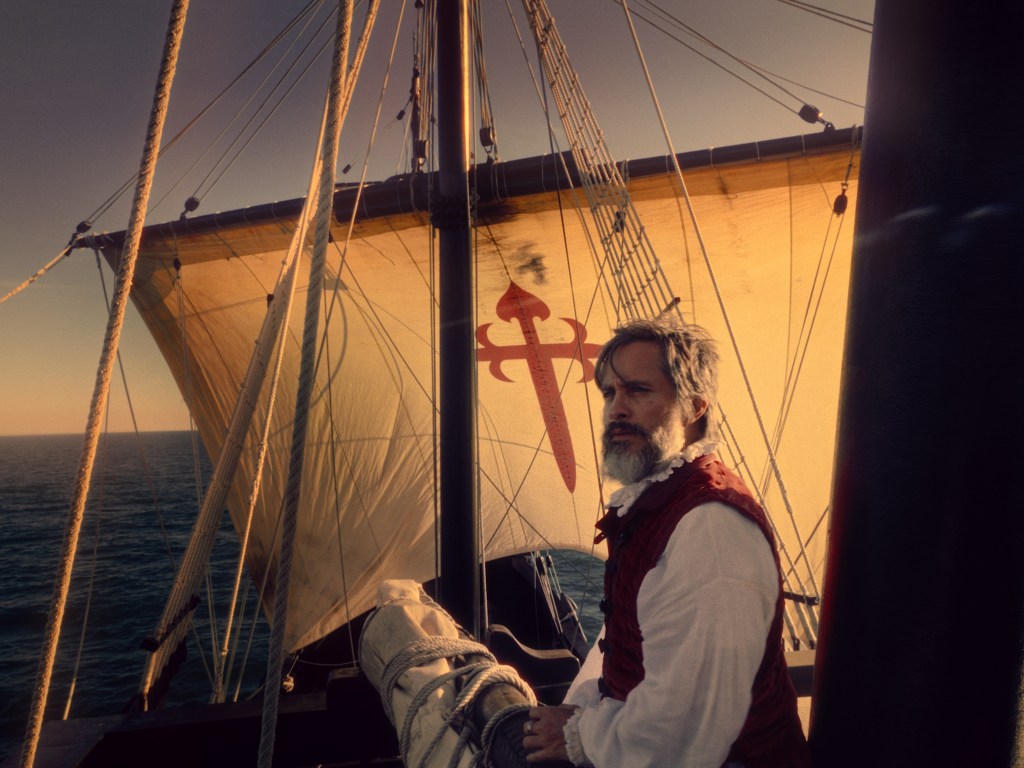
When you sit down to listen to Lav Diaz—the 67-year-old Filipino director behind austere, meditative art films that clock in at up to 10 hours—you might not expect the carefree, lyrical cadence of a wise old hippie. However, it’s this inviting, laid-back frankness that grants his latest film, Magellan, a disarming clarity in subverting cinema’s colonial gaze, a concept we discussed at length over Zoom.
The movie is, for all intents and purposes, a historical biopic about the titular explorer and colonizer Ferdinand Magellan, played with both fervor and surprising grace by Mexican actor Gael Garcia Bernal. However, rather than expanding time—as Diaz’s movies tend to do—its dreamlike unfurling collapses an entire decade into 164 minutes, a paltry runtime for the arthouse maestro.

When it comes to his ethereal approach, which renders time a fluid variable through its endless static takes, the director said: “That’s a very, very contradictory part of doing cinema, or music, or poetry. Of course, I’m not going to make a very detailed epic of 9 hours where I show all these spectacles of butchery. Here, you see the power of aesthetics. I go for the poetry, the rhythms, so it becomes this unification of time and space.”
Ironically, Diaz does have a 9-hour version of the movie in the works, but focused largely on Magellan’s wife Beatriz (Ângela Azevedo), so his desire to avoid sensationalizing colonial slaughter holds true.
Opening Images and the White Man’s Burden

The film begins with Magellan’s 1511 conquest in Malaysia under the Portuguese crown, before chronicling his arduous global circumnavigation for Spain, until his eventual arrival on Cebu, in the modern-day Philippines, in 1521. However, what separates Magellan from run-of-the-mill “prestige” dramas is how Diaz’s story, and his restrained observationalism, confront our presumptions about both cinema and history.
Take, for instance, its opening images, in which an indigenous Malay woman first spots European soldiers approaching from afar. Diaz and co-cinematographer Artur Tort capture this moment as an encroachment upon her religious ritual—not only by the colonizers, but by the camera itself. As she reacts practically down the lens, it is we, the modern audience, who become intruders gawking at her through the tall grass. “The very first connection with this alien thing, the white man,” Diaz explained, “becomes the white man’s burden imposed on the indigenous Malay woman.”
Diaz’s phrasing refers to The White Man’s Burden, the 1899 poem by Rudyard Kipling in which the British poet argues in favor of the then-ongoing annexation of the Philippines by the United States. Although Kipling’s words would be separated from Magellan’s conquests by nearly 400 years, they exist as part of the same cultural continuum that grants permission to European colonizers to enact untold horrors in the name of “civilizing” the Eastern world.
“In the Philippines, [Magellan] is a fixture in our history, in our culture,” Diaz explained. “You have novelty songs about him. Great songs from rock and roll to pop, even bar jokes that you hear every day. You ride public transportation, [and] there’s music about Magellan blasting. In elementary school, there are stories about how, supposedly, the Philippines was discovered by Magellan. It’s inescapable. It’s just everywhere.”
This status quo, of our collective understanding of ourselves, is something Diaz hoped to question with the film. However, to simply push back on historical inaccuracies—like those about Europeans “discovering” already-populated lands—is merely a factual pushback against a much larger and more pervasive hegemony. Diaz, through his steady directorial hand, goes much further.
Subverting the Colonial Gaze

Just as Laura Mulvey’s analysis of the “male gaze” unspools outward to address the presumptions at the root of patriarchal society, so too does the idea of a “colonial gaze” (or, as described by Edward Said, an orientalist “postcolonial gaze”) lend itself to a broader psychological framework of identification, from which the celluloid image itself cannot be extricated.
As far back as 1894, inventor Thomas Edison, who created some of the earliest film cameras, produced what is believed to be the very first instances of indigenous people captured on film: Buffalo Dance and Sioux Ghost Dance, silent shorts in which Native American dancers from a wild west roadshow were filmed in a studio, for distribution to white audiences.
Since the inception of cinema, the very act of looking has had colonial implications. In employing this colonial tool, then, Diaz begins his project of reclamation of the gaze by forcing us to question the very nature of the cinematic image, and its proclivity for forging relationships between people or ideas—physically, emotionally, spiritually, or historically.
With this historical paradigm in mind, the very presence of the camera’s gaze becomes akin to violent conquest in Magellan and informs how Diaz sees the world. “The way they claimed us,” he said, “the way they imposed on publications and perspectives, even the material of the camera, it all started from the West.”
He continued: “The idea of imposition starts from the West. The idea of possessions, idols, and ownership came from the West.”
In the film, the indigenous tribes of Cebu are presented by Magellan, with the Santo Niño, an idol of the child Jesus, which remains at the center of Filipino Catholic tradition to this day. While the idol represents, within the narrative, a heartfelt attempt by Magellan to heal the sick child of Cebu chieftain Rajah Humabon (Ronnie Lazaro)—whom he presents with the statue in a moment of genuine connection—this exchange also precipitates a shift in the way Magellan and his forces begin to treat the local tribes, presaging a cultural cleansing through mass conversion.
“It’s all a fracture,” Diaz said. “It’s all trauma.”
Placing Magellan Within Postcolonial Cinema Discourse
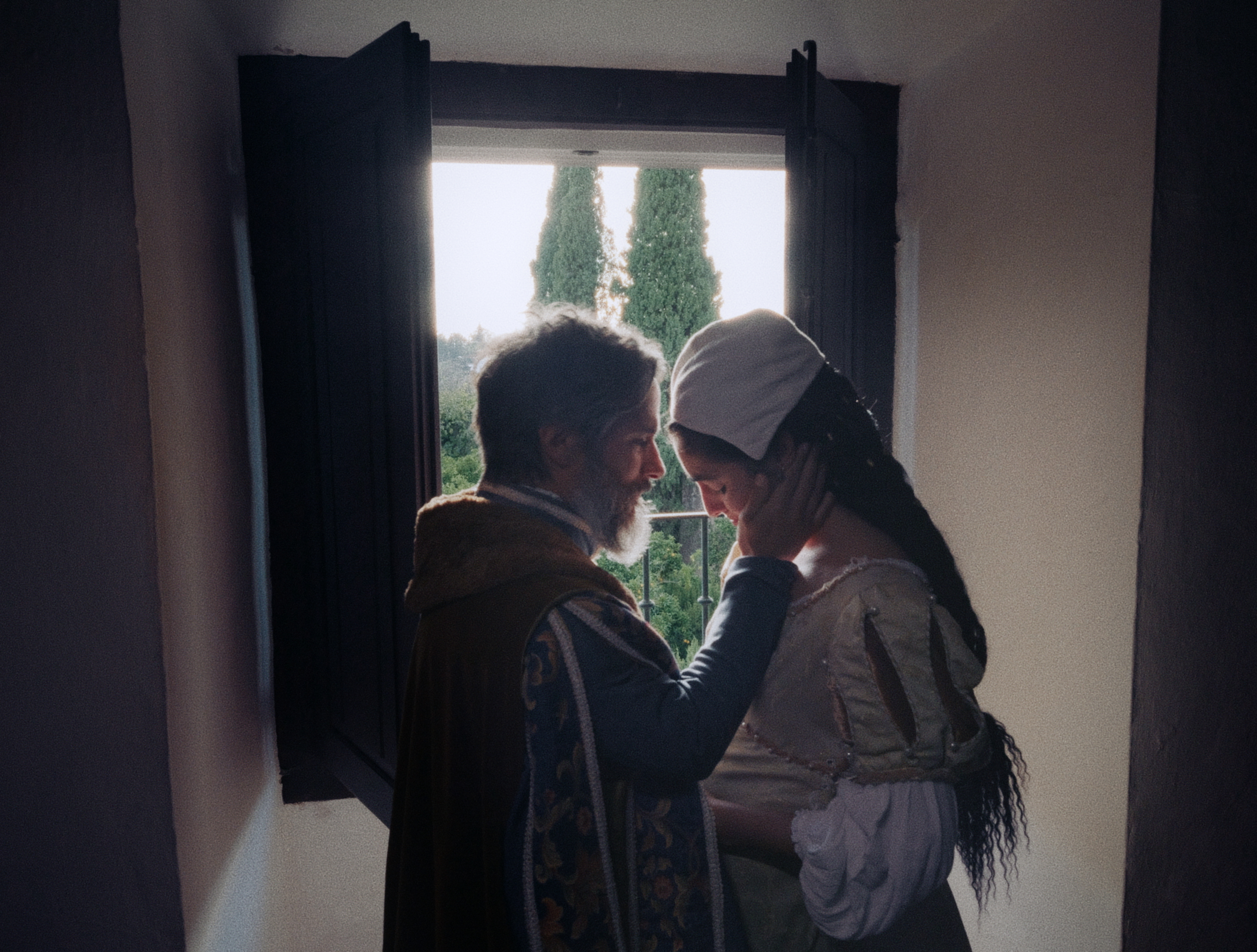
The notion of colonialism being granted tangible form, to better understand the traumas which have trickled down from it, is one that several filmmakers have attempted to confront of late. Although Diaz may not be directly indebted to them, Magellan enters an ongoing discourse on postcolonial cinema that casts a light on its own artistic language. Some directors have even wrestled with the idea that the cinematic medium is itself a colonial vessel, a concept Diaz considers as well.
In his 2019 docu-fiction piece Nhà Cây (or The Treehouse), Vietnamese filmmaker Minh Quý Truong invents a science-fiction narrative in which a director living on Mars in the year 2045 embarks on a colonial expedition back to Earth, and explores the lives of Vietnam’s Ruc, Hmong, and Kor peoples.
At the heart of Truong’s film is the idea that the oral traditions of these indigenous tribes are fundamentally incompatible with the moving image, a tension he further explores in his forthcoming documentary portrait Hair, Paper, Water. In the latter, a grandmother floating on a raft downstream, while narrating stories to her grandson, serves as a nexus for complications surrounding language and the inadequacy of translations between indigenous and postcolonial languages.
A key facet of films that perform such inquiries, including Diaz’s, is the appearance of nature, which is usually presented at odds with colonial imposition. Even in Hollywood movies, like James Gray’s thoughtful 2016 drama The Lost City of Z, about British explorer Percy Fawcett, the Amazon rainforest becomes a force of mystery and hostility towards those who would try to expose its secrets to the Western world.
This makes Magellan one of the rare examples of a movie made by and for a colonial perspective that, in some fashion, questions who is allowed to see or be seen— compared to, say, action stories like Indiana Jones, in which the catalyst for heroic adventure is presenting Western museum-goers with indigenous artifacts.
In Magellan, the exposure of indigenous lands to colonial forces is framed in stark opposition to the natural world, even through the movie’s color palette. Where the tribespeople are either naked or wear earthy tones and clothe themselves with what they find, the European invaders come dressed in primary hues of red and blue, which clash with the gentle greenery. They don’t belong.
However, Diaz doesn’t shy away from his own place in this dynamic as a filmmaker with a point of view. Numerous scenes of discovery take the form of gradual impositions into forested areas, and are introduced with the camera floating downstream, practically embodying the hull of a ship as it parts the surrounding landscape. These moments are melodic and mellifluous, but as they unfold, it’s hard not to be reminded of the many colonial vessels Magellan captained. The closer we, as viewers, come to indigenous lands, the more we become a danger to them.
But Diaz isn’t simply content with presenting this colonizer-colonizer dichotomy as-is, in the form of a dynamic in stasis with no corrective. Rather, he digs into its nature early on before gradually tilt-shifting its specifics, until eventually, the film switches protagonists altogether, as though changing allegiance from Magellan to his enslaved indigenous companion Enrique de Malaca (Amado Arjay Babon), whose voiceover eventually fills the soundscape.
For Diaz, Magellan is as much a retrospective on history as it is an opportunity to correct the power imbalance that cinematic images have long fostered. “My cinema, culturally, is a form of reclamation,” he explained. “I want to reclaim what’s been banished, what’s been destroyed, what’s been pushed out of our perspectives, from our names to how we look at life, and our attachment to nature.”
Contemporary and Cultural Relevance

In challenging the histories many people hold dear, the film has also come up against pushback domestically, despite running successfully for seven weeks. “It’s a mix,” Diaz said, of the film’s reception. “There are people who loved it. Some people were surprised by it.” The latter, according to Diaz, is primarily owed to its depiction of Humabon’s rival chieftain Lapulapu, who is long believed to have defeated Magellan in battle. In the movie, however, Lapulapu is a fictitious creation of Humabon himself, intended to intimidate the Portuguese colonizer.
Diaz’s research led him to conclude that not enough primary sources exist to prove Lapulapu’s existence. “Nobody saw him,” the director said. Although Lapulapu is considered, by many in the Philippines, to be the country’s first national hero, this mythology has continued to fuel the contemporary nationalism that Diaz also echoes in Magellan. For instance, in 2017, Filipino strongman Rodrigo Duterte declared April 27th Lapu-Lapu Day, a national holiday. “Some people were accusing me of revisionism,” Diaz added. “But for me, it’s an open dialogue.”
For Diaz, the purpose of fostering conversation through cinema is to reverse historical course. “Something’s been destroyed, and we should reclaim it,” the filmmaker said. “And cinema has that power. You talk of the now because of cinema. So, reclamation for me is about re-orientation, and re-educating people about what’s been lost.”
As for any material impact a film like Magellan could potentially have, Diaz believes that his mirror to the colonial past speaks to the objectives at the root of many of today’s continued problems. “It’s still the same, this capitalist perspective of destroying things, plundering things for profit motive, man,” Diaz said.
This lament, for the state of political modernity, appears to unlock Magellan as more than just a film about what was, but rather, a film about what still is, and why it continues to be. To present the world through this lens, Diaz rigorously confronts the very tools he himself has long used to communicate with the world—the camera and the screen—and their own place as historical artefacts which not only impose perspective, but in some ways, conjure it.
“I’ve often said, you need to connect [with cameras]. They’re living things,” Diaz explained. “If you create good music, then you have to have a good connection with the soul of this guitar, or this drum. They’re alive.”
It’s through the use of these living tools that Diaz challenges the historical record, but he doesn’t do so only through historical counter-narratives. As in Magellan’s opening scene, where the audience encroaches on the indigenous Malay woman, he highlights the contradictions inherent to his own imagery, and in the process, implicates the audience before liberating them.
“That’s the power of cinema, for me,” Diaz said. “It gives you a feeling.”


Lav Diaz on How ‘Magellan’ Subverts the Colonial Gaze
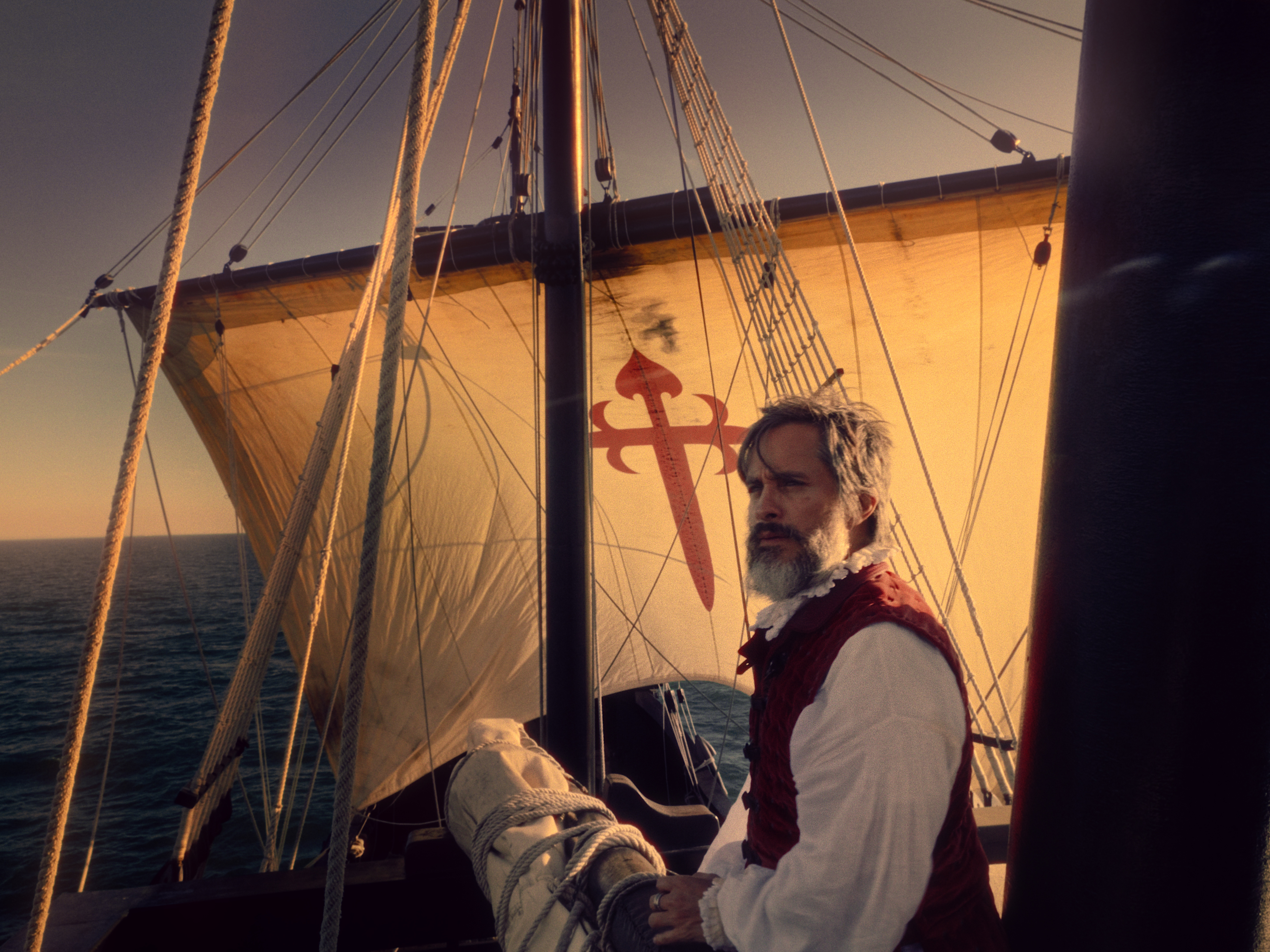
A still from Magellan.
When you sit down to listen to Lav Diaz—the 67-year-old Filipino director behind austere, meditative art films that clock in at up to 10 hours—you might not expect the carefree, lyrical cadence of a wise old hippie. However, it’s this inviting, laid-back frankness that grants his latest film, Magellan, a disarming clarity in subverting cinema’s colonial gaze, a concept we discussed at length over Zoom.
The movie is, for all intents and purposes, a historical biopic about the titular explorer and colonizer Ferdinand Magellan, played with both fervor and surprising grace by Mexican actor Gael Garcia Bernal. However, rather than expanding time—as Diaz’s movies tend to do—its dreamlike unfurling collapses an entire decade into 164 minutes, a paltry runtime for the arthouse maestro.
When it comes to his ethereal approach, which renders time a fluid variable through its endless static takes, the director said: “That’s a very, very contradictory part of doing cinema, or music, or poetry. Of course, I’m not going to make a very detailed epic of 9 hours where I show all these spectacles of butchery. Here, you see the power of aesthetics. I go for the poetry, the rhythms, so it becomes this unification of time and space.”
Ironically, Diaz does have a 9-hour version of the movie in the works, but focused largely on Magellan’s wife Beatriz (Ângela Azevedo), so his desire to avoid sensationalizing colonial slaughter holds true.
Opening Images and the White Man’s Burden
The film begins with Magellan’s 1511 conquest in Malaysia under the Portuguese crown, before chronicling his arduous global circumnavigation for Spain, until his eventual arrival on Cebu, in the modern-day Philippines, in 1521. However, what separates Magellan from run-of-the-mill “prestige” dramas is how Diaz’s story, and his restrained observationalism, confront our presumptions about both cinema and history.
Take, for instance, its opening images, in which an indigenous Malay woman first spots European soldiers approaching from afar. Diaz and co-cinematographer Artur Tort capture this moment as an encroachment upon her religious ritual—not only by the colonizers, but by the camera itself. As she reacts practically down the lens, it is we, the modern audience, who become intruders gawking at her through the tall grass. “The very first connection with this alien thing, the white man,” Diaz explained, “becomes the white man’s burden imposed on the indigenous Malay woman.”
Diaz’s phrasing refers to The White Man’s Burden, the 1899 poem by Rudyard Kipling in which the British poet argues in favor of the then-ongoing annexation of the Philippines by the United States. Although Kipling’s words would be separated from Magellan’s conquests by nearly 400 years, they exist as part of the same cultural continuum that grants permission to European colonizers to enact untold horrors in the name of “civilizing” the Eastern world.
“In the Philippines, [Magellan] is a fixture in our history, in our culture,” Diaz explained. “You have novelty songs about him. Great songs from rock and roll to pop, even bar jokes that you hear every day. You ride public transportation, [and] there’s music about Magellan blasting. In elementary school, there are stories about how, supposedly, the Philippines was discovered by Magellan. It’s inescapable. It’s just everywhere.”
This status quo, of our collective understanding of ourselves, is something Diaz hoped to question with the film. However, to simply push back on historical inaccuracies—like those about Europeans “discovering” already-populated lands—is merely a factual pushback against a much larger and more pervasive hegemony. Diaz, through his steady directorial hand, goes much further.
Subverting the Colonial Gaze
Just as Laura Mulvey’s analysis of the “male gaze” unspools outward to address the presumptions at the root of patriarchal society, so too does the idea of a “colonial gaze” (or, as described by Edward Said, an orientalist “postcolonial gaze”) lend itself to a broader psychological framework of identification, from which the celluloid image itself cannot be extricated.
As far back as 1894, inventor Thomas Edison, who created some of the earliest film cameras, produced what is believed to be the very first instances of indigenous people captured on film: Buffalo Dance and Sioux Ghost Dance, silent shorts in which Native American dancers from a wild west roadshow were filmed in a studio, for distribution to white audiences.
Since the inception of cinema, the very act of looking has had colonial implications. In employing this colonial tool, then, Diaz begins his project of reclamation of the gaze by forcing us to question the very nature of the cinematic image, and its proclivity for forging relationships between people or ideas—physically, emotionally, spiritually, or historically.
With this historical paradigm in mind, the very presence of the camera’s gaze becomes akin to violent conquest in Magellan and informs how Diaz sees the world. “The way they claimed us,” he said, “the way they imposed on publications and perspectives, even the material of the camera, it all started from the West.”
He continued: “The idea of imposition starts from the West. The idea of possessions, idols, and ownership came from the West.”
In the film, the indigenous tribes of Cebu are presented by Magellan, with the Santo Niño, an idol of the child Jesus, which remains at the center of Filipino Catholic tradition to this day. While the idol represents, within the narrative, a heartfelt attempt by Magellan to heal the sick child of Cebu chieftain Rajah Humabon (Ronnie Lazaro)—whom he presents with the statue in a moment of genuine connection—this exchange also precipitates a shift in the way Magellan and his forces begin to treat the local tribes, presaging a cultural cleansing through mass conversion.
“It’s all a fracture,” Diaz said. “It’s all trauma.”
Placing Magellan Within Postcolonial Cinema Discourse
The notion of colonialism being granted tangible form, to better understand the traumas which have trickled down from it, is one that several filmmakers have attempted to confront of late. Although Diaz may not be directly indebted to them, Magellan enters an ongoing discourse on postcolonial cinema that casts a light on its own artistic language. Some directors have even wrestled with the idea that the cinematic medium is itself a colonial vessel, a concept Diaz considers as well.
In his 2019 docu-fiction piece Nhà Cây (or The Treehouse), Vietnamese filmmaker Minh Quý Truong invents a science-fiction narrative in which a director living on Mars in the year 2045 embarks on a colonial expedition back to Earth, and explores the lives of Vietnam’s Ruc, Hmong, and Kor peoples.
At the heart of Truong’s film is the idea that the oral traditions of these indigenous tribes are fundamentally incompatible with the moving image, a tension he further explores in his forthcoming documentary portrait Hair, Paper, Water. In the latter, a grandmother floating on a raft downstream, while narrating stories to her grandson, serves as a nexus for complications surrounding language and the inadequacy of translations between indigenous and postcolonial languages.
A key facet of films that perform such inquiries, including Diaz’s, is the appearance of nature, which is usually presented at odds with colonial imposition. Even in Hollywood movies, like James Gray’s thoughtful 2016 drama The Lost City of Z, about British explorer Percy Fawcett, the Amazon rainforest becomes a force of mystery and hostility towards those who would try to expose its secrets to the Western world.
This makes Magellan one of the rare examples of a movie made by and for a colonial perspective that, in some fashion, questions who is allowed to see or be seen— compared to, say, action stories like Indiana Jones, in which the catalyst for heroic adventure is presenting Western museum-goers with indigenous artifacts.
In Magellan, the exposure of indigenous lands to colonial forces is framed in stark opposition to the natural world, even through the movie’s color palette. Where the tribespeople are either naked or wear earthy tones and clothe themselves with what they find, the European invaders come dressed in primary hues of red and blue, which clash with the gentle greenery. They don’t belong.
However, Diaz doesn’t shy away from his own place in this dynamic as a filmmaker with a point of view. Numerous scenes of discovery take the form of gradual impositions into forested areas, and are introduced with the camera floating downstream, practically embodying the hull of a ship as it parts the surrounding landscape. These moments are melodic and mellifluous, but as they unfold, it’s hard not to be reminded of the many colonial vessels Magellan captained. The closer we, as viewers, come to indigenous lands, the more we become a danger to them.
But Diaz isn’t simply content with presenting this colonizer-colonizer dichotomy as-is, in the form of a dynamic in stasis with no corrective. Rather, he digs into its nature early on before gradually tilt-shifting its specifics, until eventually, the film switches protagonists altogether, as though changing allegiance from Magellan to his enslaved indigenous companion Enrique de Malaca (Amado Arjay Babon), whose voiceover eventually fills the soundscape.
For Diaz, Magellan is as much a retrospective on history as it is an opportunity to correct the power imbalance that cinematic images have long fostered. “My cinema, culturally, is a form of reclamation,” he explained. “I want to reclaim what’s been banished, what’s been destroyed, what’s been pushed out of our perspectives, from our names to how we look at life, and our attachment to nature.”
Contemporary and Cultural Relevance
In challenging the histories many people hold dear, the film has also come up against pushback domestically, despite running successfully for seven weeks. “It’s a mix,” Diaz said, of the film’s reception. “There are people who loved it. Some people were surprised by it.” The latter, according to Diaz, is primarily owed to its depiction of Humabon’s rival chieftain Lapulapu, who is long believed to have defeated Magellan in battle. In the movie, however, Lapulapu is a fictitious creation of Humabon himself, intended to intimidate the Portuguese colonizer.
Diaz’s research led him to conclude that not enough primary sources exist to prove Lapulapu’s existence. “Nobody saw him,” the director said. Although Lapulapu is considered, by many in the Philippines, to be the country’s first national hero, this mythology has continued to fuel the contemporary nationalism that Diaz also echoes in Magellan. For instance, in 2017, Filipino strongman Rodrigo Duterte declared April 27th Lapu-Lapu Day, a national holiday. “Some people were accusing me of revisionism,” Diaz added. “But for me, it’s an open dialogue.”
For Diaz, the purpose of fostering conversation through cinema is to reverse historical course. “Something’s been destroyed, and we should reclaim it,” the filmmaker said. “And cinema has that power. You talk of the now because of cinema. So, reclamation for me is about re-orientation, and re-educating people about what’s been lost.”
As for any material impact a film like Magellan could potentially have, Diaz believes that his mirror to the colonial past speaks to the objectives at the root of many of today’s continued problems. “It’s still the same, this capitalist perspective of destroying things, plundering things for profit motive, man,” Diaz said.
This lament, for the state of political modernity, appears to unlock Magellan as more than just a film about what was, but rather, a film about what still is, and why it continues to be. To present the world through this lens, Diaz rigorously confronts the very tools he himself has long used to communicate with the world—the camera and the screen—and their own place as historical artefacts which not only impose perspective, but in some ways, conjure it.
“I’ve often said, you need to connect [with cameras]. They’re living things,” Diaz explained. “If you create good music, then you have to have a good connection with the soul of this guitar, or this drum. They’re alive.”
It’s through the use of these living tools that Diaz challenges the historical record, but he doesn’t do so only through historical counter-narratives. As in Magellan’s opening scene, where the audience encroaches on the indigenous Malay woman, he highlights the contradictions inherent to his own imagery, and in the process, implicates the audience before liberating them.
“That’s the power of cinema, for me,” Diaz said. “It gives you a feeling.”