



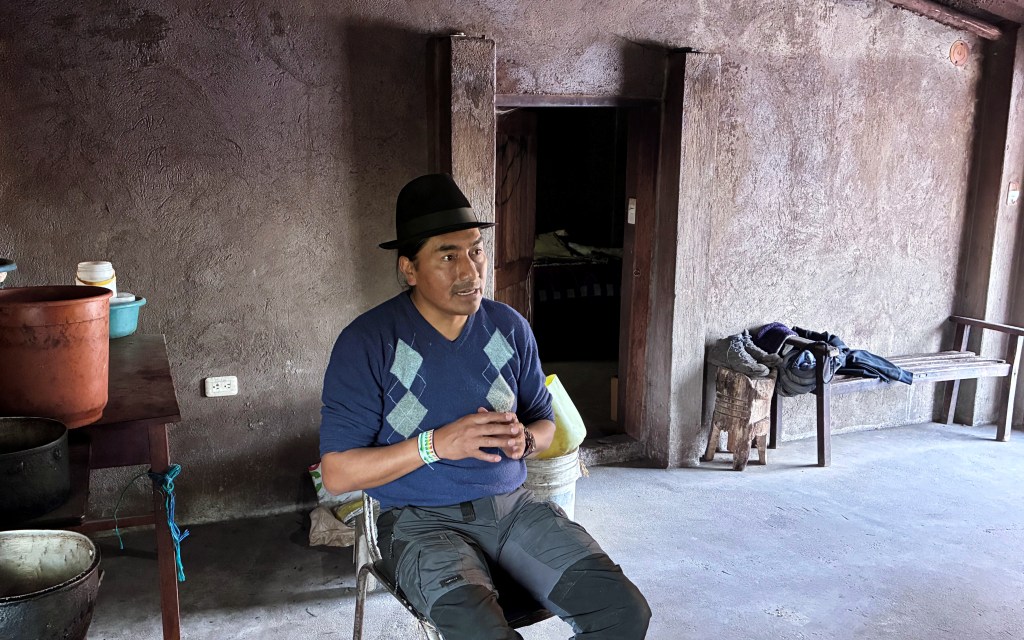
The man is 44, copper-skinned, with a strong physique. He wears the traditional black wool hat of Andean Indigenous people, a long black braid falling to his hips. Friendly but unsmiling, his charcoal-dark eyes brighten when he speaks of his people’s struggles. He welcomes us into the house where he was born, in San Ignacio, 100 km south of Quito, the capital of Ecuador. “We have put in a concrete floor; before, it was dirt. I was born across the street, in a house made of reeds,” he says. This is the leader of Ecuador’s Indigenous movement: Leonidas Iza.
A paved road gives way to dusty lanes and single-story houses—120 families, 580 people—living off agriculture, livestock, and a trickle of tourists bound for Cotopaxi or Quilotoa. Three greenhouses, a school, and a clay soccer field: this is all there is in this Kichwa Panzaleo community, 3,350 meters above sea level. It is where Iza lives.
Ecuador is Latin America in miniature: a small, peripheral country with the Andes at its center, the Amazon to the east, and the Pacific to the west.

Oil, shrimp, and bananas account for 60% of exports; 10% of the population lives in extreme poverty; remittances from migrants in the United States amount to 6% of GDP; and of the country’s 18 million inhabitants, 1.3 million identify as Indigenous. Dollarized and heavily indebted to the International Monetary Fund—$9.415 billion as of November 2025—the country has also become a logistics hub for cocaine exports and now suffers the world’s fourth-highest homicide rate.
Iza was born in San Ignacio, as were his father and grandfather. In 1972, his father, José María, helped create the Indigenous agricultural cooperative by purchasing land from a Jesuit-owned hacienda, hence the name of the village. His grandfather worked under the huasipungo system: Indigenous families labored for the estate and were granted tiny plots on loan, which were barely enough to survive. “Our language, Kichwa, was banned: my grandfather had to change his Indigenous surname and take on that of the hacienda administrator,” Iza recalls. “My great-grandfather, a huasipungero, stole five potatoes for a small party at home. They found out and forced him, in front of the community, to sit on embers: a punishment and a warning.”
A Life Against the Tide
Leonidas is a name from the Catholic tradition; it is a tribute to Leonidas Proaño, a liberation theologian and bishop (1954–1985) who launched radio literacy programs and handed over church lands to Indigenous communities. Accused of supporting guerrillas, Proaño was investigated by the Curia in Rome—without result. “My dad was a catechist; he knew him [Proaño]. It is thanks to him that we have the land: his name means ‘never stop fighting’,” Iza explains.
Proaño participated in the founding of CONAIE, the Confederation of Indigenous Nationalities of Ecuador, in 1986. Since the first Indigenous uprising in 1990, waves of protest have toppled governments and forced policy shifts, culminating in the 2008 Constitution that recognizes Ecuador as plurinational and intercultural. Uprisings can last for days and bring the country to a standstill, as in 2019 and 2022—the two strikes led by Iza. “If I could go back to 2019, I would commit to holding out a few more days: we could have overthrown the government,” he says.
“Can you roll down the window? It’s hot,” I ask as he drives his black pickup.
“No, it’s armored; you can’t open the windows. It’s the organization’s car,” he replies.
Iza has been allowed to keep the vehicle even though he no longer holds any official post, “for security reasons, after what happened in August.” On August 18, 2025, Iza was in the same house where our conversations would later take place. A car was parked in front of the house; as he approached it with suspicion, it suddenly sped off. “If I hadn’t moved, the car would have killed me,” he says. Community members stopped the vehicle in its tracks. Inside, there were two policemen. The organization had an infiltrator: “the girlfriend of one of my closest comrades,” Iza adds. The government did not issue a statement on the incident.
This was not the first close call. On June 18, 2022, the same car we sit in now was approached by another vehicle; two shots were fired from that car. Those were the days of the paro, the Indigenous strike. The next day, Iza was arrested for 48 hours without charge. “They wanted to take off my hat and poncho, but I told them they could only take them off when I was dead.”
Iza can be considered an environmental engineer of his region. He reads Latin American Marxists and colonial historians, and follows climate change and the rise of the radical right. He speaks in Spanish and Kichwa, an Indigenous language I do not understand, and he does not feel obliged to translate.
Need for a National Leader in Ecuador
In June 2022, I was in Quito during the strike that paralyzed Ecuador for 18 days in protest against the economic policies of the conservative Lasso government, which was in power at the time. Indigenous people poured into the capital—spears and shields alongside students and residents sympathetic to CONAIE’s demands. Beyond price controls on basic goods, Iza and his comrades had called for a moratorium on farmers’ bank debts, fertilizer subsidies, bilingual education, and greater investment in healthcare. “These are long-standing demands,” Ximena Ponce, former Minister of Social Inclusion under Rafael Correa’s presidency (2007-17), told me. “Indigenous communities top the national rankings for poverty, child malnutrition, low wages, and undeclared work. Their social inclusion is the real unresolved problem in our country.”
On the final day of the strike, June 30, Iza addressed a crowd in central Quito: “Our victory is the unity of the Indigenous people. Now there is a project for the whole country, an alternative to the neoliberal agenda.” As he left, words from the speech rippled through working-class neighborhoods, and people greeted him in the streets, chanting his name. In those weeks, many began to speak of him as a possible presidential candidate for the Left.
“Indigenous communities top the national rankings for poverty, child malnutrition, low wages, and undeclared work. Their social inclusion is the real unresolved problem in our country.” —Ximena Ponce
But Ecuador’s Left has a gravitational center: Rafael Correa, who governed from 2007 to 2017 and now lives in Belgium—“in exile from justice,” his detractors say; “in political asylum,” his supporters reply. He is still shaping his camp from afar. Correismo remains the second political force. Yet, after three consecutive presidential defeats, it cannot win alone and refuses alliances. That is why Iza looked like a potential unifier to many.
In 2022, early presidential elections were held. Pachakutik, the political arm of CONAIE, with 19% of the vote in 2021, did not run. It was paralyzed by internal divisions, and Iza stayed out of the race. The campaign was marked by Colombian hitmen assassinating Fernando Villavicencio, a journalist and presidential candidate who had denounced drug trafficking. Daniel Noboa won, tapping into a public hungry for security. At 36, he became the world’s youngest head of state.
In the 2025 elections, Iza ran as Pachakutik’s candidate. But Noboa was re-elected and now leads an openly right-wing government aligned with the White House. He was the only Latin American president, along with Argentina’s Javier Milei, to applaud the US military’s capture of Nicolas Maduro in Venezuela. Iza obtained half a million votes, constituting 5.25% of the total vote share. It was a drop of 1.3 million compared to 2021. Not being a parliamentary candidate, he remained outside official politics, left CONAIE’s leadership, and returned to San Ignacio. “New opportunities will come,” he says calmly.
The Weight of Debt
The 2022 strike erupted over fuel prices; the government ultimately preserved the diesel subsidy. In 2025, Noboa eliminated it. In the 2026 budget, interest payments and debt amortization have exceeded the amounts allocated to defense, police, health, education, and social security contributions to pensions. “If you want to know the government’s economic agenda, read the letters from the International Monetary Fund,” the opposition argues. Ecuador is the third most indebted country to the IMF.
“The increase in diesel rates has raised the prices of what we buy, except for the milk we sell: the transporter pays less for it because diesel costs more,” Iza says. “Then they tell us to ‘reduce state spending’. Have you seen the health center here? No paracetamol. No X-rays. They used to give children uniforms and books; now, nothing remains. The IMF figures say nothing about how people are suffering.”
“And finally,” he adds, “the IMF has launched an audit of the savings and credit cooperatives, the ones that give us credit for agricultural work. Now it’s harder to access credit, and the interest we pay each month has increased.” Savings and credit cooperatives account for $3 out of every $10 in Ecuador’s financial system—around 400 local institutions focused on rural and low-income clients. A law passed in July 2025 aims to transform them into traditional banks.
Blood and Cocaine in Paradise Lost
In August 2025, when his term as CONAIE president ended, Iza left Quito—where he had been living with his in-laws—to return to his village. “Today I am building my house, together with the community,” he says, referring to minga, unpaid collective work. “Then I devote myself to the music, language, and art school for our young people,” he adds, showing a hall where, on Saturday mornings, six children play the palla, a reed flute with a monotonous rhythm.

His other priority is the Indigenous Guard, a self-managed security service. With the rise of drug trafficking and extortion, “society is suffering greatly, and this pain has been turned into a political tool,” he says, referring to the “internal armed conflict” declared by the Noboa government two years ago, under which drug gangs were labeled terrorist groups and treated as military targets.
“The government decapitated the main groups by arresting their leaders,” says Fernando Carrión, a security expert at the URBS.TIC academic network. “That produced fragmentation—but also recomposition: the major groups strengthened their ties with cartels in other countries.”
Meanwhile, police and the military expanded their powers and blurred their roles, from neighborhood patrols to prison control. “That weakened both institutions and was accompanied by human rights violations—at least 43 cases in the last year—by law enforcement,” Carrión says. One case stands out. At the end of 2024, three teenagers and a child—Afro-Ecuadorian and poor—were on their way to play soccer when soldiers picked them up, drove them 40 km, stripped, tortured, and killed them on the coast of Guayaquil. They were innocent, mistaken for thieves. The interior minister, still in office, tried to cover up the case and, flanked by soldiers, and on live television, he threatened the judge who defined it as a forced disappearance.
“We have had painful cases here, too,” Iza says. “Young people from our community went to study in the nearby town and started taking drugs.” He clarifies that the drug was marijuana. “So, one Sunday, the whole community went to get them back: we administered Indigenous justice. The mothers told us to take off their children’s clothes, and then use whips, water, and nettles. Each one was returned to their parents.”
Indigenous justice is recognized by the Constitution as a form of local justice, a tradition of self-government that coexists with ordinary courts.
In 2025, Ecuador recorded 9,216 violent homicides: 25 per day, more than one every hour. It translates to 52 homicides per 100,000 inhabitants, the fourth-highest rate in the world. How did a country once seen as an oasis of peace—Andean trekking, Galápagos tortoises, Amazon rivers, and an affordable haven for US retirees—fall into this black hole of fear?
“The country has become a logistics hub for cocaine exports,” Carrión says. “We border, or are close to, the three coca-producing countries: Colombia, Peru, and Bolivia. The drug enters from the north, via Colombia, reaches the coast and our Pacific ports, but flows through the Amazon are also growing.”
The trafficking economy has changed consumption patterns. “Groups pay in drugs, not dollars: that has driven up local consumption.” And, under the logic of profit, criminal groups diversify: not only cocaine, but also illegal mining, extortion, and kidnapping. “There is talk of a war on drugs,” Carrión adds, “but the core problem is the rise of a criminal economy: it cannot be tackled with the military and police, but with economists.”
Seeing Threats, Not People
“There are entire areas of the country in the hands of criminals,” Iza says. “But we are resisting here.” The Pacific coast bears the heaviest toll. Guayaquil, Ecuador’s commercial and logistical center, a metropolis larger than Chicago with over three million inhabitants, hosts one of the most important ports on the American Pacific coast. In 2025, several banana shipments leaving that port were stopped by European police because they concealed cocaine: the containers belonged to Noboa Trading Co., owned by the president’s family, who rejected accusations of collaboration with cartels.
“Here, businesses are crippled by extortion,” says Blanca Moncada, a Guayaquil-based journalist who has covered the coast for years, town by town. “On December 31, a schoolteacher was killed by a stray bullet while he was out with his father to buy a monigote—the doll burned on New Year’s Eve.” Moncada has received death threats from Los Choneros. “We’re sliding toward the Mexican model: murdered journalists, media bought by traffickers, colleagues who avoid certain beats. The toughest stories we do off the record—no faces, no bylines.” For her, the government’s response of putting soldiers on the streets and turning a handful of raids into content is good for TikTok, but useless for the country. The real issue is not only desperate young people joining gangs, she argues, but “macro corruption: politicians, law enforcement, businesses, and the State sold out to drug traffickers.”
Fear shapes daily life. After sunset, Quito turns into a desert. In La Floresta (one of the capital’s cultural districts), when you leave the Ocho y Medio cinema or a restaurant, you get into your car quickly, scanning the street. In Guayaquil’s poorer neighborhoods, two out of three people say they do not trust their neighbors, due to insecurity, extortion, and trafficking, according to the Guayaquil Cómo Vamos 2025 survey. A clinical psychologist quoted in the local press describes it as a “social psychosis” in which “we see threats, not people.”
Subsoil Wealth, Surface Poverty
Ecuador’s GDP per capita is roughly one-fifth of the United States’, about the same ratio as 30 years ago, stuck in the middle-income trap. Wealth exists, but it is concentrated in the hands of a few. The poorest half of the population receives only about one-tenth of the national income, according to the Observatory on Dollarization. One in four people lives on less than $92 a month; one in ten on less than $52. In rural areas, it’s worse.
When asked whether the country can afford to keep oil and minerals underground in such economic conditions, Iza replies, “Let’s finish extracting from the oil fields already in operation—without opening new ones.”
“We’re looking at a ten-year horizon. The mines are mostly in Andean and subtropical zones, which are also the most fertile for agriculture. Our proposal is to develop tourism and agriculture there, and to dedicate just 10% of the land now occupied by mines to renewable energy, so we wouldn’t have to buy electricity from Peru and Colombia. Oil revenues have been used to service IMF debt, while mines pay little tax relative to what they export. In Zamora Chinchipe—where China’s Ecuacorriente runs the Mirador copper mine, and Canada’s Lundin Gold operates—water has been polluted, and people are left with nothing to eat. This isn’t a model that serves our economy: it’s imperial exploitation, nothing more.”
Beyond the two mega-mines in Zamora, there are about 600 illicit mines across the country. With gold prices at historic highs, mining has become a major source of financing for criminal groups, second only to drug trafficking, spawning enclaves of lawlessness—smuggling, corruption, extortion, human trafficking—alongside deforestation and mercury-contaminated waterways. In May 2025, 11 soldiers were killed during an operation against illicit mining.
In Search of Hope
“My son and his friends are thinking of moving abroad,” a left-wing university professor tells me over dinner in Quito. The feeling is widespread. People speak of searching for work for years without success. “The difference,” the professor says, “is that the poor cannot leave.”
“Families in poor neighborhoods are afraid their children will be recruited by cartels: criminals seek them out at school, enticing them with smartphones and odd jobs; teachers receive threats from the cartels.” The professor sighs. “I hope Iza and the Indigenous movement can become the core of a new political project. Without them, I don’t see a way out.”
However far politics takes him, Iza says he will not leave San Ignacio. Today is a Saturday of celebration: the local saint’s day. There will be a bullfight, volleyball, and a communal pambamesa: sitting on the ground, we eat with our hands—chicken, potatoes, corn—served on a tablecloth spread over the grass. Then the clouds part, and Nevado Illiniza Sur, a 5,245-meter-high peak, appears.


Leonidas Iza, Ecuador’s Indigenous Leader, Shines a Possibility of Hope for His People
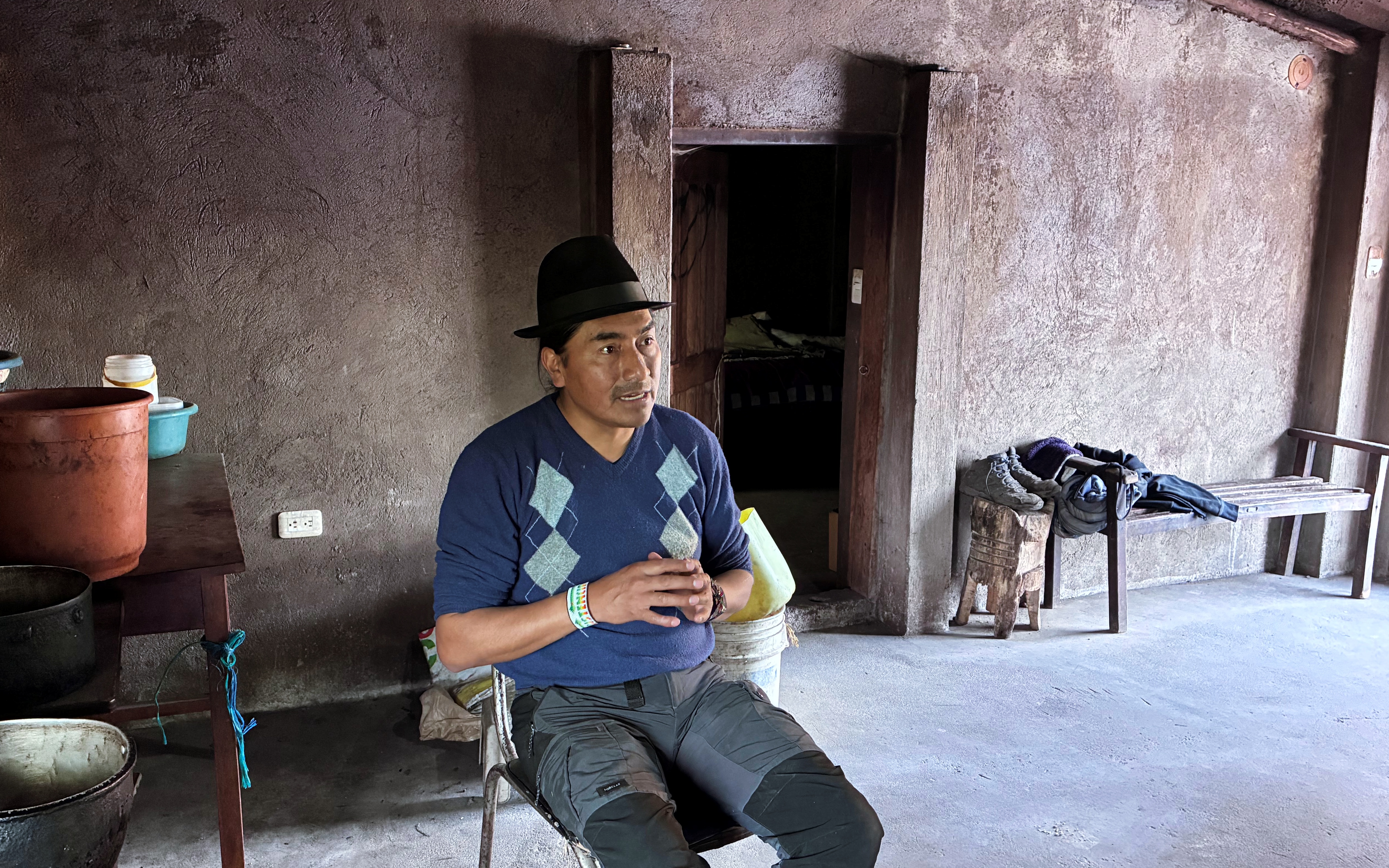
A leader of Ecuador’s Indigenous movement: Leonidas Iza. Photo by Atenea Castillo
The man is 44, copper-skinned, with a strong physique. He wears the traditional black wool hat of Andean Indigenous people, a long black braid falling to his hips. Friendly but unsmiling, his charcoal-dark eyes brighten when he speaks of his people’s struggles. He welcomes us into the house where he was born, in San Ignacio, 100 km south of Quito, the capital of Ecuador. “We have put in a concrete floor; before, it was dirt. I was born across the street, in a house made of reeds,” he says. This is the leader of Ecuador’s Indigenous movement: Leonidas Iza.
A paved road gives way to dusty lanes and single-story houses—120 families, 580 people—living off agriculture, livestock, and a trickle of tourists bound for Cotopaxi or Quilotoa. Three greenhouses, a school, and a clay soccer field: this is all there is in this Kichwa Panzaleo community, 3,350 meters above sea level. It is where Iza lives.
Ecuador is Latin America in miniature: a small, peripheral country with the Andes at its center, the Amazon to the east, and the Pacific to the west.
Oil, shrimp, and bananas account for 60% of exports; 10% of the population lives in extreme poverty; remittances from migrants in the United States amount to 6% of GDP; and of the country’s 18 million inhabitants, 1.3 million identify as Indigenous. Dollarized and heavily indebted to the International Monetary Fund—$9.415 billion as of November 2025—the country has also become a logistics hub for cocaine exports and now suffers the world’s fourth-highest homicide rate.
Iza was born in San Ignacio, as were his father and grandfather. In 1972, his father, José María, helped create the Indigenous agricultural cooperative by purchasing land from a Jesuit-owned hacienda, hence the name of the village. His grandfather worked under the huasipungo system: Indigenous families labored for the estate and were granted tiny plots on loan, which were barely enough to survive. “Our language, Kichwa, was banned: my grandfather had to change his Indigenous surname and take on that of the hacienda administrator,” Iza recalls. “My great-grandfather, a huasipungero, stole five potatoes for a small party at home. They found out and forced him, in front of the community, to sit on embers: a punishment and a warning.”
A Life Against the Tide
Leonidas is a name from the Catholic tradition; it is a tribute to Leonidas Proaño, a liberation theologian and bishop (1954–1985) who launched radio literacy programs and handed over church lands to Indigenous communities. Accused of supporting guerrillas, Proaño was investigated by the Curia in Rome—without result. “My dad was a catechist; he knew him [Proaño]. It is thanks to him that we have the land: his name means ‘never stop fighting’,” Iza explains.
Proaño participated in the founding of CONAIE, the Confederation of Indigenous Nationalities of Ecuador, in 1986. Since the first Indigenous uprising in 1990, waves of protest have toppled governments and forced policy shifts, culminating in the 2008 Constitution that recognizes Ecuador as plurinational and intercultural. Uprisings can last for days and bring the country to a standstill, as in 2019 and 2022—the two strikes led by Iza. “If I could go back to 2019, I would commit to holding out a few more days: we could have overthrown the government,” he says.
“Can you roll down the window? It’s hot,” I ask as he drives his black pickup.
“No, it’s armored; you can’t open the windows. It’s the organization’s car,” he replies.
Iza has been allowed to keep the vehicle even though he no longer holds any official post, “for security reasons, after what happened in August.” On August 18, 2025, Iza was in the same house where our conversations would later take place. A car was parked in front of the house; as he approached it with suspicion, it suddenly sped off. “If I hadn’t moved, the car would have killed me,” he says. Community members stopped the vehicle in its tracks. Inside, there were two policemen. The organization had an infiltrator: “the girlfriend of one of my closest comrades,” Iza adds. The government did not issue a statement on the incident.
This was not the first close call. On June 18, 2022, the same car we sit in now was approached by another vehicle; two shots were fired from that car. Those were the days of the paro, the Indigenous strike. The next day, Iza was arrested for 48 hours without charge. “They wanted to take off my hat and poncho, but I told them they could only take them off when I was dead.”
Iza can be considered an environmental engineer of his region. He reads Latin American Marxists and colonial historians, and follows climate change and the rise of the radical right. He speaks in Spanish and Kichwa, an Indigenous language I do not understand, and he does not feel obliged to translate.
Need for a National Leader in Ecuador
In June 2022, I was in Quito during the strike that paralyzed Ecuador for 18 days in protest against the economic policies of the conservative Lasso government, which was in power at the time. Indigenous people poured into the capital—spears and shields alongside students and residents sympathetic to CONAIE’s demands. Beyond price controls on basic goods, Iza and his comrades had called for a moratorium on farmers’ bank debts, fertilizer subsidies, bilingual education, and greater investment in healthcare. “These are long-standing demands,” Ximena Ponce, former Minister of Social Inclusion under Rafael Correa’s presidency (2007-17), told me. “Indigenous communities top the national rankings for poverty, child malnutrition, low wages, and undeclared work. Their social inclusion is the real unresolved problem in our country.”
On the final day of the strike, June 30, Iza addressed a crowd in central Quito: “Our victory is the unity of the Indigenous people. Now there is a project for the whole country, an alternative to the neoliberal agenda.” As he left, words from the speech rippled through working-class neighborhoods, and people greeted him in the streets, chanting his name. In those weeks, many began to speak of him as a possible presidential candidate for the Left.
“Indigenous communities top the national rankings for poverty, child malnutrition, low wages, and undeclared work. Their social inclusion is the real unresolved problem in our country.” —Ximena Ponce
But Ecuador’s Left has a gravitational center: Rafael Correa, who governed from 2007 to 2017 and now lives in Belgium—“in exile from justice,” his detractors say; “in political asylum,” his supporters reply. He is still shaping his camp from afar. Correismo remains the second political force. Yet, after three consecutive presidential defeats, it cannot win alone and refuses alliances. That is why Iza looked like a potential unifier to many.
In 2022, early presidential elections were held. Pachakutik, the political arm of CONAIE, with 19% of the vote in 2021, did not run. It was paralyzed by internal divisions, and Iza stayed out of the race. The campaign was marked by Colombian hitmen assassinating Fernando Villavicencio, a journalist and presidential candidate who had denounced drug trafficking. Daniel Noboa won, tapping into a public hungry for security. At 36, he became the world’s youngest head of state.
In the 2025 elections, Iza ran as Pachakutik’s candidate. But Noboa was re-elected and now leads an openly right-wing government aligned with the White House. He was the only Latin American president, along with Argentina’s Javier Milei, to applaud the US military’s capture of Nicolas Maduro in Venezuela. Iza obtained half a million votes, constituting 5.25% of the total vote share. It was a drop of 1.3 million compared to 2021. Not being a parliamentary candidate, he remained outside official politics, left CONAIE’s leadership, and returned to San Ignacio. “New opportunities will come,” he says calmly.
The Weight of Debt
The 2022 strike erupted over fuel prices; the government ultimately preserved the diesel subsidy. In 2025, Noboa eliminated it. In the 2026 budget, interest payments and debt amortization have exceeded the amounts allocated to defense, police, health, education, and social security contributions to pensions. “If you want to know the government’s economic agenda, read the letters from the International Monetary Fund,” the opposition argues. Ecuador is the third most indebted country to the IMF.
“The increase in diesel rates has raised the prices of what we buy, except for the milk we sell: the transporter pays less for it because diesel costs more,” Iza says. “Then they tell us to ‘reduce state spending’. Have you seen the health center here? No paracetamol. No X-rays. They used to give children uniforms and books; now, nothing remains. The IMF figures say nothing about how people are suffering.”
“And finally,” he adds, “the IMF has launched an audit of the savings and credit cooperatives, the ones that give us credit for agricultural work. Now it’s harder to access credit, and the interest we pay each month has increased.” Savings and credit cooperatives account for $3 out of every $10 in Ecuador’s financial system—around 400 local institutions focused on rural and low-income clients. A law passed in July 2025 aims to transform them into traditional banks.
Blood and Cocaine in Paradise Lost
In August 2025, when his term as CONAIE president ended, Iza left Quito—where he had been living with his in-laws—to return to his village. “Today I am building my house, together with the community,” he says, referring to minga, unpaid collective work. “Then I devote myself to the music, language, and art school for our young people,” he adds, showing a hall where, on Saturday mornings, six children play the palla, a reed flute with a monotonous rhythm.
His other priority is the Indigenous Guard, a self-managed security service. With the rise of drug trafficking and extortion, “society is suffering greatly, and this pain has been turned into a political tool,” he says, referring to the “internal armed conflict” declared by the Noboa government two years ago, under which drug gangs were labeled terrorist groups and treated as military targets.
“The government decapitated the main groups by arresting their leaders,” says Fernando Carrión, a security expert at the URBS.TIC academic network. “That produced fragmentation—but also recomposition: the major groups strengthened their ties with cartels in other countries.”
Meanwhile, police and the military expanded their powers and blurred their roles, from neighborhood patrols to prison control. “That weakened both institutions and was accompanied by human rights violations—at least 43 cases in the last year—by law enforcement,” Carrión says. One case stands out. At the end of 2024, three teenagers and a child—Afro-Ecuadorian and poor—were on their way to play soccer when soldiers picked them up, drove them 40 km, stripped, tortured, and killed them on the coast of Guayaquil. They were innocent, mistaken for thieves. The interior minister, still in office, tried to cover up the case and, flanked by soldiers, and on live television, he threatened the judge who defined it as a forced disappearance.
“We have had painful cases here, too,” Iza says. “Young people from our community went to study in the nearby town and started taking drugs.” He clarifies that the drug was marijuana. “So, one Sunday, the whole community went to get them back: we administered Indigenous justice. The mothers told us to take off their children’s clothes, and then use whips, water, and nettles. Each one was returned to their parents.”
Indigenous justice is recognized by the Constitution as a form of local justice, a tradition of self-government that coexists with ordinary courts.
In 2025, Ecuador recorded 9,216 violent homicides: 25 per day, more than one every hour. It translates to 52 homicides per 100,000 inhabitants, the fourth-highest rate in the world. How did a country once seen as an oasis of peace—Andean trekking, Galápagos tortoises, Amazon rivers, and an affordable haven for US retirees—fall into this black hole of fear?
“The country has become a logistics hub for cocaine exports,” Carrión says. “We border, or are close to, the three coca-producing countries: Colombia, Peru, and Bolivia. The drug enters from the north, via Colombia, reaches the coast and our Pacific ports, but flows through the Amazon are also growing.”
The trafficking economy has changed consumption patterns. “Groups pay in drugs, not dollars: that has driven up local consumption.” And, under the logic of profit, criminal groups diversify: not only cocaine, but also illegal mining, extortion, and kidnapping. “There is talk of a war on drugs,” Carrión adds, “but the core problem is the rise of a criminal economy: it cannot be tackled with the military and police, but with economists.”
Seeing Threats, Not People
“There are entire areas of the country in the hands of criminals,” Iza says. “But we are resisting here.” The Pacific coast bears the heaviest toll. Guayaquil, Ecuador’s commercial and logistical center, a metropolis larger than Chicago with over three million inhabitants, hosts one of the most important ports on the American Pacific coast. In 2025, several banana shipments leaving that port were stopped by European police because they concealed cocaine: the containers belonged to Noboa Trading Co., owned by the president’s family, who rejected accusations of collaboration with cartels.
“Here, businesses are crippled by extortion,” says Blanca Moncada, a Guayaquil-based journalist who has covered the coast for years, town by town. “On December 31, a schoolteacher was killed by a stray bullet while he was out with his father to buy a monigote—the doll burned on New Year’s Eve.” Moncada has received death threats from Los Choneros. “We’re sliding toward the Mexican model: murdered journalists, media bought by traffickers, colleagues who avoid certain beats. The toughest stories we do off the record—no faces, no bylines.” For her, the government’s response of putting soldiers on the streets and turning a handful of raids into content is good for TikTok, but useless for the country. The real issue is not only desperate young people joining gangs, she argues, but “macro corruption: politicians, law enforcement, businesses, and the State sold out to drug traffickers.”
Fear shapes daily life. After sunset, Quito turns into a desert. In La Floresta (one of the capital’s cultural districts), when you leave the Ocho y Medio cinema or a restaurant, you get into your car quickly, scanning the street. In Guayaquil’s poorer neighborhoods, two out of three people say they do not trust their neighbors, due to insecurity, extortion, and trafficking, according to the Guayaquil Cómo Vamos 2025 survey. A clinical psychologist quoted in the local press describes it as a “social psychosis” in which “we see threats, not people.”
Subsoil Wealth, Surface Poverty
Ecuador’s GDP per capita is roughly one-fifth of the United States’, about the same ratio as 30 years ago, stuck in the middle-income trap. Wealth exists, but it is concentrated in the hands of a few. The poorest half of the population receives only about one-tenth of the national income, according to the Observatory on Dollarization. One in four people lives on less than $92 a month; one in ten on less than $52. In rural areas, it’s worse.
When asked whether the country can afford to keep oil and minerals underground in such economic conditions, Iza replies, “Let’s finish extracting from the oil fields already in operation—without opening new ones.”
“We’re looking at a ten-year horizon. The mines are mostly in Andean and subtropical zones, which are also the most fertile for agriculture. Our proposal is to develop tourism and agriculture there, and to dedicate just 10% of the land now occupied by mines to renewable energy, so we wouldn’t have to buy electricity from Peru and Colombia. Oil revenues have been used to service IMF debt, while mines pay little tax relative to what they export. In Zamora Chinchipe—where China’s Ecuacorriente runs the Mirador copper mine, and Canada’s Lundin Gold operates—water has been polluted, and people are left with nothing to eat. This isn’t a model that serves our economy: it’s imperial exploitation, nothing more.”
Beyond the two mega-mines in Zamora, there are about 600 illicit mines across the country. With gold prices at historic highs, mining has become a major source of financing for criminal groups, second only to drug trafficking, spawning enclaves of lawlessness—smuggling, corruption, extortion, human trafficking—alongside deforestation and mercury-contaminated waterways. In May 2025, 11 soldiers were killed during an operation against illicit mining.
In Search of Hope
“My son and his friends are thinking of moving abroad,” a left-wing university professor tells me over dinner in Quito. The feeling is widespread. People speak of searching for work for years without success. “The difference,” the professor says, “is that the poor cannot leave.”
“Families in poor neighborhoods are afraid their children will be recruited by cartels: criminals seek them out at school, enticing them with smartphones and odd jobs; teachers receive threats from the cartels.” The professor sighs. “I hope Iza and the Indigenous movement can become the core of a new political project. Without them, I don’t see a way out.”
However far politics takes him, Iza says he will not leave San Ignacio. Today is a Saturday of celebration: the local saint’s day. There will be a bullfight, volleyball, and a communal pambamesa: sitting on the ground, we eat with our hands—chicken, potatoes, corn—served on a tablecloth spread over the grass. Then the clouds part, and Nevado Illiniza Sur, a 5,245-meter-high peak, appears.