



When asked about who the audience should be for Kavan—Yalgaar Sanskrutik Manch’s first proscenium performance in Mumbai—the Ambedkarite theater group responded: “We can perform anywhere and everywhere, under the shade of a tree or in an elite auditorium space.”
Yalgaar has traversed various performance spaces, from the streets of Mumbai to villages in Maharashtra, aiming to reach new audiences and spread awareness about Ambedkarite thought.
Dhammarakshit “Dhamma” Randhive, one of the founding members of Yalgaar, stressed that they identify as Ambedkarites, not just Dalits. “We have members from diverse caste backgrounds: Dalits, minorities, OBCs,” he said. “Anyone can be an Ambedkarite, not just by birth.”
Faturing folk performance and protest songs rooted in the tradition of shahiri (traditional Maharashtrian poetic storytelling with socio-political commentary) and jalsa (a traditional folk form that combines music, dance, drama, and poetry with tamasha or Maharashtrian folk theater tradition), anti-caste urban theater in India has long served as a force of resistance against caste hegemony and dominant narratives.
The shahiri tradition was adapted into a tool of social change by infusing traditional street theater with social reform messaging. It was called the Satyashodhaki Jalsa (early 1890s), and its origins lie in the 19th-century anti-caste reformer and educator, Jyotirao Phule’s Satyasadhak Samaj (Truth-Seeking Society), founded in 1873.
Around the 1930s, while Satyashodhaki Jalsa declined, Ambedkarite Shahiri Jalsa emerged during Dr. Babasaheb Ambedkar’s anti-caste movement. Folk songs on resistance and revolution were created and sung by shahirs (poet-performers) to express their struggles against caste oppression.
The Dalit Panthers in Maharashtra played a significant role in anti-caste urban theater and were pioneers of street performances. Founded in 1972 in Mumbai by a group of Dalit youth, including Namdeo Dhasal, Raja Dhale, and JV Pawar, the Dalit Panthers fought against caste discrimination and oppression, challenged the dominant socio-political order, and promoted Dalit literature.
Their performances include forms like powada (traditional Marathi poetry) and lavani (a traditional Marathi folk dance form), and are rooted in Ambedkarite Jalsa. Renowned personalities like Annabhau Sathe—a social reformer, folk poet and writer, and a pioneer in Dalit Literature—and Shambhaji Bhagat—a contemporary Maharashtrian folk singer, poet, playwright and activist—have also contributed significantly to anti-caste theater.
Anti-caste theater has been inspired by diverse regional movements across India. In Tamil Nadu, it was influenced by the Dravidian movement, led by prominent figures like Periyar and E.V. Ramasamy, and Oppari, a mourning song tradition performed by women at funeral ceremonies. In Karnataka, it has drawn on Kannada Dalit writing and the Bandaya Literary Movement, led by literary figures like Siddalingaiah and Devanur Mahadeva, and Dalita Sangharsha Samiti (DSS) of the 1970s and 1980s, whose urban theater centered Dalit expression and identity assertion.
In Andhra Pradesh and Telangana, anti-caste theater drew from the Jana Natya Mandali and Madiga Dandora, a cultural and political movement by the Madiga community for the right to equitable reservations. And in North India, it was inspired by forms like nautanki and street performances, and the works of Bhikhari Thakur, a Bhojpuri poet, playwright, and performer, who addressed caste oppression through folk and modern theatrical traditions.
Today, due to the proliferation of social media, rising social awareness, and the works of filmmakers like Nagraj Manjule and Pa. Ranjith, urban audiences are being exposed to anti-caste narratives. However, a lot more needs to be done to create a deeper understanding among them, including expanding knowledge of Dalit history and a deeper acknowledgment of caste privilege.
From the Yaalgaar Sanskrutik Manch in Mumbai to Sri Vamsi Matta in Bengaluru to Birati Samuho Performers Collective in Kolkata, contemporary anti-caste urban theater groups and practitioners are addressing this challenge. Through interactive theater and powerful productions, they are reclaiming their own community’s narratives while actively engaging with elite urban audiences, who are not only part of systemic oppression but also custodians of dominant culture in India.
Mumbai’s Yalgaar Sanskrutik Manch
The origins of Yalgaar can be traced to 2015, when groups of artists from across Maharashtra gathered in Pune in response to the growing threat of religious fundamentalism. In this context, artists Dhamma, Mohammad Khan, Rahul Savita, Sunil Ingale, Mutki Sadhana, Sudesh Jadav, Siddharth Pratibhawant, and Shailesh Sawant decided to form Yalgaar to bring about cultural reform.
Their performances draw from the Ambedkarite Jalsa tradition, which encompasses a wide range of theatrical elements, including storytelling, poetry, singing, improvization, and batavni (exaggerated satire), to highlight issues of caste-based and social oppression.
Their work addresses various themes, from communal harmony to caste oppression, some lilting and heartwarming, and others powerful and evocative. Their 2024 performance, titled Rang Aman Ke (Colors of Peace), promoted communal harmony by showcasing the history of saints like Sant Tukaram, Sufi saints, progressive and contemporary poets. “We formed a folk fusion band, playing instruments such as the guitar and halgi (a Marathi percussion instrument),” said Dhamma.

Jagar Samtecha (People’s Awakening), performed in 2022, emphasized equality and rights awareness, while their 2017 performance, Baar Baar Fenko (Throw Again and Again), and their 2021 performance Hum Karodo Hai Berojgar Kya Kare (We Are Crores of Unemployed, What Should We Do?) are parodies on demonetization and unemployment, respectively.
“Yalgaar has also supported rights-based movements, like the anti-CAA Movement, the Students’ Movement, and the Farmers’ Movement,” said Dhamma. “As artists, it is incumbent that we not only address caste-based social oppression in marginalized communities but also be at the forefront in upholding the Constitution and Democracy.”
Their audience interaction varies according to the specific socio-cultural context of each location. “In villages, we highlight the discrimination and violence we face,” said Dhamma, “but for an [urban] elite audience, we aim for them to understand the history of caste oppression, reflect on their privilege, and think about their responsibility as citizens.”
Yalgaar seeks to engage with urban audiences, not to offend but to create awareness. In Kavan, they have stirred urban audiences not just by their powerful performances but also by making them think and reflect. The play is an operatic satire about young Ambedkarite experiences, including members of Yalgaar and their community, into one storyline, centered on a young Bejul, a Dalit. Kavan shows how dominant castes use caste and religion as tools to control the means of production, keeping capital in their hands.
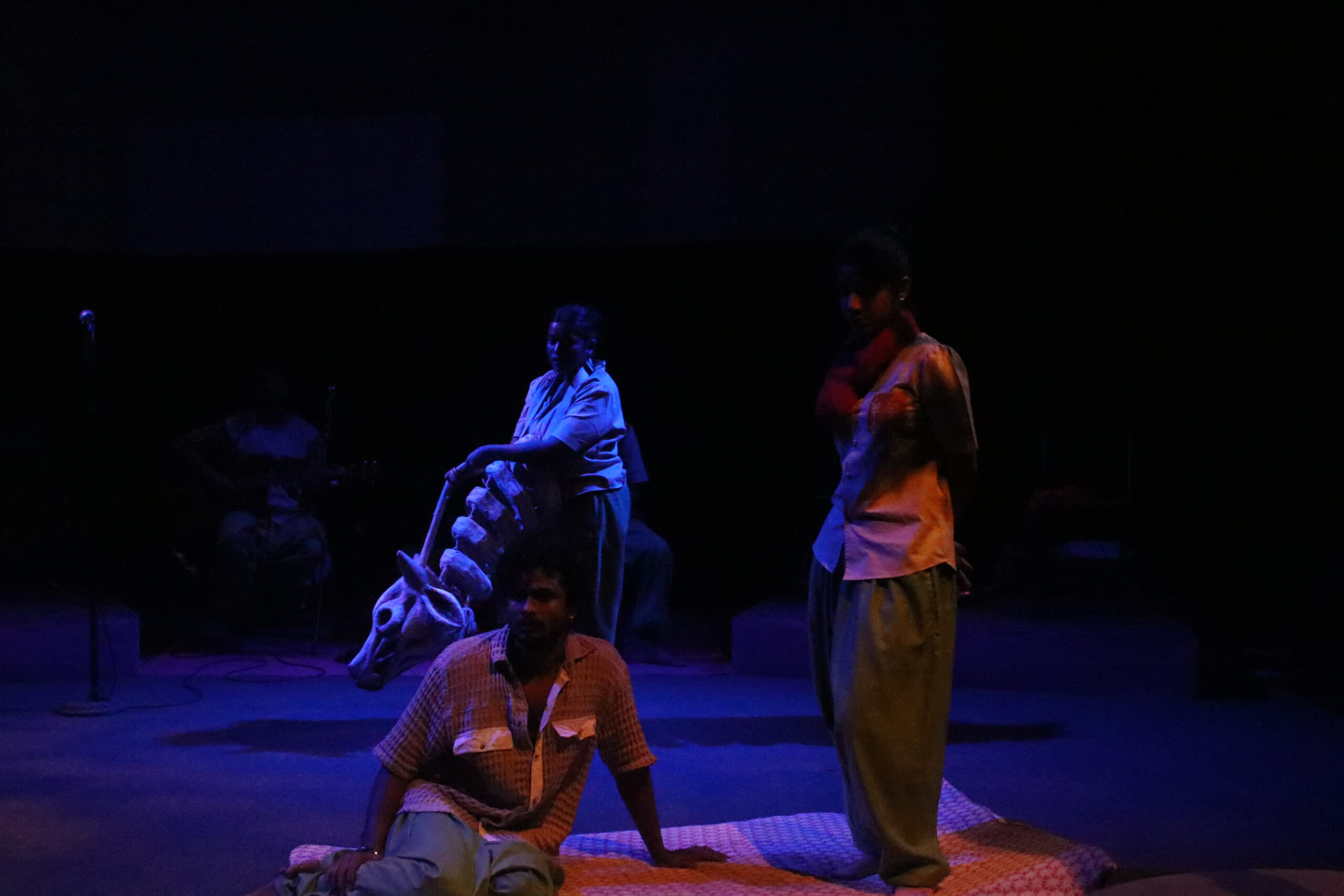
The Yalgaar ensemble collaborated with Nalanda Arts Studio, with the play being directed by award-winning playwright and theater director Abhishek Majumdar.
During the making of Kavan, the entire team collaborated as equals without hierarchy, Kadam said, which was consistent with Yalgaar’s core values and philosophy. The process included the cast and crew coming together, bringing photos of their families, and warmly sharing their life stories. “It was a process of caste annihilation,” Kadam emphasized.
The playwright, Jadav, gave them a storyline, and they worked on the flow. “We tried out different forms and we chose opera,” said Todarmal. “That is how the storyline of Kavan started emerging.”
“Kavan made audiences think about privilege and caste issues,” said Dhamma. “We had many audience members approach us after the show to ask questions and learn more.”
Ankita Jain, who watched the performance in Prithvi Theater in Mumbai, called Kavan a brave production, especially in today’s time of unprecedented censorship. “It is the need of the hour to call a spade a spade, and Kavan does that,” she said. “Also, for audiences who do not know anything about caste oppression, this production will create a shift in their perspective.”
Yalgaar members argue that mainstream theater often fails to represent lowered-caste realities. “Commercial Marathi theater is made for the upper caste,” said Priypal Dashantee, another Yalgaar member. “The lowered castes don’t relate to the plays and can’t afford to watch such plays.”
Pratibhawant criticized mainstream Marathi theater for revolving around elite domestic settings: the drawing room, bedroom, and kitchen. Meanwhile, Kadam and Amruta Todarmal, who have also acted in Marathi serials, said that they didn’t relate to the stories as they revolve around typical, regressive tropes like saas-bahu (mother-in-law, daughter-in-law) conflicts.
“This does not reflect our reality,” said Todarmal. “This is the reason why it was a welcome relief when I met members of Yalgaar, and I decided to perform in Kavan.”
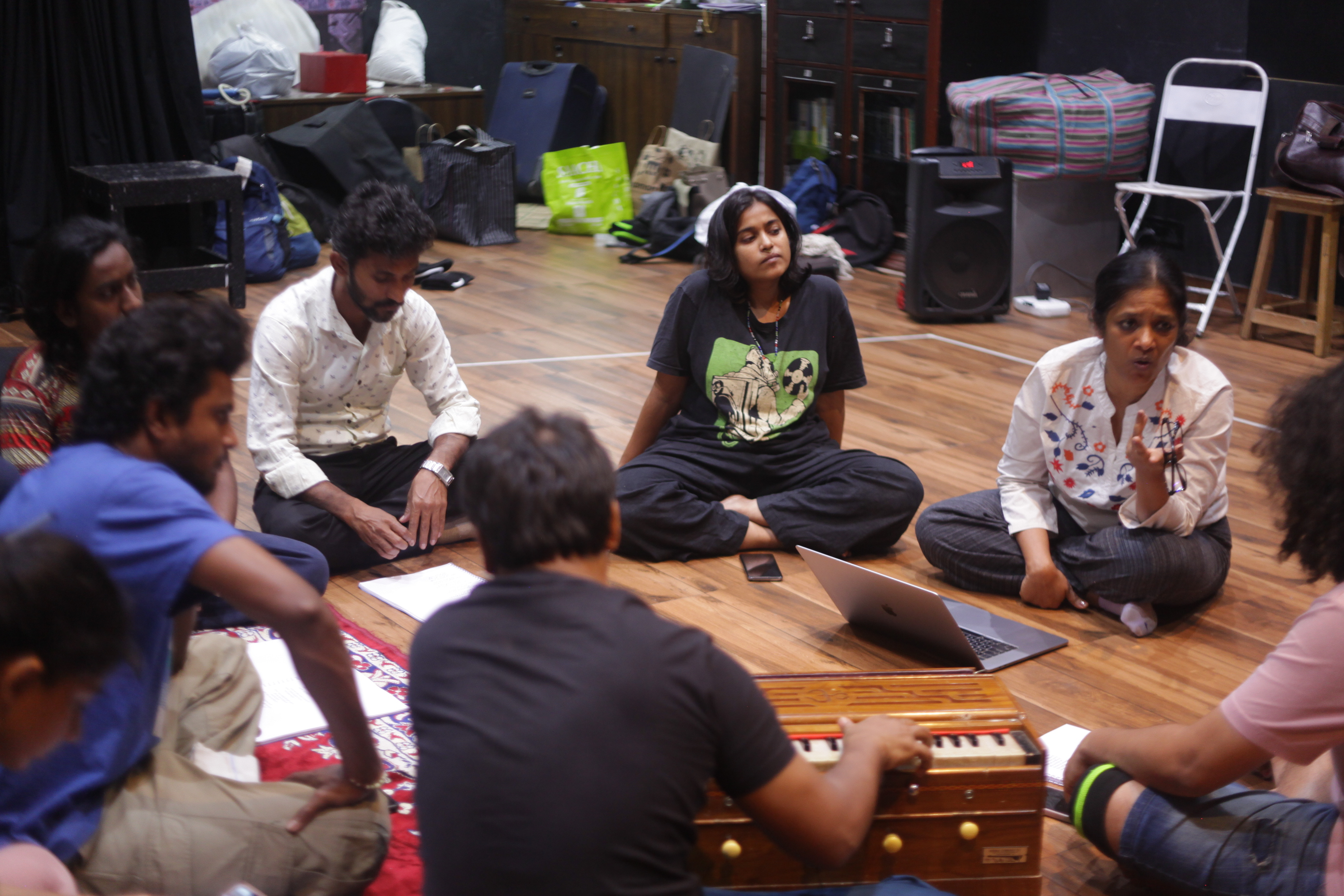
While pursuing his Master’s in Theater, Pravin Mukta of Yalgaar was introduced to the works of national and international playwrights, from Bertolt Brecht to Habib Tanvir. He also learned about established texts like the Natya Shastra (Science of Drama). But he always questioned everything he read, noting, “Babasaheb said to always question everything.”
Dhamma emphasized the need for more funding for anti-caste urban theater, as it receives far less than mainstream theater. “We have raised money through crowdfunding, and our community has consistently supported us,” he noted.
While Yalgaar has completed 10 years, they do not want to use flippant words like ‘successful’ to describe their journey. “We cannot call ourselves successful,” Kadam emphasized. “When will we be successful? It is when everyone will be equal in every sense, when people will give up hate and choose the path of love. That is what success means to us.”
Bengaluru’s Sri Vamsi Matta
Sri Vamsi Matta, a Bengaluru-based theater artist, writer, director, and visual artist, has broken new ground with his devised performance, Come Eat With Me (2022). Centred on the relationship between caste and food, this act is a celebration of Dalit food and identity.
“During the pandemic, urban elite people were complaining about how their maids and cooks were not coming to work,” Vamsi observed. “Many people couldn’t cook because they were dependent on someone else to cook their food.” This idea made him start looking at the culinary history of India, whose food is documented and whose isn’t.

During his research, Vamsi discovered a huge void in the documentation of the food of the marginalized. “I started applying for grants, but I didn’t get any, so I thought I would write about what I already know,” he recalled. “I cook, and there are stories I already know from my community.”
Vamsi started doing small shows in his friends’ houses. It started with five people and then became 10, 20, 30, and so on. “These shows were on an invite-only basis,” he shared. “Then I did a public show on June 11th, 2022, hosted by Belongg at Maraa Collective, which was at 50 people capacity. One of my biggest shows was 110 people.”
Come Eat With Me is an interactive piece to make the audience experience a human moment, where everyone sits together and shares a meal, cooked by Vamsi. “We may not understand each other, but can we bear witness to it, especially when you are eating food, you are more vulnerable,” he reasoned. “That is why I have used food as a device.”
The audience for Come Eat With Me included a cross-section of society. “There were members from my community who cried at my shows,” he shared. “Post show, they hugged me and broke down, not because it is a sad story, but because it is something they can relate to. Some people feel okay to open up and tell their story.”

For Vamsi’s Hyderabad show, late activist and revolutionary Telangana folk singer Gaddar was present. “His work is very important for my show because he talks about what it means to bring new culture, about the everyday struggles of the women from the community, and the land reform movement,” Vamsi shared. “My show starts with his song. He ate what I cooked, stayed back after the show, and spoke to me. It was a memorable meeting with him.”
But Vamsi also noted how a few well-meaning, progressive, dominant caste people have said, “Oh! I thought you would cook beef” (Vamsi cooks chicken curry for the show). “That comment is so loaded because they want to show they are so progressive, that they don’t mind, and they also assume that is something I would talk about,” he said.
For every show, as much as the audience knows about Vamsi, it is equally important for him to know about his audience. So the registration process includes a questionnaire wherein people explain why they are coming to watch the show. Specifically, Vamsi stressed the importance of radical listening, as caste is a lonely and dehumanizing experience.
Often, when sensitive topics like caste are brought up, people become defensive. When Vamsi had once performed in a predominantly white town in the US, for instance, one of the audience members said she believed what he was saying, but she wouldn’t have believed it had a Black person performed something like this.
“She said I would immediately ask a question; I would become defensive,” Vamsi recalled. “Her comment made me think about the importance of radical listening. People should listen to each other, it’s not about pointing fingers—we have been pointing fingers for a long time—but what do we do with the information that we get? The moment we become defensive, it becomes ‘your problem vs my problem’. But the moment you listen, it becomes our problem.”
However, Vamsi categorically stated he doesn’t approach Come Eat With Me as a tool to “educate” others in a traditional sense. “The show exists because dominant narratives about caste often center only on violence, erasure, or the fetishization of our suffering. Our bodies are portrayed as either invisible or symbolic of pain,” he said. “This performance is a conscious act of resistance to that. By telling our stories through food, memory, and community, it becomes a rehumanizing act.”
For Vamsi, it’s extremely important to portray that lowered-caste people are “not just a collection of brutalized histories.” Come Eat With Me is thus “rooted in joy, complexity, and the fullness of who we are,” Vamsi shared. “If that shifts someone’s understanding of caste or unsettles dominant ways of seeing, then perhaps it does have an educational effect, but its deeper purpose is to reclaim space, affirm our wholeness, and be truly seen.”

Vamsi’s first story, Star in the Sky (2021)—an adaptation of the Telugu short story Aakasam lo Oka Nakshatram, written by his father, Dr M. Suguna Rao—is based on the life and death of a young Dalit scholar Rohith Vemula, who died by suicide in 2016 due to caste discrimination. “In 2020, during the pandemic, many things happened: Doctors protested for working extra hours, the Hathras Rape Case,” Vamsi said. “All of this brought out the caste question much more to the forefront. Star in the Sky opened up my perspective of what theater could be.”
However, for the staging of Star in the Sky, performed in Bengaluru in April 2025, Vamsi wanted an all-Dalit cast. “I try to break the hierarchy in my rehearsal place,” he said. “It can’t be my play, it has to be our play, because I have limited capacities, I want others to step up.” Being a facilitator, Vamsi prefers that people who work with him should be able to do their own work and open their spaces for others, “because someone did that for me,” he explained.
Vamsi’s inspirations include his mother, Dakey Chandrakala, who was a doctor by profession and has a passion for the arts, as well as Dr Ambedkar. “They taught me to be curious,” Vamsi said. “I look at myself as a continuum of a larger movement; many other artists are doing such work.” Vamsi cited the works of contemporaries like Rahee Punyashloka, The Big Fat Bao (a visual artist from Bengaluru), and visual artists Rajyashri Goody and Tabitha Percy to illustrate his point.
He has also co-founded the Bengaluru-based Offstream Collective with Nisha Abdulla and Padmalatha Ravi. The collective explores anti-caste histories and art, and imagines a liberated future. “We do capacity-building and foreground artists from different marginalized communities,” Vamsi shared. “We give out grants, we conduct free workshops about different art practices, we ensure the ones who don’t get access to regular workshops and grants get access to ours.”
Kolkata’s Birati Samuho Performers Collective
The predominant myth is that Bengal is “casteless”, which is a form of erasure of the realities of caste. Founded in 2019, Kolkata-based Birati Samuho Performers Collective is a queer and women-centric performing collective of people from all genders comprising storytellers, theater makers, performers, actors, writers, scholars, painters, and musicians questioning majoritarian narratives in their plays.
Atho Hidimba Kotha (Hidimba’s story), first staged in 2019, reclaims the narrative of Hidimba, who is portrayed as a ‘demoness’ in The Mahabharata. Meanwhile, in Bhasaili Re… (2023), an aged Behula from the Bengali medieval saga, Manasa Mangal Kabya—originally portrayed as an ideal traditional wife submitting to patriarchal expectations—re-examines her life from a feminist perspective, challenging the mainstream views of her character.

Their 2024 production E Ek Ashcharja! Kalikata Kalankini; Athaba Chaaper Naksha Prahasan (Holy Moly! The Scandalous Kolkata or Farce of Printed Designs), supported by DAG Museums, examines the participation and representation of working-class women in the 19th century in print culture. The production is based on writings from Bengal’s Battala Literature. Bengali books published in the 19th Century were popular, widely available, and considered ‘lowly’ for some of their ‘obscene’ literature.
Samuho’s founder-member, Titas (the collective does not use their last names as a way to protest against caste discrimination), said that Kalikata Kalankini critiques Battala Literature. Titas had gone through the works of pertinent academic work around Battala Literature, including the writings of Sumanto Banerjee, Gautam Bhadra, Anindita Ghose, Sripantha et al. “What I understood is that although Battala literature was inclusive of colloquial Bengali or the commoner’s tongue of that time, the working class did not have access to the authorship and publishing,” she said. Finally, Titas had to conclude that it is hard to rely on Battala literary materials as accounts or representations of the lowered caste of colonial Bengal.
The basis of Kalikata Kalankini is the deep research into the lives of napitanis (women barbers), dhopanis (washer women), goyalnis (women milk sellers), malanis (flower garland makers), and Vaishnavite women. They secretly passed around books in the inner courts of dominant caste households, but they did not have the opportunity to read and write.
Titas gave insight into the woeful condition of the lower caste in Bengal, which is reflected in Kalikata Kalankini. The Sunset Laws, part of the Permanent Settlement, deprived the lowered caste farmers of their land and the little protection they received under the zamindari system, which made them come to Kolkata. Their condition was further worsened by the 7 to 8 famines in Bengal due to imperialism. “The working class was not part of any education system and didn’t know how to read and write,” Titas explained. “They interpreted text through images.”
Dr Maroona Murmu, professor at Jadavpur University, and Professor Hardikbrata Biswas, professor at St. Xavier’s College, helped Titas in her research. Titas’s co-creator, Subhojit, and intern Katryn Kurj from Leipzig University also helped with a vast literature review for the play.

Samuho views audiences as equal participants and not just consumers. It is not always about them sitting in an air-conditioned auditorium and watching a play. “In my work, they are often invited to participate by putting in effort to connect with the play,” said Titas. Kalikata Kalankini was created for such an engagement. It was held inside the Sovabazar Natmandir, where the audience had to walk along the route of the promenade performance. “It actually brought the audience to an equal plane with the actors, where they both are putting in effort for a human exchange,” reflected Titas. “That is pretty magical.”
According to her, urban audiences in Kolkata largely comprise the dominant caste-middle class who watch anti-caste plays from a privileged lens. “In a capitalist system, where the working class has to work and sustain themselves, barely earning Rs. 300 a week, it is challenging for them to watch a play,” she noted.
Titas further highlighted the challenges of the working class in pursuing theater as a profession. One of Samuho’s cast members had to stop pursuing theater as it was unsustainable. “I have some cultural capital, so I can still do theater, but I too struggle with finances,” she said.
From Yalgaar to Vamsi to Samuho, all three theater groups and practitioners are creating works not just critiquing the past and the present, but to usher in a new future. “My community has the power of memory and resilience,” Vamsi observed, “and we continue to churn out amazing art.”


India’s Anti-Caste Urban Theater Groups Center Resistance, Resilience, and the Marginalized
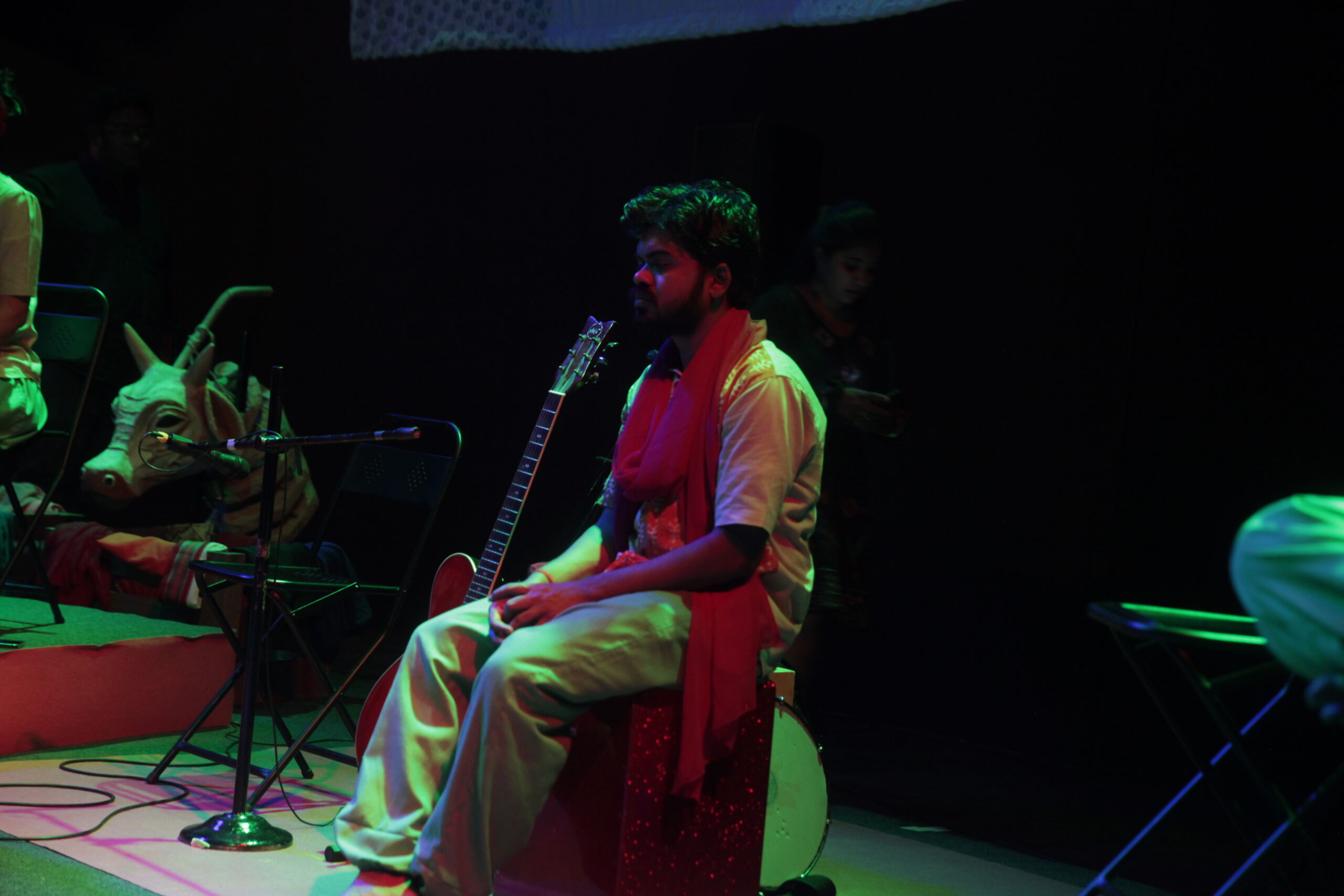
A still from Kavan. Photo courtesy of Yalgaar.
When asked about who the audience should be for Kavan—Yalgaar Sanskrutik Manch’s first proscenium performance in Mumbai—the Ambedkarite theater group responded: “We can perform anywhere and everywhere, under the shade of a tree or in an elite auditorium space.”
Yalgaar has traversed various performance spaces, from the streets of Mumbai to villages in Maharashtra, aiming to reach new audiences and spread awareness about Ambedkarite thought.
Dhammarakshit “Dhamma” Randhive, one of the founding members of Yalgaar, stressed that they identify as Ambedkarites, not just Dalits. “We have members from diverse caste backgrounds: Dalits, minorities, OBCs,” he said. “Anyone can be an Ambedkarite, not just by birth.”
Faturing folk performance and protest songs rooted in the tradition of shahiri (traditional Maharashtrian poetic storytelling with socio-political commentary) and jalsa (a traditional folk form that combines music, dance, drama, and poetry with tamasha or Maharashtrian folk theater tradition), anti-caste urban theater in India has long served as a force of resistance against caste hegemony and dominant narratives.
The shahiri tradition was adapted into a tool of social change by infusing traditional street theater with social reform messaging. It was called the Satyashodhaki Jalsa (early 1890s), and its origins lie in the 19th-century anti-caste reformer and educator, Jyotirao Phule’s Satyasadhak Samaj (Truth-Seeking Society), founded in 1873.
Around the 1930s, while Satyashodhaki Jalsa declined, Ambedkarite Shahiri Jalsa emerged during Dr. Babasaheb Ambedkar’s anti-caste movement. Folk songs on resistance and revolution were created and sung by shahirs (poet-performers) to express their struggles against caste oppression.
The Dalit Panthers in Maharashtra played a significant role in anti-caste urban theater and were pioneers of street performances. Founded in 1972 in Mumbai by a group of Dalit youth, including Namdeo Dhasal, Raja Dhale, and JV Pawar, the Dalit Panthers fought against caste discrimination and oppression, challenged the dominant socio-political order, and promoted Dalit literature.
Their performances include forms like powada (traditional Marathi poetry) and lavani (a traditional Marathi folk dance form), and are rooted in Ambedkarite Jalsa. Renowned personalities like Annabhau Sathe—a social reformer, folk poet and writer, and a pioneer in Dalit Literature—and Shambhaji Bhagat—a contemporary Maharashtrian folk singer, poet, playwright and activist—have also contributed significantly to anti-caste theater.
Anti-caste theater has been inspired by diverse regional movements across India. In Tamil Nadu, it was influenced by the Dravidian movement, led by prominent figures like Periyar and E.V. Ramasamy, and Oppari, a mourning song tradition performed by women at funeral ceremonies. In Karnataka, it has drawn on Kannada Dalit writing and the Bandaya Literary Movement, led by literary figures like Siddalingaiah and Devanur Mahadeva, and Dalita Sangharsha Samiti (DSS) of the 1970s and 1980s, whose urban theater centered Dalit expression and identity assertion.
In Andhra Pradesh and Telangana, anti-caste theater drew from the Jana Natya Mandali and Madiga Dandora, a cultural and political movement by the Madiga community for the right to equitable reservations. And in North India, it was inspired by forms like nautanki and street performances, and the works of Bhikhari Thakur, a Bhojpuri poet, playwright, and performer, who addressed caste oppression through folk and modern theatrical traditions.
Today, due to the proliferation of social media, rising social awareness, and the works of filmmakers like Nagraj Manjule and Pa. Ranjith, urban audiences are being exposed to anti-caste narratives. However, a lot more needs to be done to create a deeper understanding among them, including expanding knowledge of Dalit history and a deeper acknowledgment of caste privilege.
From the Yaalgaar Sanskrutik Manch in Mumbai to Sri Vamsi Matta in Bengaluru to Birati Samuho Performers Collective in Kolkata, contemporary anti-caste urban theater groups and practitioners are addressing this challenge. Through interactive theater and powerful productions, they are reclaiming their own community’s narratives while actively engaging with elite urban audiences, who are not only part of systemic oppression but also custodians of dominant culture in India.
Mumbai’s Yalgaar Sanskrutik Manch
The origins of Yalgaar can be traced to 2015, when groups of artists from across Maharashtra gathered in Pune in response to the growing threat of religious fundamentalism. In this context, artists Dhamma, Mohammad Khan, Rahul Savita, Sunil Ingale, Mutki Sadhana, Sudesh Jadav, Siddharth Pratibhawant, and Shailesh Sawant decided to form Yalgaar to bring about cultural reform.
Their performances draw from the Ambedkarite Jalsa tradition, which encompasses a wide range of theatrical elements, including storytelling, poetry, singing, improvization, and batavni (exaggerated satire), to highlight issues of caste-based and social oppression.
Their work addresses various themes, from communal harmony to caste oppression, some lilting and heartwarming, and others powerful and evocative. Their 2024 performance, titled Rang Aman Ke (Colors of Peace), promoted communal harmony by showcasing the history of saints like Sant Tukaram, Sufi saints, progressive and contemporary poets. “We formed a folk fusion band, playing instruments such as the guitar and halgi (a Marathi percussion instrument),” said Dhamma.
Jagar Samtecha (People’s Awakening), performed in 2022, emphasized equality and rights awareness, while their 2017 performance, Baar Baar Fenko (Throw Again and Again), and their 2021 performance Hum Karodo Hai Berojgar Kya Kare (We Are Crores of Unemployed, What Should We Do?) are parodies on demonetization and unemployment, respectively.
“Yalgaar has also supported rights-based movements, like the anti-CAA Movement, the Students’ Movement, and the Farmers’ Movement,” said Dhamma. “As artists, it is incumbent that we not only address caste-based social oppression in marginalized communities but also be at the forefront in upholding the Constitution and Democracy.”
Their audience interaction varies according to the specific socio-cultural context of each location. “In villages, we highlight the discrimination and violence we face,” said Dhamma, “but for an [urban] elite audience, we aim for them to understand the history of caste oppression, reflect on their privilege, and think about their responsibility as citizens.”
Yalgaar seeks to engage with urban audiences, not to offend but to create awareness. In Kavan, they have stirred urban audiences not just by their powerful performances but also by making them think and reflect. The play is an operatic satire about young Ambedkarite experiences, including members of Yalgaar and their community, into one storyline, centered on a young Bejul, a Dalit. Kavan shows how dominant castes use caste and religion as tools to control the means of production, keeping capital in their hands.
The Yalgaar ensemble collaborated with Nalanda Arts Studio, with the play being directed by award-winning playwright and theater director Abhishek Majumdar.
During the making of Kavan, the entire team collaborated as equals without hierarchy, Kadam said, which was consistent with Yalgaar’s core values and philosophy. The process included the cast and crew coming together, bringing photos of their families, and warmly sharing their life stories. “It was a process of caste annihilation,” Kadam emphasized.
The playwright, Jadav, gave them a storyline, and they worked on the flow. “We tried out different forms and we chose opera,” said Todarmal. “That is how the storyline of Kavan started emerging.”
“Kavan made audiences think about privilege and caste issues,” said Dhamma. “We had many audience members approach us after the show to ask questions and learn more.”
Ankita Jain, who watched the performance in Prithvi Theater in Mumbai, called Kavan a brave production, especially in today’s time of unprecedented censorship. “It is the need of the hour to call a spade a spade, and Kavan does that,” she said. “Also, for audiences who do not know anything about caste oppression, this production will create a shift in their perspective.”
Yalgaar members argue that mainstream theater often fails to represent lowered-caste realities. “Commercial Marathi theater is made for the upper caste,” said Priypal Dashantee, another Yalgaar member. “The lowered castes don’t relate to the plays and can’t afford to watch such plays.”
Pratibhawant criticized mainstream Marathi theater for revolving around elite domestic settings: the drawing room, bedroom, and kitchen. Meanwhile, Kadam and Amruta Todarmal, who have also acted in Marathi serials, said that they didn’t relate to the stories as they revolve around typical, regressive tropes like saas-bahu (mother-in-law, daughter-in-law) conflicts.
“This does not reflect our reality,” said Todarmal. “This is the reason why it was a welcome relief when I met members of Yalgaar, and I decided to perform in Kavan.”
While pursuing his Master’s in Theater, Pravin Mukta of Yalgaar was introduced to the works of national and international playwrights, from Bertolt Brecht to Habib Tanvir. He also learned about established texts like the Natya Shastra (Science of Drama). But he always questioned everything he read, noting, “Babasaheb said to always question everything.”
Dhamma emphasized the need for more funding for anti-caste urban theater, as it receives far less than mainstream theater. “We have raised money through crowdfunding, and our community has consistently supported us,” he noted.
While Yalgaar has completed 10 years, they do not want to use flippant words like ‘successful’ to describe their journey. “We cannot call ourselves successful,” Kadam emphasized. “When will we be successful? It is when everyone will be equal in every sense, when people will give up hate and choose the path of love. That is what success means to us.”
Bengaluru’s Sri Vamsi Matta
Sri Vamsi Matta, a Bengaluru-based theater artist, writer, director, and visual artist, has broken new ground with his devised performance, Come Eat With Me (2022). Centred on the relationship between caste and food, this act is a celebration of Dalit food and identity.
“During the pandemic, urban elite people were complaining about how their maids and cooks were not coming to work,” Vamsi observed. “Many people couldn’t cook because they were dependent on someone else to cook their food.” This idea made him start looking at the culinary history of India, whose food is documented and whose isn’t.
During his research, Vamsi discovered a huge void in the documentation of the food of the marginalized. “I started applying for grants, but I didn’t get any, so I thought I would write about what I already know,” he recalled. “I cook, and there are stories I already know from my community.”
Vamsi started doing small shows in his friends’ houses. It started with five people and then became 10, 20, 30, and so on. “These shows were on an invite-only basis,” he shared. “Then I did a public show on June 11th, 2022, hosted by Belongg at Maraa Collective, which was at 50 people capacity. One of my biggest shows was 110 people.”
Come Eat With Me is an interactive piece to make the audience experience a human moment, where everyone sits together and shares a meal, cooked by Vamsi. “We may not understand each other, but can we bear witness to it, especially when you are eating food, you are more vulnerable,” he reasoned. “That is why I have used food as a device.”
The audience for Come Eat With Me included a cross-section of society. “There were members from my community who cried at my shows,” he shared. “Post show, they hugged me and broke down, not because it is a sad story, but because it is something they can relate to. Some people feel okay to open up and tell their story.”
For Vamsi’s Hyderabad show, late activist and revolutionary Telangana folk singer Gaddar was present. “His work is very important for my show because he talks about what it means to bring new culture, about the everyday struggles of the women from the community, and the land reform movement,” Vamsi shared. “My show starts with his song. He ate what I cooked, stayed back after the show, and spoke to me. It was a memorable meeting with him.”
But Vamsi also noted how a few well-meaning, progressive, dominant caste people have said, “Oh! I thought you would cook beef” (Vamsi cooks chicken curry for the show). “That comment is so loaded because they want to show they are so progressive, that they don’t mind, and they also assume that is something I would talk about,” he said.
For every show, as much as the audience knows about Vamsi, it is equally important for him to know about his audience. So the registration process includes a questionnaire wherein people explain why they are coming to watch the show. Specifically, Vamsi stressed the importance of radical listening, as caste is a lonely and dehumanizing experience.
Often, when sensitive topics like caste are brought up, people become defensive. When Vamsi had once performed in a predominantly white town in the US, for instance, one of the audience members said she believed what he was saying, but she wouldn’t have believed it had a Black person performed something like this.
“She said I would immediately ask a question; I would become defensive,” Vamsi recalled. “Her comment made me think about the importance of radical listening. People should listen to each other, it’s not about pointing fingers—we have been pointing fingers for a long time—but what do we do with the information that we get? The moment we become defensive, it becomes ‘your problem vs my problem’. But the moment you listen, it becomes our problem.”
However, Vamsi categorically stated he doesn’t approach Come Eat With Me as a tool to “educate” others in a traditional sense. “The show exists because dominant narratives about caste often center only on violence, erasure, or the fetishization of our suffering. Our bodies are portrayed as either invisible or symbolic of pain,” he said. “This performance is a conscious act of resistance to that. By telling our stories through food, memory, and community, it becomes a rehumanizing act.”
For Vamsi, it’s extremely important to portray that lowered-caste people are “not just a collection of brutalized histories.” Come Eat With Me is thus “rooted in joy, complexity, and the fullness of who we are,” Vamsi shared. “If that shifts someone’s understanding of caste or unsettles dominant ways of seeing, then perhaps it does have an educational effect, but its deeper purpose is to reclaim space, affirm our wholeness, and be truly seen.”
Vamsi’s first story, Star in the Sky (2021)—an adaptation of the Telugu short story Aakasam lo Oka Nakshatram, written by his father, Dr M. Suguna Rao—is based on the life and death of a young Dalit scholar Rohith Vemula, who died by suicide in 2016 due to caste discrimination. “In 2020, during the pandemic, many things happened: Doctors protested for working extra hours, the Hathras Rape Case,” Vamsi said. “All of this brought out the caste question much more to the forefront. Star in the Sky opened up my perspective of what theater could be.”
However, for the staging of Star in the Sky, performed in Bengaluru in April 2025, Vamsi wanted an all-Dalit cast. “I try to break the hierarchy in my rehearsal place,” he said. “It can’t be my play, it has to be our play, because I have limited capacities, I want others to step up.” Being a facilitator, Vamsi prefers that people who work with him should be able to do their own work and open their spaces for others, “because someone did that for me,” he explained.
Vamsi’s inspirations include his mother, Dakey Chandrakala, who was a doctor by profession and has a passion for the arts, as well as Dr Ambedkar. “They taught me to be curious,” Vamsi said. “I look at myself as a continuum of a larger movement; many other artists are doing such work.” Vamsi cited the works of contemporaries like Rahee Punyashloka, The Big Fat Bao (a visual artist from Bengaluru), and visual artists Rajyashri Goody and Tabitha Percy to illustrate his point.
He has also co-founded the Bengaluru-based Offstream Collective with Nisha Abdulla and Padmalatha Ravi. The collective explores anti-caste histories and art, and imagines a liberated future. “We do capacity-building and foreground artists from different marginalized communities,” Vamsi shared. “We give out grants, we conduct free workshops about different art practices, we ensure the ones who don’t get access to regular workshops and grants get access to ours.”
Kolkata’s Birati Samuho Performers Collective
The predominant myth is that Bengal is “casteless”, which is a form of erasure of the realities of caste. Founded in 2019, Kolkata-based Birati Samuho Performers Collective is a queer and women-centric performing collective of people from all genders comprising storytellers, theater makers, performers, actors, writers, scholars, painters, and musicians questioning majoritarian narratives in their plays.
Atho Hidimba Kotha (Hidimba’s story), first staged in 2019, reclaims the narrative of Hidimba, who is portrayed as a ‘demoness’ in The Mahabharata. Meanwhile, in Bhasaili Re… (2023), an aged Behula from the Bengali medieval saga, Manasa Mangal Kabya—originally portrayed as an ideal traditional wife submitting to patriarchal expectations—re-examines her life from a feminist perspective, challenging the mainstream views of her character.
Their 2024 production E Ek Ashcharja! Kalikata Kalankini; Athaba Chaaper Naksha Prahasan (Holy Moly! The Scandalous Kolkata or Farce of Printed Designs), supported by DAG Museums, examines the participation and representation of working-class women in the 19th century in print culture. The production is based on writings from Bengal’s Battala Literature. Bengali books published in the 19th Century were popular, widely available, and considered ‘lowly’ for some of their ‘obscene’ literature.
Samuho’s founder-member, Titas (the collective does not use their last names as a way to protest against caste discrimination), said that Kalikata Kalankini critiques Battala Literature. Titas had gone through the works of pertinent academic work around Battala Literature, including the writings of Sumanto Banerjee, Gautam Bhadra, Anindita Ghose, Sripantha et al. “What I understood is that although Battala literature was inclusive of colloquial Bengali or the commoner’s tongue of that time, the working class did not have access to the authorship and publishing,” she said. Finally, Titas had to conclude that it is hard to rely on Battala literary materials as accounts or representations of the lowered caste of colonial Bengal.
The basis of Kalikata Kalankini is the deep research into the lives of napitanis (women barbers), dhopanis (washer women), goyalnis (women milk sellers), malanis (flower garland makers), and Vaishnavite women. They secretly passed around books in the inner courts of dominant caste households, but they did not have the opportunity to read and write.
Titas gave insight into the woeful condition of the lower caste in Bengal, which is reflected in Kalikata Kalankini. The Sunset Laws, part of the Permanent Settlement, deprived the lowered caste farmers of their land and the little protection they received under the zamindari system, which made them come to Kolkata. Their condition was further worsened by the 7 to 8 famines in Bengal due to imperialism. “The working class was not part of any education system and didn’t know how to read and write,” Titas explained. “They interpreted text through images.”
Dr Maroona Murmu, professor at Jadavpur University, and Professor Hardikbrata Biswas, professor at St. Xavier’s College, helped Titas in her research. Titas’s co-creator, Subhojit, and intern Katryn Kurj from Leipzig University also helped with a vast literature review for the play.
Samuho views audiences as equal participants and not just consumers. It is not always about them sitting in an air-conditioned auditorium and watching a play. “In my work, they are often invited to participate by putting in effort to connect with the play,” said Titas. Kalikata Kalankini was created for such an engagement. It was held inside the Sovabazar Natmandir, where the audience had to walk along the route of the promenade performance. “It actually brought the audience to an equal plane with the actors, where they both are putting in effort for a human exchange,” reflected Titas. “That is pretty magical.”
According to her, urban audiences in Kolkata largely comprise the dominant caste-middle class who watch anti-caste plays from a privileged lens. “In a capitalist system, where the working class has to work and sustain themselves, barely earning Rs. 300 a week, it is challenging for them to watch a play,” she noted.
Titas further highlighted the challenges of the working class in pursuing theater as a profession. One of Samuho’s cast members had to stop pursuing theater as it was unsustainable. “I have some cultural capital, so I can still do theater, but I too struggle with finances,” she said.
From Yalgaar to Vamsi to Samuho, all three theater groups and practitioners are creating works not just critiquing the past and the present, but to usher in a new future. “My community has the power of memory and resilience,” Vamsi observed, “and we continue to churn out amazing art.”