


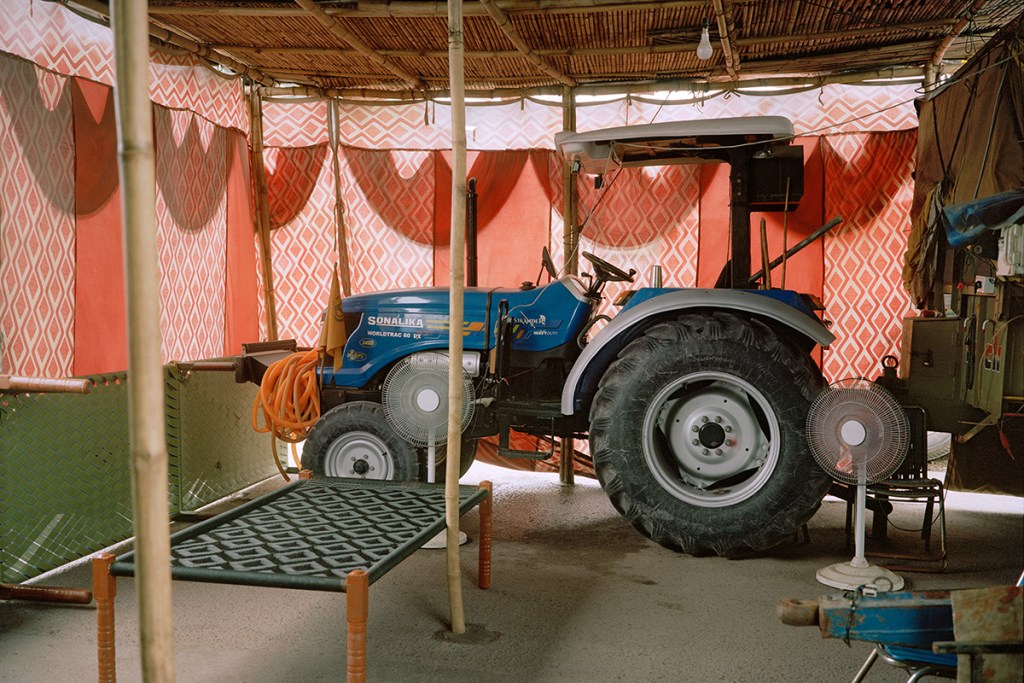
In the sterile white walls of South Delhi’s Vadehra Art Gallery, earlier this year, visitors encountered an unlikely architecture: photographs of blue and yellow tarpaulin sheets stretched between bamboo poles, concrete barricades repurposed as furniture, and tractors transformed into temporary homes. Photographer Gauri Gill’s exhibition The Village On The Highway captured what she called the “architecture of resistance”—the improvised structures that housed India’s historic farmer protests from 2020 to 2021.
“I just thought it’s incredible how they are managing to inhabit the highway,” Gill reflected on her first visit to the Singhu border, where farmers had blocked a major highway connecting New Delhi to neighboring agrarian states Haryana and Punjab. “They had transformed a transit route into a living community.”
Her photographs, shot on analog film over twelve months, document not the faces of protesters but their material world—the everyday objects that became tools of survival and symbols of defiance: tractors, trucks, old wheels, tarpaulins, sticks, tents, bed cots, and cotton sheets.
All of these objects eventually make up what would be established as their own village on the highway, as well as symbols of their refusal to give in to the government’s negotiations and their resolve to stay put until their demands were met.
Inside the Farmer Protests
For thirteen months, from November 2020 to December 2021, farmers from Punjab, Haryana, Uttar Pradesh, and other states staged an indefinite sit-in at Delhi’s borders. They were protesting three new farm bills that threatened to corporatize India’s agricultural sector, potentially allowing private players to dominate markets that small farmers had relied on for generations.
At least 40,000 farmers took part in the protests, which originally kicked off in Punjab and later spread through northern India and the borders surrounding New Delhi. Their demands included a minimum support price bill that would not give corporations power to decide their crop prices, waiving of farmers’ debt, and revoking the three new onerous farm laws, which they referred to as “kaala kanoon” (black laws).
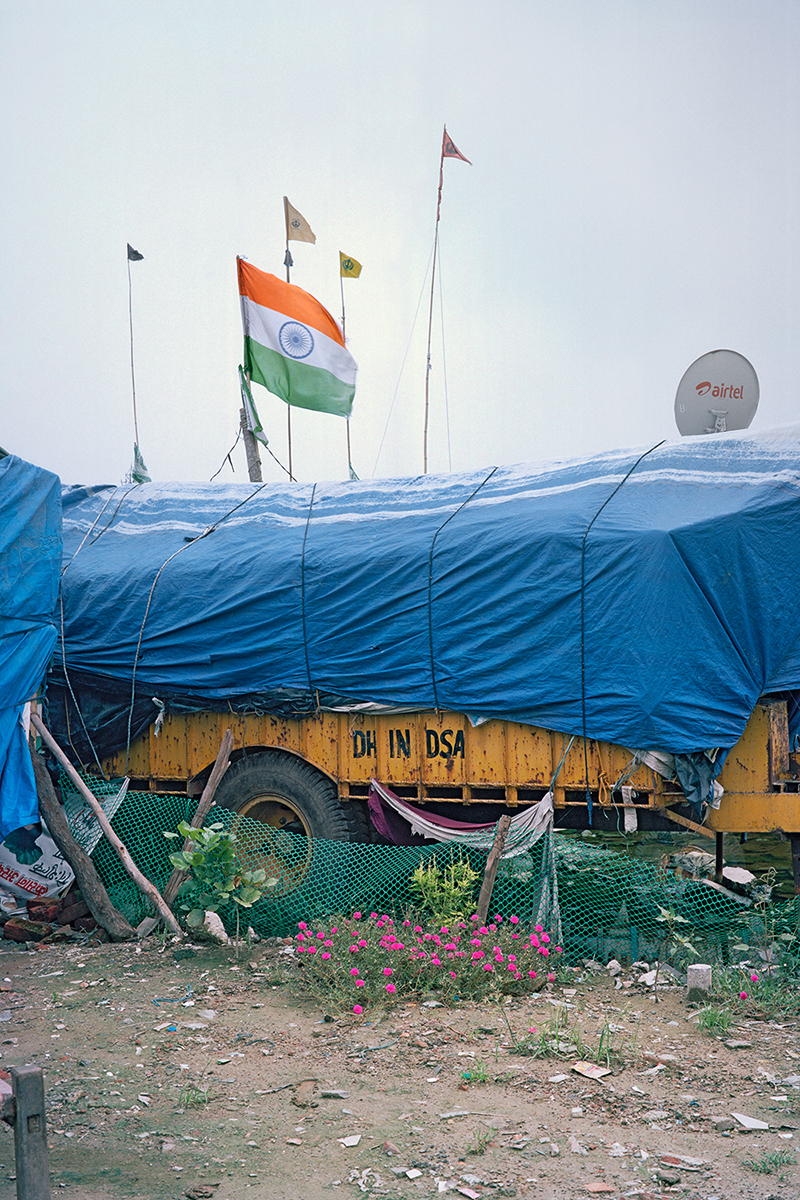
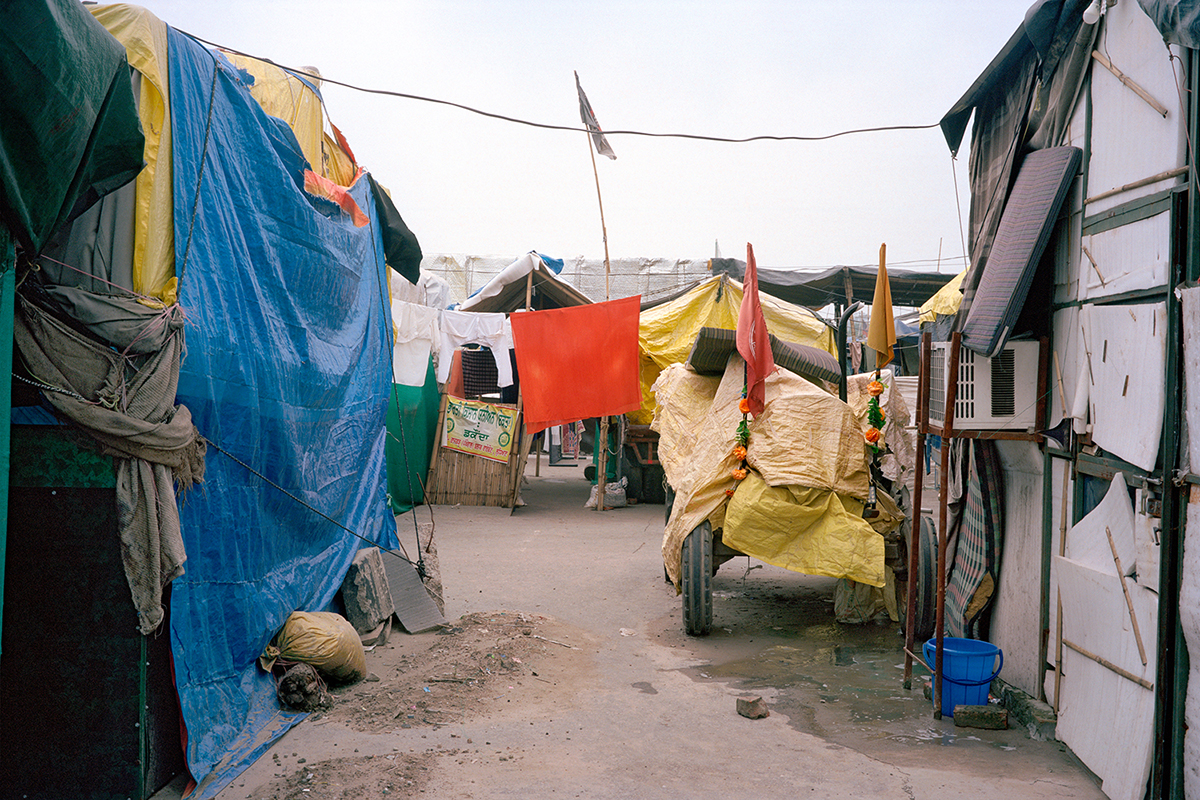
At the border points, farmers constructed a parallel society complete with community kitchens, libraries, nursing stations, and sleeping quarters built from whatever materials they could find. A new temporary village of their own in the face of violence from the state. Gill’s images show the soft intimacy of makeshift tents with multiple cots and blankets, trucks slowly turning into homes, old cotton bedsheets turning into dividers and curtains. Even in the absence of people who occupy these spaces, traces of their resilience are felt.
The protests came at a grave human cost. According to the catalogue and wall text, Gill’s exhibition is dedicated to the 750 farmers who lost their lives during the movement. Many died due to extreme weather, police brutality, illness, and suicide. In October 2021, eight farmers died in Lakhimpur Kheri district, in Uttar Pradesh, after a minister’s convoy ran over them. In November, a 45-year-old landless farmer was found hanging from a tree at the Singhu border protest site. He left behind no suicide note, just the words ‘zimmedar’ (responsible) written on his palm.
The pattern of farmer suicides continues even now. During protests in January of this year, a farmer wrote in his suicide note: “In order to wake up the Centre and state government, we need to sacrifice ourselves and I have started it.”
The highways they occupied are lifelines of the Indian economy, connecting the capital to the agricultural heartlands that produce wheat, rice, maize, and sugarcane—staple foods for a population of 1.4 billion people, the largest in the world. By blocking these arteries, farmers forced the nation to confront its dependence on the very people it had marginalized.
Since farmers at the borders of Delhi blocked key highways connecting the rest of the country to Delhi, several supply chains and transport networks were disrupted, including food grains, fuel, milk, vegetables, fruits, edible oil, everyday products, and commuter routes.
Transforming Ordinary Objects into Extraordinary Solutions
Gill’s connection to the protests was personal before it became artistic. “The very first time I visited with a friend, the first people I encountered turned out to be farmers from my father’s village in Punjab’s Taran Tarn district,” she recalled. “They gave us a warm welcome with kheer, tea, rotis, and saag. It was January, and it was really cold, so it was extra welcome.”
A photographer known for documenting rural lives, indigenous communities, and grassroots movements for which she was awarded the 10th Prix Pictet prize, Gill found herself drawn to the material ingenuity on display. Based in New Delhi, Gill has published two books with Edition Patrick Frey about her collaborations with rural artists, titled Acts of Appearance (2022) and Fields of Sight (2023).
She began visiting the Singhu border regularly, camera in hand, documenting how ordinary objects had been transformed into extraordinary solutions. “In the beginning, I saw no reason to document the protests because the farmers were doing such a fine job of it, as were the many activists living on the site,” she recalled. “But as I continued to return, I found over time that no one was documenting the very distinct structures that had manifested at the site, and that enabled the farmers to survive a whole year on a highway.”
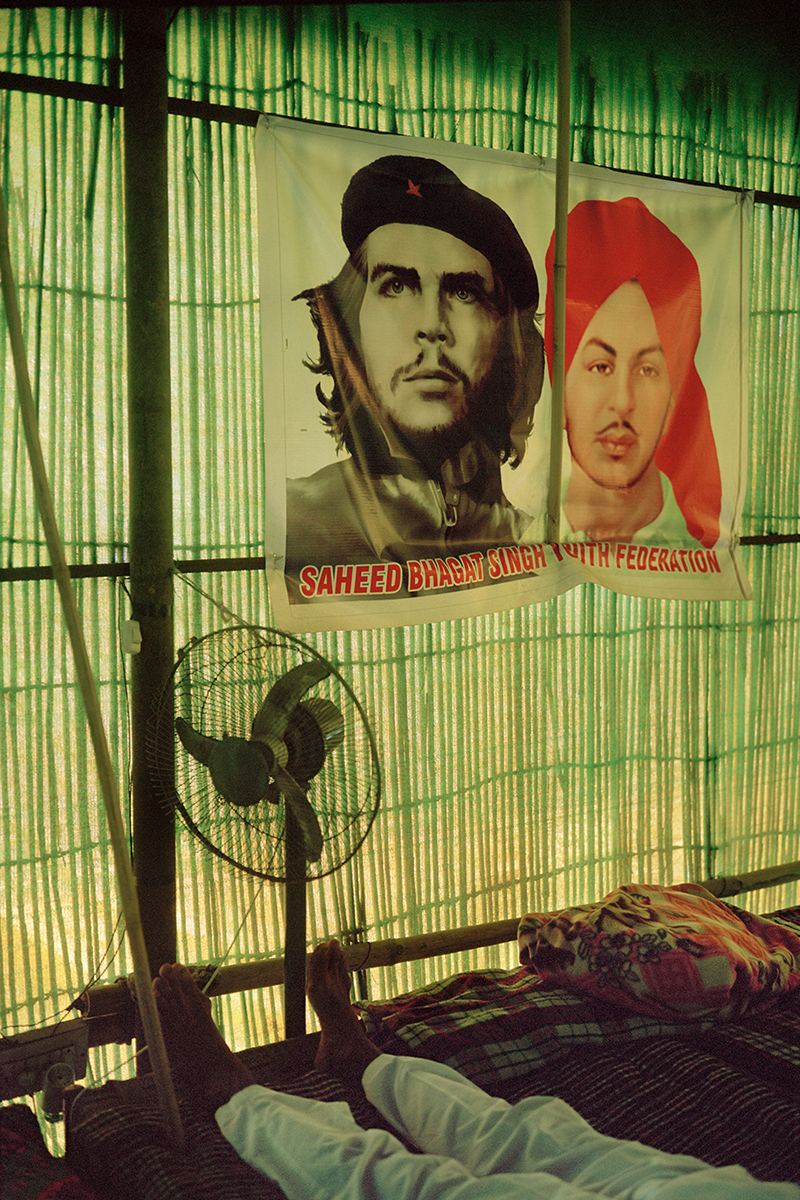
Her photographs reveal a world built from scraps: green, yellow, and blue tarpaulin sheets providing shelter, thermocol and plastic offering insulation, tin and wood creating furniture, rope and net holding everything together. In one rare image showing a human silhouette, a farmer lies resting beneath this improvised architecture—a reminder that behind every structure was someone’s body, someone’s endurance.

“The architecture of protest was created by people to serve a unique exigency,” Gill explained. “The structures spoke to me of the dignified tenacity of these rural workers, and their photographic record marks a continuation of my practice, which has continually focused on how people in precarity find ways to float, rather than drown.”
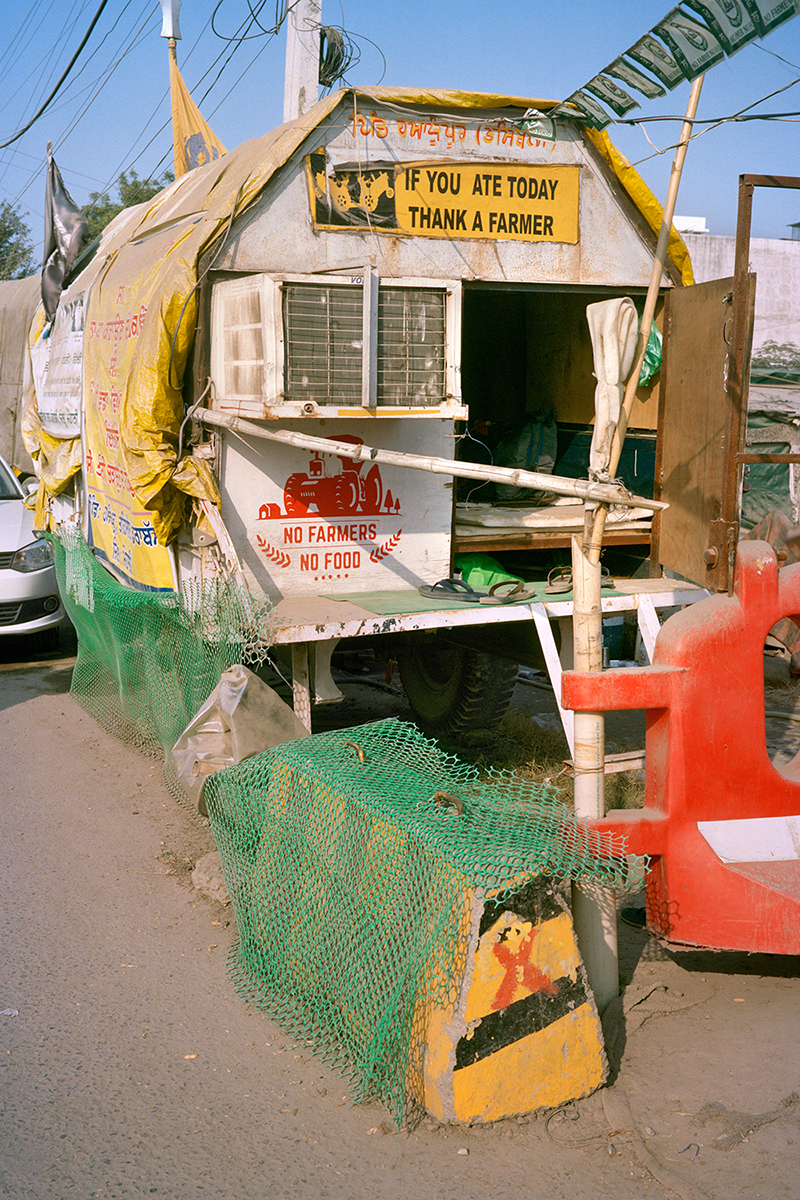
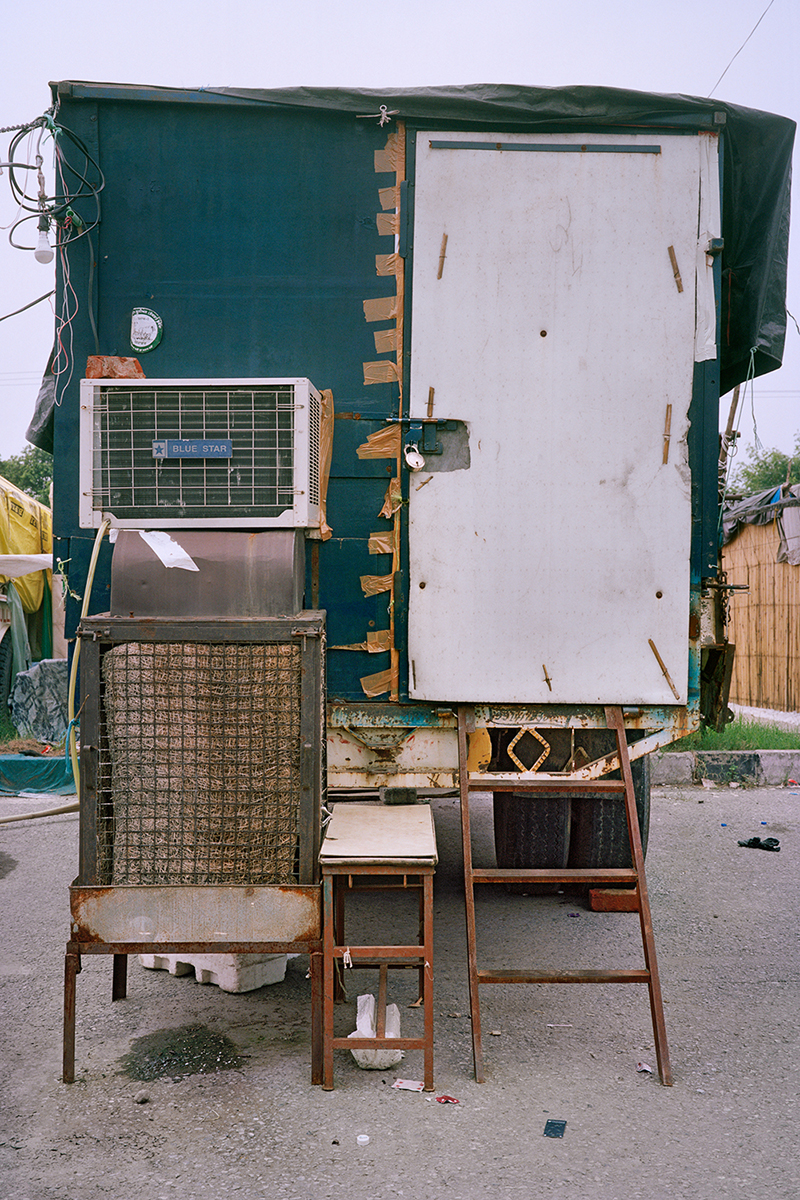
As the seasons changed, so did the protest landscape. Summer brought air conditioners and khus coolers and mosquito nets; monsoons required better waterproofing; winter demanded blankets and warming fires. Makeshift washing machines linked to tubes and buckets appeared to enable communal washing spaces. “It began to metamorphose,” Gill shared. “I was at the protests for 12 months, and it never looked the same.”
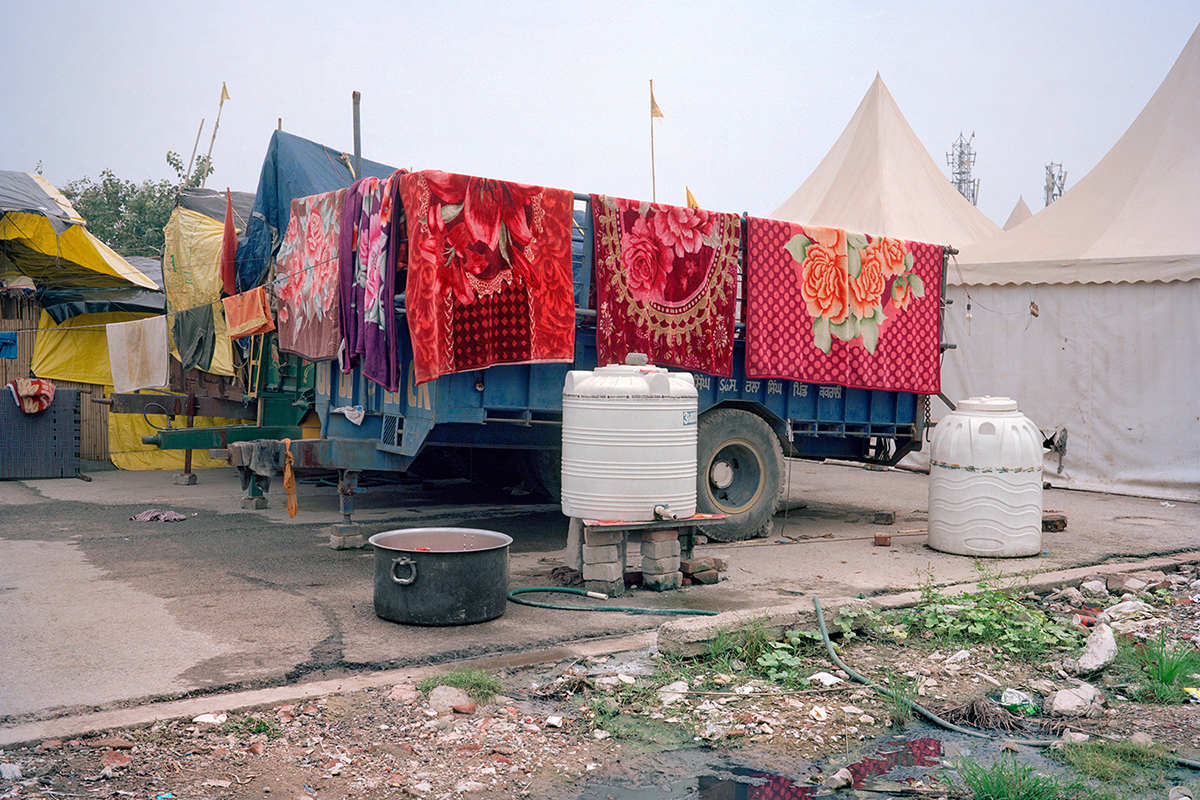
This is reflected in the photographs, too. Where table fans and coolers stand next to tractors and cots. In another photo, the outside part of a window AC attached to a makeshift trolley is next to a poster that says, “We are farmers, not a terrorist(s).” From the winter months, one can see ashes on the ground from makeshift campfires using hay, bricks, newspapers, and other materials, while thick blankets hang outside of trucks and trolleys.

In another photo, thick woolen blankets are seen hanging from a clothesline made around a truck.
A Visual Language of Resistance
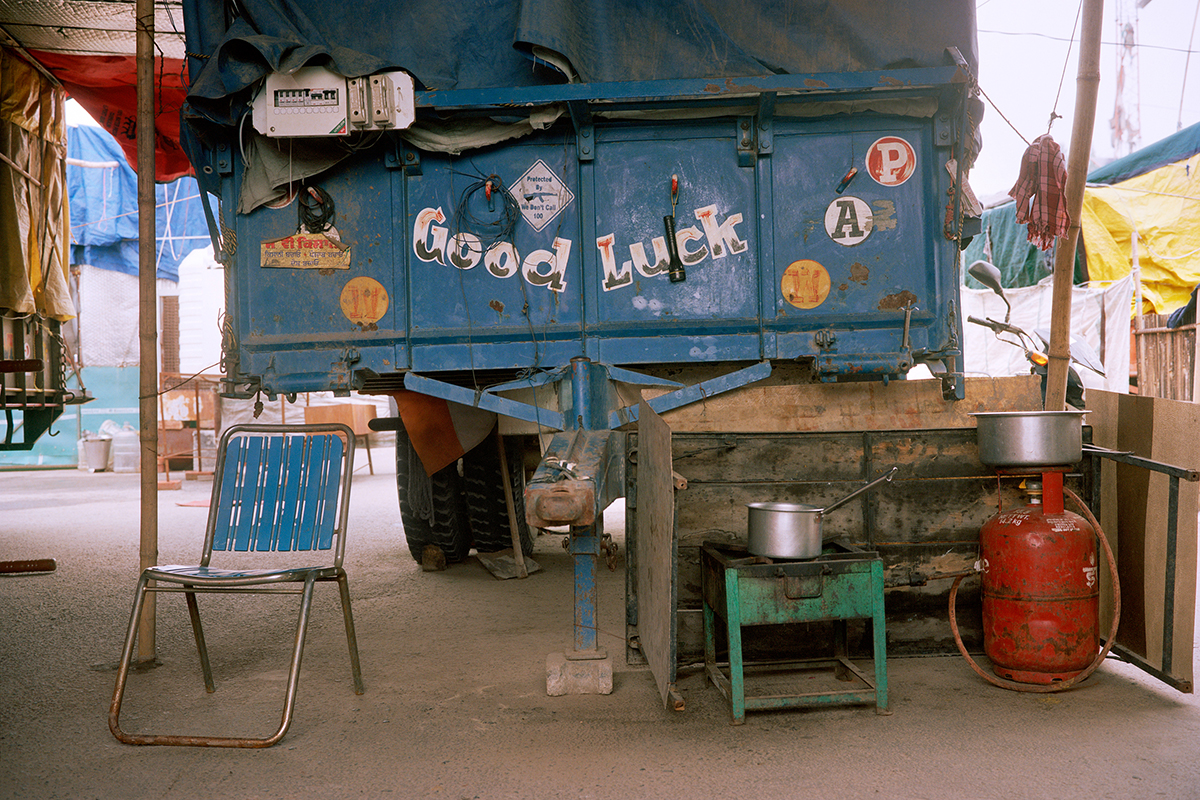
What emerges from Gill’s photographs is a visual language of resistance. Each structure tells a story of adaptation, creativity, and collective problem-solving. Concrete barriers intended to keep protesters out became seating and tables. Barricades became aids for hanging clothes. Vehicle rooftops became observation posts and meeting spaces. “I began to witness the road itself dug up into patches of earth to plant vegetables such as cauliflower and radishes,” Gill said.
Previously, India witnessed the creation of a language of resistance during the 2019-20 anti-CAA protests. In the lanes of Shaheen Bagh, in south-east Delhi, protestors turned barricades and concrete blocks into similar spaces of art and community. In Nepal’s Gen Z protests against mass government corruption this September, young protestors took over public spaces and dismantled barricades set up to withhold them.
Yet, farmers and union leaders involved in the protests were routinely vilified by the mainstream Indian media with the false tag of being a part of the Sikh separatist Khalistan movement. Farmers thus weren’t only fighting for their rights, but they were actively fighting misinformation, too. As the trust in mainstream media and its journalists broke down, the farmers launched their own bi-weekly publication called Trolley Times, circulated in English, Hindi, and Punjabi.
“I got interested in what I saw in these structures, the architecture of life and resistance,” said Gill. “The shape-shifting structures began to speak to me of the embodied struggle of the farmers, forming a completely handmade and homegrown architecture of resistance, in which the protestors ingeniously repurposed tractors, trailers, trolleys, trucks, and other farming vehicles to allow for the vagaries of changing seasons and extreme elements. The spaces and structures cannot be separated from the struggle; they enabled it, are symbols of it, and now even form memorials to it.”
The protests were sustained by the Sikh principle of seva (service), most visibly through community kitchens called langar, which fed not only protesters but police officers, migrant workers, and curious locals. This spirit of generosity, Gill argued, could only come from farmers—people accustomed to feeding others.
While Gill’s exhibition did not explicitly feature images of community kitchens or langars, an image shows an empty cauldron and other cooking vessels. Yet, multiple langars, run independently by members of a union, or of families, communities, and villages, would remain open 24×7, offering water, tea, food, and snacks. Even today, ongoing protests in Punjab by Panjab University students, and a previous farmer’s protest also included langars.
“To me, what was so moving was the spirit of just staying, of not leaving,” Gill reflected. “There was this incredible spirit of communality, where everyone had this huge common uniting purpose. Farmers would have discussions and debates, talking about global politics, Monsanto and the perils of genetic engineering, facing down corporations worldwide, struggles and crises faced by fellow farmers in California and beyond.”
Archiving a Moment Already Passed into History
Gill’s documentation took on additional urgency when the Narendra Modi-led government suddenly repealed the farm bills in November 2021, ending the protests. Experts say the upcoming regional elections were the reason behind this sudden and unprecedented move. Within days, the highway villages were dismantled, leaving only faint traces of their existence. Her photographs thus became an archive of a moment that had already passed into history.
The exhibition at Vadehra Art Gallery extended beyond Gill’s images to include performance art, film screenings, and panel discussions, creating a broader conversation about farming, ecology, and resistance movements. Gill’s exhibition programming went beyond her photographs. Along with talks and discussions on the agrarian crisis, performer, artist, and dancer Navtej Singh Johar performed “Tanashah” (Dictator), which is based on Indian freedom fighter Bhagat Singh’s diaries.
Performed in Punjabi with some parts in English, the performance particularly draws from Singh’s 1930 essay, “Why I am an Atheist.” Johar examines a young revolutionary’s uncompromising resolve and fierce clarity while walking to the gallows. The performance juxtaposes this political intensity with a classical padam—a song of longing and separation—somatically fusing the courage of a martyr with the longing of a lover, to seat both desire and resistance on the same emotional register.
In collaboration with the Punjabi grassroots collective Kirrt Collective, there was a series of films and documentaries on ecology, farming, climate change, oppression from India, and other parts of the world. This included but was not limited to films and documentaries examining the position of Dalit farmers, water scarcity, cotton crop failures, and discussions on the role of artists in the farmers’ protests.
A Historical Document and a Contemporary Warning
Meanwhile, this year, farmers continued to protest in different parts of India. The issues that drove the 2020-2021 demonstrations—agricultural policy, corporate influence, rural economic distress—remain unresolved in a country where over 54.6% of the population is dependent on agriculture and allied activities for work.
At the beginning of the year, in the state of Karnataka, farmers protested over slashed onion prices on NH-52, another national highway. In the same state, farmers continue to protest over a river link canal project, and the price of sugarcane crops. Unchecked development that depletes water resources and unfair prices that don’t compensate farmers for their harvest negatively impact their livelihoods.
Earlier this year, farmers in Punjab and Haryana took to the streets and highways again over their demands, with a 70-year-old farmer leader continuing a 123-day-long hunger strike. In late March, the police bulldozed protest sites, but the demonstrations continued, even though smaller in intensity.
Meanwhile, the debt crisis is choking farmers. Over half of Indian farmers and agricultural households are in debt. Government data indicates that 8.5 million farmers from 4 north Indian regions, including Punjab, owe 24.86 billion rupees in debt to commercial, cooperative, and regional banks. According to the National Crime Records Bureau, 10,786 farmers died by suicide in 2023. Last year, the western state of Maharashtra saw the highest number of farmer suicides following crop failure, water scarcity, and debt. A key part of the farmers’ movement in 2020-21 was also to demand justice and recourse from the government on the systemic issues of debt and farmer suicides.
Gill’s photographs, then, serve as both a historical document and a contemporary warning. They capture a moment when India’s rural-urban divide became physically manifest on its highways, when the invisibilized infrastructure of food production forced itself into national consciousness.
“I think the distance has grown so wide between people in the city, even though most of us have roots going back one generation, two generations,” Gill observed. “We all come from villages in India. But somehow we exist in these bubbles, and imagine [that] we are not connected to those who grow our food.”
The Village On The Highway offers a way out of those bubbles—not through sentiment or nostalgia, but through careful attention to the material reality of resistance. The pictures force viewers to look at and reflect on the objects that shape our everyday life. In documenting the village that briefly existed on the highway, Gill has preserved more than images.
She has captured proof of what becomes possible when necessity meets creativity, when survival demands invention, and when ordinary people transform the landscape simply by refusing to leave.


Photographer Gauri Gill Reimagines India’s Farmer Protests as ‘The Village on the Highway’
Gauri Gill, Untitled, (5) from the series 'The Village on the Highway', 2021.
In the sterile white walls of South Delhi’s Vadehra Art Gallery, earlier this year, visitors encountered an unlikely architecture: photographs of blue and yellow tarpaulin sheets stretched between bamboo poles, concrete barricades repurposed as furniture, and tractors transformed into temporary homes. Photographer Gauri Gill’s exhibition The Village On The Highway captured what she called the “architecture of resistance”—the improvised structures that housed India’s historic farmer protests from 2020 to 2021.
“I just thought it’s incredible how they are managing to inhabit the highway,” Gill reflected on her first visit to the Singhu border, where farmers had blocked a major highway connecting New Delhi to neighboring agrarian states Haryana and Punjab. “They had transformed a transit route into a living community.”
Her photographs, shot on analog film over twelve months, document not the faces of protesters but their material world—the everyday objects that became tools of survival and symbols of defiance: tractors, trucks, old wheels, tarpaulins, sticks, tents, bed cots, and cotton sheets.
All of these objects eventually make up what would be established as their own village on the highway, as well as symbols of their refusal to give in to the government’s negotiations and their resolve to stay put until their demands were met.
Inside the Farmer Protests
For thirteen months, from November 2020 to December 2021, farmers from Punjab, Haryana, Uttar Pradesh, and other states staged an indefinite sit-in at Delhi’s borders. They were protesting three new farm bills that threatened to corporatize India’s agricultural sector, potentially allowing private players to dominate markets that small farmers had relied on for generations.
At least 40,000 farmers took part in the protests, which originally kicked off in Punjab and later spread through northern India and the borders surrounding New Delhi. Their demands included a minimum support price bill that would not give corporations power to decide their crop prices, waiving of farmers’ debt, and revoking the three new onerous farm laws, which they referred to as “kaala kanoon” (black laws).
At the border points, farmers constructed a parallel society complete with community kitchens, libraries, nursing stations, and sleeping quarters built from whatever materials they could find. A new temporary village of their own in the face of violence from the state. Gill’s images show the soft intimacy of makeshift tents with multiple cots and blankets, trucks slowly turning into homes, old cotton bedsheets turning into dividers and curtains. Even in the absence of people who occupy these spaces, traces of their resilience are felt.
The protests came at a grave human cost. According to the catalogue and wall text, Gill’s exhibition is dedicated to the 750 farmers who lost their lives during the movement. Many died due to extreme weather, police brutality, illness, and suicide. In October 2021, eight farmers died in Lakhimpur Kheri district, in Uttar Pradesh, after a minister’s convoy ran over them. In November, a 45-year-old landless farmer was found hanging from a tree at the Singhu border protest site. He left behind no suicide note, just the words ‘zimmedar’ (responsible) written on his palm.
The pattern of farmer suicides continues even now. During protests in January of this year, a farmer wrote in his suicide note: “In order to wake up the Centre and state government, we need to sacrifice ourselves and I have started it.”
The highways they occupied are lifelines of the Indian economy, connecting the capital to the agricultural heartlands that produce wheat, rice, maize, and sugarcane—staple foods for a population of 1.4 billion people, the largest in the world. By blocking these arteries, farmers forced the nation to confront its dependence on the very people it had marginalized.
Since farmers at the borders of Delhi blocked key highways connecting the rest of the country to Delhi, several supply chains and transport networks were disrupted, including food grains, fuel, milk, vegetables, fruits, edible oil, everyday products, and commuter routes.
Transforming Ordinary Objects into Extraordinary Solutions
Gill’s connection to the protests was personal before it became artistic. “The very first time I visited with a friend, the first people I encountered turned out to be farmers from my father’s village in Punjab’s Taran Tarn district,” she recalled. “They gave us a warm welcome with kheer, tea, rotis, and saag. It was January, and it was really cold, so it was extra welcome.”
A photographer known for documenting rural lives, indigenous communities, and grassroots movements for which she was awarded the 10th Prix Pictet prize, Gill found herself drawn to the material ingenuity on display. Based in New Delhi, Gill has published two books with Edition Patrick Frey about her collaborations with rural artists, titled Acts of Appearance (2022) and Fields of Sight (2023).
She began visiting the Singhu border regularly, camera in hand, documenting how ordinary objects had been transformed into extraordinary solutions. “In the beginning, I saw no reason to document the protests because the farmers were doing such a fine job of it, as were the many activists living on the site,” she recalled. “But as I continued to return, I found over time that no one was documenting the very distinct structures that had manifested at the site, and that enabled the farmers to survive a whole year on a highway.”
Her photographs reveal a world built from scraps: green, yellow, and blue tarpaulin sheets providing shelter, thermocol and plastic offering insulation, tin and wood creating furniture, rope and net holding everything together. In one rare image showing a human silhouette, a farmer lies resting beneath this improvised architecture—a reminder that behind every structure was someone’s body, someone’s endurance.
“The architecture of protest was created by people to serve a unique exigency,” Gill explained. “The structures spoke to me of the dignified tenacity of these rural workers, and their photographic record marks a continuation of my practice, which has continually focused on how people in precarity find ways to float, rather than drown.”
As the seasons changed, so did the protest landscape. Summer brought air conditioners and khus coolers and mosquito nets; monsoons required better waterproofing; winter demanded blankets and warming fires. Makeshift washing machines linked to tubes and buckets appeared to enable communal washing spaces. “It began to metamorphose,” Gill shared. “I was at the protests for 12 months, and it never looked the same.”
This is reflected in the photographs, too. Where table fans and coolers stand next to tractors and cots. In another photo, the outside part of a window AC attached to a makeshift trolley is next to a poster that says, “We are farmers, not a terrorist(s).” From the winter months, one can see ashes on the ground from makeshift campfires using hay, bricks, newspapers, and other materials, while thick blankets hang outside of trucks and trolleys.
In another photo, thick woolen blankets are seen hanging from a clothesline made around a truck.
A Visual Language of Resistance
What emerges from Gill’s photographs is a visual language of resistance. Each structure tells a story of adaptation, creativity, and collective problem-solving. Concrete barriers intended to keep protesters out became seating and tables. Barricades became aids for hanging clothes. Vehicle rooftops became observation posts and meeting spaces. “I began to witness the road itself dug up into patches of earth to plant vegetables such as cauliflower and radishes,” Gill said.
Previously, India witnessed the creation of a language of resistance during the 2019-20 anti-CAA protests. In the lanes of Shaheen Bagh, in south-east Delhi, protestors turned barricades and concrete blocks into similar spaces of art and community. In Nepal’s Gen Z protests against mass government corruption this September, young protestors took over public spaces and dismantled barricades set up to withhold them.
Yet, farmers and union leaders involved in the protests were routinely vilified by the mainstream Indian media with the false tag of being a part of the Sikh separatist Khalistan movement. Farmers thus weren’t only fighting for their rights, but they were actively fighting misinformation, too. As the trust in mainstream media and its journalists broke down, the farmers launched their own bi-weekly publication called Trolley Times, circulated in English, Hindi, and Punjabi.
“I got interested in what I saw in these structures, the architecture of life and resistance,” said Gill. “The shape-shifting structures began to speak to me of the embodied struggle of the farmers, forming a completely handmade and homegrown architecture of resistance, in which the protestors ingeniously repurposed tractors, trailers, trolleys, trucks, and other farming vehicles to allow for the vagaries of changing seasons and extreme elements. The spaces and structures cannot be separated from the struggle; they enabled it, are symbols of it, and now even form memorials to it.”
The protests were sustained by the Sikh principle of seva (service), most visibly through community kitchens called langar, which fed not only protesters but police officers, migrant workers, and curious locals. This spirit of generosity, Gill argued, could only come from farmers—people accustomed to feeding others.
While Gill’s exhibition did not explicitly feature images of community kitchens or langars, an image shows an empty cauldron and other cooking vessels. Yet, multiple langars, run independently by members of a union, or of families, communities, and villages, would remain open 24×7, offering water, tea, food, and snacks. Even today, ongoing protests in Punjab by Panjab University students, and a previous farmer’s protest also included langars.
“To me, what was so moving was the spirit of just staying, of not leaving,” Gill reflected. “There was this incredible spirit of communality, where everyone had this huge common uniting purpose. Farmers would have discussions and debates, talking about global politics, Monsanto and the perils of genetic engineering, facing down corporations worldwide, struggles and crises faced by fellow farmers in California and beyond.”
Archiving a Moment Already Passed into History
Gill’s documentation took on additional urgency when the Narendra Modi-led government suddenly repealed the farm bills in November 2021, ending the protests. Experts say the upcoming regional elections were the reason behind this sudden and unprecedented move. Within days, the highway villages were dismantled, leaving only faint traces of their existence. Her photographs thus became an archive of a moment that had already passed into history.
The exhibition at Vadehra Art Gallery extended beyond Gill’s images to include performance art, film screenings, and panel discussions, creating a broader conversation about farming, ecology, and resistance movements. Gill’s exhibition programming went beyond her photographs. Along with talks and discussions on the agrarian crisis, performer, artist, and dancer Navtej Singh Johar performed “Tanashah” (Dictator), which is based on Indian freedom fighter Bhagat Singh’s diaries.
Performed in Punjabi with some parts in English, the performance particularly draws from Singh’s 1930 essay, “Why I am an Atheist.” Johar examines a young revolutionary’s uncompromising resolve and fierce clarity while walking to the gallows. The performance juxtaposes this political intensity with a classical padam—a song of longing and separation—somatically fusing the courage of a martyr with the longing of a lover, to seat both desire and resistance on the same emotional register.
In collaboration with the Punjabi grassroots collective Kirrt Collective, there was a series of films and documentaries on ecology, farming, climate change, oppression from India, and other parts of the world. This included but was not limited to films and documentaries examining the position of Dalit farmers, water scarcity, cotton crop failures, and discussions on the role of artists in the farmers’ protests.
A Historical Document and a Contemporary Warning
Meanwhile, this year, farmers continued to protest in different parts of India. The issues that drove the 2020-2021 demonstrations—agricultural policy, corporate influence, rural economic distress—remain unresolved in a country where over 54.6% of the population is dependent on agriculture and allied activities for work.
At the beginning of the year, in the state of Karnataka, farmers protested over slashed onion prices on NH-52, another national highway. In the same state, farmers continue to protest over a river link canal project, and the price of sugarcane crops. Unchecked development that depletes water resources and unfair prices that don’t compensate farmers for their harvest negatively impact their livelihoods.
Earlier this year, farmers in Punjab and Haryana took to the streets and highways again over their demands, with a 70-year-old farmer leader continuing a 123-day-long hunger strike. In late March, the police bulldozed protest sites, but the demonstrations continued, even though smaller in intensity.
Meanwhile, the debt crisis is choking farmers. Over half of Indian farmers and agricultural households are in debt. Government data indicates that 8.5 million farmers from 4 north Indian regions, including Punjab, owe 24.86 billion rupees in debt to commercial, cooperative, and regional banks. According to the National Crime Records Bureau, 10,786 farmers died by suicide in 2023. Last year, the western state of Maharashtra saw the highest number of farmer suicides following crop failure, water scarcity, and debt. A key part of the farmers’ movement in 2020-21 was also to demand justice and recourse from the government on the systemic issues of debt and farmer suicides.
Gill’s photographs, then, serve as both a historical document and a contemporary warning. They capture a moment when India’s rural-urban divide became physically manifest on its highways, when the invisibilized infrastructure of food production forced itself into national consciousness.
“I think the distance has grown so wide between people in the city, even though most of us have roots going back one generation, two generations,” Gill observed. “We all come from villages in India. But somehow we exist in these bubbles, and imagine [that] we are not connected to those who grow our food.”
The Village On The Highway offers a way out of those bubbles—not through sentiment or nostalgia, but through careful attention to the material reality of resistance. The pictures force viewers to look at and reflect on the objects that shape our everyday life. In documenting the village that briefly existed on the highway, Gill has preserved more than images.
She has captured proof of what becomes possible when necessity meets creativity, when survival demands invention, and when ordinary people transform the landscape simply by refusing to leave.