

In the 1990s, the Special Anti-Robbery Squad (SARS) was created in Nigeria as a plainclothes tactical unit of the country’s police force to combat armed robbery, kidnapping, and other violent crimes. Operating with broad powers and little oversight, the squad soon became synonymous not with public safety but with torture, extortion, arbitrary arrests, and extrajudicial killings. It turned into an enduring symbol of unchecked police violence and impunity in the West African nation.
In October 2020, a video showing a SARS officer killing a young man in Nigeria went viral. Between October 5 and 14, the hashtag #EndSARS generated over 28 million tweets and 48 million mentions from nearly 5 million unique users, transforming the outrage into a mass national uprising against police brutality.
During the protests, activists like Kola Edokpayi used his social media to demand the release of a young man arrested by police and amplify calls shared under #EndSARS. The movement demanded justice and compensation for victims, independent panels to investigate abuses, and structural reform of Nigerian policing. In the protests’ aftermath, several states established judicial panels and announced billions in compensation, yet many victims remain unpaid years later. Repression has persisted since then despite protests, through arrests and stalled reforms, deepening public distrust in the police and state institutions.
Four years after the uprising, on September 12, 2024, five young men were killed in a fatal crash along the Warrake–Auchi road in Owan East, Edo State, allegedly involving the campaign convoy of the state’s then-governorship candidate (now governor). The incident sparked fear and anger among residents, but few dared to speak publicly. Edokpayi and his civil society group, Talakawa Parliament, used social media to name the victims, condemn the killings, and hold the campaign accountable. Till now, the families had not received any compensation, apology, or statement from the Edo State government. The story faded from major headlines after the elections, but has continued to reverberate through advocacy groups like Talakawa.
On April 28, 2025, Edokpayi announced plans for a solidarity rally to promote Pan-African unity and denounce neo-colonial interference, specifically urging former US President Donald Trump to stop intervening in Burkina Faso’s internal affairs. Ibrahim Traore, the military leader of Burkina Faso, had reportedly been facing coup attempts. The call for the rally also came on the heels of Niger, Mali, and Burkina Faso withdrawing from the Economic Community of West African States (ECOWAS) in January 2025; the 15-nation bloc has been accused of serving the interests of Western nations like France.
Within 24 hours of the rally’s announcement, Nigerian security agencies, who had been monitoring Edokpayi’s activity, moved in. Police armed with rifles and batons arrested Edokpayi, confiscated banners and flags, and detained him in a mosquito-infested cell crammed with other suspects, the activist said. After four days, they sought a court order to extend his detention. He finally spent a week in detention.
“It was a terrible experience, but it was also a sacrifice,” Edokpayi told The Polis Project. “My partners protested. It attracted international attention—some from France and Britain, others from several African countries, and then the United States. People called for my release. I eventually spent a week in the cell. But it was a sacrifice we had to face.”
Edokpayi’s long history of protest and his recent detention reflect a broader escalation: as President Bola Tinubu’s expected re-election bid in early 2027 approaches, his government has been systematically using laws, security agencies, and social media platforms to pressure and deter critics from mobilizing both online and offline.
Silencing Dissent Ahead of 2027 Elections
Rights groups have repeatedly raised alarms over the Cybercrimes (Prohibition, Prevention, etc.) Act 2015, which lies at the heart of the Nigerian state’s campaign of control. Amended in 2024, the Act’s Section 24 criminalizes “cyberstalking,” defined as knowingly transmitting false information that causes “annoyance” to others—punishable by up to three years in prison or a ₦7 million fine. Human rights lawyer Femi Falama said that despite the amendments, Nigerians continue to witness arrests, detentions, and prosecutions under the repealed version of the law, because security agencies still operate with a mindset that sees criticism as a threat rather than a democratic function.
The Socio-Economic Rights and Accountability Project (SERAP) challenged “the repressive use of the Cybercrimes (Amendment) Act 2024 to criminalize legitimate expression and violate the human rights of Nigerians, including activists, journalists, bloggers, and social media users.” In a March 25, 2022, ruling, the ECOWAS Court of Justice ordered Nigerian authorities to cease using Section 24 to prosecute individuals for allegedly insulting or stalking public officials online, declaring the provision “arbitrary, vague, and repressive.” The Court directed the government to repeal it in line with human rights obligations. Yet, the government has largely ignored the judgment, continuing to wield the Act as one of many tools to suppress dissent. According to Falama, it was due to a significant justice gap in Nigeria, where enforcement culture remained unchanged even when legal reforms occurred.
Pattern of Arrests for Online Speech
In August 2019, police arrested journalist Agba Jalingo for publishing an online report alleging corruption by a state governor. Charged with terrorism, treasonable felony, and cybercrime, he was held for days. Four months later, police arrested him again after he alleged a relative of the governor had cheated in an exam.
In May 2024, police detained Daniel Ojukwu, a journalist with the Foundation for Investigative Journalism, over an article exposing procurement fraud involving a government official. He was released after 10 days without charges. That same month, officers arrested staff at the International Centre for Investigative Reporting (ICIR) for alleged cybercrime. Alongside, they arrested popular TikTok content creator Olumide Ogunsanwo, known as Seaking, hours after he posted a video criticizing President Tinubu, Lagos Governor Babajide Sanwo-Olu, and Inspector General Kayode Egbetokun. Days later, activist Olamide Abiodun Thomas was detained over a Facebook post protesting tear gas at the fourth #EndSARS anniversary gathering, and accused of insulting the president’s son and Egbetokun.
In January 2025, police held activist and former presidential candidate Omoyele Sowore at Abuja’s Abattoir station after he posted a video accusing officers of extortion in Lagos—a month after criticizing Egbetokun for corruption. In September 2025, the Department of State Services (DSS) charged him under the 2024 Cybercrimes Act for anti-Tinubu posts; he spent a month in prison before release.
Administrative retaliation has also escalated. Since 2017, Sowore has been arrested at least eight different times by the Nigerian police or DSS. In March 2025, a National Youth Service Corps (NYSC) member, Ushie Uguamaye, faced certificate withholding and a two-month service extension after refusing to delete a TikTok criticizing Tinubu’s economic policies. In November 2025, security services arrested Innocent Onukwume in Port Harcourt for tweets calling for military overthrow, filing six charges against him.
Media Rights Agenda documented 141 attacks on journalists and citizens for online speech in Tinubu’s first two years; nearly half of them were by police and DSS under cybercrime pretexts. When the police announced 130 cybercrime arrests recently, activists flagged many as politically motivated. Lawyers across cases condemned the charges as human rights violations aimed at silencing dissent.
Nosa Tokunbor, director of the Climate Action Foundation in Benin City, Nigeria, sees a pattern in there. “Another attempt to harass activists,” he told The Polis Project. “We’ve been harassed even when our posts comply with Facebook’s guidelines. There’s ongoing surveillance, threats of arrest, and the use of cybercrime laws to silence us.”
Oluyemi Fasipe, an #EndSARS advocate, added: “Many faced surveillance, harassment, de-platforming simply for speaking out. Accountability goes both ways, but intimidation must never target young voices.”

Platform Pressure and Surveillance Expansion
The DSS has expanded monitoring via official social media channels launched in March 2023, while threatening a ban on X (formerly Twitter) in September 2025 over Sowore’s posts. Nigeria’s 222-day Twitter suspension (June 2021–January 2022) had already set a precedent.
In August 2025, authorities orchestrated the removal of 59 million pieces of content and the shutdown of 13.5 million accounts across TikTok, Facebook, Instagram, X, Google, and Microsoft. NITDA director Hadiza Umar cited the agency’s 2024 Compliance Report, which mandates the removal of “harmful” content within 48 hours. That month, DSS official B. Bamigboye demanded that Twitter remove Sowore’s tweet “disparaging” Tinubu, warning of “sweeping measures.”
Freedom House’s 2024 Freedom on the Net report has documented ongoing platform pressures in the country, declaring it “partly free”. It said, “During the coverage period [June 1, 2023 -May 31, 2024] a number of bloggers, journalists, and private citizens were arrested for their online activities, including for investigative reporting into corruption cases involving government officials, negative coverage of authorities or powerful businesspeople, or for violation of blasphemy laws in states under Sharia jurisdiction.” The report added that “Despite the amendment of Section 24 of the Cybercrimes Act in February 2024 (see C2), authorities continued to detain journalists using the previous, broadly defined version of the “cyberstalking” offense through the end of the coverage period.”
In recent years, surveillance and policing budgets in Nigeria have risen dramatically, signaling a shift toward technologically driven control of dissent. Federal security allocations climbed from ₦2.7 trillion in 2022 to ₦3.85 trillion in 2024, with a proposed ₦5.41 trillion for 2026—the highest ever under President Tinubu. Officials justify the increase as necessary for “intelligence-driven policing” and national security modernization. Yet, much of it has underwritten digital surveillance tools, the expansion of the DSS monitoring operations, and cybercrime task forces targeting online activists.
Since 2023, the DSS has launched real-time social media tracking systems, while police cyber units have dismantled thousands of domains and arrested hundreds under the Cybercrimes (Amendment) Act 2024. These funds have not demonstrably reduced insecurity; instead, they have supported repressive practices such as mass content takedowns, platform pressure, and politically motivated surveillance against opponents and arrests ahead of the 2027 elections.
Strategies of Adaptation in Nigeria
In this repressive climate, Nigerian activists have adapted to government harassment by turning social media into a tool for emancipation and rapid mobilization. “Social media is fast becoming a tool for the emancipation of the people,” said Edokpayi. “Many use it to promote good governance, to reduce the oppression going on in the country. Whatever I do, whatever I say, I upload them on social media. We shoot videos and upload them. Many of our members monitor us and are alerted when we’re arrested. When I was arrested by the DSS for my protest, our members all over the world used social media to canvas for my release.”
Activists have also adopted diaspora strategies and other tactics to counter crackdowns. In 2019, they protested the Protection from Internet Falsehood and Manipulation Bill, which would have allowed the government to cut internet access or block platforms at its discretion. One provision imposed three years imprisonment and fines up to 300,000 naira ($2,000) for offenders, in a country where about 50% of the population earns less than one dollar per day.
Eighty-five thousand people signed an online petition against the bill. Amnesty International and Human Rights Watch condemned it, alarmed by its possible effects on public discourse in Nigeria, which then had an estimated 123 million internet users, 30 million of whom were active on social media.
The crackdown on critics, activists, and journalists, as noted by Human Rights Watch in 2024, has only intensified, undermining freedom of expression. As Nigeria edges toward another election cycle, the emerging pattern suggests a steady recalibration of power, in which laws meant to curb crime are repurposed to police speech and expand surveillance. For activists like Edokpayi and many others, the lesson is stark: in Tinubu’s Nigeria, the battle over digital speech has become a defining front in the struggle for true democracy and political freedom itself.


Policing Speech: As Elections Inch Closer in Tinubu’s Nigeria, Digital Crackdown on the Rise
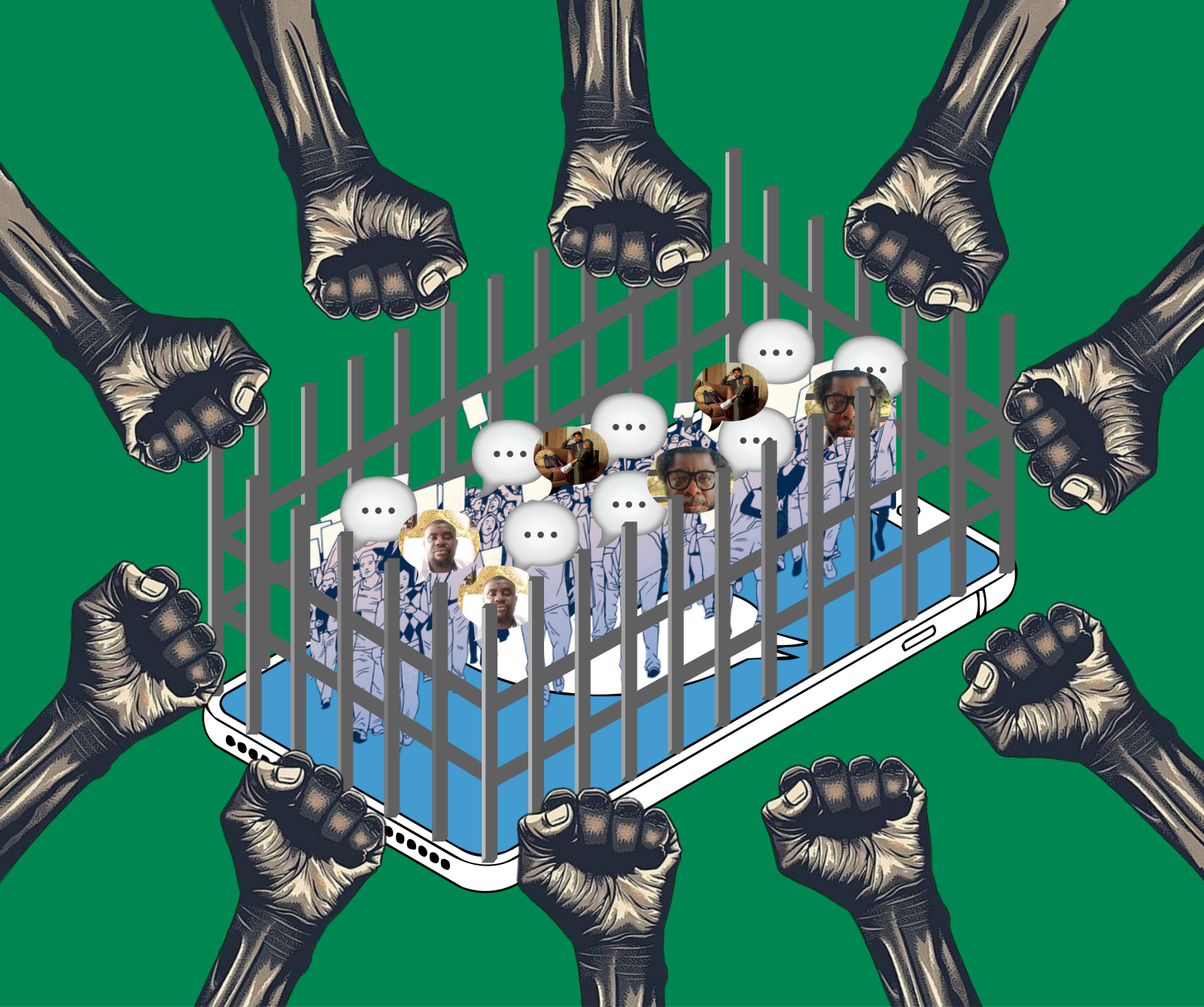
As Nigeria edges toward another election cycle, laws meant to curb crime are repurposed to police speech and expand surveillance. Design by Nirkhunan G K.
In the 1990s, the Special Anti-Robbery Squad (SARS) was created in Nigeria as a plainclothes tactical unit of the country’s police force to combat armed robbery, kidnapping, and other violent crimes. Operating with broad powers and little oversight, the squad soon became synonymous not with public safety but with torture, extortion, arbitrary arrests, and extrajudicial killings. It turned into an enduring symbol of unchecked police violence and impunity in the West African nation.
In October 2020, a video showing a SARS officer killing a young man in Nigeria went viral. Between October 5 and 14, the hashtag #EndSARS generated over 28 million tweets and 48 million mentions from nearly 5 million unique users, transforming the outrage into a mass national uprising against police brutality.
During the protests, activists like Kola Edokpayi used his social media to demand the release of a young man arrested by police and amplify calls shared under #EndSARS. The movement demanded justice and compensation for victims, independent panels to investigate abuses, and structural reform of Nigerian policing. In the protests’ aftermath, several states established judicial panels and announced billions in compensation, yet many victims remain unpaid years later. Repression has persisted since then despite protests, through arrests and stalled reforms, deepening public distrust in the police and state institutions.
Four years after the uprising, on September 12, 2024, five young men were killed in a fatal crash along the Warrake–Auchi road in Owan East, Edo State, allegedly involving the campaign convoy of the state’s then-governorship candidate (now governor). The incident sparked fear and anger among residents, but few dared to speak publicly. Edokpayi and his civil society group, Talakawa Parliament, used social media to name the victims, condemn the killings, and hold the campaign accountable. Till now, the families had not received any compensation, apology, or statement from the Edo State government. The story faded from major headlines after the elections, but has continued to reverberate through advocacy groups like Talakawa.
On April 28, 2025, Edokpayi announced plans for a solidarity rally to promote Pan-African unity and denounce neo-colonial interference, specifically urging former US President Donald Trump to stop intervening in Burkina Faso’s internal affairs. Ibrahim Traore, the military leader of Burkina Faso, had reportedly been facing coup attempts. The call for the rally also came on the heels of Niger, Mali, and Burkina Faso withdrawing from the Economic Community of West African States (ECOWAS) in January 2025; the 15-nation bloc has been accused of serving the interests of Western nations like France.
Within 24 hours of the rally’s announcement, Nigerian security agencies, who had been monitoring Edokpayi’s activity, moved in. Police armed with rifles and batons arrested Edokpayi, confiscated banners and flags, and detained him in a mosquito-infested cell crammed with other suspects, the activist said. After four days, they sought a court order to extend his detention. He finally spent a week in detention.
“It was a terrible experience, but it was also a sacrifice,” Edokpayi told The Polis Project. “My partners protested. It attracted international attention—some from France and Britain, others from several African countries, and then the United States. People called for my release. I eventually spent a week in the cell. But it was a sacrifice we had to face.”
Edokpayi’s long history of protest and his recent detention reflect a broader escalation: as President Bola Tinubu’s expected re-election bid in early 2027 approaches, his government has been systematically using laws, security agencies, and social media platforms to pressure and deter critics from mobilizing both online and offline.
Silencing Dissent Ahead of 2027 Elections
Rights groups have repeatedly raised alarms over the Cybercrimes (Prohibition, Prevention, etc.) Act 2015, which lies at the heart of the Nigerian state’s campaign of control. Amended in 2024, the Act’s Section 24 criminalizes “cyberstalking,” defined as knowingly transmitting false information that causes “annoyance” to others—punishable by up to three years in prison or a ₦7 million fine. Human rights lawyer Femi Falama said that despite the amendments, Nigerians continue to witness arrests, detentions, and prosecutions under the repealed version of the law, because security agencies still operate with a mindset that sees criticism as a threat rather than a democratic function.
The Socio-Economic Rights and Accountability Project (SERAP) challenged “the repressive use of the Cybercrimes (Amendment) Act 2024 to criminalize legitimate expression and violate the human rights of Nigerians, including activists, journalists, bloggers, and social media users.” In a March 25, 2022, ruling, the ECOWAS Court of Justice ordered Nigerian authorities to cease using Section 24 to prosecute individuals for allegedly insulting or stalking public officials online, declaring the provision “arbitrary, vague, and repressive.” The Court directed the government to repeal it in line with human rights obligations. Yet, the government has largely ignored the judgment, continuing to wield the Act as one of many tools to suppress dissent. According to Falama, it was due to a significant justice gap in Nigeria, where enforcement culture remained unchanged even when legal reforms occurred.
Pattern of Arrests for Online Speech
In August 2019, police arrested journalist Agba Jalingo for publishing an online report alleging corruption by a state governor. Charged with terrorism, treasonable felony, and cybercrime, he was held for days. Four months later, police arrested him again after he alleged a relative of the governor had cheated in an exam.
In May 2024, police detained Daniel Ojukwu, a journalist with the Foundation for Investigative Journalism, over an article exposing procurement fraud involving a government official. He was released after 10 days without charges. That same month, officers arrested staff at the International Centre for Investigative Reporting (ICIR) for alleged cybercrime. Alongside, they arrested popular TikTok content creator Olumide Ogunsanwo, known as Seaking, hours after he posted a video criticizing President Tinubu, Lagos Governor Babajide Sanwo-Olu, and Inspector General Kayode Egbetokun. Days later, activist Olamide Abiodun Thomas was detained over a Facebook post protesting tear gas at the fourth #EndSARS anniversary gathering, and accused of insulting the president’s son and Egbetokun.
In January 2025, police held activist and former presidential candidate Omoyele Sowore at Abuja’s Abattoir station after he posted a video accusing officers of extortion in Lagos—a month after criticizing Egbetokun for corruption. In September 2025, the Department of State Services (DSS) charged him under the 2024 Cybercrimes Act for anti-Tinubu posts; he spent a month in prison before release.
Administrative retaliation has also escalated. Since 2017, Sowore has been arrested at least eight different times by the Nigerian police or DSS. In March 2025, a National Youth Service Corps (NYSC) member, Ushie Uguamaye, faced certificate withholding and a two-month service extension after refusing to delete a TikTok criticizing Tinubu’s economic policies. In November 2025, security services arrested Innocent Onukwume in Port Harcourt for tweets calling for military overthrow, filing six charges against him.
Media Rights Agenda documented 141 attacks on journalists and citizens for online speech in Tinubu’s first two years; nearly half of them were by police and DSS under cybercrime pretexts. When the police announced 130 cybercrime arrests recently, activists flagged many as politically motivated. Lawyers across cases condemned the charges as human rights violations aimed at silencing dissent.
Nosa Tokunbor, director of the Climate Action Foundation in Benin City, Nigeria, sees a pattern in there. “Another attempt to harass activists,” he told The Polis Project. “We’ve been harassed even when our posts comply with Facebook’s guidelines. There’s ongoing surveillance, threats of arrest, and the use of cybercrime laws to silence us.”
Oluyemi Fasipe, an #EndSARS advocate, added: “Many faced surveillance, harassment, de-platforming simply for speaking out. Accountability goes both ways, but intimidation must never target young voices.”
Platform Pressure and Surveillance Expansion
The DSS has expanded monitoring via official social media channels launched in March 2023, while threatening a ban on X (formerly Twitter) in September 2025 over Sowore’s posts. Nigeria’s 222-day Twitter suspension (June 2021–January 2022) had already set a precedent.
In August 2025, authorities orchestrated the removal of 59 million pieces of content and the shutdown of 13.5 million accounts across TikTok, Facebook, Instagram, X, Google, and Microsoft. NITDA director Hadiza Umar cited the agency’s 2024 Compliance Report, which mandates the removal of “harmful” content within 48 hours. That month, DSS official B. Bamigboye demanded that Twitter remove Sowore’s tweet “disparaging” Tinubu, warning of “sweeping measures.”
Freedom House’s 2024 Freedom on the Net report has documented ongoing platform pressures in the country, declaring it “partly free”. It said, “During the coverage period [June 1, 2023 -May 31, 2024] a number of bloggers, journalists, and private citizens were arrested for their online activities, including for investigative reporting into corruption cases involving government officials, negative coverage of authorities or powerful businesspeople, or for violation of blasphemy laws in states under Sharia jurisdiction.” The report added that “Despite the amendment of Section 24 of the Cybercrimes Act in February 2024 (see C2), authorities continued to detain journalists using the previous, broadly defined version of the “cyberstalking” offense through the end of the coverage period.”
In recent years, surveillance and policing budgets in Nigeria have risen dramatically, signaling a shift toward technologically driven control of dissent. Federal security allocations climbed from ₦2.7 trillion in 2022 to ₦3.85 trillion in 2024, with a proposed ₦5.41 trillion for 2026—the highest ever under President Tinubu. Officials justify the increase as necessary for “intelligence-driven policing” and national security modernization. Yet, much of it has underwritten digital surveillance tools, the expansion of the DSS monitoring operations, and cybercrime task forces targeting online activists.
Since 2023, the DSS has launched real-time social media tracking systems, while police cyber units have dismantled thousands of domains and arrested hundreds under the Cybercrimes (Amendment) Act 2024. These funds have not demonstrably reduced insecurity; instead, they have supported repressive practices such as mass content takedowns, platform pressure, and politically motivated surveillance against opponents and arrests ahead of the 2027 elections.
Strategies of Adaptation in Nigeria
In this repressive climate, Nigerian activists have adapted to government harassment by turning social media into a tool for emancipation and rapid mobilization. “Social media is fast becoming a tool for the emancipation of the people,” said Edokpayi. “Many use it to promote good governance, to reduce the oppression going on in the country. Whatever I do, whatever I say, I upload them on social media. We shoot videos and upload them. Many of our members monitor us and are alerted when we’re arrested. When I was arrested by the DSS for my protest, our members all over the world used social media to canvas for my release.”
Activists have also adopted diaspora strategies and other tactics to counter crackdowns. In 2019, they protested the Protection from Internet Falsehood and Manipulation Bill, which would have allowed the government to cut internet access or block platforms at its discretion. One provision imposed three years imprisonment and fines up to 300,000 naira ($2,000) for offenders, in a country where about 50% of the population earns less than one dollar per day.
Eighty-five thousand people signed an online petition against the bill. Amnesty International and Human Rights Watch condemned it, alarmed by its possible effects on public discourse in Nigeria, which then had an estimated 123 million internet users, 30 million of whom were active on social media.
The crackdown on critics, activists, and journalists, as noted by Human Rights Watch in 2024, has only intensified, undermining freedom of expression. As Nigeria edges toward another election cycle, the emerging pattern suggests a steady recalibration of power, in which laws meant to curb crime are repurposed to police speech and expand surveillance. For activists like Edokpayi and many others, the lesson is stark: in Tinubu’s Nigeria, the battle over digital speech has become a defining front in the struggle for true democracy and political freedom itself.