A new architecture of information control is taking shape in India. Its arsenal is vast: a biometric database of over a billion people, a record number of internet shutdowns, and a prolific state-aligned troll-bot army.
The world's largest democracy is now a sophisticated laboratory for digital control, offering a template for regimes seeking to fuse the language of ‘development’ with the logic of domination.
We are witnessing a transition beyond democratic backsliding or an authoritarian drift. India has decisively entered the stage of fascist consolidation, defined by a clear doctrine: Hindutva as ethno-religious identity, Brahmanical culture as morality, and citizenship as loyalty to a Hindu nation.
This ideological capture of state power thrives on total information control. The mainstream media forged by its state-corporate nexus is the regime’s propaganda arm. It works to narrow the spectrum of legitimate debate, ensuring only state-sanctioned, majoritarian voices can circulate. Personality cults replace accountability, communal scapegoating diverts anger from policy failures, and “anti-national” labels are weaponised to manufacture consent for the criminalisation of dissent.
However, power is not a system of domination that controls everything and leaves no room for freedom, as Michel Foucault has observed. In all relations of power lies the possibility of resistance, as this report will illustrate. From these margins, gaps, and fractures emerges an assemblage of media practices, platforms, people ,and collectives which defy fascistic consolidation; an insurgent media.
Historically, radical media proliferated through underground presses, pirate radio, people's theatre (nukkad natak), and revolutionary music (lokgeet). Insurgent media extends this lineage into the digital, voicing dissent through memes, satire, audiovisual storytelling, and local community testimonies. These articulations challenge State disinformation and propaganda not by imitating the mainstream and corporate-run media networks, but by inventing radically different modes of circulation, verification, and communication, ultimately forging plural publics that resist the homogenising nationalism advanced by the Bharatiya Janata Party (BJP).
Unlike “alternative media,” which may operate parallel to the mainstream, insurgent media is fundamentally forged in antagonism. It refuses to seek legitimacy from institutional authority, actively destabilising the mainstream's fantasy of being society's symbolic core. Instead, it redistributes narrative authority to those systematically excluded – Dalit reporters, Kashmiri journalists, and vernacular chroniclers of caste and communal violence –thereby, challenging the state’s narrative control over ideas and visiblilising the discursive practices of exclusion.
This report maps the insurgent media ecosystem as a critical front in the defence of democracy in India. We study how ordinary people struggle against the hegemonic control of information, hybridising radical traditions with digital narrative tools to forge a new praxis. By analysing insurgent media actors, their relation to State and Capital, and their strategies of resilience, we identify their most effective tactics, evaluate their potential for replication, and offer a blueprint for cross-border solidarity against the global rise of fascism.
01
Timeline
The fall of legacy media in India was not a gradual erosion in journalistic ethics, but an engineered capture of information dissemination. Consolidated ownership, ideological co-option, and weaponised regulation reprogrammed the fourth estate from watchdog to lapdog, aka, the infamous ‘Godi media.’
The following timeline traces this systemic capture of mainstream media and the parallel rise of its insurgent counterpart.
This timeline traces this systemic capture and the parallel rise of its insurgent counterpart.
The consolidation unfolded in five distinct phases (2011–2024), summarised below. Each marks a deepening of control and a corresponding evolution in resistance.
On 5 April 2011, social activist Anna Hazare went on hunger strike, signalling the start of the ‘India Against Corruption’ (IAC) movement. A group of activists that came to be styled by the media as ‘Team Anna’ demanded the enactment of an anti-corruption law, the Jan Lokpal Bill. The protest attracted national attention, tapping into public anger over a series of high-profile scandals (like the 2G scam and Commonwealth Games scam). The movement’s origins and links to RSS think-tanks have since proven suspicious. Former IAC members have alleged that it was covertly orchestrated by the BJP, and its ideological parent, the Rashtriya Swayamsevak Sangh (RSS).
At the time, mainstream media began amplifying a “Congress = Corruption” narrative, going beyond holding power accountable. Television debates increasingly privileged spectacle over scrutiny. Congress leader Rahul Gandhi’s public image was systematically dismantled from a “youthful leader” to an incompetent “pappu,” establishing a template for personality-driven ridicule politics. The media ecosystem was primed for populist takeover.
In the 2014 Lok Sabha elections, the BJP secured an absolute majority with 282 seats out of 543. The victory was powered by a strong anti-incumbency sentiment (the “corrupt and incompetent” old guard) and the championing of Narendra Modi's ‘Gujarat model’ of development, to promise a new era of "Acche Din" (Good Days).
The BJP's electoral victory was swiftly followed by a taming of mainstream media through ideological and economic capture.
Legacy newsrooms were systematically reorganised. Senior editors perceived as loyal to a liberal ideology were replaced by a new generation of journalists, who were required to demonstrate overt fealty to Prime Minister Narendra Modi and the BJP.
In December 2015, Reliance Industries announced the launch of Jio telecommunications, which initially offered 4GB of free data usage per day. Six months after commercial launch, India had become the top mobile data user in the world.
As public attention rapidly shifted to digital platforms, TV news grew significantly dependent on government advertising revenue. In 2014-15, Rs 470.39 crore was spent in advertising through electronic media. In 2015-16, this rose to Rs 541.99 crore. This economy of dependency created a perverse incentive: news shows now competed for governmental favor, which was directly exchanged for advertising contracts, business favors, and regulatory protection.
The Insurgent Seed: This period saw the emergence of a founding wave of English-first digital outlets such as The Wire (est. 2015), Scroll (est. 2015), and Maktoob Media (est. 2014) coming up in metropolitan hubs. Building on the groundwork of early digital outlets like NewsClick (est. 2009), these entities were motivated to fill the investigative vacuum left by the tamed mainstream. Many employed senior journalists who had been ousted from legacy newsrooms over ideological differences. Crucially, they pioneered reader-supported revenue models to safeguard editorial autonomy from both corporate and state influence.
On 8 November 2016, to “break the grip of corruption and black money,” the Prime Minister abruptly announced the immediate demonetisation of all ₹500 and ₹1,000 banknotes and the issuance of new ₹500 and ₹2000 banknotes in exchange.
Mainstream media hailed the overnight policy as a ‘masterstroke,’ with some anchors propagating the fantastical claim that the new notes would come embedded with “nano GPS chips,” making them impossible to hide. Misinformation ran rampant. This narrative directly conflicted with the lived reality of the people, who were dropped into chaos – scrambling to exchange or deposit invalid currency amongst cash shortages and long ATM queues, leading to over 100 reported deaths.
In 2016, veteran broadcast journalist Ravish Kumar also coined the term ‘Godi media’ for complicit outlets, including Times Now, Zee News, Aaj Tak, News18, ABP, Republic Tv, and Sudharshan News. In the year of demonetisation (2016-17), the central government’s expenditure on advertising through electronic media was Rs 613.78 crore.
A New Demand: This chasm between media reporting and public experience created the first significant rupture in trust, seeding widespread suspicion and disillusionment. A questioning, restless audience created a market demand for an alternative source of news.
A nascent digital vanguard began to emerge. The SaveTheInternet campaign (2015) had already mobilised a generation of young users to defend net neutrality, establishing the internet as a new political battleground. Subsequently, as fake news proliferated online, fact-checking organisations like Alt News (est. 2017) emerged as essential correctives to a polluted information environment. On YouTube, a new breed of creators, including Dhruv Rathee (est. 2014), The Deshbhakt (est. 2017), and Soch by Mohak Mangal (est. 2017), began producing audio-visual political explainers as an alternative to TV news. Parallelly, marginalised groups began using low-cost digital platforms to bypass upper-caste, corporate media gatekeepers; Dalit Camera (est. 2011) was followed by collectives like Neelam Social (est. 2017) and accounts like Dalit Voice (est. 2018), while vernacular artists like Bhojpuri folk-singer Neha Singh Rahore (est. 2018) began recording and uploading their work on social media.
While not yet a cohesive ecosystem, the outlines of an insurgent media were taking shape through an archipelago of Twitter threads, YouTube channels, and independent websites. However, its reach remained limited as it struggled to survive against a rapidly consolidating, state-aligned television behemoth and aggressive, organised online harassment campaigns that targeted dissenting voices with coordinated trolling, abuse, and threats.
In May 2019, the BJP returned to power in a landslide victory, winning 303 seats out of 543. This victory was powered by a strong national security mandate (capitalising on recent terror attacks at Pulwama and Balakot) and Modi's strongman cult of personality. The Congress was decimated to a mere 52 seats, failing to win the 10% of seats required to claim the post of Leader of the Opposition.
In the 2019-20 fiscal year, the central government spent nearly ₹2 crore (US $270,000 in 2023) on advertisements per day. Of a total expenditure of ₹713.20 crore, ₹317.05 crore was given to electronic media.
On 5 August 2019, the Government of India revoked the special constitutional status of Jammu and Kashmir under Article 370 and thereafter ordered a total communication blackout in the valley, shutting down cable TV, landlines, cellphones and the Internet. This instituted the longest internet shutdown ever recorded, lasting 552 consecutive days.
On 9 November 2019, the Supreme Court ordered the disputed 2.77-acre land in Ayodhya, the site of the Babri Masjid, which was violently demolished by a Hindutva mob in 1992, to be handed over to the government for the creation of the Ram Janmabhoomi temple. Mainstream media systematically altered the public narrative. It diminished the history of the mosque's demolition, recasting the issue as a ‘matter of faith.’ This phrase legitimised manufactured claims and fake discoveries as divine miracles, critically influencing the judicial outcome.
On 12 December 2019, the government enacted the Citizenship Amendment Act (CAA), which established a religious basis for citizenship. This sparked a mass movement led by Muslims, students, and women – the first major popular challenge to the BJP since it came to power in 2014. On 15 December, Delhi Police forcefully entered Jamia Millia Islamia university during a confrontation with student protesters. The same day, hundreds of women began a non-violent, 24/7 blockade (chakka jam) at Shaheen Bagh in Delhi. Mainstream media, especially broadcast and Hindi newspapers, systematically portrayed peaceful protestors as violent, misled, disruptive, dangerous, anti-national and linked to terrorism. Even after 20 Muslims were shot dead in Uttar Pradesh and videos of police brutality at the Jamia Milia Islamia library went viral, media reporting continued to amplify traffic obstruction and minor property damage to depict protesters as the primary cause of unrest.
On 23 February 2020, senior BJP leader Kapil Mishra issued an ultimatum for the forceful removal of protestors. Hours later, communal violence erupted in North-East Delhi, resulting in five days of riots that left 53 people dead (majority Muslim) and over 700 injured. Mainstream media again amplified the police’s narrative that the violence was the result of a conspiracy orchestrated by the protestors. This narrative crystallised around the targeted vilification of student activists like Umar Khalid and Sharjeel Imam as ‘India-hating terrorists.’ Outlets like Zee News played doctored video footage showing Khalid shouting the slogan “Bharat tere tukde honge” (India, you will break into pieces). This media gave rise to the phrase “tukde tukde gang”, which has since been consistently deployed by Hindutva groups and their television channels to vilify dissenters. In October 2020, Republic TV proprietor Arnab Goswami brought out the ‘Full Tukde Gang Files’ falsely naming Umar Khalid as the “mastermind of the Delhi violence” and holding him responsible for “every single thing that has gone wrong in the capital city since 2016.” The media trial manufactured consent for the imprisonment of 18 student leaders and activists including Khalid Saifi, Gulfisha Fatima, and Meeran Haider, under the draconian Unlawful Activities Prevention Act (UAPA). The police narrative and the prosecution’s argument followed the media’s footsteps in alleging a “larger conspiracy” to incite riots. Five years later, Umar Khalid and Sharjeel Imam remain in jail while their trial is yet to start.
On 25 March 2020, the nationwide lockdown in response to the COVID-19 pandemic and the Northeast Delhi riots brought the mass movement to an abrupt halt. Building on its 2016 playbook, the mainstream media protected Modi from any proper public scrutiny of his initial handling of the pandemic. He made repeated television appearances in which he said little of substance, instead calling for symbolic gestures of sound (bartan-bajao) and light (diya-jalao), and ordering armed forces to shower flowers on hospitals. Doting anchors swallowed this up as proof of decisive leadership, portraying Modi as the sole savior of the nation.
The media's diversionary tactics intensified with the "Corona Jihad" conspiracy theory. As the latest in a series of manufactured “jihads” (following “love jihad” and “population jihad”), this campaign of communal scapegoating accused Muslims of deliberately spreading the virus as a form of “bio-jihad.” Islamophobic hashtags and fabricated videos, falsely showing Muslim men intentionally coughing, sneezing, or spitting on Hindus, were widely circulated on social media and unquestioningly consumed by a large audience. This incendiary rhetoric incited calls for social and economic boycotts of Muslims and led to physical attacks on Muslim relief volunteers.
In August 2020, with the pandemic still raging, Modi presided over the groundbreaking ceremony for the Ram Temple in Ayodhya. A new religiosity entered the national reportage, as photographs of Modi prostrating before the Ram idol dominated front pages and television screens. The coverage marked a theocratic consolidation of Modi’s image, from political strongman into quasi-spiritual leader.
In September 2020, the government passed three farm laws. Farmers recognised that the new regulation would leave them at the mercy of private corporations. Unions organised massive protests in Punjab and Haryana demanding a legal guarantee for Minimum Support Prices (MSP). After two months, protesters began a Dilli Chalo (go to Delhi) march alongside a nationwide strike. Mainstream media responded with a systematic delegitimisation campaign, branding protestors as "Khalistanis," foreign agents, and paid demonstrators. The disinformation ecosystem peaked on Republic Day 2021, when media outlets falsely claimed farmers replaced the Indian tricolor on top of the Red Fort with a Khalistani flag.
In March 2021, as India's healthcare system collapsed during a devastating second wave of the pandemic, television channels gave prime-time slots for the promotion of snake oil as a cure for Covid. This stood in chilling contrast to the ground reality, as a desperate nation scrounged for oxygen and a mountain of corpses overwhelmed cremation grounds.
The Last Straw: Pandemic-reporting was the final breaking point for India’s mainstream media. During the lockdown, social media rapidly emerged as a parallel information infrastructure. Even as misinformation proliferated far and wide, counter-forces arose to combat the fake news, critique policy failures and expose official figures as bogus, coordinate blood donations and transport of oxygen cylinders, provide updates on hospital beds and corona safety measures, and laugh at the absurdity of state propaganda through satirical memes. The digital space became a civic lifeline, encouraging citizen journalists and content creators to communicate directly with a highly engaged audience and document ground realities that legacy media ignored.
The organic explosion of vernacular, creator-led digital resistance marked a decisive shift. The model was solidified by the farmers’ movement, where protesters boycotted mainstream reporters and built their own media infrastructure. Punjabi-first publications like Trolley Times and Instagram pages like Kisan Ekta Morcha offered real-time, ground-level counter-narratives, proving that insurgent media could out-report the mainstream. The credibility gap was now irreversible.
By 2022, mainstream media had become a saturated engine of propaganda, operating through a predictable playbook of hate and coercion. Key tactics include:
- Strategic Diversion: Ensuring damaging news never breaks, or if it does, that it is quickly drowned out by a new spectacle.
- Communal Scapegoating: Systematically blaming religious minorities, particularly Muslims, for social and economic problems to divert public anger from governance failures.
- The Personality Cult: Relentless cheerleading that frames every action by Narendra Modi as a "masterstroke," transforming the Prime Minister into an infallible strongman leader and ultimately a divine reincarnation.
- The “Vishwaguru” Narrative: Promoting an aspirational image of "New India" as a global leader to overshadow domestic criticism with unsubstantiated claims of international prestige.
- Scandal Over System: Focusing on individual scandals to avoid substantive reporting on systemic policy failures and institutional decay.
- Weaponised Labeling: Vilifying dissenters, activists, and journalists with tags like “anti-national,” “urban Naxal,” “jihadi,” and "tukde tukde gang" to delegitimise and sideline criticism (a phenomenon that began with the 2018 Bhima Koregaon arrests and peaked during the 2020 Delhi riots).
- Manufacturing Consent for Legal Harassment: Normalising the use of contentious laws like UAPA and selective deployment of agencies like the Enforcement Directorate and Central Bureau of Investigation (CBI) as tools to intimidate, silence, and imprison critics, human rights defenders, and political opposition.
According to an analysis of Directorate of Advertising and Visual Publicity (DAVP) data by the opposition party Trinamool Congress (TMC), government ad spending peaked in pre-election years: from ₹274.87 crore (2021-22) to ₹656.08 crore (2023-24). However, official reports contradict the numbers released under the RTI Act, raising questions about under-reporting or opaque classification of expenditures.
In the run-up to the 2024 general elections, mainstream media unabashedly promoted Modi’s personality cult. The trending slogan, “Ab ki baar 400 paar” (“this time, cross 400 seats”), was treated as a prophecy rather than a campaign rhetoric. Newsrooms framed Modi’s victory as a foregone conclusion, with interviewers instead asking about his plans for 2029. In one viral clip, Modi claimed he was “convinced he was sent by God,” since his energy could not come from “a biological body.” Such uncritical amplification of messianic self-mythologising transformed journalism into crowd management.
Meanwhile, the Congress-led opposition front of 28 parties (INDIA) boycotted talk shows hosted by 14 anchors, including Arnab Goswami, Amish Devgan, Shiv Aroor, and Sudhir Chaudhary, publicly branding them as faces of Godi Media. More strikingly, a powerful new front emerged online as a once-fragmented creator ecosystem began to coalesce around a shared counter-narrative (a strategic shift we will analyse in detail later).
On 5 June 2024, the Election Commission of India declared the Lok Sabha results. The BJP, having run an election campaign purely on the Hindutva plank(centered on the Ram Mandir inauguration, fear-mongering over Muslim ‘infiltrators,’ and Brahmanical Patriarchal ‘protectionist’ rhetoric), won 240 seats, and fell short of a majority. This compelled the party to form a coalition government under the National Democratic Alliance (NDA). The opposing INDIA alliance won 234 seats, with the Congress bagging 99 seats.
The aftermath was chaos. Exit pollsters cried on-air, stock markets crashed, and television anchors vacillated between disbelief and denial as they scrambled to explain the unexpected results.
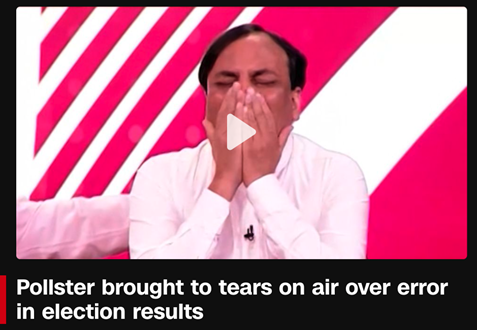
Source: CNN

Source: Newslaundry
Modi’s carefully crafted image of invincibility – the core myth behind his authority – was publicly repudiated at the ballot box. For the first time in a decade, the choreography of the propaganda machine faltered.
02
The Insurgent Media Ecosystem
In this section, we survey this new information terrain by studying a typology of insurgent actors, analysing their operational pathways, uncovering their radical roots, situating them in an enabling ecosystem, and distilling the core principles of an insurgent ethos.
2.1: Who are the Insurgents? A Typology of Resistance
The insurgent media ecosystem is a constellation of actors operating across scales, formats, and publics. To study this landscape, we mapped over 100 media projects, platforms, and collectives that demonstrate an antagonism toward hegemonic control of information.
We define insurgency in informational terms as an actor’s capacity to counter the State’s narrative control through independence from the state-corporate nexus. To determine whether an agent is an ‘insurgent,’ we consider:
- Relation to the State (Antagonism): An uncompromising critical voice against the ruling dispensation and state structures. This relationship is defined by constant suppression, primarily executed through algorithmic throttling (platform bans, content takedowns), legal mechanisms (FIRs, lawsuits, arrests, raids), and intimidation (organised trolling, targeted hate, physical intimidation).
- Relation to Capital (Autonomy): A principled refusal to accept funding from political parties or large corporations, which would compromise editorial independence. This dictates a state of financial precarity, forcing innovation through survival strategies like crowdfunding, diasporic solidarity, resource sharing, and lean or volunteer-driven operations.
Based on these criteria, we have mapped the key insurgent actors in the following database:
The landscape crystallises around five clusters of insurgent practice.
CLUSTER 01
English-first Digital Media
The English-language press in India has long upheld a professional ethic rooted in editorial independence and public accountability, a legacy dating back to the nationalist press and post-independence institutions like the Press Club of India. While this ethic has been corroded within today’s mainstream, it has found its most resilient guardians in a new wave of English-first digital outlets. Many senior journalists, ousted or disillusioned after the editorial reorganisation of 2014, now carry these standards into the newsrooms of The Wire, Scroll, Maktoob Media, Article 14, Reporters’ Collective, NewsClick, and AltNews.
Misinformation exists everywhere, but in India, it is not a glitch in the system – it is the system. The ruling BJP’s digital machinery, powered by an army of coordinated accounts and amplified by complicit media networks, has weaponised disinformation into a mode of governance. The average Indian media consumer is inundated with misinformation from the time they open the day’s paper to when they lie in bed scrolling on their smartphones at night. To navigate this without a guide is to lose all semblance of truth itself.
It was against this rising tide that two software engineers in Ahmedabad began building a levee. Back in 2014, during the nascent skirmishes of the information war, Pratik Sinha who ran the Facebook page ‘Truth of Gujarat’ (dissecting fake news in Gujarat) connected with Mohammad Zubair who operated ‘Unofficial: Submanium Swamy’ (a satirical meme page countering right-wing misinformation). In 2017, they started AltNews – a digital initiative dedicated to a radical act in post-truth India: debunking.
The team chronicles the right-wing “news” ecosystem and its coordinated cross-platform drops. Alt News’ sleuthing has led to the core of India’s misinformation factories, uncovering direct links between online posters, political parties, and capital networks. In the endless churn of misinformation, the newsroom isn’t fighting a single lie, it’s fighting the system that produces them.
The Propaganda Continuum and the Evolution of a Disinformation StateThe Sangh Parivar has long mastered the art of convincing fear-mongering, factual falsification, and orchestrated misinformation to further polarisation and hatred against minorities. Attendees of Rashtriya Swayamsevak Sangh (RSS) shakas recall that in the course of morning rituals, a “rumour of the day” would be discussed so that it can be disseminated in public places. Today, the emergence of BJP governments at the Center and in several States has ensured that mainstream media is completely dominated by those who share the RSS ideology.
In the early years of social media, misinformation was mostly a fragmented, opportunist hustle. The first inflection point was in the lead up to the 2014 Lok Sabha elections as an army of right-wing trolls descended on Twitter. Behind the scenes, professional consultancies were crafting Narendra Modi’s online persona and calibrating the party’s messaging with corporate precision. The 2016 launch of Reliance Jio, flooding the country with cheap data, brought hundreds of millions of first-time users online into an unregulated public square..By the time the public caught on to the coordinated nature of these digital operations, the propaganda machine was already in place.
“It is through social media that we have to form governments at the state and national levels. Keep making messages go viral. We are capable of delivering any message we want to the public, whether sweet or sour, true or fake.”
— Amit Shah, address to BJP social media volunteers, Kota, Rajasthan (2018)
The shakha’s rumour is now a clinically manufactured, strategically circulated commodity, flowing seamlessly from television broadcasts to political speeches to social-media timelines.
Anatomy of a Lie: The Three Pillars of the Disinformation MachineThe coordinated messaging, Pratik Sinha explains, rests on three components.
- Corporate consultancies: Since 2014, professional campaign firms pioneered by strategists like Prashant Kishor have been treating political communication as a full-scale industry. What started as Modi’s image management evolved into a lucrative business model replicated by every major party, with corporations paid crores to run Facebook and Instagram pages at the national, state, and district levels.
- IT Cell: While every major party now has one, the BJP’s Cell remains the largest and most disciplined. Contrary to popular belief, these are not loose collectives of ideological volunteers but a financially driven ecosystem of contractors. Funds flow through opaque tenders and welfare projects, which are then diverted to sustain networks of paid content creators.
- Political Influencers: The boundaries between propaganda and influencer marketing have collapsed. An account need not have millions of followers; even those with ten or twenty thousand can be enlisted to push political messaging for modest payments routed through informal channels.
“The story behind why disinformation, narrative building, and propaganda have become such a huge story of our lives, is a story of the capital that is flowing” says Sinha.
From Falsehood to Hatred: The Grammar of OtheringThe public conversation on misinformation in India often collapses into a single term: “fake news.” However, falsity comes in various degrees. For example, an outdated photograph used in a recent story may not be wholly false but contextually misleading. Disinformation, by contrast, signifies intent – the deliberate creation or circulation of falsehood with the purpose of deceiving.
The most severe of these gradations is hate speech. A substantial portion of India’s misinformation ecosystem is anti-Muslim in content and effect. It begins with selective coverage and deepens through layers of fabricated context designed to evoke fear or disgust. Over time, this produces what Sinha calls a “sophisticated hate machine,” capable of generating not just false belief but visceral hostility.
The success of this project is measured by its penetration into daily life. Sustained exposure has normalised hate as a mode of public expression. The lexicon of trolls has migrated into the mainstream. Code words like “fridge” and “suitcase” (macabre references to the ‘love jihad’ conspiracy theory) now circulate in comments sections as shorthand insults. This linguistic colonisation is the final stage of disinformation, when language itself becomes a vessel for contempt.
Countering the Machine: How Alt News Fights BackConfronting a disinformation ecosystem engineered for speed and scale requires systematic monitoring. At AltNews, the team maintains a database of social-media accounts known primarily for circulating falsehoods, scanning them daily for new trends. A dedicated WhatsApp helpline invites citizens to send images, videos, and messages for verification. Their mobile app extends this participatory model further – users can both access verified information and submit dubious content for review, helping decentralise the pursuit of truth.
Fact-checks start simple: reverse image search, geolocation tags, calls with subject experts. When tracing more complex networks, such as right-wing websites or anonymous propaganda pages, Sinha combines digital forensics with open-source investigation.
However, even the most efficient verification apparatus cannot keep pace with the velocity of lies. Every day, multiple trends go viral producing an untamable amount of content. A short form video can feature multiple unsourced photos, and a tweet can be screenshotted and circulated across platforms. “Moderation is failing across the world,” says Sinha. “Forget a small team like Alt News, even Facebook with 20,000 or 30,000 people in their ranks is not able to keep up.”
Instead of chasing volume, the team instead prioritises misinformation with the greatest reach, identifying keystone posts that anchor larger propaganda waves. “What we keep track of is the narratives. We look at how they are unfolding, the major pieces of misinformation which are influencing them, and zero in on those.” In this way, Alt News is able to shift from reactive correction to strategic containment, targeting the misinformation nodes most likely to influence public perception.
Platform-Government Collusion and the Politics of DataSocial-media platforms have built their business models on intimate surveillance – collecting granular information about what users read, share, like, or ignore to sell advertisements more efficiently. But this same data, Sinha warns, is political gold. Tailoring electoral propaganda follows the same mechanism and advertising a product; only here, the product is a vote.
This alignment of incentives has produced a quiet collusion between platforms and political power. The algorithms that prioritise outrage for profit have no qualms about amplifying disinformation for political gain. For the ruling party, these networks serve a dual function: propaganda infrastructure and intelligence apparatus. While platforms harvest behavioural data to monetise attention, the state leverages access to that data for electoral microtargeting and surveillance. Together, they form a feedback loop in which every click refines the tools of persuasion.
The risks extend beyond political manipulation to systemic surveillance. India’s Digital Personal Data Protection Act (DPDP), 2023, gives the government sweeping powers to demand access to user data under vaguely defined grounds of “national security” and “public order.” The law’s insistence that all Indian user data be stored domestically ostensibly promotes data sovereignty but, in effect, enables easier state access. Combined with telecom-level monitoring by giants like Jio and Airtel, this architecture grants the state near-total visibility into citizens’ digital lives.
Globally, similar battles over encryption and privacy are unfolding, from the EU’s proposed chat-control laws to the UK’s standoff with Apple over encrypted cloud storage. India’s case is distinct in one respect: the convergence of corporate data extraction, political propaganda, and state surveillance within a single ecosystem. In this collusion, the citizen is both the target and the commodity.
The Cost of Truth: Legal Harassment and Financial StrangulationAlt News operates under relentless scrutiny. Over the years, the organisation, especially co-founder Mohammed Zubair, has faced a steady barrage of legal intimidation: criminal FIRs, defamation suits, income-tax notices, and countless others. The cumulative effect is slow, bureaucratic exhaustion to drain time and resources.
In 2022, AltNews announced that Indian payments gateway Razorpay, which it used to receive donations, had shared donors’ data with New Delhi police. This came a month after Zubair was arrested for a 2018 tweet that allegedly hurt religious sentiments. However, the police had also begun investigating him for other charges, including receiving foreign funds under India’s Foreign Contribution (Regulation) Act, which restricts foreign donations to nonprofits. While Alt News’s funding is transparent – it has received a grant from The Independent and Public-Spirited Media Foundation (IPSMF), but staff salaries are largely paid through social media fundraisers – the message was chilling: even funding transparency could be weaponised to squeeze organisations dry. Exposing donor information, phone numbers, email addresses, and tax IDs, created a ripple of fear, aiming to sever the organisation’s financial lifelines.
An Uphill BattleWhen Alt News first began, the organisation briefly entertained the idea of working directly with social-media companies. Executives from Facebook would call, seeking advice on combating misinformation. But the team’s optimism quickly curdled into disillusionment as they realised the outreach was less about accountability and more about optics. Meta has been funding select fact-checking partners, creating an ecosystem of dependent organisations to neutralise critical commentators, who are unlikely to scrutinise the platform’s own complicity.
Alt News’ refusal to join Facebook’s third-party fact-checking network has left it in principled isolation. “We have not collaborated with other fact-checking organisations purely because they are all associated with Facebook and they are getting money from Facebook,” says Sinha. “And we think Facebook and Google are as much part of the problem as the people who are creating disinformation. So, you can't be taking money from people from platforms which have actually enabled the complete erosion of democracies around the world and say that we are going to fight misinformation.” However, solidarity has emerged organically. When individuals or organisations become targets of online defamation, the team intervenes to verify and expose the falsehoods. “We’ve had family members and people reach out just to say thank you,” Sinha notes, recalling how the outlet’s intervention countered a smear campaign against activist Sonam Wangchuk. These acts of mutual defence create a vital network of trust. The irony, Sinha observes, is that global platforms worth billions have effectively outsourced the Sisyphean task of maintaining informational integrity to a handful of small, underfunded newsrooms.
“25 years ago, a bunch of people in the US thought, ‘hey, let's connect the world, that will be a good idea’,” he reflects wryly. “That was the worst idea ever. Human societies have always developed as communities confined within each other. That very architecture has been demolished.”
In its place stands a disinformation state, and the small, stubborn fortress of truth-tellers trying to hold the line.
This legacy commits them to a practice of evidence-based investigation. Ground reporting is practiced not just by asking questions but by unearthing evidence – retrieving government documents, analysing data, and collecting community testimonies that reveal how authority operates. A commitment to uncovering the truth compels journalists to record statements from every side, ensuring officials and the accused are given a formal opportunity to respond. In a hostile media environment, disciplined adherence to fact-finding transforms professional rigour into a direct form of resistance.
“You can shake the government with a ₹10 RTI. When the public begins to understand that even though we are like ants, we can still question power... that our public servants work for us with our money…when a village can come together with 100 other villagers to question the Sub-Divisional Officer or Patwari without fear of losing his job, home, or life…that is where we find a good democracy.” – Nitin Sethi, Founder of The Reporters’ Collective
However, operating with this ethos invites systemic suppression that defines their insurgent status.
- Legal and Physical Suppression: Defamation laws are wielded not just to silence a story, but to cripple the journalist as the process itself becomes punishment. On the ground, reporters face direct violence, with police explicitly targeting them during protests or communal riots. This physical intimidation has become a normalised occupational hazard.
- Chronic Financial Precarity: Limited resources compel journalists to miss crucial stories or dig through their own savings to cover travel costs. Reporters live in constant survival mode. The situation is exacerbated by laws like the Foreign Contribution (Regulation) Act (FCRA), which effectively chokes off foreign grants. This precarity forces brutal editorial choices: with limited resources, reporters are forced to decide which essential stories to leave uncovered.
However, a significant operational hurdle for text-based news lies in audience engagement. Even among politically engaged feeds, ground-level reports struggle for visibility against a tide of derivative commentary. Journalists express a core frustration: their firsthand, evidence-based accounts are viewed less than the polished, second-hand opinions of influencers and YouTubers.
This visibility gap offers an opportunity for functional symbiosis. The detailed, evidence-based reporting from the first cluster becomes the foundational fuel for the second: The Digital Creator Network.
CLUSTER 02
The Digital Creator Network
This cluster operates in the realm of interpretation and amplification. It is populated by ordinary citizens, students, and working professionals who make political content online. Their approach varies - some use a direct, explanatory style to talk about current issues, others opt for a candid interview format, while short-form creators give regular updates on news highlights through Instagram Reels.
As audiences (across demographics, but especially younger) increasingly turn to social media to make sense of news, ‘political influencers’ have emerged as crucial mediators of information. These commentators, educators, and comedians cut through the noise of the news cycle, translating complex issues into accessible, conversational language. Political content, especially in audio-visual form, is known to have high recall value even among otherwise disinterested audiences. Unlike journalists who maintain an appearance of neutrality, digital creators are free to openly discuss their perspectives, shaping audience opinion through personal credibility and consistent engagement.
The 2024 general election, India's first ‘social media election,’ cemented the impact of political influencers. These creators successfully generated widespread cognitive dissonance with the official government narrative, puncturing its information monopoly and establishing a durable counter-narrative outside state control.
The movement was led by a vanguard of senior figures. Veteran journalist Ravish Kumar, who resigned from NDTV after the 2022 Adani-takeover, leveraged his credibility to launch an independent YouTube channel where he delivers forensic counter-narratives that soon became a primary news source for 10 million subscribers. In a parallel vein, senior journalist Paranjoy Guha Thakurta produced a viral music video ‘Saheb’ critiquing Modi's leadership, which was then translated into Assamese, Bengali, and Gujarati for greater reach.
The most prominent figure to emerge in the lead up to the elections was Germany-based influencer Dhruv Rathee. His viral video, “Is India becoming a Dictatorship?,” garnered over 24 million views before the election and was AI-translated into Tamil, Telugu, Kannada, Malayalam, and Bangla to meet demand. It became so influential that opposition party candidates began using it in their election campaigns to create awareness about the dangers of Modi returning to power. Akash Banerjee, host of The DeshBhakt, observed that “after the video, the term 'dictatorship' has popped up more in conversations. This is something that has never happened before.” Rathee then declared “#Mission100Crore to counter BJP IT cell propaganda, urging 10 million Indians to share his videos with 100 of WhatsApp contacts daily.
This was a landmark moment which dramatically spurred the already growing frequency and intensity of political content. On Instagram, The Ranting Gola, who describes herself as “fighting fascism ke jokers with comedy,” countered the diversionary communal tactics of the mainstream by urging her audience to focus on unemployment, rising prices, unaffordable healthcare, and burgeoning inequality. Dr Medusa, a linguistics professor, grew popular for her satirical series like the “NTPC Helpline” for Hindutva trolls and “Dukhdarshan,” a parody of government broadcast news.
On the internet, Madri Kakoti is ‘the Neighborhood Teacher’ - Dr Medusa. A linguistics professor hailing from Assam, she posts short-form videos marked by her trademark raised eyebrow, sardonic wit, and a punchline that lands where it hurts. Within hours, the reels are everywhere, shared across politically engaged feeds which are hungry for humour that still bites.
Behind the camera, what looks like effortless satire is an act of survival. Dr Medusa began creating during the COVID-19 lockdown, when the migrant worker crisis exposed the brutality of state neglect and the depth of collective helplessness. “I have always said that this is a very personal journey for me,” she says. “I do it so that I do not go mad.”
Transforming personal distress into political media has since become the foundation of her work. Her primary metric is not market success, but personal integrity. She refuses to monitor platform analytics or chase engagement. “I have always been very careful about not letting the number of people following or liking my videos influence me,” she says. “This is a very conscious decision for me, to not be a slave to the algorithm.”
This ethic of stubborn honesty is reflected in her content, and has shaped her relationship with the audience. “My pain, which I pour into a video, is shared by them. They feel heard, they feel seen.” Audience engagement is not about consumption but collaboration. “You want me to voice your opinion? You want me to talk about something which is happening to you? I will do that. That’s something which I honour. But the moment I start honouring somebody liking me or giving importance to the fact that somebody likes me, I will also be giving importance to the fact that someone doesn’t like me.” The connection she builds with her viewers rests on shared pain and the articulation of structural inequality, not metrics or parasocial intimacy.
From this emotional commons emerges her sharpest narrative tool: satire. “I have always thought of my sarcasm and my humour, first of all, as a shield for myself,” she explains. “I need to do a little bit of self-preservation. We have seen where direct approaches lead people, in this country.” This coded humour allows creators to speak safely, using inside jokes to signal dissent to those within the political in-group.
At the same time, satire is a powerful sword. As an individual creator without political connections or resource networks, laughter is wielded to wound authority and unsettle power. Humour becomes a way to mark aggressors as absurd, unworthy of fear, and embarrassing to associate with – ‘cringe’ (a tactic used by early feminist youtubers, using ridicule to push back against patriarchal ‘mens-rights’ groups). “A woman’s laughter is extremely uncomfortable for these people,” she observes. “You can be extremely powerful, very macho, wave all sorts of guns. But if I laugh at your face, that completely breaks the image you have tried so hard to create. I can laugh at them, and that hurts them.”
Medusa’s insurgency rests on a deliberate refusal to legitimise violent ideology. Her editorial policy is principled and unapologetic: fascism can not be debated, it must be destroyed. “I do not want to engage in a conversation with somebody who thinks that genocide is okay. There is no conversation to be had with the murderous mob.”
The refusal to engage with the state–corporate nexus leaves the insurgent media ecosystem in a state of chronic financial precarity. In Medusa’s case, her work is sustained by her day job as a salaried professor at a public university. This foundational security allows her to remain independent while upholding a zero-tolerance policy toward co-option.
“Political parties have approached me to push their narratives,” she says. “But I value the independence of my word and my content so much that I do not want to be dictated by anyone. That’s the reason I don’t take money from them.”
Unlike most digital creators, Medusa rarely participates in brand collaborations. When opportunities do arise, she subjects every offer to ideological vetting, rejecting companies with Zionist affiliations or links to the Gujarat lobby. The politically antagonistic nature of her work, she notes, functions as an automatic barrier to commercial co-option. “We don’t get paid collaborations anyway. No political commentator gets that,” she says, recalling an instance where a Saree company retracted an offer after actually watching her content.
Crowdfunding, she notes, is unreliable as a source of sustenance, and she has not needed to depend on it so far. But when the battleground shifts from content creation to legal survival, then the community becomes the only safety net. In May 2025, a police complaint was filed against her for videos posted after the Pahalgam terror attack. “My lawyer was expensive,” she recalls. “As a middle-class person, one case literally wipes out all of your savings.” At the time, fellow creator Meghnad (@meghnerds) stepped in. “Without even asking me, he put out an appeal to his followers. They contributed a lot to my Buy Me a Coffee account.”
The First Information Report (FIR) against Dr. Medusa was registered at Hasanganj police station, Uttar Pradesh, after a complaint by a leader of the Akhil Bharatiya Vidyarthi Parishad (the student-wing of the Rashtriya Swayamsevak Sangh) objected to her videos demanding government accountability for security failures and condemning against attacks on Kashmiri students in the aftermath of the terror attack. This was the first time her legal name was revealed in public.
“There was a lot of pressure because I have a sarkari (government) job,” she recalls. “The university also tried to send me a show cause notice. There were ABVP student protests.” The complaint was filed under various provisions of the Bharatiya Nyaya Sanhita, including sections 197(1) (assertions prejudicial to national integrity), 196(1)(a) (promoting enmity between groups), and 152 (sedition, or acts that endanger India's sovereignty, unity, and integrity) of the Bhartiya Nyay Sanhita, apart from Section 69-A (power of government to block online content) of the IT Act. Most of the charges have since been dropped; the chargesheet now retains only Sections 302 (hurting religious sentiments) and 352 (statements creating ill will).
She describes the case as a political time bomb – a dormant FIR kept alive to be revived at any convenient moment. “Right now, my thing is silent. But tomorrow if I say something which is not very pleasurable to hear by these people, they are going to bring it up again, call me a seditious person and put me in jail.” The threat, she adds, extends beyond individual harm. “Yeh aise sarkar hai aur aisa samay hai ki akele mere pe gaj nahi giregi (This is the kind of government and time where the blow will not fall on me alone). It’s entirely possible that my parents’ or in-laws’ house could be demolished by bulldozer. Who knows? They’ll attack my family. I’m scared not for myself, but for them.”
While state power operates through fear and legal harassment, digital platforms enable a quieter form of suppression. Online threats and hate speech have become routine for creators like Medusa. On Twitter (X), she has received multiple notifications that police have ordered the takedown of her posts. Yet, the final decision, she notes, usually rests with the platform itself. “If the pressure isn’t too much, or if the issue isn’t sensitive enough for the Home Ministry to send continuous reminders, then they don’t take action,” she says.
Youtube is a different story. Copyright strikes result in punitive takedowns - “they file a case, but don’t take it up for hearing,” she explains. “Until the hearing happens and there’s a resolution, your content doesn’t come back up.” The result is an indefinite freeze; content disappears not through stated censorship, but through bureaucratic inertia.
When asked whether this suppression, both by the state and the algorithm, leads her to self-censor, she shrugs it off. “If they want to come after me, they’ll come after me one way or the other,” she says. “So I might as well say what I want to say, right?”
However, she does practice strategic restraint, refraining from criticising the political opposition, even when justified. “I have to figure out the larger enemy. I cannot fight a battle on all fronts.” Self-censorship, then, is not capitulation but clarity: a deliberate decision to focus fire on the primary source of hegemonic control of information, the ruling government, rather than deploying limited resources against every opponent.
Exhaustion is a constant undercurrent. In moments of burnout, Medusa draws strength from the ecosystem around her - from fellow creators and audience support. In the months leading up to the 2024 general election, the creator ecosystem made itself impossible to ignore. A new generation of online satirists and political commentators began challenging state propaganda with humour and fact-checking at scale. “It all happened purely organically,” says Medusa. “We didn’t talk to each other or plan anything. Even when our topics overlapped, it just happened because all of us thought it was the right thing to do at that point of time.”
It was a moment of decentralised collective action; spontaneous coordination bound by shared intuition and political urgency. The conviction-driven surge dismantled the state’s narrative that dissent is foreign-funded or orchestrated by a ‘Naxal’ or ‘jihadi’ enemy. And the audiences recognised and responded: in the first half of 2024, Medusa’s reach expanded beyond her core followers, with reels circulating widely through cross-posts, reshares, and story amplifications.
The organic defiance did not escape the notice of the state. In the aftermath of the election, the government introduced the Broadcasting Regulation Bill, 2024, which will require YouTubers and Instagram creators who comment on politics or news to register with the Information and Broadcasting Ministry and operate under its discretion. The intent, Medusa says, is clear: “to make sure such a pushback does not happen again.”.
In an environment built to isolate and exhaust, solidarity becomes its own act of resistance. The insurgent media ecosystem is sustained by decentralised networks of care – creators and audiences who refuse to be silenced. “The fight is extremely long,” Medusa says, “and every single soldier on this side is extremely important.”
University of Michigan researchers Raghavan and Pal note that influencers are emerging as a channel for slow propaganda and brand building. They find that while influencers have a much smaller output than mainstream and digital news, which tend to produce a large amount of content daily, but “this output is heavily advertised and, on average, gets much more viewership.”
The creator ecosystem is not without its tensions. Raghavan and Pal also note a trend toward personality-driven content over policy or position discussions: “Influencers allow politicians to present an alternate image of themselves, without the baggage of formality, or the weight of policy conversation. By giving us a glimpse into the lives of politicians in casual settings, influencers can help humanise politicians, and in the same vein an interview with an influencer is also a point at which a politician can save him or herself the inconvenience of difficult questions that a professional journalist can ask.” This observation is exemplified by Samdish Bhatia, who is known for his quirky style and lighthearted interviews, which make hard-to-access political figures feel relatable. His unique way of making power feel deflated makes his videos go extremely viral, but also exposes the tension between palatability and accountability – creating space for a more unapologetically critical voice.
CLUSTER 03
Comedians and Satirists
In a post-truth society where the very existence of facts is constantly doubted, insurgent voices must change tactics. For a growing audience, the meme has become a primary vehicle of information, and political satire by comedians has supplanted traditional news portals as a trusted source of perspective. When reality turns bizarre, laughter is the only response which can shatter the climate of fear.
Satire operates on a unique logic that makes it a potent form of dissent. It functions as a shield, leveraging irony and absurdity to create content that is difficult to censor, regulate, or legally retaliate against. This coded humor allows creators to speak safely, using inside jokes to signal dissent to a knowing in-group. Simultaneously, it acts as a sword. By marking aggressors as absurd and unworthy of fear, laughter dismantles the macho, powerful images that authoritarian figures cultivate. Ridicule, a tactic famously used by early feminist YouTubers against patriarchal ‘men’s rights’ groups, becomes a way to wound authority and unsettle power, confining it to the realm of the ‘cringe.’
Comedy, memes, and satire are also strategic hooks. The comedic artform packages politics into an instantaneously consumable format – a joke – to capture scrolling audiences. This initial laugh becomes a gateway to draw people into a broader sphere of counter-propaganda that might otherwise seem too radical or dense. In a fractured environment, a well-aimed joke can reach a common denominator - creating a moment where a diverse audience can collectively laugh at a shared absurdity.
SavalaVada is India's Most Honest News Source, printed in the fictional land of Mavelinadu. This is its first joke.
“In a post-truth society, we must change tactics on reporting the truth,” says J, the anonymous creator behind the account. “We don’t have static facts anymore. People care about the emotions attached to the story. What satire does is it banks on that emotional perspective. The irony, the humor, the exaggeration.”
The satirical meme page amassed over 80,000 followers on Instagram by employing sardonic, dark humour to dissect contemporary news and politics. Its primary medium is the ‘meme,’ a form of information originally defined as a “unit of cultural transmission.” A meme is an idea or belief that spreads from one organism to another through self-replication or ‘imitation’ (‘mimema’ in Greek). Its propagation is analogous to that of a biological gene, as memes also undergo a type of natural selection which determines survival. On the internet, memetic communication is the dominant form of information-exchange, with as much subtlety and diversity as a ‘proper’ language.
The Memer’s ArsenalSavalaVada’s memetic practice mimics the front page of a newspaper. Each post features a large headline and an image, usually referencing current events and online discourse.
Their tone is irreverent and dissentious, taking pot shots at political parties, governments, the judiciary, the rich, and the Savarna (upper caste) elite. One of their most popular posts responded to the inauguration of the Ram Mandir at the site of the demolished Babri Masjid: “Remains of Indian Constitution Beneath Ram Mandir: ASI Survey.” Another, following the death of industrialist Ratan Tata, read: “Tata Bye Bye: Humble Billionaire passes away in a country where 60% live under Rs 260 a day” and “Ratan Tata passes due to natural causes, unlike his workers.”
Satire is a strategic rhetoric choice. By cloaking a joke in the authoritative format of a newspaper headline, SavalaVada creates a potent, difficult-to-censor critique. “The government can jail a journalist by saying what they're reporting is wrong, because the State controls the narrative and decides what is true,” says J. “But it’s very hard for the government to control what you can laugh at.”
India’s comedy landscape emerged from an engagement with topics traditionally considered off-limits – politics, religion, caste, sexual norms, hypocrisy. Today, stand-up comedians often uphold an uncritically libertarian stance where offensiveness is the primary measure of comedic worth and mistaken for truth-telling. This has basically revived ‘Uncle humour’ (the tradition of uncles assembling in the evenings to complain about their wives, make non-veg jokes, and ridicule Pakistan) recycling tired casteist, sexist, and Islamophobic jokes under the guise of ‘dark humour.’ On the internet, pages like The Bindu Times (“India’s most trusted Satire News Source”) amplifies these clichéd forms of humour which self-identifying as ‘edgy.’
“Satire is being used by the right wing, but they use it to punch down. What they stand for is just bad, bad humor. It's the friend in the group who tells a joke that isn't funny, but if everyone else laughs then they think it's normal humor,” says J.
SavalaVada did not want to simply participate in this environment, but to reclaim it. “We felt that if the genre of satire exists, somebody has to step up,” J explains. Their work is a direct challenge to the right's monopoly on “darkness” of humour: what happens when the sardonic glare is turned upward at billionaires, political elites, and the systems that shield them? Cheap provocation and uncritical laughter over normalised oppression becomes genuinely funny: not a mechanical chuckle of complicity, but a sharp laugh of reflection and revelation.
Virality and VulnerabilityFor younger generations coming online, there is simply an overload of information so immersive and vast, that people don’t have time to take it all in. In this economy of attention, SavalaVada’s format allows them to cut through the noise and distill complex concepts.
“The specific platform we use has been key,” says J. “If SavalaVada had started off on WordPress or Reddit, I don't think it would have taken off. Twitter is too hateful, Facebook is dead. Instagram, then, becomes a very unique space - it has the right demography and an English-language audience that transcends linguistic barriers. The other thing is the Stories feature – that works as a big pyramid scheme to reach newer audiences.”
Instagram is their primary hub and content repository. From there, posts were organically cross-posted - screenshotted for Twitter, going viral on Reddit, even appearing on Facebook.But for all its accessibility, influence, and virality, Instagram remains a rented stage where the lights can go off without warning. On June 20, 2025, SavalaVada’s Instagram page was blocked in India.

Instagram says the geo-block was a result of a legal request which was reviewed against its own policies and found to go against local laws. While the posts are still up, they’re now only accessible to diaspora.
 Source: MediaNama
“We had been predicting this from the start,” says J. “When the ban happened, we were shaken, but deep down we knew that these platforms are subservient to the State. A company would not sacrifice a billion-person customer base to protect one person; the economics doesn't add up.”
The geo-block is the most severe on a spectrum of platform-enforced censorship. Before the ban, Savala had experienced shadow-banning. “We had 85,000 followers, but the view count on our stories would stick exactly at 1000, which seems suspicious,” J reports.
Stories about Palestine were automatically taken down, likely by AI detection, citing Meta’s policy against ‘Dangerous Organizations and Individuals.’ “This is the FBI's list of terrorist organisations,” J says. “India has not designated Hamas a terrorist group, but because Meta is based in the U.S., it follows the FBI list by default. So this sort of censorship is ultimately dictated by imperial Western interests.”
If not automatic detection, there is pressure from the Indian State. Posts about Kashmiri independence or the genocide of Adivasis under the tag of “Naxals” were taken down under the general label of depicting or promoting violence. “If they get a call from the government, they'll fall in line - it’s a billion-person market,” says J.
Meta’s content restrictions and community guidelines operate as a kind of ‘digital prison,’ with a system of escalating punishments that keeps creators in line. It doesn’t just censor, it disciplines. Minor infractions trigger temporary suspensions (like a two-week ban on liking posts or a 14-day restriction on going live); repeat offences or politically sensitive content can lead to shadow-banning, geo-blocking, or outright deletion.
The effect is quietly carceral. Content creators are trained to self-censor, internalising the boundaries of acceptable speech long before a post is ever removed. When I asked J how they negotiated with self-censorship, the response was unambiguous. “Editorially, we really didn't give a fuck.”
This uncompromising defiance was enabled by the nature of satire, which becomes a method to reclaim narrative autonomy and build a shared lexicon. A journalist might write, 'This is an occupation,' and get taken down. But Savala would say, 'Kashmir, which is definitely not an occupied territory…' Irony allows the speaker to name the unnameable, using exaggeration and mockery to create a coded language for their audience.
Recent years have exposed how language used by media outlets, down to seemingly innocuous decisions like active versus passive voice, can downplay and normalise a literal genocide. In this context, creating a shared lexicon becomes a necessary infrastructure for Insurgent media - and satire is a crucial tool to deliberately subvert the State’s own propaganda. Savala, for example, frequently deploys terms like “our emperor,” “Bharat,” or “the regime” with heavy sarcasm, while popularising mocking neologisms like “Sanghi.” This counter-lexicon forges a community (an "inside joke”) and a resilient space for dissent insulated from the coercive semantics of state and platform.
Digital Resilience and Pipeline Creation“The main thing about digital resistance is this: if you have an audience, do you have access to your audience?” says J. “Meta took away our ability to reach 84,000 people out of 85,000. We can't send out our message anymore.”
Digital resilience begins with strategising access and means of circulation. This means building a multi-platform pipeline that is both a defensive measure against deplatforming and an offensive strategy to nurture political consciousness. “You need to reach people where they are, but also get people to come to where you are,” J explains.
The first step is to meet the audience where they are: scrolling. “Hit them with satire, irony, and a joke, you reach a common denominator where everyone can agree on laughing at this one thing.” SavalaVada’s format (a self-replicating newspaper styled with big text on top, the logo, the eye-catching headline, and an image) is a great example of something instantly consumable. “It’s sad that we have to do this to get people’s attention, but it's always the hook. That’s a monumental step, to get them all in one place.” explains J.
Once hooked, the audience is guided into deeper engagement through comments, reshares, and conversation. SavalaVada would repost their memes alongside ground reports and explainers on their Instagram story. “The crux is, we cannot expect everyone to follow [the complete story]. To expect that everyone has the time and resources and space to commit to all of this on the same level as we do is very optimistic.”
In the final phase, the core, engaged audience is slowly guided into closed communities like dedicated websites, backup archives, and secondary platforms like Discord, Telegram, or Whatsapp. “You need to have a presence across as many spaces as you can, but also finally retreat to your own space,” J advises. The idea is to retreat from algorithmic chaos and create spaces for more nuanced discussion, community-based learning, and political consciousness-raising. Gradual education, which is not overly intimidating or overwhelming, can transform casual but interested followers into engaged and active community participants who share verified information within their networks, contribute to crowdfunding and mutual aid, and report on local stories.
Financing: Precarity and the Climate of FearSavalaVada started as an Instagram page run by a group of college students. It is not a resource-intensive operation, but as the audience expanded, questions of monetisation began cropping up.
“I never liked paywalls. They are really fucked up, because they just put up another barrier to information,” says J. Coupled with a similarly principled rejection of ads and paid sponsorships, that left crowdfunding - unreliable and difficult to sustain.
“I'm also concerned about linking banks,” says J. “I had to do it through a proxy organization, but ultimately it leads to my bank account. If the government decided, they could just find out every single detail about me. Everything has a paper trail.”
Their fear is rooted in the state’s known tactics of harassment through weaponisation of laws like the FCRA. “Anything can be made to be anything,” says J. “The government just goes and says: you're getting foreign funds from George Soros to run this protest. It becomes a hyperbole, and any funds become an incentive: you're getting paid to do this, you're getting paid to dissent.”
Looking ahead, the team is considering a pay-as-you-like subscription model or planning SavalaVada merchandise.
Anonymity as a Foundational CloakAnonymity is the cornerstone for a memer like Savala Vada. “It gives you control over yourself in an online ecosystem. Without that, you would be defenceless,” says J. “Especially because the other side is very cloaked. Right-wing incel accounts are all anonymous.”
This need is multi-layered. The primary threat is state surveillance. The second is doxing and repercussions on academic or professional lives.
While a public face can lend credibility, it comes at the cost of expressive freedom. “That is where pages like us can step in. We need a bit of both.”
Significantly, anonymity functions as a strategic equaliser. “For marginalized individuals, oppressed populations, and political dissidents to be able to say what you want without backlash, you need to be anonymous,” J explains. Anonymity sheds identity and recenters the voice. A fixed identity comes with a fixed performance (for instance, an added burden on women or queer folks to explain their position), which encourages the audience to think ‘they’re saying X because they are Y.’
Anonymity blurs the boundaries of identity. “Because there’s no particular identity to latch on to, people get confused. They don’t know whether to call you a jihadi or a ricebag, a sudapi or a congi. This lets you transcend these labels in a way that it becomes harder to delegitimise your message,” says J. The amorphous persona becomes a tactic of survival and reach; its fluidity enables constant reinvention, ensuring that the message circulates faster than the identity that carries it.
“The jester or the clown has a costume for a reason. The clown is a clown. The moment we put a face and identity, everything that you do or say is directly linked to you. Why is that necessary at all times?”
The Way Forward: Collective ResilienceFor SavalaVada, insurgent resilience ultimately lies in building a broad, pluralistic coalition.
“We have an insane job ahead of us because never before has there been such a diverse amount of people in such a diverse area having access to information. There will always be differences. We need at least to be united on one front. We can agree that our systems are fucked. We can agree that you shouldn't hate someone because of their religion. Having that sort of common ideals of equality, of democracy, of secularism. There is safety in numbers.”
“You cannot have a one size fits all approach. That's the main fault that the propagandists don't realize, because their entire narrative is a one size fits all approach. It's one nation, one election, one code, one religion. They want to homogenize society.”
Once you get that collective identity, you can push the barrier of what you're able to do. You also have this support system to protect yourself because you're not approaching it individually, but also you have a backup along with you. You have other media outlets and creators coming together. My strategy is kind of just like, people should just be there for each other.”
Operating in the realm of the provocative and the obscene, satire pushes the boundaries of permissibility. This has made comedic speech a frequent target over the last decade, with figures like Varun Grover, Daniel Fernandes, and Manjeet Sarkar facing threats, police complaints, and violent intimidation. The career of stand-up comedian Kunal Kamra stands as the most extensive catalog of this multi-pronged suppression:
- Airline Ban: After a 2020 in-flight confrontation with news anchor Arnab Goswami went viral, Kamra was banned from multiple airlines. Critically, India's aviation minister publicly urged other airlines to “set an example,” demonstrating state-backed pressure on private companies to punish dissent.
- Cancelled shows: In 2022, his shows were cancelled in Gurgaon due to threats from the Vishva Hindu Parishad (VHP) and Bajrang Dal. In response, Kamra challenged VHP to condemn Mahatma Gandhi's assassin Nathuram Godse.
- Legal Harassment: Kamra faces ongoing contempt of court cases for tweets criticising the Supreme Court, reflecting the judiciary's use of legal machinery to silence criticism. Kamra refused to apologise, saying that he continued to believe that “the silence of the Supreme Court of India on matters of other's personal liberty cannot go uncriticised.” He asked that the time allotted for hearing his contempt case should instead be spent on more important cases pending before the court.
- Physical Violence: In a show made available on YouTube in March 2025, Kamra made a parody song directed towards Maharashtra Deputy Chief Minister, Eknath Shinde. Hours after the video was posted on YouTube, Shinde-led Shiv Sena workers vandalised the Habitat comedy club (where the show had been filmed two months prior). Twelve vandals were arrested and granted bail on the same day. A First information report (FIR) was filed against Kamra by Shinde led Shiv Sena MLA Murji Patel for defamation and statements conducive to public mischief, following which Patel issued a two-day ultimatum demanding an apology. Kamra refused and was eventually summoned by Greater Mumbai Police for questioning.
- Corporate Censorship: The ticketing monopoly BookMyShow removed Kamra's shows following political pressure, illustrating how private market dominance can be leveraged for political censorship.
The multi-pronged assault against individual artists and comedians illustrates the vulnerabilities of metropolitan, personality-driven dissent. This creates a strategic imperative for a different model, a press that is dispersed, networked, and operates at the grassroots.
CLUSTER 04
Hyperlocal Media
The heart of insurgent journalism is the hyperlocal press – media that emerges from within the communities it serves. In contrast to the elite distance of metropolitan newsrooms, these platforms operate in intimate proximity to the lives they document and uncover stories that the national media systematically ignores. Seasoned journalist P. Sainath observes that the current generation in urban India is a foreigner in its own country as its connection with rural India has been badly eroded. “The average national daily in India gives 0.67 per cent of its front page space to rural India, for 69% of population,” he notes.
Sainath is the founder of the People’s Archive of Rural India (PARI), which operates as a “living, breathing archive” of India’s villages. PARI also hosts a free online library with a growing collection of reports, surveys and other material relevant to understanding and contextualising rural India. PARI’s stories are translated into over ten Indian languages by a network of volunteers.
If PARI constructs a national memory of rural India, Khabar Lahariya transforms that memory into grassroots assertion. Founded by Dalit women in Bundelkhand, the newsroom is powered by rural women reporters who write and film in Bundeli and Awadhi. These languages have rich oral traditions, but are often dismissed as mere ‘dialects’ of the superior Hindi, spoken by ‘dehatis’ (unsophisticated or village people). Their linguistic choice is deliberate and political, as the refusal to conform restores dignity to local expression. As one editor noted, “communicating through poetry in Bundeli comes naturally to the rural women in the Bundelkhand region. They could write anything in poetic meter – a news item, a personal experience, even a report of an accident. Some Bundeli words are so integral that to substitute them with Hindi words would have made the entire article strangely alien and impersonal.” Using local languages to report directly on issues of caste, land, and gender resists the homogenising “One Nation, One Language” propaganda of the State.
Most hyperlocal media serve local audiences or migrants from the community. The credibility of hyperlocal reporting stems from its journalists being embedded within the communities they document. This rootedness signals authentic, ground-up reporting that is highly trustworthy. This connection to the community also transforms the relationship with the audience from a passive viewership into an active partnership: the Seemanchal-based platform Main Media has systematized this through this through WhatsApp groups with over 10,000 contacts, where locals constantly share information and recordings, turning the public into a distributed news-gathering network.
In the Bihar far away from Patna and the Bengal far away from Kolkata lies a peripheral stretch where communities, castes, and frontiers blur. Every few years, Seemanchal surfaces in election headlines, cast as the epicenter of Bihar’s communal and caste undercurrents. Once the votes are counted, it disappears back into margins.
Seemanchal is one of the most historically backward regions of the country, consistently ranking at the bottom of multidimensional poverty scales. In 2017, devastating floods swept through nineteen districts of North Bihar, claiming 514 lives. The four districts of Seemanchal alone accounted for 160 deaths. Yet, even this tragedy drew barely a passing mention in the national press. For Tanzil Asif, a journalist with ANI in Delhi, this deafening silence was a breaking point. He realized that if he wanted to do anything for his region, he had to return to his village.
That conviction marked the beginning of Main Media, a local newsroom built to tell the story of a neglected heartland.
Building a Hyperlocal NewsroomMain Media began with Asif and a camera. He worked alone, reporting from the field, and uploading videos on Youtube. The first major test was the 2019 elections, which was covered by a team of two. The turning point came with crucial funding: a grant from YouTube's Creators for Change program was followed by selection for Google News Initiative's Startup Lab, and bolstered by support from Bangalore-based Independent and Public-Spirited Media Foundation (IPSMF). From a one-man band, Main Media expanded into a structured newsroom. Unlike corporate sponsorships or political patronage, these came with no editorial strings attached. “When they reach out to an organisation, they already like the work, content, and editorial style. So they never interfere,” Asif explains. “With Google News Initiative, because they have a technical understanding of social media and algorithmic reach, they train us on what styles and forms we can use. In GNI's first event, 2021 Startup Labs, they predicted that everyone will go towards Reels and Shorts. So they pushed us into short-form videos early.”
With this financial support, Main Media evolved from a one-man operation into a regional network. Today, it operates with a core team of 10, supported by a network of 25-30 local reporters and freelancers across Seemanchal, creating a news-gathering apparatus of a scale that national media outlets rarely dedicate to the region.
Negotiations with Algorithmic GatekeepersMain Media’s audience reports circulate through WhatsApp groups, Facebook pages, and YouTube channels watched across Bihar and by the state’s vast migrant workforce scattered across cities like Delhi, Mumbai, and Surat.
In its early years, Main Media relied almost entirely on YouTube. After the 2019 election, the channel saw a surge in viewership and subscribers. But soon after, YouTube revoked its monetisation, cutting off the small stream of revenue. The setback was a lesson in platform precarity. “It’s risky to be dependent on any single platform,” Asif learnt. “Your content should reach everywhere — only then can you survive in the long term.” Today, Main Media distributes every story across five major platforms: YouTube, Facebook, Instagram, X (Twitter), and its own website.
However, each platform comes with its own set of opaque rules and forms of suppression. YouTube, for instance, frequently flags their content for violating community guidelines in baffling ways. Asif points to their policy-awareness show, ‘Jago Bihar,’ which uses sample documents from government manuals. “If you use that manual in your video, YouTube says that you are publishing someone's personal information... They take no written explanation, even if you try to explain that this is not a real person,” he says. Even blurring personal details or citing public domain documents offers little protection against what he describes as an automated “system to suppress.”
Facebook is the most impactful platform for Main Media due to its interactive nature, two-way communication through comments, and resharing options. However, the social media platform will often limit the reach of political content.
This forces constant negotiation. While YouTube is a repository for their long-form investigations, Facebook is prioritized for engaging content to grow viewership, with Instagram becoming increasingly vital for capturing a younger audience. For Main Media, the digital public square is a fractured, contested space where every story must be tailored not just for its audience, but for the gatekeeping algorithms that control its visibility.
Between Power and the PeopleBeyond the opaque rules of platforms lies a more immediate threat: the physical weight of the State and its agents.
“Everyone wants an independent media. But they want an independent media which is a little tilted towards them,” says Asif. “You are as free as we want you to be.”
On 31 August 2025, Main Media journalists visited Buteejhari village in Basarwati Panchayat to verify Election Commission notices issued during Bihar’s Special Intensive Revision – a controversial citizenship-verification drive marked by widespread voter deletions and targeting of Muslim-majority border areas ahead of the Assembly polls.
The reporters were interviewing with a family when a crowd descended upon them. They demanded to see the reporters’ identification cards, snatched their phones, and forcibly deleted the footage. Among them, Asif noticed a man wearing a T-shirt emblazoned with the BJP election symbol. Their anger coalesced around a communal script - that journalists investigating voter irregularities were “harassing Hindus” instead of visiting ‘Bangladeshi’ Muslim households. “We were surrounded,” Asif recalls. “It was almost like a lynching attempt.”
In the past seven years of reporting in Seemanchal, Main Media has faced numerous attempts at intimidation from verbal threats to coordinated online trolling to physical assaults. Many of these incidents never made it to public view. “Even when we had audio or video evidence, we didn’t bring it before people,” Asif says. “We always tried to keep the discussion focused on the news, not the journalist who makes it.”
The choice is not merely editorial but existential. In Seemanchal’s small towns and villages, there is no separation between newsroom and neighbourhood. “We report and live here,” he explains. “We are concerned about our reporter's safety, that the person on the other side will think about taking revenge. People know where I live, where my office is. We can’t just come, do a story, and leave. That’s a privilege we don’t have. So we generally avoid confrontation.” Their usual protocol involves formally logging incident reports with the press associations and networks such as the DigiPub News India Foundation and Press Club of India.
This was the first time Main Media chose to go public about an attack. The response was unprecedented. “We only put this video. But the audience, the people, they fought,” said Asif. “I was surprised. For a week, there was a trend online to defend Main Media. Some youth activists made a committee of 10-15 people. They identified the goons, including Gopal Agarwal, a former MLA from Thakurganj. They questioned and condemned the mob. They filed a complaint with the local administration. We only put the video, the rest of the people did it. They stood up for us. They joined us.”
Community as InfrastructureOver the years, Main Media has built a relationship of quiet trust with its community. “Wherever we go, people have always been helpful,” says Asif. “Especially in Bihar, they treat you like a guest. They want that you sit, have tea, eat with them.”
Hospitality and community support form the foundation of Main Media’s reporting network. The newsroom has cultivated an informal web of local contacts across Seemanchal – people who alert them to developing stories, help verify information, and act as on-the-ground fact-checkers. When rumours circulate, trusted villagers often confirm what is real and what is fabricated, allowing Main Media to respond quickly before misinformation hardens into communal tension.
Asif recalls one such instance from the previous year when a mainstream Hindi channel aired a sensational segment claiming that Muslim residents of Sharma Toli village had “encircled” a nearby Hindu settlement and were preventing access to the road that connected them. This claim was amplified across Zee News and TV9 Bharatvarsh. Main Media journalists reached out to the local community, who refuted the story. Reporters then travelled to the site, spoke to both Hindus and Muslims, and found the dispute had nothing to do with religion but was a civil disagreement over a private land. “The propaganda is spread in the name of a community,” observed Asif. “So if that community itself is denying it, then there can be no greater evidence.” The investigation exposed the misinformation and helped calm tensions before the situation escalated.
To sustain relationships with community contacts, Main Media has built its own hyperlocal information network. Through the years, the newsroom has systematically created WhatsApp groups for villages across Seemanchal. The office number is publicly available, and residents use it to send updates, videos, and alerts from their areas. “There are more than 10,000 contacts on that number,” says Asif. “People keep sharing what’s happening around them all day.” Each tip is then verified, and if a report merits coverage, the team follows up on the ground. This improvised network has become both an early-warning system and a reporting backbone, transforming Main Media into a community newsroom powered by the people it serves.
The Economics of SurvivalFor all its reach and credibility, Main Media’s biggest challenge remains survival. Ad revenue from YouTube and Facebook is nowhere near enough to sustain a newsroom. “We can’t depend on that,” Asif admits. “To make it sustainable, we need a membership model.”
The outlet has been experimenting with ‘Hamra 199,’ a voluntary membership plan inviting readers to contribute ₹199 a month to support independent reporting from Seemanchal. “Our target was that if 2,500 people gave ₹199 every month, the organisation could run smoothly,” says Asif. “But in practice, the number has never gone beyond twenty-five.
The difficulty, he explains, is not just economic but cultural. While urban outlets like The Quint or Newslaundry draw from an elite, media-literate audience accustomed to paying for journalism, Main Media’s base is largely rural and working-class. “Despite all the support we have from the community, it’s hard to explain why we need money,” Asif says. “Whenever we push this campaign, people start commenting, ‘they are begging for money.’”
For hyperlocal outlets, sustainability is not just a financial goal but a political one – evidence that independent journalism can survive beyond the cities.
At the Edges of SolidarityFor journalists working beyond the metros, even solidarity can feel like a city privilege.
Despite being a member of DigiPub for several years, Asif describes a persistent sense of exclusion. “They never make you feel like you’re part of them,” he says. “There’s no WhatsApp group, no community email. We only see updates on social media. Even when they’re doing good work, we don’t know. Rural and small-town journalists are not part of decision-making. It’s only Delhi journalists.”
Despite its problems, Asif views the formation of such collectives as essential. Recently, he shared his feedback directly with the organisation. “The people who run DigiPub or Press Club, they are also journalists, like us. They are also suffering,” he says. “If something seems wrong, we should say it, so it can improve. Associations are the only way to build safety and strength. Alone, we can’t fight big threats.”
However, the burden of bringing the periphery into the centre cannot rest on hyperlocal outlets alone. The burden of addressing marginalisation cannot be outsourced to those who live it. When the united movement takes up these struggles as its own, borders crumble into grounds of solidarity rather than fragmentation.
Main Media’s story reveals a deeper tension in India’s insurgent media ecosystem: the same geography that breeds vulnerability also generates resilience. Vernacular newsrooms illuminate what survives when institutions collapse – collective care, local credibility, and the stubborn will to keep speaking.
The symbiotic relationship creates a unique dynamic where the local community can both protect or threaten. On the one hand, Khabar Lahariya reporters are a role model for local women. But their visibility also makes them targets of misogyny, patronising attitudes from male peers, and the constant threat of violent retaliation from those they report on.
Financially too, these outlets navigate a precarious path. While they are able to receive some grants and philanthropic donations, building a sustainable audience-driven membership model remains a challenge. Main Media’s ‘Hamra’ campaign aims for 2500 people to contribute to a monthly subscription of ₹199 to sustain operational expenses. However, founder Tanzil Asif has expressed difficulty in pushing this campaign. “Whenever we post more aggressively, there is pushback. People start commenting that we are begging for money and such derogatory remarks. Now Quint and News Laundry, also have such a model but they have a more elite, urban audience. To get that support from our audience is a little challenging,” he says.
Khabar Lahariya is also looking for ways to diversify their audience and revenue streams. They are currently financed through philanthropic support, project grants, and commissioned content. They have started experimenting with putting some of their English content behind a paywall to push metropolitan audiences towards a subscription model.
The daily struggle for sustainability and safety on the hyperlocal frontlines, and indeed of all insurgent actors, requires a fifth cluster operating behind the scenes, to provide the critical infrastructure that allows the entire ecosystem to function.
CLUSTER 05
Archival and Support Organizations
Operating as the central nervous system, archival and legal organisations coordinate, defend and prop up the insurgent ecosystem's backbone.
Groups like HindutvaWatch, which systematically documents hate crimes, and Land Conflict Watch, which maps disputes over land and resources, create robust, public-facing databases which drop real-time incident reports into social media feeds. Their posts are frequently shared and reposted by creators and journalists. This data becomes a foundational tool for resistance, used by lawyers, researchers, and civil society activists to challenge state-sanctioned narratives with verified facts and video evidence.
Legal advocacy organizations like the Internet Freedom Foundation (IFF) have played a critical role in building systemic resilience. Through strategic litigation and digital rights advocacy, they contest the legal and technical mechanisms of state suppression – from internet shutdowns and platform bans to predatory lawsuits. By defending digital freedoms and providing legal cover, these support organisations mitigate the risk of insurgent reporting.
The Internet Freedom Foundation (IFF) emerged from the SaveTheInternet movement, which was focused on battling Telco-driven control of the internet (corporate gatekeepers). "We grew out of the roots of a campaign for net neutrality but realised that the mandate to defend the internet was wider," recalls founder Apar Gupta.
Today, the initial idealism of enabling people to rally for the defence of their own civil liberties has been cautioned with setbacks. "The biggest threats are no longer corporate gatekeepers but the state itself with mass internet shutdowns, new surveillance laws, and broad censorship," says Gupta. "We're now battling digital authoritarianism with the government now ordering take-downs of speech, blocking websites, using colonial-era laws like sedition to silence dissent."
The Evolution of the Struggle for Digital Rights StruggleThe digital rights struggle has seen a fundamental shift in its primary threat source.
The shift to direct state suppression and digital authoritarianism is driven by macro trends:
Political Centralisation: Growing concentration of political and executive power + social support for state control, autocratic values and religious nationalism. Consolidation of power by a majoritarian bloc, increasingly institutionalised within governance, has led to a culture of fear ("chilling effect") amongst advocates for civil liberties.
Weaponised Digitisation: Rapid digitisation of services and a growth in internet users, embedding technology across daily life and institutions. Digital Public Infrastructure (Aadhaar linked identity, payments, rations and benefits, mobility, digital stacks) now mediate access to food, work, health, and identity. Artificial intelligence, fuelled by capital and geopolitical interest, has become a layer of digital infrastructure that mediates social relations.
Systematic uncertainty: Recurring "social shocks" (public health crises, armed conflicts, security incidents, moral panics, and communal tensions) create impact at the intersection of welfare, rights, and technology. These shocks trigger sudden policy shifts, numb public support for civil liberties, permit extra constitutional measures and normalise a state of exception to the rule of law. Combined with sweeping legislative changes and increased state capacity, this has produced a paradox for rights advocacy: state and corporate responses are more sophisticated and institutionalised, yet remain in a constant flux.
The Biggest Threats to Digital Rights TodayCivil society actors face increasing regulatory, security, reputational and financial risks across India. This is compounded for insurgent actors, whose mission of advancing the liberty of Indians is at friction with an aggregation of state and corporate power.
Legal and Legislative Onslaught: The state is arming itself with an array of broad, draconian laws to choke dissent. It has re-legislated colonial era criminal speech laws which are routinely used against critics on the internet.
Sweeping executive powers: The new Intermediary Rules and telecom laws allow the government to make platforms censor or suspend content on vague grounds.
Restrictions on free expression: India has wide pre-existing wide ranging content offences which already exist and apply online including criminal prosecutions for online content, internet shutdowns, website blocking, platform governance and the IT Act Process. As platforms become more concentrated and online abuse spreads, there are continuing calls to remove intermediary liability exceptions or limit their extent as presently provided under Section 79 of the Information Technology Act and made available by the holding in Shreya Singhal. There are continuing calls to relegislate Section 66A (vague broad criminal provision) under different guises and forms, as a fake news provision, an anti-harassment provision or something else.
Surveillance Risks: The rapid scaling of AI and biometric mass surveillance (e.g., Facial Recognition Technology or FRT) threatens to reinforce existing power structures and deepen rights deprivations.
IndiaAI Mission: AI embedding in welfare delivery, policing, fintech, media, and elections. India's policy push is rapidly scaling computing access and public-private deployments, leading to opaque automated decision making, biometric mass surveillance, and generative AI harms that can lead to censorship.
For "insurgent" media, this means constant legal and policy landmines such as opaque IT Rules that demand self-censorship, draconian content-laws, and harassment of journalists. The challenge is making sure citizen media survive these onslaughts and that requires unity, transparency and pushing courts to protect speech.
Risk mitigation requires active strategies that include choice/timing of programme goals and their public messaging, scrupulous regulatory compliance, funding diversity, senior human resource staffing, leadership diversity and the executive directors transition.
Strategic Playbook: Scaling and Sustaining the Counter-Ecology
IFF operates as a small team that has historically averaged to 7-8 staffers split across three verticals. Its labour structure is built to scale capacity without incurring high fixed overheads.
During 2018-19, IFF was focussed on strengthening its foundations:
- Staffing and Expertise: Raising quality through expertise
- Fundraising and Membership: Growing resources and community
- Programme and Campaigns: Executing strategy with emotion
- Organisation Development: Practising accountability with autonomy and discipline
At this stage, its primary labour requirements were administrative and organisational coordinators, legal and policy planners (especially policy technologists), and a communications team.
To manage its intensive, high-stakes work, it developed a nuanced labour and collaboration model.
Contractors (IFF Fellows): Permanent staff are supplemented by contractors or "IFF Fellows." They serve as the primary human resource for medium-term, high-priority work that is labour-intensive or requires external expertise. In the founding stage, this model allows the organisation to scale up execution capacity based on immediate program needs without the overhead of permanent hires.
Volunteers: Involved in specific tasks, primarily campaign and local chapter development. This component requires dedicated volunteer channels and a coordinator. IFF aims for a tiered contributor model that adds capacity without draining staff time as skills and dedication from volunteers varies considerably.
IFF identified key structural defects during its team-building stage to address proactively:
Formalising spokespersons: to ensure consistent external messaging and protect staff from unnecessary exposure or media misrepresentation
Diversity: a structural defect which it aimed to address with a hard quota of 50% in favour of women, sexual and caste based diversity.
Non-Rivalrous Collaborations: IFF had experienced difficulties in cross-organisational collaborations despite its invitations. It therefore began developing an engagement model where regular check-ins, calls, and meetings are facilitated with other digital rights organisations on specific issues to provide IFF updates and reciprocally take them in.
Campaigns & Strategic Prioritisation to Maximising Impact"We have to be extremely selective about litigation," says Gupta. "Our team is tiny, so we only take cases that meet strict strategic goals. It must be tied to public interest by making technology more rights-respecting."
Growing digitisation has offered strategic opportunities for institutional incentives in areas such as connectivity, open data and STEM policy. It also offers IFF to grow in greenfield areas such as disinformation and AI. More users helps augment the centrality of IFF's mission and individual donor/member based funding.
IFF's core campaign strategy is Document → Education → Lobby → Litigate.
Some IFF Campaigns (2018-present):
#KeepUsOnline: Advocate against internet shutdowns
#WhatTheBlock: Policy oriented attempt at reforming the opaque process for website blocking. Specifically lobbying for changing blocking rules + require ISPs to display the full text of a blocking order online on the website that is blocked.
#RightToGIF #RightToMeme: Substantive Reform on Content Restrictions
#SaveOurPrivacy: Preventing the erosion of the Puttaswamy precedent and protections. Campaign against Data Protection Bill (Digital Personal Data Protection Act, 2023). Effectively engage with national security arguments to advance institutional reforms against surveillance mass surveillance, strengthen encryption.
Project Panoptic: Bring transparency and accountability to the relevant government stakeholders involved in the deployment and implementation of facial recognition technology (FRT) projects in India. Includes an FRT tracker with city reports, procurement/RFP archives, and reporting of new deployments.
LetUsChill: Resisting government censorship and over-regulation of Over-The-Top (OTT) streaming platforms. Includes a catalogue of OTT and online video censorship actions beyond the Broadcasting Bill, with creator guidance and rapid response intake.
Blocked.in (new): A citizen reporting tool and verified dashboard of blocked URLs, mapping statute used, order dates, and review status, plus RTI templates
Programmatic Strategy: Educate, Collaborate, LitigateCivic education:
To join the dots between welfare harms and Digital Public Infrastructures (eg: failed e KYC, wage loss). This requires:
- Public playbooks for civic literacy such as Digital Patrakar Defence Clinic (templates, helpline, counsel roster)
- Publishing multilingual "Know Your Order" micro videos that are service oriented (how to read a blocking/shutdown notice, request a hearing, demand reasons, and file reviews/appeals)
- Collaborating with creators and visual artists to tell rights-stories with craft, not jargon
Co-organise quarterly clinics with gig worker unions, worker collectives and local journalists that may also serve as a basis for learning for policy advocacy and strategic litigation.
"To be candid, our ability to service the needs of communities is also shaped by our resource limits where we may advise or refer out if we can't carry it, but our focus is always on systemic impact," says Gupta.
Strategic litigation:
"While we do offer clinical assistance, we usually look for cases that will help not just one person but set a broad right to speech or privacy norm (often sourced from grassroots inquiries or journalist contacts)," Gupta explains. "Then we assess the legal merit and urgency and ask ourselves, is this claim novel? Is it winnable? Will it help create a positive precedent? Is this a fight that needs to be fought today? What are the odds of a loss and the impact it can have?"
The current litigation focus is on bringing or assisting matters that:
- Challenge service denial arising from Biometric/ID failures
- Attack unlawful or overbroad internet shutdown orders that block access to essential services
- Test abusive data processing clauses in DPI public–private contracts (overcollection, indefinite retention, opaque grievance)
The Artificial Intelligence Frontier
To anticipate and challenge AI and algorithmic governance, IFF prioritises population scale systems (welfare IDs, policing analytics, credit scoring, content moderation) where harms are immediate and structural.
Civic Education:
Bilingual "AI & Your Rights" stream focusing on two streamlined use cases: (i) facial recognition and video analytics in policing and (ii) automated decisions in welfare/finance (credit scoring, fraud flags, e-KYC).
The outputs are short, shareable explainer videos and checklists ("what to do when an algorithm denies you," "how to challenge a facial recognition hit," etc.)
Policy Work hinging on three levers:
- Insists that high risk public AI systems adopt an AI management system (AIMS) and publish a risk register with humans in the loop, and audit trails.
- Advocate for rulemaking and the creation/enforcement of regulations through the DPDPA and sectoral rules (such as those through the RBI or the IRDAI) while pressing for explicit automated decision safeguards.
- Push for information integrity especially on the censorship risks it presents, for instance during elections.
Strategic Litigation targeting:
- Biometric mass surveillance (FRT/video analytics) where match thresholds, watchlists, and deployment scope lack statutory basis or fail proportionality and seek disclosure of vendor contracts, accuracy/bias studies, and real time audit logs
- Automated welfare/finance decisions that deny entitlements or credit without reasons or review for securing natural justice in orders and suppression of tainted outputs
- Election period deepfake enforcement that bypasses natural justice pressing for transparent orders, narrow tailoring, and post fact notice.
The evidentiary strategy is to pair procurement records with technical expert reports and affected person affidavits.
The goal is interim/final orders that establish due process baselines for high risk AI systems (notice, explanation, human review, publication of policies and audits) and curb low threshold biometric identifications in policing and welfare.
Funding Structure and Independence
IFF is funded by a mix of individuals and grants. It largely operates on a retail fundraising model that prioritises individual giving through fundraisers and membership drives (online & offline).
"At the very start we decided not to get FCRA given the nature of our work that carries risk and requires functional autonomy," explains Gupta. "This of course has downsides. We have not been able to grow a large team, have middle management and often staff have to bundle in multiple roles. We also plan budgets carefully but again many of the South Asia focussed tech and society funds do not touch us."
In 2024, the gap between income and expenses widened. IFF raised Rs. 96,87,174 and their total expenses amounted to Rs. 1,23,37,875.
"We practice radical transparency [with our finances]," says Gupta. "Even though we are not required by regulation to publish monthly accounts, tax filings and have held quarterly donor calls so everyone knows where their money goes. That openness, plus encouragement of recurring donations (80G tax exemptions on contributions), keeps our community engaged."
In August 2021, IFF's membership base peaked at 471 members. However, the new RBI guidelines, which caused card payments to stop working, left donors unable to support on a recurring basis. By 2023, the membership base decreased to 179 Members, rising to 274 Members by 2024.
"In short, we juggle short-term case costs by diverse giving, slow growth, and always being honest with our supporters about how precarious finances are," says Gupta.
Experiences with State Suppression
IFF's visibility on the civic, policy, and legal fronts makes it a constant target of state repression, which has an operational and psychological toll.
"We've seen it all, trolls, doxing of our staff, the retreat of donors as they privately state they admire our work but cannot fund us, and gradually over time a sense of fatigue that has set in within the broad tech policy community," says Gupta. "Every new case invites online hate."
Operationally, this challenges the small team which has historically overcome it on the basis of their own personal solidarity with each other.
IFF has built a culture of security protocols and use of encrypted communications. They also lean on our community for solidarity, which has come to aid. "I think openly admitting our vulnerability as a small team with a limited budget helps us fight back together," says Gupta.
What's Next?
IFF's Second Strategic Plan (2026-29) recognised the organisation at present is in a survival phase rather than a growth phase. The plan states that "IFF must recompose to endure rather than simply hit push on a reset button that wipes off its institutional memory."
To continue its work, IFF aims to refocus. Its priorities are:
- Continuing legal aid and pro bono support for human rights defenders and journalists
- Building expertise on DPI linked exclusion, platform accountability, and dark patterns through investigations, RTIs, and strategic litigation
- Shaping AI governance, including standards for facial recognition, and exploring strategic litigation on disability and access impacts
- Growing community and talent (eg. the Freedom Innovation Fellowship adds near term capacity and seeds future leadership)
- Strengthening distribution and funding through a contemporary media strategy that prioritises audio visual channels on growth platforms (Youtube, Substack and WhatsApp) to convert reach into members and small donors.
"This will be difficult, but it is the only viable path for IFF's survival. It will have to recompose, rather than reboot," the plan states.
Operational Pathways: An Architecture Distributed for Dissent
The functional symbiosis among the clusters demonstrates that insurgent media functions as a decentralised network sustained by a multi-nodal flow of information. Ground reports unearthed by local reporters are contextualised by English outlets operating from cities and amplified by digital commentators online. Volunteer archivists track incident reports and maintain public records, which in turn become vital evidence for activists, lawyers, and researchers documenting patterns of abuse and diagnosing the scale of systemic failure. In this way, insurgent media transforms fragmented efforts of individuals into a distributed system of witnessing and accountability.
This architecture enables three core operational pathways for dissent to move from the ground up:
-
The Amplification Pipeline
Elevates hyperlocal testimony to the level of national political discourse
-
The Archival-Judicial Bridge
Transforms real-time documentation into durable evidence for legal accountability and policy reform
-
The Solidarity Network
Orchestrates rapid, multi-platform narrative support to protect and sustain social movements under pressure
Genealogy of Dissent: Peripheral Roots, Countering Communalism, and an Ambedkarite Compass
The decentralised architecture of today’s insurgent media is not a digital invention, but draws on a rich radical lineage. While the ecosystem maintains strategic hubs in metropolises like Delhi and Mumbai, its most vital nodes have always been at the peripheries.
From the geographical margins, contested territories have long sustained a critical regional press. Publications like Shillong Times (est. 1945) in the Northeast and Kashmir Times (est. 1954) in Jammu and Kashmir contest mainland-focused narratives, often reporting from under siege.
From the social margins, counter-hegemonic journalism has flourished through print initiatives led by oppressed groups. Vernacular publications such as the farmer-first Punjabi daily Rozana Pehredar (est. 2001) and the Republican Panthers’ Marathi magazine Vidrohi (est. 2002) chronicle everyday struggles of local communities, thereby shattering the systemic invisibility of caste, gender, and class and transforming lived experience into political consciousness. These experiments laid the fundamental principle for insurgent journalism today: reportage as collective assertion rather than commodity.
A specific brand of counter-hegemony crystallized during the decade of escalating communal friction between the 1992 Babri Masjid demolition and the 2002 Gujarat pogrom. In 1993, activists Teesta Setalvad and Javed Anand founded Communalism Combat as a direct response to the Babri demolition, with the explicit goal of battling the rising tide of Hindu majoritarianism. The organisation has remained committed even as it evolved through the years into sister-organisation Sabrang India and Citizens for Justice and Peace, creating a living archive of the Gujarat riots that would later form the backbone of legal challenges and survivor testimonies.
In 1999, Aniruddha Bahal and Tarun Tejpal launched Tehelka, which pioneered large-scale sting operations that pierced the sanctity of the political establishment. Most notably, its exposé, "The Truth: Gujarat 2002," the result of a six-month sting operation, captured video footage of the Bajrang Dal members admitting their role in the Naroda Patiya massacre.
Tehelka’s evolution through the years has seen internal turbulence and leadership collapses. Bahal left Tehelka in 2005, after which Tehelka was managed by Tejpal through 2013. In 2013, Tejpal stepped aside from Tehelka after being accused of sexual assault by his employee. After leaving Tehelka, Bahal launched Cobrapost (est. 2005) which continued investigative antagonism and aggression. In 2005, it conducted a sting operation along with Aaj Tak which secretly recorded conversations with 11 elected members of Indian parliament taking bribes.
Among the various radical roots of the insurgent press, the Ambedkarite press stands out as an especially critical and enduring force in countering Hindutva fascism today.
Dr. BR Ambedkar recognised an autonomous media as a prerequisite for caste liberation, because a mainstream locked into the power structure of caste could never articulate the truth of the oppressed. The Ambedkarite tradition, therefore, holds that the struggle against Hindutva requires sustained exposure of its Manuvadi core – the Brahmanical ideology that stands in direct opposition to the Constitution, the liberation of women, and the annihilation of caste. It further recognises that the Indian working class is largely composed of Dalits and adivasis, whose caste subjugation is a primary lever for their economic exploitation.
Today, a linguistically diverse Ambedkarite media extends the legacy of the “untouchable press” envisioned by Dr. Ambedkar. Platforms like The Mooknayak, Dalit Camera, Neelam Social, The News Beak, Dalit Dastak, Democratic Bharat, and Ambedkarian Chronicle build autonomous spaces of articulation for oppressed castes, mounting a fundamental challenge to the consolidation project of “Hindu unity” and shaping the political compass of an insurgent media ecosystem under a Hindutva fascist State.
The Scaffolding: Interdependence on Alternate Media
Insurgent media can not survive in a vacuum. It exists along a continuum of dissent that begins with an independent or “alternative” media. These actors may not share the insurgent press’s explicit antagonism toward the state and capital; however, they are animated by a dissatisfaction with the current regime. In defending their own autonomy, they perform two essential scaffolding functions that make insurgent journalism possible:
- Securing Democratic Bandwidth: Insurgent media cannot fight a legal and structural battle on all fronts. Alternative media, operating within the framework of rights, contests laws that restrict free speech (such as the IT Act) and defends a basic right to dissent. This gives insurgent media room to breathe.
- Expanding the Overton Window: Alternative media strengthens discursive preconditions by shifting the range of publicly acceptable discourse. This is essential to prepare audiences to engage with more radical critique. For instance, visible electoral opposition ensures that the public remains receptive to baseline criticism of the ruling government, creating the cognitive space necessary for an insurgent critique of State structure to land and resonate.
The strength of this alternative foundation directly determines the insurgent media's capacity to challenge ruling-class narratives. Though distinct in orientation, they are an interdependent ally in defending the democratic imagination against authoritarian control.
So, What Makes Media Insurgent?
Insurgent media arises from concrete crises and local lifeworlds. It emerges in response to a particular historical moment defined by an amalgam of law, capital, policing, and militarised violence. It counters manufactured consent, intervening in the production of visibility, revealing how resistance is organised, suppressed, and sustained.
-
Antagonistic Clarity
It exists in defiance of the state-corporate nexus, resisting the climate of fear and hopelessness. It shatters the illusion that the State enjoys overwhelming majority support, and therefore punctures the myth of invincibility.
-
Epistemic Reclamation
It refuses neutrality as a shield for the powerful. It rejects ‘both sides-ism,’ recognising that fascism can not be debated, it must be destroyed. Its epistemic stance aims to redefine the language of objectivity, which is often weaponised to delegitimise the marginalised. It actively reclaims contested language, counters euphemisms, and expands the vocabulary for naming injury, repair, and justice.
-
Editorial ethics
Its mandate is rooted in public service. It sides with the people over power, amplifying workers' movements, farmers' protests, and trade unions. It exposes the complicity of the Indian bourgeoisie in imperialist projects. It investigates the evolving forms of exploitation in the name of ‘innovation’ and ‘development,’ always asking the question: development for whom?
-
Plurality
It resists homogenisation into a single unified identity, whether Jewish, Christian, or ‘White.’ In India, it confronts the construction of a Hindu majoritarian national identity that seeks to subsume diverse cultures, languages, and faiths into a single Brahmanical order. It documents communities that resist assimilation and actively assert the reality of a pluralistic nation.
-
Dynamism
Insurgent media is cacophonous, contested, and turbulent. Emerging from the scattered, organic resistance to fascism, its actors are united in antagonism but divided on ideology, method, and tactics. Its positions are forged in immediate resistance and therefore contingent on a shifting political terrain, leaving it vulnerable to co-option, suppression, or financial collapse.
-
Archival Duty
It builds the infrastructure for inter-generational struggle, creating living records that enable future redress and collective memory. It creates footnotes of oppression that become the basis for writing and rewriting our histories.
03
Mechanisms of Suppression
The operational reality of the insurgent press is a precarious balancing exercise. It must maintain uncompromising ideological antagonism while securing three interwoven necessities:
- Reach: Navigating algorithmic and market logic to build an audience large enough for effective counter-propaganda
- Resources: Acquiring bare minimum capital for organisational survival (paying employees, funding ground reports)
- Resilience: Sustaining critique without inviting suppression to the level of annihilation (through legal or physical elimination)
The Indian state, its allied actors, and its deputised social media platforms deploy a suite of mechanisms targeting these necessities in order to starve, silence, and scare these actors into submission.
Financial Precarity
The most fundamental constraint is a chronic lack of capital, bluntly summarised by one journalist as “those who have the resources don’t have the backbone; those who have the backbone don't have the resources.” The core of their work – ground reports requiring travel and time – is the first casualty of resource constraints. This vulnerability is systematically exploited through synchronised financial attacks.
- Platform Demonetisation: Outlets are starved of operating funds through the removal of ad revenue streams, a direct financial punishment for adversarial reporting. For instance, Dalit journalists have reported that using words like “Chamar,” “Bhangi,” or “Valmiki” in the news coverage of caste discrimination leads to automatic demonetisation, even though no such restriction applies when using words like “Kshtriya” or “Brahmin.”
-
Legal Chokeholds: The Foreign Contribution Regulation Act (FCRA) has become one of the most effective structural tools for squeezing the insurgent media ecosystem. Originally framed to regulate the flow of foreign donations to political parties and NGOs, successive amendments have transformed it into a mechanism of pre-emptive control. Independent newsrooms that rely on international grants for investigative reporting, human rights documentation, or public-interest journalism must navigate an increasingly opaque and discretionary approval process. Renewal of FCRA licences can be delayed for years without explanation, bank accounts can be frozen overnight, and even minor procedural discrepancies are sufficient grounds for suspension. The 2020 amendment further capped administrative expenses at 20% (down from 50%) and prohibited sub-granting of foreign funds, effectively dismantling collaborative models that allowed smaller regional outlets to survive through pooled resources. The result is a climate of financial self-censorship and a free rein for the Ministry of Home Affairs to target insurgent actors by categorizing research papers, policy briefs, or investigative audits as “unauthorized journalism.”
In 2023, digital news platform NewsClick was accused of receiving “illegal funding from China.” Its offices have been raided by five different agencies deployed by the Central government (the Enforcement Directorate, the Income Tax Department, the Delhi Police Special Cell, the Central Bureau of Investigation, and the Economic Offences Wing of the Delhi Police). The founder and editor, Prabir Purkayasth, was later arrested under the UAPA along with administrative officer Amit Chakravarty. NewsClick has maintained that all its funding has been through the appropriate banking channels and has been reported to the relevant authorities, as confirmed by the Reserve Bank of India to the Economic Offences Wing. It points out that despite having access to all NewsClick files and accounts for over two years and having carried out an extensive interrogation of Directors and employees, the Enforcement Directorate has still not been able to file a complaint for offences under the criminal code.
-
The Unsustainable Hustle: In response, insurgent media is forced into a patchwork of unreliable survival strategies.
- Crowdfunding is inconsistent and offers no assurance. There is a persistent shame in asking for money.
- Paywalls are a double-edged sword, replicating the very financial barriers to information they seek to dismantle.
- Merchandise offers potential but requires upfront investment.
Personal sacrifice becomes the norm. Many insurgent actors need to do multiple jobs, and content creators are only able to sustain their work due to a salaried ‘day job.’ RoundTable Studios, run by two JNU students, reported that they invested their fellowships and PhD grants to cover the cost of recording equipment.
Platform Suppression
Insurgent media is forced to operate on platforms fundamentally hostile to its survival. Digital empires, driven by global capital and engagement metrics, operate solely to maximise data extraction. The profit motive creates a natural alliance with State power, converging to throttle dissent.
- Algorithmic Throttling: Outlets that have committed ‘infractions’, which violate community guidelines (for example, posting in support of the Palestinian resistance), face opaque and arbitrary penalties such as shadow banning, de-ranking, being blocked from going live for weeks, etc., without clear recourse or explanation. Dalit journalists reported that when they uploaded content showing suicide victims hanging from a tree, Facebook demonetised their channel for 6 months, even though they had blurred the image as per the Guidelines.
- Weaponised Copyright Claims: Platform policies are being exploited for financial and punitive leverage. Asian News International (ANI), which enjoys a state-backed monopoly over video news in India, has strategically weaponised the YouTube copyright strike system, where three strikes can permanently delete a channel. By filing claims against dissident creators for using short new video clips under fair use, ANI forces them into an impossible choice: sign exorbitant licensing deals costing up to ₹40 lakh, or see years of work erased. This tactic financially bleeds opponents and creates a profound chilling effect on speech.
- Organised Harassment: Sustained, coordinated trolling campaigns (flooding comments and DMs with threats, intimidation, and organised hate) have become a normalised, but psychologically exhausting, operational hazard. The threat of doxxing translates into fear for physical safety, especially for women.
- State-Directed Content Takedowns: Big Tech platforms are deputised as agents of the Indian State and routinely comply with government orders to remove content. Despite corporate claims of free speech advocacy, as seen in X Corp's legal challenges against the Union of India, the government holds the ultimate leverage of a potential platform ban. As one creator noted, no company would sacrifice a billion-person customer base to protect a single tweet. This power is exercised extensively; in the winter session of Parliament, the Centre disclosed that it sent 13,660 blocking orders to X between 2018 and 2023.
-
State-Directed Geo-Blocking: The most severe form of platform censorship is the complete erasure of critical voices from the national digital space.
In May 2025, over 8,000 accounts on the X (Twitter) were withheld in India including Maktoob Media, Srinagar-based journalist Anuradha Bhasin, and political content creator Arpit Sharma. In January 2024, the X account of hate crime tracker Hindutva Watch was blocked in India ahead of the national vote. Previously in 2021, 250 accounts critical of the farm laws were geo-blocked to silence dissent during the farmers’ protests.
Legal Suppression
Beyond platform and financial pressure, the state always has at its disposal its most formidable tools: direct legal and physical suppression. This arsenal is designed to intimidate, imprison, and physically harm journalists, moves beyond simply throttling reach to threatening annihilation.
- SLAPP Suits: Strategic lawsuits against public participation, particularly defamation and contempt of court cases, are wielded to bury journalists in endless bureaucracy and legal proceedings. Their purpose is to exhaust limited time, financial resources, and morale by forcing them into a protracted legal battle that cripples their capacity to report.
-
The Communal Charge: Accusations of “hurting religious sentiments” have become a popular tool to not only to silence criticism of majoritarian politics, but also to frame fact-checking and documentation of violence against minorities as acts of provocation.
In 2021, a criminal investigation was opened against Alt-News founder Mohammad Zubair and journalists Rana Ayyub and Saba Naqvi for sharing a video of an elderly Muslim man being thrashed by a group of vigilantes, who cut off his beard and forced him to chant ‘Jai Shree Ram’ (Hindu slogan). The journalists were accused of “provoking communal unrest” for documenting a hate crime, and charged with IPC Sections 153 (provocation to cause a riot), 153A (promoting enmity between religious groups), and 295A (insulting religious beliefs), among others.
In 2022, Zubair was arrested for “hurting religious sentiments” after an anonymous Twitter user (alias ‘Hanuman Bhakt’) claimed that a tweet which satirically contrasted a hotel's name change from “Honeymoon” to “Hanuman” was a direct insult to Hindus due to the god’s connection with celibacy.
In 2024, Zubair faced another FIR after he posted a speech delivered by militant Hindu priest Yati Narsinghanand. Zubair was booked under IPC Sections 196 (Promoting enmity between different groups on grounds of religion, etc.) and 299 (Deliberate and malicious acts intended to outrage religious feelings), among others.
-
The Terrorism Accusation: The most severe legal weaponisation involves charges under the Unlawful Activities (Prevention) Act (UAPA), a draconian anti-terror law. This special preventive detention statute allows the State to imprison an accused for years without trial. Within the regular criminal code, the repealed colonial-era sedition law has been functionally resurrected and definitionally broadened under Section 152 of the BNS, which criminalises acts “endangering the sovereignty, unity and integrity of India” and carries a life sentence.
In May 2025, an FIR was filed against folk-singer and content creator Neha Singh Rathore under Section 152 following her posts on X (Twitter) criticising the government's response to the Pahalgam terror attack. The complaint alleged that her post could “adversely affect national integrity” and “incite one community against another.” In September 2025, the Allahabad High Court held that the allegations against her warranted an investigation since “the name of the Prime Minister of India has been used in a derogatory and disrespectful manner.”
-
The Smear Campaign: Prior to or parallel with legal action, the state and its allies engage in systematic labeling, branding critics as “anti-national,” “urban naxal,” or “jihadi.”
Rejaz Sydeek, a journalist with Maktoob Media, was arrested on 7 May 2025. He was charged with 'waging war against the government' over social media posts critical of the Indian Army in the aftermath of the Pehalgam Terror attacks. The Maharashtra Police immediately red-tagged him as a Maoist, following which a coordinated smear campaign was initiated by Hindutva-aligned social media accounts. Pages like Jaipur Dialogues and accounts such as HindutvaKnight injected Islamophobic conspiracy theories into the narrative, falsely alleging he was part of a “Love Jihad” plot to “brainwash” and radicalize his friend, Isha Kumari. Sydeek’s reporting on caste struggles and human rights was framed as a form of seditious “jihad.”
Violence and Disappearance
Beyond platform and financial pressure, the state always has at its disposal its most formidable tools: direct legal and physical suppression. This arsenal is designed to intimidate, imprison, and physically harm journalists, moves beyond simply throttling reach to threatening annihilation.
-
Mob Violence: A climate of impunity for police and Hindutva-aligned vigilante groups has legitimised physical assaults on journalists. For ground reporters covering protests, communal riots, or civil unrest, the press card no longer offers protection against indiscriminate police violence. For local reporters, this threat is compounded by their embeddedness in the community as their families become soft targets for retribution.
In July 2025, journalist Sneha Barwe, founder-editor of independent digital outfit Samarth Bharat, was assaulted on camera while reporting on illegal construction near a riverbed in the Nighotwadi village of Maharashtra. A viral video shows that she was beaten with a wooden stick until she blacked out. The prime accused, a former Shiv Sena city president, remains locally influential. Barwe has expressed concern about the safety of her family after the accused’s son visited her village, allegedly inquiring about her relatives and personal details.
-
Disappearance through Incarceration: When a sensitive story captures national attention, the state's narrative is at its most vulnerable. To reclaim the volatile news cycles, the State resorts to the strategic incarceration of independent and investigative journalists under draconian laws. This serves the dual purpose of disappearing a critical voice while issuing a chilling warning to the entire media ecosystem to abandon the story.
In October 2020, a brutal gang-rape and murder of a 19-year-old Dalit girl by four upper-caste men caught national headlines. Journalist Siddique Kappan was travelling to Hathras, Uttar Pradesh, to report on the case and the police’s manhandling of evidence, when his car was stopped at a toll plaza in Mathura. Officials claimed that he was going to Hathras with an intention “to breach the peace” as part of a “conspiracy.” He was arrested under the Unlawful Activities (Prevention) Act and spent 850 days in jail.
In January 2021, journalist Mandeep Punia was arrested while covering the farmers’ protest in Delhi. Punia had gone live on Facebook, alleging that police had allowed men claiming to be locals to pelt stones and hurl abuses at protesters, even attempting to commit arson. His arrest came hours after he questioned the role of the police on the grounds of obstructing a public servant in the discharge of his duty. He was sent to Tihar Jail for 14 days.
-
Assassinations: The final form of suppression is physical elimination. A pattern of assassinations targets journalists whose reporting threatens illicit economic and political interests, especially at the local level.
In September 2025, Rajeev Pratap, who ran the YouTube news channel Delhi Uttarakhand Live, was found dead in a river. His wife reported that he had been receiving threatening calls to take down his video reporting on an Uttarakhand hospital.
In January 2025, Mukesh Chandrakar, who ran the YouTube channel Bastar Junction from the heart of the Maoist insurgency in Chhattisgarh, was found dead in a septic tank with severe injuries to his head and torso. His killing took place days after he reported on corruption involving local road-building contractors.
In February 2023, investigative reporter Shashikant Warishe was run down by an SUV in Maharashtra. The car was driven by a real estate lobbyist connected to illegal land seizures that he had been investigating.
In May 2022, Subhash Kumar Mahto, a freelance reporter known for his reporting on the sand mafia, was fatally shot in the head by four hitmen outside his home in Bihar.
In the previous decade, four noted rationalists - Communist Party of India (CPI) leader Govind Pansare, journalist Gauri Lankesh, Dr. Narendra Dabholkar, and Professor M.M. Kalburgi were murdered in different cities under strikingly similar circumstances, with overlapping suspects linked to Hindu fundamentalist organisations.

04
Strategies for Resilience
Facing a multi-front siege, the insurgent media ecosystem has developed distinct strategies for resilience. These are not mere survival tactics, but the foundational principles of a new, counter-hegemonic information architecture.
Financial Autonomy Through Audience-First Funding
To secure editorial independence, the insurgent model rejects state-corporate capital. This means reliance on direct audience support via crowdfunding and pay-as-you-like membership models that avoid creating financial barriers to information, often supplemented by grants.
Revenue is not consolidated for profit, but reinvested to cover operational costs and expand ground reporting.
Hyperlocal outlets have innovated a ‘metropolis-vernacular subsidy.’ This paywalls English-language content, using metropolitan subscribers to offset the cost of free, vernacular reporting for the local community.
Capital remains the most pressing challenge for insurgent media. Chronic precarity remains the norm, compelling individuals to rely on multiple incomes or day jobs to keep families afloat.
Satire as a Narrative Strategy
The State can not ban what the public has learned to laugh at. Humour as a rhetorical device bypasses traditional journalistic filters and leverages the logic of digital culture to achieve memorability and impact.
Comedic forms are diverse and ever evolving: memes, GIFs, unscripted shorts and breathless monologues, stand-up specials, reaction streams, parody songs, sketch comedy, satirical news shows, live-tweeting or commentary, etc.
Collaborative meme warfare is led by comedians like Kunal Kamra, who hosts streams featuring various political satirists and creators. The ‘reaction content’ created by a networked front humorously and derisively deconstructs the absurdities of antagonistic Hindutva influencers and mainstream anchors.
Comedy thrives on relatability. Vernacular comedy, in particular, is able to speak in regional tones, idioms, and slang to reflect hyperspecific experiences of a local community.
Public Service breeds Public Support
When media stems from its linguistic and geographic rootedness, reporting from within the communities they serve, a symbiotic relationship develops between the journalist/creator and the audience. The public goes from a passive consumer base to an active, politically conscious agent.
With the right conditions, public support creates a community shield. In September 2025, journalists from Main Media were investigating Election Commission notices in Buteejhari village during the ongoing Bihar Special Intensive Revision (SIR). They were encircled and attacked by a political mob, who accused them of intrusion and “torture” of the Hindu family they were interviewing, and forced them to delete the recordings. "It was almost a lynching attempt," recalled journalist Tanzil Asif.
When the outlet publicly released a video statement describing their experience, the audience response was urgent and autonomous. Local youth activists formed a committee to identify the assailants, defend journalists through a trending hashtag, and file a complaint to the local administrator. “I only put the video,” Asif said. “The rest, the people did it. They stood up for us. They kept us going.”
Anonymity as a Security Protocol
For insurgent media, anonymity can be a powerful tool for security and freedom of expression. It works as a “digital costume” that decouples the physical person from their critical voice – a necessary defense against the organised vitriol that often targets individuals on the basis of their marginalised identities (rape threats to women, slurs against Dalits, etc.).
However, anonymity on the internet often comes at the expense of trustworthiness. Therefore, the ecosystem needs a bit of both. Public-facing figures like journalists and YouTubers who build credibility through their known identities, but may have critique constrained. Parallel, anonymous personas, and collectives can operate with greater latitude for radical expression and investigation. The collective ecosystem can thus fill in each other's tactical gaps.
Multi-Platform Pipelines for Political Engagement
Insurgent media must first reach the audience where it is at. This means maintaining a presence across all social platforms, using memes, short-form videos, and satire to forge a broad front receptive to certain first principles. This initial connection, made at the level of general consciousness, is the critical first step.
The next step is to slowly guide traffic to closed communities like dedicated websites, backup archives, and secondary platforms like Discord, Telegram, or WhatsApp. The idea is to retreat from algorithmic chaos and create spaces for more nuanced discussion, community-based learning, and political consciousness-raising. Gradual education (which is not overly intimidating or overwhelming) transforms casual but interested followers into engaged and active community participants who share verified information within their networks, contribute to crowdfunding and mutual aid, and report on local stories.
This retreatable pipeline also ensures operational survival – even if the primary platform is banned or throttled, the audience is not lost. The newsletter, in particular, serves as a durable channel immune to algorithmic shifts while also providing a direct line of contact (email) between individuals.
Decentralised Collaboration for a Broadly anti-Fascist Front
“If we expect to just replace the State’s propaganda outlets, that's never going to happen. What we need to do is we need to completely dismantle the idea of information consumption in the 21st century, and then recreate it.” – SavalaVada, digital satirist
Insurgent resilience is rooted in a decentralised, bottom-up collective – a direct counter to the State’s homogenising project. Where State propaganda pushes a “one size fits all” narrative (one nation, one election, one religion, one law) to enforce uniformity and mask systemic oppression, the insurgent front embraces strategic pluralism united under a popular front.
The coalition does not have to agree on everything. It thrives on difference: diverse creators, formats, languages, self-conceptions, and tactical approaches. However, there is a common denominator of mutually agreed-upon principles: that government institutions are failing and workers bear the most severe consequences, that people should be raped because of their gender or hated because of their caste or killed because of their religion, that there should be adherence to the Constitutional principles of democracy, secularism, and socialism. Shared ideological conviction, rather than top-down orders, drives collective action and provides safety in numbers.
There are presently two associations that represent legacy digital media publications in India. The Digital News Publishers Association (DNPA) includes the Times Group, India Today group, Hindustan Times, and NDTV, among other legacy media houses. The more recently formed Indian Digital Media Association (IDMA) favours ideologically alt-right news outlets – Republic TV, India News, Odisha TV, and News X, the Sunday Guardian, newspaper, Goa Chronicle, and the ‘Op-India’ website. The backdrop of competing legacy alliances and openly partisan industry bodies necessitates counter-experiments in collective action. One such group is the DIGIPUB News India Foundation, a collective of digital news media organisations and individuals launched in 2020. It comprises 105 member organisations and 25 individual journalists and commentators, including Alt News, Article 14, Newsclick, The Wire, Akash Banerji, Paranjoy Guha Thakurta, Countercurrents.org, Dalit Camera, PARI, Behen Box, Ravish Kumar, and Sabrang India. Digipub aims to “represent, amplify and evolve best practices” to build a robust digital news ecology. It differentiates its pursuits and interests from those of legacy media, especially with regard to regulation, business models, technology and structures. Membership fees for organisations are Rs. 10,000 per annum, and for individual members are Rs.5,000 per annum.
The promise of an inclusive front is not without its flaws. Tanzil Asif of Main Media, a Digipub member for several years, speaks of a persistent sense of exclusion. “There’s no WhatsApp group, no community email. We only see updates on social media. Even when they’re doing good work, we don’t know,” he says. “Rural and small-town journalists are not part of decision-making. It’s only Delhi journalists.”
Despite its problems, Asif views the formation of such groups as essential. Recently, he shared his feedback directly with the collective. “The people who run DigiPub or Press Club, they are also journalists, like us. They are also suffering,” he says. “If something seems wrong, we should say it, so it can improve. Associations are the only way to build safety and strength. Alone, we can’t fight big threats.”
Overall, insurgent collaborations are structured through:
- Unions and Collectives for resource sharing and collective bargaining (Digipub is a crucial start, in need of continuous organisational growth and evolution)
- Partnerships with legal and digital rights advocates for essential support against state and platform suppression (like the Internet Freedom Foundation)
- Solidarity among digital creators for content collaboration, cross-platform amplification, and mobilising against suppression tactics against any one actor
- Strategic alliances with senior/networked journalists and political opposition leaders to leverage their institutional credibility and connections to gain a layer of protection
05
Conclusion: An Underground Railroad
In the 1780s, as the institution of slavery tightened its grip on the American South, a covert network emerged to dismantle the system from within. The Underground Railroad was neither underground nor a railroad, but a decentralised web of secret routes, safe houses, and insurgent alliances which helped enslaved people escape to freedom.
As the network grew, the railroad metaphor stuck. Various routes were called lines, stopping places were called stations, those who aided along the way were conductors, and their charges were known as packages or freight. Each journey relied on guidance, directions, shelter, supplies, and trust.
In the 21st century, as the hinge of power turns on control over the means of information, a new kind of resistance network has taken shape. The insurgent media ecosystem is a modern-day underground railroad for information. Its purpose is not to move people, but to move truth – smuggling facts, testimonies, and counter-narratives through a hostile terrain, from the margins of a controlled state to the public square.
Confronted with the state's capture of mainstream media, insurgents have organically rebuilt a cognate structure. It is decentralised and self-organising, composed of individuals from varied backgrounds and vocations (often those already marked by exclusion), and small collectives who work autonomously but remain bound by a shared goal. The functional roles of the Underground Railroad find their direct analogues in today's insurgent media ecosystem, revealing a shared blueprint for operating under oppression.
The Railroad's Roles Today
- Guides: The initial contacts who helped fugitive slaves find the railroad were called ‘Agents.’ In Insurgent Media, highly visible digital creators (for example, Ravish Kumar, Dhruv Rathee, and Kunal Kamra) function as algorithmic beacons. They appear across feeds, helping audiences find the railroad of insurgent information. Once arrived, ‘Conductors’ guide people along the routes. This is the broader fabric of insurgent actors. Their reporting, explainers, and satire create a guided path through the information overload, using a powerful network effect of cross-citation and collaboration to ensure a passenger always knows where to go next.
- Stations: A lantern in a window was a promised sanctuary; a ‘Station’ was a safe house where fugitives could rest and hide from pursuing patrols. The insurgent media, however, is sorely lacking secure stations. Digital monopolies beholden to imperial interests have left actors haplessly dependent on the “houses” - platforms - of Big Tech. Closed groups on WhatsApp, Telegram, and Discord offer relative safety, but are never truly encrypted. In this environment, the only reliable sanctuary is the community itself. There is a heightened burden on the trust and collective vigilance of the network.
- Station Masters: The individuals who provided shelter, food, and vital assistance. Their equivalents are the legal defenders, archivists, and volunteer coordinators who provide the ecosystem's essential support structure. They provide legal shelter, supplies of data necessary to challenge state narratives, while mitigating the risks faced by a safe house.
- Passengers: The enslaved people seeking freedom were the network's entire reason for being. For the insurgent media, this is the dissenting, restless audience – the public that is unsatisfied with official narratives and driven to understand the true political and social reality of the land on which they live. They are not merely passive consumers but active participants, carrying information forward, sharing it within their networks, and providing a shield of solidarity for targeted journalists.
Like the Railroad, the insurgent network survives by toeing the border between the visible and the concealed. It must announce its presence to those who seek it while remaining indistinct to those who wish to destroy it. Satire, mimicry, and memes are its camouflage, circulating freely through popular culture while signalling dissent to the political in-group. A multi-stage pipeline for information flow ensures that even if one station is raided, the entire route does not collapse; the information can be re-routed and the message and audience can be retained.
Ultimately, the ecosystem is not a static entity but a living, evolving front. Its resilience lies in its capacity for pluralistic evolution, constantly platforming new voices and adapting its narrative tactics. As more people learn to read its signals and navigate its pathways, the network’s reach and sophistication grow organically. The wheels keep on turning.
Recommendations
The Underground Railroad endured because it combined political clarity with practical design – trust networks, shared resources, and distributed functionality. Insurgent media, as its contemporary analogue, demands the same infrastructure. Since it operates within a global information commons, where repression and resistance alike travel across borders, its survival therefore depends on cross-border solidarity between journalists, movement strategists, and funders.
For Journalists and Community Elders
-
Cultivate the Pipeline
Reach the audience where they are, but gradually guide them to where sustained engagement is possible. Build retreatable pipelines: newsletters, community servers, and independent websites that can migrate when platforms censor or collapse. Collaborate with fellow journalists and creators to ensure that the pipeline survives even after an individual retires. Maintain collective structure through unions, cooperatives, or cross-outlet associations for mutual protection.
-
For the Next Generation
For those born into disinformation, insurgent media offers an inheritance – a living archive of struggle. Its role is to teach how power works: how fascism captures institutions, how it has been resisted, and what is to be done to continue the struggle.
For Strategists and Movement Organisers
-
Pluralistic Unity, Not Uniformity
Build coalitions that can hold internal differences. Encourage diverse tactics, formats, and viewpoints bound by broad democratic principles. Reject both sectarian purism (such as ‘cancel culture’) and reactionary infiltration (often by identitarians). Create spaces for gradual education, political disagreement, and collective learning.
-
Negotiating Identity Politics
Right-wing forces thrive on pitting oppressed populations against each other in competition for scarce visibility and resources. To counter this, movements must hold two truths simultaneously: separate platforms for oppressed groups are essential for mobilisation and representation, and these must feed into a shared, class-conscious democratic movement. The burden of addressing caste, religious, and gendered oppression cannot be outsourced to those who live it. When the united movement takes up these struggles as its own, identity becomes the ground of solidarity rather than fragmentation.
For Funders and Infrastructure Builders
-
Invest Beyond Content
The ‘stockholders’ who sustained the Underground Railroad’s financial foundations funded safety over spectacle. In today’s context, this means investing not only in specific stories but in structures. Support core operational costs, legal defence funds, and digital security protocols.
-
Infrastructure of Resistance
Fund the scaffolding that holds insurgent media together: collaborative networks, journalist unions, decentralised servers, secure communication tools, and digital rights litigation. Resilience is built not in reaction to crisis but through preemptive architecture.
The insurgent media ecosystem does not replicate the mainstream; it routes around it. Like the Underground Railroad, it survives through trust, care, and shared labour. Each story that moves through the network is a declaration that truth still travels, that no system of capture is total, and that the work of liberation, then and now, depends on the networks we build to carry the struggle forward.