




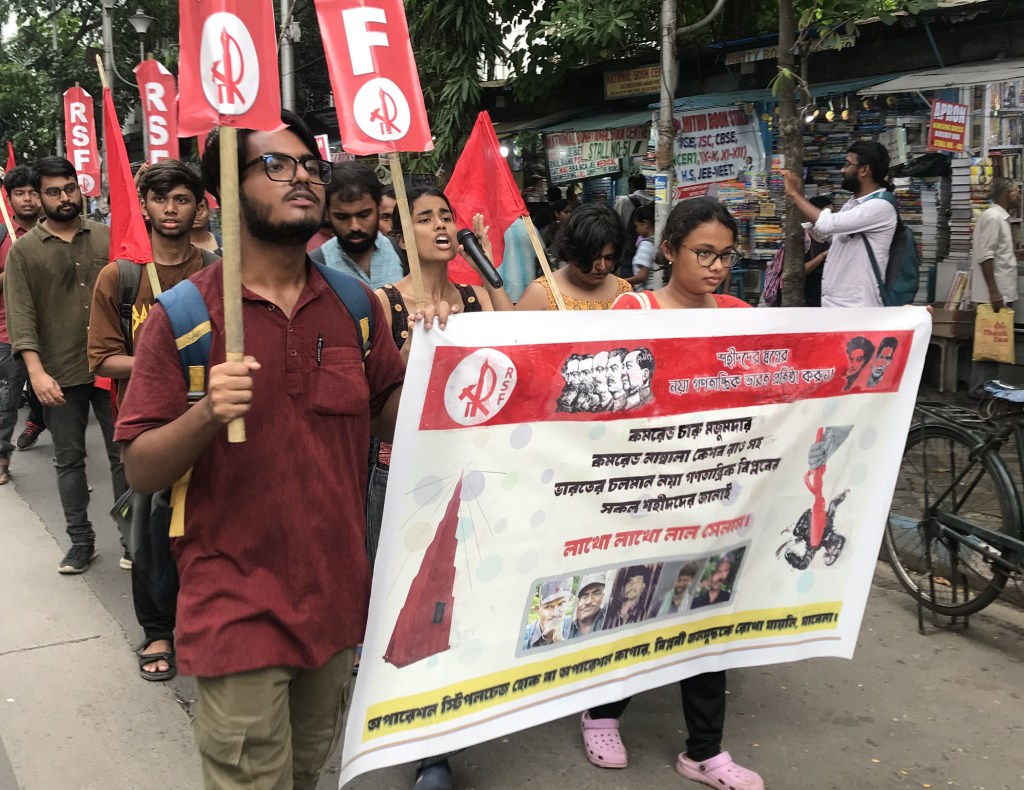
Septuagenarian Tapan Chatterjee is one of the last living survivors of a daring attempt by political prisoners to break free from the “condemned” cells of a notorious Indian jail. This year, he deliberately chose central Kolkata’s vibrant College Street, steps away from the Kolkata Police Headquarters, for the 54th commemoration of the 1971 jailbreak. Sixteen of his comrades were gunned down at Hazaribagh, in present-day Jharkhand. And twice as many were injured by bullets or beatings. Chatterjee is now the only surviving witness to this chapter of Naxalite history.
Over the decades, Chatterjee, a homeopath by profession, has hosted a public event every July 25th, the day of the jail revolt, in Jamshedpur. The country’s first steel-producing city, Jamshedpur, has been his home since his teens. He chose to move this year’s commemoration to Kolkata for political reasons.
Why Kolkata, Why Now
The jailbreak date coincides with another significant anniversary: July 28th, 1972. On this day, political prisoner Charu Majumdar died in custody at Lal Bazaar police headquarters; this was one year after the jailbreak. Majumdar was the architect of the 1967 Naxalbari peasant uprising that gave the current Maoist movement its “Naxalite” name. He remains one of India’s most iconic communist leaders. His 53rd death anniversary, alongside the Hazaribagh commemoration and coming amid the state’s ongoing war with Maoists in the hinterlands, ensured intense fervor among Kolkata’s radical leftists and intelligentsia. For Chatterjee, these overlapping dates presented an opportunity to connect past martyrs to present-day struggles.
For more than a year, reports from eastern and central India have described mounting “encounter” deaths of Maoists, most of them Adivasis. His most profound concern was the highly militarized Operation Kagaar—meaning “threshold”—a campaign of ground and air assaults coupled with policies that, in the name of development, facilitate the transfer of vast mineral-rich Adivasi lands to profit-seeking corporations. These accounts were a primary reason Chatterjee relocated the commemoration to Kolkata’s College Street, which has long been a hub of academic and radical thought as well as civil protests.
From the militant assertion of Naxalbari peasants for rights over their crops and land, and ending landlord exploitation, the Maoist vanguard has reached a juncture where the survival of armed agrarian struggles is once again under existential threat. Chatterjee, usually a soft-spoken doctor, saw in this moment both the urgency to oppose Operation Kagaar and the chance to rekindle memories of those who once defied the carceral state.
On both July 25 and 28, as anticipated, slogans echoed across College Street and in its meeting halls, ranging from “Naxalbari: The Only Path!” to “Stop Operation Kagaar!”
The response was hardly surprising in a city whose revolutionary legacy stretches back to the early 20th-century resistance against British colonial rule, followed by decades of post-Independence upheavals as millions of Partition refugees joined students and workers in mass movements demanding food, housing, and social justice.
The Plot
Against this backdrop of warmth and solidarity among Kolkata’s left, Chatterjee recounted, in a later private session, the often-overlooked details of the blood-soaked Hazaribagh jailbreak of which he is now the lone surviving witness.
The action was led by 26-year-old Murari Mukhopadhyay, a charismatic political organizer and poet from Kolkata. Chatterjee, barely 20 at the time, remembers him with deep reverence more than five decades later. “I was enthusiastically involved in the preparations,” he recalled, “but Murari-da [elder brother] told me not to take part in the jail-break itself. He said I was too young, and that my father, a well-known doctor, might somehow secure my release on bail.” About 50 politically committed prisoners from the 26-cell section were listed for the attempt. None had influential families or the inclination to seek pardon. In the 1970s, social patronage was often crucial in securing bail, discharge, or even acquittal.
The prisoners were held under the controversial Maintenance of Internal Security Act (MISA). The law was promulgated in 1971, passed by a ruling party with a resounding majority, replacing an earlier ordinance. This law gave indefinite preventive detention of alleged Naxalites the presidential seal of democratic legitimacy. Darker clouds loomed: the Bangladesh war was about to begin, bringing martial law under the Defence of India Rules (DIR). Soon after, Operation Steeplechase, combining state police, central paramilitary, and the Indian Army, would attempt to crush the Naxal movement, killing hundreds and arresting thousands of youth. Leading Naxalite cadres, already implicated under MISA, may also have anticipated the oncoming suspension of judicial independence. In June 1975, constitutional rights were withdrawn for nearly two years, a period known as the Emergency.
In the summer of 1971, amid the politically heated climate, the desire for a jailbreak crystallized into concrete preparations. In another section of the cells was a separate group of political prisoners from the Revolutionary Communist Council of India (RCCI), founded by Anant Lal Singh, a veteran of the Dhaka-based Anusheelan Samiti, known for the 1930 Chittagong armoury raid, “Also referred to in sensationalized reports as ‘Man, Money and Guns,’” Chatterjee recalled, “the Anusheelan Samiti placed too much reliance on those three resources, neglecting mass political activity and broad-based organization.” Still, the two collectives exchanged views and ideas through secret meetings, arranged with the help of sympathetic warders and convicts who could move more freely.
“The RCCI comrades also contributed to the jail-break, providing materials initially.” However, they backed out subsequently, as they reviewed the growing challenges inside the jail. “In their assessment, a successful jailbreak had become impossible,” he added. By then, the jail administration had already caught wind of the clandestine activities, at least three months before the attempt was actually made.
British author Mary Tyler’s acclaimed 1977 book, My Days in an Indian Prison, based on her incarceration in the same jail during that period, paints a stark picture of the preparations for the revolt. She recalls that in late April 1971, fruit trees and green foliage that brightened the dreary wards were suddenly cut down. In the women’s ward where Tyler and Naxalite organizer Kalpana were held in adjoining cells near a dormitory, every nook and cranny of their two cells was repeatedly searched. Even staff were subjected to body searches whenever they entered through the iron gate to report for duty.
A section of the warders, nevertheless, remained discreetly supportive, insisted Chatterjee. This, he felt, was “due to the warders’ own social oppression, and the rack-renting exploitation, back in their villages. This generated amongst them a natural affinity towards us, as we were dedicated to the emancipation of their people.” As a result, the warm gestures and gentle words of support from some of the warders would restore the political prisoners’ latent faith in humanity and bolster their spirits, he said. “At times, there would be friendly discussions with them, and also with convicts brought in for administrative services.” The Naxalites’ fundamental role was to “serve the people”– the crux of the Eight Documents, issued by Charu Majumdar between 1965 and 1967. This message was conveyed over months of interaction to the lowest rung of the jail administration. This won the Naxalite prisoners the leverage of friends in carceral conditions.
“I can’t forget how the friendly warders, from a distance, would point to the ledge jutting from our cell wall and whisper, ‘take care of that; keep it out of sight,’” Chatterjee recalled. “That” was often a dynamite stick manufactured in the dungeon itself. The staff were careful too, wary of sudden inspections by superiors. Usually, just before a “surprise search,” a warder would stroll by and quietly offer to hide anything that might be confiscated.
The picric acid and potassium carbonate, smuggled in before the trees were cut down, remained hidden and safe. The crystalline acid was neutralized with an alkaline powder to produce potassium picrate, which was then packed as a basic explosive material. But how had such dangerous compounds entered the cells in the first place? Chatterjee paused, gestured with his fingers to show how the substances were packed into crude capsules outside the prison, then pointed to where carriers hid them on their bodies. The method was similar to that used to smuggle weed into jails across India.
Curious to know how the jailbreak was attempted — and why it failed — I turned to Tyler’s account, which begins after the events had unfolded. “One Sunday afternoon, in a torrential downpour, I was trying to urge some life into the fire to make our evening chapatis,” she wrote, “when the alarm bell started clanging, followed by the urgent blowing of warders’ whistles.” Tyler, trapped in another sector, could only guess what had happened elsewhere in the prison.
The action began about an hour earlier in one of the 26 cells that housed the would-be escapees. “Shortly after meals, two or three fettered prisoners called out to the lone guard on duty, clutching their abdomens with contorted faces and complaining of severe discomfort,” Chatterjee narrated. The 26-cell block was one of four sections of the condemned ward. The ruse of pretending to have diarrhea had been planned for weeks. When the warder unlocked the cell and removed the fetters so the men could rush to the toilet, their sixty-odd comrades played along. The prisoners chosen for the opening scene were selected for their strength: once freed, they used that brawn to overpower the guard. “He was not one of the friendly ones, but he had the keys for all the cells,” Chatterjee said. The wrestlers used threats to silence him—“If you shout, you’ll be killed!” since a rope was not available inside the prison.
The threatened guard fought back. With his free hands, he scrambled the 26 keys, jumbling them so that the orderly sequence—one that would have opened every cell quickly—was lost. The wrestlers were temporarily stymied. “The confusion increased the anxiety in the air,” Chatterjee said.
After a tense interval, as cells were eventually opened, fetters and chains were removed from all the men. Chatterjee did not explain the precise techniques used. The next obstacle was the inner wall of the “condemned block”: at less than ten feet high, prisoners hoisted one another on their shoulders, and those who reached the top helped pull up the rest. With the inner hurdles cleared, only the outer perimeter remained. “That outer wall was about 16 feet high; that was the one we intended to dynamite,” he said.
“We placed the dynamite sticks into the crevices of the outer wall and detonated them,” Chatterjee said. “But alarmingly, none of the charges went off.” The wall stood firm. Faced with failure, the prisoners had stark choices: retreat to their cells and accept likely severe punishment, or attempt to escape in full view of the guards. Almost instantly, they chose the latter—an open, desperate dash for freedom.
Mukhopadhyay briefly consulted his deputy, Bijon Biswas, and both agreed there was no time to lose. Signalling to the others, each man tested his ability to seize the moment. They launched an offensive charge toward the prison’s main gate, where the jail’s defensive resources were concentrated. Ignoring the alarm bells and the urgent blowing of whistles, they ran forward. Before any close combat could unfold, armed guards had cocked their rifles—and opened fire with abandon. Tyler, from another block, could only record fragments of what followed. “The wardress on duty ran to lock us all in our cells. Almost before our padlocks were fastened, the shooting started. For the next two hours, I listened, trapped in the cell, helplessly clutching the bars while shots rang out from every corner of the jail,” she wrote.
Mukhopadhyay, leading from the front, was among the first to be hit. Chatterjee, who had fallen back out of deference to his seniors, recalled: “Bijon-da caught Murari-da before both fell to the ground. But the end was yet to come.” Overcome with grief, Chatterjee fell silent before slowly regaining composure to name the others who died—16 comrades in all, including Murari Mukhopadhyay and Bijon Biswas. Some were killed instantly; others succumbed later in the jail hospital: Sameer Das, Venu Bose, Dilip Bangawasi, Chiranjeev Mukherjee, Dumbell Sengupta, Babi Bangawasi, Sunil Das, Lalmohan Mishra, Pradip Bhattacharjee, Aloke Das, Ganesh Das, Gurucharan Kalindi, Mahadevan, and Robin Adhikari. About 35 others sustained bullet or baton injuries. Chatterjee himself was shot twice, once in the stomach and once in the left foot, which he pointed to as he spoke.
All joined the line of fire without hesitation—except Mahadevan, a trade unionist, and Robin Adhikari, a driver affiliated with the RCCI, neither of whom had intended to participate in the escape. Their visions of emancipation may nevertheless have passed down through later generations. Reflecting on the moment, Chatterjee said: “It was the sheer poetry of Murari-da that steered the daring escape to freedom, shunning all ‘legalist’ claptrap.” If the state’s very edifice was built upon carcerality, he asked, “what justice could be expected from pleading at its altar?”
Mukhopadhyay’s verses, read at the commemoration, carried an ardor that urged courage in the face of overwhelming adversity, political and otherwise. For instance, the only available English translation of one of his poems, ‘Love’, reads:
When in love
Do not become the moon
If you can
Come forth as the sun
I’ll take along its heat
And light up the darkened forests.
Join us
Prashant Rahi is an electrical and systems engineer, who completed his education from IIT, BHU, before eventually becoming a journalist for about a decade in Uttar Pradesh and Uttarakhand. He was the Chairperson for Human Rights and Democracy at the annual Indian Social Science Congresses held between 2011 and 2013, contributing to the theorisation of social activists’ and researchers’ experiences.
Rahi devoted the greater part of his time and energy for revolutionary democratic changes as a grassroots activist with various collectives. For seven years, he worked as a Correspondent for The Statesman, chronicling the Uttarakhand statehood movement, while also participating in it. He has also contributed political articles for Hindi periodicals including Blitz, Itihasbodh, Samkaleen Teesri Duniya, Samayantar and Samkaleem Hastakshep.
From his first arrest in 2007 December in a fake case, where he was charged as the key organiser of an imagined Maoist training camp in a forest area of Uttarakhand, to his release in March 2024 in the well-known GN Saibaba case, Rahi has been hounded as a prominent Maoist by the state for all of 17 years.
In 2024, he joined The Polis Project as a roving reporter, focusing on social movements.
Related Posts

Remembering the Hazaribagh Jailbreak: A Witness Marks 54 Years
By Prashant Rahi
September 20, 2025
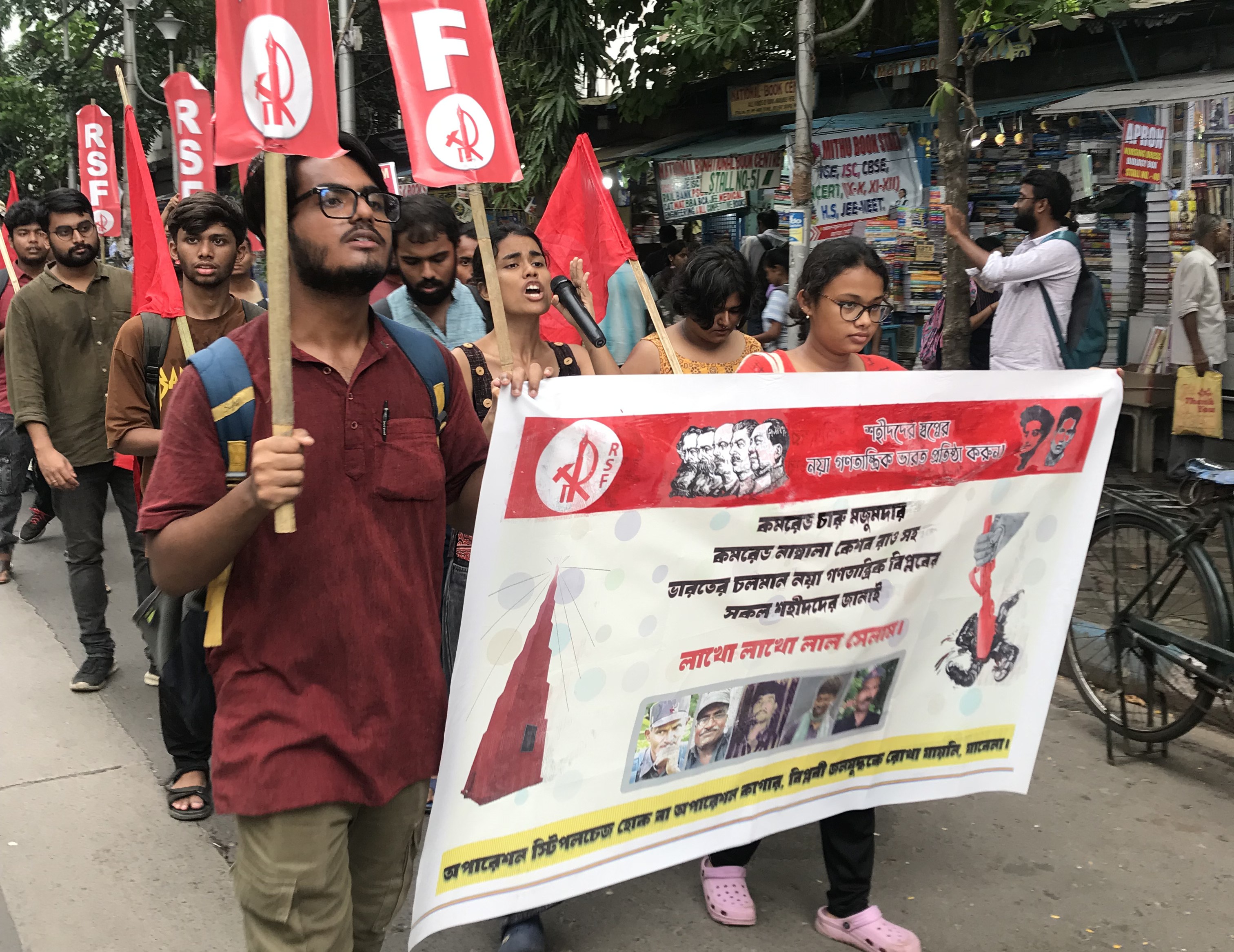
Martyr's Day rally at College Street, Kolkata. Photo by Prashant Rahi.
Septuagenarian Tapan Chatterjee is one of the last living survivors of a daring attempt by political prisoners to break free from the “condemned” cells of a notorious Indian jail. This year, he deliberately chose central Kolkata’s vibrant College Street, steps away from the Kolkata Police Headquarters, for the 54th commemoration of the 1971 jailbreak. Sixteen of his comrades were gunned down at Hazaribagh, in present-day Jharkhand. And twice as many were injured by bullets or beatings. Chatterjee is now the only surviving witness to this chapter of Naxalite history.
Over the decades, Chatterjee, a homeopath by profession, has hosted a public event every July 25th, the day of the jail revolt, in Jamshedpur. The country’s first steel-producing city, Jamshedpur, has been his home since his teens. He chose to move this year’s commemoration to Kolkata for political reasons.
Why Kolkata, Why Now
The jailbreak date coincides with another significant anniversary: July 28th, 1972. On this day, political prisoner Charu Majumdar died in custody at Lal Bazaar police headquarters; this was one year after the jailbreak. Majumdar was the architect of the 1967 Naxalbari peasant uprising that gave the current Maoist movement its “Naxalite” name. He remains one of India’s most iconic communist leaders. His 53rd death anniversary, alongside the Hazaribagh commemoration and coming amid the state’s ongoing war with Maoists in the hinterlands, ensured intense fervor among Kolkata’s radical leftists and intelligentsia. For Chatterjee, these overlapping dates presented an opportunity to connect past martyrs to present-day struggles.
For more than a year, reports from eastern and central India have described mounting “encounter” deaths of Maoists, most of them Adivasis. His most profound concern was the highly militarized Operation Kagaar—meaning “threshold”—a campaign of ground and air assaults coupled with policies that, in the name of development, facilitate the transfer of vast mineral-rich Adivasi lands to profit-seeking corporations. These accounts were a primary reason Chatterjee relocated the commemoration to Kolkata’s College Street, which has long been a hub of academic and radical thought as well as civil protests.
From the militant assertion of Naxalbari peasants for rights over their crops and land, and ending landlord exploitation, the Maoist vanguard has reached a juncture where the survival of armed agrarian struggles is once again under existential threat. Chatterjee, usually a soft-spoken doctor, saw in this moment both the urgency to oppose Operation Kagaar and the chance to rekindle memories of those who once defied the carceral state.
On both July 25 and 28, as anticipated, slogans echoed across College Street and in its meeting halls, ranging from “Naxalbari: The Only Path!” to “Stop Operation Kagaar!”
The response was hardly surprising in a city whose revolutionary legacy stretches back to the early 20th-century resistance against British colonial rule, followed by decades of post-Independence upheavals as millions of Partition refugees joined students and workers in mass movements demanding food, housing, and social justice.
The Plot
Against this backdrop of warmth and solidarity among Kolkata’s left, Chatterjee recounted, in a later private session, the often-overlooked details of the blood-soaked Hazaribagh jailbreak of which he is now the lone surviving witness.
The action was led by 26-year-old Murari Mukhopadhyay, a charismatic political organizer and poet from Kolkata. Chatterjee, barely 20 at the time, remembers him with deep reverence more than five decades later. “I was enthusiastically involved in the preparations,” he recalled, “but Murari-da [elder brother] told me not to take part in the jail-break itself. He said I was too young, and that my father, a well-known doctor, might somehow secure my release on bail.” About 50 politically committed prisoners from the 26-cell section were listed for the attempt. None had influential families or the inclination to seek pardon. In the 1970s, social patronage was often crucial in securing bail, discharge, or even acquittal.
The prisoners were held under the controversial Maintenance of Internal Security Act (MISA). The law was promulgated in 1971, passed by a ruling party with a resounding majority, replacing an earlier ordinance. This law gave indefinite preventive detention of alleged Naxalites the presidential seal of democratic legitimacy. Darker clouds loomed: the Bangladesh war was about to begin, bringing martial law under the Defence of India Rules (DIR). Soon after, Operation Steeplechase, combining state police, central paramilitary, and the Indian Army, would attempt to crush the Naxal movement, killing hundreds and arresting thousands of youth. Leading Naxalite cadres, already implicated under MISA, may also have anticipated the oncoming suspension of judicial independence. In June 1975, constitutional rights were withdrawn for nearly two years, a period known as the Emergency.
In the summer of 1971, amid the politically heated climate, the desire for a jailbreak crystallized into concrete preparations. In another section of the cells was a separate group of political prisoners from the Revolutionary Communist Council of India (RCCI), founded by Anant Lal Singh, a veteran of the Dhaka-based Anusheelan Samiti, known for the 1930 Chittagong armoury raid, “Also referred to in sensationalized reports as ‘Man, Money and Guns,’” Chatterjee recalled, “the Anusheelan Samiti placed too much reliance on those three resources, neglecting mass political activity and broad-based organization.” Still, the two collectives exchanged views and ideas through secret meetings, arranged with the help of sympathetic warders and convicts who could move more freely.
“The RCCI comrades also contributed to the jail-break, providing materials initially.” However, they backed out subsequently, as they reviewed the growing challenges inside the jail. “In their assessment, a successful jailbreak had become impossible,” he added. By then, the jail administration had already caught wind of the clandestine activities, at least three months before the attempt was actually made.
British author Mary Tyler’s acclaimed 1977 book, My Days in an Indian Prison, based on her incarceration in the same jail during that period, paints a stark picture of the preparations for the revolt. She recalls that in late April 1971, fruit trees and green foliage that brightened the dreary wards were suddenly cut down. In the women’s ward where Tyler and Naxalite organizer Kalpana were held in adjoining cells near a dormitory, every nook and cranny of their two cells was repeatedly searched. Even staff were subjected to body searches whenever they entered through the iron gate to report for duty.
A section of the warders, nevertheless, remained discreetly supportive, insisted Chatterjee. This, he felt, was “due to the warders’ own social oppression, and the rack-renting exploitation, back in their villages. This generated amongst them a natural affinity towards us, as we were dedicated to the emancipation of their people.” As a result, the warm gestures and gentle words of support from some of the warders would restore the political prisoners’ latent faith in humanity and bolster their spirits, he said. “At times, there would be friendly discussions with them, and also with convicts brought in for administrative services.” The Naxalites’ fundamental role was to “serve the people”– the crux of the Eight Documents, issued by Charu Majumdar between 1965 and 1967. This message was conveyed over months of interaction to the lowest rung of the jail administration. This won the Naxalite prisoners the leverage of friends in carceral conditions.
“I can’t forget how the friendly warders, from a distance, would point to the ledge jutting from our cell wall and whisper, ‘take care of that; keep it out of sight,’” Chatterjee recalled. “That” was often a dynamite stick manufactured in the dungeon itself. The staff were careful too, wary of sudden inspections by superiors. Usually, just before a “surprise search,” a warder would stroll by and quietly offer to hide anything that might be confiscated.
The picric acid and potassium carbonate, smuggled in before the trees were cut down, remained hidden and safe. The crystalline acid was neutralized with an alkaline powder to produce potassium picrate, which was then packed as a basic explosive material. But how had such dangerous compounds entered the cells in the first place? Chatterjee paused, gestured with his fingers to show how the substances were packed into crude capsules outside the prison, then pointed to where carriers hid them on their bodies. The method was similar to that used to smuggle weed into jails across India.
Curious to know how the jailbreak was attempted — and why it failed — I turned to Tyler’s account, which begins after the events had unfolded. “One Sunday afternoon, in a torrential downpour, I was trying to urge some life into the fire to make our evening chapatis,” she wrote, “when the alarm bell started clanging, followed by the urgent blowing of warders’ whistles.” Tyler, trapped in another sector, could only guess what had happened elsewhere in the prison.
The action began about an hour earlier in one of the 26 cells that housed the would-be escapees. “Shortly after meals, two or three fettered prisoners called out to the lone guard on duty, clutching their abdomens with contorted faces and complaining of severe discomfort,” Chatterjee narrated. The 26-cell block was one of four sections of the condemned ward. The ruse of pretending to have diarrhea had been planned for weeks. When the warder unlocked the cell and removed the fetters so the men could rush to the toilet, their sixty-odd comrades played along. The prisoners chosen for the opening scene were selected for their strength: once freed, they used that brawn to overpower the guard. “He was not one of the friendly ones, but he had the keys for all the cells,” Chatterjee said. The wrestlers used threats to silence him—“If you shout, you’ll be killed!” since a rope was not available inside the prison.
The threatened guard fought back. With his free hands, he scrambled the 26 keys, jumbling them so that the orderly sequence—one that would have opened every cell quickly—was lost. The wrestlers were temporarily stymied. “The confusion increased the anxiety in the air,” Chatterjee said.
After a tense interval, as cells were eventually opened, fetters and chains were removed from all the men. Chatterjee did not explain the precise techniques used. The next obstacle was the inner wall of the “condemned block”: at less than ten feet high, prisoners hoisted one another on their shoulders, and those who reached the top helped pull up the rest. With the inner hurdles cleared, only the outer perimeter remained. “That outer wall was about 16 feet high; that was the one we intended to dynamite,” he said.
“We placed the dynamite sticks into the crevices of the outer wall and detonated them,” Chatterjee said. “But alarmingly, none of the charges went off.” The wall stood firm. Faced with failure, the prisoners had stark choices: retreat to their cells and accept likely severe punishment, or attempt to escape in full view of the guards. Almost instantly, they chose the latter—an open, desperate dash for freedom.
Mukhopadhyay briefly consulted his deputy, Bijon Biswas, and both agreed there was no time to lose. Signalling to the others, each man tested his ability to seize the moment. They launched an offensive charge toward the prison’s main gate, where the jail’s defensive resources were concentrated. Ignoring the alarm bells and the urgent blowing of whistles, they ran forward. Before any close combat could unfold, armed guards had cocked their rifles—and opened fire with abandon. Tyler, from another block, could only record fragments of what followed. “The wardress on duty ran to lock us all in our cells. Almost before our padlocks were fastened, the shooting started. For the next two hours, I listened, trapped in the cell, helplessly clutching the bars while shots rang out from every corner of the jail,” she wrote.
Mukhopadhyay, leading from the front, was among the first to be hit. Chatterjee, who had fallen back out of deference to his seniors, recalled: “Bijon-da caught Murari-da before both fell to the ground. But the end was yet to come.” Overcome with grief, Chatterjee fell silent before slowly regaining composure to name the others who died—16 comrades in all, including Murari Mukhopadhyay and Bijon Biswas. Some were killed instantly; others succumbed later in the jail hospital: Sameer Das, Venu Bose, Dilip Bangawasi, Chiranjeev Mukherjee, Dumbell Sengupta, Babi Bangawasi, Sunil Das, Lalmohan Mishra, Pradip Bhattacharjee, Aloke Das, Ganesh Das, Gurucharan Kalindi, Mahadevan, and Robin Adhikari. About 35 others sustained bullet or baton injuries. Chatterjee himself was shot twice, once in the stomach and once in the left foot, which he pointed to as he spoke.
All joined the line of fire without hesitation—except Mahadevan, a trade unionist, and Robin Adhikari, a driver affiliated with the RCCI, neither of whom had intended to participate in the escape. Their visions of emancipation may nevertheless have passed down through later generations. Reflecting on the moment, Chatterjee said: “It was the sheer poetry of Murari-da that steered the daring escape to freedom, shunning all ‘legalist’ claptrap.” If the state’s very edifice was built upon carcerality, he asked, “what justice could be expected from pleading at its altar?”
Mukhopadhyay’s verses, read at the commemoration, carried an ardor that urged courage in the face of overwhelming adversity, political and otherwise. For instance, the only available English translation of one of his poems, ‘Love’, reads:
When in love
Do not become the moon
If you can
Come forth as the sun
I’ll take along its heat
And light up the darkened forests.
SUPPORT US
We like bringing the stories that don’t get told to you. For that, we need your support. However small, we would appreciate it.
Prashant Rahi is an electrical and systems engineer, who completed his education from IIT, BHU, before eventually becoming a journalist for about a decade in Uttar Pradesh and Uttarakhand. He was the Chairperson for Human Rights and Democracy at the annual Indian Social Science Congresses held between 2011 and 2013, contributing to the theorisation of social activists’ and researchers’ experiences.
Rahi devoted the greater part of his time and energy for revolutionary democratic changes as a grassroots activist with various collectives. For seven years, he worked as a Correspondent for The Statesman, chronicling the Uttarakhand statehood movement, while also participating in it. He has also contributed political articles for Hindi periodicals including Blitz, Itihasbodh, Samkaleen Teesri Duniya, Samayantar and Samkaleem Hastakshep.
From his first arrest in 2007 December in a fake case, where he was charged as the key organiser of an imagined Maoist training camp in a forest area of Uttarakhand, to his release in March 2024 in the well-known GN Saibaba case, Rahi has been hounded as a prominent Maoist by the state for all of 17 years.
In 2024, he joined The Polis Project as a roving reporter, focusing on social movements.
Related Posts

To Bloom Like Jirhul and Cry “Hool!”: A Profile of Poet Jacinta Kerketta
Varsha Prakash, Arjun Rai Gupta